Amazon Web Services
Microsoft Azure
Google Cloud Platform
This is the multi-page printable view of this section. Click here to print.
Amazon Web Services
Microsoft Azure
Google Cloud Platform
This section describes the high-level architecture of Protegrity Cloud API, installation procedures, and performance guidance. This section focuses on Protegrity specific aspects and should be consumed in conjunction with the corresponding AWS documentation.
This guide may also be used with the Protegrity Enterprise Security Administrator Guide, which explains the mechanism for managing the data security policy.
Cloud API Protector on AWS is a cloud-native, serverless product for fine-grained data protection. This enables the invocation of Protegrity data protection cryptographic methods in cloud-native serverless technology. The benefits of serverless include rapid auto-scaling, performance, low administrative overhead, and reduced infrastructure costs compared to a server-based solution.
This product provides a data protection API end-point for clients. The product is designed to scale elastically and yield reliable query performance under extremely high concurrent loads. During idle use, the serverless product will scale completely down, providing significant savings in Cloud compute fees.
Protegrity utilizes a data security policy maintained by an Enterprise Security Administrator (ESA), similar to other Protegrity products. Using a simple REST API interface, authorized users can perform both de-identification (protect) and re-identification (unprotect) operations on data. A user’s individual capabilities are subject to privileges and policies defined by the Enterprise Security Administrator.
Protegrity’s format and length preserving tokenization scheme make it possible to perform analytics directly on protected data. Tokens are join-preserving so protected data can be joined across datasets. Often statistical analytics and machine learning training can be performed without the need to re-identify protected data. However, a user or service account with authorized security policy privileges may re-identify subsets of data using the Cloud API Protector on AWS service.
Cloud API Protector on AWS incorporates Protegrity’s patent-pending vaultless tokenization capabilities into cloud-native serverless technology. Combined with an ESA security policy, the protector provides the following features:
For more information about the available protection options, such as, data types, Tokenization or Encryption types, or length preserving and non-preserving tokens, refer to Protection Methods Reference.
The product will be deployed in the Customer’s AWS account. The product incorporates Protegrity’s vaultless tokenization engine within an AWS Lambda Function. The encrypted data security policy from an ESA is deployed as a static resource through an Amazon Lambda Layer. The policy is decrypted in memory at runtime within the Lambda. This architecture allows Protegrity Serverless to be highly available and scale very quickly without direct dependency on any other Protegrity services.
The product exposes a remote data protection service. Each REST request includes a micro-batch of data to process and the data element type. The function applies the data security policy including user authorization and returns a corresponding response.
When used with an Enterprise Security Administrator (ESA) application, the security policy is synchronized through another serverless component called the Protegrity Policy Agent. The agent operates on a configurable schedule, fetches the policy from the ESA, performs additional envelope encryption using Amazon KMS, and deploys the policy into the Lambda Layer used by the serverless product. This solution can be configured to automatically provision the static policy or the final step can be performed on-demand by an administrator. The policy takes effect immediately for all new requests. There is no downtime for users during this process.
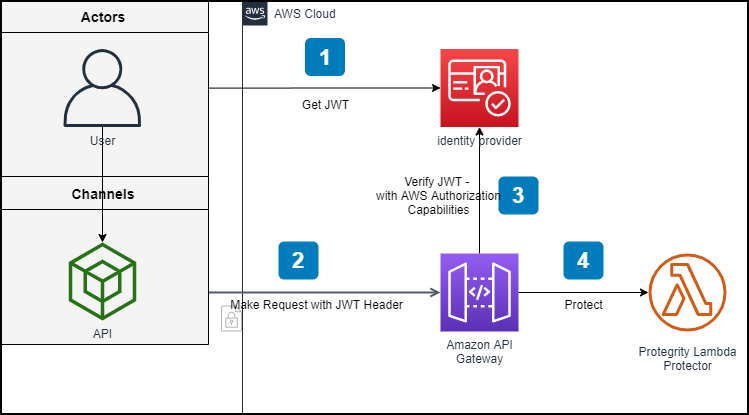
The following diagram shows the high-level architecture described above.
The following diagram shows a reference architecture for synchronizing the security policy from ESA.
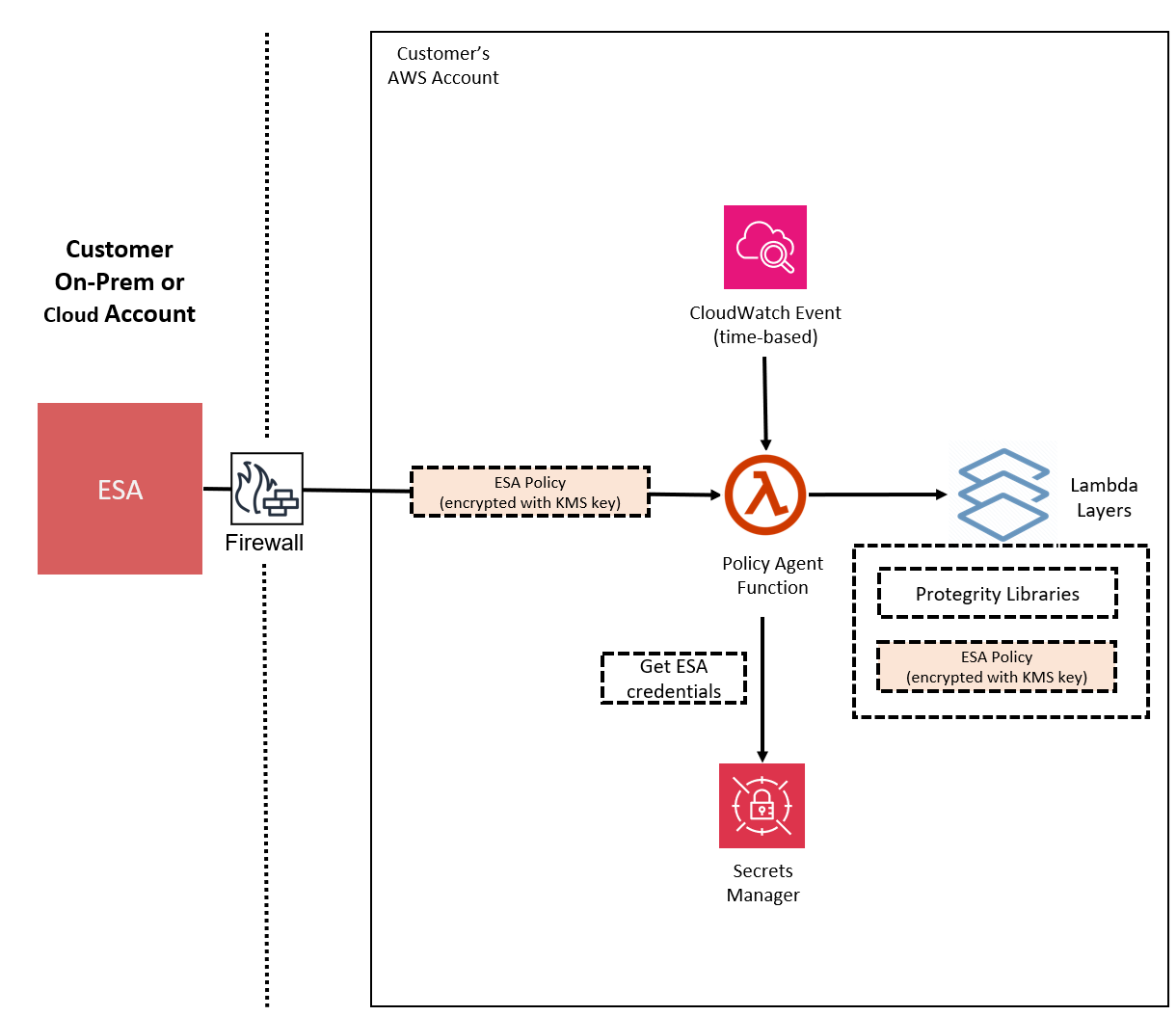
The Protegrity Policy Agent requires network access to an Enterprise Security Administrator (ESA). Most organizations install the ESA on-premise. Therefore, it is recommended that the Policy Agent is installed into a private subnet with a Cloud VPC using a NAT Gateway to enable this communication through a corporate firewall.
The ESA is a soft appliance that must be pre-installed on a separate server. It is used to create and manage security policies.
For more information about installing the ESA, and creating and managing policies, refer to the Policy Management Guide.
Audit logs are by default sent to CloudWatch as long as the function’s execution role has the necessary permissions. The Protegrity Product can also be configured to send audit logs to ESA. Such configuration requires deploying Log Forwarder component which is available as part of Protegrity Product deployment bundle. The diagram below shows additional resources deployed with Log Forwarder component.
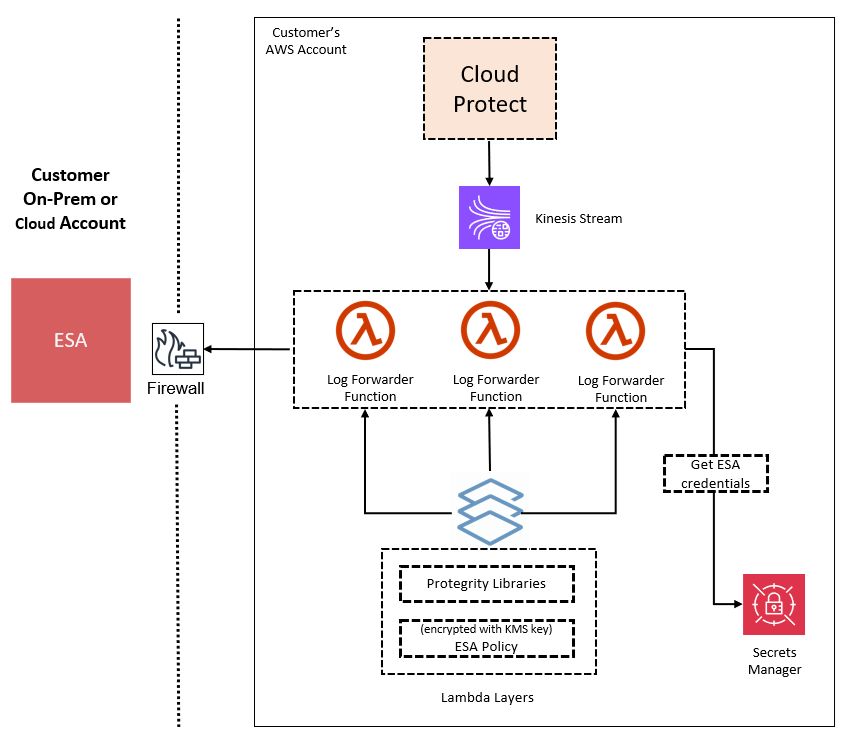
The log forwarder component includes Amazon Kinesis data stream and the forwarder Lambda function. Amazon Kinesis stream is used to batch audit records before sending them to forwarder function, where similar audit logs are aggregated before sending to ESA. Aggregation rules are described in the Protegrity Log Forwarding guide. When the protector function is configured to send audit logs to log forwarder, audit logs are aggregated on the protector function before sending to Amazon Kinesis. Due to specifics of the Lambda runtime lifecycle, audit logs may take up to 15 minutes before being sent to Amazon Kinesis. Protector function exposes configuration to minimize this time which is described in the protector function installation section.
The security of audit logs is ensured by using HTTPS connection on each link of the communication between protector function and ESA. Integrity and authenticity of audit logs is additionally checked on log forwarder which verifies individual logs signature. The signature verification is done upon arrival from Amazon Kinesis before applying aggregation. If signature cannot be verified, the log is forwarded as is to ESA where additional signature verification can be configured. Log forwarder function uses client certificate to authenticate calls to ESA.
To learn more about individual audit log entry structure and purpose of audit logs, refer to Audit Logging section in this document. Installation instructions can be found in Audit Log Forwarder installation.
The audit log forwarding requires network access from the cloud to the ESA. Most organizations install the ESA on-premise. Therefore, it is recommended that the Log Forwarder Function is installed into a private subnet with a Cloud VPC using a NAT Gateway to enable this communication through a corporate firewall.
The following mechanisms are available for controlling and restricting access to the endpoint:
Access and authorization between various AWS services involved in this architecture are achieved through IAM resource policies. For instance, the Amazon Lambda resource-based policy can restrict requests to the Amazon API Gateway or optionally allow direct invocation to the Lambda function itself. The installation steps provide a default recommended configuration. Alternative IAM role configurations are shown in the appendices in this document.
AWS API Gateway supports multiple mechanisms for controlling and managing access to the product.
In standard solutions, AWS API Gateway will authorize access tokens generated in the identity provider. When setting up an AWS API Gateway method to require an authorization, customers can leverage AWS Signature Version 4 or Lambda authorizers to support their organization’s bearer token auth strategy.
https://docs.aws.amazon.com/apigateway/latest/developerguide/apigateway-control-access-to-api.html
Once the request is authenticated and authorized in the API Gateway, Protegrity Lambda Protector validates the user received in the authorization header of JWT, and the data element and security operations (protect or unprotect) from the payload with Protegrity Security Policy.
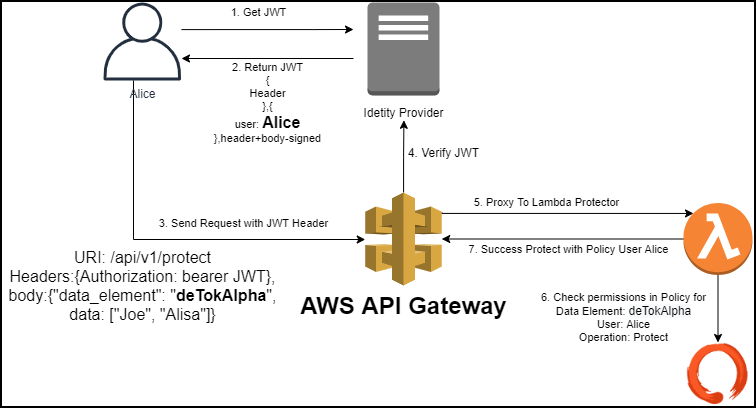
If the API Gateway is not used or configured to verify JWT tokens, the product can be configured to perform the JWT verification in the Lambda function itself.
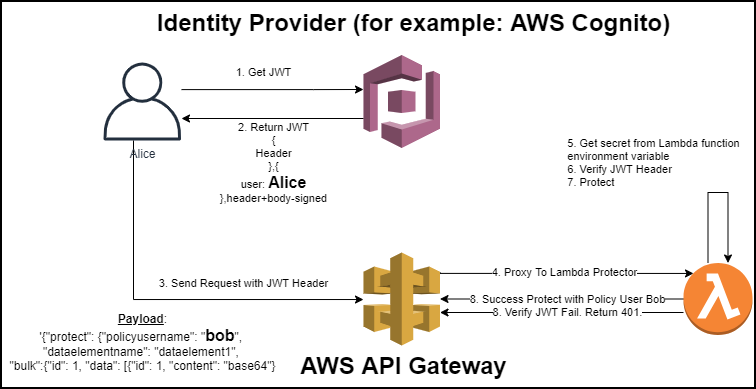
The following table describes the AWS services that may be a part of your Protegrity installation.
Service | Description |
|---|---|
Lambda | Provides serverless compute for Protegrity protection operations and the ESA integration to fetch policy updates or deliver audit logs. |
API Gateway | Provides the endpoint and access control. |
KMS | Provides secrets for envelope policy encryption/decryption for Protegrity. |
Secrets Manager | Provides secrets management for the ESA credentials . |
S3 | Intermediate storage location for the encrypted ESA policy layer. |
Kinesis | Required if Log Forwarder is to be deployed. Amazon Kinesis is used to batch audit logs sent from protector function to ESA. |
VPC & NAT Gateway | Optional. Provides a private subnet to communicate with an on-prem ESA. |
CloudWatch | Application and audit logs, performance monitoring, and alerts. Scheduling for the policy agent. |
The Protector and Log Forwarder functions require a security policy from a compatible ESA version.
The table below shows compatibility between different Protector and ESA versions.
| Protector Version | ESA Version | |||
|---|---|---|---|---|
| 8.x | 9.0 | 9.1 & 9.2 | 10.0 | |
| 2.x | No | Yes | * | No |
| 3.0.x & 3.1.x | No | No | Yes | No |
| 3.2.x | No | No | Yes | * |
| 4.0.x | No | No | No | Yes |
Legend | |
|---|---|
Yes | Protector was designed to work with this ESA version |
No | Protector will not work with this ESA version |
* | Backward compatible policy download supported:
|
Requirement | Detail |
|---|---|
Protegrity distribution and installation scripts | These artifacts are provided by Protegrity |
Protegrity ESA 10.0+ | The Cloud VPC must be able to obtain network access to the ESA |
AWS Account | Recommend creating a new sub-account for Protegrity Serverless |
Role / Skillset | Description |
|---|---|
AWS Account Administrator | To run CloudFormation (or perform steps manually), create/configure a VPC and IAM permissions. |
Protegrity Administrator | The ESA credentials required to extract the policy for the Policy Agent |
Network Administrator | To open firewall to access ESA and evaluate AWS network setup |
AWS Account ID: ___________________
AWS Region (AwsRegion): ___________________
S3 Bucket name (ArtifactS3Bucket): ___________________
KMS Key ARN (AWS_KMS_KEY_ID): ___________________
ProtectLambdaPolicyName: __________________
Role ARN (LambdaExecutionRoleArn): ___________________
ApiGatewayId: ________________________________
ProtectFunctionName: __________________________
ProtectLayerName: _____________________________
ESA IP address: ___________________
VPC name: ___________________
Subnet name: ___________________
Policy Agent Security Group Id: ___________________
ESA Credentials Secret Name: ___________________
Policy Name: ___________________
Agent Lambda IAM Execution Role Name: ___________________
Identify or create an AWS account where the Protegrity solution will be installed. It is recommended that a new AWS sub-account be created. This can provide greater security controls and help avoid conflicts with other applications that might impact regional account limits. An individual with the Cloud Administrator role will be required for some subsequent installation steps.
AWS Account ID: ___________________
AWS Region (AwsRegion): ___________________
This S3 bucket will be used for the artifacts required by the CloudFormation installation steps. This S3 bucket must be created in the region that is defined in Provide AWS sub-account
Sign in to the AWS Management Console and open the Amazon S3 console.
Change region to the one determined in Provide AWS sub-account
Click Create Bucket.
Enter a unique bucket name:
For example, protegrity-install.us-west-2.example.com
Upload the installation artifacts to this bucket. Protegrity will provide the following three artifacts:
S3 Bucket name (ArtifactS3Bucket): ___________________
The Amazon Key Management Service (KMS) provides the ability for the Protegrity Serverless solution to encrypt and decrypt the Protegrity Security Policy.
To create KMS key:
In the AWS sub-account where the KMS key will reside, select the region.
Navigate to Key Management Service > Create Key.
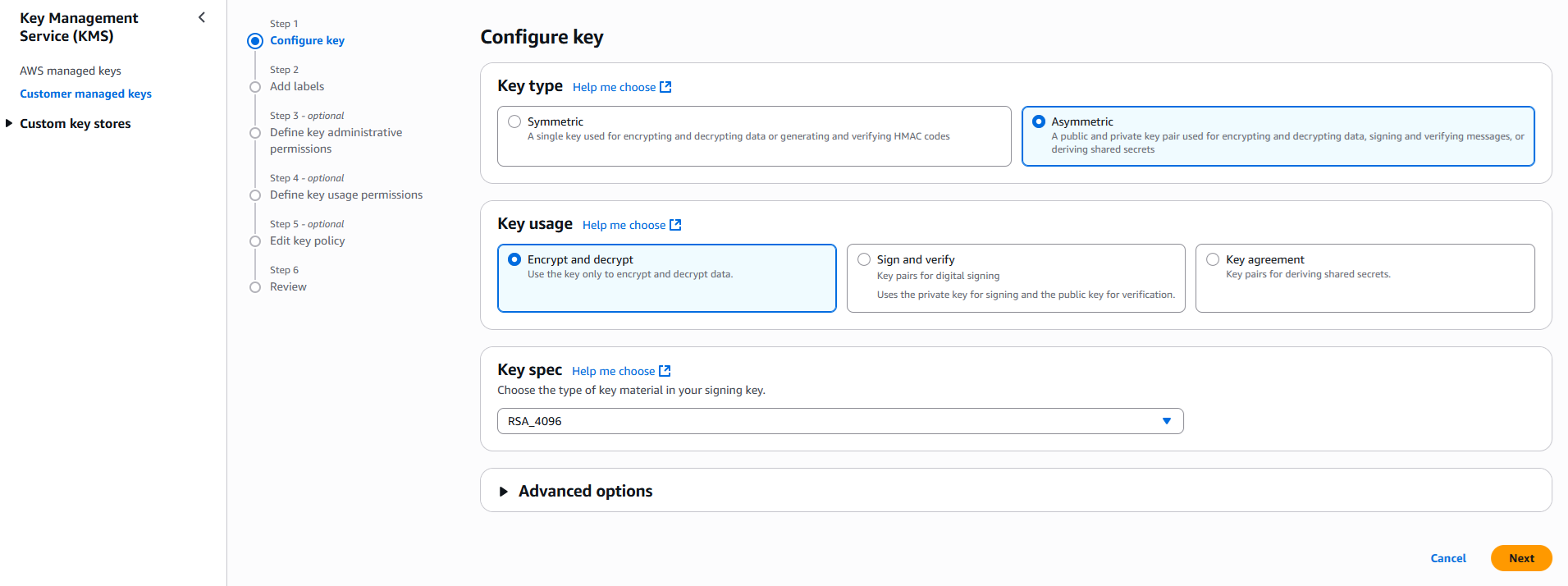
Configure the key settings:
Create alias and optional description, such as, Protegrity-Serverless and click Next.
Define key administrative permissions, the IAM user who will administrate the key.
Click Next.
Define the key usage permissions.
In Other AWS accounts, enter the AWS account id used for the Protegrity Serverless installation.
Continue on to create the key. If there is a concern this permission is overly broad, then you can return later to restrict access to the role of two Protegrity Serverless Lambda as principals. Click to open the key in the list and record the ARN.
KMS Key ARN (AWS_KMS_KEY_ID): ___________________
Download the public key from the KMS key. Navigate to the key in KMS console, select the Public key tab, and click Download. Save the PEM file. This public key will be added to the ESA data store as an export key. Refer to Exporting Keys to Datastore for instructions on adding the public key to the data store.
KMS Public Key PEM file: ___________________
The following sections install the Cloud Protect serverless Lambda function.
Ensure that all the steps in Pre-Configuration are performed.
Login to the AWS sub-account console where Protegrity will be installed.
Ensure that the required CloudFormation templates provided by Protegrity are available on your local computer.
This task defines a policy used by the Protegrity Lambda function to write CloudWatch logs and access the KMS encryption key to decrypt the policy.
Perform the following steps to create the Lambda execution role and required policies:
From the AWS IAM console, select Policies > Create Policy.
Select the JSON tab and copy the following sample policy.
{
  "Version": "2012-10-17",
  "Statement": [
    {
      "Sid": "CloudWatchWriteLogs",
      "Effect": "Allow",
      "Action": [
        "logs:CreateLogGroup",
        "logs:CreateLogStream",
        "logs:PutLogEvents"
      ],
      "Resource": "*"
    },
    {
      "Sid": "KmsDecrypt",
      "Effect": "Allow",
      "Action": [
        "kms:Decrypt"
      ],
      "Resource": [
        "arn:aws:kms:*:*:key/*"
      ]
    }
  ]
}
For the KMS policy, replace the Resource with the ARN for the KMS key created in a previous step.
Select Next, type in a policy name, for example, ProtegrityProtectLambdaPolicy and Create Policy. Record the policy name:
ProtectLambdaPolicyName:__________________
The following steps create the role to utilize the policy defined in Create Protect Lambda IAM Execution Policy.
To create protect lambda IAM execution role:
From the AWS IAM console, select Roles > Create Role.
Select AWS Service > Lambda > Next.
In the list, search and select the policy created in Create Protect Lambda IAM Execution Policy.
Click Next
Type the role name, for example, ProtegrityProtectRole
Click Create role
Record the role ARN.
Role ARN (LambdaExecutionRoleArn): ___________________
The following steps describe the deployment of the Lambda function.
Access CloudFormation and select the target AWS Region in the console.
Click Create Stack and choose With new resources.
Specify the template.
Select Upload a template file.
Upload the Protegrity-provided CloudFormation template called pty_protect_api_cf.json and click Next.
Specify the stack details. Enter a stack name.
Enter the required parameters. All the values were generated in the pre-configuration steps.
Parameter | Description | Default Value |
|---|---|---|
ArtifactS3Bucket | The name of S3 bucket created during the pre-configuration steps |
|
LambdaExecutionRoleArn | The ARN of Lambda role created in the prior step |
|
MinLogLevel | The minimum log level for the protect function. Supported values: [off, severe, warning, info, config, all] | severe |
AllowAssumeUser (Optional) | If 0 is set, the user in the request body will be ignored and the REST API authenticated user will be the acting user. Supported values: [0, 1] | 0 |
LambdaAuthorization (Optional) | If “jwt” is set, then Authorization header for JWT will be required in the AWS Protect Lambda request. Any other value is ignored and effective policy user is taken from request payload. Supported values: [“jwt”, “”] | "" |
jwtUsernameClaim (Optional) | The JWT claim with username. Common claims: name, preferred_username, cognito:username Also accepts ordered list of claim names in JSON array format, e.g. [“username”, “email”] | cognito:username |
jwtVerify (Optional) | If 1 is set, then jwtSecretBase64 is required. Only applicable when LambdaAuthorization is set to “jwt”. Supported JWT algorithms are: RS256, RS384, RS512. While algorithms HS256, HS384, HS512 are supported, they are not recommended for use. | 0 |
jwtSecretBase64 (Optional) | Required when jwtVerify is set to 1 and Authorization is set to “jwt”. The secret must be provided in base64 encoding. It is recommended to only use public key (asymmetric algorithm). | "" |
The log forwarder parameters can be provided later after log forwarder is deployed. If you are not planning to deploy log forwarder you can skip this step.
| Parameter | Description |
|---|---|
| KinesisLogStreamArn | The ARN of the AWS Kinesis stream where audit logs will be sent for aggregation |
| AuditLogFlushInterval | Time interval in seconds used to accumulate audit logs before sending to Kinesis. Default value: 30. See Log Forwarder Performance section for more details. |
Click Next with defaults to complete CloudFormation.
After CloudFormation is completed, select the Outputstab in the stack.
Record the following values:
ApiGatewayId: ________________________________
ProtectFunctionName: __________________________
ProtectFunctionProductionAlias: __________________________
ProtectLayerName: _____________________________
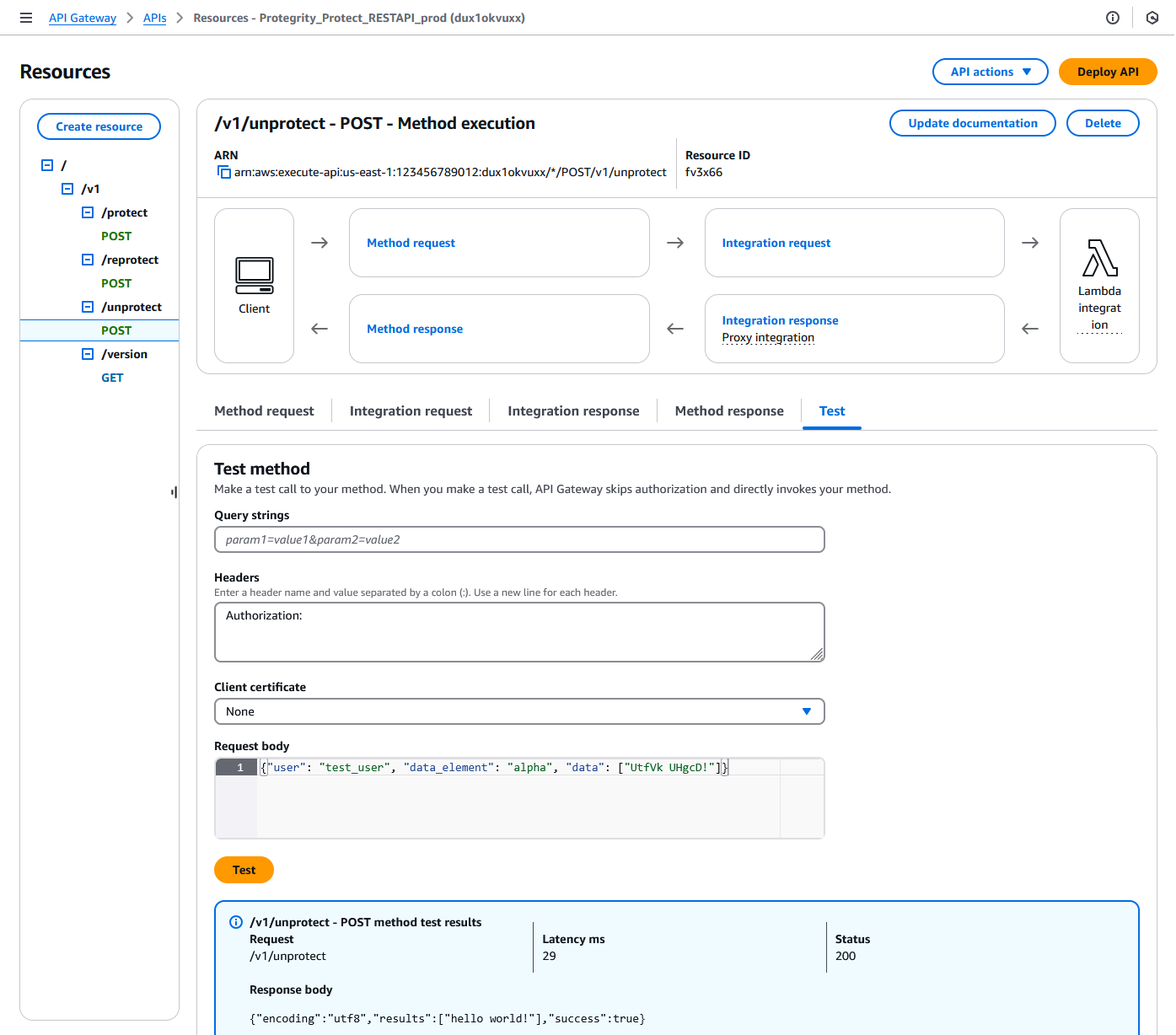
Perform the following steps to verify if the API Gateway is working correctly with the Protegrity product.
Search for API (CloudFormation output ApiGatewayId value).
Select Resources > /v1/unprotect POST.
Click on Test tab.
Provide the following input in Headers.
Authorization:
Provide the following input in Request body.
{"user": "test_user", "data_element": "alpha", "data": ["UtfVk UHgcD!"]}
Click Test.
Verify the response Status is 200 and the Response Body is as follows:
{"encoding": "utf8", "results": ["hello world!"], "success": true}
For example:
Error | Action |
|---|---|
5xx error |
If this step fails, then check the console for the meaningful error. |
This step describes how to setup an AWS API Gateway Authorization.
By default, the API Gateway is configured to use AWS_IAM Authorization.
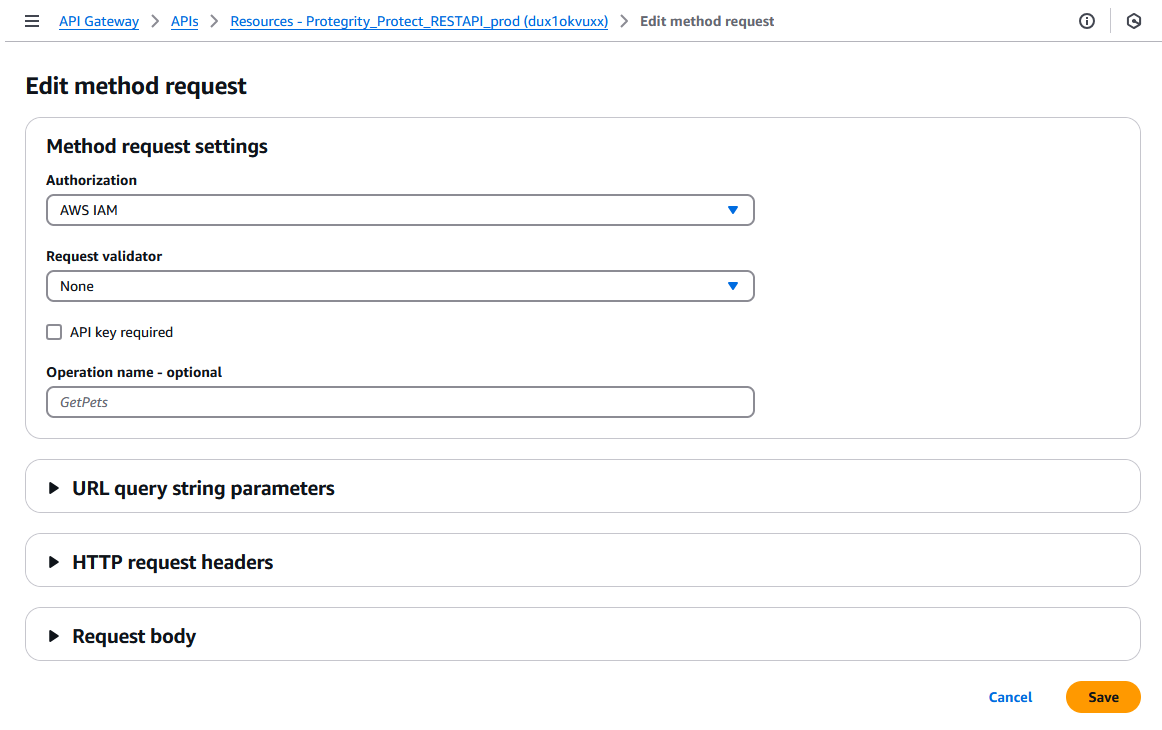
After Cloud Formation stack is deployed, Protector Lambda can be reconfigured based on the authentication selected in previous stage. From your AWS console navigate to lambda and select following lambda: Protegrity_Protect_RESTAPI_<STACK_NAME>. Scroll down to Environment variables section, select Edit and replace the entries based on the following information.
Environment Variable | Description | Notes |
|---|---|---|
authorization | If “jwt” is set, Authorization header with JWT will be required in the AWS Protect Lambda request. Any other value is ignored and effective policy user is taken from request payload. Supported Values: [“jwt”, “”] | If “jwt” is set, any request without valid JWT in the Authorization header, will result in error from API Gateway: 502 Bad Gateway. Default Value: "" |
allow_assume_user | If 0 is set, API Gateway user will not be used, and the effective user is the JWT user. Supported Values: [0, 1] | Applicable when authorization is set to “jwt”. Default Value: 0 |
jwt_user_claim | The JWT claim with username. Common claims: name, preferred_username, cognito:username | Applicable when authorization is set to “jwt” Default Value: cognito:username |
jwt_verify | If 1 is set, jwt_secret_base64 is required. Only applicable when authorization is set to “jwt”. Supported JWT algorithm RS256, RS384, RS512. While algorithms HS256, HS384, HS512 are supported, they are not recommended for use. | Applicable when authorization is set to “jwt” |
jwt_secret_base64 | Required when jwt_verify is set to 1 and Authorization is set to “jwt”. The secret must be provided in base64 encoding. It is recommended to only use public key (asymmetric algorithm). | Applicable when authorization is set to “jwt” and jwt_verify is set to 1 |
service_user | If set, it will be used as effective policy user. | service_user should be used when the Cloud API should always run as single service user or account no matter what user is in the request. service_user will always take priority over users in the payload and in the JWT header. |
USERNAME_REGEX | If set, the effective policy user will be extracted from the user in the request using supplied regular expression. | See Configuring Regular Expression to Extract Policy Username to learn how to extract username from the request |
The following sections will install the Policy Agent. The Policy Agent polls the ESA and deploys the policy to Protegrity Serverless as a static resource. Some of the installation steps are not required for the operation of the software but recommended for establishing a secure environment. Contact Protegrity Professional Services for further guidance on configuration alternatives in the Cloud.
Policy Agent Lambda requires ESA server running and accessible on TCP port 443.
Note down ESA IP address:
ESA IP Address (EsaIpAddress): ___________________
Whether your ESA is configured with default self-signed certificate or your corporate CA certificate, Policy Agent can validate authenticity of ESA connection using CA certificate. The process for both scenarios is the same:
To obtain self-signed CA certificate from ESA:
Log in to ESA Web UI.
Select Settings > Network > Manage Certificates.
Hover over Server Certificate and click on download icon to download the CA certificate.
To convert downloaded CA certificate to a value accepted by Policy Agent, open the downloaded PEM file in text editor and replace all new lines with escaped new line: \n.
To escape new lines from command line, use one of the following commands depending on your operating system:
Linux Bash:
awk 'NF {printf "%s\\n",$0;}' ProtegrityCA.pem > output.txt
Windows PowerShell:
(Get-Content '.\ProtegrityCA.pem') -join '\n' | Set-Content 'output.txt'
Record the certificate content with new lines escaped.
ESA CA Server Certificate (EsaCaCert): ___________________
This value will be used to set PTY_ESA_CA_SERVER_CERT or PTY_ESA_CA_SERVER_CERT_SECRET Lambda variable in section Policy Agent Lambda Configuration
For more information about ESA certificate management refer to Certificate Management Guide in ESA documentation.
Establish a VPC where the Policy Agent will be hosted. This VPC will need connectivity to the ESA. The VPC should be in the same account and region established in Pre-Configuration.
VPC name: ___________________
Identify or create a new subnet in the VPC where tha Lambda function will be connected to. It is recommended to use a private subnet.
Subnet name: ___________________
If ESA server is hosted outside of the AWS Cloud network, the VPC configured for Lambda function must ensure additional network configuration is available to allow connectivity with ESA. For instance if ESA has a public IP, the Lambda function VPC must have public subnet with a NAT server to allow routing traffic outside of the AWS network. A Routing Table and Network ACL may need to be configured for outbound access to the ESA as well.
If an internal VPC was created, then add VPC Endpoints, which will be used by the Policy Agent to access AWS services. Policy Agent needs access to the following AWS services:
Type | Service name |
|---|---|
Interface | com.amazonaws.{REGION}.secretsmanager |
Interface | com.amazonaws.{REGION}.kms |
Gateway | com.amazonaws.{REGION}.s3 |
Interface | com.amazonaws.{REGION}.lambda |
Policy Agent and cloud-based ESA appliance use AWS security groups to control traffic that is allowed to leave and reach them. Policy Agent runs on schedule and is mostly concerned with allowing traffic out of itself to ESA and AWS services it depends on. ESA runs most of the time and it must allow Policy Agent to connect to it.
Policy Agent security group must allow outbound traffic using rules described in the table below. To edit security group navigate:
From VPC > Security Groups > Policy Agent Security Group configuration.
| Type | Protocol | Port Range | Destination | Reason |
|---|---|---|---|---|
| Custom TCP | TCP | 443 | Policy Agent Lambda SG | ESA Communication |
| HTTPS | TCP | 443 | Any | AWS Services |
Record Policy Agent security group ID:
Policy Agent Security Group Id: ___________________
Policy Agent will reach out to ESA on port 443. Create following inbound security group rule for cloud-based ESA appliance to allow connections from Policy Agent:
| Type | Protocol | Port Range | Source |
|---|---|---|---|
| Custom TCP | TCP | 443 | Policy Agent Lambda SG |
Policy Agent Lambda requires ESA credentials to be provided as one of the three options.
Creating secrets manager secret with ESA username and password.
From the AWS Secrets Manager Console, select Store New Secret.
Select Other Type of Secrets.
Specify the username and password key value pair.
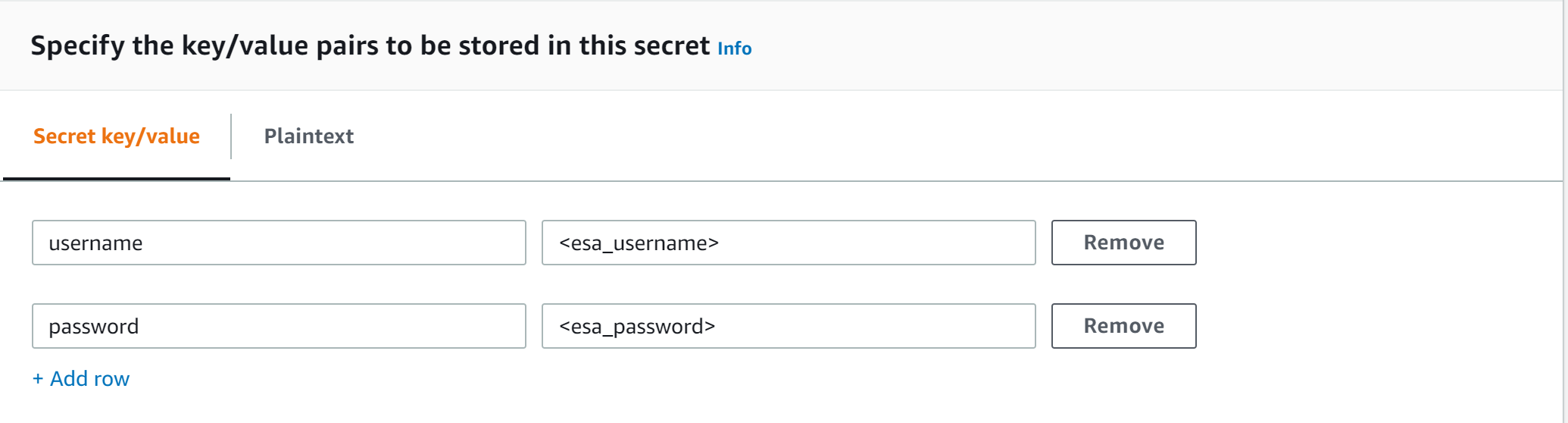
Select the encryption key or leave default AWS managed key.
Specify the Secret Name and record it.
ESA Credentials Secret Name: __________________
ESA password is encrypted with AWS KMS symmetric key.
Create AWS KMS symmetric key which will be used to encrypt ESA password. See Create KMS Key for instructions on how to create KMS symmetric key using AWS console.
Record KMS Key ARN.
ESA PASSWORD KMS KEY ARN: __________________
Run AWS CLI command to encrypt ESA password. Below you can find sample Linux aws cli command. Replace <key_arn> with KMS symmetric key ARN.
aws kms encrypt --key-id <key_arn> --plaintext $(echo '<esa_password>' | base64 )
Sample output.
{
  "CiphertextBlob": "esa_encrypted_password",
  "KeyId": "arn:aws:kms:region:aws_account:key/key_id ",
  "EncryptionAlgorithm": "SYMMETRIC_DEFAULT"
}
Record ESA username and encrypted password.
ESA USERNAME: __________________
ESA ENCRYPTED PASSWORD: __________________
With this option ESA username and password are returned by a custom AWS Lambda function. This method may be used to get the username and password from external vaults.
Create AWS Lambda in any AWS supported runtime.
There is no input needed.
The Lambda function must return the following response schema.
response:
type: object
  properties:
    username: string
    password: string
For example,
example output: {"username": "admin", "password": "Password1234"}
Sample AWS Lambda function in Python:
import json

def lambda_handler(event, context):

    return {"username": "admin", "password": "password1234"}
Record the Lambda name:
Custom AWS lambda for ESA credentials: _______________
Follow the steps below to create Lambda execution policies.
Create Agent Lambda IAM policy
From AWS IAM console, select Policies > Create Policy.
Select JSON tab and copy the following snippet.
{
  "Version": "2012-10-17",
  "Statement": [
    {
      "Sid": "EC2ModifyNetworkInterfaces",
      "Effect": "Allow",
      "Action": [
        "ec2:CreateNetworkInterface",
        "ec2:DescribeNetworkInterfaces",
        "ec2:DeleteNetworkInterface"
      ],
      "Resource": "*"
    },
    {
      "Sid": "CloudWatchWriteLogs",
      "Effect": "Allow",
      "Action": [
        "logs:CreateLogGroup",
        "logs:CreateLogStream",
        "logs:PutLogEvents"
      ],
      "Resource": "*"
    },
    {
      "Sid": "LambdaUpdateFunction",
      "Effect": "Allow",
      "Action": [
        "lambda:UpdateFunctionConfiguration"
      ],
      "Resource": [
        "arn:aws:lambda:*:*:function:*"
      ]
    },
    {
      "Sid": "LambdaReadLayerVersion",
      "Effect": "Allow",
      "Action": [
        "lambda:GetLayerVersion",
        "lambda:ListLayerVersions"
      ],
      "Resource": "*"
    },
    {
      "Sid": "LambdaDeleteLayerVersion",
      "Effect": "Allow",
      "Action": "lambda:DeleteLayerVersion",
      "Resource": "arn:aws:lambda:*:*:layer:*:*"
    },
    {
      "Sid": "LambdaPublishLayerVersion",
      "Effect": "Allow",
      "Action": "lambda:PublishLayerVersion",
      "Resource": "arn:aws:lambda:*:*:layer:*"
    },
    {
      "Sid": "S3GetObject",
      "Effect": "Allow",
      "Action": [
        "s3:GetObject"
      ],
      "Resource": "arn:aws:s3:::*/*"
    },
    {
      "Sid": "S3PutObject",
      "Effect": "Allow",
      "Action": [
        "s3:PutObject"
      ],
      "Resource": "arn:aws:s3:::*/*"
    },
    {
      "Sid": "KmsEncrypt",
      "Effect": "Allow",
      "Action": [
        "kms:GetPublicKey"
      ],
      "Resource": [
        "arn:aws:kms:*:*:key/*"
      ]
    },
    {
      "Sid": "SecretsManagerGetSecret",
      "Effect": "Allow",
      "Action": [
        "secretsmanager:GetSecretValue"
      ],
      "Resource": [
        "arn:aws:secretsmanager:*:*:secret:*"
      ]
    },
    {
      "Sid": "LambdaGetConfiguration",
      "Effect": "Allow",
      "Action": [
          "lambda:GetFunctionConfiguration"
      ],
      "Resource": [
          "arn:aws:lambda:*:*:function:*"
      ]
    }
  ]
}
Replace wildcard * with the region, account, and resource name information where required.
This step is required if KMS is used to encrypt ESA password.
Add policy entry below. Replace ESA PASSWORD KMS KEY ARN with the value recorded in Option 2: KMS Encrypted Password.
  {
    "Sid": "KmsDecryptEsaPassword",
    "Effect": "Allow",
    "Action": [
      "kms:Decrypt"
    ],
    "Resource": [
      "**ESA PASSWORD KMS KEY ARN**"
    ]
  }
Select Next type in the policy name and Create Policy. Record policy name:
Policy Name: ___________________
Perform the following steps to create Agent Lambda execution IAM role.
To create agent Lambda IAM role:
From AWS IAM console, select Roles > Create Role.
Select AWS Service > Lambda > Next.
Select the policy created in Create Agent Lambda IAM policy.
Proceed to Name, Review and Create.
Type the role name, for example, ProtegrityAgentRole and click Confirm.
Select Create role.
Record the role ARN.
Agent Lambda IAM Execution Role Name: ___________________
If an on-premise firewall is used, then the firewall must allow access from the NAT Gateway to an ESA. The firewall must allow access from the NAT Gateway IP to ESA via port 443 and 443.
Create the Policy Agent in the VPC using the CloudFormation script provided by Protegrity.
Access the CloudFormation service.
Select the target installation region.
Create a stack with new resources.
Upload the Policy Agent CloudFormation template (file name: pty_agent_cf.json).
Specify the following parameters for Cloud Formation:
| Parameter | Description | Note |
|---|---|---|
| VPC | VPC where the Policy Agent will be hosted | Identify or Create a new VPC |
| Subnet | Subnet where the Policy Agent will be hosted | VPC Subnet Configuration |
| PolicyAgentSecurityGroupId | Security Group Id, which allows communication between the Policy Agent and the ESA | Identify or Create Security Groups |
| LambdaExecutionRoleArn | Agent Lambda IAM execution role ARN allowing access to the S3 bucket, KMS encryption Key, Lambda and Lambda Layer | Create Agent Lambda IAM Role |
| ArtifactS3Bucket | S3 bucket name with deployment package for the Policy Agent | Use S3 Bucket name recorded in Create S3 bucket for Installing Artifacts |
| CreateCRONJob | Set to True to create a CloudWatch schedule for the agent to run. | Default: False |
After the CloudFormation stack is deployed, the Policy Agent Lambda must be configured with parameters recorded in earlier steps. From your AWS Console, navigate to lambda and select the following Lambda.
Protegrity_Agent<STACK_NAME>_
Select Configuration tab and scroll down to the Environment variables section. Select Editand replace all entries with the actual values.
Parameter | Description | Notes |
|---|---|---|
PTY_ESA_IP | ESA IP address or hostname | |
PTY_ESA_CA_SERVER_CERT | ESA self-signed CA certificate or your corporate CA certificate used by policy Agent Lambda to ensure ESA is the trusted server. | Recorded in step Certificates on ESA NoteFor PPC deployments, see PPC Appendix: Policy Agent Certificate Guidance for details on obtaining and using the CA certificate.In case ESA is configured with publicly signed certificates, the PTY_ESA_CA_SERVER_CERT configuration will be ignored. |
PTY_ESA_CA_SERVER_CERT_SECRET | This configuration option fulfills the same function as PTY_ESA_CA_SERVER_CERT but supports larger configuration values, making it the recommended choice. The value should specify the name of the AWS Secrets Manager secret containing the ESA self-signed CA certificate. The secret value should be set to the json with “PTY_ESA_CA_SERVER_CERT” key and PEM formated CA certificate content value as shown below. | Recorded in step Certificates on ESA NoteFor PPC deployments, see PPC Appendix: Policy Agent Certificate Guidance for details on obtaining and using the CA certificate.In case ESA is configured with publicly signed certificates, the PTY_ESA_CA_SERVER_CERT_SECRET configuration will be ignored. When both PTY_ESA_CA_SERVER_CERT and PTY_ESA_CA_SERVER_CERT_SECRET are configured the PTY_ESA_CA_SERVER_CERT_SECRET takes precedence. |
PTY_ESA_CREDENTIALS_SECRET | ESA username and password (encrypted value by AWS Secrets Manager) | |
PTY_DATASTORE_KEY | ESA policy datastore public key fingerprint (64 char long) e.g. 123bff642f621123d845f006c6bfff27737b21299e8a2ef6380aa642e76e89e5. | NoteThis configuration is not applicable for ESA versions lower than 10.2.The export key is the public part of an asymmetric key pair created in a Create KMS Key. A user with Security Officer permissions adds the public key to the data store in ESA via Policy Management > Data Stores > Export Keys. The fingerprint can then be copied using the Copy Fingerprint icon next to the key. Refer to Exporting Keys to Datastore for details. NoteFor PPC deployments, see PPC Appendix: Policy Agent Certificate and Key Guidance for details on obtaining and using the datastore key fingerprint. |
AWS_KMS_KEY_ID | KMS key id or full ARN e.g. arn:aws:kms:us-west-2:112233445566:key/bfb6c4fb-509a-43ac-b0aa-82f1ca0b52d3 | |
AWS_POLICY_S3_BUCKET | S3 bucket where the encrypted policy will be written | S3 bucket of your choice |
AWS_POLICY_S3_FILENAME | Filename of the encrypted policy stored in S3 bucket | Default: protegrity-policy.zip |
AWS_PROTECT_FN_NAME | Comma separated list of Protect function names or ARNs | ProtectFunctionName(s), recorded in CloudFormation Installation |
DISABLE_DEPLOY | This flag can be either 1 or 0. If set to 1, then the agent will not update PTY_PROTECT lambda with the newest policy. Else, the policy will be saved in the S3 bucket and deployed to the Lambda Layer | Default: 0 |
AWS_POLICY_LAYER_NAME | Lambda layer used to store the Protegrity policy used by the PTY_PROTECT function |
|
POLICY_LAYER_RETAIN | Number of policy versions to retain as backup. (e.g. 2 will retain the latest 2 policies and remove older ones). -1 retains all. | Default: 2 |
POLICY_PULL_TIMEOUT | Time in seconds to wait for the ESA to send the full policy | Default: 20s |
ESA_CONNECTION_TIMEOUT | Time in seconds to wait for the ESA response | Default: 5s |
LOG_LEVEL | Application and audit logs verbiage level | Default: INFO Allowed values: DEBUG – the most verbose, INFO, WARNING, ERROR – the least verbose |
PTY_CORE_EMPTYSTRING | Override default behavior. Empty string response values are returned as null values. For instance: (un)protect(’’) -> null (un)protect(’’) -> '' | Default: empty Allowed values: null empty |
PTY_CORE_CASESENSITIVE | Specifies whether policy usernames should be case sensitive | Default: no Allowed values: yes no |
PTY_ADDIPADDRESSHEADER | When enabled, agent will send its source IP address in the request header. This configuration works in conjunction with ESA hubcontroller configuration ASSIGN_DATASTORE_USING_NODE_IP (default=false). See Associating ESA Data Store With Cloud Protect Agent for more information. | Default: yes Allowed values: yes no |
PTY_ESA_USERNAME | Plaintext ESA username which is used together with PTY_ESA_ENCRYPTED_PASSWORD as an optional ESA credentials | Option 2: KMS Encrypted Password Presence of this parameter will cause PTY_ESA_CREDENTIALS_SECRET to be ignored |
PTY_ESA_ENCRYPTED_PASSWORD | ESA password encrypted with KMS symmetric key. Example AWS cli command to generate the value:
| Option 2: KMS Encrypted Password Presence of this parameter will cause PTY_ESA_CREDENTIALS_SECRET to be ignored Value must be base64 encoded |
EMPTY_POLICY_S3 | This flag can be either 1 or 0. If set to 1, then the agent will remove the content of the policy file in S3 bucket, but will keep the checksum in the metadata. Else, the policy will be saved in the S3 bucket and not removed. | Default: 0 |
PTY_ESA_CREDENTIALS_LAMBDA | Lambda function to return ESA credentials | Recorded in step Option 3: Custom AWS Lambda function LAMBDA FOR ESA CREDENTIALS. Presence of PTY_ESA_USERNAME, or PTY_ESA_CREDENTIALS_SECRET will cause this value to be ignored. The Policy Agent Lambda must have network access and IAM permissions to invoke the custom ESA Credentials Lambda you have created in Option 3: Custom AWS Lambda function. |
Open the Lambda and configure Test to execute the lambda and specify the default test event. Wait for around 20 seconds for the Lambda to complete. If policy is downloaded successfully, then a success message appears.
Navigate to the AWS_POLICY_S3_BUCKET bucket and verify that the AWS_POLICY_S3_FILENAME file was created.
Lambda Error | Example Error | Action |
|---|---|---|
Task timed out after x seconds | |
|
ESA connection error. Failed to download certificates | ||
Policy Pull takes a long time | |
|
ESA connection error. Failed to download certificates. HTTP response code: 401 | | Ensure that the PTY_ESA_CREDENTIALS_SECRET has correct ESA username and password |
An error occurred (AccessDeniedException) when calling xyz operation | | Ensure that the Lambda execution role has permission to call the xyz operation |
Access Denied to Secret Manager. | |
|
Master Key xyz unable to generate data key | Ensure that the Lambda can access xyz CMK key | |
The S3 bucket server-side encryption is enabled, the encryption key type is SSE-KMS but the Policy Agent execution IAM role doesn’t have permissions to encrypt using the KMS key . | | Add the following permissions to the Policy Agent excution role. NoteWhen the KMS key and the Policy Agent Lambda are in separate accounts, update both the AWS KMS key and the Policy Agent execution role. |
The S3 bucket has bucket policy to only allow access from within the VPC. | | The Policy Agent publishes a new Lambda Layer version, and the Lambda Layer service uploads the policy file from the s3 bucket and the upload request is originated from the AWS service outside the Policy Agent Lambda VPC. Update the S3 bucket resource policy to allow access from AWS Service. Sample security policy to lock down access to the vpc: |
Strengthen the KMS IAM policy by granting access only to the required Lambda function(s).
Finalize the IAM policy for the Lambda Execution Role. Ensure to replace wildcard * with the region, account, and resource name information where required.
For example,
"arn:aws:lambda:*:*:function:*" -> "arn:aws:lambda:us-east-1:account:function:function_name"
If specified in CloudFormation Installation, the agent installation created a CloudWatch event rule, which checks for policy update on an hourly schedule. This schedule can be altered to the required frequency.
Under CloudWatch > Events > Rules, find Protegrity_Agent_{stack_name}. Click Action > Edit Set the cron expression. A cron expression can easily be defined using CronMaker, a free online tool. Refer to http://www.cronmaker.com.
The following sections show steps how to install Audit Log Forwarder component in the AWS Cloud. The Log Forwarder deployment allows for the audit logs generated by Protector to be delivered to ESA for auditing and governance purposes. Log Forwarder component is optional and is not required for the Protector Service to work properly. See Log Forwarding Architecture section in this document for more information. Some of the installation steps are not required for the operation of the software but recommended for establishing a secure environment. C ontact Protegrity for further guidance on configuration alternatives in the Cloud.
ESA server is required as the recipient of audit logs. Verify the information below to ensure ESA is accessible and configured properly.
ESA server running and accessible on TCP port 9200 (Audit Store) or 24284 (td-agent).
Audit Store service is configured and running on ESA. Applies when audit logs are output to Audit Store directly or through td-agent. For information related to ESA Audit Store configuration, refer to Audit Store Guide.
(Optional) td-agent is configured for external input. For more information related to td-agent configuration, refer to ESA guide Sending logs to an external security information and event management (SIEM).
This section is optional. If CA certificate is not provided, the Log Forwarder will skip server certificate validation and will connect to ESA without verifying that it is a trusted server.
If you are deploying Log Forwarder with Protegrity Provisioned Cluster (PPC), certificate authorization and CA validation are not supported. Configuration steps related to certificates in this section do not apply to PPC. See Integrating Cloud Protect with PPC (Protegrity Provisioned Cluster): Log Forwarder Setup with PPC for details.
By default, ESA is configured with self-signed certificates, which can optionally be validated using a self-signed CA certificate supplied in the Log Forwarder configuration. If no CA certificate is provided, the Log Forwarder will skip server certificate validation.
If ESA is configured with publicly signed certificates, this section can be skipped since the forwarder Lambda will use the public CA to validate ESA certificates.
To obtain the self-signed CA certificate from ESA:
Download ESA CA certificate from the /etc/ksa/certificates/plug directory of the ESA
After certificate is downloaded, open the PEM file in text editor and replace all new lines with escaped new line: \n.
To escape new lines from command line, use one of the following commands depending on your operating system:
Linux Bash:
awk 'NF {printf "%s\\n",$0;}' CA.pem > output.txt
Windows PowerShell:
(Get-Content '.\CA.pem') -join '\n' | Set-Content 'output.txt'
Record the certificate content with new lines escaped.
ESA CA Server Certificate (EsaCaCert): ___________________
This value will be used to set PtyEsaCaServerCert cloudformation parameter in section Install through CloudFormation
For more information about ESA certificate management refer to Certificate Management Guide in ESA documentation.
Log forwarder Lambda function requires network connectivity to ESA, similar to Policy Agent Lambda function. Therefore, it can be hosted in the same VPC as Policy Agent.
Separate VPC can be used, as long as it provides network connectivity to ESA.
VPC Name: ___________________
Log Forwarder can be connected to the same subnet as Policy Agent or separate one as long as it provides connectivity to ESA.
Subnet Name: ___________________
If ESA server is hosted outside of the AWS Cloud network, the VPC configured for Lambda function must ensure additional network configuration is available to allow connectivity with ESA. For instance if ESA has a public IP, the Lambda function VPC must have public subnet with a NAT server to allow routing traffic outside of the AWS network. A Routing Table and Network ACL may need to be configured for outbound access to the ESA as well.
Log Forwarder Lambda function requires connectivity to Secrets Manager AWS service. If the VPC identified in the steps before has no connectivity to public internet through the NAT Gateway, then the following service endpoint must be configured:
Security groups restrict communication between Log Forwarder Lambda function and the ESA appliance. The following rules must be in place for ESA and Log Forwarder Lambda function.
From VPC > Security Groups > Log Forwarder Security Group configuration.
| Type | Protocol | Port Range | Destination | Reason |
|---|---|---|---|---|
| Custom TCP | TCP | 9200 | Log Forwarder Lambda SG | ESA Communication |
Record the name of Log Forwarder security group name.
Log Forwarder Security Group Id: ___________________
The following port must be open for the ESA. If the ESA is running in the Cloud, then create the following security.
ESA Security Group configuration
| Type | Protocol | Port Range | Source |
|---|---|---|---|
| Custom TCP | TCP | 9200 | Log Forwarder Lambda SG |
Audit Log Forwarder can optionally authenticate with ESA using certificate-based authentication with a client certificate and certificate key. If used, both the certificate and certificate key will be stored in AWS Secrets Manager.
Download the following certificates from the /etc/ksa/certificates/plug directory of the ESA:
After certificates are downloaded, open each PEM file in text editor and replace all new lines with escaped new line: \n. To escape new lines from command line, use one of the commands below depending on your operating system.
Linux Bash:
awk 'NF {printf "%s\\n",$0;}' client.key > private_key.txt
awk 'NF {printf "%s\\n",$0;}' client.pem > public_key.txt
Windows PowerShell:
(Get-Content '.\client.key') -join '\n' | Set-Content 'private_key.pem'
(Get-Content '.\client.pem') -join '\n' | Set-Content 'public_key.pem'
For more information on how to configure client certificate authentication for Audit Store on ESA refer to Audit Store Guide.
To create secret with ESA client certificate/key pair in AWS Secrets Manager.
From the AWS Secrets Manager Console, select Store New Secret.
Select Other Type of Secrets.
Specify the private_key and public_key value pair.
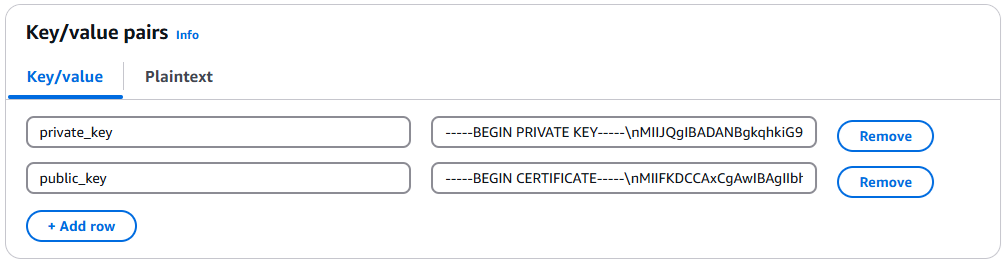
Select the encryption key or leave default AWS managed key.
Specify the Secret Name and record it below.
ESA Client Certificate/Key Pair Secret Name: ___________________
This value will be used to set PtyEsaClientCertificatesSecretId cloudformation parameter in section Install through CloudFormation
This task defines a policy used by the Protegrity Log Forwarder Lambda function to write CloudWatch logs, access the KMS encryption key to decrypt the policy and access Secrets Manager for log forwarder user credentials.
Perform the following steps to create the Lambda execution role and required policies:
From the AWS IAM console, select Policies > Create Policy.
Select the JSON tab and copy the following sample policy.
{
  "Version": "2012-10-17",
  "Statement": [
    {
      "Sid": "EC2ModifyNetworkInterfaces",
      "Effect": "Allow",
      "Action": [
        "ec2:CreateNetworkInterface",
        "ec2:DescribeNetworkInterfaces",
        "ec2:DeleteNetworkInterface"
      ],
      "Resource": "*"
    },
    {
      "Sid": "CloudWatchWriteLogs",
      "Effect": "Allow",
      "Action": [
        "logs:CreateLogGroup",
        "logs:CreateLogStream",
        "logs:PutLogEvents"
      ],
      "Resource": "*"
    },
    {
      "Sid": "KmsDecrypt",
      "Effect": "Allow",
      "Action": [
        "kms:Decrypt"
      ],
      "Resource": [
        "arn:aws:kms:*:*:key/*"
      ]
    },
    {
        "Sid": "KinesisStreamRead",
        "Effect": "Allow",
        "Action": [
            "kinesis:GetRecords",
            "kinesis:GetShardIterator",
            "kinesis:DescribeStream",
            "kinesis:DescribeStreamSummary",
            "kinesis:ListShards",
            "kinesis:ListStreams"
        ],
        "Resource": "*"
    },
    {
      "Sid": "SecretsManagerGetSecret",
      "Effect": "Allow",
      "Action": [
        "secretsmanager:GetSecretValue"
      ],
      "Resource": [
        "arn:aws:secretsmanager:*:*:secret:*"
      ]
    }
  ]
}
For the KMS policy, replace the Resource with the ARN for the KMS key created in a previous step.
Select Review policy, type in a policy name, for example, ProtegrityLogForwarderLambdaPolicy and Confirm. Record the policy name:
LogForwarderLambdaPolicyName:__________________
Perform the following steps to create Log Forwarder execution IAM role.
To create Log Forwarder IAM role:
From AWS IAM console, select Roles > Create Role.
Select AWS Service > Lambda > Next.
Select the policy created in Create Audit Log Forwarder IAM Execution Policy.
Proceed to Name, Review and Create.
Type the role name, for example, ProtegrityForwarderRole and click Confirm.
Record the role ARN.
Log Forwarder IAM Execution Role Name: ___________________
Audit Log Forwarder installation artifacts are part of the same deployment package as the one used for protect and policy agent services. Follow the steps below to ensure the right artifacts are available for log forwarder installation.
Verify that the Protegrity deployment package is available on your local system, if not, you can download it from the Protegrity portal.
Extract the pty_log_forwarder_cf.json cloud formation file from the deployment package.
Check the S3 deployment bucket identified in section Create S3 bucket for Installing Artifacts. Make sure that all Protegrity deployment zip files are uploaded to the S3 bucket.
The following steps describe the deployment of the Audit Log Forwarder AWS cloud components.
Access CloudFormation and select the target AWS Region in the console.
Click Create Stack and choose With new resources.
Specify the template.
Select Upload a template file.
Upload the Protegrity-provided CloudFormation template called pty_log_forwarder_cf.json and click Next.
Specify the stack details. Enter a stack name.
Enter the required parameters. All the values were generated in the pre-configuration steps.
Parameter | Description | Default Value | Required |
|---|---|---|---|
LogForwarderSubnets | Subnets where the Log Forwarder will be hosted. |
|
|
LogForwarderSecurityGroups | Security Groups, which allow communication between the Log Forwarder and ESA. |
| X |
LambdaExecutionRoleArn | The ARN of Lambda role created in the prior step. |
| X |
ArtifactS3Bucket | Name of S3 bucket created in the pre-configuration step. |
| X |
LogDestinationEsaIp | IP or FQDN of the ESA instance or cluster. |
| X |
AuditLogOutput | Audit log processor to target on ESA. Allowed values: audit-store, td-agent | audit-store | X |
PtyEsaClientCertificatesSecretId | AWS Secrets Manager secret id containing client certificates used for authentication with ESA Audit Store. It is expected that the public key will be stored in a field public_key and the private key in a field named private_key. This parameter is optional. If not provided, Log Forwarder will connect to ESA without client certificate authentication. | ||
EsaTlsDisableCertVerify | Disable certificate verification when connecting to ESA if set to 1. This is only for dev purposes, do not disable in production environment. | 0 | X |
PtyEsaCaServerCert | ESA self-signed CA certificate used by log forwarder Lambda to ensure ESA is the trusted server. Recorded in step Certificates on ESA In case ESA is configured with publicly signed certificates, the PtyEsaCaServerCert configuration will be ignored. |
| |
EsaConnectTimeout | Time in seconds to wait for the ESA response. Minimum value: 1. | 5 | X |
EsaVirtualHost | ESA virtual hostname. This configuration is optional and it can be used when proxy server is present and supports TLS SNI extension. |
|
|
KinesisLogStreamRetentionPeriodHours | The number of hours for the log records to be stored in Kinesis Stream in case log destination server is not available. Minimum value: 24. See Log Forwarder Performance section for more details. | 24 | X |
KinesisLogStreamShardCount | The number of shards that the Kinesis log stream uses. For greater provisioned throughput, increase the number of shards. Minimum value: 1. See Log Forwarder Performance section for more details. | 10 | X |
MinLogLevel | Minimum log level for protect function. Allowed Values: off, severe, warning, info, config, all | severe | X |
Click Next with defaults to complete CloudFormation.
After CloudFormation is completed, select the Outputstab in the stack.
Record the following values
KinesisLogStreamArn: ________________________________
Login to the AWS account that hosts the Protect Lambda Function.
Search for Protect Lambda Function IAM Execution Role Name created in Create Protect Lambda IAM role.
Under Permissions policies, select Add Permissions > Create inline policy.
In Specify permissions view, switch to JSON.
Copy the policy json from below replacing the placeholder value indicated in the following snippet as <Audit Log Kinesis Stream ARN> with the value recorded in the previous step.
{
	"Version": "2012-10-17",
	"Statement": [
		{
			"Sid": "KinesisPutRecords",
			"Effect": "Allow",
			"Action": "kinesis:PutRecords",
			"Resource": "<Audit Log Kinesis Stream ARN>"
		}
	]
}
When you are finished, choose Next.
On the Review and create page, type a Name, then choose Create policy.
Testing in this section validates the connectivity between Log Forwarder and ESA. The sample policy included with the initial installation and test event below are not based on your ESA policy. Any logs forwarded to ESA which are not signed with a policy generated by your ESA will not be added to the audit store.
Install Log Forwarder and configure according to previous sections. Log Forwarder configuration MinLogLevel must be at least info level.
Navigate to the log forwarder lambda function.
Select the Test tab.
Copy the json test event into the Event JSON pane.
{
    "Records": [
        {
            "kinesis": {
                "kinesisSchemaVersion": "1.0",
                "partitionKey": "041e96d78c778677ce43f50076a8ae3e",
                "sequenceNumber": "49620336010289430959432297775520367512250709822916263938",
                "data": "eyJpbmdlc3RfdGltZV91dGMiOiIyMDI2LTAzLTI3VDEzOjIzOjEyLjkwNFoiLCJhZGRpdGlvbmFsX2luZm8iOnsiZGVzY3JpcHRpb24iOiJEYXRhIHVucHJvdGVjdCBvcGVyYXRpb24gd2FzIHN1Y2Nlc3NmdWwuIn0sImNsaWVudCI6e30sImNudCI6NCwiY29ycmVsYXRpb25pZCI6InJzLXF1ZXJ5LWlkOjEyMzQiLCJsZXZlbCI6IlNVQ0NFU1MiLCJsb2d0eXBlIjoiUHJvdGVjdGlvbiIsIm9yaWdpbiI6eyJob3N0bmFtZSI6IlBSTy1VUy1QRjNSSEdGOSIsImlwIjoiMTAuMTAuMTAuMTAiLCJ0aW1lX3V0YyI6MTcxMTU1OTEwMH0sInByb2Nlc3MiOnsiaWQiOjJ9LCJwcm90ZWN0aW9uIjp7ImF1ZGl0X2NvZGUiOjgsImRhdGFlbGVtZW50IjoiYWxwaGEiLCJkYXRhc3RvcmUiOiJTQU1QTEVfUE9MSUNZIiwibWFza19zZXR0aW5nIjoiIiwib2xkX2RhdGFlbGVtZW50IjpudWxsLCJvcGVyYXRpb24iOiJVbnByb3RlY3QiLCJwb2xpY3lfdXNlciI6IlBUWURFViJ9LCJwcm90ZWN0b3IiOnsiY29yZV92ZXJzaW9uIjoiMS4yLjErNTUuZzU5MGZlLkhFQUQiLCJmYW1pbHkiOiJjcCIsInBjY192ZXJzaW9uIjoiMy40LjAuMTQiLCJ2ZW5kb3IiOiJyZWRzaGlmdCIsInZlcnNpb24iOiIwLjAuMS1kZXYifSwic2lnbmF0dXJlIjp7ImNoZWNrc3VtIjoiN0VCMkEzN0FDNzQ5MDM1NjQwMzBBNUUxNENCMTA5QzE0OEJGODYwRjE3NEVCMjMxMTAyMEI3RkE1QTY4MjdGQyIsImtleV9pZCI6ImM0MjQ0MzZhLTExMmYtNGMzZi1iMmRiLTEwYmFhOGI1NjJhNyJ9fQ==",
                "approximateArrivalTimestamp": 1626878559.213
            },
            "eventSource": "aws:kinesis",
            "eventVersion": "1.0",
            "eventID": "shardId-000000000000:49620336010289430959432297775520367512250709822916261234",
            "eventName": "aws:kinesis:record",
            "invokeIdentityArn": "arn:aws:iam::555555555555:role/service-role/TestRole",
            "awsRegion": "us-east-1",
            "eventSourceARN": "arn:aws:kinesis:us-east-1:555555555555:stream/CloudProtectEventStream"
        }
    ]
}
Select Test to execute the test event.
Test is successful if the Log Output of test results contains the following log:
[INFO] [kinesis-log-aggregation-format.cpp:77] Aggregated 1 records into 0 aggregated, 1 forwarded and 0 failed records
If the log is not present, please consult the Troubleshooting section for common errors and solutions.
In this section, Kinesis log stream ARN will be provided to the Protect Function installation.
Navigate to the Protector CloudFormation stack created in the protector installation section.
Select Update.
Choose Use existing template > Next.
Set parameter KinesisLogStreamArn to the output value recorded in Install through CloudFormation.
Proceed with Next and Submit the changes.
Continue to the next section once stack status indicates UPDATE_COMPLETE.
Log Forwarder Lambda function requires a policy layer which is in sync with the Protegrity Protector. This section will describe the steps to update the policy agent to include updating Log Forwarder Lambda function.
Navigate to the Policy Agent Function created in Policy Agent Installation
Select Configuration > Environment variables > Edit
Edit the value for environment variable AWS_PROTECT_FN_NAME to include the log forwarder function name/arn in the comma separated list of Lambda functions.
Save the changes and continue when update completes
Navigate to Test tab
Add an event {} and select Test to run the Policy Agent function
Verify Log forwarder function was updated to use the policy layer by inspecting the log output. Logs should include the following:
[INFO] 2024-07-09 18:58:04,793.793Z 622d374b-1f73-4123-9a38-abc61973adef iap_agent.policy_deployer:Updating lambda [Protegrity_LogForwarder_<stack ID>] to use layer version [arn:aws:lambda:<aws region>:<aws account number>:layer:Protegrity_Layer_<layer name>:<layer version>]
Install and configure Protegrity Agent, Protector, and Log Forwarder components.
Send a protect operation to the protector using a data element or user which will result in audit log generation
Navigate to the CloudWatch log group for the Protect function
Select the log stream for the test operation and scroll to the latest logs
Expect to see a log similar to the below:
[2024-07-09T19:28:23.158] [INFO] [kinesis-external-sink.cpp:51] Sending 2 logs to Kinesis ...
[2024-07-09T19:28:23.218] [INFO] [aws-utils.cpp:206] Kinesis send time: 0.060s
Navigate to the CloudWatch log group for the Log Forwarder function
Expect to see a new log stream - it may take several minutes for the stream to start
Select the new stream and scroll to the most recent logs in the stream
Expect to see a log similar to the below:
[2024-07-09T19:32:31.648] [INFO] [kinesis-log-aggregation-format.cpp:77] Aggregated 1 records into 0 aggregated, 1 forwarded and 0 failed records
Error | Action |
|---|---|
Log forwarder log contains severe level secrets permissions error: |
|
When testing log forwarder as described in Test Log Forwarder Installation, response contains policy decryption error: |
|
Cloudformation stack creation fails with error: |
|
Severe level kinesis permissions log message in protector function: |
|
TLS errors reported in log forwarder function logs: |
|
AWS Account ID: ___________________
AWS Region (AwsRegion): ___________________
S3 Bucket name (ArtifactS3Bucket): ___________________
KMS Key ARN (AWS_KMS_KEY_ID): ___________________
ProtectLambdaPolicyName: __________________
Role ARN (LambdaExecutionRoleArn): ___________________
ApiGatewayId: ________________________________
ProtectFunctionName: __________________________
ProtectLayerName: _____________________________
ESA IP address: ___________________
VPC name: ___________________
Subnet name: ___________________
Policy Agent Security Group Id: ___________________
ESA Credentials Secret Name: ___________________
Policy Name: ___________________
Agent Lambda IAM Execution Role Name: ___________________
Requirement | Detail |
|---|---|
Protegrity distribution and installation scripts | These artifacts are provided by Protegrity |
Protegrity ESA 10.0+ | The Cloud VPC must be able to obtain network access to the ESA |
AWS Account | Recommend creating a new sub-account for Protegrity Serverless |
The following table describes the AWS services that may be a part of your Protegrity installation.
Service | Description |
|---|---|
Lambda | Provides serverless compute for Protegrity protection operations and the ESA integration to fetch policy updates or deliver audit logs. |
API Gateway | Provides the endpoint and access control. |
KMS | Provides secrets for envelope policy encryption/decryption for Protegrity. |
Secrets Manager | Provides secrets management for the ESA credentials . |
S3 | Intermediate storage location for the encrypted ESA policy layer. |
Kinesis | Required if Log Forwarder is to be deployed. Amazon Kinesis is used to batch audit logs sent from protector function to ESA. |
VPC & NAT Gateway | Optional. Provides a private subnet to communicate with an on-prem ESA. |
CloudWatch | Application and audit logs, performance monitoring, and alerts. Scheduling for the policy agent. |
Role / Skillset | Description |
|---|---|
AWS Account Administrator | To run CloudFormation (or perform steps manually), create/configure a VPC and IAM permissions. |
Protegrity Administrator | The ESA credentials required to extract the policy for the Policy Agent |
Network Administrator | To open firewall to access ESA and evaluate AWS network setup |
The following sections describe the key concepts in understanding the REST API.
Base URL:
https://{ApiGatewayId}.execute-api.{Region}.amazonaws.com/pty/v1
Once Protegrity Serverless REST API is installed, you can export the OpenAPI documentation file from API Gateway Export API, located in the AWS API Gateway Control Service.
https://docs.aws.amazon.com/apigateway/latest/developerguide/api-gateway-export-api.html
For testing the REST API, we recommend using tools, such as, Postman.
Protegrity Policy roles defines the unique data access privileges for every member. The Protegrity Lambda protects the data with the username sent in either the JWT-formatted authorization header or the request body.
The lambda behavior can be set in the Lambda environment variables as described in Protect Lambda Configuration
| Authorization/allow_assume_user | 0 | 1 |
|---|---|---|
| Empty | User from the request body. / (Throw an error). | User from the request body. |
| JWT | User from JWT payload | User from request body. If not found user from JWT payload. |
To ensure the integrity of the user, the lambda protect can verify the JWT.
Parameter | Value | Notes |
|---|---|---|
authorization | JWT | |
jwt_verify | 1 |
|
jwt_secret_base64 | Secret in base64 encoding. For example, the value of the public key is as follows. This public key will be stored as follows. | The secret must be in base64. We recommend using RSA public certificates, it is not recommended to keep Hash (symmetric) secrets in the clear. |
The following table explains the different HTTP Status Codes with their corresponding response.
Status Codes | Response | Description |
|---|---|---|
200 | | Success protected data is in results, and success attribute is true |
400 | | There was an issue in the request, success is false, check error_msg attribute. For more information check AWS Lambda’s CloudWatch logs. For example, the following error appears.
|
403 | |
|
500 | |
Authorization is to JWT and jwt _user_claim is not a valid json array. Example valid input: [“username”, “firstname”].
|
The following encoding formats are supported in the REST API.
For every encoding, the resultant protected data is returned in the same encoding. For example, if request is hex-encoded, the response is also hex-encoded.
For more information about the encoding formats, refer to the Protection Methods Reference.
Encoding | Supported by data elements | Notes |
|---|---|---|
utf8 | All except binary data elements. | Default encoding if encoding is not specified. |
hex | All | Default encoding for binary data elements. |
base64 | All |
|
base64_mime | All |
|
base64_pem | All |
|
base64_url | All |
|
By default, AWS API Gateway supports HTTPS endpoint and doesn’t allow HTTP protocol.
For an additional layer of security, you can configure AWS API Gateway TLS Mutual Authentication.
AWS API Gateway will ensure that the clients with a valid certificate only can call the REST API. Protegrity recommends to setup TLS Mutual Authentication in AWS API Gateway. For more information on how to set AWS API Gateway Mutual TLS go to the following link.
https://docs.aws.amazon.com/apigateway/latest/developerguide/rest-api-mutual-tls.html
AWS Lambda service limits maximum size of payload to 6 MB. Client applications of Protegrity Cloud API must ensure their payload size is within this limit. This applies to all types of requests described below.
AWS Lambda service limits maximum size of payload to 6 MB. Client applications of Protegrity Cloud API must ensure their payload size is within this limit. This applies to all types of requests described below.
Performs a policy operation such as protect, unprotect, or reprotect.
URI
/v1/protect or /v1/unprotect or /v1/reprotect
Method
POST
Parameters
data: Input data to the policy operation.
data_element: Data element to use for the policy operation.
encoding: Optional, encoding of the data. One of: base64, base64_mime, base64_pem, base64_url, hex, or utf8. Defaults to hex for binary data elements, otherwise defaults to utf8.
external_iv: Optional, external initialization vector.
old_data_element: (reprotect) Data element for unprotecting the input.
old_external_iv: (reprotect) Optional, external initialization vector for the input.
query_id: Optional, identifier for the request.
user: User performing the operation.
Result
Returns the output of the policy operation.
{
  "encoding": "utf8",
  "query_id": "1",
  "user": "user1",
  "data_element": "Alphanum",
  "data":[<data1>,<data2>]
}
{
  "encoding": "utf8",
  "query_id": "1",
  "user": "user1",
  "data_element": "Alphanum",
  "external_iv": "abc123",
  "data":[<data1>,<data2>]
}
{
  "encoding": "utf8",
  "query_id": "1",
  "user": "user1",
  "data_element": "deName",
  "old_data_element": "Alphanum",
  "data":[<data1>,<data2>]
}
Performs policy operations using different data elements for each data set.
URI
/v1/protect or /v1/unprotect or /v1/reprotect
Method
POST
Parameters
encoding: Optional, encoding of the data. One of: base64, base64_mime, base64_pem, base64_url, hex, or utf8. Defaults to hex for binary data elements, otherwise defaults to utf8.
query_id: Optional, prefix for the request identifier.
user: User performing the operation.
arguments[].data: Input data to the policy operation.
arguments[].data_element: Data element to use for the policy operation.
arguments[].external_iv: Optional, external initialization vector.
arguments[].id: Optional, request identifier.
arguments[].old_data_element: (reprotect) Data element for unprotecting the input.
arguments[].old_external_iv: (reprotect) Optional, external initialization vector for the input.
{
  "encoding": "utf8",
  "query_id": "query1234",
  "user": <policy_user>,
  "arguments": [
    {
      "id": "1",
      "external_iv": "<external iv>",
      "data_element": "<data element name>",
      "data":["<data1>","<data2>"]
    },
    {
      "data_element": <data element name>,
      "data":["<data1>","<data2>"]
    }
  ]
}
External IV
The External IV feature provides an additional level of security by allowing different tokenized results across protectors for the same input data and token element, depending on the External IV set on each protector. External IVs must adhere to certain guardrails and not all data elements support External IV. To read more about the Tokenization model with External IV, refer to the External Initialization Vector (IV) chapter in the Protection Methods Reference.
responsePayloadV1:
type: object
  properties:
    success:
      type: bool
    error_msg:
      type: string
      description: When success is false, error_msg is included
    results:
      type: array
      items:
        type: string
Example success:
{
  "encoding": "utf8",
  "results":["str1","str2"],
  "success": true
}
If the request was successful, the success flag will always be true.
Example failure:
{
  "error_msg": "token expired",
  "success": false
}
If the request fails, the success flag will always be false.
Multi Data Elements Support Payload
responsePayloadV2:
type: object
  properties:
    success:
      type: boolean
    results:
      type: array
        items:
          type: object
          properties:
            success:
              type: bool
            error_msg:
              type: string
              description: When success is false, error_msg is included
            id:
              type: string
              description: When id is sent in the request payload, id is included in the response
            results:
              type: array
              items:
                type: string
Example success:
{
  "encoding": "utf8",
  "results":[
    {
      "encoding": "utf8",
      "results":["str1","str2"],
      "success": true
    },
    {
      "encoding": "utf8",
      "results":["str1","str2"],
      "success": true
    }
  ],
  "success": true
}
If the all the subrequests were successful, the success flag will be true.
Example failure:
{
  "results": [
    {
      "error_msg":
      "Protect failed. Data element not found. Refer to audit log for details",
      "success": false
    },
    {
      "encoding": "utf8",
      "results":["str1","str2"],
      "success": true
    }
  ],
  "success": false
}
It is possible to have a mix of successful and unsuccessful results. In this case, the global success flag will be false.
Protegrity has multiple products with REST API capabilities, such as Protection Server (out of support), DSG, and the latest product - IAP REST. Each one has its use case. To help you move to cloud-native implementation, Cloud Product REST API supports legacy payload.
Legacy documentation can be downloaded from AWS console, API, Models, prefix Legacy.
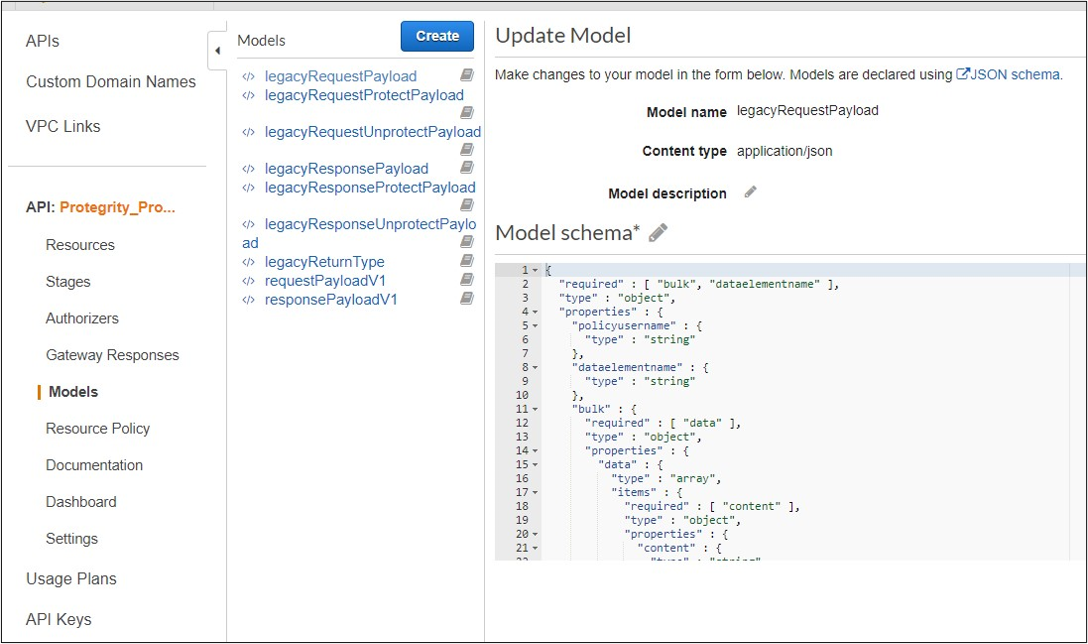
Performs a policy operation such as protect, unprotect, or reprotect.
Method
POST
Parameters
dataelementname: (protect/unprotect) Data element to use for the policy operation.
externaliv: (protect/unprotect) Optional, external initialization vector.
newdataelementname: (reprotect) Data element to use for the output.
newexternaliv: (reprotect) Optional, external initialization vector for the output.
olddataelementname: (reprotect) Data element to use for the input.
oldexternaliv: (reprotect) Optional, external initialization vector for the input.
policyusername: User performing the operation.
bulk.id: Optional, identifier for the request.
bulk.data[].content: Input data to the policy operation.
Result
Returns the output of the policy operation.
{
  "protect": {
    "policyusername": "user1",
    "dataelementname": "Alphanum",
    "bulk": {
      "id": "1",
      "data": [
        {
          "content": <Data encoded in base64>
        }
      ]
    }
  }
}
{
  "protect": {
    "policyusername": "user1",
    "dataelementname": "Alphanum",
    "externaliv": "abc123",
    "bulk": {
      "id": "1",
      "data": [
        {
          "content": <Data encoded in base64>
        }
      ]
    }
  }
}
{
  "unprotect": {
    "policyusername": "user1",
    "dataelementname": "Alphanum",
    "bulk": {
      "id": "1",
      "data": [
        {
          "content": <Data encoded in base64>
        }
      ]
    }
  }
}
{
  "reprotect": {
    "policyusername": "user1",
    "newdataelementname": "deName",
    "olddataelementname": "Alphanum",
    "bulk": {
      "id": "1",
      "data": [
        {
          "content": <Data encoded in base64>
        }
      ]
    }
  }
}
Example:
{"protect":{"bulk":{"returntype":"success","data":[{"returntype":"success","message":"Data
 protection was successful.","content":"RGZBUFR4ODAzejFwNjQ5TWg0TEFpcFNqbA=="},{"returntype":"success",
"message":"Data protection was successful.","content":"aHNnVVB5QWFDYw=="}]}}}
The following factors may cause variation in real performance versus benchmarks:
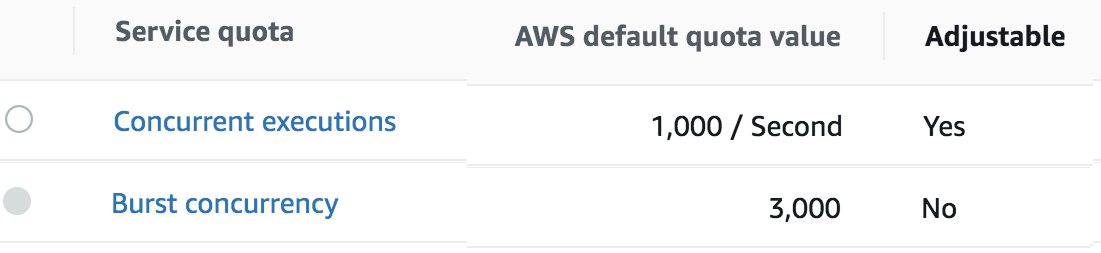
AWS maintains quotas for Lambda concurrent execution. Two of these quotas impact concurrency and compete with other Lambdas in the same account and region.
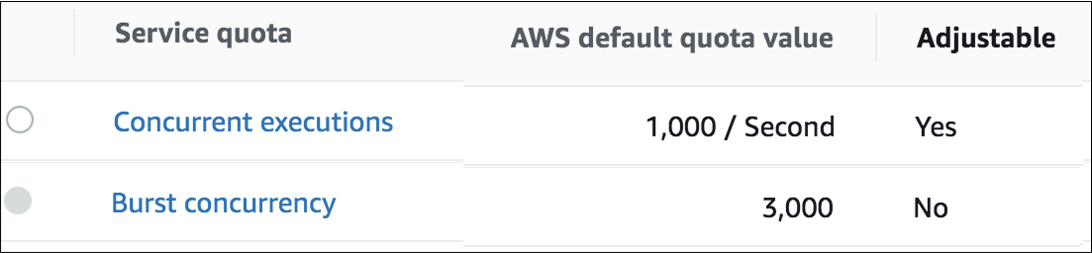
The concurrent executions quota cap is the maximum number of Lambda instances that can serve requests for an account and region. The default AWS quota may be inadequate based on peak concurrency based on the table in the previous section. This quota can be increased with an AWS support ticket.
The Burst concurrency quota limits the rate at which Lambda will scale to accommodate demand. This quota is also per account and region. The burst quota cannot be adjusted. AWS will quickly scale until the burst limit is reached. After the burst limit is reached, functions will scale at a reduced rate per minute (e.g. 500). If no Lambda instances can serve a request, the request will fail with a 429 Too Many Requests response.
The burst limit is a fixed value and varies significantly by AWS region. The highest burst (3,000) is currently available in the following regions: US West (Oregon), US East (N.Virginia), and Europe (Ireland). Other regions can burst between 500 and 1,000. It is recommended to select an AWS region with the highest burst limits.
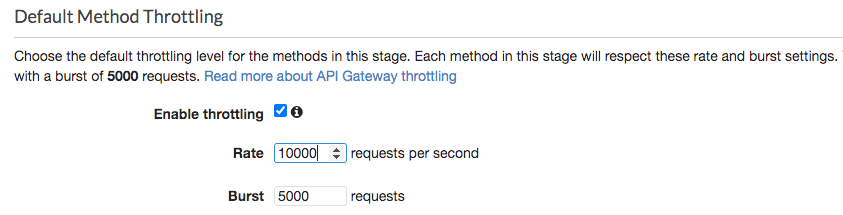
AWS maintains a Throttle quota for the API Gateway. By default, API Gateway limits concurrent requests to 10,000 requests per second and throttles subsequent traffic with a 429 Too Many Requests error response. This quota applies across all APIs in an account and region.
The API Gateway default quota may need to be increased based on the Concurrency table. Keep in mind that hitting quota limits effectively throttles any other API services in the region.
The API Gateway also limits burst. Burst is the maximum number of concurrent requests that API Gateway can fulfill at any instant without returning 429 Too Many Requests error responses. This limit can be increased by AWS, but is not adjustable.
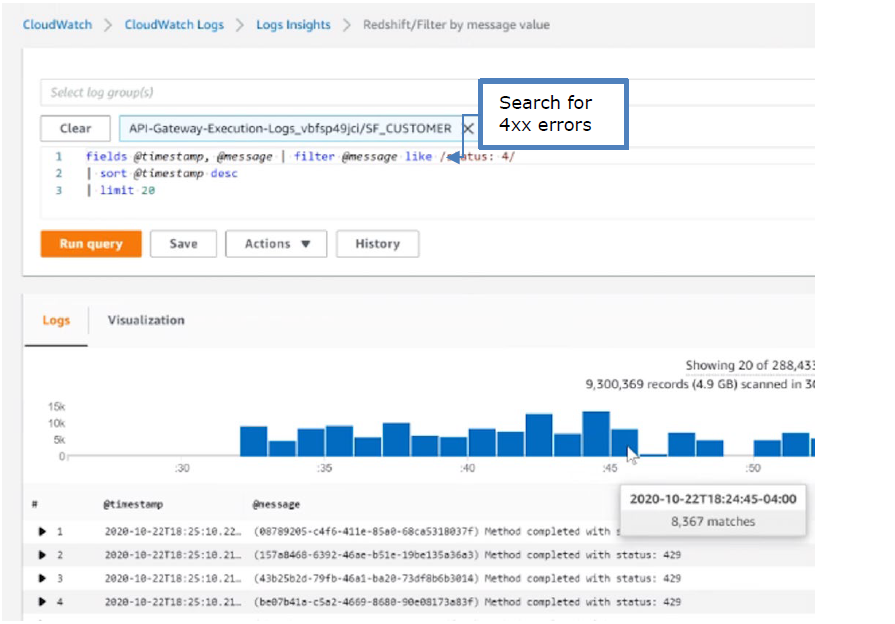
Enable CloudWatch metrics within the API Gateway to monitor max concurrency and investigate throttling errors. See the Concurrency Troubleshooting section on interpreting CloudWatch metrics.
Quotas adjustments are applied for region and account. Throttling is also enabled by default in the API Gateway stage used by the Protegrity Lambda function. The stage configuration throttling must be adjusted if the quota is modified. Stage throttling is shown in the following image.
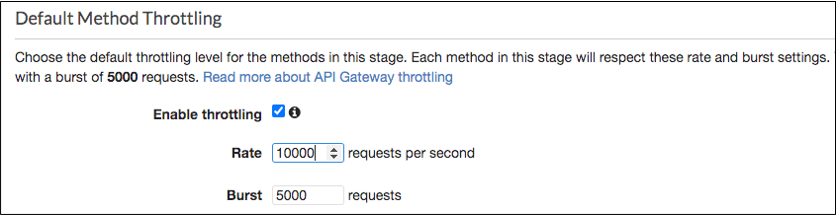
For example, the REST Client makes over 20,000 requests/sec to execute the given query. Using API Gateway’s default settings, the requests exceeding 10,000 requests/sec will be throttled. Therefore, this query may fail intermittently due to a high number of throttling errors.
Hitting up against quota limits may indicate that quota adjustments are required. Exceeding quota limits may cause a client query to fail or reduce performance. In the worst case, significant throttling can impact the performance of all your API Gateway or Lambda services in the region.
CloudWatch Metrics can be manually enabled on the API Gateway to reveal if quotas are being reached. Metrics aggregate errors into two buckets that are 4xx and 5xx. CloudWatch logs can be used to access the actual error code. The following table describes how to interpret the CloudWatch metrics.
| Error Type | Possible issue | Remedy |
|---|---|---|
| 4xx errors | API Gateway burst or throttle quota exceeded | Request an increase to the API Gateway throttle quota. |
| 5xx errors | Lambda concurrent requests or burst quota exceeded. Verify 4xx errors in Lambda Metrics. | Request an increase the Lambda concurrent request quota |
The following screenshot shows an example of searching CloudWatch Logs using Log Insights:
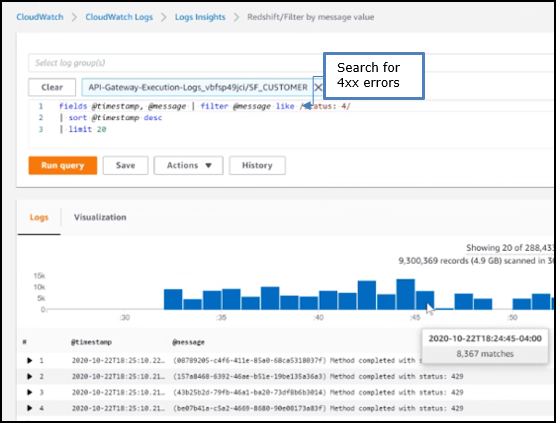
Cold-start vs warm execution refers to the state of the Lambda when a request is received. A cold-start undergoes additional initialization, such as, loading the security policy. Warm execution applies to all subsequent requests served by the Lambda.
The following table shows an example how these states impact latency and performance:
| Execution state | Avg. Execution Duration | Avg. Total (w/ network latency) |
|---|---|---|
| Cold execution | 438 ms | 522 ms |
| Warm execution | < 2ms | 84 ms |
Log forwarder architecture is optimized to minimize the amount of connections and reduce the overall network bandwidth required to send audit logs to ESA. This is achieved with batching and aggregation taking place on two levels. The first level is in protect function instances, where audit logs from consecutive requests to an instance are batched and aggregated. The second level of batching takes place in Amazon Kinesis Stream where log records from different protect function instances are additionally batched and sent to log forwarder function where they are aggregated. This section shows how to configure the deployment to accommodate different patterns of anticipated audit log stream. It also shows how to monitor deployment resources to detect problems before audit records are lost.
Protector Cloud Formation Parameters
AuditLogFlushInterval: Determines the minimum amount of time required for the audit log to be sent to Amazon Kinesis. Changing flush interval may affect the level of aggregation, which in turn may result in different number of connections and different data rates to Amazon Kinesis. Default value is 30 seconds.
Increasing the flush interval may result in higher aggregation of audit logs, in fewer connections to Amazon Kinesis, in higher latency of audit logs arriving to ESA and in higher data throughput.
Lowering the flush interval may result in lower aggregation of audit logs, in more connections to Amazon Kinesis, in lower latency of audit logs arriving to ESA and in lower data throughput.
It is not recommended to reduce the flush interval from default value in production environment as it may overload the Amazon Kinesis service. However, it may be beneficial to reduce flush interval during testing to make audit records appear on ESA faster.
Log Forwarder Cloud Formation Parameters
Amazon KinesisLogStreamShardCount: The number of shards represents the level of parallel streams in the Amazon Kinesis and it is proportional to the throughput capacity of the stream. If the number of shards is too low and the volume of audit logs is too high, Amazon Kinesis service may be overloaded and some audit records sent from protect function may be lost.
Default value is 10, however you are advised to test with a production-like load to determine whether this is sufficient or not.
Amazon KinesisLogStreamRetentionPeriodHours: The time for the audit records to be retained in Amazon Kinesis log stream in cases where log forwarder function is unable to read records from the Kinesis stream or send records to ESA, for example due to a connectivity outage. Amazon Kinesis will retain failed audit records and retry periodically until connectivity with ESA is restored or retention period expires.
Default value is 24 hours, however you are advised to review this value to align it with your Recovery Time Objective and Recovery Point Objective SLAs.
Monitoring Log Forwarder Resources
Amazon Kinesis Stream Metrics: Any positive value in Amazon Kinesis PutRecords throttled records metric indicates that audit logs rate from protect function is too high. The recommended action is to increase the Amazon KinesisLogStreamShardCount or optionally increase the AuditLogFlushInterval.
Log Forwarder Function CloudWatch Logs: If log forwarder function is unable to send logs to ESA, it will log the following message:
[SEVERE] Dropped records: x.
Protect Function CloudWatch Logs: If protect function is unable to send logs to Amazon Kinesis, it will log the following message:
[SEVERE] Amazon Kinesis error, retrying in x ms (retry: y/z) ..."
Any dropped audit log records will be reported with the following log message:
[SEVERE] Failed to send x/y audit logs to Amazon Kinesis.
Audit records and application logs stream to Amazon CloudWatch Logs or optionally be sent to ESA. Cloud Protect uses a JSON format for audit records that is described in the following sections.
You can analyze and alert on audit records using Protegrity ESA or Amazon CloudWatch. Third-party solutions may be used if they are supported by Amazon Cloudwatch or AWS Lambda logging extensions. For more information about forwarding your audit records to ESA, contact Protegrity. For more information about Amazon CloudWatch, refer to the Amazon CloudWatch User Guide.
For more information about audit records, refer to the Protegrity Analytics Guide.
The audit record format has been altered in version 3.1 of the protector to provide more information.
| Field | Description |
|---|---|
| additional_info.deployment_id | The deployment_id contains the name of the Protect Function. It is automatically set based on the cloud-specific environment variables assigned to the Protect Function. This allows identifying the Cloud Protect deployment responsible for generating audit log. |
| additional_info.cluster | (Optional) Redshift cluster ARN |
| additional_info.description | A human-readable message describing the operation |
| additional_info.query_id | (Optional) Identifies the query that triggered the operation |
| additional_info.request_id | (Optional) AWS Lambda request identifier |
| cnt | Number of operations, may be aggregated |
| correlationid | (Deprecated) Use additional_info instead |
| level | Log severity, one of: SUCCESS, WARNING, ERROR, EXCEPTION |
| logtype | Always “Protection” |
| origin.ip | The private IP address of the compute resource that operates the Protect Function and is responsible for generating the log entry.NoteThe IP address is private, meaning it is used for internal network communication and is not accessible directly from the public internet.When Log Forwarding is enabled the IP address may be aggregated into minimal CIDR blocks. |
| origin.hostname | Hostname of the system that generated the log entry |
| origin.time_utc | UTC timestamp when the log entry was generated |
| protection.audit_code | Audit code of the protect operation; see the log return codes table in the Protegrity Troubleshooting Guide |
| protection.dataelement | Data element used for the policy operation |
| protection.datastore | Name of the data store corresponding to the deployed policy |
| protection.mask_setting | (Optional) Mask setting from policy management |
| protection.operation | Operation type, one of: Protect, Unprotect, Reprotect |
| protection.policy_user | User that performed the operation |
| protector.core_version | Internal core component version |
| protector.family | Always “cp” for Cloud Protect |
| protector.lambda_version | Protector Lambda application version. |
| protector.pcc_version | Internal pcc component version |
| protector.vendor | Identifies the cloud vendor and the database vendor |
| protector.version | Protector version number |
| signature.checksum | Hash value of the signature key ID used to sign the log message when the log is generated |
| signature.key_id | Key used to sign the log message when the log is generated |
The following are sample audit messages:
Protect Success:
{
      "additional_info": {
        "deployment_id": "Protegrity-Protect-function-deployment-id",
        "description": "Data protect operation was successful.",
        "query_id": "sf-query-id:01978dbc-0582-d7e4-0000-002a3603a20d",
        "request_id": "8476a536-e9f4-11e8-9739-2dfe598c3fcd"
      },
      "cnt": 4000,
      "correlationid": "sf-query-id:01978dbc-0582-d7e4-0000-002a3603a20d",
      "logtype": "Protection",
      "level": "SUCESS",
      "origin": {
        "hostname": "localhost",
        "ip": "127.0.0.1",
        "time_utc": 1635363966
      },
      "protection": {
        "dataelement": "deAddress",
        "operation": "Protect",
        "audit_code": 6,
        "datastore": "SAMPLE_POLICY",
        "policy_user": "test_user"
      },
      process":{
        "name":"protect",
        "id":"13",
        "module":"coreprovider",
        "thread_id":"573580544",
        "user":"sbx_user1051",
        "platform":"\"Linux_x64\"",
        "version":"UNKNOWN"
      },
      "client": {
        "ip":"169.254.62.117"
      },
      "protector": {
        "family": "cp",
        "version": "4.0.0.102",
        "vendor": "aws.snowflake",
        "datastore":"SAMPLE_POLICY",
        "pcc_version": "4.0.0.9",
        "core_version": "2.1.4+0.g93016.2.1",
        "lambda_version":"4.0.1"
      },
      "signature": {
        "key_id": "95f5a194-b0a4-4351-a",
        "checksum": "B324AF7C56944D91C47847A77C0367C594C0B948E7E75654B889571BD4F60A71"
      }
    }
User permission denied:
{
      "additional_info": {
        "deployment_id": "Protegrity-Protect-function-deployment-id",
        "description": "The user does not have the appropriate permissions to perform the requested operation.",
        "query_id": "sf-query-id:01978dbc-0582-d7e4-0000-002a3603a20d",
        "request_id": "8476a536-e9f4-11e8-9739-2dfe598c3fcd"
      },
      "cnt": 4000,
      "correlationid": "sf-query-id:01978dbc-0582-d7e4-0000-002a3603a20d",
      "logtype": "Protection",
      "level": "ERROR",
      "origin": {
        "hostname": "localhost",
        "ip": "127.0.0.1",
        "time_utc": 1635363966
      },
      "protection": {
        "dataelement": "deAddress",
        "operation": "Protect",
        "audit_code": 3,
        "datastore": "SAMPLE_POLICY",
        "policy_user": "test_user"
      },
      process":{
        "name":"protect",
        "id":"13",
        "module":"coreprovider",
        "thread_id":"573580544",
        "user":"sbx_user1051",
        "platform":"\"Linux_x64\"",
        "version":"UNKNOWN"
      },
      "client": {
        "ip":"169.254.62.117"
      },
      "protector": {
        "family": "cp",
        "version": "4.0.0.102",
        "vendor": "aws.snowflake",
        "datastore":"SAMPLE_POLICY",
        "pcc_version": "4.0.0.9",
        "core_version": "2.1.4+0.g93016.2.1",
        "lambda_version":"4.0.1"
      },
      "signature": {
        "key_id": "95f5a194-b0a4-4351-a",
        "checksum": "A216797C56944D91C47847A77C0367C594C0B948E7E75654B889571BD4F60A71"
      }
    }
Data element not found:
{
      "additional_info": {
        "deployment_id": "Protegrity-Protect-function-deployment-id",
        "description": "The data element could not be found in the policy.",
        "query_id": "sf-query-id:01978dbc-0582-d7e4-0000-002a3603a20d",
        "request_id": "8476a536-e9f4-11e8-9739-2dfe598c3fcd"
      },
      "cnt": 4000,
      "correlationid": "sf-query-id:01978dbc-0582-d7e4-0000-002a3603a20d",
      "logtype": "Protection",
      "level": "ERROR",
      "origin": {
        "hostname": "localhost",
        "ip": "127.0.0.1",
        "time_utc": 1635363966
      },
      "protection": {
        "dataelement": "deAddress",
        "operation": "Protect",
        "audit_code": 2,
        "datastore": "SAMPLE_POLICY",
        "policy_user": "test_user"
      },
      process":{
        "name":"protect",
        "id":"13",
        "module":"coreprovider",
        "thread_id":"573580544",
        "user":"sbx_user1051",
        "platform":"\"Linux_x64\"",
        "version":"UNKNOWN"
      },
      "client": {
        "ip":"169.254.62.117"
      },
      "protector": {
        "family": "cp",
        "version": "4.0.0.102",
        "vendor": "aws.snowflake",
        "datastore":"SAMPLE_POLICY",
        "pcc_version": "4.0.0.9",
        "core_version": "2.1.4+0.g93016.2.1",
        "lambda_version":"4.0.1"
      },
      "signature": {
        "key_id": "95f5a194-b0a4-4351-a",
        "checksum": "AF09217C56944D91C47847A77C0367C594C0B948E7E75654B889571BD4F60A71"
      }
    }
The security policy maintains a No Access Operation, configured in an ESA, which determines the response for unauthorized unprotect requests.
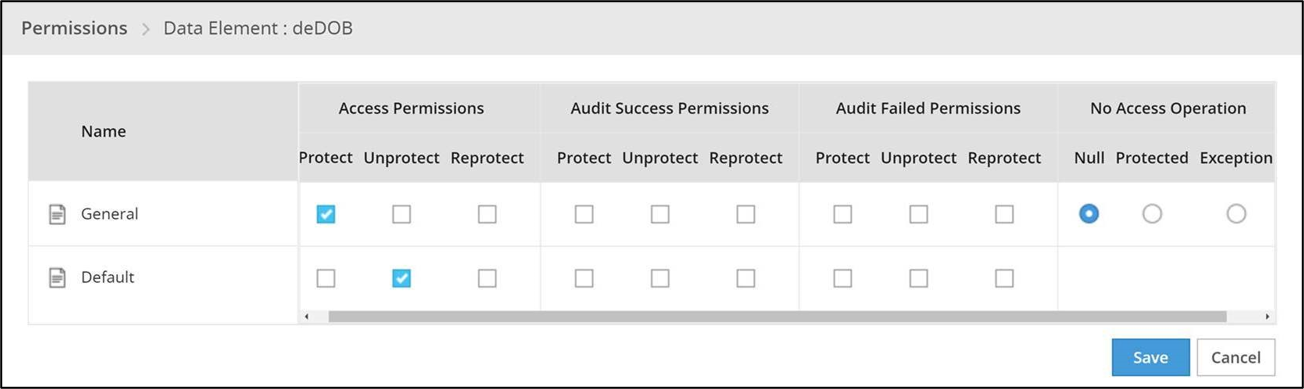
The following table describes the result returned in the response for the various no access unprotect permissions.
| No Access Operation | Data Returned |
|---|---|
| Null | null |
| Protected | (protected value) |
| Exception | Query will fail with an exception |
Known product limitations:
You can download the latest version of the deployment package from https://my.protegrity.com. Navigate to Data Protection > Cloud Protect to download the latest version.
After downloading the deployment package from the Protegrity Portal, unzip the package to extract the artifact files. In the AWS Console, navigate to the S3 bucket that was previously created to upload deployment artifacts (see: Create S3 bucket for Installing Artifacts).
Upload the following artifacts to the S3 bucket:
- -If the release version matches your existing deployment, you don’t need to upload it again. Save the following artifacts on your local system so that you have them available during the next steps:
- -Perform the following steps to upgrade the Agent Lambda and Protect Lambda separately.
Cloud Watch Event Rule is used to periodically run Protegrity Agent Function to synchronize policy from ESA. This functionality is optional when deploying Protegrity Serverless Solution. If the Event Rule is enabled, it must be disabled temporarily for the time of the upgrade process.
Follow the steps below to determine if your deployment uses Event Rule and disable it.
Go to AWS Cloud Formation and select existing Protegrity deployment stack.
Select Resources tab from the top portion of the screen.
Check if there is a resource with ScheduledRule LogicalID. If there is no such resource you can skip to Upgrading Policy Agent Lambda section. If the scheduled rule is there, continue with the next steps in this section.
Click on the Physical ID link in the ScheduledRule row. The link opens Policy Agent Event Rule configuration.
Select Disable from the top-right portion of the screen. This will disable the rule. You will re-enable it after the upgrade process is complete.
Go to AWS Lambda console and select existing Protegrity Agent Lambda.
Click Actions in top right portion of the screen. Select Publish new version. Click Publish. The version of Agent Lambda you just created will serve as restore point in the case you needed to rollback the upgrade.
Go to Lambda Configuration > Environment variables.
Record environment variables values. You will use them later to configure upgraded Lambda Function. You can use the aws cli command below to save the function variables into the local json file:
aws lambda get-function-configuration --function-name \
arn:aws:lambda:<aws_region>:<aws_account>:function:<function_name> \
--query Environment > <function_name>_env_config.json
Go to AWS Cloud Formation and select existing Protegrity Agent deployment stack.
Select Update. Check Replace current template > Upload a template file.
Upload pty_agent_cf.json file and select Next.
Click Next until Review window and then select Update stack.
Wait for the Cloud Formation to complete.
Navigate back to Agent Lambda Function.
Go to Configuration > Environment variables. Replace placeholder values with values recorded in previous step. Alternatively, you can run the following aws cli command to update function configuration using json file saved in the previous steps:
aws lambda update-function-configuration --function-name \
arn:aws:lambda:<aws_region>:<aws_account>:function:<function_name> \
--environment file://./<function_name>_env_config.json
If your current agent installation version is lower than 3.0.12, make sure you set the following function configuration variables:
If you are upgrading from versions prior to v3.0, backup and remove existing policy from the bucket defined by AWS_POLICY_S3_BUCKET property, so that the policy can be re-downloaded and re-encrypted with new ‘key commitment’ feature.
If you are upgrading from version prior to 1.6.1 please follow the steps below, otherwise the upgrade process is completed.
From AWS Console, navigate to IAM > Policies
Search for the Agent Lambda IAM Policy created in Create Agent Lambda IAM policy
Click on the policy, then select Edit Policy. Select JSON tab.
Add the following statement to the list of policy statements.
{
  "Sid": "LambdaGetConfiguration",
  "Effect": "Allow",
  "Action": [
      "lambda:GetFunctionConfiguration"
  ],
  "Resource": [
      "arn:aws:lambda:*:*:function:*"
  ]
}
Click Review Policy, then Save Changes. Wait for the changes to save.
Publish Log Forwarder Lambda Version
Publishing a version of the Log Forwarder Lambda allows to roll-back to pre-existing version if upgrade fails
Go to AWS Lambda console and select existing Protegrity Log Forwarder Lambda.
Click Actions in top right portion of the screen. Select Publish new version. Click Publish.
Record the Lambda version number. It will be displayed at the top of the screen. You can also retrieve it from the Lambda function view, under Versions tab.
Log Forwarder Lambda version number for roll-backs: ___________________
Disable Kinesis Trigger
Disabling Kinesis trigger ensures there are no unprocessed or re-processed events while function is upgraded.
Upgrade Forwarder Lambda Version
Upgrade Log Forwarder function with new code
Enable Kinesis Trigger
Monitor and roll-back
Monitor Log Forwarder function for errors in its CloudWatch logs and in Montior tab. To roll back function to the previous version if any errors occur follow these steps:
Go to AWS Lambda console and select existing Protegrity Log Forwarder Lambda.
Select Configuration tab > Triggers
Expand Details section of Kinesis trigger and record UUID value
Execute the following AWS CLI command to move Kinesis trigger to previous version of Log Forwarder Lambda that was created earlier and recorded as Log Forwarder Lambda version number for roll-backs. Substitute kinesis-mapping-uuid, log-forwarder-function-name, version-for-roll-backs with your values:
aws lambda update-event-source-mapping --uuid <kinesis-mapping-uuid> --function-name <log-forwarder-function-name>:<version-for-roll-backs>
Find Kinesis trigger attached to previous version of Log Forwarder Lambda by navigating Versions tab > Version number link in the Versions column Kinesis trigger is now moved to previous version of Log Forwarder Lambda function.
Diagram below illustrates upgrade steps.
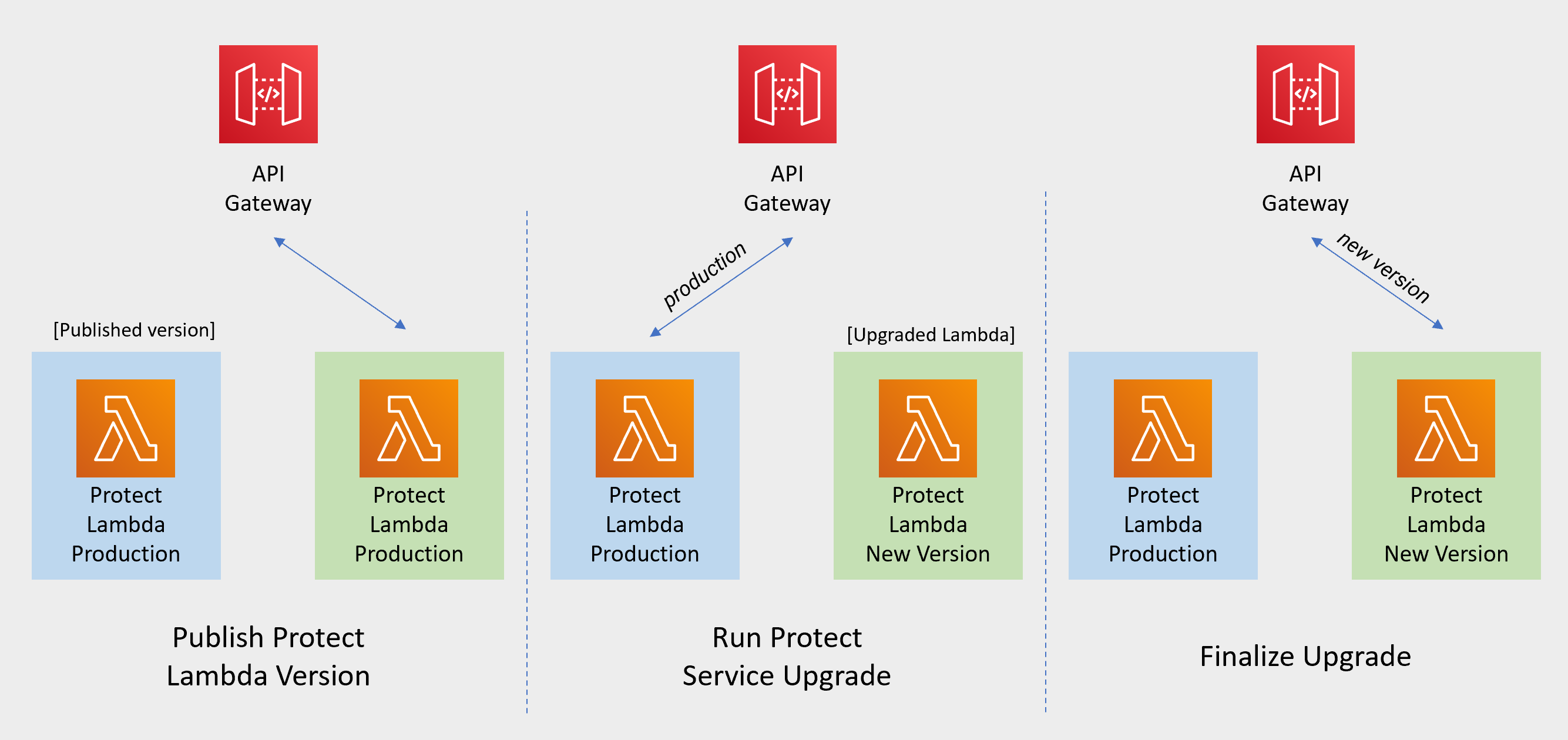

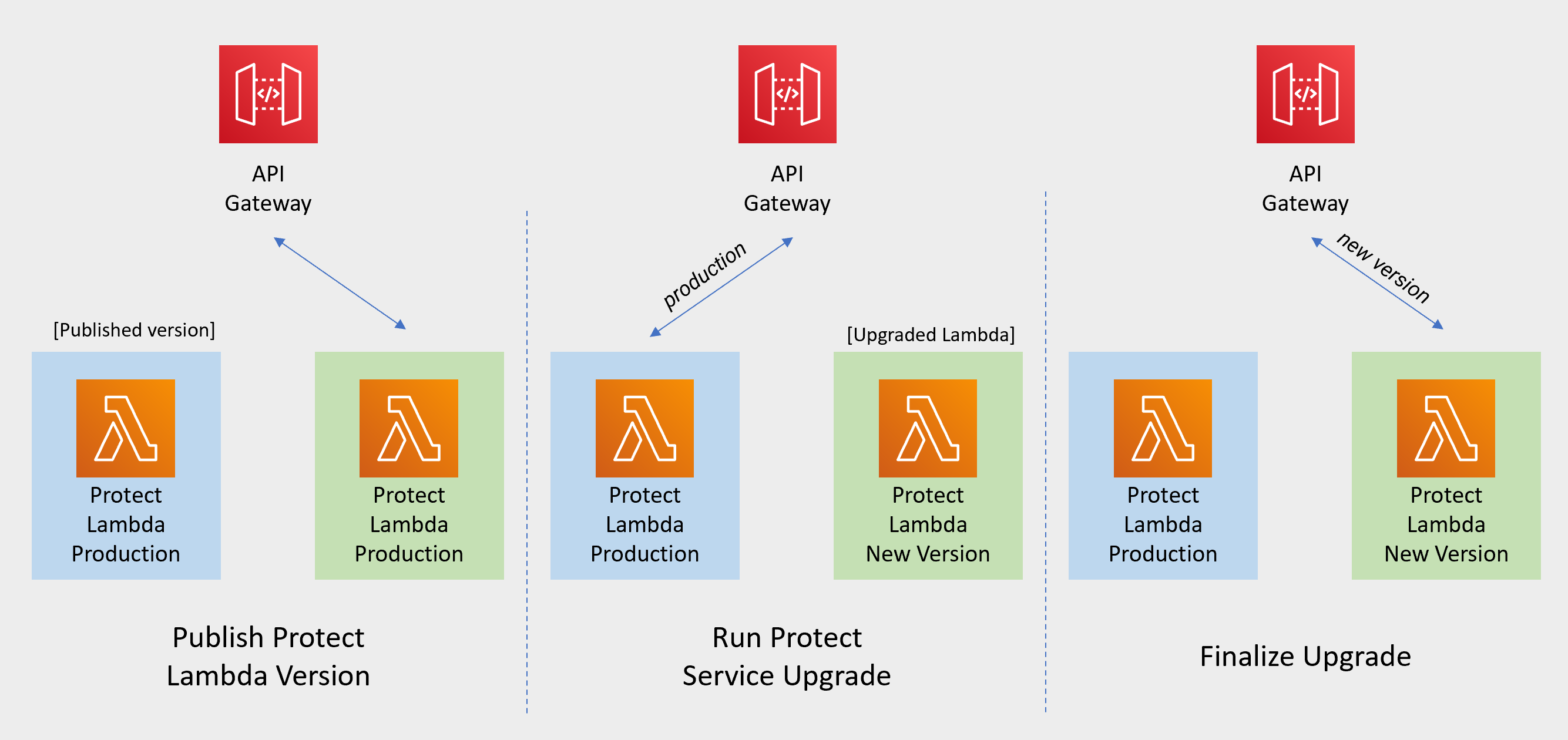
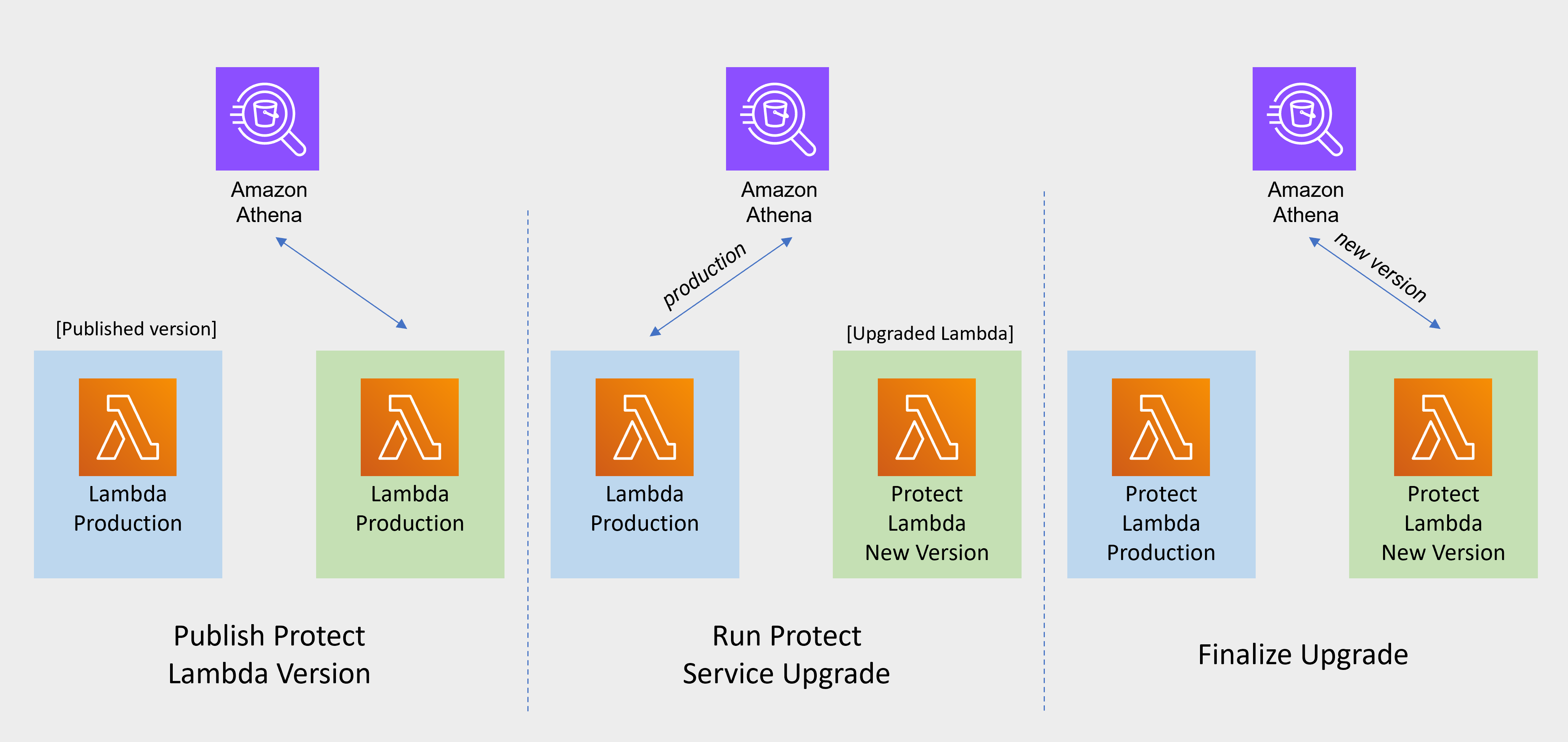
Publish Protect Lambda Version
Publishing a version of the Protect Lambda allows updating it without interruptions to the existing traffic.
Go to AWS Lambda console and select existing Protegrity Protect Lambda.
Go to Lambda Configuration > Environment variables.
Record environment variables values. You will use them later to configure upgraded Lambda Function. You can use the aws cli command below to save the function variables into the local json file:
aws lambda get-function-configuration --function-name \
arn:aws:lambda:<aws_region>:<aws_account>:function:<function_name> \
--query Environment > <function_name>_env_config.json
Click Actions in top right portion of the screen. Select Publish new version. Click Publish.
Record the Lambda version number. It will be displayed at the top of the screen. You can also retrieve it from the Lambda function view, under Versions tab.
Protect Lambda version number: ___________________
If you are upgrading a Cloud Protect Redshift version 1.x to 2.x/3x, you must recreate your Redshift external function definitions with Protect Lambda Function version appended to the Lambda Function name. See example below.
CREATE OR REPLACE EXTERNAL FUNCTION PTY_PROTECT_TEST ( val varchar )
    RETURNS varchar
    VOLATILE lambda
    'Protegrity_Protect_test:<protect_lambda_version_number>' iam_role
    'arn:aws:iam::123456789212:role/example_role';
Run protect service upgrade
In this step, the Protect service including Lambda $LATEST version will be updated using Cloud Formation template. The Lambda version created in previous step will be used to serve existing traffic during the upgrade process.
Go to AWS Cloud Formation and select existing Protegrity deployment stack.
Select Update. Check Replace current template > Upload a template file.
Upload pty_protect_cf.json file and select Next.
Update ProtectFunctionProductionVersion parameter with Protect Lambda version number recorded in step 3.
Click Next until Review window and then select Update stack.
Wait for the Cloud Formation to complete.
Go back to Lambda console and select Protect Lambda.
Go to Configuration > Environment variables. Replace placeholder values with values recorded in previous step. Alternatively, you can run the following aws cli command to update function configuration using json file saved in the previous steps:
aws lambda update-function-configuration --function-name \
arn:aws:lambda:<aws_region>:<aws_account>:function:<function_name> \
--environment file://./<function_name>_env_config.json
If your current protect installation version is lower than 3.0.14, you can optionally set the following variable:
Navigate to Aliases tab. Verify that Production alias points to the lambda version you specified in the cloud formation template.
The upgraded Protect Lambda is configured with a sample policy. Run Agent Lambda Function before continuing with next steps.
Finalize upgrade
In this step, the Protect Lambda will be configured to serve traffic using $LATEST version upgraded in the previous step.
Go back to Protegrity AWS Cloud Formation deployment stack.
Select Update. Check Use Current template.
Update ProtectFunctionProductionVersion parameter with the following value: $LATEST.
Click Next until Review window and then select Update stack.
Go back to Lambda console and select Protect Lambda.
From the Lambda console, verify that Latest alias points to $LATEST version.
Test your function to make sure it works as expected.
If you are upgrading a Cloud Protect Redshift version 1.x to 2.x/3x, you must recreate your Redshift external function definitions with Protect Lambda Function version appended to the Lambda Function name. See example below.
CREATE OR REPLACE EXTERNAL FUNCTION PTY_PROTECT_TEST ( val varchar )
    RETURNS varchar
    VOLATILE lambda
    'Protegrity_Protect_test:Production' iam_role
    'arn:aws:iam::123456789212:role/example_role';
If you need to rollback to older version of Protect Lambda, you can re-run the cloud formation with ProtectFunctionProductionVersion parameter set to the previous version of Protect Lambda.
If the Event Rule was disabled at the beginning of the upgrade process, you must re-enabled it. Follow the steps below to re-enable Policy Agent Event rule.
Go to the Protegrity Agent Cloud Formation Stack.
Select Resources tab from the top portion of the screen.
Click on the Physical ID link in the ScheduledRule row. The link opens Policy Agent Event Rule configuration.
Select Enable from the top-right portion of the screen. This will enable the rule. You will re-enable it after the upgrade process is complete.
Common use case for Protegrity Policy Member source integrates with customer’s Active Directory. The AWS API Gateway can integrate with ADFS using AWS Cognito. The following article describes the procedure.
The Policy Agent Lambda function and Protect Lambda functions can be installed in separate AWS accounts. However, additional configuration is required to authorize the Policy Agent to provision the security policy to a remote Protect Lambda function.
Login to the AWS account that hosts the Protect Lambda function.
From the AWS IAM console, select Policies > Create Policy.
Select the JSON tab and copy the following snippet.
{
  "Version": "2012-10-17",
  "Statement": [
    {
      "Sid": "LambdaUpdateFunction",
      "Effect": "Allow",
      "Action": [
        "lambda:UpdateFunctionConfiguration"
      ],
      "Resource": [
        "arn:aws:lambda:*:*:function:*"
      ]
    },
    {
      "Sid": "LambdaReadLayerVersion",
      "Effect": "Allow",
      "Action": [
        "lambda:GetLayerVersion",
        "lambda:ListLayerVersions"
      ],
      "Resource": "*"
    },
    {
      "Sid": "LambdaDeleteLayerVersion",
      "Effect": "Allow",
      "Action": "lambda:DeleteLayerVersion",
      "Resource": "arn:aws:lambda:*:*:layer:*:*"
    },
    {
      "Sid": "LambdaPublishLayerVersion",
      "Effect": "Allow",
      "Action": "lambda:PublishLayerVersion",
      "Resource": "arn:aws:lambda:*:*:layer:*"
    },
    {
      "Sid": "S3GetObject",
      "Effect": "Allow",
      "Action": [
        "s3:GetObject"
      ],
      "Resource": "arn:aws:s3:::*/*"
    },
    {
      "Sid": "S3PutObject",
      "Effect": "Allow",
      "Action": [
        "s3:PutObject"
      ],
      "Resource": "arn:aws:s3:::*/*"
    },
    {
      "Sid": "LambdaGetConfiguration",
      "Effect": "Allow",
      "Action": [
          "lambda:GetFunctionConfiguration"
      ],
      "Resource": [
          "arn:aws:lambda:*:*:function:*"
      ]
    }
  ]
}
Replace the wildcards (*) with the region, account, and resource name information where required.
Select Review policy, type in the policy name, and confirm. Record policy name:
Agent Lambda Cross Account Policy Name: ___________________
Login to the AWS account that hosts the Protect Lambda function.
From the AWS IAM console, select Roles > Create Role
Select AWS Service > Lambda . Proceed to Permissions.
Select Policy created in the step above. Proceed to Tags.
Specify Tag, proceed to the final screen. Type in policy name and confirm. Record the name.
Policy Agent Cross Account IAM Role Name: ___________________
Login to the AWS account that hosts the Protect Lambda function.
Navigate to the previously created IAM Role (Agent Lambda Cross-Account IAM Role Name).
Navigate to Trust Relationships > Edit Trust Relationships.
Modify the Policy Document, replacing the placeholder value indicated in the following snippet as <Agent Lambda IAM Execution Role ARN> with ARN of Agent Lambda IAM Role that was created in Agent Installation.
{
  "Version": "2012-10-17",
  "Statement": [
    {
      "Effect": "Allow",

   "Principal": {

            "AWS": "<Agent Lambda IAM Execution Role Name>"

      },
      "Action": "sts:AssumeRole"
    }
  ]
}
Click Update Trust Policy.
Login to the AWS account that hosts the Policy Agent.
Navigate to the Agent Lambda IAM Execution Role that was created in Agent Installation.
{
  "Version": "2012-10-17",
  "Statement": [
    {
      "Effect": "Allow",

   "Principal": {

            "AWS": "<Agent Lambda IAM Execution Role Name>"

      },
      "Action": "sts:AssumeRole"
    }
  ]
}
Add Inline Policy.
Modify the Policy Document, replacing the placeholder value indicated in the following snippet as <Agent Lambda Cross-Account IAM ARN> with the value recorded in Create Policy Agent cross-account IAM Role.
{
  "Version": "2012-10-17",
  "Statement": [
    {
      "Effect": "Allow",
      "Action": [
        "sts:AssumeRole"
      ],
      "Resource": "<Agent Lambda Cross-Account IAM  ARN>."
    }
  ]
}
When you are finished, choose Review Policy.
On the Review policy page, type a Name, then choose Create Policy.
From the AWS console, navigate to Lambda, and select the Policy Agent Lambda function.
Select Configuration tab | Environment variables.
Select Edit and add the following environment variables with the value from Agent Lambda Cross-Account IAM ARN:
| Parameter | Value |
|---|---|
| AWS_ASSUME_ROLE | Agent Lambda Cross-Account IAM ARN |
Ensure the values in the Parameters AWS_POLICY_S3_BUCKET, AWS_PROTECT_FN_NAME and AWS_POLICY_LAYER_NAME are all in the Protect Lambda Function AWS Account.
In case custom VPC hostname configuration is used, you will need to set the ENDPOINT_URL. Refer to Policy Agent - Custom VPC Endpoint Hostname Configuration.
AWS_VPC_ENDPOINT_URL | <AWS_VPC_ENDPOINT> |
Click Save and Run the Lambda. The Lambda will now assume the Role in Protect Lambda Function AWS Account and update the policy cross accounts.
| Feature | ESA 10.2 | PPC (this guide) |
|---|---|---|
| Datastore Key Fingerprint | Optional/Recommended | Required |
| CA Certificate on Agent | Optional/Recommended | Optional/Recommended |
| CA Certificate on Log Forwarder | Optional/Recommended | Not supported |
| Client Certificate Authentication from Log Forwarder | Optional/Recommended | Not supported |
| IP Address | ESA IP address | PPC address |
curl, kubectl installed.Follow these instructions as a guide for understanding specific inputs for Policy Agent integrating with PPC:
Obtain the Datastore Key Fingerprint
To retrieve the fingerprint for your Policy Agent:
Retrieve public key from the Cloud Provider Key Management service for the policy encryption key created in pre-configuration:
Escape the new line characters in the downloaded public key for use in the next step - for example:
awk 'NF {printf "%s\\n",$0}' "<public_key_file>" > "new-line-escaped-public-key.pem"
cat new-line-escaped-public-key.pem
Export key fingerprint using the PPC API as indicated in the curl example below:
curl -k -H "Authorization: Bearer ${TOKEN}" -X POST https://${HOST}/pty/v2/pim/datastores/1/export/keys  -H "Content-Type: application/json" --data '{
  "algorithm": "RSA-OAEP-256",
  "description": "example-key-from-key-management",
  "pem": "<value of new-line-escaped-public-key>"
}'
Sample Output:
{"uid":"1","algorithm":"RSA-OAEP-256","fingerprint":"4c:46:d8:05:35:2e:eb:39:4d:39:8e:6f:28:c3:ab:d3:bc:9e:7a:cb:95:cb:b1:8e:b5:90:21:0f:d3:2c:0b:27","description":"example-key-from-kms"}
Record the value for fingerprint and configure the Policy Agent:
Set the environment variable PTY_DATASTORE_KEY in the Policy Agent Lambda function to the fingerprint value.
Set the environment variable PTY_DATASTORE_KEY in the Policy Agent Function App to the fingerprint value.
Set the variable in Policy Agent main.tf pty_datastore_key to the fingerprint value and apply the changes.
Retrieve the PPC CA Certificate
To obtain the CA certificate from PPC:
kubectl -n api-gateway get secret ingress-certificate-secret -o jsonpath='{.data.ca\.crt}' | base64 -d > CA.pem
Use the ProtegrityCA.pem that was returned as described in Policy Agent Installation.
Configure the PPC Address
Use the PPC address in place of the ESA IP address wherever required in your configuration.
PTY_ESA_CA_SERVER_CERT is not provided.AWS Lambda can be invoked directly, such as from AWS SDK. This section contains information about request and response payloads with examples demonstrating direct invocation using AWS CLI and Python SDK (Boto3).
Lambda request payload for the direct invocation is defined as following
{
  "body": "<rest-api-request-payload>",
  "path": "/v1/<operation>",
  "headers": {}
}
Example request:
{
  "body": "{\"query_id\": \"3\",\"user\": \"user1\",\"data_element\": \"deAlpha\",\"data\": [\"data1\", \"data2\"]}",
  "path": "/v1/protect",
  "headers": {}
}
Example Request with JWT authorization:
Lambda Environment sample configuration:
authorization="jwt"
jwt_verify=1
allow_assume_user=1
jwt_user_claim="username"
jwt_secret_base64="Must be set to public certificate"
See REST API Authorization for JWT configuration details.
{
  "body": "{\"query_id\": \"3\",\"user\": \"user1\",\"data_element\": \"deAlpha\",\"data\": [\"data1\", \"data2\"]}",
  "path": "/v1/protect",
  "headers": {
    "authorization": "bearer eyJhbGciOiJSUzI1NiIsInR5cCI6IkpXVCJ9.eyJpYXQiOjE2MTM4NjIzNzEsImlkIjoiYS1iLWMtZC1lLWYtMS0yLTMiLCJ1c2VybmFtZSI6IlBhdWwgQXRyZWlkZXMifQ.R1NcJ43540HKdhEBOK9WaMMpjBOYSJetckQKrcPQdz0z6sx1EDwHXYngBP9DtHgUM-6Vf1VNjtFh_Nqfeepp1BavmigIXoe3ZbrxRI3DFKi2UuLmgn--EYrSGlWsQjnmjaz5qUkID9iY2MtsRunKSuolSvG9UsD1G32kv0KZYX0"
  }
}
Lambda response payload has the following structure
{
  "body": "<rest-api-response-payload>"
  "isBase64Encoded": false,
  "statusCode": <http-status-code>,
}
Success Response Payload Example:
{
  "body": "{\"encoding\":\"utf8\",\"results\":[\"xcgd\", \"migs\"],\"success\":true}",
  "isBase64Encoded": false,
  "statusCode": 200
}
Cloud API Lambda returns following error responses depending on the error type
Cloud API Protection Operation Error
Returned when invalid data element is used or user has insufficient permissions to execute security operation.
{
  "body": "{\"error_msg\":\"Unprotect failed. Data element not found. Refer to audit log for details.\",\"success\":false}",
  "isBase64Encoded": false,
  "statusCode": 400
}
Cloud API Invalid Request Error
Missing fields in the incoming request or malformed request JSON.
{
  "body": "Request format is not supported",
  "isBase64Encoded": false,
  "statusCode": 400
}
Cloud API Unexpected Lambda Exception Error
Caused by Lambda runtime exception, for instance due to too short timeout or not enough memory.
{
  "errorMessage": "2023-01-18T16:42:19.593Z d0cf62d0-9eaf-427b-8ca5-1bdd8bd0b082 Task timed out after 10.25 seconds"
}
Prerequisites:
See Request Payload for request payload examples.
AWS CLI command to invoke Cloud API Lambda function:
aws lambda invoke --function-name Protegrity_Protect_RESTAPI_{stackname} --payload
    fileb://request_payload.json --log-type Tail output
Sample Python code demonstrating Cloud API Direct Lambda Calls
import json
import logging
import boto3
lambda_client = boto3.client("lambda")
logging.basicConfig(format="%(message)s")
logger = logging.getLogger('pty_cloud_api_sample')
logger.setLevel(logging.DEBUG)


class ProtectClient(object):
  """
    Sample client demonstrating how to invoke Protegrity Cloud API Lambda

      protect_fn: str - Name of the Cloud API Lambda (for example, Protegrity_Protect_RESTAPI_my_deployment)
  """

  def __init__(self, protect_fn):
    self.protect_fn = protect_fn

  def invoke_protect(self, values, data_element, operation, user, query_id,
              column_info=""):
    """
    Invokes Protegrity Cloud API Lambda to execute protect or unprotect operation

      values: list[str] - List of values to be protected/unprotected
      data_element: str - Name of the policy data element to use with protect/unprotect operation
      operation: str - Either 'protect' or 'unprotect'
      user: str - Policy user
      query_id: str - Query id will be present in the audit log
      column_info: - Used for troubleshooting, for instance, when protecting values/rows from multiple database columns
    """

    # Set authorization header here if JWT authorization is
    # enabled in Cloud API Function configuration
    headers = {"Authorization": ""}
    request_body = {
      "user": user,
      "data_element": data_element,
      "data": values,
      "query_id": query_id
    }
    payload = json.dumps({"body": json.dumps(request_body), "path": f"/v1/{operation}",
                  "headers": headers})
    logger.debug(f"Request payload: {payload}")
    response = lambda_client.invoke(FunctionName=self.protect_fn, Payload=payload)
    lambda_response_payload = json.loads(response["Payload"].read().decode())
    logger.debug(f"Response payload: {lambda_response_payload}")
    response_status_code = lambda_response_payload.get("statusCode")
    response_body_string = lambda_response_payload.get("body")
    if response_status_code == None or response_body_string == None:
      raise Exception(f"Unexpected Cloud API Lambda error: [{lambda_response_payload}]")
    try:
      body_json = json.loads(response_body_string)
      if response_status_code == 200:
        return body_json.get("results", [])
      elif body_json.get("error_msg"):
        raise Exception(f"Cloud API Lambda error: [{response_status_code} - {body_json.get('error_msg')}]")
      raise Exception(f"Unexpected Cloud API Lambda error: [{lambda_response_payload}]")
    except json.decoder.JSONDecodeError:
      # Cloud API may return error in the response body
      # For example, {"statusCode": 400, "body":"Error message"}
      raise Exception(f"Cloud API Lambda error: [{response_status_code} - {response_body_string}]")

# Replace cloud-api-lambda-name with the name of the Cloud API Lambda
# For example, Protegrity_Protect_RESTAPI_my_deployment
protect_client = ProtectClient('cloud-api-lambda-name')
protected_data = ["UtfVk UHgcD!"]
logger.info(f"Protected data: {protected_data}")
unprotected_data = protect_client.invoke_protect(
  values=protected_data,
  data_element='alpha',
  operation='unprrotect',
  user='test-user',
  query_id='1234')
logger.info(f"Unprotected data: {unprotected_data}")
The Policy Agent uses default endpoint hostnames to communicate with other AWS services (for example, secretsmanager.amazonaws.com). This configuration will only work in VPCs where Amazon-provided DNS is available (default VPC configuration with private DNS option enabled for the endpoint). If your VPC uses custom DNS, follow the instructions below to configure the Policy Agent Lambda to use custom endpoint hostnames.
To identify DNS hostnames:
From AWS console, select VPC > Endpoints.
Select Secrets Manager endpoint from the list of endpoints.
Under Details > DNS Names, note the private endpoint DNS names adding https:// at the beginning of the endpoint name.
For example, https://vpce-1234-4pzomrye.kms.us-west-1.vpce.amazonaws.com
Note down DNS names for the KMS and Lambda endpoints:
AWS_SECRETSMANAGER_ENDPOINT: https://_________________
AWS_KMS_ENDPOINT: https://_________________
AWS_LAMBDA_ENDPOINT: https://_________________
To update policy agent lambda configuration:
From the AWS console, navigate to Lambda, and select the Policy Agent Lambda function.
Select the Configuration section and choose Environment variables.
Select Edit and add the following environment variables with the corresponding endpoint URLs recorded in steps 3-4:
| Parameters | Value |
|---|---|
| AWS_SECRETSMANAGER_ENDPOINT_URL | <AWS_SECRETS_ENDPOINT> |
| AWS_KMS_ENDPOINT_URL | <AWS KMS ENDPOINT> |
| AWS_LAMBDA_ENDPOINT_URL | <AWS LAMBDA ENDPOINT> |
Click Save and Run the Lambda. The Lambda will now use endpoints you have just configured.
For more information about the protection methods supported by Protegrity, refer to the Protection Methods Reference.
Tokenization Type | Supported Input Data Types | Notes |
|---|---|---|
Numeric Credit Card Alpha Upper-case Alpha Alpha-Numeric Upper Alpha-Numeric Lower ASCII Printable Decimal Unicode Unicode Base64 Unicode Gen2 | STRING NULL | |
Integer | NUMBER NULL | |
Date Datetime | STRING NULL | For information about supported formats, refer to the Protection Methods Reference. |
Binary | STRING NULL | Must be |
Protection Method | Supported Input Data Types | Notes |
|---|---|---|
No Encryption | STRING NUMBER NULL |
Encryption Algorithm | Supported Input Data Types | Notes |
|---|---|---|
3DES AES-128 AES-256 CUSP 3DES CUSP AES-128 CUSP AES-256 | STRING | Must be |
Cloud Protect Lambda Function exposes USERNAME_REGEX configuration to allow extraction of policy username from user in the request.
USERNAME_REGEX Lambda Environment configuration
The USERNAME_REGEX configuration can be used to extract policy username from user in the request. The following are allowed values for USERNAME_REGEX:
1 - Default build-in regular expression is used:
^arn:aws:(?:iam|sts)::[0-9]{12}:(?:role|user|group|assumed\-role|federated\-user)\/([\w\/+=,.\-]{1,1024}|[\w\/+=,.\-@]{1,1024})(?:@[a-zA-Z0-9\-]{1,320}(?:\.\w+)+)?$
^User regex$ - Custom regex with one capturing group. This group is used to extract the username. Examples below show different regular expression values and the resulting policy user.
USERNAME_REGEX | User in the request | Effective Policy User |
|---|---|---|
Not Set | arn:aws:iam::123456789012:user/juliet.snow | arn:aws:iam::123456789012:user/juliet.snow |
arn:aws:sts::123456789012:assumed-role/TestSaml | arn:aws:sts::123456789012:assumed-role/TestSaml | |
1 | arn:aws:iam::123456789012:user/juliet.snow | juliet.snow |
arn:aws:sts::123456789012:assumed-role/TestSaml | TestSaml | |
| arn:aws:iam::123456789012:user/juliet.snow | user/juliet.snow |
arn:aws:sts::123456789012:assumed-role/TestSaml | assumed-role/TestSaml |
ESA controls which policy is deployed to protector using concept of data store. A data store may contain a list of IP addresses identifying servers allowed to pull the policy associated with that specific data store. Data store may also be defined as default data store, which allows any server to pull the policy, provided it does not belong to any other data stores. Node registration occurs when the policy server (in this case the policy agent) makes a policy request to ESA, where the agent’s IP address is identified by ESA.
Policy agent lambda source IP address used for node registration on ESA depends on ESA hubcontroller configuration ASSIGN_DATASTORE_USING_NODE_IP and the PTY_ADDIPADDRESSHEADER configuration exposed by the agent lambda.
The Lambda service uses multiple network interfaces, internal network interface with ephemeral IP range of 169.254.x.x and external network interface with IP range of the VPC subnet the Lambda is associated with. By default, when agent lambda is contacting ESA to register node for policy download, ESA uses agent Lambda VPC IP address. This default behavior is caused by the default ESA hubcontroller configuration ASSIGN_DATASTORE_USING_NODE_IP=false and agent default configuration PTY_ADDIPADDRESSHEADER=yes.
In some cases, when there is a proxy server between the ESA and agent lambda, the desirable ESA configuration is ASSIGN_DATASTORE_USING_NODE_IP=true. and PTY_ADDIPADDRESSHEADER=no which will cause the ESA to use proxy server IP address.
The table below shows how the hubcontroller and agent settings will affect node IP registration on ESA.
| Agent source IP | Agent VPC subnet IP | Proxy IP | ESA config - ASSIGN_DATASTORE_USING_NODE_IP | Agent lambda config - PTY_ADDIPADDRESSHEADER | Agent node registration IP |
|---|---|---|---|---|---|
| 169.254.144.81 | 10.1.2.173 | No Proxy | true | yes | 169.254.144.81 |
| true | no | 10.1.2.173 | |||
| false | yes | ||||
| false | no | ||||
| 169.254.144.81 | 10.1.2.173 | 34.230.42.110 | true | yes | 169.254.144.81 |
| true | no | 34.230.42.110 | |||
| false | yes | ||||
| false | no |
This section describes the high-level architecture of Athena, installation procedures, and performance guidance. This section focuses on Protegrity specific aspects and should be consumed in conjunction with the corresponding AWS documentation.
This guide may also be used with the Protegrity Enterprise Security Administrator Guide, which explains the mechanism for managing the data security policy.
Athena Protector on AWS is a cloud native, serverless product for fine-grained data protection with Amazon Athena. It enables invocation of Protegrity data protection operations from Amazon Athena SQL.
The product provides data protection services invoked by External User Defined Functions (UDFs) within Amazon Athena. The UDFs act as a client transmitting micro-batches of data to a remote Protegrity Athena Protector. The protector runs inside a serverless AWS Lambda function. User queries from Amazon Athena may generate hundreds or thousands of parallel requests to perform security operations. Protegrity’s serverless solution is designed to scale and yield reliable query performance under such load.
The Amazon Athena Protector utilizes a data security policy from an Enterprise Security Administrator (ESA), similar to other Protegrity products.
Protegrity’s format and length preserving tokenization scheme make it possible to perform analytics directly on protected data. Tokens are join-preserving so protected data can be joined across datasets. Often statistical analytics and machine learning training can be performed without the need to re-identify protected data. However, a user or service account with authorized security policy privileges may re-identify subsets of data using the Athena Protector on AWS service.
Athena Protector on AWS incorporates Protegrity’s patent-pending vaultless tokenization capabilities into cloud-native serverless technology. Combined with an ESA security policy, the protector provides the following features:
For more information about the available protection options, such as, data types, Tokenization or Encryption types, or length preserving and non-preserving tokens, refer to Protection Methods Reference.
The Amazon Athena Protector should be deployed in the customer’s AWS account. The product incorporates Protegrity’s vaultless tokenizationengine within an AWS Lambda Function. The data security policy from an ESA is provisioned periodically as a static, encrypted resource through an AWS Lambda Layer. The policy is decrypted in memory at runtime within the Lambda. This architecture allows Protegrity to be highly available and scale very quickly without direct dependency on other Protegrity services.
The product exposes a remote data protection service invoked from external User Defined Functions (UDFs), a native feature of Amazon Athena.The UDFs is invoked by users through SQL queries. The Amazon Athena execution engine makes remote calls to the Protegrity product to perform protect and unprotect data operations. Each network request includes a micro-batch of data to process and a secure payload including the federated user (if available) and the data element type. The product applies the ESA security policy including user authorization and returns a corresponding response.
When used with an Enterprise Security Administrator (ESA) application, the security policy is synchronized through another serverless component called the Protegrity Policy Agent. The agent operates on a configurable schedule, fetches the policy from the ESA, performs additional envelope encryption using Amazon KMS, and deploys the policy into the Lambda Layer used by the serverless product. This solution can be configured to automatically provision the static policy or the final step can be performed on-demand by an administrator. The policy takes effect immediately for all new requests. There is no downtime for users during this process.
The following diagram shows the high-level architecture described above.
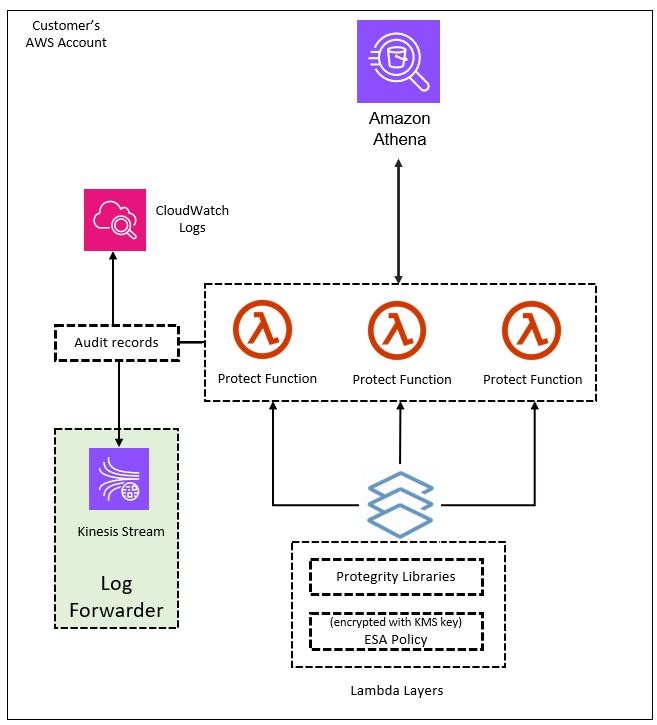
The following diagram shows a reference architecture for synchronizing the security policy from the ESA to the product.
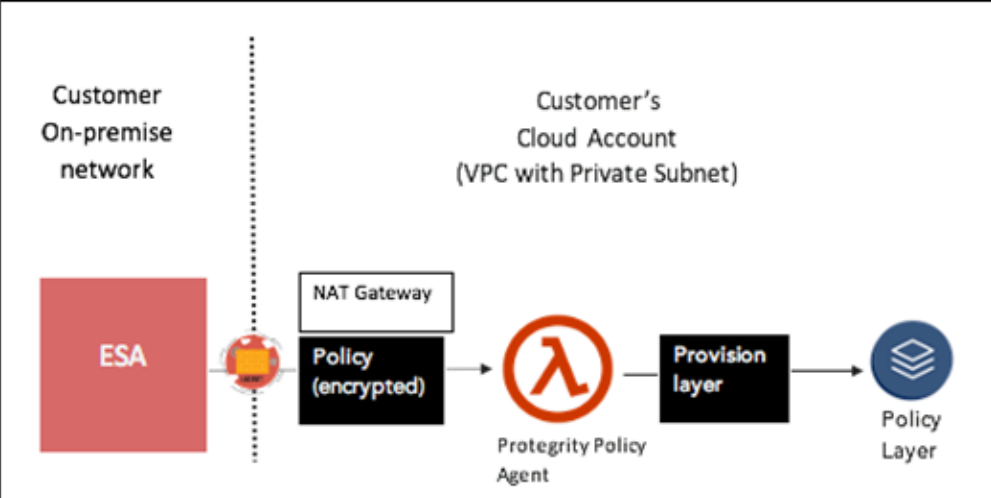
The Protegrity Policy Agent requires network access to an Enterprise Security Administrator (ESA). Most organizations install the ESA on-premise. Therefore, it is recommended that the Policy Agent is installed into a private subnet with a Cloud VPC using a NAT Gateway to enable this communication through a corporate firewall.
The ESA is a soft appliance that must be pre-installed on a separate server. It is used to create and manage security policies.
For more information about installing the ESA, and creating and managing policies, refer to the Policy Management Guide.
Audit logs are by default sent to CloudWatch as long as the function’s execution role has the necessary permissions. The Protegrity Product can also be configured to send audit logs to ESA. Such configuration requires deploying Log Forwarder component which is available as part of Protegrity Product deployment bundle. The diagram below shows additional resources deployed with Log Forwarder component.
The log forwarder component includes Amazon Kinesis data stream and the forwarder Lambda function. Amazon Kinesis stream is used to batch audit records before sending them to forwarder function, where similar audit logs are aggregated before sending to ESA. Aggregation rules are described in the Protegrity Log Forwarding guide. When the protector function is configured to send audit logs to log forwarder, audit logs are aggregated on the protector function before sending to Amazon Kinesis. Due to specifics of the Lambda runtime lifecycle, audit logs may take up to 15 minutes before being sent to Amazon Kinesis. Protector function exposes configuration to minimize this time which is described in the protector function installation section.
The security of audit logs is ensured by using HTTPS connection on each link of the communication between protector function and ESA. Integrity and authenticity of audit logs is additionally checked on log forwarder which verifies individual logs signature. The signature verification is done upon arrival from Amazon Kinesis before applying aggregation. If signature cannot be verified, the log is forwarded as is to ESA where additional signature verification can be configured. Log forwarder function uses client certificate to authenticate calls to ESA.
To learn more about individual audit log entry structure and purpose of audit logs, refer to Audit Logging section in this document. Installation instructions can be found in Audit Log Forwarder installation.
The audit log forwarding requires network access from the cloud to the ESA. Most organizations install the ESA on-premise. Therefore, it is recommended that the Log Forwarder Function is installed into a private subnet with a Cloud VPC using a NAT Gateway to enable this communication through a corporate firewall.
Amazon Athena is an interactive, serverless query service that makes it easy to analyze data in Amazo n S3 using standard SQL. Athena is serverless, so there is no infrastructure to manage, and you pay only for the queries that you run.
Athena’s external UDF makes remote invocations to the Protegrity protector, a serverless Lambda function incorporating Protegrity libraries and the Athena Query Federation SDK.
Access and authorization between various AWS services involved in this architecture is achieved throu gh Identity Access Management (IAM). For instance, the IAM principal running the query must be allowed to invoke the protect Lambda. Various IAM role configuration settings are shown in the appen dices of this document.
The following figure illustrates the Protegrity Athena Integration architecture.
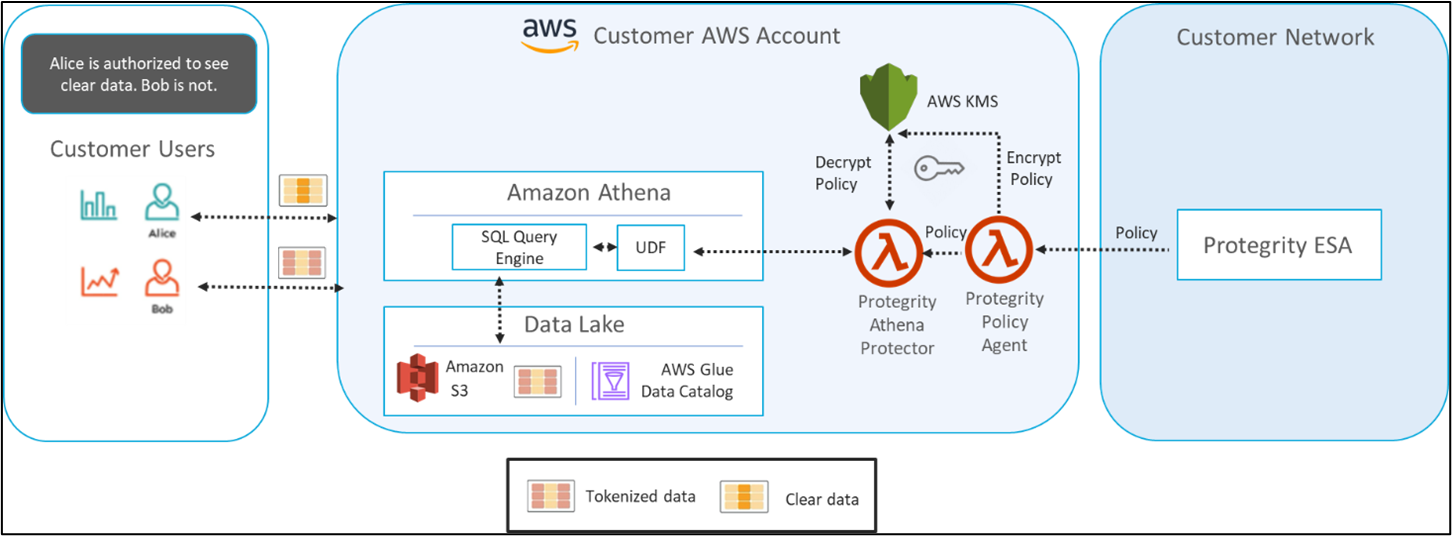
The following table describes the AWS services that may be a part of your Protegrity installation.
Service | Description |
|---|---|
Lambda | Provides serverless compute for Protegrity protection operations and the ESA integration to fetch policy updates or deliver audit logs. |
KMS | Provides secrets for envelope policy encryption/decryption for Protegrity. |
Secrets Manager | Provides secrets management for the ESA credentials. |
S3 | Intermediate storage location for the encrypted ESA policy layer. |
Kinesis | Required if Log Forwarder is to be deployed. Amazon Kinesis is used to batch audit logs sent from protector function to ESA. |
VPC & NAT Gateway | Optional. Provides a private subnet to communicate with an on-prem ESA. |
CloudWatch | Application and audit logs, performance monitoring, and alerts. Scheduling for the policy agent. |
The Protector and Log Forwarder functions require a security policy from a compatible ESA version.
The table below shows compatibility between different Protector and ESA versions.
| Protector Version | ESA Version | |||
|---|---|---|---|---|
| 8.x | 9.0 | 9.1 & 9.2 | 10.0 | |
| 2.x | No | Yes | * | No |
| 3.0.x & 3.1.x | No | No | Yes | No |
| 3.2.x | No | No | Yes | * |
| 4.0.x | No | No | No | Yes |
Legend | |
|---|---|
Yes | Protector was designed to work with this ESA version |
No | Protector will not work with this ESA version |
* | Backward compatible policy download supported:
|
| Requirement | Detail |
|---|---|
| Protegrity distribution and installation scripts | These artifacts are provided by Protegrity |
| Protegrity ESA 10.0+ | The Cloud VPC must be able to obtain network access to the ESA |
| AWS Account | Recommend creating a new sub-account for Protegrity Serverless |
| Athena Engine Version 3 | Only Athena engine version 3 is supported. The product may work in Athena engine version 2, but it is deprecated and all users are encouraged to upgrade. |
Role / Skillset | Description |
|---|---|
AWS Account Administrator | To run CloudFormation (or perform steps manually), create/configure a VPC and IAM permissions. |
Protegrity Administrator | The ESA credentials required to extract the policy for the Policy Agent |
Network Administrator | To open firewall to access ESA and evaluate AWS network setup |
Identify or create an AWS account where the Protegrity solution will be installed. It is recommended that a new AWS sub-account be created. This can provide greater security controls and help avoid conflicts with other applications that might impact regional account limits. An individual with the Cloud Administrator role will be required for some subsequent installation steps.
AWS Account ID: ___________________
AWS Region (AwsRegion): ___________________
This S3 bucket will be used for the artifacts required by the CloudFormation installation steps. This S3 bucket must be created in the region that is defined in Determine AWS Region.
To create S3 bucket for installing artifacts:
Access the AWS S3 Management Console.
Change region to the one determined in Determine AWS Region
Click Create Bucket.
Enter a unique bucket name:
For example, protegrity-install.us-west-2.example.com.
Click Create Bucket.
Upload the installation artifacts to this bucket. Protegrity will provide the following three artifacts.
S3 Bucket name (ArtifactS3Bucket): ___________________
The Amazon Key Management Service (KMS) provides the ability for the Protegrity Serverless solution to encrypt and decrypt the Protegrity Security Policy.
To create KMS key:
In the AWS sub-account where the KMS key will reside, select the region.
Navigate to Key Management Service > Create Key.
Configure the key settings:
Create alias and optional description, such as, Protegrity-Serverless and click Next.
Define key administrative permissions, the IAM user who will administrate the key.
Click Next.
Define the key usage permissions.
In Other AWS accounts, enter the AWS account id used for the Protegrity Serverless installation.
Continue on to create the key. If there is a concern this permission is overly broad, then you can return later to restrict access to the role of two Protegrity Serverless Lambda as principals. Click to open the key in the list and record the ARN.
KMS Key ARN (AWS_KMS_KEY_ID): ___________________
Download the public key from the KMS key. Navigate to the key in KMS console, select the Public key tab, and click Download. Save the PEM file. This public key will be added to the ESA data store as an export key. Refer to Exporting Keys to Datastore for instructions on adding the public key to the data store.
KMS Public Key PEM file: ___________________
Determine the AWS region where the Amazon Athena Workgroup is running. This is the region in where the Protegrity solution must be installed.
AWS Region (AccountRegion): ___________________
The following sections install the Cloud Protect serverless Lambda function.
Ensure that all the steps in Pre-Configuration are performed.
Login to the AWS account console where Protegrity Serverless will be installed.
Ensure that the required CloudFormation templates provided by Protegrity are available on your local computer.
This task defines a policy used by the Protegrity Lambda function to write CloudWatch logs and access the KMS encryption key to decrypt the policy.
Perform the following steps to create the Lambda execution role and required policies:
From the AWS IAM console, select Policies > Create Policy.
Select the JSON tab and copy the following sample policy.
{
  "Version": "2012-10-17",
  "Statement": [
    {
      "Sid": "CloudWatchWriteLogs",
      "Effect": "Allow",
      "Action": [
        "logs:CreateLogGroup",
        "logs:CreateLogStream",
        "logs:PutLogEvents"
      ],
      "Resource": "*"
    },
    {
      "Sid": "KmsDecrypt",
      "Effect": "Allow",
      "Action": [
        "kms:Decrypt"
      ],
      "Resource": [
        "arn:aws:kms:*:*:key/*"
      ]
    }
  ]
}
For the KMS policy, replace the Resource with the ARN for the KMS key created in a previous step.
Select Next, type in a policy name, for example, ProtegrityProtectLambdaPolicy and Create Policy. Record the policy name:
ProtectLambdaPolicyName:__________________
The following steps create the role to utilize the policy defined in Create Protect Lambda IAM Execution Policy.
To create protect lambda IAM execution role:
From the AWS IAM console, select Roles > Create Role.
Select AWS Service > Lambda > Next.
In the list, search and select the policy created in Create Protect Lambda IAM Execution Policy.
Click Next
Type the role name, for example, ProtegrityProtectRole
Click Create role
Record the role ARN.
Role ARN (LambdaExecutionRoleArn): ___________________
The following steps describe the deployment of the Lambda function.
Access CloudFormation and select the target AWS Region in the console.
Click Create Stack and choose With new resources.
In Specify template section select Upload a template file.
Click Choose file to upload the Protegrity-provided CloudFormation template called pty_athena_protect_cf.json and click Next.
Specify stack details. Enter stack name.
Enter the required parameters. All the values were generated in the pre-configuration steps.
Parameter | Description |
|---|---|
ArtifactS3Bucket | Name of S3 bucket created in the pre-configuration step |
LambdaExecutionRoleArn | The ARN of Lambda role created in the prior step |
PolicyUser | Name of the Policy User that will be passed as an environment variable to the lambda function. With protegrity-sample-policy-<version>.zip, you can set this value to policyuser. |
PolicyUserConfig | The settings for POLICY_USER_CONFIG. Default Value: 0, Values: [0,1,2]. NoteSee Policy User for information on POLICY_USER_CONFIG. |
UsernameRegex | The settings for USERNAME_REGEX. Default Value: Not Set, Values: “1” or regex expression. NoteSee Policy User and Configuring Regular Expression to Extract Policy Username for information on USERNAME_REGEX. |
MinLogLevel | Minimum log level for protect function. Allowed Values: off, severe, warning, info, config, all |
The log forwarder parameters can be provided later after log forwarder is deployed. If you are not planning to deploy log forwarder you can skip this step.
| Log Forwarder Parameters | Description |
|---|---|
| KinesisLogStreamArn | The ARN of the AWS Kinesis stream where audit logs will be sent for aggregation |
| AuditLogFlushInterval | Time interval used to accumulate audit logs before sending to Kinesis |
Proceed to the last step of the Create Stack wizard with defaults and click Submit to create CloudFormation stack.
After CloudFormation is completed, select the Outputs tab in the stack. Record the following values:
ProtectFunctionName: __________________________
ProtectFunctionProductionAlias: __________________________
ProtectLayerName: _____________________________
Perform the following steps to verify Athena is working correctly with Protegrity.
Access the Athena console.
Copy and paste the following snippet into a worksheet.
USING EXTERNAL FUNCTION unprotect(val varchar, el varchar) RETURNS varchar
     LAMBDA '<replace_with_athena_protect_function_name>:Production'
SELECT unprotect('UtfVk UHgcD!', 'alpha')
Replace the placeholder value with the lambda function name
Run the above Query
Verify that the string hello world! is returned.
Error | Action |
|---|---|
User: <USER_ARN> is not authorized to perform: glue:GetDatabases on resource: arn:aws:glue:<AWS_REGION>:<AWS_ACCOUNT>:catalog (Service: AmazonDataCatalog; Status Code: 400; Error Code: AccessDeniedException; Request ID: <REQUEST_ID>; Proxy: null) | Verify user has Glue permission GetDatabases |
User: <USER_ARN> is not authorized to perform: glue:GetTables on resource: arn:aws:glue: <AWS_REGION>:<AWS_ACCOUNT>:catalog (Service: AmazonDataCatalog; Status Code: 400; Error Code: AccessDeniedException; Request ID: <REQUEST_ID>; Proxy: null) | Verify user has Glue permission GetTables |
Insufficient permissions to execute the query | Verify user has InvokeFunction permission for the protect lambda function |
Access denied when writing output to url: s3://<BUCKET_NAME>/Unsaved/<YEAR>/<MONTH>/<DAY>/<QUERY_ID>.csv Please ensure you are allowed to access the S3 bucket. If you are encrypting query results with KMS key, please ensure you are allowed to access your KMS key | Verify user has S3 permission PutObject for the query result location bucket. If using KMS encryption, verify the required KMS permissions. |
You do not seem to have access to the S3 location of your query results. Please confirm your account has access to the S3 location where your query results are saved and try again. If you are using KMS to encrypt query results, please ensure you have permission to access your KMS key. | Verify user has S3 permission GetObject for the query result location bucket. If using KMS encryption, verify the required KMS decrypt permissions. |
User: <USER_ARN>is not authorized to perform: athena:<ACTION> on resource: arn:aws:athena:<AWS_REGION>:<ACCOUNT>:workgroup/<WORKGROUP> (Service: AmazonAthena; Status Code: 400; Error Code: AccessDeniedException; Request ID: <REQUEST_ID>; Proxy: null) | Verify user has the permissions: StartQueryExecution GetQueryResults GetWorkGroup StopQueryExecution GetQueryExecution |
java.lang.RuntimeException: Failed to initialize MemoryUtil. Was Java started with `–add-opens=java.base/java.nio=ALL-UNNAMED`? (See https://arrow.apache.org/docs/java/install.html) | Verify that the environment variable |
The following sections will install the Policy Agent. The Policy Agent polls the ESA and deploys the policy to Protegrity Serverless as a static resource. Some of the installation steps are not required for the operation of the software but recommended for establishing a secure environment. Contact Protegrity Professional Services for further guidance on configuration alternatives in the Cloud.
Policy Agent Lambda requires ESA server running and accessible on TCP port 443.
Note down ESA IP address:
ESA IP Address (EsaIpAddress): ___________________
Whether your ESA is configured with default self-signed certificate or your corporate CA certificate, Policy Agent can validate authenticity of ESA connection using CA certificate. The process for both scenarios is the same:
To obtain self-signed CA certificate from ESA:
Log in to ESA Web UI.
Select Settings > Network > Manage Certificates.
Hover over Server Certificate and click on download icon to download the CA certificate.
To convert downloaded CA certificate to a value accepted by Policy Agent, open the downloaded PEM file in text editor and replace all new lines with escaped new line: \n.
To escape new lines from command line, use one of the following commands depending on your operating system:
Linux Bash:
awk 'NF {printf "%s\\n",$0;}' ProtegrityCA.pem > output.txt
Windows PowerShell:
(Get-Content '.\ProtegrityCA.pem') -join '\n' | Set-Content 'output.txt'
Record the certificate content with new lines escaped.
ESA CA Server Certificate (EsaCaCert): ___________________
This value will be used to set PTY_ESA_CA_SERVER_CERT or PTY_ESA_CA_SERVER_CERT_SECRET Lambda variable in section Policy Agent Lambda Configuration
For more information about ESA certificate management refer to Certificate Management Guide in ESA documentation.
Establish a VPC where the Policy Agent will be hosted. This VPC will need connectivity to the ESA. The VPC should be in the same account and region established in Pre-Configuration.
VPC name: ___________________
Identify or create a new subnet in the VPC where tha Lambda function will be connected to. It is recommended to use a private subnet.
Subnet name: ___________________
If ESA server is hosted outside of the AWS Cloud network, the VPC configured for Lambda function must ensure additional network configuration is available to allow connectivity with ESA. For instance if ESA has a public IP, the Lambda function VPC must have public subnet with a NAT server to allow routing traffic outside of the AWS network. A Routing Table and Network ACL may need to be configured for outbound access to the ESA as well.
If an internal VPC was created, then add VPC Endpoints, which will be used by the Policy Agent to access AWS services. Policy Agent needs access to the following AWS services:
Type | Service name |
|---|---|
Interface | com.amazonaws.{REGION}.secretsmanager |
Interface | com.amazonaws.{REGION}.kms |
Gateway | com.amazonaws.{REGION}.s3 |
Interface | com.amazonaws.{REGION}.lambda |
Policy Agent and cloud-based ESA appliance use AWS security groups to control traffic that is allowed to leave and reach them. Policy Agent runs on schedule and is mostly concerned with allowing traffic out of itself to ESA and AWS services it depends on. ESA runs most of the time and it must allow Policy Agent to connect to it.
Policy Agent security group must allow outbound traffic using rules described in the table below. To edit security group navigate:
From VPC > Security Groups > Policy Agent Security Group configuration.
| Type | Protocol | Port Range | Destination | Reason |
|---|---|---|---|---|
| Custom TCP | TCP | 443 | Policy Agent Lambda SG | ESA Communication |
| HTTPS | TCP | 443 | Any | AWS Services |
Record Policy Agent security group ID:
Policy Agent Security Group Id: ___________________
Policy Agent will reach out to ESA on port 443. Create following inbound security group rule for cloud-based ESA appliance to allow connections from Policy Agent:
| Type | Protocol | Port Range | Source |
|---|---|---|---|
| Custom TCP | TCP | 443 | Policy Agent Lambda SG |
Policy Agent Lambda requires ESA credentials to be provided as one of the three options.
Creating secrets manager secret with ESA username and password.
From the AWS Secrets Manager Console, select Store New Secret.
Select Other Type of Secrets.
Specify the username and password key value pair.
Select the encryption key or leave default AWS managed key.
Specify the Secret Name and record it.
ESA Credentials Secret Name: __________________
ESA password is encrypted with AWS KMS symmetric key.
Create AWS KMS symmetric key which will be used to encrypt ESA password. See Create KMS Key for instructions on how to create KMS symmetric key using AWS console.
Record KMS Key ARN.
ESA PASSWORD KMS KEY ARN: __________________
Run AWS CLI command to encrypt ESA password. Below you can find sample Linux aws cli command. Replace <key_arn> with KMS symmetric key ARN.
aws kms encrypt --key-id <key_arn> --plaintext $(echo '<esa_password>' | base64 )
Sample output.
{
  "CiphertextBlob": "esa_encrypted_password",
  "KeyId": "arn:aws:kms:region:aws_account:key/key_id ",
  "EncryptionAlgorithm": "SYMMETRIC_DEFAULT"
}
Record ESA username and encrypted password.
ESA USERNAME: __________________
ESA ENCRYPTED PASSWORD: __________________
With this option ESA username and password are returned by a custom AWS Lambda function. This method may be used to get the username and password from external vaults.
Create AWS Lambda in any AWS supported runtime.
There is no input needed.
The Lambda function must return the following response schema.
response:
type: object
  properties:
    username: string
    password: string
For example,
example output: {"username": "admin", "password": "Password1234"}
Sample AWS Lambda function in Python:
import json

def lambda_handler(event, context):

    return {"username": "admin", "password": "password1234"}
Record the Lambda name:
Custom AWS lambda for ESA credentials: _______________
Follow the steps below to create Lambda execution policies.
Create Agent Lambda IAM policy
From AWS IAM console, select Policies > Create Policy.
Select JSON tab and copy the following snippet.
{
  "Version": "2012-10-17",
  "Statement": [
    {
      "Sid": "EC2ModifyNetworkInterfaces",
      "Effect": "Allow",
      "Action": [
        "ec2:CreateNetworkInterface",
        "ec2:DescribeNetworkInterfaces",
        "ec2:DeleteNetworkInterface"
      ],
      "Resource": "*"
    },
    {
      "Sid": "CloudWatchWriteLogs",
      "Effect": "Allow",
      "Action": [
        "logs:CreateLogGroup",
        "logs:CreateLogStream",
        "logs:PutLogEvents"
      ],
      "Resource": "*"
    },
    {
      "Sid": "LambdaUpdateFunction",
      "Effect": "Allow",
      "Action": [
        "lambda:UpdateFunctionConfiguration"
      ],
      "Resource": [
        "arn:aws:lambda:*:*:function:*"
      ]
    },
    {
      "Sid": "LambdaReadLayerVersion",
      "Effect": "Allow",
      "Action": [
        "lambda:GetLayerVersion",
        "lambda:ListLayerVersions"
      ],
      "Resource": "*"
    },
    {
      "Sid": "LambdaDeleteLayerVersion",
      "Effect": "Allow",
      "Action": "lambda:DeleteLayerVersion",
      "Resource": "arn:aws:lambda:*:*:layer:*:*"
    },
    {
      "Sid": "LambdaPublishLayerVersion",
      "Effect": "Allow",
      "Action": "lambda:PublishLayerVersion",
      "Resource": "arn:aws:lambda:*:*:layer:*"
    },
    {
      "Sid": "S3GetObject",
      "Effect": "Allow",
      "Action": [
        "s3:GetObject"
      ],
      "Resource": "arn:aws:s3:::*/*"
    },
    {
      "Sid": "S3PutObject",
      "Effect": "Allow",
      "Action": [
        "s3:PutObject"
      ],
      "Resource": "arn:aws:s3:::*/*"
    },
    {
      "Sid": "KmsEncrypt",
      "Effect": "Allow",
      "Action": [
        "kms:GetPublicKey"
      ],
      "Resource": [
        "arn:aws:kms:*:*:key/*"
      ]
    },
    {
      "Sid": "SecretsManagerGetSecret",
      "Effect": "Allow",
      "Action": [
        "secretsmanager:GetSecretValue"
      ],
      "Resource": [
        "arn:aws:secretsmanager:*:*:secret:*"
      ]
    },
    {
      "Sid": "LambdaGetConfiguration",
      "Effect": "Allow",
      "Action": [
          "lambda:GetFunctionConfiguration"
      ],
      "Resource": [
          "arn:aws:lambda:*:*:function:*"
      ]
    }
  ]
}
Replace wildcard * with the region, account, and resource name information where required.
This step is required if KMS is used to encrypt ESA password.
Add policy entry below. Replace ESA PASSWORD KMS KEY ARN with the value recorded in Option 2: KMS Encrypted Password.
  {
    "Sid": "KmsDecryptEsaPassword",
    "Effect": "Allow",
    "Action": [
      "kms:Decrypt"
    ],
    "Resource": [
      "**ESA PASSWORD KMS KEY ARN**"
    ]
  }
Select Next type in the policy name and Create Policy. Record policy name:
Policy Name: ___________________
Perform the following steps to create Agent Lambda execution IAM role.
To create agent Lambda IAM role:
From AWS IAM console, select Roles > Create Role.
Select AWS Service > Lambda > Next.
Select the policy created in Create Agent Lambda IAM policy.
Proceed to Name, Review and Create.
Type the role name, for example, ProtegrityAgentRole and click Confirm.
Select Create role.
Record the role ARN.
Agent Lambda IAM Execution Role Name: ___________________
If an on-premise firewall is used, then the firewall must allow access from the NAT Gateway to an ESA. The firewall must allow access from the NAT Gateway IP to ESA via port 443 and 443.
Create the Policy Agent in the VPC using the CloudFormation script provided by Protegrity.
Access the CloudFormation service.
Select the target installation region.
Create a stack with new resources.
Upload the Policy Agent CloudFormation template (file name: pty_agent_cf.json).
Specify the following parameters for Cloud Formation:
| Parameter | Description | Note |
|---|---|---|
| VPC | VPC where the Policy Agent will be hosted | Identify or Create a new VPC |
| Subnet | Subnet where the Policy Agent will be hosted | VPC Subnet Configuration |
| PolicyAgentSecurityGroupId | Security Group Id, which allows communication between the Policy Agent and the ESA | Identify or Create Security Groups |
| LambdaExecutionRoleArn | Agent Lambda IAM execution role ARN allowing access to the S3 bucket, KMS encryption Key, Lambda and Lambda Layer | Create Agent Lambda IAM Role |
| ArtifactS3Bucket | S3 bucket name with deployment package for the Policy Agent | Use S3 Bucket name recorded in Create S3 bucket for Installing Artifacts |
| CreateCRONJob | Set to True to create a CloudWatch schedule for the agent to run. | Default: False |
After the CloudFormation stack is deployed, the Policy Agent Lambda must be configured with parameters recorded in earlier steps. From your AWS Console, navigate to lambda and select the following Lambda.
Protegrity_Agent<STACK_NAME>_
Select Configuration tab and scroll down to the Environment variables section. Select Editand replace all entries with the actual values.
Parameter | Description | Notes |
|---|---|---|
PTY_ESA_IP | ESA IP address or hostname | |
PTY_ESA_CA_SERVER_CERT | ESA self-signed CA certificate or your corporate CA certificate used by policy Agent Lambda to ensure ESA is the trusted server. | Recorded in step Certificates on ESA NoteFor PPC deployments, see PPC Appendix: Policy Agent Certificate Guidance for details on obtaining and using the CA certificate.In case ESA is configured with publicly signed certificates, the PTY_ESA_CA_SERVER_CERT configuration will be ignored. |
PTY_ESA_CA_SERVER_CERT_SECRET | This configuration option fulfills the same function as PTY_ESA_CA_SERVER_CERT but supports larger configuration values, making it the recommended choice. The value should specify the name of the AWS Secrets Manager secret containing the ESA self-signed CA certificate. The secret value should be set to the json with “PTY_ESA_CA_SERVER_CERT” key and PEM formated CA certificate content value as shown below. | Recorded in step Certificates on ESA NoteFor PPC deployments, see PPC Appendix: Policy Agent Certificate Guidance for details on obtaining and using the CA certificate.In case ESA is configured with publicly signed certificates, the PTY_ESA_CA_SERVER_CERT_SECRET configuration will be ignored. When both PTY_ESA_CA_SERVER_CERT and PTY_ESA_CA_SERVER_CERT_SECRET are configured the PTY_ESA_CA_SERVER_CERT_SECRET takes precedence. |
PTY_ESA_CREDENTIALS_SECRET | ESA username and password (encrypted value by AWS Secrets Manager) | |
PTY_DATASTORE_KEY | ESA policy datastore public key fingerprint (64 char long) e.g. 123bff642f621123d845f006c6bfff27737b21299e8a2ef6380aa642e76e89e5. | NoteThis configuration is not applicable for ESA versions lower than 10.2.The export key is the public part of an asymmetric key pair created in a Create KMS Key. A user with Security Officer permissions adds the public key to the data store in ESA via Policy Management > Data Stores > Export Keys. The fingerprint can then be copied using the Copy Fingerprint icon next to the key. Refer to Exporting Keys to Datastore for details. NoteFor PPC deployments, see PPC Appendix: Policy Agent Certificate and Key Guidance for details on obtaining and using the datastore key fingerprint. |
AWS_KMS_KEY_ID | KMS key id or full ARN e.g. arn:aws:kms:us-west-2:112233445566:key/bfb6c4fb-509a-43ac-b0aa-82f1ca0b52d3 | |
AWS_POLICY_S3_BUCKET | S3 bucket where the encrypted policy will be written | S3 bucket of your choice |
AWS_POLICY_S3_FILENAME | Filename of the encrypted policy stored in S3 bucket | Default: protegrity-policy.zip |
AWS_PROTECT_FN_NAME | Comma separated list of Protect function names or ARNs | ProtectFunctionName(s), recorded in CloudFormation Installation |
DISABLE_DEPLOY | This flag can be either 1 or 0. If set to 1, then the agent will not update PTY_PROTECT lambda with the newest policy. Else, the policy will be saved in the S3 bucket and deployed to the Lambda Layer | Default: 0 |
AWS_POLICY_LAYER_NAME | Lambda layer used to store the Protegrity policy used by the PTY_PROTECT function |
|
POLICY_LAYER_RETAIN | Number of policy versions to retain as backup. (e.g. 2 will retain the latest 2 policies and remove older ones). -1 retains all. | Default: 2 |
POLICY_PULL_TIMEOUT | Time in seconds to wait for the ESA to send the full policy | Default: 20s |
ESA_CONNECTION_TIMEOUT | Time in seconds to wait for the ESA response | Default: 5s |
LOG_LEVEL | Application and audit logs verbiage level | Default: INFO Allowed values: DEBUG – the most verbose, INFO, WARNING, ERROR – the least verbose |
PTY_CORE_EMPTYSTRING | Override default behavior. Empty string response values are returned as null values. For instance: (un)protect(’’) -> null (un)protect(’’) -> '' | Default: empty Allowed values: null empty |
PTY_CORE_CASESENSITIVE | Specifies whether policy usernames should be case sensitive | Default: no Allowed values: yes no |
PTY_ADDIPADDRESSHEADER | When enabled, agent will send its source IP address in the request header. This configuration works in conjunction with ESA hubcontroller configuration ASSIGN_DATASTORE_USING_NODE_IP (default=false). See Associating ESA Data Store With Cloud Protect Agent for more information. | Default: yes Allowed values: yes no |
PTY_ESA_USERNAME | Plaintext ESA username which is used together with PTY_ESA_ENCRYPTED_PASSWORD as an optional ESA credentials | Option 2: KMS Encrypted Password Presence of this parameter will cause PTY_ESA_CREDENTIALS_SECRET to be ignored |
PTY_ESA_ENCRYPTED_PASSWORD | ESA password encrypted with KMS symmetric key. Example AWS cli command to generate the value:
| Option 2: KMS Encrypted Password Presence of this parameter will cause PTY_ESA_CREDENTIALS_SECRET to be ignored Value must be base64 encoded |
EMPTY_POLICY_S3 | This flag can be either 1 or 0. If set to 1, then the agent will remove the content of the policy file in S3 bucket, but will keep the checksum in the metadata. Else, the policy will be saved in the S3 bucket and not removed. | Default: 0 |
PTY_ESA_CREDENTIALS_LAMBDA | Lambda function to return ESA credentials | Recorded in step Option 3: Custom AWS Lambda function LAMBDA FOR ESA CREDENTIALS. Presence of PTY_ESA_USERNAME, or PTY_ESA_CREDENTIALS_SECRET will cause this value to be ignored. The Policy Agent Lambda must have network access and IAM permissions to invoke the custom ESA Credentials Lambda you have created in Option 3: Custom AWS Lambda function. |
Open the Lambda and configure Test to execute the lambda and specify the default test event. Wait for around 20 seconds for the Lambda to complete. If policy is downloaded successfully, then a success message appears.
Navigate to the AWS_POLICY_S3_BUCKET bucket and verify that the AWS_POLICY_S3_FILENAME file was created.
Lambda Error | Example Error | Action |
|---|---|---|
Task timed out after x seconds | |
|
ESA connection error. Failed to download certificates | ||
Policy Pull takes a long time | |
|
ESA connection error. Failed to download certificates. HTTP response code: 401 | | Ensure that the PTY_ESA_CREDENTIALS_SECRET has correct ESA username and password |
An error occurred (AccessDeniedException) when calling xyz operation | | Ensure that the Lambda execution role has permission to call the xyz operation |
Access Denied to Secret Manager. | |
|
Master Key xyz unable to generate data key | Ensure that the Lambda can access xyz CMK key | |
The S3 bucket server-side encryption is enabled, the encryption key type is SSE-KMS but the Policy Agent execution IAM role doesn’t have permissions to encrypt using the KMS key . | | Add the following permissions to the Policy Agent excution role. NoteWhen the KMS key and the Policy Agent Lambda are in separate accounts, update both the AWS KMS key and the Policy Agent execution role. |
The S3 bucket has bucket policy to only allow access from within the VPC. | | The Policy Agent publishes a new Lambda Layer version, and the Lambda Layer service uploads the policy file from the s3 bucket and the upload request is originated from the AWS service outside the Policy Agent Lambda VPC. Update the S3 bucket resource policy to allow access from AWS Service. Sample security policy to lock down access to the vpc: |
Strengthen the KMS IAM policy by granting access only to the required Lambda function(s).
Finalize the IAM policy for the Lambda Execution Role. Ensure to replace wildcard * with the region, account, and resource name information where required.
For example,
"arn:aws:lambda:*:*:function:*" -> "arn:aws:lambda:us-east-1:account:function:function_name"
If specified in CloudFormation Installation, the agent installation created a CloudWatch event rule, which checks for policy update on an hourly schedule. This schedule can be altered to the required frequency.
Under CloudWatch > Events > Rules, find Protegrity_Agent_{stack_name}. Click Action > Edit Set the cron expression. A cron expression can easily be defined using CronMaker, a free online tool. Refer to http://www.cronmaker.com.
The following sections show steps how to install Audit Log Forwarder component in the AWS Cloud. The Log Forwarder deployment allows for the audit logs generated by Protector to be delivered to ESA for auditing and governance purposes. Log Forwarder component is optional and is not required for the Protector Service to work properly. See Log Forwarding Architecture section in this document for more information. Some of the installation steps are not required for the operation of the software but recommended for establishing a secure environment. C ontact Protegrity for further guidance on configuration alternatives in the Cloud.
ESA server is required as the recipient of audit logs. Verify the information below to ensure ESA is accessible and configured properly.
ESA server running and accessible on TCP port 9200 (Audit Store) or 24284 (td-agent).
Audit Store service is configured and running on ESA. Applies when audit logs are output to Audit Store directly or through td-agent. For information related to ESA Audit Store configuration, refer to Audit Store Guide.
(Optional) td-agent is configured for external input. For more information related to td-agent configuration, refer to ESA guide Sending logs to an external security information and event management (SIEM).
This section is optional. If CA certificate is not provided, the Log Forwarder will skip server certificate validation and will connect to ESA without verifying that it is a trusted server.
If you are deploying Log Forwarder with Protegrity Provisioned Cluster (PPC), certificate authorization and CA validation are not supported. Configuration steps related to certificates in this section do not apply to PPC. See Integrating Cloud Protect with PPC (Protegrity Provisioned Cluster): Log Forwarder Setup with PPC for details.
By default, ESA is configured with self-signed certificates, which can optionally be validated using a self-signed CA certificate supplied in the Log Forwarder configuration. If no CA certificate is provided, the Log Forwarder will skip server certificate validation.
If ESA is configured with publicly signed certificates, this section can be skipped since the forwarder Lambda will use the public CA to validate ESA certificates.
To obtain the self-signed CA certificate from ESA:
Download ESA CA certificate from the /etc/ksa/certificates/plug directory of the ESA
After certificate is downloaded, open the PEM file in text editor and replace all new lines with escaped new line: \n.
To escape new lines from command line, use one of the following commands depending on your operating system:
Linux Bash:
awk 'NF {printf "%s\\n",$0;}' CA.pem > output.txt
Windows PowerShell:
(Get-Content '.\CA.pem') -join '\n' | Set-Content 'output.txt'
Record the certificate content with new lines escaped.
ESA CA Server Certificate (EsaCaCert): ___________________
This value will be used to set PtyEsaCaServerCert cloudformation parameter in section Install through CloudFormation
For more information about ESA certificate management refer to Certificate Management Guide in ESA documentation.
Log forwarder Lambda function requires network connectivity to ESA, similar to Policy Agent Lambda function. Therefore, it can be hosted in the same VPC as Policy Agent.
Separate VPC can be used, as long as it provides network connectivity to ESA.
VPC Name: ___________________
Log Forwarder can be connected to the same subnet as Policy Agent or separate one as long as it provides connectivity to ESA.
Subnet Name: ___________________
If ESA server is hosted outside of the AWS Cloud network, the VPC configured for Lambda function must ensure additional network configuration is available to allow connectivity with ESA. For instance if ESA has a public IP, the Lambda function VPC must have public subnet with a NAT server to allow routing traffic outside of the AWS network. A Routing Table and Network ACL may need to be configured for outbound access to the ESA as well.
Log Forwarder Lambda function requires connectivity to Secrets Manager AWS service. If the VPC identified in the steps before has no connectivity to public internet through the NAT Gateway, then the following service endpoint must be configured:
Security groups restrict communication between Log Forwarder Lambda function and the ESA appliance. The following rules must be in place for ESA and Log Forwarder Lambda function.
From VPC > Security Groups > Log Forwarder Security Group configuration.
| Type | Protocol | Port Range | Destination | Reason |
|---|---|---|---|---|
| Custom TCP | TCP | 9200 | Log Forwarder Lambda SG | ESA Communication |
Record the name of Log Forwarder security group name.
Log Forwarder Security Group Id: ___________________
The following port must be open for the ESA. If the ESA is running in the Cloud, then create the following security.
ESA Security Group configuration
| Type | Protocol | Port Range | Source |
|---|---|---|---|
| Custom TCP | TCP | 9200 | Log Forwarder Lambda SG |
Audit Log Forwarder can optionally authenticate with ESA using certificate-based authentication with a client certificate and certificate key. If used, both the certificate and certificate key will be stored in AWS Secrets Manager.
Download the following certificates from the /etc/ksa/certificates/plug directory of the ESA:
After certificates are downloaded, open each PEM file in text editor and replace all new lines with escaped new line: \n. To escape new lines from command line, use one of the commands below depending on your operating system.
Linux Bash:
awk 'NF {printf "%s\\n",$0;}' client.key > private_key.txt
awk 'NF {printf "%s\\n",$0;}' client.pem > public_key.txt
Windows PowerShell:
(Get-Content '.\client.key') -join '\n' | Set-Content 'private_key.pem'
(Get-Content '.\client.pem') -join '\n' | Set-Content 'public_key.pem'
For more information on how to configure client certificate authentication for Audit Store on ESA refer to Audit Store Guide.
To create secret with ESA client certificate/key pair in AWS Secrets Manager.
From the AWS Secrets Manager Console, select Store New Secret.
Select Other Type of Secrets.
Specify the private_key and public_key value pair.
Select the encryption key or leave default AWS managed key.
Specify the Secret Name and record it below.
ESA Client Certificate/Key Pair Secret Name: ___________________
This value will be used to set PtyEsaClientCertificatesSecretId cloudformation parameter in section Install through CloudFormation
This task defines a policy used by the Protegrity Log Forwarder Lambda function to write CloudWatch logs, access the KMS encryption key to decrypt the policy and access Secrets Manager for log forwarder user credentials.
Perform the following steps to create the Lambda execution role and required policies:
From the AWS IAM console, select Policies > Create Policy.
Select the JSON tab and copy the following sample policy.
{
  "Version": "2012-10-17",
  "Statement": [
    {
      "Sid": "EC2ModifyNetworkInterfaces",
      "Effect": "Allow",
      "Action": [
        "ec2:CreateNetworkInterface",
        "ec2:DescribeNetworkInterfaces",
        "ec2:DeleteNetworkInterface"
      ],
      "Resource": "*"
    },
    {
      "Sid": "CloudWatchWriteLogs",
      "Effect": "Allow",
      "Action": [
        "logs:CreateLogGroup",
        "logs:CreateLogStream",
        "logs:PutLogEvents"
      ],
      "Resource": "*"
    },
    {
      "Sid": "KmsDecrypt",
      "Effect": "Allow",
      "Action": [
        "kms:Decrypt"
      ],
      "Resource": [
        "arn:aws:kms:*:*:key/*"
      ]
    },
    {
        "Sid": "KinesisStreamRead",
        "Effect": "Allow",
        "Action": [
            "kinesis:GetRecords",
            "kinesis:GetShardIterator",
            "kinesis:DescribeStream",
            "kinesis:DescribeStreamSummary",
            "kinesis:ListShards",
            "kinesis:ListStreams"
        ],
        "Resource": "*"
    },
    {
      "Sid": "SecretsManagerGetSecret",
      "Effect": "Allow",
      "Action": [
        "secretsmanager:GetSecretValue"
      ],
      "Resource": [
        "arn:aws:secretsmanager:*:*:secret:*"
      ]
    }
  ]
}
For the KMS policy, replace the Resource with the ARN for the KMS key created in a previous step.
Select Review policy, type in a policy name, for example, ProtegrityLogForwarderLambdaPolicy and Confirm. Record the policy name:
LogForwarderLambdaPolicyName:__________________
Perform the following steps to create Log Forwarder execution IAM role.
To create Log Forwarder IAM role:
From AWS IAM console, select Roles > Create Role.
Select AWS Service > Lambda > Next.
Select the policy created in Create Audit Log Forwarder IAM Execution Policy.
Proceed to Name, Review and Create.
Type the role name, for example, ProtegrityForwarderRole and click Confirm.
Record the role ARN.
Log Forwarder IAM Execution Role Name: ___________________
Audit Log Forwarder installation artifacts are part of the same deployment package as the one used for protect and policy agent services. Follow the steps below to ensure the right artifacts are available for log forwarder installation.
Verify that the Protegrity deployment package is available on your local system, if not, you can download it from the Protegrity portal.
Extract the pty_log_forwarder_cf.json cloud formation file from the deployment package.
Check the S3 deployment bucket identified in section Create S3 bucket for Installing Artifacts. Make sure that all Protegrity deployment zip files are uploaded to the S3 bucket.
The following steps describe the deployment of the Audit Log Forwarder AWS cloud components.
Access CloudFormation and select the target AWS Region in the console.
Click Create Stack and choose With new resources.
Specify the template.
Select Upload a template file.
Upload the Protegrity-provided CloudFormation template called pty_log_forwarder_cf.json and click Next.
Specify the stack details. Enter a stack name.
Enter the required parameters. All the values were generated in the pre-configuration steps.
Parameter | Description | Default Value | Required |
|---|---|---|---|
LogForwarderSubnets | Subnets where the Log Forwarder will be hosted. |
|
|
LogForwarderSecurityGroups | Security Groups, which allow communication between the Log Forwarder and ESA. |
| X |
LambdaExecutionRoleArn | The ARN of Lambda role created in the prior step. |
| X |
ArtifactS3Bucket | Name of S3 bucket created in the pre-configuration step. |
| X |
LogDestinationEsaIp | IP or FQDN of the ESA instance or cluster. |
| X |
AuditLogOutput | Audit log processor to target on ESA. Allowed values: audit-store, td-agent | audit-store | X |
PtyEsaClientCertificatesSecretId | AWS Secrets Manager secret id containing client certificates used for authentication with ESA Audit Store. It is expected that the public key will be stored in a field public_key and the private key in a field named private_key. This parameter is optional. If not provided, Log Forwarder will connect to ESA without client certificate authentication. | ||
EsaTlsDisableCertVerify | Disable certificate verification when connecting to ESA if set to 1. This is only for dev purposes, do not disable in production environment. | 0 | X |
PtyEsaCaServerCert | ESA self-signed CA certificate used by log forwarder Lambda to ensure ESA is the trusted server. Recorded in step Certificates on ESA In case ESA is configured with publicly signed certificates, the PtyEsaCaServerCert configuration will be ignored. |
| |
EsaConnectTimeout | Time in seconds to wait for the ESA response. Minimum value: 1. | 5 | X |
EsaVirtualHost | ESA virtual hostname. This configuration is optional and it can be used when proxy server is present and supports TLS SNI extension. |
|
|
KinesisLogStreamRetentionPeriodHours | The number of hours for the log records to be stored in Kinesis Stream in case log destination server is not available. Minimum value: 24. See Log Forwarder Performance section for more details. | 24 | X |
KinesisLogStreamShardCount | The number of shards that the Kinesis log stream uses. For greater provisioned throughput, increase the number of shards. Minimum value: 1. See Log Forwarder Performance section for more details. | 10 | X |
MinLogLevel | Minimum log level for protect function. Allowed Values: off, severe, warning, info, config, all | severe | X |
Click Next with defaults to complete CloudFormation.
After CloudFormation is completed, select the Outputstab in the stack.
Record the following values
KinesisLogStreamArn: ________________________________
Login to the AWS account that hosts the Protect Lambda Function.
Search for Protect Lambda Function IAM Execution Role Name created in Create Protect Lambda IAM role.
Under Permissions policies, select Add Permissions > Create inline policy.
In Specify permissions view, switch to JSON.
Copy the policy json from below replacing the placeholder value indicated in the following snippet as <Audit Log Kinesis Stream ARN> with the value recorded in the previous step.
{
	"Version": "2012-10-17",
	"Statement": [
		{
			"Sid": "KinesisPutRecords",
			"Effect": "Allow",
			"Action": "kinesis:PutRecords",
			"Resource": "<Audit Log Kinesis Stream ARN>"
		}
	]
}
When you are finished, choose Next.
On the Review and create page, type a Name, then choose Create policy.
Testing in this section validates the connectivity between Log Forwarder and ESA. The sample policy included with the initial installation and test event below are not based on your ESA policy. Any logs forwarded to ESA which are not signed with a policy generated by your ESA will not be added to the audit store.
Install Log Forwarder and configure according to previous sections. Log Forwarder configuration MinLogLevel must be at least info level.
Navigate to the log forwarder lambda function.
Select the Test tab.
Copy the json test event into the Event JSON pane.
{
    "Records": [
        {
            "kinesis": {
                "kinesisSchemaVersion": "1.0",
                "partitionKey": "041e96d78c778677ce43f50076a8ae3e",
                "sequenceNumber": "49620336010289430959432297775520367512250709822916263938",
                "data": "eyJpbmdlc3RfdGltZV91dGMiOiIyMDI2LTAzLTI3VDEzOjIzOjEyLjkwNFoiLCJhZGRpdGlvbmFsX2luZm8iOnsiZGVzY3JpcHRpb24iOiJEYXRhIHVucHJvdGVjdCBvcGVyYXRpb24gd2FzIHN1Y2Nlc3NmdWwuIn0sImNsaWVudCI6e30sImNudCI6NCwiY29ycmVsYXRpb25pZCI6InJzLXF1ZXJ5LWlkOjEyMzQiLCJsZXZlbCI6IlNVQ0NFU1MiLCJsb2d0eXBlIjoiUHJvdGVjdGlvbiIsIm9yaWdpbiI6eyJob3N0bmFtZSI6IlBSTy1VUy1QRjNSSEdGOSIsImlwIjoiMTAuMTAuMTAuMTAiLCJ0aW1lX3V0YyI6MTcxMTU1OTEwMH0sInByb2Nlc3MiOnsiaWQiOjJ9LCJwcm90ZWN0aW9uIjp7ImF1ZGl0X2NvZGUiOjgsImRhdGFlbGVtZW50IjoiYWxwaGEiLCJkYXRhc3RvcmUiOiJTQU1QTEVfUE9MSUNZIiwibWFza19zZXR0aW5nIjoiIiwib2xkX2RhdGFlbGVtZW50IjpudWxsLCJvcGVyYXRpb24iOiJVbnByb3RlY3QiLCJwb2xpY3lfdXNlciI6IlBUWURFViJ9LCJwcm90ZWN0b3IiOnsiY29yZV92ZXJzaW9uIjoiMS4yLjErNTUuZzU5MGZlLkhFQUQiLCJmYW1pbHkiOiJjcCIsInBjY192ZXJzaW9uIjoiMy40LjAuMTQiLCJ2ZW5kb3IiOiJyZWRzaGlmdCIsInZlcnNpb24iOiIwLjAuMS1kZXYifSwic2lnbmF0dXJlIjp7ImNoZWNrc3VtIjoiN0VCMkEzN0FDNzQ5MDM1NjQwMzBBNUUxNENCMTA5QzE0OEJGODYwRjE3NEVCMjMxMTAyMEI3RkE1QTY4MjdGQyIsImtleV9pZCI6ImM0MjQ0MzZhLTExMmYtNGMzZi1iMmRiLTEwYmFhOGI1NjJhNyJ9fQ==",
                "approximateArrivalTimestamp": 1626878559.213
            },
            "eventSource": "aws:kinesis",
            "eventVersion": "1.0",
            "eventID": "shardId-000000000000:49620336010289430959432297775520367512250709822916261234",
            "eventName": "aws:kinesis:record",
            "invokeIdentityArn": "arn:aws:iam::555555555555:role/service-role/TestRole",
            "awsRegion": "us-east-1",
            "eventSourceARN": "arn:aws:kinesis:us-east-1:555555555555:stream/CloudProtectEventStream"
        }
    ]
}
Select Test to execute the test event.
Test is successful if the Log Output of test results contains the following log:
[INFO] [kinesis-log-aggregation-format.cpp:77] Aggregated 1 records into 0 aggregated, 1 forwarded and 0 failed records
If the log is not present, please consult the Troubleshooting section for common errors and solutions.
In this section, Kinesis log stream ARN will be provided to the Protect Function installation.
Navigate to the Protector CloudFormation stack created in the protector installation section.
Select Update.
Choose Use existing template > Next.
Set parameter KinesisLogStreamArn to the output value recorded in Install through CloudFormation.
Proceed with Next and Submit the changes.
Continue to the next section once stack status indicates UPDATE_COMPLETE.
Log Forwarder Lambda function requires a policy layer which is in sync with the Protegrity Protector. This section will describe the steps to update the policy agent to include updating Log Forwarder Lambda function.
Navigate to the Policy Agent Function created in Policy Agent Installation
Select Configuration > Environment variables > Edit
Edit the value for environment variable AWS_PROTECT_FN_NAME to include the log forwarder function name/arn in the comma separated list of Lambda functions.
Save the changes and continue when update completes
Navigate to Test tab
Add an event {} and select Test to run the Policy Agent function
Verify Log forwarder function was updated to use the policy layer by inspecting the log output. Logs should include the following:
[INFO] 2024-07-09 18:58:04,793.793Z 622d374b-1f73-4123-9a38-abc61973adef iap_agent.policy_deployer:Updating lambda [Protegrity_LogForwarder_<stack ID>] to use layer version [arn:aws:lambda:<aws region>:<aws account number>:layer:Protegrity_Layer_<layer name>:<layer version>]
Install and configure Protegrity Agent, Protector, and Log Forwarder components.
Send a protect operation to the protector using a data element or user which will result in audit log generation
Navigate to the CloudWatch log group for the Protect function
Select the log stream for the test operation and scroll to the latest logs
Expect to see a log similar to the below:
[2024-07-09T19:28:23.158] [INFO] [kinesis-external-sink.cpp:51] Sending 2 logs to Kinesis ...
[2024-07-09T19:28:23.218] [INFO] [aws-utils.cpp:206] Kinesis send time: 0.060s
Navigate to the CloudWatch log group for the Log Forwarder function
Expect to see a new log stream - it may take several minutes for the stream to start
Select the new stream and scroll to the most recent logs in the stream
Expect to see a log similar to the below:
[2024-07-09T19:32:31.648] [INFO] [kinesis-log-aggregation-format.cpp:77] Aggregated 1 records into 0 aggregated, 1 forwarded and 0 failed records
Error | Action |
|---|---|
Log forwarder log contains severe level secrets permissions error: |
|
When testing log forwarder as described in Test Log Forwarder Installation, response contains policy decryption error: |
|
Cloudformation stack creation fails with error: |
|
Severe level kinesis permissions log message in protector function: |
|
TLS errors reported in log forwarder function logs: |
|
Cloud Protect Lambda Function exposes USERNAME_REGEX configuration to allow extraction of policy username from user in the request.
USERNAME_REGEX Lambda Environment configuration
The USERNAME_REGEX configuration can be used to extract policy username from user in the request. The following are allowed values for USERNAME_REGEX:
1 - Default build-in regular expression is used:
^arn:aws:(?:iam|sts)::[0-9]{12}:(?:role|user|group|assumed\-role|federated\-user)\/([\w\/+=,.\-]{1,1024}|[\w\/+=,.\-@]{1,1024})(?:@[a-zA-Z0-9\-]{1,320}(?:\.\w+)+)?$
^User regex$ - Custom regex with one capturing group. This group is used to extract the username. Examples below show different regular expression values and the resulting policy user.
USERNAME_REGEX | User in the request | Effective Policy User |
|---|---|---|
Not Set | arn:aws:iam::123456789012:user/juliet.snow | arn:aws:iam::123456789012:user/juliet.snow |
arn:aws:sts::123456789012:assumed-role/TestSaml | arn:aws:sts::123456789012:assumed-role/TestSaml | |
1 | arn:aws:iam::123456789012:user/juliet.snow | juliet.snow |
arn:aws:sts::123456789012:assumed-role/TestSaml | TestSaml | |
| arn:aws:iam::123456789012:user/juliet.snow | user/juliet.snow |
arn:aws:sts::123456789012:assumed-role/TestSaml | assumed-role/TestSaml |
This task defines a policy used by the Protegrity Lambda function to write CloudWatch logs and access the KMS encryption key to decrypt the policy.
Perform the following steps to create the Lambda execution role and required policies.
To create protect lambda IAM execution policy:
From the AWS IAM console, select Policies > Create Policy.
Select the JSON tab and copy the following sample policy.
{
  "Version": "2012-10-17",
  "Statement": [
    {
      "Sid": "CloudWatchWriteLogs",
      "Effect": "Allow",
      "Action": [
        "logs:CreateLogGroup",
        "logs:CreateLogStream",
        "logs:PutLogEvents"
      ],
      "Resource": "*"
    },
    {
      "Sid": "KmsDecrypt",
      "Effect": "Allow",
      "Action": [
        "kms:Decrypt"
      ],
      "Resource": [
        "arn:aws:kms:*:*:key/*"
      ]
    }
  ]
}
For the KMS policy, replace the Resource with the ARN for the KMS key created in a previous step.
Select Next, type in a policy name, for example, ProtegrityProtectLambdaPolicy and Create Policy. Record the policy name:
ProtectLambdaPolicyName:__________________
The ability to use the Cloud Protect UDF from Athena is controlled through IAM permissions. The Athena user/role must have the InvokeFunction permission to the Cloud Protect Lambda function as shown in the following example:
{
    "Version": "2012-10-17",
    "Statement": [
      {
            "Sid": "ProtectLambdaFunction",
            "Effect": "Allow",
            "Action": "lambda:InvokeFunction",
            "Resource": "<PROTECT_FUNCTION_ARN>"
       }
    ]
}
The policy above would be used in addition to any other IAM policies required to use Amazon Athena. Refer to the AWS Athena example policy for a typical IAM policy.
Policy user for protect and unprotect operations can be provided from either Lambda environment variable or federated identity.
POLICY_USER Environment Variable in the Athena Protect Lambda
The Lambda environment variable POLICY_USER, may be set with a default user in the security policy or as a service user.
Federated Identity
When the request contains the federated identity, the policy user maybe the IAM ARN of the user running the SQL query. For example:
User | arn:aws:iam::123456789012:user/juliet.snow |
Role | arn:aws:sts::123456789012:assumed-role/TestSaml |
To control which Policy User is used, Athena Protect Lambda has the Environment Variable: POLICY_USER_CONFIG.
Value | description |
|---|---|
0 | (Default) The Federated Identity is used when provided by Amazon Athena, if the Federated Identity is not provided, the user defaults to the POLICY_USER. |
1 | The Federated Identity will only be used. If The Federated Identity is not provided the Athena Protect Lambda will fail the query. |
2 | The POLICY_USER will always be used, regardless if the Federated Identity is provided or not. POLICY_USER is required. If it is empty or missing the Protect Lambda will fail the query. NoteThe USERNAME_REGEX Lambda configuration described in Configuring Regular Expression to Extract Policy Username will not have effect when the POLICY_USER=2. |
| Requirement | Detail |
|---|---|
| Protegrity distribution and installation scripts | These artifacts are provided by Protegrity |
| Protegrity ESA 10.0+ | The Cloud VPC must be able to obtain network access to the ESA |
| AWS Account | Recommend creating a new sub-account for Protegrity Serverless |
| Athena Engine Version 3 | Only Athena engine version 3 is supported. The product may work in Athena engine version 2, but it is deprecated and all users are encouraged to upgrade. |
The following table describes the AWS services that may be a part of your Protegrity installation.
Service | Description |
|---|---|
Lambda | Provides serverless compute for Protegrity protection operations and the ESA integration to fetch policy updates or deliver audit logs. |
KMS | Provides secrets for envelope policy encryption/decryption for Protegrity. |
Secrets Manager | Provides secrets management for the ESA credentials. |
S3 | Intermediate storage location for the encrypted ESA policy layer. |
Kinesis | Required if Log Forwarder is to be deployed. Amazon Kinesis is used to batch audit logs sent from protector function to ESA. |
VPC & NAT Gateway | Optional. Provides a private subnet to communicate with an on-prem ESA. |
CloudWatch | Application and audit logs, performance monitoring, and alerts. Scheduling for the policy agent. |
Role / Skillset | Description |
|---|---|
AWS Account Administrator | To run CloudFormation (or perform steps manually), create/configure a VPC and IAM permissions. |
Protegrity Administrator | The ESA credentials required to extract the policy for the Policy Agent |
Network Administrator | To open firewall to access ESA and evaluate AWS network setup |
The following sections describe key concepts in understanding Protegrity Serverless with Athena.
User Defined Functions (UDF) in Amazon Athena allow users to invoke protect and unprotect operations on data using Athena SQL.
To use a UDF in Athena, you must declare the USING EXTERNAL FUNCTION clause before the SELECT statement in a SQL query. For example, the following query would perform an unprotect on first_name and last_name fields using the deName element policy:
USING EXTERNAL FUNCTION unprotect(val varchar, el varchar) RETURNS varchar      LAMBDA '<replace_with_athena_protect_function_name>:Production'
SELECT unprotect(first_name, 'deName'), unprotect(last_name, 'deName')
FROM customers;
Parent topic:Understanding Athena Objects
The following factors may cause variation in real performance versus benchmarks:
The following benchmarks were performed against CSV files from an S3 bucket.
Benchmark (rows x columns):
| Operations | 1M * 6 cols | 10M * 6 cols | 100M * 6 cols |
|---|---|---|---|
| Athena Protector (Athena v3 Engine) | 8.5s | 17.9s | 2m 12s |
Estimated AWS costs:
| Type/#Ops | 5B ops/mo. | 50B ops/mo. | 500B ops/mo. | 1T ops/mo. |
|---|---|---|---|---|
| Athena Protector | $8 | $80 | $800 | $1,600 |
AWS maintains quotas for Lambda concurrent execution. Two of these quotas impact concurrency and compete with other Lambdas in the same account and region.
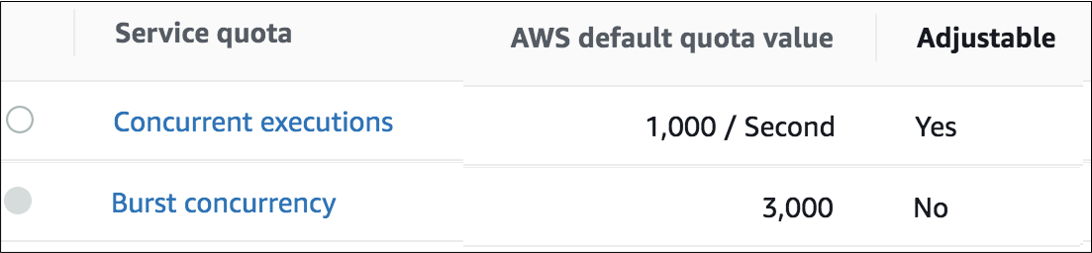
The concurrent executionsquota cap is the maximum number of lambda instances that can serve requests for an account and region. The default AWS quota may be inadequate based on peak concurrency based on the table in the previous section. This quota can be increased with an AWS support ticket.
The burst concurrency quota limits the rate at which Lambda will scale to accommodate demand. This quota is also per account and region. The burst quota cannot be adjusted. AWS will quickly scale until the burst limit is reached. Once the burst limit is reached, functions will scale at a reduced rate per minute (e.g. 500). If no Lambda instances can serve a request, the request will fail with a 429 Too Many Requests response. Athena will generally retry until all requests succeed but may abort if a high percentage of failed responses occur.
The burst limit is a fixed value and varies significantly by AWS region. The highest burst (3,000) is currently available in the following regions: US West (Oregon), US East (N.Virginia), and Europe (Ireland). Other regions can burst between 500 and 1,000. It is recommended selecting a Athena AWS region with the highest burst limits.
Exceeding your quota limits may indicate quota adjustments are required. Exceeding quota limits may cause a query to fail or reduce performance. Worst case, significant throttling can impact the performance of all your Lambda functions in the region.
Athena is tolerant of a certain ratio of failed requests and automatically retries. If a high percentage of requests fail, the query may abort.
CloudWatch Metrics can be observed on Lambda to reveal if quotas are being reached. CloudWatch logs can be used to access the actual error code.
Cold-start vs warm execution refers to the state of the Lambda function when a request is received. A cold-start undergoes additional initialization such as loading the security policy. Warm execution applies to all subsequent requests served by the Lambda. The following table shows an example how these states impact latency and performance:
| Execution state | Avg. Execution Duration |
|---|---|
| Cold execution | 438 ms |
| Warm execution | < 2ms |
Log forwarder architecture is optimized to minimize the amount of connections and reduce the overall network bandwidth required to send audit logs to ESA. This is achieved with batching and aggregation taking place on two levels. The first level is in protect function instances, where audit logs from consecutive requests to an instance are batched and aggregated. The second level of batching takes place in Amazon Kinesis Stream where log records from different protect function instances are additionally batched and sent to log forwarder function where they are aggregated. This section shows how to configure the deployment to accommodate different patterns of anticipated audit log stream. It also shows how to monitor deployment resources to detect problems before audit records are lost.
Protector Cloud Formation Parameters
AuditLogFlushInterval: Determines the minimum amount of time required for the audit log to be sent to Amazon Kinesis. Changing flush interval may affect the level of aggregation, which in turn may result in different number of connections and different data rates to Amazon Kinesis. Default value is 30 seconds.
Increasing the flush interval may result in higher aggregation of audit logs, in fewer connections to Amazon Kinesis, in higher latency of audit logs arriving to ESA and in higher data throughput.
Lowering the flush interval may result in lower aggregation of audit logs, in more connections to Amazon Kinesis, in lower latency of audit logs arriving to ESA and in lower data throughput.
It is not recommended to reduce the flush interval from default value in production environment as it may overload the Amazon Kinesis service. However, it may be beneficial to reduce flush interval during testing to make audit records appear on ESA faster.
Log Forwarder Cloud Formation Parameters
Amazon KinesisLogStreamShardCount: The number of shards represents the level of parallel streams in the Amazon Kinesis and it is proportional to the throughput capacity of the stream. If the number of shards is too low and the volume of audit logs is too high, Amazon Kinesis service may be overloaded and some audit records sent from protect function may be lost.
Default value is 10, however you are advised to test with a production-like load to determine whether this is sufficient or not.
Amazon KinesisLogStreamRetentionPeriodHours: The time for the audit records to be retained in Amazon Kinesis log stream in cases where log forwarder function is unable to read records from the Kinesis stream or send records to ESA, for example due to a connectivity outage. Amazon Kinesis will retain failed audit records and retry periodically until connectivity with ESA is restored or retention period expires.
Default value is 24 hours, however you are advised to review this value to align it with your Recovery Time Objective and Recovery Point Objective SLAs.
Monitoring Log Forwarder Resources
Amazon Kinesis Stream Metrics: Any positive value in Amazon Kinesis PutRecords throttled records metric indicates that audit logs rate from protect function is too high. The recommended action is to increase the Amazon KinesisLogStreamShardCount or optionally increase the AuditLogFlushInterval.
Log Forwarder Function CloudWatch Logs: If log forwarder function is unable to send logs to ESA, it will log the following message:
[SEVERE] Dropped records: x.
Protect Function CloudWatch Logs: If protect function is unable to send logs to Amazon Kinesis, it will log the following message:
[SEVERE] Amazon Kinesis error, retrying in x ms (retry: y/z) ..."
Any dropped audit log records will be reported with the following log message:
[SEVERE] Failed to send x/y audit logs to Amazon Kinesis.
Audit records and application logs stream to Amazon CloudWatch Logs or optionally be sent to ESA. Cloud Protect uses a JSON format for audit records that is described in the following sections.
You can analyze and alert on audit records using Protegrity ESA or Amazon CloudWatch. Third-party solutions may be used if they are supported by Amazon Cloudwatch or AWS Lambda logging extensions. For more information about forwarding your audit records to ESA, contact Protegrity. For more information about Amazon CloudWatch, refer to the Amazon CloudWatch User Guide.
For more information about audit records, refer to the Protegrity Analytics Guide.
The audit record format has been altered in version 3.1 of the protector to provide more information.
| Field | Description |
|---|---|
| additional_info.deployment_id | The deployment_id contains the name of the Protect Function. It is automatically set based on the cloud-specific environment variables assigned to the Protect Function. This allows identifying the Cloud Protect deployment responsible for generating audit log. |
| additional_info.cluster | (Optional) Redshift cluster ARN |
| additional_info.description | A human-readable message describing the operation |
| additional_info.query_id | (Optional) Identifies the query that triggered the operation |
| additional_info.request_id | (Optional) AWS Lambda request identifier |
| cnt | Number of operations, may be aggregated |
| correlationid | (Deprecated) Use additional_info instead |
| level | Log severity, one of: SUCCESS, WARNING, ERROR, EXCEPTION |
| logtype | Always “Protection” |
| origin.ip | The private IP address of the compute resource that operates the Protect Function and is responsible for generating the log entry.NoteThe IP address is private, meaning it is used for internal network communication and is not accessible directly from the public internet.When Log Forwarding is enabled the IP address may be aggregated into minimal CIDR blocks. |
| origin.hostname | Hostname of the system that generated the log entry |
| origin.time_utc | UTC timestamp when the log entry was generated |
| protection.audit_code | Audit code of the protect operation; see the log return codes table in the Protegrity Troubleshooting Guide |
| protection.dataelement | Data element used for the policy operation |
| protection.datastore | Name of the data store corresponding to the deployed policy |
| protection.mask_setting | (Optional) Mask setting from policy management |
| protection.operation | Operation type, one of: Protect, Unprotect, Reprotect |
| protection.policy_user | User that performed the operation |
| protector.core_version | Internal core component version |
| protector.family | Always “cp” for Cloud Protect |
| protector.lambda_version | Protector Lambda application version. |
| protector.pcc_version | Internal pcc component version |
| protector.vendor | Identifies the cloud vendor and the database vendor |
| protector.version | Protector version number |
| signature.checksum | Hash value of the signature key ID used to sign the log message when the log is generated |
| signature.key_id | Key used to sign the log message when the log is generated |
The following are sample audit messages:
Protect Success:
{
      "additional_info": {
        "deployment_id": "Protegrity-Protect-function-deployment-id",
        "description": "Data protect operation was successful.",
        "query_id": "sf-query-id:01978dbc-0582-d7e4-0000-002a3603a20d",
        "request_id": "8476a536-e9f4-11e8-9739-2dfe598c3fcd"
      },
      "cnt": 4000,
      "correlationid": "sf-query-id:01978dbc-0582-d7e4-0000-002a3603a20d",
      "logtype": "Protection",
      "level": "SUCESS",
      "origin": {
        "hostname": "localhost",
        "ip": "127.0.0.1",
        "time_utc": 1635363966
      },
      "protection": {
        "dataelement": "deAddress",
        "operation": "Protect",
        "audit_code": 6,
        "datastore": "SAMPLE_POLICY",
        "policy_user": "test_user"
      },
      process":{
        "name":"protect",
        "id":"13",
        "module":"coreprovider",
        "thread_id":"573580544",
        "user":"sbx_user1051",
        "platform":"\"Linux_x64\"",
        "version":"UNKNOWN"
      },
      "client": {
        "ip":"169.254.62.117"
      },
      "protector": {
        "family": "cp",
        "version": "4.0.0.102",
        "vendor": "aws.snowflake",
        "datastore":"SAMPLE_POLICY",
        "pcc_version": "4.0.0.9",
        "core_version": "2.1.4+0.g93016.2.1",
        "lambda_version":"4.0.1"
      },
      "signature": {
        "key_id": "95f5a194-b0a4-4351-a",
        "checksum": "B324AF7C56944D91C47847A77C0367C594C0B948E7E75654B889571BD4F60A71"
      }
    }
User permission denied:
{
      "additional_info": {
        "deployment_id": "Protegrity-Protect-function-deployment-id",
        "description": "The user does not have the appropriate permissions to perform the requested operation.",
        "query_id": "sf-query-id:01978dbc-0582-d7e4-0000-002a3603a20d",
        "request_id": "8476a536-e9f4-11e8-9739-2dfe598c3fcd"
      },
      "cnt": 4000,
      "correlationid": "sf-query-id:01978dbc-0582-d7e4-0000-002a3603a20d",
      "logtype": "Protection",
      "level": "ERROR",
      "origin": {
        "hostname": "localhost",
        "ip": "127.0.0.1",
        "time_utc": 1635363966
      },
      "protection": {
        "dataelement": "deAddress",
        "operation": "Protect",
        "audit_code": 3,
        "datastore": "SAMPLE_POLICY",
        "policy_user": "test_user"
      },
      process":{
        "name":"protect",
        "id":"13",
        "module":"coreprovider",
        "thread_id":"573580544",
        "user":"sbx_user1051",
        "platform":"\"Linux_x64\"",
        "version":"UNKNOWN"
      },
      "client": {
        "ip":"169.254.62.117"
      },
      "protector": {
        "family": "cp",
        "version": "4.0.0.102",
        "vendor": "aws.snowflake",
        "datastore":"SAMPLE_POLICY",
        "pcc_version": "4.0.0.9",
        "core_version": "2.1.4+0.g93016.2.1",
        "lambda_version":"4.0.1"
      },
      "signature": {
        "key_id": "95f5a194-b0a4-4351-a",
        "checksum": "A216797C56944D91C47847A77C0367C594C0B948E7E75654B889571BD4F60A71"
      }
    }
Data element not found:
{
      "additional_info": {
        "deployment_id": "Protegrity-Protect-function-deployment-id",
        "description": "The data element could not be found in the policy.",
        "query_id": "sf-query-id:01978dbc-0582-d7e4-0000-002a3603a20d",
        "request_id": "8476a536-e9f4-11e8-9739-2dfe598c3fcd"
      },
      "cnt": 4000,
      "correlationid": "sf-query-id:01978dbc-0582-d7e4-0000-002a3603a20d",
      "logtype": "Protection",
      "level": "ERROR",
      "origin": {
        "hostname": "localhost",
        "ip": "127.0.0.1",
        "time_utc": 1635363966
      },
      "protection": {
        "dataelement": "deAddress",
        "operation": "Protect",
        "audit_code": 2,
        "datastore": "SAMPLE_POLICY",
        "policy_user": "test_user"
      },
      process":{
        "name":"protect",
        "id":"13",
        "module":"coreprovider",
        "thread_id":"573580544",
        "user":"sbx_user1051",
        "platform":"\"Linux_x64\"",
        "version":"UNKNOWN"
      },
      "client": {
        "ip":"169.254.62.117"
      },
      "protector": {
        "family": "cp",
        "version": "4.0.0.102",
        "vendor": "aws.snowflake",
        "datastore":"SAMPLE_POLICY",
        "pcc_version": "4.0.0.9",
        "core_version": "2.1.4+0.g93016.2.1",
        "lambda_version":"4.0.1"
      },
      "signature": {
        "key_id": "95f5a194-b0a4-4351-a",
        "checksum": "AF09217C56944D91C47847A77C0367C594C0B948E7E75654B889571BD4F60A71"
      }
    }
The security policy maintains a No Access Operation, configured in an ESA, which determines the response for unauthorized unprotect requests.
The following table describes the result returned in the response for the various no access unprotect permissions.
| No Access Operation | Data Returned |
|---|---|
| Null | null |
| Protected | (protected value) |
| Exception | Query will fail with an exception |
You can download the latest version of the deployment package from https://my.protegrity.com. Navigate to Data Protection > Cloud Protect to download the latest version.
After downloading the deployment package from the Protegrity Portal, unzip the package to extract the artifact files. In the AWS Console, navigate to the S3 bucket that was previously created to upload deployment artifacts (see: Create S3 bucket for Installing Artifacts).
Upload the following artifacts to the S3 bucket:
- -If the release version matches your existing deployment, you don’t need to upload it again. Save the following artifacts on your local system so that you have them available during the next steps:
- -Perform the following steps to upgrade the Agent Lambda and Protect Lambda separately.
Cloud Watch Event Rule is used to periodically run Protegrity Agent Function to synchronize policy from ESA. This functionality is optional when deploying Protegrity Serverless Solution. If the Event Rule is enabled, it must be disabled temporarily for the time of the upgrade process.
Follow the steps below to determine if your deployment uses Event Rule and disable it.
Go to AWS Cloud Formation and select existing Protegrity deployment stack.
Select Resources tab from the top portion of the screen.
Check if there is a resource with ScheduledRule LogicalID. If there is no such resource you can skip to Upgrading Policy Agent Lambda section. If the scheduled rule is there, continue with the next steps in this section.
Click on the Physical ID link in the ScheduledRule row. The link opens Policy Agent Event Rule configuration.
Select Disable from the top-right portion of the screen. This will disable the rule. You will re-enable it after the upgrade process is complete.
Go to AWS Lambda console and select existing Protegrity Agent Lambda.
Click Actions in top right portion of the screen. Select Publish new version. Click Publish. The version of Agent Lambda you just created will serve as restore point in the case you needed to rollback the upgrade.
Go to Lambda Configuration > Environment variables.
Record environment variables values. You will use them later to configure upgraded Lambda Function. You can use the aws cli command below to save the function variables into the local json file:
aws lambda get-function-configuration --function-name \
arn:aws:lambda:<aws_region>:<aws_account>:function:<function_name> \
--query Environment > <function_name>_env_config.json
Go to AWS Cloud Formation and select existing Protegrity Agent deployment stack.
Select Update. Check Replace current template > Upload a template file.
Upload pty_agent_cf.json file and select Next.
Click Next until Review window and then select Update stack.
Wait for the Cloud Formation to complete.
Navigate back to Agent Lambda Function.
Go to Configuration > Environment variables. Replace placeholder values with values recorded in previous step. Alternatively, you can run the following aws cli command to update function configuration using json file saved in the previous steps:
aws lambda update-function-configuration --function-name \
arn:aws:lambda:<aws_region>:<aws_account>:function:<function_name> \
--environment file://./<function_name>_env_config.json
If your current agent installation version is lower than 3.0.12, make sure you set the following function configuration variables:
If you are upgrading from versions prior to v3.0, backup and remove existing policy from the bucket defined by AWS_POLICY_S3_BUCKET property, so that the policy can be re-downloaded and re-encrypted with new ‘key commitment’ feature.
If you are upgrading from version prior to 1.6.1 please follow the steps below, otherwise the upgrade process is completed.
From AWS Console, navigate to IAM > Policies
Search for the Agent Lambda IAM Policy created in Create Agent Lambda IAM policy
Click on the policy, then select Edit Policy. Select JSON tab.
Add the following statement to the list of policy statements.
{
  "Sid": "LambdaGetConfiguration",
  "Effect": "Allow",
  "Action": [
      "lambda:GetFunctionConfiguration"
  ],
  "Resource": [
      "arn:aws:lambda:*:*:function:*"
  ]
}
Click Review Policy, then Save Changes. Wait for the changes to save.
Publish Log Forwarder Lambda Version
Publishing a version of the Log Forwarder Lambda allows to roll-back to pre-existing version if upgrade fails
Go to AWS Lambda console and select existing Protegrity Log Forwarder Lambda.
Click Actions in top right portion of the screen. Select Publish new version. Click Publish.
Record the Lambda version number. It will be displayed at the top of the screen. You can also retrieve it from the Lambda function view, under Versions tab.
Log Forwarder Lambda version number for roll-backs: ___________________
Disable Kinesis Trigger
Disabling Kinesis trigger ensures there are no unprocessed or re-processed events while function is upgraded.
Upgrade Forwarder Lambda Version
Upgrade Log Forwarder function with new code
Enable Kinesis Trigger
Monitor and roll-back
Monitor Log Forwarder function for errors in its CloudWatch logs and in Montior tab. To roll back function to the previous version if any errors occur follow these steps:
Go to AWS Lambda console and select existing Protegrity Log Forwarder Lambda.
Select Configuration tab > Triggers
Expand Details section of Kinesis trigger and record UUID value
Execute the following AWS CLI command to move Kinesis trigger to previous version of Log Forwarder Lambda that was created earlier and recorded as Log Forwarder Lambda version number for roll-backs. Substitute kinesis-mapping-uuid, log-forwarder-function-name, version-for-roll-backs with your values:
aws lambda update-event-source-mapping --uuid <kinesis-mapping-uuid> --function-name <log-forwarder-function-name>:<version-for-roll-backs>
Find Kinesis trigger attached to previous version of Log Forwarder Lambda by navigating Versions tab > Version number link in the Versions column Kinesis trigger is now moved to previous version of Log Forwarder Lambda function.
Diagram below illustrates upgrade steps.
Publish Protect Lambda Version
Publishing a version of the Protect Lambda allows updating it without interruptions to the existing traffic.
Go to AWS Lambda console and select existing Protegrity Protect Lambda.
Go to Lambda Configuration > Environment variables.
Record environment variables values. You will use them later to configure upgraded Lambda Function. You can use the aws cli command below to save the function variables into the local json file:
aws lambda get-function-configuration --function-name \
arn:aws:lambda:<aws_region>:<aws_account>:function:<function_name> \
--query Environment > <function_name>_env_config.json
Click Actions in top right portion of the screen. Select Publish new version. Click Publish.
Record the Lambda version number. It will be displayed at the top of the screen. You can also retrieve it from the Lambda function view, under Versions tab.
Protect Lambda version number: ___________________
If you are upgrading a Cloud Protect Redshift version 1.x to 2.x/3x, you must recreate your Redshift external function definitions with Protect Lambda Function version appended to the Lambda Function name. See example below.
CREATE OR REPLACE EXTERNAL FUNCTION PTY_PROTECT_TEST ( val varchar )
    RETURNS varchar
    VOLATILE lambda
    'Protegrity_Protect_test:<protect_lambda_version_number>' iam_role
    'arn:aws:iam::123456789212:role/example_role';
Run protect service upgrade
In this step, the Protect service including Lambda $LATEST version will be updated using Cloud Formation template. The Lambda version created in previous step will be used to serve existing traffic during the upgrade process.
Go to AWS Cloud Formation and select existing Protegrity deployment stack.
Select Update. Check Replace current template > Upload a template file.
Upload pty_protect_cf.json file and select Next.
Update ProtectFunctionProductionVersion parameter with Protect Lambda version number recorded in step 3.
Click Next until Review window and then select Update stack.
Wait for the Cloud Formation to complete.
Go back to Lambda console and select Protect Lambda.
Go to Configuration > Environment variables. Replace placeholder values with values recorded in previous step. Alternatively, you can run the following aws cli command to update function configuration using json file saved in the previous steps:
aws lambda update-function-configuration --function-name \
arn:aws:lambda:<aws_region>:<aws_account>:function:<function_name> \
--environment file://./<function_name>_env_config.json
If your current protect installation version is lower than 3.0.14, you can optionally set the following variable:
Navigate to Aliases tab. Verify that Production alias points to the lambda version you specified in the cloud formation template.
The upgraded Protect Lambda is configured with a sample policy. Run Agent Lambda Function before continuing with next steps.
Finalize upgrade
In this step, the Protect Lambda will be configured to serve traffic using $LATEST version upgraded in the previous step.
Go back to Protegrity AWS Cloud Formation deployment stack.
Select Update. Check Use Current template.
Update ProtectFunctionProductionVersion parameter with the following value: $LATEST.
Click Next until Review window and then select Update stack.
Go back to Lambda console and select Protect Lambda.
From the Lambda console, verify that Latest alias points to $LATEST version.
Test your function to make sure it works as expected.
If you are upgrading a Cloud Protect Redshift version 1.x to 2.x/3x, you must recreate your Redshift external function definitions with Protect Lambda Function version appended to the Lambda Function name. See example below.
CREATE OR REPLACE EXTERNAL FUNCTION PTY_PROTECT_TEST ( val varchar )
    RETURNS varchar
    VOLATILE lambda
    'Protegrity_Protect_test:Production' iam_role
    'arn:aws:iam::123456789212:role/example_role';
If you need to rollback to older version of Protect Lambda, you can re-run the cloud formation with ProtectFunctionProductionVersion parameter set to the previous version of Protect Lambda.
If the Event Rule was disabled at the beginning of the upgrade process, you must re-enabled it. Follow the steps below to re-enable Policy Agent Event rule.
Go to the Protegrity Agent Cloud Formation Stack.
Select Resources tab from the top portion of the screen.
Click on the Physical ID link in the ScheduledRule row. The link opens Policy Agent Event Rule configuration.
Select Enable from the top-right portion of the screen. This will enable the rule. You will re-enable it after the upgrade process is complete.
Method: Tokenization | ||
Type: ALPHA | ||
| ||
Athena Data Types | Athena Max Size | Protegrity Max Size |
VARCHAR | 65K (65,535 bytes) | 4K (4,096 bytes) |
| ||
| ||
| ||
External Function Sample Definitions: | ||
| ||
| ||
| ||
Method: Tokenization | ||
Type: NUMERIC | ||
| ||
Athena Data Types | Athena Max Size | Protegrity Max Size |
DECIMAL | 4K (4,096 bytes) | 4K (4,096 bytes) |
INTEGER | ||
BIGINT | ||
DOUBLE | ||
| ||
External Function Sample Definitions: | ||
| ||
| ||
Method: Tokenization | ||
Type: Date YYYY-MM-DD | ||
| ||
Athena Data Types | Athena Max Size | Protegrity Max Size |
DATE (any supported format) | 10 bytes | 10 bytes |
| ||
External Function Sample Definitions: | ||
| ||
| ||
| ||
Method: Tokenization | ||
Type: DATETIME YYYY-MM-DD HH:mm:ss | ||
| ||
Athena Data Types | Athena Max Size | Protegrity Max Size |
TIMESTAMP | 29 bytes | 29 bytes |
External Function Sample Definitions: | ||
| ||
| ||
Method: Encryption | ||
Type: AES | ||
| ||
Athena Data Types | Athena Max Size | Protegrity Max Size |
VARBINARY |
|
|
| ||
External Function Sample Definitions: | ||
| ||
| ||
The Policy Agent Lambda function and Protect Lambda functions can be installed in separate AWS accounts. However, additional configuration is required to authorize the Policy Agent to provision the security policy to a remote Protect Lambda function.
Login to the AWS account that hosts the Protect Lambda function.
From the AWS IAM console, select Policies > Create Policy.
Select the JSON tab and copy the following snippet.
{
  "Version": "2012-10-17",
  "Statement": [
    {
      "Sid": "LambdaUpdateFunction",
      "Effect": "Allow",
      "Action": [
        "lambda:UpdateFunctionConfiguration"
      ],
      "Resource": [
        "arn:aws:lambda:*:*:function:*"
      ]
    },
    {
      "Sid": "LambdaReadLayerVersion",
      "Effect": "Allow",
      "Action": [
        "lambda:GetLayerVersion",
        "lambda:ListLayerVersions"
      ],
      "Resource": "*"
    },
    {
      "Sid": "LambdaDeleteLayerVersion",
      "Effect": "Allow",
      "Action": "lambda:DeleteLayerVersion",
      "Resource": "arn:aws:lambda:*:*:layer:*:*"
    },
    {
      "Sid": "LambdaPublishLayerVersion",
      "Effect": "Allow",
      "Action": "lambda:PublishLayerVersion",
      "Resource": "arn:aws:lambda:*:*:layer:*"
    },
    {
      "Sid": "S3GetObject",
      "Effect": "Allow",
      "Action": [
        "s3:GetObject"
      ],
      "Resource": "arn:aws:s3:::*/*"
    },
    {
      "Sid": "S3PutObject",
      "Effect": "Allow",
      "Action": [
        "s3:PutObject"
      ],
      "Resource": "arn:aws:s3:::*/*"
    },
    {
      "Sid": "LambdaGetConfiguration",
      "Effect": "Allow",
      "Action": [
          "lambda:GetFunctionConfiguration"
      ],
      "Resource": [
          "arn:aws:lambda:*:*:function:*"
      ]
    }
  ]
}
Replace the wildcards (*) with the region, account, and resource name information where required.
Select Review policy, type in the policy name, and confirm. Record policy name:
Agent Lambda Cross Account Policy Name: ___________________
Login to the AWS account that hosts the Protect Lambda function.
From the AWS IAM console, select Roles > Create Role
Select AWS Service > Lambda . Proceed to Permissions.
Select Policy created in the step above. Proceed to Tags.
Specify Tag, proceed to the final screen. Type in policy name and confirm. Record the name.
Policy Agent Cross Account IAM Role Name: ___________________
Login to the AWS account that hosts the Protect Lambda function.
Navigate to the previously created IAM Role (Agent Lambda Cross-Account IAM Role Name).
Navigate to Trust Relationships > Edit Trust Relationships.
Modify the Policy Document, replacing the placeholder value indicated in the following snippet as <Agent Lambda IAM Execution Role ARN> with ARN of Agent Lambda IAM Role that was created in Agent Installation.
{
  "Version": "2012-10-17",
  "Statement": [
    {
      "Effect": "Allow",

   "Principal": {

            "AWS": "<Agent Lambda IAM Execution Role Name>"

      },
      "Action": "sts:AssumeRole"
    }
  ]
}
Click Update Trust Policy.
Login to the AWS account that hosts the Policy Agent.
Navigate to the Agent Lambda IAM Execution Role that was created in Agent Installation.
{
  "Version": "2012-10-17",
  "Statement": [
    {
      "Effect": "Allow",

   "Principal": {

            "AWS": "<Agent Lambda IAM Execution Role Name>"

      },
      "Action": "sts:AssumeRole"
    }
  ]
}
Add Inline Policy.
Modify the Policy Document, replacing the placeholder value indicated in the following snippet as <Agent Lambda Cross-Account IAM ARN> with the value recorded in Create Policy Agent cross-account IAM Role.
{
  "Version": "2012-10-17",
  "Statement": [
    {
      "Effect": "Allow",
      "Action": [
        "sts:AssumeRole"
      ],
      "Resource": "<Agent Lambda Cross-Account IAM  ARN>."
    }
  ]
}
When you are finished, choose Review Policy.
On the Review policy page, type a Name, then choose Create Policy.
From the AWS console, navigate to Lambda, and select the Policy Agent Lambda function.
Select Configuration tab | Environment variables.
Select Edit and add the following environment variables with the value from Agent Lambda Cross-Account IAM ARN:
| Parameter | Value |
|---|---|
| AWS_ASSUME_ROLE | Agent Lambda Cross-Account IAM ARN |
Ensure the values in the Parameters AWS_POLICY_S3_BUCKET, AWS_PROTECT_FN_NAME and AWS_POLICY_LAYER_NAME are all in the Protect Lambda Function AWS Account.
In case custom VPC hostname configuration is used, you will need to set the ENDPOINT_URL. Refer to Policy Agent - Custom VPC Endpoint Hostname Configuration.
AWS_VPC_ENDPOINT_URL | <AWS_VPC_ENDPOINT> |
Click Save and Run the Lambda. The Lambda will now assume the Role in Protect Lambda Function AWS Account and update the policy cross accounts.
This guide describes how to configure the Protegrity Policy Agent and Log Forwarder to connect to a Protegrity Provisioned Cluster (PPC), highlighting the differences from connecting to ESA.
| Feature | ESA 10.2 | PPC (this guide) |
|---|---|---|
| Datastore Key Fingerprint | Optional/Recommended | Required |
| CA Certificate on Agent | Optional/Recommended | Optional/Recommended |
| CA Certificate on Log Forwarder | Optional/Recommended | Not supported |
| Client Certificate Authentication from Log Forwarder | Optional/Recommended | Not supported |
| IP Address | ESA IP address | PPC address |
curl, kubectl installed.Follow these instructions as a guide for understanding specific inputs for Policy Agent integrating with PPC:
Obtain the Datastore Key Fingerprint
To retrieve the fingerprint for your Policy Agent:
Retrieve public key from the Cloud Provider Key Management service for the policy encryption key created in pre-configuration:
Escape the new line characters in the downloaded public key for use in the next step - for example:
awk 'NF {printf "%s\\n",$0}' "<public_key_file>" > "new-line-escaped-public-key.pem"
cat new-line-escaped-public-key.pem
Export key fingerprint using the PPC API as indicated in the curl example below:
curl -k -H "Authorization: Bearer ${TOKEN}" -X POST https://${HOST}/pty/v2/pim/datastores/1/export/keys  -H "Content-Type: application/json" --data '{
  "algorithm": "RSA-OAEP-256",
  "description": "example-key-from-key-management",
  "pem": "<value of new-line-escaped-public-key>"
}'
Sample Output:
{"uid":"1","algorithm":"RSA-OAEP-256","fingerprint":"4c:46:d8:05:35:2e:eb:39:4d:39:8e:6f:28:c3:ab:d3:bc:9e:7a:cb:95:cb:b1:8e:b5:90:21:0f:d3:2c:0b:27","description":"example-key-from-kms"}
Record the value for fingerprint and configure the Policy Agent:
Set the environment variable PTY_DATASTORE_KEY in the Policy Agent Lambda function to the fingerprint value.
Set the environment variable PTY_DATASTORE_KEY in the Policy Agent Function App to the fingerprint value.
Set the variable in Policy Agent main.tf pty_datastore_key to the fingerprint value and apply the changes.
Retrieve the PPC CA Certificate
To obtain the CA certificate from PPC:
kubectl -n api-gateway get secret ingress-certificate-secret -o jsonpath='{.data.ca\.crt}' | base64 -d > CA.pem
Use the ProtegrityCA.pem that was returned as described in Policy Agent Installation.
Configure the PPC Address
Use the PPC address in place of the ESA IP address wherever required in your configuration.
PTY_ESA_CA_SERVER_CERT is not provided.The following section provides recommendations on configuring Amazon Athena for querying PII Data protected by Protegrity Athena Protector.
Security is a shared responsibility between AWS and you. When using PII Data in Amazon Athena, it is essential to understand the best practices and keep your Data always protected. In this section, we summarize the configuration needed when using Amazon Athena.
To read more on Amazon Shared responsibility on Amazon Athena, visit Amazon Athena Security - Amazon Athena
Enable AWS CloudTrail to audit all calls made to Athena API.
For more information, visit Logging Amazon Athena API Calls with AWS CloudTrail - Amazon Athena .
Amazon Athena lets you run queries on encrypted data stored in Amazon S3 repositories in the same region. Make sure you enable Amazon S3 encryption options supported by Amazon Athena.
For more information, visit Creating Tables Based on Encrypted Datasets in Amazon S3 - Amazon Athena .
Amazon Athena saves the query history in an S3 bucket. If you unprotect data using Amazon Athena Protector, Amazon Athena saves the results (the unprotected data) in an S3 bucket. The query history is viewable by anyone with IAM permissions on the bucket. To remediate, we suggest the following configurations.
You should set up the Amazon Athena Workgroup S3 staging directory and overwrite Client-side settings. It ensures all users comply with the S3 staging directory and encryption setting for the results. Restrict the IAM access to the bucket to the minimum required for Amazon Athena to work.
Amazon Athena’s defaults configuration is to store the results for 45 days, and we suggest reducing it to the minimum (1 day) using the Amazon S3 lifecycle policy.
For more infromation, visit Working with Query Results, Output Files, and Query History - Amazon Athena
Amazon Athena has integration with AWS Glue Data Catalog. If you use it, you can enable encryption in the AWS Glue Data Catalog. It doesn’t encrypt the data, only the Athena table definition. It provides another layer of security on where your data exists and what it includes.
For more information, visit Encrypting Your Data Catalog. Access from Athena to Encrypted Metadata in the AWS Glue Data Catalog - Amazon Athena.
To allow only encrypted connections with HTTPS (TLS), you can apply the aws:SecureTransport condition on S3 buckets IAM policies.
Make sure you provide the least privilege access control to Amazon Athena workgroup, S3 buckets, Protegrity Protect Lambda function, AWS KMS (If used for data encryption at rest).
For more information, visit Identity and Access Management in Athena - Amazon Athena .
The ability to use the Cloud Protect UDF from Athena is controlled through IAM permissions. The Athena user/role must have the InvokeFunction permission to the Cloud Protect Lambda function as shown in the following example:
{
    "Version": "2012-10-17",
    "Statement": [
      {
            "Sid": "ProtectLambdaFunction",
            "Effect": "Allow",
            "Action": "lambda:InvokeFunction",
            "Resource": "<PROTECT_FUNCTION_ARN>"
       }
    ]
}
The policy above would be used in addition to any other IAM policies required to use Amazon Athena. Refer to the AWS Athena example policy for a typical IAM policy.
Create separate Workgroups based on the privacy controls. It provides more control on who can see the Query History and access unprotected data stored there.
For more information, visit Using Workgroups to Control Query Access and Costs - Amazon Athena .
Amazon Athena can benefit from AWS Lake Formation table and column access policies. It is another layer of security before Protegrity Protect Function and reduces unauthorized requests.
For more information, visit Using Athena to Query Data Registered With AWS Lake Formation - Amazon Athena .
The Policy Agent uses default endpoint hostnames to communicate with other AWS services (for example, secretsmanager.amazonaws.com). This configuration will only work in VPCs where Amazon-provided DNS is available (default VPC configuration with private DNS option enabled for the endpoint). If your VPC uses custom DNS, follow the instructions below to configure the Policy Agent Lambda to use custom endpoint hostnames.
To identify DNS hostnames:
From AWS console, select VPC > Endpoints.
Select Secrets Manager endpoint from the list of endpoints.
Under Details > DNS Names, note the private endpoint DNS names adding https:// at the beginning of the endpoint name.
For example, https://vpce-1234-4pzomrye.kms.us-west-1.vpce.amazonaws.com
Note down DNS names for the KMS and Lambda endpoints:
AWS_SECRETSMANAGER_ENDPOINT: https://_________________
AWS_KMS_ENDPOINT: https://_________________
AWS_LAMBDA_ENDPOINT: https://_________________
To update policy agent lambda configuration:
From the AWS console, navigate to Lambda, and select the Policy Agent Lambda function.
Select the Configuration section and choose Environment variables.
Select Edit and add the following environment variables with the corresponding endpoint URLs recorded in steps 3-4:
| Parameters | Value |
|---|---|
| AWS_SECRETSMANAGER_ENDPOINT_URL | <AWS_SECRETS_ENDPOINT> |
| AWS_KMS_ENDPOINT_URL | <AWS KMS ENDPOINT> |
| AWS_LAMBDA_ENDPOINT_URL | <AWS LAMBDA ENDPOINT> |
Click Save and Run the Lambda. The Lambda will now use endpoints you have just configured.
For more information about the protection methods supported by Protegrity, refer to the Protection Methods Reference.
Tokenization Type | Supported Input Data Types | Notes |
|---|---|---|
Numeric Credit Card Alpha Upper-case Alpha Alpha-Numeric Upper Alpha-Numeric Lower ASCII Printable Decimal Unicode Unicode Base64 Unicode Gen2 | STRING NULL | |
Integer | NUMBER NULL | |
Date Datetime | STRING NULL | For information about supported formats, refer to the Protection Methods Reference. |
Binary | STRING NULL | Must be |
Protection Method | Supported Input Data Types | Notes |
|---|---|---|
No Encryption | STRING NUMBER NULL |
Encryption Algorithm | Supported Input Data Types | Notes |
|---|---|---|
3DES AES-128 AES-256 CUSP 3DES CUSP AES-128 CUSP AES-256 | STRING | Must be |
Cloud Protect Lambda Function exposes USERNAME_REGEX configuration to allow extraction of policy username from user in the request.
USERNAME_REGEX Lambda Environment configuration
The USERNAME_REGEX configuration can be used to extract policy username from user in the request. The following are allowed values for USERNAME_REGEX:
1 - Default build-in regular expression is used:
^arn:aws:(?:iam|sts)::[0-9]{12}:(?:role|user|group|assumed\-role|federated\-user)\/([\w\/+=,.\-]{1,1024}|[\w\/+=,.\-@]{1,1024})(?:@[a-zA-Z0-9\-]{1,320}(?:\.\w+)+)?$
^User regex$ - Custom regex with one capturing group. This group is used to extract the username. Examples below show different regular expression values and the resulting policy user.
USERNAME_REGEX | User in the request | Effective Policy User |
|---|---|---|
Not Set | arn:aws:iam::123456789012:user/juliet.snow | arn:aws:iam::123456789012:user/juliet.snow |
arn:aws:sts::123456789012:assumed-role/TestSaml | arn:aws:sts::123456789012:assumed-role/TestSaml | |
1 | arn:aws:iam::123456789012:user/juliet.snow | juliet.snow |
arn:aws:sts::123456789012:assumed-role/TestSaml | TestSaml | |
| arn:aws:iam::123456789012:user/juliet.snow | user/juliet.snow |
arn:aws:sts::123456789012:assumed-role/TestSaml | assumed-role/TestSaml |
ESA controls which policy is deployed to protector using concept of data store. A data store may contain a list of IP addresses identifying servers allowed to pull the policy associated with that specific data store. Data store may also be defined as default data store, which allows any server to pull the policy, provided it does not belong to any other data stores. Node registration occurs when the policy server (in this case the policy agent) makes a policy request to ESA, where the agent’s IP address is identified by ESA.
Policy agent lambda source IP address used for node registration on ESA depends on ESA hubcontroller configuration ASSIGN_DATASTORE_USING_NODE_IP and the PTY_ADDIPADDRESSHEADER configuration exposed by the agent lambda.
The Lambda service uses multiple network interfaces, internal network interface with ephemeral IP range of 169.254.x.x and external network interface with IP range of the VPC subnet the Lambda is associated with. By default, when agent lambda is contacting ESA to register node for policy download, ESA uses agent Lambda VPC IP address. This default behavior is caused by the default ESA hubcontroller configuration ASSIGN_DATASTORE_USING_NODE_IP=false and agent default configuration PTY_ADDIPADDRESSHEADER=yes.
In some cases, when there is a proxy server between the ESA and agent lambda, the desirable ESA configuration is ASSIGN_DATASTORE_USING_NODE_IP=true. and PTY_ADDIPADDRESSHEADER=no which will cause the ESA to use proxy server IP address.
The table below shows how the hubcontroller and agent settings will affect node IP registration on ESA.
| Agent source IP | Agent VPC subnet IP | Proxy IP | ESA config - ASSIGN_DATASTORE_USING_NODE_IP | Agent lambda config - PTY_ADDIPADDRESSHEADER | Agent node registration IP |
|---|---|---|---|---|---|
| 169.254.144.81 | 10.1.2.173 | No Proxy | true | yes | 169.254.144.81 |
| true | no | 10.1.2.173 | |||
| false | yes | ||||
| false | no | ||||
| 169.254.144.81 | 10.1.2.173 | 34.230.42.110 | true | yes | 169.254.144.81 |
| true | no | 34.230.42.110 | |||
| false | yes | ||||
| false | no |
This section describes the high-level architecture of the product on AWS for integration with Amazon Redshift, the installation procedures, and provides guidance on performance. This section focuses on Protegrity-specific aspects and should be consumed with corresponding Redshift documentation.
This guide may also be used with the Protegrity Enterprise Security Administrator Guide, which explains the mechanism for managing the data security policy.
Amazon Redshift Protector is a cloud native, serverless product for fine-grained data protection with Redshift™, a managed Cloud data warehouse. This enables invocation of the Protegrity data protection cryptographic methods from the Redshift SQL execution context. The benefits of serverless include rapid auto-scaling, performance, low administrative overhead, and reduced infrastructure costs compared to a server-based solution.
This product provides data protection services invoked by External User Defined Functions (UDFs) within Amazon Redshift. The UDFs act as a client transmitting micro-batches of data to the serverless Protegrity Lambda function. User queries may generate hundreds or thousands of parallel requests to perform security operations. Protegrity’s serverless function is designed to scale and yield reliable query performance under such load.
Amazon Redshift Protector utilizes a data security policy maintained by an Enterprise Security Administrator (ESA), similar to other Protegrity products. Using regular SQL database queries or tools, such as, Tableau™, authorized users can perform de-identification (protect) and re-identification (unprotect) operations on data within the managed Cloud data warehouse. A user’s individual capabilities are subject to privileges and policies defined by the Enterprise Security Administrator.
The following data ingestion patterns are available with your managed Cloud data warehouse:
Protegrity’s format and length preserving tokenization scheme make it possible to perform analytics directly on protected data. Tokens are join-preserving so protected data can be joined across datasets. Often statistical analytics and machine learning training can be performed without the need to re-identify protected data. However, a user or service account with authorized security policy privileges may re-identify subsets of data using the Redshift Protector on AWS service.
Amazon Redshift Protector incorporates Protegrity’s patent-pending vaultless tokenization capabilities into cloud-native serverless technology. Combined with an ESA security policy, Protegrity provides the following features:
For more information about the available protection options, such as, data types, Tokenization or Encryption types, or length preserving and non-preserving tokens, refer to Protection Methods Reference.
The Protegrity product should be deployed in the customer’s Cloud account within the same AWS region as the Redshift cluster. The product incorporates Protegrity’s vaultless tokenization engine within an AWS Lambda Function. The encrypted data security policy from an ESA is deployed periodically as a static resource through an AWS Lambda Layer. The policy is decrypted in memory at runtime within the Lambda. This architecture allows Protegrity to be highly available and scale very quickly without direct dependency on any other Protegrity services.
The product exposes a remote data protection service invoked from external User Defined Functions (UDFs), a native feature of specific Cloud databases. The UDFs can be invoked through direct SQL queries or database views. The external UDF makes parallel calls to the serverless Protegrity Lambda function to perform protect and unprotect data operations. Each network REST request includes a micro-batch of data to process and a secure context header generated by the database with the username and a Protegrity context header with the data element type, and operation to perform. The product applies the ESA security policy including user authorization and returns a corresponding response.
The security policy is synchronized through another serverless component called the Protegrity Policy Agent. The agent operates on a configurable schedule, fetches the policy from the ESA, performs additional envelope encryption using Amazon KMS, and deploys the policy into the Lambda Layer used by the serverless product. This solution can be configured to automatically provision the static policy or the final step can be performed on-demand by an administrator. The policy takes effect immediately for all new requests. There is no downtime for users during this process.
The following diagram shows the high-level architecture described above.
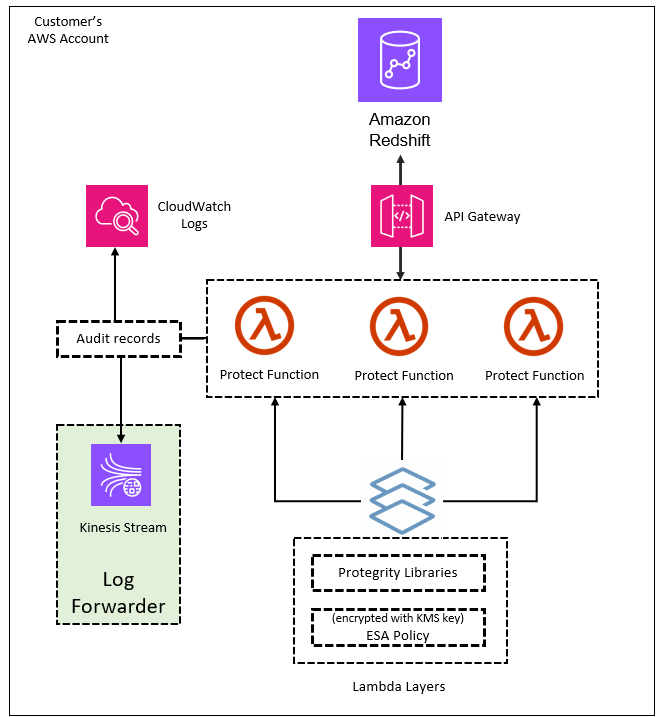
The following diagram shows a reference architecture for synchronizing the security policy from ESA.
The Protegrity Policy Agent requires network access to an Enterprise Security Administrator (ESA). Most organizations install the ESA on-premise. Therefore, it is recommended that the Policy Agent is installed into a private subnet with a Cloud VPC using a NAT Gateway to enable this communication through a corporate firewall.
The ESA is a soft appliance that must be pre-installed on a separate server. It is used to create and manage security policies.
For more information about installing the ESA, and creating and managing policies, refer to the Policy Management Guide.
Audit logs are by default sent to CloudWatch as long as the function’s execution role has the necessary permissions. The Protegrity Product can also be configured to send audit logs to ESA. Such configuration requires deploying Log Forwarder component which is available as part of Protegrity Product deployment bundle. The diagram below shows additional resources deployed with Log Forwarder component.
The log forwarder component includes Amazon Kinesis data stream and the forwarder Lambda function. Amazon Kinesis stream is used to batch audit records before sending them to forwarder function, where similar audit logs are aggregated before sending to ESA. Aggregation rules are described in the Protegrity Log Forwarding guide. When the protector function is configured to send audit logs to log forwarder, audit logs are aggregated on the protector function before sending to Amazon Kinesis. Due to specifics of the Lambda runtime lifecycle, audit logs may take up to 15 minutes before being sent to Amazon Kinesis. Protector function exposes configuration to minimize this time which is described in the protector function installation section.
The security of audit logs is ensured by using HTTPS connection on each link of the communication between protector function and ESA. Integrity and authenticity of audit logs is additionally checked on log forwarder which verifies individual logs signature. The signature verification is done upon arrival from Amazon Kinesis before applying aggregation. If signature cannot be verified, the log is forwarded as is to ESA where additional signature verification can be configured. Log forwarder function uses client certificate to authenticate calls to ESA.
To learn more about individual audit log entry structure and purpose of audit logs, refer to Audit Logging section in this document. Installation instructions can be found in Audit Log Forwarder installation.
The audit log forwarding requires network access from the cloud to the ESA. Most organizations install the ESA on-premise. Therefore, it is recommended that the Log Forwarder Function is installed into a private subnet with a Cloud VPC using a NAT Gateway to enable this communication through a corporate firewall.
The AWS Redshift system is a cloud data warehouse Platform-as-a-Service (PaaS) from AWS. Unlike traditional (on-prem or customer-managed) data warehouses and RDBMS systems, Redshift is a fully managed, multi-tenant PaaS service, where the customers do not have the ability to install 3rd party software within the Redshift infrastructure.
Currently, the Redshift architecture does not allow installing Protegrity data protection UDFs and policy enforcement point (PEP) agents inside the Redshift infrastructure. Therefore, a remote-coupling integration mechanism where Redshift invokes RESTful APIs exposed by the Protegrity product is used.
Redshift supports remote invocations to the Protegrity infrastructure through External Functions, which in turn calls AWS Lambda.
Access and authorization between various AWS services involved in this architecture is achieved through Identity Access Management (IAM). For instance, Redshift is given an IAM role to call Lambda, Lambda is given an IAM role to call Secrets Manager, etc. Various IAM role configuration settings are shown in the appendices of this document.
The following figure illustrates the Protegrity Redshift Integration architecture.
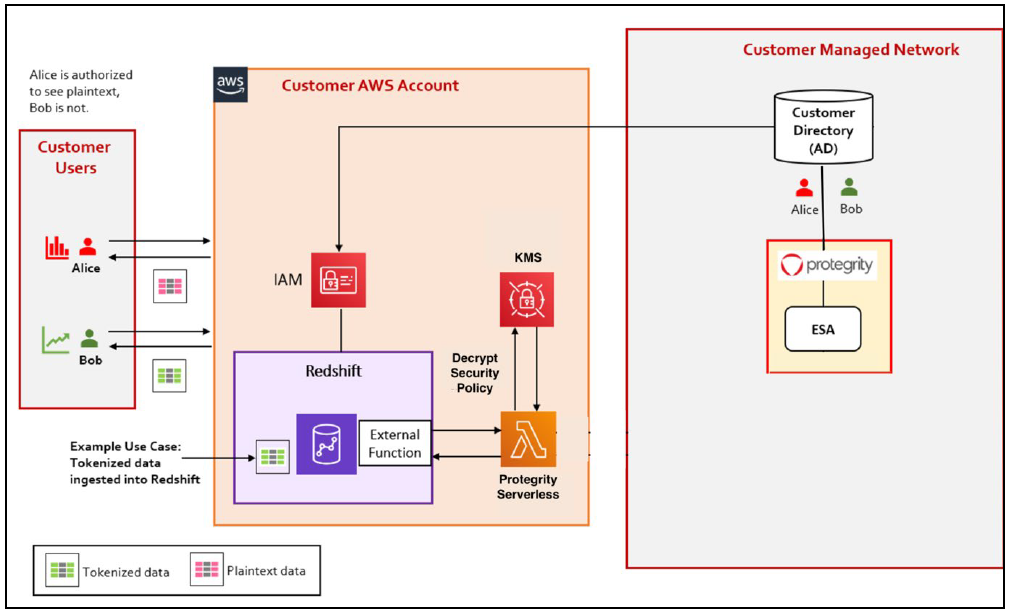
The AWS Redshift system is a cloud data warehouse Platform-as-a-Service (PaaS) from AWS. Unlike traditional (on-prem or customer-managed) data warehouses and RDBMS systems, Redshift is a fully managed, multi-tenant PaaS service, where the customers do not have the ability to install 3rd party software within the Redshift infrastructure.
Currently, the Redshift architecture does not allow installing Protegrity data protection UDFs and policy enforcement point (PEP) agents inside the Redshift infrastructure. Therefore, a remote-coupling integration mechanism where Redshift invokes RESTful APIs exposed by the Protegrity product is used.
Redshift supports remote invocations to the Protegrity infrastructure through External Functions, which in turn calls AWS Lambda.
Access and authorization between various AWS services involved in this architecture is achieved through Identity Access Management (IAM). For instance, Redshift is given an IAM role to call Lambda, Lambda is given an IAM role to call Secrets Manager, etc. Various IAM role configuration settings are shown in the appendices of this document.
The following figure illustrates the Protegrity Redshift Integration architecture.
The following table describes the AWS services that may be a part of your Protegrity installation.
Service | Description |
|---|---|
Lambda | Provides serverless compute for Protegrity protection operations and the ESA integration to fetch policy updates or deliver audit logs. |
KMS | Provides secrets for envelope policy encryption/decryption for Protegrity. |
Secrets Manager | Provides secrets management for the ESA credentials. |
S3 | Intermediate storage location for the encrypted ESA policy layer. |
Kinesis | Required if Log Forwarder is to be deployed. Amazon Kinesis is used to batch audit logs sent from protector function to ESA. |
VPC & NAT Gateway | Optional. Provides a private subnet to communicate with an on-prem ESA. |
CloudWatch | Application and audit logs, performance monitoring, and alerts. Scheduling for the policy agent. |
The Protector and Log Forwarder functions require a security policy from a compatible ESA version.
The table below shows compatibility between different Protector and ESA versions.
| Protector Version | ESA Version | |||
|---|---|---|---|---|
| 8.x | 9.0 | 9.1 & 9.2 | 10.0 | |
| 2.x | No | Yes | * | No |
| 3.0.x & 3.1.x | No | No | Yes | No |
| 3.2.x | No | No | Yes | * |
| 4.0.x | No | No | No | Yes |
Legend | |
|---|---|
Yes | Protector was designed to work with this ESA version |
No | Protector will not work with this ESA version |
* | Backward compatible policy download supported:
|
| Requirements | Description |
|---|---|
| Protegrity distribution and installation scripts | These artifacts are provided by Protegrity |
| Protegrity ESA 10.0+ | The Cloud VPC must be able to obtain network access to the ESA |
| AWS Account | Recommend creating a new sub-account for Protegrity Serverless |
| Redshift cluster (Enterprise Edition) | Must be in the same region as Protegrity Protect Lambda |
| Requirements | Description |
|---|---|
| AWS Account Administrator | To run CloudFormation (or perform steps manually), create/configure a VPC and IAM permissions. |
| Protegrity Administrator | The ESA credentials required to extract the policy for the Policy Agent |
| Redshift Administrator | Account Admin access required to setup access |
| Network Administrator | To open firewall to access ESA and evaluate AWS network setup |
Identify or create an AWS account where the Protegrity solution will be installed. It is recommended that a new AWS sub-account be created. This can provide greater security controls and help avoid conflicts with other applications that might impact regional account limits. An individual with the Cloud Administrator role will be required for some subsequent installation steps.
AWS Account ID: ___________________
AWS Region (AwsRegion): ___________________
Determine the AWS region where the Amazon Redshift cluster is running. This is the region in where the Protegrity solution must be installed.
AWS Region (AccountRegion): ___________________
This S3 bucket will be used for the artifacts required by the CloudFormation installation steps. This S3 bucket must be created in the region that is defined in Provide AWS sub-account
Sign in to the AWS Management Console and open the Amazon S3 console.
Change region to the one determined in Provide AWS sub-account
Click Create Bucket.
Enter a unique bucket name:
For example, protegrity-install.us-west-2.example.com
Upload the installation artifacts to this bucket. Protegrity will provide the following three artifacts:
S3 Bucket name (ArtifactS3Bucket): ___________________
The Amazon Key Management Service (KMS) provides the ability for the Protegrity Serverless solution to encrypt and decrypt the Protegrity Security Policy.
To create KMS key:
In the AWS sub-account where the KMS key will reside, select the region.
Navigate to Key Management Service > Create Key.
Configure the key settings:
Create alias and optional description, such as, Protegrity-Serverless and click Next.
Define key administrative permissions, the IAM user who will administrate the key.
Click Next.
Define the key usage permissions.
In Other AWS accounts, enter the AWS account id used for the Protegrity Serverless installation.
Continue on to create the key. If there is a concern this permission is overly broad, then you can return later to restrict access to the role of two Protegrity Serverless Lambda as principals. Click to open the key in the list and record the ARN.
KMS Key ARN (AWS_KMS_KEY_ID): ___________________
Download the public key from the KMS key. Navigate to the key in KMS console, select the Public key tab, and click Download. Save the PEM file. This public key will be added to the ESA data store as an export key. Refer to Exporting Keys to Datastore for instructions on adding the public key to the data store.
KMS Public Key PEM file: ___________________
An IAM role is used to authorize Redshift to access the future Protect Lambda resource.
To create IAM account role:
From the AWS console, access IAM, select Roles and then Create Role.
In Trusted entity type section, select AWS service
In Use case section, for Service or use case, select Redshift.
For Use case, select Redshift – Customizable.
Click Next to advance to Add Permissions step.
Click Next to skip Add Permissions step.
Enter a Role name, for example, RedshiftProtegrity.
Click Create role.
After the role is created, click on the role. Record the following information:
Ensure that all the steps in Pre-Configuration are performed.
Login to the AWS account console where Amazon Redshift Protector will be installed.
Ensure that the required CloudFormation templates provided by Protegrity are available on your local computer.
This task defines a policy used by the Protegrity Lambda function to write CloudWatch logs and access the KMS encryption key to decrypt the policy.
Perform the following steps to create the Lambda execution role and required policies:
From the AWS IAM console, select Policies > Create Policy.
Select the JSON tab and copy the following sample policy.
{
  "Version": "2012-10-17",
  "Statement": [
    {
      "Sid": "CloudWatchWriteLogs",
      "Effect": "Allow",
      "Action": [
        "logs:CreateLogGroup",
        "logs:CreateLogStream",
        "logs:PutLogEvents"
      ],
      "Resource": "*"
    },
    {
      "Sid": "KmsDecrypt",
      "Effect": "Allow",
      "Action": [
        "kms:Decrypt"
      ],
      "Resource": [
        "arn:aws:kms:*:*:key/*"
      ]
    }
  ]
}
For the KMS policy, replace the Resource with the ARN for the KMS key created in a previous step.
Select Next, type in a policy name, for example, ProtegrityProtectLambdaPolicy and Create Policy. Record the policy name:
ProtectLambdaPolicyName:__________________
The following steps create the role to utilize the policy defined in Create Protect Lambda IAM Execution Policy.
To create protect lambda IAM execution role:
From the AWS IAM console, select Roles > Create Role.
Select AWS Service > Lambda > Next.
In the list, search and select the policy created in Create Protect Lambda IAM Execution Policy.
Click Next
Type the role name, for example, ProtegrityProtectRole
Click Create role
Record the role ARN.
Role ARN (LambdaExecutionRoleArn): ___________________
The following steps describe the deployment of the Lambda function.
To install through CloudFormation:
Access CloudFormation and select the target AWS Region in the console.
Click Create Stack and choose With new resources.
Specify the template.
Select Upload a template file.
Upload the Protegrity-provided CloudFormation template called pty_protect_cf.json and click Next.
Specify the stack details. Enter a stack name.
Enter the required parameters. All the values were generated in the pre-configuration steps.
Parameter | Description |
|---|---|
DBRoleName | Name of the account role created in the pre-configuration step |
ArtifactS3Bucket | Name of S3 bucket created in the pre-configuration step |
LambdaExecutionRoleArn | The ARN of Lambda role created in the prior step |
MinLogLevel | Minimum log level for protect function. Allowed Values: off, severe, warning, info, config, all |
UsernameRegex | If set, the effective policy user will be extracted from the user in the request. NoteSee Configuring Regular Expression to Extract Policy Username to learn how to extract username from the request |
If you are not planning to deploy log forwarder you can skip this step. The log forwarder parameters can be provided later after log forwarder is deployed.
| Log Forwarder Parameters | Description |
|---|---|
| KinesisLogStreamArn | The ARN of the AWS Kinesis stream where audit logs will be sent for aggregation |
| AuditLogFlushInterval | Time interval in seconds used to accumulate audit logs before sending to Kinesis. Default value: 30. See Log Forwarder Performance section for more details. |
Proceed to the last step of the Create Stack wizard with defaults and click Submit to create CloudFormation stack.
Select Outputs tab of the stack after stack is created.
Record the following values:
ProtectFunctionName: __________________________
ProtectFunctionProductionAlias: __________________________
ProtectLayerName: _____________________________
After CloudFormation stack is deployed, the Protect Lambda default configuration can be changed using Lambda environment configuration. See below for list of available configuration and instructions how to update it.
List of Protect Lambda Environment Variables
Variable Name | Description | Notes |
|---|---|---|
LOG_REDSHIFT_CLUSTER_ARN | When enabled, Redshift cluster ARN is recorded in CloudWatch audit log. | Set LOG_REDSHIFT_CLUSTER_ARN = 1 to enable. See Audit Logging for audit log examples. |
Updating Lambda Configuration
From your AWS console, navigate to Lambda and select the following Lambda:
Protegrity_Protect_<STACK_NAME>
Select Configuration tab and scroll down to the Environment variables section. Select Edit then Add environment variable. For the list of allowed variables and corresponding values refer to the table above.
CloudFormation created an API Gateway that makes this product compatible with Snowflake. However, this service is not required for Amazon Redshift so it may be optionally removed.
To delete API Gateway:
From Services, access API Gateway.
Select the API Gateway service that is created.
Click Actions > Delete.
To add inline Lambda Protect IAM permissions to role:
Select the role created in section Create IAM Account Role (DBRoleName).
In the Permissions tab, click Add inline policy.
Select the JSON tab and copy the following sample policy.
{
  "Version": "2012-10-17",
  "Statement": [
    {
      "Sid": "ProtegrityProtectInvokePermission",
      "Effect": "Allow",
      "Action": "lambda:InvokeFunction",
      "Resource": "arn:aws:lambda:*:*:function:*"
    }
  ]
}
Edit the Resource value in the snippet with the ARN of the Protect Lambda function to further restrict privileges.
Perform the following steps to allow Redshift to invoke the Protect Lambda function.
Attach the IAM role (DBRoleName) created in Create IAM Account Role to the Redshift cluster.
To attach IAM account role to Redshift:
From the AWS console, access Amazon Redshift and click on the cluster.
Select Actions > Manage IAM Roles.
Under Available IAM roles, select Enter ARN.
Enter the Role ARN recorded in Create Protect Lambda IAM Role.
Click Add IAM role.
Perform the following steps to verify if Redshift is working correctly with the Protegrity product.
To test the connectivity:
Access the Redshift SQL console.
Copy and paste the following snippet into a worksheet.
CREATE OR REPLACE EXTERNAL FUNCTION pty_unprotect_alpha(varchar) RETURNS varchar
VOLATILE lambda '<replace_with_protect_function_name>:Production' iam_role 'arn:aws:iam::<you-awsaccount-
number>:role/<role-name>
Replace the placeholder values with the lambda function name and role created in earlier steps.
Run the following command in the console:
select pty_unprotect_alpha('UtfVk UHgcD!')
Verify that the string hello world! is returned.
Error | Action |
|---|---|
Empty result or Invalid operation error |
|
The following sections will install the Policy Agent. The Policy Agent polls the ESA and deploys the policy to Protegrity Serverless as a static resource. Some of the installation steps are not required for the operation of the software but recommended for establishing a secure environment. Contact Protegrity Professional Services for further guidance on configuration alternatives in the Cloud.
Policy Agent Lambda requires ESA server running and accessible on TCP port 443.
Note down ESA IP address:
ESA IP Address (EsaIpAddress): ___________________
Whether your ESA is configured with default self-signed certificate or your corporate CA certificate, Policy Agent can validate authenticity of ESA connection using CA certificate. The process for both scenarios is the same:
To obtain self-signed CA certificate from ESA:
Log in to ESA Web UI.
Select Settings > Network > Manage Certificates.
Hover over Server Certificate and click on download icon to download the CA certificate.
To convert downloaded CA certificate to a value accepted by Policy Agent, open the downloaded PEM file in text editor and replace all new lines with escaped new line: \n.
To escape new lines from command line, use one of the following commands depending on your operating system:
Linux Bash:
awk 'NF {printf "%s\\n",$0;}' ProtegrityCA.pem > output.txt
Windows PowerShell:
(Get-Content '.\ProtegrityCA.pem') -join '\n' | Set-Content 'output.txt'
Record the certificate content with new lines escaped.
ESA CA Server Certificate (EsaCaCert): ___________________
This value will be used to set PTY_ESA_CA_SERVER_CERT or PTY_ESA_CA_SERVER_CERT_SECRET Lambda variable in section Policy Agent Lambda Configuration
For more information about ESA certificate management refer to Certificate Management Guide in ESA documentation.
Establish a VPC where the Policy Agent will be hosted. This VPC will need connectivity to the ESA. The VPC should be in the same account and region established in Pre-Configuration.
VPC name: ___________________
Identify or create a new subnet in the VPC where tha Lambda function will be connected to. It is recommended to use a private subnet.
Subnet name: ___________________
If ESA server is hosted outside of the AWS Cloud network, the VPC configured for Lambda function must ensure additional network configuration is available to allow connectivity with ESA. For instance if ESA has a public IP, the Lambda function VPC must have public subnet with a NAT server to allow routing traffic outside of the AWS network. A Routing Table and Network ACL may need to be configured for outbound access to the ESA as well.
If an internal VPC was created, then add VPC Endpoints, which will be used by the Policy Agent to access AWS services. Policy Agent needs access to the following AWS services:
Type | Service name |
|---|---|
Interface | com.amazonaws.{REGION}.secretsmanager |
Interface | com.amazonaws.{REGION}.kms |
Gateway | com.amazonaws.{REGION}.s3 |
Interface | com.amazonaws.{REGION}.lambda |
Policy Agent and cloud-based ESA appliance use AWS security groups to control traffic that is allowed to leave and reach them. Policy Agent runs on schedule and is mostly concerned with allowing traffic out of itself to ESA and AWS services it depends on. ESA runs most of the time and it must allow Policy Agent to connect to it.
Policy Agent security group must allow outbound traffic using rules described in the table below. To edit security group navigate:
From VPC > Security Groups > Policy Agent Security Group configuration.
| Type | Protocol | Port Range | Destination | Reason |
|---|---|---|---|---|
| Custom TCP | TCP | 443 | Policy Agent Lambda SG | ESA Communication |
| HTTPS | TCP | 443 | Any | AWS Services |
Record Policy Agent security group ID:
Policy Agent Security Group Id: ___________________
Policy Agent will reach out to ESA on port 443. Create following inbound security group rule for cloud-based ESA appliance to allow connections from Policy Agent:
| Type | Protocol | Port Range | Source |
|---|---|---|---|
| Custom TCP | TCP | 443 | Policy Agent Lambda SG |
Policy Agent Lambda requires ESA credentials to be provided as one of the three options.
Creating secrets manager secret with ESA username and password.
From the AWS Secrets Manager Console, select Store New Secret.
Select Other Type of Secrets.
Specify the username and password key value pair.
Select the encryption key or leave default AWS managed key.
Specify the Secret Name and record it.
ESA Credentials Secret Name: __________________
ESA password is encrypted with AWS KMS symmetric key.
Create AWS KMS symmetric key which will be used to encrypt ESA password. See Create KMS Key for instructions on how to create KMS symmetric key using AWS console.
Record KMS Key ARN.
ESA PASSWORD KMS KEY ARN: __________________
Run AWS CLI command to encrypt ESA password. Below you can find sample Linux aws cli command. Replace <key_arn> with KMS symmetric key ARN.
aws kms encrypt --key-id <key_arn> --plaintext $(echo '<esa_password>' | base64 )
Sample output.
{
  "CiphertextBlob": "esa_encrypted_password",
  "KeyId": "arn:aws:kms:region:aws_account:key/key_id ",
  "EncryptionAlgorithm": "SYMMETRIC_DEFAULT"
}
Record ESA username and encrypted password.
ESA USERNAME: __________________
ESA ENCRYPTED PASSWORD: __________________
With this option ESA username and password are returned by a custom AWS Lambda function. This method may be used to get the username and password from external vaults.
Create AWS Lambda in any AWS supported runtime.
There is no input needed.
The Lambda function must return the following response schema.
response:
type: object
  properties:
    username: string
    password: string
For example,
example output: {"username": "admin", "password": "Password1234"}
Sample AWS Lambda function in Python:
import json

def lambda_handler(event, context):

    return {"username": "admin", "password": "password1234"}
Record the Lambda name:
Custom AWS lambda for ESA credentials: _______________
Follow the steps below to create Lambda execution policies.
Create Agent Lambda IAM policy
From AWS IAM console, select Policies > Create Policy.
Select JSON tab and copy the following snippet.
{
  "Version": "2012-10-17",
  "Statement": [
    {
      "Sid": "EC2ModifyNetworkInterfaces",
      "Effect": "Allow",
      "Action": [
        "ec2:CreateNetworkInterface",
        "ec2:DescribeNetworkInterfaces",
        "ec2:DeleteNetworkInterface"
      ],
      "Resource": "*"
    },
    {
      "Sid": "CloudWatchWriteLogs",
      "Effect": "Allow",
      "Action": [
        "logs:CreateLogGroup",
        "logs:CreateLogStream",
        "logs:PutLogEvents"
      ],
      "Resource": "*"
    },
    {
      "Sid": "LambdaUpdateFunction",
      "Effect": "Allow",
      "Action": [
        "lambda:UpdateFunctionConfiguration"
      ],
      "Resource": [
        "arn:aws:lambda:*:*:function:*"
      ]
    },
    {
      "Sid": "LambdaReadLayerVersion",
      "Effect": "Allow",
      "Action": [
        "lambda:GetLayerVersion",
        "lambda:ListLayerVersions"
      ],
      "Resource": "*"
    },
    {
      "Sid": "LambdaDeleteLayerVersion",
      "Effect": "Allow",
      "Action": "lambda:DeleteLayerVersion",
      "Resource": "arn:aws:lambda:*:*:layer:*:*"
    },
    {
      "Sid": "LambdaPublishLayerVersion",
      "Effect": "Allow",
      "Action": "lambda:PublishLayerVersion",
      "Resource": "arn:aws:lambda:*:*:layer:*"
    },
    {
      "Sid": "S3GetObject",
      "Effect": "Allow",
      "Action": [
        "s3:GetObject"
      ],
      "Resource": "arn:aws:s3:::*/*"
    },
    {
      "Sid": "S3PutObject",
      "Effect": "Allow",
      "Action": [
        "s3:PutObject"
      ],
      "Resource": "arn:aws:s3:::*/*"
    },
    {
      "Sid": "KmsEncrypt",
      "Effect": "Allow",
      "Action": [
        "kms:GetPublicKey"
      ],
      "Resource": [
        "arn:aws:kms:*:*:key/*"
      ]
    },
    {
      "Sid": "SecretsManagerGetSecret",
      "Effect": "Allow",
      "Action": [
        "secretsmanager:GetSecretValue"
      ],
      "Resource": [
        "arn:aws:secretsmanager:*:*:secret:*"
      ]
    },
    {
      "Sid": "LambdaGetConfiguration",
      "Effect": "Allow",
      "Action": [
          "lambda:GetFunctionConfiguration"
      ],
      "Resource": [
          "arn:aws:lambda:*:*:function:*"
      ]
    }
  ]
}
Replace wildcard * with the region, account, and resource name information where required.
This step is required if KMS is used to encrypt ESA password.
Add policy entry below. Replace ESA PASSWORD KMS KEY ARN with the value recorded in Option 2: KMS Encrypted Password.
  {
    "Sid": "KmsDecryptEsaPassword",
    "Effect": "Allow",
    "Action": [
      "kms:Decrypt"
    ],
    "Resource": [
      "**ESA PASSWORD KMS KEY ARN**"
    ]
  }
Select Next type in the policy name and Create Policy. Record policy name:
Policy Name: ___________________
Perform the following steps to create Agent Lambda execution IAM role.
To create agent Lambda IAM role:
From AWS IAM console, select Roles > Create Role.
Select AWS Service > Lambda > Next.
Select the policy created in Create Agent Lambda IAM policy.
Proceed to Name, Review and Create.
Type the role name, for example, ProtegrityAgentRole and click Confirm.
Select Create role.
Record the role ARN.
Agent Lambda IAM Execution Role Name: ___________________
If an on-premise firewall is used, then the firewall must allow access from the NAT Gateway to an ESA. The firewall must allow access from the NAT Gateway IP to ESA via port 443 and 443.
Create the Policy Agent in the VPC using the CloudFormation script provided by Protegrity.
Access the CloudFormation service.
Select the target installation region.
Create a stack with new resources.
Upload the Policy Agent CloudFormation template (file name: pty_agent_cf.json).
Specify the following parameters for Cloud Formation:
| Parameter | Description | Note |
|---|---|---|
| VPC | VPC where the Policy Agent will be hosted | Identify or Create a new VPC |
| Subnet | Subnet where the Policy Agent will be hosted | VPC Subnet Configuration |
| PolicyAgentSecurityGroupId | Security Group Id, which allows communication between the Policy Agent and the ESA | Identify or Create Security Groups |
| LambdaExecutionRoleArn | Agent Lambda IAM execution role ARN allowing access to the S3 bucket, KMS encryption Key, Lambda and Lambda Layer | Create Agent Lambda IAM Role |
| ArtifactS3Bucket | S3 bucket name with deployment package for the Policy Agent | Use S3 Bucket name recorded in Create S3 bucket for Installing Artifacts |
| CreateCRONJob | Set to True to create a CloudWatch schedule for the agent to run. | Default: False |
After the CloudFormation stack is deployed, the Policy Agent Lambda must be configured with parameters recorded in earlier steps. From your AWS Console, navigate to lambda and select the following Lambda.
Protegrity_Agent<STACK_NAME>_
Select Configuration tab and scroll down to the Environment variables section. Select Editand replace all entries with the actual values.
Parameter | Description | Notes |
|---|---|---|
PTY_ESA_IP | ESA IP address or hostname | |
PTY_ESA_CA_SERVER_CERT | ESA self-signed CA certificate or your corporate CA certificate used by policy Agent Lambda to ensure ESA is the trusted server. | Recorded in step Certificates on ESA NoteFor PPC deployments, see PPC Appendix: Policy Agent Certificate Guidance for details on obtaining and using the CA certificate.In case ESA is configured with publicly signed certificates, the PTY_ESA_CA_SERVER_CERT configuration will be ignored. |
PTY_ESA_CA_SERVER_CERT_SECRET | This configuration option fulfills the same function as PTY_ESA_CA_SERVER_CERT but supports larger configuration values, making it the recommended choice. The value should specify the name of the AWS Secrets Manager secret containing the ESA self-signed CA certificate. The secret value should be set to the json with “PTY_ESA_CA_SERVER_CERT” key and PEM formated CA certificate content value as shown below. | Recorded in step Certificates on ESA NoteFor PPC deployments, see PPC Appendix: Policy Agent Certificate Guidance for details on obtaining and using the CA certificate.In case ESA is configured with publicly signed certificates, the PTY_ESA_CA_SERVER_CERT_SECRET configuration will be ignored. When both PTY_ESA_CA_SERVER_CERT and PTY_ESA_CA_SERVER_CERT_SECRET are configured the PTY_ESA_CA_SERVER_CERT_SECRET takes precedence. |
PTY_ESA_CREDENTIALS_SECRET | ESA username and password (encrypted value by AWS Secrets Manager) | |
PTY_DATASTORE_KEY | ESA policy datastore public key fingerprint (64 char long) e.g. 123bff642f621123d845f006c6bfff27737b21299e8a2ef6380aa642e76e89e5. | NoteThis configuration is not applicable for ESA versions lower than 10.2.The export key is the public part of an asymmetric key pair created in a Create KMS Key. A user with Security Officer permissions adds the public key to the data store in ESA via Policy Management > Data Stores > Export Keys. The fingerprint can then be copied using the Copy Fingerprint icon next to the key. Refer to Exporting Keys to Datastore for details. NoteFor PPC deployments, see PPC Appendix: Policy Agent Certificate and Key Guidance for details on obtaining and using the datastore key fingerprint. |
AWS_KMS_KEY_ID | KMS key id or full ARN e.g. arn:aws:kms:us-west-2:112233445566:key/bfb6c4fb-509a-43ac-b0aa-82f1ca0b52d3 | |
AWS_POLICY_S3_BUCKET | S3 bucket where the encrypted policy will be written | S3 bucket of your choice |
AWS_POLICY_S3_FILENAME | Filename of the encrypted policy stored in S3 bucket | Default: protegrity-policy.zip |
AWS_PROTECT_FN_NAME | Comma separated list of Protect function names or ARNs | ProtectFunctionName(s), recorded in CloudFormation Installation |
DISABLE_DEPLOY | This flag can be either 1 or 0. If set to 1, then the agent will not update PTY_PROTECT lambda with the newest policy. Else, the policy will be saved in the S3 bucket and deployed to the Lambda Layer | Default: 0 |
AWS_POLICY_LAYER_NAME | Lambda layer used to store the Protegrity policy used by the PTY_PROTECT function |
|
POLICY_LAYER_RETAIN | Number of policy versions to retain as backup. (e.g. 2 will retain the latest 2 policies and remove older ones). -1 retains all. | Default: 2 |
POLICY_PULL_TIMEOUT | Time in seconds to wait for the ESA to send the full policy | Default: 20s |
ESA_CONNECTION_TIMEOUT | Time in seconds to wait for the ESA response | Default: 5s |
LOG_LEVEL | Application and audit logs verbiage level | Default: INFO Allowed values: DEBUG – the most verbose, INFO, WARNING, ERROR – the least verbose |
PTY_CORE_EMPTYSTRING | Override default behavior. Empty string response values are returned as null values. For instance: (un)protect(’’) -> null (un)protect(’’) -> '' | Default: empty Allowed values: null empty |
PTY_CORE_CASESENSITIVE | Specifies whether policy usernames should be case sensitive | Default: no Allowed values: yes no |
PTY_ADDIPADDRESSHEADER | When enabled, agent will send its source IP address in the request header. This configuration works in conjunction with ESA hubcontroller configuration ASSIGN_DATASTORE_USING_NODE_IP (default=false). See Associating ESA Data Store With Cloud Protect Agent for more information. | Default: yes Allowed values: yes no |
PTY_ESA_USERNAME | Plaintext ESA username which is used together with PTY_ESA_ENCRYPTED_PASSWORD as an optional ESA credentials | Option 2: KMS Encrypted Password Presence of this parameter will cause PTY_ESA_CREDENTIALS_SECRET to be ignored |
PTY_ESA_ENCRYPTED_PASSWORD | ESA password encrypted with KMS symmetric key. Example AWS cli command to generate the value:
| Option 2: KMS Encrypted Password Presence of this parameter will cause PTY_ESA_CREDENTIALS_SECRET to be ignored Value must be base64 encoded |
EMPTY_POLICY_S3 | This flag can be either 1 or 0. If set to 1, then the agent will remove the content of the policy file in S3 bucket, but will keep the checksum in the metadata. Else, the policy will be saved in the S3 bucket and not removed. | Default: 0 |
PTY_ESA_CREDENTIALS_LAMBDA | Lambda function to return ESA credentials | Recorded in step Option 3: Custom AWS Lambda function LAMBDA FOR ESA CREDENTIALS. Presence of PTY_ESA_USERNAME, or PTY_ESA_CREDENTIALS_SECRET will cause this value to be ignored. The Policy Agent Lambda must have network access and IAM permissions to invoke the custom ESA Credentials Lambda you have created in Option 3: Custom AWS Lambda function. |
Open the Lambda and configure Test to execute the lambda and specify the default test event. Wait for around 20 seconds for the Lambda to complete. If policy is downloaded successfully, then a success message appears.
Navigate to the AWS_POLICY_S3_BUCKET bucket and verify that the AWS_POLICY_S3_FILENAME file was created.
Lambda Error | Example Error | Action |
|---|---|---|
Task timed out after x seconds | |
|
ESA connection error. Failed to download certificates | ||
Policy Pull takes a long time | |
|
ESA connection error. Failed to download certificates. HTTP response code: 401 | | Ensure that the PTY_ESA_CREDENTIALS_SECRET has correct ESA username and password |
An error occurred (AccessDeniedException) when calling xyz operation | | Ensure that the Lambda execution role has permission to call the xyz operation |
Access Denied to Secret Manager. | |
|
Master Key xyz unable to generate data key | Ensure that the Lambda can access xyz CMK key | |
The S3 bucket server-side encryption is enabled, the encryption key type is SSE-KMS but the Policy Agent execution IAM role doesn’t have permissions to encrypt using the KMS key . | | Add the following permissions to the Policy Agent excution role. NoteWhen the KMS key and the Policy Agent Lambda are in separate accounts, update both the AWS KMS key and the Policy Agent execution role. |
The S3 bucket has bucket policy to only allow access from within the VPC. | | The Policy Agent publishes a new Lambda Layer version, and the Lambda Layer service uploads the policy file from the s3 bucket and the upload request is originated from the AWS service outside the Policy Agent Lambda VPC. Update the S3 bucket resource policy to allow access from AWS Service. Sample security policy to lock down access to the vpc: |
Strengthen the KMS IAM policy by granting access only to the required Lambda function(s).
Finalize the IAM policy for the Lambda Execution Role. Ensure to replace wildcard * with the region, account, and resource name information where required.
For example,
"arn:aws:lambda:*:*:function:*" -> "arn:aws:lambda:us-east-1:account:function:function_name"
If specified in CloudFormation Installation, the agent installation created a CloudWatch event rule, which checks for policy update on an hourly schedule. This schedule can be altered to the required frequency.
Under CloudWatch > Events > Rules, find Protegrity_Agent_{stack_name}. Click Action > Edit Set the cron expression. A cron expression can easily be defined using CronMaker, a free online tool. Refer to http://www.cronmaker.com.
The following sections show steps how to install Audit Log Forwarder component in the AWS Cloud. The Log Forwarder deployment allows for the audit logs generated by Protector to be delivered to ESA for auditing and governance purposes. Log Forwarder component is optional and is not required for the Protector Service to work properly. See Log Forwarding Architecture section in this document for more information. Some of the installation steps are not required for the operation of the software but recommended for establishing a secure environment. C ontact Protegrity for further guidance on configuration alternatives in the Cloud.
ESA server is required as the recipient of audit logs. Verify the information below to ensure ESA is accessible and configured properly.
ESA server running and accessible on TCP port 9200 (Audit Store) or 24284 (td-agent).
Audit Store service is configured and running on ESA. Applies when audit logs are output to Audit Store directly or through td-agent. For information related to ESA Audit Store configuration, refer to Audit Store Guide.
(Optional) td-agent is configured for external input. For more information related to td-agent configuration, refer to ESA guide Sending logs to an external security information and event management (SIEM).
This section is optional. If CA certificate is not provided, the Log Forwarder will skip server certificate validation and will connect to ESA without verifying that it is a trusted server.
If you are deploying Log Forwarder with Protegrity Provisioned Cluster (PPC), certificate authorization and CA validation are not supported. Configuration steps related to certificates in this section do not apply to PPC. See Integrating Cloud Protect with PPC (Protegrity Provisioned Cluster): Log Forwarder Setup with PPC for details.
By default, ESA is configured with self-signed certificates, which can optionally be validated using a self-signed CA certificate supplied in the Log Forwarder configuration. If no CA certificate is provided, the Log Forwarder will skip server certificate validation.
If ESA is configured with publicly signed certificates, this section can be skipped since the forwarder Lambda will use the public CA to validate ESA certificates.
To obtain the self-signed CA certificate from ESA:
Download ESA CA certificate from the /etc/ksa/certificates/plug directory of the ESA
After certificate is downloaded, open the PEM file in text editor and replace all new lines with escaped new line: \n.
To escape new lines from command line, use one of the following commands depending on your operating system:
Linux Bash:
awk 'NF {printf "%s\\n",$0;}' CA.pem > output.txt
Windows PowerShell:
(Get-Content '.\CA.pem') -join '\n' | Set-Content 'output.txt'
Record the certificate content with new lines escaped.
ESA CA Server Certificate (EsaCaCert): ___________________
This value will be used to set PtyEsaCaServerCert cloudformation parameter in section Install through CloudFormation
For more information about ESA certificate management refer to Certificate Management Guide in ESA documentation.
Log forwarder Lambda function requires network connectivity to ESA, similar to Policy Agent Lambda function. Therefore, it can be hosted in the same VPC as Policy Agent.
Separate VPC can be used, as long as it provides network connectivity to ESA.
VPC Name: ___________________
Log Forwarder can be connected to the same subnet as Policy Agent or separate one as long as it provides connectivity to ESA.
Subnet Name: ___________________
If ESA server is hosted outside of the AWS Cloud network, the VPC configured for Lambda function must ensure additional network configuration is available to allow connectivity with ESA. For instance if ESA has a public IP, the Lambda function VPC must have public subnet with a NAT server to allow routing traffic outside of the AWS network. A Routing Table and Network ACL may need to be configured for outbound access to the ESA as well.
Log Forwarder Lambda function requires connectivity to Secrets Manager AWS service. If the VPC identified in the steps before has no connectivity to public internet through the NAT Gateway, then the following service endpoint must be configured:
Security groups restrict communication between Log Forwarder Lambda function and the ESA appliance. The following rules must be in place for ESA and Log Forwarder Lambda function.
From VPC > Security Groups > Log Forwarder Security Group configuration.
| Type | Protocol | Port Range | Destination | Reason |
|---|---|---|---|---|
| Custom TCP | TCP | 9200 | Log Forwarder Lambda SG | ESA Communication |
Record the name of Log Forwarder security group name.
Log Forwarder Security Group Id: ___________________
The following port must be open for the ESA. If the ESA is running in the Cloud, then create the following security.
ESA Security Group configuration
| Type | Protocol | Port Range | Source |
|---|---|---|---|
| Custom TCP | TCP | 9200 | Log Forwarder Lambda SG |
Audit Log Forwarder can optionally authenticate with ESA using certificate-based authentication with a client certificate and certificate key. If used, both the certificate and certificate key will be stored in AWS Secrets Manager.
Download the following certificates from the /etc/ksa/certificates/plug directory of the ESA:
After certificates are downloaded, open each PEM file in text editor and replace all new lines with escaped new line: \n. To escape new lines from command line, use one of the commands below depending on your operating system.
Linux Bash:
awk 'NF {printf "%s\\n",$0;}' client.key > private_key.txt
awk 'NF {printf "%s\\n",$0;}' client.pem > public_key.txt
Windows PowerShell:
(Get-Content '.\client.key') -join '\n' | Set-Content 'private_key.pem'
(Get-Content '.\client.pem') -join '\n' | Set-Content 'public_key.pem'
For more information on how to configure client certificate authentication for Audit Store on ESA refer to Audit Store Guide.
To create secret with ESA client certificate/key pair in AWS Secrets Manager.
From the AWS Secrets Manager Console, select Store New Secret.
Select Other Type of Secrets.
Specify the private_key and public_key value pair.
Select the encryption key or leave default AWS managed key.
Specify the Secret Name and record it below.
ESA Client Certificate/Key Pair Secret Name: ___________________
This value will be used to set PtyEsaClientCertificatesSecretId cloudformation parameter in section Install through CloudFormation
This task defines a policy used by the Protegrity Log Forwarder Lambda function to write CloudWatch logs, access the KMS encryption key to decrypt the policy and access Secrets Manager for log forwarder user credentials.
Perform the following steps to create the Lambda execution role and required policies:
From the AWS IAM console, select Policies > Create Policy.
Select the JSON tab and copy the following sample policy.
{
  "Version": "2012-10-17",
  "Statement": [
    {
      "Sid": "EC2ModifyNetworkInterfaces",
      "Effect": "Allow",
      "Action": [
        "ec2:CreateNetworkInterface",
        "ec2:DescribeNetworkInterfaces",
        "ec2:DeleteNetworkInterface"
      ],
      "Resource": "*"
    },
    {
      "Sid": "CloudWatchWriteLogs",
      "Effect": "Allow",
      "Action": [
        "logs:CreateLogGroup",
        "logs:CreateLogStream",
        "logs:PutLogEvents"
      ],
      "Resource": "*"
    },
    {
      "Sid": "KmsDecrypt",
      "Effect": "Allow",
      "Action": [
        "kms:Decrypt"
      ],
      "Resource": [
        "arn:aws:kms:*:*:key/*"
      ]
    },
    {
        "Sid": "KinesisStreamRead",
        "Effect": "Allow",
        "Action": [
            "kinesis:GetRecords",
            "kinesis:GetShardIterator",
            "kinesis:DescribeStream",
            "kinesis:DescribeStreamSummary",
            "kinesis:ListShards",
            "kinesis:ListStreams"
        ],
        "Resource": "*"
    },
    {
      "Sid": "SecretsManagerGetSecret",
      "Effect": "Allow",
      "Action": [
        "secretsmanager:GetSecretValue"
      ],
      "Resource": [
        "arn:aws:secretsmanager:*:*:secret:*"
      ]
    }
  ]
}
For the KMS policy, replace the Resource with the ARN for the KMS key created in a previous step.
Select Review policy, type in a policy name, for example, ProtegrityLogForwarderLambdaPolicy and Confirm. Record the policy name:
LogForwarderLambdaPolicyName:__________________
Perform the following steps to create Log Forwarder execution IAM role.
To create Log Forwarder IAM role:
From AWS IAM console, select Roles > Create Role.
Select AWS Service > Lambda > Next.
Select the policy created in Create Audit Log Forwarder IAM Execution Policy.
Proceed to Name, Review and Create.
Type the role name, for example, ProtegrityForwarderRole and click Confirm.
Record the role ARN.
Log Forwarder IAM Execution Role Name: ___________________
Audit Log Forwarder installation artifacts are part of the same deployment package as the one used for protect and policy agent services. Follow the steps below to ensure the right artifacts are available for log forwarder installation.
Verify that the Protegrity deployment package is available on your local system, if not, you can download it from the Protegrity portal.
Extract the pty_log_forwarder_cf.json cloud formation file from the deployment package.
Check the S3 deployment bucket identified in section Create S3 bucket for Installing Artifacts. Make sure that all Protegrity deployment zip files are uploaded to the S3 bucket.
The following steps describe the deployment of the Audit Log Forwarder AWS cloud components.
Access CloudFormation and select the target AWS Region in the console.
Click Create Stack and choose With new resources.
Specify the template.
Select Upload a template file.
Upload the Protegrity-provided CloudFormation template called pty_log_forwarder_cf.json and click Next.
Specify the stack details. Enter a stack name.
Enter the required parameters. All the values were generated in the pre-configuration steps.
Parameter | Description | Default Value | Required |
|---|---|---|---|
LogForwarderSubnets | Subnets where the Log Forwarder will be hosted. |
|
|
LogForwarderSecurityGroups | Security Groups, which allow communication between the Log Forwarder and ESA. |
| X |
LambdaExecutionRoleArn | The ARN of Lambda role created in the prior step. |
| X |
ArtifactS3Bucket | Name of S3 bucket created in the pre-configuration step. |
| X |
LogDestinationEsaIp | IP or FQDN of the ESA instance or cluster. |
| X |
AuditLogOutput | Audit log processor to target on ESA. Allowed values: audit-store, td-agent | audit-store | X |
PtyEsaClientCertificatesSecretId | AWS Secrets Manager secret id containing client certificates used for authentication with ESA Audit Store. It is expected that the public key will be stored in a field public_key and the private key in a field named private_key. This parameter is optional. If not provided, Log Forwarder will connect to ESA without client certificate authentication. | ||
EsaTlsDisableCertVerify | Disable certificate verification when connecting to ESA if set to 1. This is only for dev purposes, do not disable in production environment. | 0 | X |
PtyEsaCaServerCert | ESA self-signed CA certificate used by log forwarder Lambda to ensure ESA is the trusted server. Recorded in step Certificates on ESA In case ESA is configured with publicly signed certificates, the PtyEsaCaServerCert configuration will be ignored. |
| |
EsaConnectTimeout | Time in seconds to wait for the ESA response. Minimum value: 1. | 5 | X |
EsaVirtualHost | ESA virtual hostname. This configuration is optional and it can be used when proxy server is present and supports TLS SNI extension. |
|
|
KinesisLogStreamRetentionPeriodHours | The number of hours for the log records to be stored in Kinesis Stream in case log destination server is not available. Minimum value: 24. See Log Forwarder Performance section for more details. | 24 | X |
KinesisLogStreamShardCount | The number of shards that the Kinesis log stream uses. For greater provisioned throughput, increase the number of shards. Minimum value: 1. See Log Forwarder Performance section for more details. | 10 | X |
MinLogLevel | Minimum log level for protect function. Allowed Values: off, severe, warning, info, config, all | severe | X |
Click Next with defaults to complete CloudFormation.
After CloudFormation is completed, select the Outputstab in the stack.
Record the following values
KinesisLogStreamArn: ________________________________
Login to the AWS account that hosts the Protect Lambda Function.
Search for Protect Lambda Function IAM Execution Role Name created in Create Protect Lambda IAM role.
Under Permissions policies, select Add Permissions > Create inline policy.
In Specify permissions view, switch to JSON.
Copy the policy json from below replacing the placeholder value indicated in the following snippet as <Audit Log Kinesis Stream ARN> with the value recorded in the previous step.
{
	"Version": "2012-10-17",
	"Statement": [
		{
			"Sid": "KinesisPutRecords",
			"Effect": "Allow",
			"Action": "kinesis:PutRecords",
			"Resource": "<Audit Log Kinesis Stream ARN>"
		}
	]
}
When you are finished, choose Next.
On the Review and create page, type a Name, then choose Create policy.
Testing in this section validates the connectivity between Log Forwarder and ESA. The sample policy included with the initial installation and test event below are not based on your ESA policy. Any logs forwarded to ESA which are not signed with a policy generated by your ESA will not be added to the audit store.
Install Log Forwarder and configure according to previous sections. Log Forwarder configuration MinLogLevel must be at least info level.
Navigate to the log forwarder lambda function.
Select the Test tab.
Copy the json test event into the Event JSON pane.
{
    "Records": [
        {
            "kinesis": {
                "kinesisSchemaVersion": "1.0",
                "partitionKey": "041e96d78c778677ce43f50076a8ae3e",
                "sequenceNumber": "49620336010289430959432297775520367512250709822916263938",
                "data": "eyJpbmdlc3RfdGltZV91dGMiOiIyMDI2LTAzLTI3VDEzOjIzOjEyLjkwNFoiLCJhZGRpdGlvbmFsX2luZm8iOnsiZGVzY3JpcHRpb24iOiJEYXRhIHVucHJvdGVjdCBvcGVyYXRpb24gd2FzIHN1Y2Nlc3NmdWwuIn0sImNsaWVudCI6e30sImNudCI6NCwiY29ycmVsYXRpb25pZCI6InJzLXF1ZXJ5LWlkOjEyMzQiLCJsZXZlbCI6IlNVQ0NFU1MiLCJsb2d0eXBlIjoiUHJvdGVjdGlvbiIsIm9yaWdpbiI6eyJob3N0bmFtZSI6IlBSTy1VUy1QRjNSSEdGOSIsImlwIjoiMTAuMTAuMTAuMTAiLCJ0aW1lX3V0YyI6MTcxMTU1OTEwMH0sInByb2Nlc3MiOnsiaWQiOjJ9LCJwcm90ZWN0aW9uIjp7ImF1ZGl0X2NvZGUiOjgsImRhdGFlbGVtZW50IjoiYWxwaGEiLCJkYXRhc3RvcmUiOiJTQU1QTEVfUE9MSUNZIiwibWFza19zZXR0aW5nIjoiIiwib2xkX2RhdGFlbGVtZW50IjpudWxsLCJvcGVyYXRpb24iOiJVbnByb3RlY3QiLCJwb2xpY3lfdXNlciI6IlBUWURFViJ9LCJwcm90ZWN0b3IiOnsiY29yZV92ZXJzaW9uIjoiMS4yLjErNTUuZzU5MGZlLkhFQUQiLCJmYW1pbHkiOiJjcCIsInBjY192ZXJzaW9uIjoiMy40LjAuMTQiLCJ2ZW5kb3IiOiJyZWRzaGlmdCIsInZlcnNpb24iOiIwLjAuMS1kZXYifSwic2lnbmF0dXJlIjp7ImNoZWNrc3VtIjoiN0VCMkEzN0FDNzQ5MDM1NjQwMzBBNUUxNENCMTA5QzE0OEJGODYwRjE3NEVCMjMxMTAyMEI3RkE1QTY4MjdGQyIsImtleV9pZCI6ImM0MjQ0MzZhLTExMmYtNGMzZi1iMmRiLTEwYmFhOGI1NjJhNyJ9fQ==",
                "approximateArrivalTimestamp": 1626878559.213
            },
            "eventSource": "aws:kinesis",
            "eventVersion": "1.0",
            "eventID": "shardId-000000000000:49620336010289430959432297775520367512250709822916261234",
            "eventName": "aws:kinesis:record",
            "invokeIdentityArn": "arn:aws:iam::555555555555:role/service-role/TestRole",
            "awsRegion": "us-east-1",
            "eventSourceARN": "arn:aws:kinesis:us-east-1:555555555555:stream/CloudProtectEventStream"
        }
    ]
}
Select Test to execute the test event.
Test is successful if the Log Output of test results contains the following log:
[INFO] [kinesis-log-aggregation-format.cpp:77] Aggregated 1 records into 0 aggregated, 1 forwarded and 0 failed records
If the log is not present, please consult the Troubleshooting section for common errors and solutions.
In this section, Kinesis log stream ARN will be provided to the Protect Function installation.
Navigate to the Protector CloudFormation stack created in the protector installation section.
Select Update.
Choose Use existing template > Next.
Set parameter KinesisLogStreamArn to the output value recorded in Install through CloudFormation.
Proceed with Next and Submit the changes.
Continue to the next section once stack status indicates UPDATE_COMPLETE.
Log Forwarder Lambda function requires a policy layer which is in sync with the Protegrity Protector. This section will describe the steps to update the policy agent to include updating Log Forwarder Lambda function.
Navigate to the Policy Agent Function created in Policy Agent Installation
Select Configuration > Environment variables > Edit
Edit the value for environment variable AWS_PROTECT_FN_NAME to include the log forwarder function name/arn in the comma separated list of Lambda functions.
Save the changes and continue when update completes
Navigate to Test tab
Add an event {} and select Test to run the Policy Agent function
Verify Log forwarder function was updated to use the policy layer by inspecting the log output. Logs should include the following:
[INFO] 2024-07-09 18:58:04,793.793Z 622d374b-1f73-4123-9a38-abc61973adef iap_agent.policy_deployer:Updating lambda [Protegrity_LogForwarder_<stack ID>] to use layer version [arn:aws:lambda:<aws region>:<aws account number>:layer:Protegrity_Layer_<layer name>:<layer version>]
Install and configure Protegrity Agent, Protector, and Log Forwarder components.
Send a protect operation to the protector using a data element or user which will result in audit log generation
Navigate to the CloudWatch log group for the Protect function
Select the log stream for the test operation and scroll to the latest logs
Expect to see a log similar to the below:
[2024-07-09T19:28:23.158] [INFO] [kinesis-external-sink.cpp:51] Sending 2 logs to Kinesis ...
[2024-07-09T19:28:23.218] [INFO] [aws-utils.cpp:206] Kinesis send time: 0.060s
Navigate to the CloudWatch log group for the Log Forwarder function
Expect to see a new log stream - it may take several minutes for the stream to start
Select the new stream and scroll to the most recent logs in the stream
Expect to see a log similar to the below:
[2024-07-09T19:32:31.648] [INFO] [kinesis-log-aggregation-format.cpp:77] Aggregated 1 records into 0 aggregated, 1 forwarded and 0 failed records
Error | Action |
|---|---|
Log forwarder log contains severe level secrets permissions error: |
|
When testing log forwarder as described in Test Log Forwarder Installation, response contains policy decryption error: |
|
Cloudformation stack creation fails with error: |
|
Severe level kinesis permissions log message in protector function: |
|
TLS errors reported in log forwarder function logs: |
|
| Requirements | Description |
|---|---|
| Protegrity distribution and installation scripts | These artifacts are provided by Protegrity |
| Protegrity ESA 10.0+ | The Cloud VPC must be able to obtain network access to the ESA |
| AWS Account | Recommend creating a new sub-account for Protegrity Serverless |
| Redshift cluster (Enterprise Edition) | Must be in the same region as Protegrity Protect Lambda |
The following table describes the AWS services that may be a part of your Protegrity installation.
Service | Description |
|---|---|
Lambda | Provides serverless compute for Protegrity protection operations and the ESA integration to fetch policy updates or deliver audit logs. |
KMS | Provides secrets for envelope policy encryption/decryption for Protegrity. |
Secrets Manager | Provides secrets management for the ESA credentials. |
S3 | Intermediate storage location for the encrypted ESA policy layer. |
Kinesis | Required if Log Forwarder is to be deployed. Amazon Kinesis is used to batch audit logs sent from protector function to ESA. |
VPC & NAT Gateway | Optional. Provides a private subnet to communicate with an on-prem ESA. |
CloudWatch | Application and audit logs, performance monitoring, and alerts. Scheduling for the policy agent. |
| Requirements | Description |
|---|---|
| AWS Account Administrator | To run CloudFormation (or perform steps manually), create/configure a VPC and IAM permissions. |
| Protegrity Administrator | The ESA credentials required to extract the policy for the Policy Agent |
| Redshift Administrator | Account Admin access required to setup access |
| Network Administrator | To open firewall to access ESA and evaluate AWS network setup |
Redshift provides an External Function capability that is used to call out to a process external to Redshift. In this solution, the external service is Protegrity Redshift Protector, an AWS Lambda for re-identification operations.
The request payload header indicates the current user context making the Protegrity operation through an SQL request. Protegrity also requires the type of operation and the security policy element name. Protegrity Serverless provides a UDF function naming convention to provide this additional context.
The function name convention requires the prefix pty, the type of operation (protect or unprotect), and the ESA policy element name. The three tokens are separated by underscores. Additional underscores are interpreted as part of the element name. (e.g. pty_protect_tok_deSSN).
The UDF naming convention is as follows.
| Token | Description | Valid Options |
|---|---|---|
| Prefix | Required to indicate this method | pty |
| operation | Type of operation | protect, unprotect |
| Element name | ESA element name | Valid ESA element name (can contain additional underscores) |
For example, the following UDF will perform an unprotect using the alpha element policy.
CREATE OR REPLACE EXTERNAL FUNCTION pty_unprotect_alpha(varchar)
RETURNS varchar VOLATILE lambda '<replace_with_protect_function_name>:Production' iam_role 'arn:aws:iam::<you-aws-account-number>:role/<role-name>'
Protegrity Serverless provides an additional method for mapping UDF function names to operations and security policy elements through a JSON mapping file. This method is recommended when either custom naming conventions are needed or element names do not conform to Redshift’s function naming validation rules. Here is an example.
The mapping file must be provided in the same S3 bucket as policy export: AWS_POLICY_S3_BUCKET
{
  "myudf_unp_city":
    {
      "Operation": "unprotect",
      "Element": "deCity”
    },
  "myudf_pro_dob": {
      "Operation": "protect",
      "Element": "deBirthdate"
    },
    ...
}
The example mapping above would cause Protegrity Serverless to perform an unprotect on the deCity security element for the requests made from the myudf_unp_city UDF function within Redshift.
Redshift provides an External Function capability that is used to call out to a process external to Redshift. In this solution, the external service is Protegrity Redshift Protector, an AWS Lambda for re-identification operations.
The request payload header indicates the current user context making the Protegrity operation through an SQL request. Protegrity also requires the type of operation and the security policy element name. Protegrity Serverless provides a UDF function naming convention to provide this additional context.
The function name convention requires the prefix pty, the type of operation (protect or unprotect), and the ESA policy element name. The three tokens are separated by underscores. Additional underscores are interpreted as part of the element name. (e.g. pty_protect_tok_deSSN).
The UDF naming convention is as follows.
| Token | Description | Valid Options |
|---|---|---|
| Prefix | Required to indicate this method | pty |
| operation | Type of operation | protect, unprotect |
| Element name | ESA element name | Valid ESA element name (can contain additional underscores) |
For example, the following UDF will perform an unprotect using the alpha element policy.
CREATE OR REPLACE EXTERNAL FUNCTION pty_unprotect_alpha(varchar)
RETURNS varchar VOLATILE lambda '<replace_with_protect_function_name>:Production' iam_role 'arn:aws:iam::<you-aws-account-number>:role/<role-name>'
Protegrity Serverless provides an additional method for mapping UDF function names to operations and security policy elements through a JSON mapping file. This method is recommended when either custom naming conventions are needed or element names do not conform to Redshift’s function naming validation rules. Here is an example.
The mapping file must be provided in the same S3 bucket as policy export: AWS_POLICY_S3_BUCKET
{
  "myudf_unp_city":
    {
      "Operation": "unprotect",
      "Element": "deCity”
    },
  "myudf_pro_dob": {
      "Operation": "protect",
      "Element": "deBirthdate"
    },
    ...
}
The example mapping above would cause Protegrity Serverless to perform an unprotect on the deCity security element for the requests made from the myudf_unp_city UDF function within Redshift.
The following factors may cause variation in real performance versus benchmarks:
The following benchmarks were performed against different cluster sizes. These are median times of approximately five runs each. The query unprotected six columns per row (first_name, last_name, email, postal_code, ssn, iban):
| Rows x Cols | # Ops | dc2.large (24 nodes) | ra3.4xl (3 nodes) | ra3.4xl (7 nodes) | ra3.16xl (7 nodes) |
|---|---|---|---|---|---|
| 1M x 6 cols | 6M | 1.6 | 1.7 | 1.5 | 1.2 |
| 10M x 6 cols | 60M | 6.0 | 6.3 | 2.8 | 3.3 |
| 100M x 6 cols | 600M | 44.3 | 49.8 | 23.4 | 15.1 |
AWS maintains quotas for Lambda concurrent execution. Two of these quotas impact concurrency and compete with other Lambdas in the same account and region:
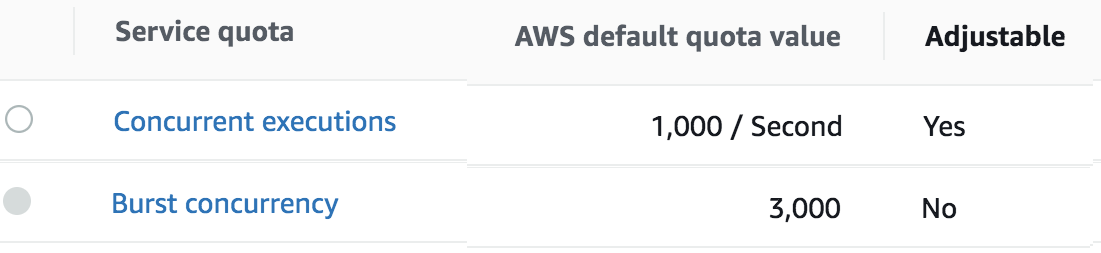
The Concurrent executions quota cap is the maximum number of Lambda instances that can serve requests for an account and region. The default AWS quota may be inadequate based on peak concurrency based on the table in the previous section. This quota can be increased with an AWS support ticket.
The Burst concurrency quota limits the rate at which Lambda will scale to accommodate demand. This quota is also per account and region. The burst quota cannot be adjusted. AWS will quickly scale until the burst limit is reached. After the burst limit is reached, functions will scale at a reduced rate per minute (e.g. 500). If no Lambda instances can serve a request, the request will fail with a 429 Too Many Requests response. Redshift will generally retry until all requests succeed but may abort if a high percentage of failed responses occur.
The burst limit is a fixed value and varies significantly by AWS region. The highest burst (3,000) is currently available in the following regions: US West (Oregon), US East (N.Virginia), and Europe (Ireland). Other regions can burst between 500 and 1,000. It is recommended to select a Redshift AWS region with the highest burst limits.
Hitting up against quota limits may indicate that quota adjustments are required. Exceeding quota limits may cause a Redshift query to fail or reduce performance. In the worst case, significant throttling can impact the performance of all your Lambda services in the region.
Redshift is tolerant of a certain ratio of failed requests and automatically retries. If a high percentage of requests fail, then the query may abort and the last error code will display in the console. For example, 429 Too Many Requests.
CloudWatch Metrics can be manually enabled on the Lambda to reveal if quotas are being reached. Metrics aggregate errors into two buckets that are 4xx. CloudWatch logs can be used to access the actual error code.
Log forwarder architecture is optimized to minimize the amount of connections and reduce the overall network bandwidth required to send audit logs to ESA. This is achieved with batching and aggregation taking place on two levels. The first level is in protect function instances, where audit logs from consecutive requests to an instance are batched and aggregated. The second level of batching takes place in Amazon Kinesis Stream where log records from different protect function instances are additionally batched and sent to log forwarder function where they are aggregated. This section shows how to configure the deployment to accommodate different patterns of anticipated audit log stream. It also shows how to monitor deployment resources to detect problems before audit records are lost.
Protector Cloud Formation Parameters
AuditLogFlushInterval: Determines the minimum amount of time required for the audit log to be sent to Amazon Kinesis. Changing flush interval may affect the level of aggregation, which in turn may result in different number of connections and different data rates to Amazon Kinesis. Default value is 30 seconds.
Increasing the flush interval may result in higher aggregation of audit logs, in fewer connections to Amazon Kinesis, in higher latency of audit logs arriving to ESA and in higher data throughput.
Lowering the flush interval may result in lower aggregation of audit logs, in more connections to Amazon Kinesis, in lower latency of audit logs arriving to ESA and in lower data throughput.
It is not recommended to reduce the flush interval from default value in production environment as it may overload the Amazon Kinesis service. However, it may be beneficial to reduce flush interval during testing to make audit records appear on ESA faster.
Log Forwarder Cloud Formation Parameters
Amazon KinesisLogStreamShardCount: The number of shards represents the level of parallel streams in the Amazon Kinesis and it is proportional to the throughput capacity of the stream. If the number of shards is too low and the volume of audit logs is too high, Amazon Kinesis service may be overloaded and some audit records sent from protect function may be lost.
Default value is 10, however you are advised to test with a production-like load to determine whether this is sufficient or not.
Amazon KinesisLogStreamRetentionPeriodHours: The time for the audit records to be retained in Amazon Kinesis log stream in cases where log forwarder function is unable to read records from the Kinesis stream or send records to ESA, for example due to a connectivity outage. Amazon Kinesis will retain failed audit records and retry periodically until connectivity with ESA is restored or retention period expires.
Default value is 24 hours, however you are advised to review this value to align it with your Recovery Time Objective and Recovery Point Objective SLAs.
Monitoring Log Forwarder Resources
Amazon Kinesis Stream Metrics: Any positive value in Amazon Kinesis PutRecords throttled records metric indicates that audit logs rate from protect function is too high. The recommended action is to increase the Amazon KinesisLogStreamShardCount or optionally increase the AuditLogFlushInterval.
Log Forwarder Function CloudWatch Logs: If log forwarder function is unable to send logs to ESA, it will log the following message:
[SEVERE] Dropped records: x.
Protect Function CloudWatch Logs: If protect function is unable to send logs to Amazon Kinesis, it will log the following message:
[SEVERE] Amazon Kinesis error, retrying in x ms (retry: y/z) ..."
Any dropped audit log records will be reported with the following log message:
[SEVERE] Failed to send x/y audit logs to Amazon Kinesis.
Hitting up against quota limits may indicate that quota adjustments are required. Exceeding quota limits may cause a Redshift query to fail or reduce performance. In the worst case, significant throttling can impact the performance of all your Lambda services in the region.
Redshift is tolerant of a certain ratio of failed requests and automatically retries. If a high percentage of requests fail, then the query may abort and the last error code will display in the console. For example, 429 Too Many Requests.
CloudWatch Metrics can be manually enabled on the Lambda to reveal if quotas are being reached. Metrics aggregate errors into two buckets that are 4xx. CloudWatch logs can be used to access the actual error code.
AWS maintains quotas for Lambda concurrent execution. Two of these quotas impact concurrency and compete with other Lambdas in the same account and region:
The Concurrent executions quota cap is the maximum number of Lambda instances that can serve requests for an account and region. The default AWS quota may be inadequate based on peak concurrency based on the table in the previous section. This quota can be increased with an AWS support ticket.
The Burst concurrency quota limits the rate at which Lambda will scale to accommodate demand. This quota is also per account and region. The burst quota cannot be adjusted. AWS will quickly scale until the burst limit is reached. After the burst limit is reached, functions will scale at a reduced rate per minute (e.g. 500). If no Lambda instances can serve a request, the request will fail with a 429 Too Many Requests response. Redshift will generally retry until all requests succeed but may abort if a high percentage of failed responses occur.
The burst limit is a fixed value and varies significantly by AWS region. The highest burst (3,000) is currently available in the following regions: US West (Oregon), US East (N.Virginia), and Europe (Ireland). Other regions can burst between 500 and 1,000. It is recommended to select a Redshift AWS region with the highest burst limits.
The following benchmarks were performed against different cluster sizes. These are median times of approximately five runs each. The query unprotected six columns per row (first_name, last_name, email, postal_code, ssn, iban):
| Rows x Cols | # Ops | dc2.large (24 nodes) | ra3.4xl (3 nodes) | ra3.4xl (7 nodes) | ra3.16xl (7 nodes) |
|---|---|---|---|---|---|
| 1M x 6 cols | 6M | 1.6 | 1.7 | 1.5 | 1.2 |
| 10M x 6 cols | 60M | 6.0 | 6.3 | 2.8 | 3.3 |
| 100M x 6 cols | 600M | 44.3 | 49.8 | 23.4 | 15.1 |
The following factors may cause variation in real performance versus benchmarks:
Audit records and application logs stream to Amazon CloudWatch Logs or optionally be sent to ESA. Cloud Protect uses a JSON format for audit records that is described in the following sections.
You can analyze and alert on audit records using Protegrity ESA or Amazon CloudWatch. Third-party solutions may be used if they are supported by Amazon Cloudwatch or AWS Lambda logging extensions. For more information about forwarding your audit records to ESA, contact Protegrity. For more information about Amazon CloudWatch, refer to the Amazon CloudWatch User Guide.
For more information about audit records, refer to the Protegrity Analytics Guide.
The audit record format has been altered in version 3.1 of the protector to provide more information.
| Field | Description |
|---|---|
| additional_info.deployment_id | The deployment_id contains the name of the Protect Function. It is automatically set based on the cloud-specific environment variables assigned to the Protect Function. This allows identifying the Cloud Protect deployment responsible for generating audit log. |
| additional_info.cluster | (Optional) Redshift cluster ARN |
| additional_info.description | A human-readable message describing the operation |
| additional_info.query_id | (Optional) Identifies the query that triggered the operation |
| additional_info.request_id | (Optional) AWS Lambda request identifier |
| cnt | Number of operations, may be aggregated |
| correlationid | (Deprecated) Use additional_info instead |
| level | Log severity, one of: SUCCESS, WARNING, ERROR, EXCEPTION |
| logtype | Always “Protection” |
| origin.ip | The private IP address of the compute resource that operates the Protect Function and is responsible for generating the log entry.NoteThe IP address is private, meaning it is used for internal network communication and is not accessible directly from the public internet.When Log Forwarding is enabled the IP address may be aggregated into minimal CIDR blocks. |
| origin.hostname | Hostname of the system that generated the log entry |
| origin.time_utc | UTC timestamp when the log entry was generated |
| protection.audit_code | Audit code of the protect operation; see the log return codes table in the Protegrity Troubleshooting Guide |
| protection.dataelement | Data element used for the policy operation |
| protection.datastore | Name of the data store corresponding to the deployed policy |
| protection.mask_setting | (Optional) Mask setting from policy management |
| protection.operation | Operation type, one of: Protect, Unprotect, Reprotect |
| protection.policy_user | User that performed the operation |
| protector.core_version | Internal core component version |
| protector.family | Always “cp” for Cloud Protect |
| protector.lambda_version | Protector Lambda application version. |
| protector.pcc_version | Internal pcc component version |
| protector.vendor | Identifies the cloud vendor and the database vendor |
| protector.version | Protector version number |
| signature.checksum | Hash value of the signature key ID used to sign the log message when the log is generated |
| signature.key_id | Key used to sign the log message when the log is generated |
The following are sample audit messages:
Protect Success:
{
      "additional_info": {
        "deployment_id": "Protegrity-Protect-function-deployment-id",
        "description": "Data protect operation was successful.",
        "query_id": "sf-query-id:01978dbc-0582-d7e4-0000-002a3603a20d",
        "request_id": "8476a536-e9f4-11e8-9739-2dfe598c3fcd"
      },
      "cnt": 4000,
      "correlationid": "sf-query-id:01978dbc-0582-d7e4-0000-002a3603a20d",
      "logtype": "Protection",
      "level": "SUCESS",
      "origin": {
        "hostname": "localhost",
        "ip": "127.0.0.1",
        "time_utc": 1635363966
      },
      "protection": {
        "dataelement": "deAddress",
        "operation": "Protect",
        "audit_code": 6,
        "datastore": "SAMPLE_POLICY",
        "policy_user": "test_user"
      },
      process":{
        "name":"protect",
        "id":"13",
        "module":"coreprovider",
        "thread_id":"573580544",
        "user":"sbx_user1051",
        "platform":"\"Linux_x64\"",
        "version":"UNKNOWN"
      },
      "client": {
        "ip":"169.254.62.117"
      },
      "protector": {
        "family": "cp",
        "version": "4.0.0.102",
        "vendor": "aws.snowflake",
        "datastore":"SAMPLE_POLICY",
        "pcc_version": "4.0.0.9",
        "core_version": "2.1.4+0.g93016.2.1",
        "lambda_version":"4.0.1"
      },
      "signature": {
        "key_id": "95f5a194-b0a4-4351-a",
        "checksum": "B324AF7C56944D91C47847A77C0367C594C0B948E7E75654B889571BD4F60A71"
      }
    }
User permission denied:
{
      "additional_info": {
        "deployment_id": "Protegrity-Protect-function-deployment-id",
        "description": "The user does not have the appropriate permissions to perform the requested operation.",
        "query_id": "sf-query-id:01978dbc-0582-d7e4-0000-002a3603a20d",
        "request_id": "8476a536-e9f4-11e8-9739-2dfe598c3fcd"
      },
      "cnt": 4000,
      "correlationid": "sf-query-id:01978dbc-0582-d7e4-0000-002a3603a20d",
      "logtype": "Protection",
      "level": "ERROR",
      "origin": {
        "hostname": "localhost",
        "ip": "127.0.0.1",
        "time_utc": 1635363966
      },
      "protection": {
        "dataelement": "deAddress",
        "operation": "Protect",
        "audit_code": 3,
        "datastore": "SAMPLE_POLICY",
        "policy_user": "test_user"
      },
      process":{
        "name":"protect",
        "id":"13",
        "module":"coreprovider",
        "thread_id":"573580544",
        "user":"sbx_user1051",
        "platform":"\"Linux_x64\"",
        "version":"UNKNOWN"
      },
      "client": {
        "ip":"169.254.62.117"
      },
      "protector": {
        "family": "cp",
        "version": "4.0.0.102",
        "vendor": "aws.snowflake",
        "datastore":"SAMPLE_POLICY",
        "pcc_version": "4.0.0.9",
        "core_version": "2.1.4+0.g93016.2.1",
        "lambda_version":"4.0.1"
      },
      "signature": {
        "key_id": "95f5a194-b0a4-4351-a",
        "checksum": "A216797C56944D91C47847A77C0367C594C0B948E7E75654B889571BD4F60A71"
      }
    }
Data element not found:
{
      "additional_info": {
        "deployment_id": "Protegrity-Protect-function-deployment-id",
        "description": "The data element could not be found in the policy.",
        "query_id": "sf-query-id:01978dbc-0582-d7e4-0000-002a3603a20d",
        "request_id": "8476a536-e9f4-11e8-9739-2dfe598c3fcd"
      },
      "cnt": 4000,
      "correlationid": "sf-query-id:01978dbc-0582-d7e4-0000-002a3603a20d",
      "logtype": "Protection",
      "level": "ERROR",
      "origin": {
        "hostname": "localhost",
        "ip": "127.0.0.1",
        "time_utc": 1635363966
      },
      "protection": {
        "dataelement": "deAddress",
        "operation": "Protect",
        "audit_code": 2,
        "datastore": "SAMPLE_POLICY",
        "policy_user": "test_user"
      },
      process":{
        "name":"protect",
        "id":"13",
        "module":"coreprovider",
        "thread_id":"573580544",
        "user":"sbx_user1051",
        "platform":"\"Linux_x64\"",
        "version":"UNKNOWN"
      },
      "client": {
        "ip":"169.254.62.117"
      },
      "protector": {
        "family": "cp",
        "version": "4.0.0.102",
        "vendor": "aws.snowflake",
        "datastore":"SAMPLE_POLICY",
        "pcc_version": "4.0.0.9",
        "core_version": "2.1.4+0.g93016.2.1",
        "lambda_version":"4.0.1"
      },
      "signature": {
        "key_id": "95f5a194-b0a4-4351-a",
        "checksum": "AF09217C56944D91C47847A77C0367C594C0B948E7E75654B889571BD4F60A71"
      }
    }
The security policy maintains a No Access Operation, configured in an ESA, which determines the response for unauthorized unprotect requests.
The following table describes the result returned in the response for the various no access unprotect permissions.
| No Access Operation | Data Returned |
|---|---|
| Null | null |
| Protected | (protected value) |
| Exception | Query will fail with an exception |
Known product limitations:
You can download the latest version of the deployment package from https://my.protegrity.com. Navigate to Data Protection > Cloud Protect to download the latest version.
After downloading the deployment package from the Protegrity Portal, unzip the package to extract the artifact files. In the AWS Console, navigate to the S3 bucket that was previously created to upload deployment artifacts (see: Create S3 bucket for Installing Artifacts).
Upload the following artifacts to the S3 bucket:
- -If the release version matches your existing deployment, you don’t need to upload it again. Save the following artifacts on your local system so that you have them available during the next steps:
- -Perform the following steps to upgrade the Agent Lambda and Protect Lambda separately.
Cloud Watch Event Rule is used to periodically run Protegrity Agent Function to synchronize policy from ESA. This functionality is optional when deploying Protegrity Serverless Solution. If the Event Rule is enabled, it must be disabled temporarily for the time of the upgrade process.
Follow the steps below to determine if your deployment uses Event Rule and disable it.
Go to AWS Cloud Formation and select existing Protegrity deployment stack.
Select Resources tab from the top portion of the screen.
Check if there is a resource with ScheduledRule LogicalID. If there is no such resource you can skip to Upgrading Policy Agent Lambda section. If the scheduled rule is there, continue with the next steps in this section.
Click on the Physical ID link in the ScheduledRule row. The link opens Policy Agent Event Rule configuration.
Select Disable from the top-right portion of the screen. This will disable the rule. You will re-enable it after the upgrade process is complete.
Go to AWS Lambda console and select existing Protegrity Agent Lambda.
Click Actions in top right portion of the screen. Select Publish new version. Click Publish. The version of Agent Lambda you just created will serve as restore point in the case you needed to rollback the upgrade.
Go to Lambda Configuration > Environment variables.
Record environment variables values. You will use them later to configure upgraded Lambda Function. You can use the aws cli command below to save the function variables into the local json file:
aws lambda get-function-configuration --function-name \
arn:aws:lambda:<aws_region>:<aws_account>:function:<function_name> \
--query Environment > <function_name>_env_config.json
Go to AWS Cloud Formation and select existing Protegrity Agent deployment stack.
Select Update. Check Replace current template > Upload a template file.
Upload pty_agent_cf.json file and select Next.
Click Next until Review window and then select Update stack.
Wait for the Cloud Formation to complete.
Navigate back to Agent Lambda Function.
Go to Configuration > Environment variables. Replace placeholder values with values recorded in previous step. Alternatively, you can run the following aws cli command to update function configuration using json file saved in the previous steps:
aws lambda update-function-configuration --function-name \
arn:aws:lambda:<aws_region>:<aws_account>:function:<function_name> \
--environment file://./<function_name>_env_config.json
If your current agent installation version is lower than 3.0.12, make sure you set the following function configuration variables:
If you are upgrading from versions prior to v3.0, backup and remove existing policy from the bucket defined by AWS_POLICY_S3_BUCKET property, so that the policy can be re-downloaded and re-encrypted with new ‘key commitment’ feature.
If you are upgrading from version prior to 1.6.1 please follow the steps below, otherwise the upgrade process is completed.
From AWS Console, navigate to IAM > Policies
Search for the Agent Lambda IAM Policy created in Create Agent Lambda IAM policy
Click on the policy, then select Edit Policy. Select JSON tab.
Add the following statement to the list of policy statements.
{
  "Sid": "LambdaGetConfiguration",
  "Effect": "Allow",
  "Action": [
      "lambda:GetFunctionConfiguration"
  ],
  "Resource": [
      "arn:aws:lambda:*:*:function:*"
  ]
}
Click Review Policy, then Save Changes. Wait for the changes to save.
Publish Log Forwarder Lambda Version
Publishing a version of the Log Forwarder Lambda allows to roll-back to pre-existing version if upgrade fails
Go to AWS Lambda console and select existing Protegrity Log Forwarder Lambda.
Click Actions in top right portion of the screen. Select Publish new version. Click Publish.
Record the Lambda version number. It will be displayed at the top of the screen. You can also retrieve it from the Lambda function view, under Versions tab.
Log Forwarder Lambda version number for roll-backs: ___________________
Disable Kinesis Trigger
Disabling Kinesis trigger ensures there are no unprocessed or re-processed events while function is upgraded.
Upgrade Forwarder Lambda Version
Upgrade Log Forwarder function with new code
Enable Kinesis Trigger
Monitor and roll-back
Monitor Log Forwarder function for errors in its CloudWatch logs and in Montior tab. To roll back function to the previous version if any errors occur follow these steps:
Go to AWS Lambda console and select existing Protegrity Log Forwarder Lambda.
Select Configuration tab > Triggers
Expand Details section of Kinesis trigger and record UUID value
Execute the following AWS CLI command to move Kinesis trigger to previous version of Log Forwarder Lambda that was created earlier and recorded as Log Forwarder Lambda version number for roll-backs. Substitute kinesis-mapping-uuid, log-forwarder-function-name, version-for-roll-backs with your values:
aws lambda update-event-source-mapping --uuid <kinesis-mapping-uuid> --function-name <log-forwarder-function-name>:<version-for-roll-backs>
Find Kinesis trigger attached to previous version of Log Forwarder Lambda by navigating Versions tab > Version number link in the Versions column Kinesis trigger is now moved to previous version of Log Forwarder Lambda function.
Diagram below illustrates upgrade steps.
Publish Protect Lambda Version
Publishing a version of the Protect Lambda allows updating it without interruptions to the existing traffic.
Go to AWS Lambda console and select existing Protegrity Protect Lambda.
Go to Lambda Configuration > Environment variables.
Record environment variables values. You will use them later to configure upgraded Lambda Function. You can use the aws cli command below to save the function variables into the local json file:
aws lambda get-function-configuration --function-name \
arn:aws:lambda:<aws_region>:<aws_account>:function:<function_name> \
--query Environment > <function_name>_env_config.json
Click Actions in top right portion of the screen. Select Publish new version. Click Publish.
Record the Lambda version number. It will be displayed at the top of the screen. You can also retrieve it from the Lambda function view, under Versions tab.
Protect Lambda version number: ___________________
If you are upgrading a Cloud Protect Redshift version 1.x to 2.x/3x, you must recreate your Redshift external function definitions with Protect Lambda Function version appended to the Lambda Function name. See example below.
CREATE OR REPLACE EXTERNAL FUNCTION PTY_PROTECT_TEST ( val varchar )
    RETURNS varchar
    VOLATILE lambda
    'Protegrity_Protect_test:<protect_lambda_version_number>' iam_role
    'arn:aws:iam::123456789212:role/example_role';
Run protect service upgrade
In this step, the Protect service including Lambda $LATEST version will be updated using Cloud Formation template. The Lambda version created in previous step will be used to serve existing traffic during the upgrade process.
Go to AWS Cloud Formation and select existing Protegrity deployment stack.
Select Update. Check Replace current template > Upload a template file.
Upload pty_protect_cf.json file and select Next.
Update ProtectFunctionProductionVersion parameter with Protect Lambda version number recorded in step 3.
Click Next until Review window and then select Update stack.
Wait for the Cloud Formation to complete.
Go back to Lambda console and select Protect Lambda.
Go to Configuration > Environment variables. Replace placeholder values with values recorded in previous step. Alternatively, you can run the following aws cli command to update function configuration using json file saved in the previous steps:
aws lambda update-function-configuration --function-name \
arn:aws:lambda:<aws_region>:<aws_account>:function:<function_name> \
--environment file://./<function_name>_env_config.json
If your current protect installation version is lower than 3.0.14, you can optionally set the following variable:
Navigate to Aliases tab. Verify that Production alias points to the lambda version you specified in the cloud formation template.
The upgraded Protect Lambda is configured with a sample policy. Run Agent Lambda Function before continuing with next steps.
Finalize upgrade
In this step, the Protect Lambda will be configured to serve traffic using $LATEST version upgraded in the previous step.
Go back to Protegrity AWS Cloud Formation deployment stack.
Select Update. Check Use Current template.
Update ProtectFunctionProductionVersion parameter with the following value: $LATEST.
Click Next until Review window and then select Update stack.
Go back to Lambda console and select Protect Lambda.
From the Lambda console, verify that Latest alias points to $LATEST version.
Test your function to make sure it works as expected.
If you are upgrading a Cloud Protect Redshift version 1.x to 2.x/3x, you must recreate your Redshift external function definitions with Protect Lambda Function version appended to the Lambda Function name. See example below.
CREATE OR REPLACE EXTERNAL FUNCTION PTY_PROTECT_TEST ( val varchar )
    RETURNS varchar
    VOLATILE lambda
    'Protegrity_Protect_test:Production' iam_role
    'arn:aws:iam::123456789212:role/example_role';
If you need to rollback to older version of Protect Lambda, you can re-run the cloud formation with ProtectFunctionProductionVersion parameter set to the previous version of Protect Lambda.
If the Event Rule was disabled at the beginning of the upgrade process, you must re-enabled it. Follow the steps below to re-enable Policy Agent Event rule.
Go to the Protegrity Agent Cloud Formation Stack.
Select Resources tab from the top portion of the screen.
Click on the Physical ID link in the ScheduledRule row. The link opens Policy Agent Event Rule configuration.
Select Enable from the top-right portion of the screen. This will enable the rule. You will re-enable it after the upgrade process is complete.
The Policy Agent Lambda function and Protect Lambda functions can be installed in separate AWS accounts. However, additional configuration is required to authorize the Policy Agent to provision the security policy to a remote Protect Lambda function.
Login to the AWS account that hosts the Protect Lambda function.
From the AWS IAM console, select Policies > Create Policy.
Select the JSON tab and copy the following snippet.
{
  "Version": "2012-10-17",
  "Statement": [
    {
      "Sid": "LambdaUpdateFunction",
      "Effect": "Allow",
      "Action": [
        "lambda:UpdateFunctionConfiguration"
      ],
      "Resource": [
        "arn:aws:lambda:*:*:function:*"
      ]
    },
    {
      "Sid": "LambdaReadLayerVersion",
      "Effect": "Allow",
      "Action": [
        "lambda:GetLayerVersion",
        "lambda:ListLayerVersions"
      ],
      "Resource": "*"
    },
    {
      "Sid": "LambdaDeleteLayerVersion",
      "Effect": "Allow",
      "Action": "lambda:DeleteLayerVersion",
      "Resource": "arn:aws:lambda:*:*:layer:*:*"
    },
    {
      "Sid": "LambdaPublishLayerVersion",
      "Effect": "Allow",
      "Action": "lambda:PublishLayerVersion",
      "Resource": "arn:aws:lambda:*:*:layer:*"
    },
    {
      "Sid": "S3GetObject",
      "Effect": "Allow",
      "Action": [
        "s3:GetObject"
      ],
      "Resource": "arn:aws:s3:::*/*"
    },
    {
      "Sid": "S3PutObject",
      "Effect": "Allow",
      "Action": [
        "s3:PutObject"
      ],
      "Resource": "arn:aws:s3:::*/*"
    },
    {
      "Sid": "LambdaGetConfiguration",
      "Effect": "Allow",
      "Action": [
          "lambda:GetFunctionConfiguration"
      ],
      "Resource": [
          "arn:aws:lambda:*:*:function:*"
      ]
    }
  ]
}
Replace the wildcards (*) with the region, account, and resource name information where required.
Select Review policy, type in the policy name, and confirm. Record policy name:
Agent Lambda Cross Account Policy Name: ___________________
Login to the AWS account that hosts the Protect Lambda function.
From the AWS IAM console, select Roles > Create Role
Select AWS Service > Lambda . Proceed to Permissions.
Select Policy created in the step above. Proceed to Tags.
Specify Tag, proceed to the final screen. Type in policy name and confirm. Record the name.
Policy Agent Cross Account IAM Role Name: ___________________
Login to the AWS account that hosts the Protect Lambda function.
Navigate to the previously created IAM Role (Agent Lambda Cross-Account IAM Role Name).
Navigate to Trust Relationships > Edit Trust Relationships.
Modify the Policy Document, replacing the placeholder value indicated in the following snippet as <Agent Lambda IAM Execution Role ARN> with ARN of Agent Lambda IAM Role that was created in Agent Installation.
{
  "Version": "2012-10-17",
  "Statement": [
    {
      "Effect": "Allow",

   "Principal": {

            "AWS": "<Agent Lambda IAM Execution Role Name>"

      },
      "Action": "sts:AssumeRole"
    }
  ]
}
Click Update Trust Policy.
Login to the AWS account that hosts the Policy Agent.
Navigate to the Agent Lambda IAM Execution Role that was created in Agent Installation.
{
  "Version": "2012-10-17",
  "Statement": [
    {
      "Effect": "Allow",

   "Principal": {

            "AWS": "<Agent Lambda IAM Execution Role Name>"

      },
      "Action": "sts:AssumeRole"
    }
  ]
}
Add Inline Policy.
Modify the Policy Document, replacing the placeholder value indicated in the following snippet as <Agent Lambda Cross-Account IAM ARN> with the value recorded in Create Policy Agent cross-account IAM Role.
{
  "Version": "2012-10-17",
  "Statement": [
    {
      "Effect": "Allow",
      "Action": [
        "sts:AssumeRole"
      ],
      "Resource": "<Agent Lambda Cross-Account IAM  ARN>."
    }
  ]
}
When you are finished, choose Review Policy.
On the Review policy page, type a Name, then choose Create Policy.
From the AWS console, navigate to Lambda, and select the Policy Agent Lambda function.
Select Configuration tab | Environment variables.
Select Edit and add the following environment variables with the value from Agent Lambda Cross-Account IAM ARN:
| Parameter | Value |
|---|---|
| AWS_ASSUME_ROLE | Agent Lambda Cross-Account IAM ARN |
Ensure the values in the Parameters AWS_POLICY_S3_BUCKET, AWS_PROTECT_FN_NAME and AWS_POLICY_LAYER_NAME are all in the Protect Lambda Function AWS Account.
In case custom VPC hostname configuration is used, you will need to set the ENDPOINT_URL. Refer to Policy Agent - Custom VPC Endpoint Hostname Configuration.
AWS_VPC_ENDPOINT_URL | <AWS_VPC_ENDPOINT> |
Click Save and Run the Lambda. The Lambda will now assume the Role in Protect Lambda Function AWS Account and update the policy cross accounts.
This guide describes how to configure the Protegrity Policy Agent and Log Forwarder to connect to a Protegrity Provisioned Cluster (PPC), highlighting the differences from connecting to ESA.
| Feature | ESA 10.2 | PPC (this guide) |
|---|---|---|
| Datastore Key Fingerprint | Optional/Recommended | Required |
| CA Certificate on Agent | Optional/Recommended | Optional/Recommended |
| CA Certificate on Log Forwarder | Optional/Recommended | Not supported |
| Client Certificate Authentication from Log Forwarder | Optional/Recommended | Not supported |
| IP Address | ESA IP address | PPC address |
curl, kubectl installed.Follow these instructions as a guide for understanding specific inputs for Policy Agent integrating with PPC:
Obtain the Datastore Key Fingerprint
To retrieve the fingerprint for your Policy Agent:
Retrieve public key from the Cloud Provider Key Management service for the policy encryption key created in pre-configuration:
Escape the new line characters in the downloaded public key for use in the next step - for example:
awk 'NF {printf "%s\\n",$0}' "<public_key_file>" > "new-line-escaped-public-key.pem"
cat new-line-escaped-public-key.pem
Export key fingerprint using the PPC API as indicated in the curl example below:
curl -k -H "Authorization: Bearer ${TOKEN}" -X POST https://${HOST}/pty/v2/pim/datastores/1/export/keys  -H "Content-Type: application/json" --data '{
  "algorithm": "RSA-OAEP-256",
  "description": "example-key-from-key-management",
  "pem": "<value of new-line-escaped-public-key>"
}'
Sample Output:
{"uid":"1","algorithm":"RSA-OAEP-256","fingerprint":"4c:46:d8:05:35:2e:eb:39:4d:39:8e:6f:28:c3:ab:d3:bc:9e:7a:cb:95:cb:b1:8e:b5:90:21:0f:d3:2c:0b:27","description":"example-key-from-kms"}
Record the value for fingerprint and configure the Policy Agent:
Set the environment variable PTY_DATASTORE_KEY in the Policy Agent Lambda function to the fingerprint value.
Set the environment variable PTY_DATASTORE_KEY in the Policy Agent Function App to the fingerprint value.
Set the variable in Policy Agent main.tf pty_datastore_key to the fingerprint value and apply the changes.
Retrieve the PPC CA Certificate
To obtain the CA certificate from PPC:
kubectl -n api-gateway get secret ingress-certificate-secret -o jsonpath='{.data.ca\.crt}' | base64 -d > CA.pem
Use the ProtegrityCA.pem that was returned as described in Policy Agent Installation.
Configure the PPC Address
Use the PPC address in place of the ESA IP address wherever required in your configuration.
PTY_ESA_CA_SERVER_CERT is not provided.The Policy Agent uses default endpoint hostnames to communicate with other AWS services (for example, secretsmanager.amazonaws.com). This configuration will only work in VPCs where Amazon-provided DNS is available (default VPC configuration with private DNS option enabled for the endpoint). If your VPC uses custom DNS, follow the instructions below to configure the Policy Agent Lambda to use custom endpoint hostnames.
To identify DNS hostnames:
From AWS console, select VPC > Endpoints.
Select Secrets Manager endpoint from the list of endpoints.
Under Details > DNS Names, note the private endpoint DNS names adding https:// at the beginning of the endpoint name.
For example, https://vpce-1234-4pzomrye.kms.us-west-1.vpce.amazonaws.com
Note down DNS names for the KMS and Lambda endpoints:
AWS_SECRETSMANAGER_ENDPOINT: https://_________________
AWS_KMS_ENDPOINT: https://_________________
AWS_LAMBDA_ENDPOINT: https://_________________
To update policy agent lambda configuration:
From the AWS console, navigate to Lambda, and select the Policy Agent Lambda function.
Select the Configuration section and choose Environment variables.
Select Edit and add the following environment variables with the corresponding endpoint URLs recorded in steps 3-4:
| Parameters | Value |
|---|---|
| AWS_SECRETSMANAGER_ENDPOINT_URL | <AWS_SECRETS_ENDPOINT> |
| AWS_KMS_ENDPOINT_URL | <AWS KMS ENDPOINT> |
| AWS_LAMBDA_ENDPOINT_URL | <AWS LAMBDA ENDPOINT> |
Click Save and Run the Lambda. The Lambda will now use endpoints you have just configured.
The following figure illustrates the Protegrity Redshift Integration architecture when Protegrity Solution is installed on separate from Amazon Redshift Cluster Account.
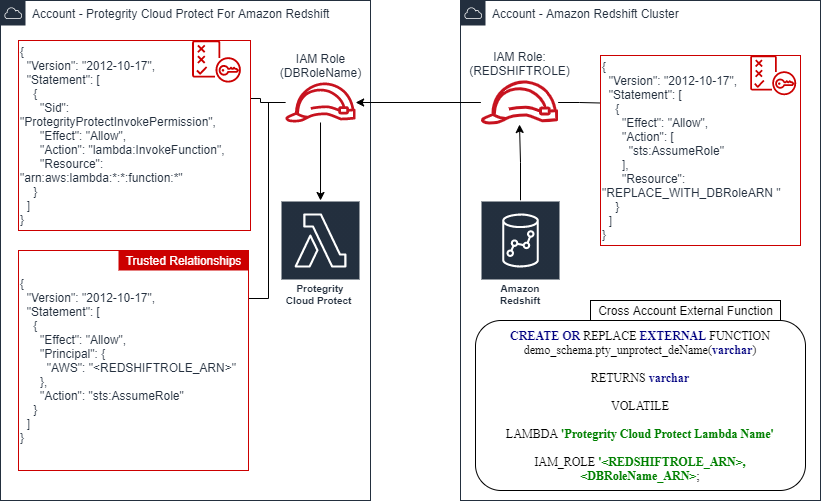
This step creates Redshift IAM role with permissions to assume role in separate account.
Create Redshift IAM policy:
Login to the AWS account that hosts the Amazon Redshift cluster.
In the AWS console, access Services > IAM and click Policies.
Click Create Policy.
Select the JSON tab and paste the following JSON snippet:
{ "Version": "2012-10-17", "Statement": [ { "Effect": "Allow", "Action": [ "sts:AssumeRole" ], "Resource": "<DBRoleARN>" } ] }
Replace the resource value with DBRoleARN recorded in Create IAM Account Role
Click Review policy to continue.
Enter a name for the policy.
Click Create Policy.
Record the policy name.
Redshift IAM Policy Name: ___________________
This step creates Redshift IAM role with permissions to assume role in separate account.
Create Redshift IAM Role:
Login to the AWS account that hosts the Amazon Redshift cluster.
In the AWS console, access Services > IAM and click Roles.
Click Create Role.
Select AWS Service as the trusted entity type, then select Redshift use case from the list of services.
Select Redshift – Customizable from the use case section.
Continue by clicking Next:Permissions.
Filter the list and search for the policy recorded in the step above (Redshift IAM Policy Name).
Click the Next:Tags button to continue to the next step.
Click the Next:Review button to continue.
Enter a role name, such as Redshift2ProtegrityRole.
Click Create Role.
Record role ARN:
RedshiftIAMRoleARN: ____________________
This step creates Redshift IAM role with permissions to assume role in separate account.
Attach IAM role to the Redshift cluster:
Login to AWS Console.
Access Amazon Redshift and select your cluster.
Select Properties > Cluster Permissions > Manage IAM Roles.
Select RedshiftIAMRoleARN configured in the step above and click Associate IAM role.
Save the changes.
After saving the changes it may take couple of minutes until the cluster IAM role is fully configured.
You can check configuration status by navigating back to the cluster IAM role settings.
The status field next to the IAM role will show in-sync once the role is configured.
The external function for cross-account differs slightly from the reference material in this document. The function requires two roles to be specified. The following is an example of the modified function definition.
CREATE OR REPLACE EXTERNAL FUNCTION demo_schema.pty_unprotect_deName(varchar)
RETURNS varchar
VOLATILE
LAMBDA 'ProtectFunctionProductionAlias'
IAM_ROLE '<RedshiftIAMRoleARN>,<DBRoleARN>;
Replace <ProtectFunctionProductionAlias> with the value recorded in Install through CloudFormation Replace <RedshiftIAMRoleARN> with the value recorded in Create Redshift IAM Role Replace <DBRoleARN> with the value recorded in Create IAM Account Role
Method: Tokenization | ||
Type: ALPHA | ||
| ||
Redshift Data Types | Redshift Max Size | Protegrity Max Size |
VARCHAR | 4K (4,096 bytes) | 4K (4,096 bytes) |
CHAR | ||
| ||
| ||
| ||
External Function Sample Definitions: | ||
| ||
| ||
Sample EF Calls: | ||
| ||
| ||
| ||
| ||
Method: Tokenization | ||
Type: NUMERIC | ||
| ||
Redshift Data Types | Redshift Max Size | Protegrity Max Size |
DECIMAL | 4K (4,096 bytes) | 4K (4,096 bytes) |
INTEGER | ||
BIGINT | ||
| ||
| ||
External Function Sample Definitions: | ||
| ||
| ||
Sample EF Calls: | ||
| ||
| ||
Cloud Protect Lambda Function exposes USERNAME_REGEX configuration to allow extraction of policy username from user in the request.
USERNAME_REGEX Lambda Environment configuration
The USERNAME_REGEX configuration can be used to extract policy username from user in the request. The following are allowed values for USERNAME_REGEX:
1 - Default build-in regular expression is used:
^arn:aws:(?:iam|sts)::[0-9]{12}:(?:role|user|group|assumed\-role|federated\-user)\/([\w\/+=,.\-]{1,1024}|[\w\/+=,.\-@]{1,1024})(?:@[a-zA-Z0-9\-]{1,320}(?:\.\w+)+)?$
^User regex$ - Custom regex with one capturing group. This group is used to extract the username. Examples below show different regular expression values and the resulting policy user.
USERNAME_REGEX | User in the request | Effective Policy User |
|---|---|---|
Not Set | arn:aws:iam::123456789012:user/juliet.snow | arn:aws:iam::123456789012:user/juliet.snow |
arn:aws:sts::123456789012:assumed-role/TestSaml | arn:aws:sts::123456789012:assumed-role/TestSaml | |
1 | arn:aws:iam::123456789012:user/juliet.snow | juliet.snow |
arn:aws:sts::123456789012:assumed-role/TestSaml | TestSaml | |
| arn:aws:iam::123456789012:user/juliet.snow | user/juliet.snow |
arn:aws:sts::123456789012:assumed-role/TestSaml | assumed-role/TestSaml |
ESA controls which policy is deployed to protector using concept of data store. A data store may contain a list of IP addresses identifying servers allowed to pull the policy associated with that specific data store. Data store may also be defined as default data store, which allows any server to pull the policy, provided it does not belong to any other data stores. Node registration occurs when the policy server (in this case the policy agent) makes a policy request to ESA, where the agent’s IP address is identified by ESA.
Policy agent lambda source IP address used for node registration on ESA depends on ESA hubcontroller configuration ASSIGN_DATASTORE_USING_NODE_IP and the PTY_ADDIPADDRESSHEADER configuration exposed by the agent lambda.
The Lambda service uses multiple network interfaces, internal network interface with ephemeral IP range of 169.254.x.x and external network interface with IP range of the VPC subnet the Lambda is associated with. By default, when agent lambda is contacting ESA to register node for policy download, ESA uses agent Lambda VPC IP address. This default behavior is caused by the default ESA hubcontroller configuration ASSIGN_DATASTORE_USING_NODE_IP=false and agent default configuration PTY_ADDIPADDRESSHEADER=yes.
In some cases, when there is a proxy server between the ESA and agent lambda, the desirable ESA configuration is ASSIGN_DATASTORE_USING_NODE_IP=true. and PTY_ADDIPADDRESSHEADER=no which will cause the ESA to use proxy server IP address.
The table below shows how the hubcontroller and agent settings will affect node IP registration on ESA.
| Agent source IP | Agent VPC subnet IP | Proxy IP | ESA config - ASSIGN_DATASTORE_USING_NODE_IP | Agent lambda config - PTY_ADDIPADDRESSHEADER | Agent node registration IP |
|---|---|---|---|---|---|
| 169.254.144.81 | 10.1.2.173 | No Proxy | true | yes | 169.254.144.81 |
| true | no | 10.1.2.173 | |||
| false | yes | ||||
| false | no | ||||
| 169.254.144.81 | 10.1.2.173 | 34.230.42.110 | true | yes | 169.254.144.81 |
| true | no | 34.230.42.110 | |||
| false | yes | ||||
| false | no |
This section describes the high-level architecture of the product for integration with Snowflake, the installation procedures, and provides guidance on performance. This section focuses on Protegrity-specific aspects and should be consumed with the corresponding Snowflake documentation.
This guide may also be used with the Protegrity Enterprise Security Administrator Guide, which explains the mechanism for managing the data security policy.
Snowflake Protector on AWS is a cloud native, serverless product for fine-grained data protection with Snowflake™, a managed Cloud data warehouse. This enables invocation of the Protegrity data protection cryptographic methods from the Snowflake SQL execution context. The benefits of serverless include rapid auto-scaling, performance, low administrative overhead, and reduced infrastructure costs compared to a server-based solution.
This product provides data protection services invoked by External User Defined Functions (UDFs) within Snowflake. The UDFs act as a client transmitting micro-batches of data to the serverless Protegrity Lambda function. User queries may generate hundreds or thousands of parallel requests to perform security operations. Protegrity’s serverless function is designed to scale and yield reliable query performance under such load.
Snowflake Protector on AWS utilizes a data security policy maintained by an Enterprise Security Administrator (ESA), similar to other Protegrity products. Using regular SQL database queries or tools, such as, Tableau™, authorized users can perform de-identification (protect) and re-identification (unprotect) operations on data within the managed Cloud data warehouse. A user’s individual capabilities are subject to privileges and policies defined by the Enterprise Security Administrator.
The following data ingestion patterns are available with your managed Cloud data warehouse:
Protegrity’s format and length preserving tokenization scheme make it possible to perform analytics directly on protected data. Tokens are join-preserving so protected data can be joined across datasets. Often statistical analytics and machine learning training can be performed without the need to re-identify protected data. However, a user or service account with authorized security policy privileges may re-identify subsets of data using the Snowflake Protector on AWS service.
Snowflake Protector on AWS incorporates Protegrity’s patent-pending vaultless tokenization capabilities into cloud-native serverless technology. Combined with an ESA security policy, the protector provides the following features:
For more information about the available protection options, such as, data types, Tokenization or Encryption types, or length preserving and non-preserving tokens, refer to Protection Methods Reference.
The Protegrity product should be deployed in the customer’s Cloud account within the same AWS region as the Snowflake cluster. The product incorporates Protegrity’s vaultless tokenization engine within an AWS Lambda Function. The encrypted data security policy from an ESA is deployed periodically as a static resource through an AWS Lambda Layer. The policy is decrypted in memory at runtime within the Lambda. This architecture allows Protegrity to be highly available and scale very quickly without direct dependency on any other Protegrity services.
The product exposes a remote data protection service invoked from external User Defined Functions (UDFs), a native feature of specific Cloud databases. The UDFs can be invoked through direct SQL queries or database views. The external UDF makes parallel API calls to the serverless Protegrity Lambda function via the AWS API Gateway to perform protect and unprotect data operations. Each network REST request includes a micro-batch of data to process and a secure context header generated by the database with the username and a Protegrity context header with the data element type, and operation to perform. The product applies the ESA security policy including user authorization and returns a corresponding response. Security operations on sensitive data performed by protector can be audited. The product can be configured to send audit logs to ESA for reporting and alerting purposes via optional component called Log Forwarder explained in details in the next section of this guide.
The security policy is synchronized through another serverless component called the Protegrity Policy Agent. The agent operates on a configurable schedule, fetches the policy from the ESA, performs additional envelope encryption using Amazon KMS, and deploys the policy into the Lambda Layer used by the serverless product. This solution can be configured to automatically provision the static policy or the final step can be performed on-demand by an administrator. The policy takes effect immediately for all new requests. There is no downtime for users during this process.
The following diagram shows the high-level architecture described above.
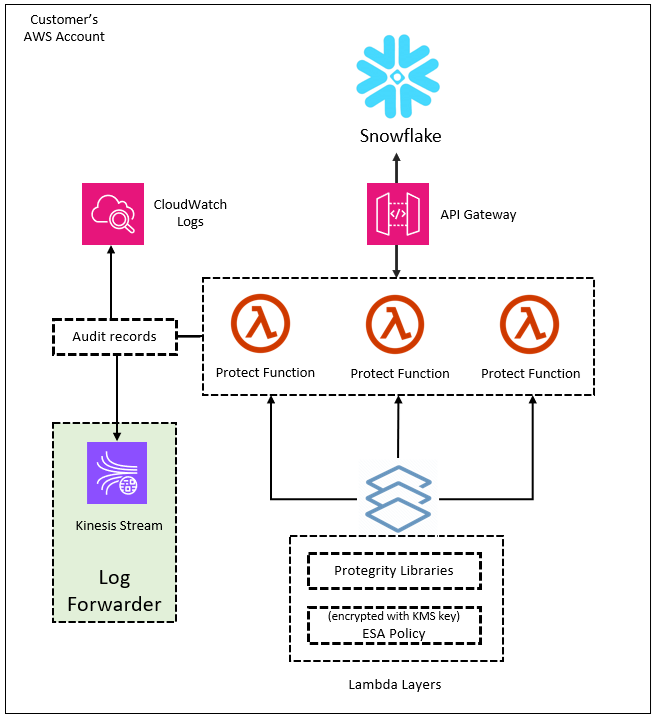
The following diagram shows a reference architecture for synchronizing the security policy from ESA.
The Protegrity Policy Agent requires network access to an Enterprise Security Administrator (ESA). Most organizations install the ESA on-premise. Therefore, it is recommended that the Policy Agent is installed into a private subnet with a Cloud VPC using a NAT Gateway to enable this communication through a corporate firewall.
The ESA is a soft appliance that must be pre-installed on a separate server. It is used to create and manage security policies.
For more information about installing the ESA, and creating and managing policies, refer to the Policy Management Guide.
Audit logs are by default sent to CloudWatch as long as the function’s execution role has the necessary permissions. The Protegrity Product can also be configured to send audit logs to ESA. Such configuration requires deploying Log Forwarder component which is available as part of Protegrity Product deployment bundle. The diagram below shows additional resources deployed with Log Forwarder component.
The log forwarder component includes Amazon Kinesis data stream and the forwarder Lambda function. Amazon Kinesis stream is used to batch audit records before sending them to forwarder function, where similar audit logs are aggregated before sending to ESA. Aggregation rules are described in the Protegrity Log Forwarding guide. When the protector function is configured to send audit logs to log forwarder, audit logs are aggregated on the protector function before sending to Amazon Kinesis. Due to specifics of the Lambda runtime lifecycle, audit logs may take up to 15 minutes before being sent to Amazon Kinesis. Protector function exposes configuration to minimize this time which is described in the protector function installation section.
The security of audit logs is ensured by using HTTPS connection on each link of the communication between protector function and ESA. Integrity and authenticity of audit logs is additionally checked on log forwarder which verifies individual logs signature. The signature verification is done upon arrival from Amazon Kinesis before applying aggregation. If signature cannot be verified, the log is forwarded as is to ESA where additional signature verification can be configured. Log forwarder function uses client certificate to authenticate calls to ESA.
To learn more about individual audit log entry structure and purpose of audit logs, refer to Audit Logging section in this document. Installation instructions can be found in Audit Log Forwarder installation.
The audit log forwarding requires network access from the cloud to the ESA. Most organizations install the ESA on-premise. Therefore, it is recommended that the Log Forwarder Function is installed into a private subnet with a Cloud VPC using a NAT Gateway to enable this communication through a corporate firewall.
Request authorization between Snowflake’s AWS VPC to the customer’s AWS API-Gateway occurs using a Snowflake integration enabled by an AWS cross-account IAM role created within the customer’s AWS account. The API Gateway authorizes each request, limiting access to the Snowflake AWS IAM user and external ID established through a Snowflake API Integration object. The following figure illustrates the Protegrity Snowflake Integration architecture.
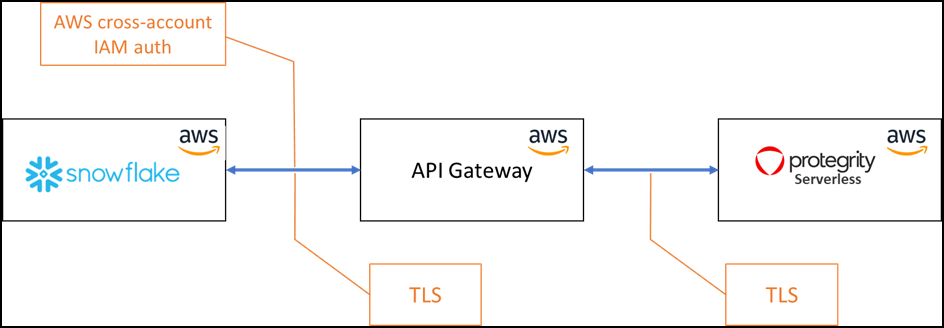
The Snowflake API Integration Object provides a connection between your Snowflake VPC and your AWS account where the Protegrity product is hosted. Creating this connection requires setting up the API Gateway and the IAM shared account role. These steps are provided in the installation.

The following figure shows how trust is established between Snowflake and the product.
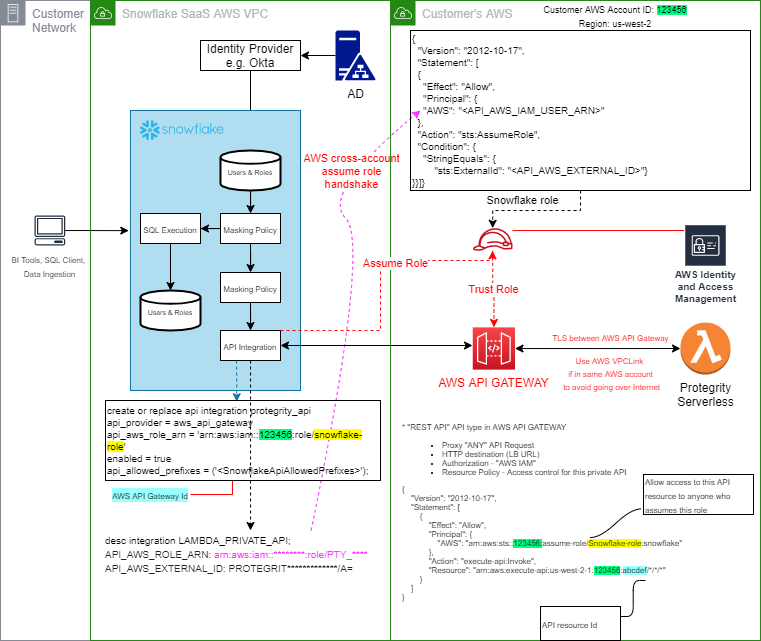
Query the AWS region where the Snowflake cluster is running. This is the region in which Protegrity Serverless must be installed.
To determine AWS region:
Login to Snowflake
In the SQL console, run the following query.
select current_region();
Record the AWS region (e.g. us-east-1).
AWS Region: ___________________
Identify or create an AWS account where the Protegrity solution will be installed. It is recommended that a new AWS sub-account be created. This can provide greater security controls and help avoid conflicts with other applications that might impact regional account limits. An individual with the Cloud Administrator role will be required for some subsequent installation steps.
AWS Account ID: ___________________
AWS Region (AwsRegion): ___________________
This S3 bucket will be used for the artifacts required by the CloudFormation installation steps. This S3 bucket must be created in the region that is defined in Provide AWS sub-account
Sign in to the AWS Management Console and open the Amazon S3 console.
Change region to the one determined in Provide AWS sub-account
Click Create Bucket.
Enter a unique bucket name:
For example, protegrity-install.us-west-2.example.com
Upload the installation artifacts to this bucket. Protegrity will provide the following three artifacts:
S3 Bucket name (ArtifactS3Bucket): ___________________
The Amazon Key Management Service (KMS) provides the ability for the Protegrity Serverless solution to encrypt and decrypt the Protegrity Security Policy.
To create KMS key:
In the AWS sub-account where the KMS key will reside, select the region.
Navigate to Key Management Service > Create Key.
Configure the key settings:
Create alias and optional description, such as, Protegrity-Serverless and click Next.
Define key administrative permissions, the IAM user who will administrate the key.
Click Next.
Define the key usage permissions.
In Other AWS accounts, enter the AWS account id used for the Protegrity Serverless installation.
Continue on to create the key. If there is a concern this permission is overly broad, then you can return later to restrict access to the role of two Protegrity Serverless Lambda as principals. Click to open the key in the list and record the ARN.
KMS Key ARN (AWS_KMS_KEY_ID): ___________________
Download the public key from the KMS key. Navigate to the key in KMS console, select the Public key tab, and click Download. Save the PEM file. This public key will be added to the ESA data store as an export key. Refer to Exporting Keys to Datastore for instructions on adding the public key to the data store.
KMS Public Key PEM file: ___________________
An IAM role is used to authorize Snowflake to access the future Protect Lambda resource.
To create IAM account role:
From the AWS console, login to the AWS sub-account where Protegrity will be hosted.
Access IAM, select roles and then Create Role.
Select AWS account from the list of trusted entities types.
Select your AWS Account Id as a placeholder value. You will update this field later when configuring Snowflake access.
Select Require external ID and enter the following placeholder value.
REPLACE_ME_WITH_EXTERNAL_ID
Click Next.
Continue and click Next
Enter a Role name, for example, Snowflake.
After the role is created, click on the role. Record the following information:
The following table describes the AWS services that may be a part of your Protegrity installation.
Service | Description |
|---|---|
Lambda | Provides serverless compute for Protegrity protection operations and the ESA integration to fetch policy updates or deliver audit logs. |
API Gateway | Provides the endpoint and access control. |
KMS | Provides secrets for envelope policy encryption/decryption for Protegrity. |
Secrets Manager | Provides secrets management for the ESA credentials . |
S3 | Intermediate storage location for the encrypted ESA policy layer. |
Kinesis | Required if Log Forwarder is to be deployed. Amazon Kinesis is used to batch audit logs sent from protector function to ESA. |
VPC & NAT Gateway | Optional. Provides a private subnet to communicate with an on-prem ESA. |
CloudWatch | Application and audit logs, performance monitoring, and alerts. Scheduling for the policy agent. |
The Protector and Log Forwarder functions require a security policy from a compatible ESA version.
The table below shows compatibility between different Protector and ESA versions.
| Protector Version | ESA Version | |||
|---|---|---|---|---|
| 8.x | 9.0 | 9.1 & 9.2 | 10.0 | |
| 2.x | No | Yes | * | No |
| 3.0.x & 3.1.x | No | No | Yes | No |
| 3.2.x | No | No | Yes | * |
| 4.0.x | No | No | No | Yes |
Legend | |
|---|---|
Yes | Protector was designed to work with this ESA version |
No | Protector will not work with this ESA version |
* | Backward compatible policy download supported:
|
Requirement | Detail |
|---|---|
Protegrity distribution and installation scripts | These artifacts are provided by Protegrity |
Protegrity ESA 10.0+ | The Cloud VPC must be able to obtain network access to the ESA |
| AWS Account | Recommend creating a new sub-account for Protegrity Serverless |
| Snowflake cluster (Enterprise Edition) |
Role / Skillset | Description |
|---|---|
AWS Account Administrator | To run CloudFormation (or perform steps manually), create/configure a VPC and IAM permissions. |
Protegrity Administrator | The ESA credentials required to extract the policy for the Policy Agent |
| Network Administrator | To open firewall to access ESA and evaluate AWS network setup |
| Snowflake Administrator | Account Admin access required to setup access |
Ensure that all the steps in Pre-Configuration are performed.
Login to the AWS account console where - Snowflake Protector on AWS will be installed.
Ensure that the required CloudFormation templates provided by Protegrity are available on your local computer.
This task defines a policy used by the Protegrity Lambda function to write CloudWatch logs and access the KMS encryption key to decrypt the policy.
Perform the following steps to create the Lambda execution role and required policies:
From the AWS IAM console, select Policies > Create Policy.
Select the JSON tab and copy the following sample policy.
{
  "Version": "2012-10-17",
  "Statement": [
    {
      "Sid": "CloudWatchWriteLogs",
      "Effect": "Allow",
      "Action": [
        "logs:CreateLogGroup",
        "logs:CreateLogStream",
        "logs:PutLogEvents"
      ],
      "Resource": "*"
    },
    {
      "Sid": "KmsDecrypt",
      "Effect": "Allow",
      "Action": [
        "kms:Decrypt"
      ],
      "Resource": [
        "arn:aws:kms:*:*:key/*"
      ]
    }
  ]
}
For the KMS policy, replace the Resource with the ARN for the KMS key created in a previous step.
Select Next, type in a policy name, for example, ProtegrityProtectLambdaPolicy and Create Policy. Record the policy name:
ProtectLambdaPolicyName:__________________
The following steps create the role to utilize the policy defined in Create Protect Lambda IAM Execution Policy.
To create protect lambda IAM execution role:
From the AWS IAM console, select Roles > Create Role.
Select AWS Service > Lambda > Next.
In the list, search and select the policy created in Create Protect Lambda IAM Execution Policy.
Click Next
Type the role name, for example, ProtegrityProtectRole
Click Create role
Record the role ARN.
Role ARN (LambdaExecutionRoleArn): ___________________
The following steps describe the deployment of the Lambda function.
To install through CloudFormation:
Access CloudFormation and select the target AWS Region.
Click Create Stack and choose With new resources.
Specify the template.
Select Upload a template file.
Upload the Protegrity-provided CloudFormation template called pty_protect_cf.json and click Next.
Specify the stack details. Enter a stack name.
Enter the required parameters. All the values were generated in Pre-Configuration.
| Parameter | Description |
|---|---|
| DBRoleName | Name of the account role created in the pre-configuration step |
| ArtifactS3Bucket | Name of S3 bucket created in the pre-configuration step |
| LambdaExecutionRoleArn | The ARN of Lambda role created in the prior step |
| MinLogLevel | Minimum log level for protect function. Allowed Values: off, severe, warning, info, config, all |
The log forwarder parameters can be provided later after log forwarder is deployed. If you are not planning to deploy log forwarder you can skip this step.
| Parameter | Description |
|---|---|
| KinesisLogStreamArn | The ARN of the AWS Kinesis stream where audit logs will be sent for aggregation |
| AuditLogFlushInterval | Time interval in seconds used to accumulate audit logs before sending to Kinesis. Default value: 30. See Log Forwarder Performance section for more details. |
Click Next with defaults to complete CloudFormation.
After CloudFormation is completed, select the Outputs tab in the stack.
Record the following values:
The following sections will configure Snowflake to access the API Gateway. The CloudFormation installation installed a sample policy that can be used to smoke test the installation.
Ensure that the current user can assume the Account Administrator role. This role must be created.
From the Snowflake console worksheet, select the role ACCOUNTADMIN.
Paste the following text and replace the two parameters <SnowflakeApiAwsRoleARN> and <SnowflakeApiAllowedPrefixes> with values recorded in the last installation step of Installing through CloudFormation, then run the following Data Definition Language (DDL) in the console to create API integration object:
create or replace api integration protegrity_api
api_provider = aws_api_gateway api_aws_role_arn = '<SnowflakeApiAwsRoleARN>'
enabled = true
api_allowed_prefixes = ('<SnowflakeApiAllowedPrefixes>');
We require values generated by the Snowflake integration object to complete configuring the API Gateway resource policy.
To describe API integration objects:
Run the following query in the console.
DESCRIBE API INTEGRATION protegrity_api;
Record the following output values from the resulting query:
This step allows the Snowflake IAM account to assume the role required to invoke the API Gateway resource.
To update API Integration Objects:
Return to theAWS Console > IAM > Roles and find the IAM role created earlier. For example, Snowflake.
Navigate to Trust Relationships > Edit trust policy.
Modify the Policy Document replacing the placeholder values indicated in the following snippet as API_AWS_IAM_USER_ARN and API_AWS_EXTERNAL_ID with the values recorded from the Snowflake integration object in Describe the API Integration Object.
{
  "Version": "2012-10-17",
  "Statement": [
    {
      "Effect": "Allow",
      "Principal": {
        "AWS": "<API_AWS_IAM_USER_ARN>"
      },
      "Action": "sts:AssumeRole",
      "Condition": {
        "StringEquals": {
          "sts:ExternalId": "<API_AWS_EXTERNAL_ID>"
        }
      }
    }
  ]
}
Perform the following steps to verify if Snowflake is working correctly with the Protegrity product.
Access the Snowflake SQL console.
Copy and paste the following snippet into a worksheet.
CREATE OR REPLACE SECURE EXTERNAL FUNCTION PTY_UNPROTECT_SAMPLE_POLICY(VAL VARCHAR)
    RETURNS VARCHAR(16777216)
    IMMUTABLE
    API_INTEGRATION = PROTEGRITY_API
    HEADERS = (
      'X-Protegrity-HCoP-Rules'=
      '{"jsonpaths":[{"op_type":"unprotect","data_element":"alpha"}]}'
    )
    CONTEXT_HEADERS = (CURRENT_USER,CURRENT_TIMESTAMP,CURRENT_ACCOUNT)
    COMMENT='Unprotects text using an alpha token type.'
    AS '<SnowflakeApiAllowedPrefixes>';
Replace the placeholder value indicated substituting your API Gateway URL captured in the stack outputs (SnowflakeApiAllowedPrefixes).
Run the following protect in the console:
select pty_unprotect_sample_policy('UtfVk UHgcD!');
Verify that the string hello world! is returned.
Error | Action | ||||||||||||||||||||||||||||||||||||||||||||||||||||||||||||||||||||||||||||||||||||||||||||||||||||||||||||||||||||||||||||||||||||||||||||||||||||||||||||||||||||||||||||||||||||||||||||||||||||||||||||||||||||||||||||||||||||||||||||||||||||||||||||||||||||||||||||||||||||||||||||||||||||||||||||||||||||||||||||||||||||||||||||||||||||||||||||||||||||||||||||||||||||||||||||||||||||||||||||||||||||||||||||||||||||||||||||||||||||||||||||||||||||||||||||||||||||||||||||||||||||||||||||||||||||||||||||||||||||||||||||||||||||||||||||||||||||||||||||||||||||||||||||||||||||||||||||||||||||||||||||||||||||||||||||||||||||||||||||||||||||||||||||||||||||||||||||||||||||||||||||||||||||||||||||||||||||||||||||||||||||||||||||||||||||||||||||||||||||||||||||||||||||||||||||||||||||||||||||||||||||||||||||||||||||||||||||||||||||||||||||||||||||||||||||||||||||||||||||||||||||||||||||||||||||||||||||||||||||||||||||||||||||||||||||||||||||||||||||||||||||||||||||||||||||||||||||||||||||||
|---|---|---|---|---|---|---|---|---|---|---|---|---|---|---|---|---|---|---|---|---|---|---|---|---|---|---|---|---|---|---|---|---|---|---|---|---|---|---|---|---|---|---|---|---|---|---|---|---|---|---|---|---|---|---|---|---|---|---|---|---|---|---|---|---|---|---|---|---|---|---|---|---|---|---|---|---|---|---|---|---|---|---|---|---|---|---|---|---|---|---|---|---|---|---|---|---|---|---|---|---|---|---|---|---|---|---|---|---|---|---|---|---|---|---|---|---|---|---|---|---|---|---|---|---|---|---|---|---|---|---|---|---|---|---|---|---|---|---|---|---|---|---|---|---|---|---|---|---|---|---|---|---|---|---|---|---|---|---|---|---|---|---|---|---|---|---|---|---|---|---|---|---|---|---|---|---|---|---|---|---|---|---|---|---|---|---|---|---|---|---|---|---|---|---|---|---|---|---|---|---|---|---|---|---|---|---|---|---|---|---|---|---|---|---|---|---|---|---|---|---|---|---|---|---|---|---|---|---|---|---|---|---|---|---|---|---|---|---|---|---|---|---|---|---|---|---|---|---|---|---|---|---|---|---|---|---|---|---|---|---|---|---|---|---|---|---|---|---|---|---|---|---|---|---|---|---|---|---|---|---|---|---|---|---|---|---|---|---|---|---|---|---|---|---|---|---|---|---|---|---|---|---|---|---|---|---|---|---|---|---|---|---|---|---|---|---|---|---|---|---|---|---|---|---|---|---|---|---|---|---|---|---|---|---|---|---|---|---|---|---|---|---|---|---|---|---|---|---|---|---|---|---|---|---|---|---|---|---|---|---|---|---|---|---|---|---|---|---|---|---|---|---|---|---|---|---|---|---|---|---|---|---|---|---|---|---|---|---|---|---|---|---|---|---|---|---|---|---|---|---|---|---|---|---|---|---|---|---|---|---|---|---|---|---|---|---|---|---|---|---|---|---|---|---|---|---|---|---|---|---|---|---|---|---|---|---|---|---|---|---|---|---|---|---|---|---|---|---|---|---|---|---|---|---|---|---|---|---|---|---|---|---|---|---|---|---|---|---|---|---|---|---|---|---|---|---|---|---|---|---|---|---|---|---|---|---|---|---|---|---|---|---|---|---|---|---|---|---|---|---|---|---|---|---|---|---|---|---|---|---|---|---|---|---|---|---|---|---|---|---|---|---|---|---|---|---|---|---|---|---|---|---|---|---|---|---|---|---|---|---|---|---|---|---|---|---|---|---|---|---|---|---|---|---|---|---|---|---|---|---|---|---|---|---|---|---|---|---|---|---|---|---|---|---|---|---|---|---|---|---|---|---|---|---|---|---|---|---|---|---|---|---|---|---|---|---|---|---|---|---|---|---|---|---|---|---|---|---|---|---|---|---|---|---|---|---|---|---|---|---|---|---|---|---|---|---|---|---|---|---|---|---|---|---|---|---|---|---|---|---|---|---|---|---|---|---|---|---|---|---|---|---|---|---|---|---|---|---|---|---|---|---|---|---|---|---|---|---|---|---|---|---|---|---|---|---|---|---|---|---|---|---|---|---|---|---|---|---|---|---|---|---|---|---|---|---|---|---|---|---|---|---|---|---|---|---|---|---|---|---|---|---|---|---|---|---|---|---|---|---|---|---|---|---|---|---|---|---|---|---|---|---|---|---|---|---|---|---|---|---|---|---|---|---|---|---|---|---|---|---|---|---|---|---|---|---|---|---|---|---|---|---|---|---|---|---|---|---|---|---|---|---|---|---|---|---|---|---|---|---|---|---|---|---|---|---|---|---|---|---|---|---|---|---|---|---|---|---|---|---|---|---|---|---|---|---|---|---|---|---|---|---|---|---|---|---|---|---|---|---|---|---|---|---|---|---|---|---|---|---|---|---|---|---|---|---|---|---|---|---|---|---|---|---|---|---|---|---|---|---|---|---|---|---|---|---|---|---|---|---|---|---|---|---|---|---|---|---|---|---|---|---|---|---|---|---|---|---|---|---|---|---|---|---|---|---|---|---|---|---|---|---|---|---|---|---|---|---|---|---|---|---|---|---|---|---|---|---|---|---|---|---|---|---|---|---|---|---|---|---|---|---|---|---|---|---|---|---|---|---|---|---|---|---|---|---|---|---|---|---|---|---|---|---|---|---|---|---|---|---|---|---|---|---|---|---|---|---|---|---|---|---|---|---|---|---|---|---|---|---|---|---|---|---|---|---|---|---|---|---|---|---|---|---|---|---|---|---|---|---|---|---|---|---|---|---|---|---|---|
Snowflake: 403 unauthorized |
| ||||||||||||||||||||||||||||||||||||||||||||||||||||||||||||||||||||||||||||||||||||||||||||||||||||||||||||||||||||||||||||||||||||||||||||||||||||||||||||||||||||||||||||||||||||||||||||||||||||||||||||||||||||||||||||||||||||||||||||||||||||||||||||||||||||||||||||||||||||||||||||||||||||||||||||||||||||||||||||||||||||||||||||||||||||||||||||||||||||||||||||||||||||||||||||||||||||||||||||||||||||||||||||||||||||||||||||||||||||||||||||||||||||||||||||||||||||||||||||||||||||||||||||||||||||||||||||||||||||||||||||||||||||||||||||||||||||||||||||||||||||||||||||||||||||||||||||||||||||||||||||||||||||||||||||||||||||||||||||||||||||||||||||||||||||||||||||||||||||||||||||||||||||||||||||||||||||||||||||||||||||||||||||||||||||||||||||||||||||||||||||||||||||||||||||||||||||||||||||||||||||||||||||||||||||||||||||||||||||||||||||||||||||||||||||||||||||||||||||||||||||||||||||||||||||||||||||||||||||||||||||||||||||||||||||||||||||||||||||||||||||||||||||||||||||||||||||||||||||||
Snowflake: 5xx error | Try running the Lambda directly. Open the Lambda function and create the following test case:``` { “body”: “{ "data":[ [0," ‘UtfVk UHgcD!’"] ] }”, “headers”: { “sf-context-current-user”: “test”, “sf-custom-x-protegrity-hcop-rules”: “{"jsonpaths":[{"op_type":"unprotect","data_element":"alpha"}]}”, “sf-external-function-current-query-id”: “test-id” } } 1.4.2.4 - Policy Agent InstallationInstall the policy agent. The following sections will install the Policy Agent. The Policy Agent polls the ESA and deploys the policy to Protegrity Serverless as a static resource. Some of the installation steps are not required for the operation of the software but recommended for establishing a secure environment. Contact Protegrity Professional Services for further guidance on configuration alternatives in the Cloud. ImportantIf you are deploying Policy Agent with Protegrity Provisioned Cluster (PPC), refer to the PPC Appendix: Policy Agent Certificate and Key Guidance for specific instructions on obtaining and using the CA certificate and datastore key fingerprint. The steps in this section are specific to ESA and may differ for PPC. Be sure to follow the PPC documentation for the most accurate and up-to-date setup guidance.ESA ServerPolicy Agent Lambda requires ESA server running and accessible on TCP port 443. Note down ESA IP address: ESA IP Address (EsaIpAddress): ___________________ Certificates on ESANoteIf you are deploying Policy Agent with Protegrity Provisioned Cluster (PPC), see PPC Appendix: Policy Agent Certificate Guidance for specific instructions on obtaining and using the CA certificate. The steps in this section are specific to ESA and may differ for PPC.Whether your ESA is configured with default self-signed certificate or your corporate CA certificate, Policy Agent can validate authenticity of ESA connection using CA certificate. The process for both scenarios is the same:
To obtain self-signed CA certificate from ESA:
For more information about ESA certificate management refer to Certificate Management Guide in ESA documentation. Identify or Create a new VPCEstablish a VPC where the Policy Agent will be hosted. This VPC will need connectivity to the ESA. The VPC should be in the same account and region established in Pre-Configuration. VPC name: ___________________ VPC Subnet ConfigurationIdentify or create a new subnet in the VPC where tha Lambda function will be connected to. It is recommended to use a private subnet. Subnet name: ___________________ NAT Gateway For ESA Hosted Outside AWS NetworkIf ESA server is hosted outside of the AWS Cloud network, the VPC configured for Lambda function must ensure additional network configuration is available to allow connectivity with ESA. For instance if ESA has a public IP, the Lambda function VPC must have public subnet with a NAT server to allow routing traffic outside of the AWS network. A Routing Table and Network ACL may need to be configured for outbound access to the ESA as well. VPC Endpoints ConfigurationIf an internal VPC was created, then add VPC Endpoints, which will be used by the Policy Agent to access AWS services. Policy Agent needs access to the following AWS services:
Identify or Create Security GroupsPolicy Agent and cloud-based ESA appliance use AWS security groups to control traffic that is allowed to leave and reach them. Policy Agent runs on schedule and is mostly concerned with allowing traffic out of itself to ESA and AWS services it depends on. ESA runs most of the time and it must allow Policy Agent to connect to it. Policy Agent security group must allow outbound traffic using rules described in the table below. To edit security group navigate: From VPC > Security Groups > Policy Agent Security Group configuration.
Record Policy Agent security group ID: Policy Agent Security Group Id: ___________________ Policy Agent will reach out to ESA on port 443. Create following inbound security group rule for cloud-based ESA appliance to allow connections from Policy Agent:
Creating ESA CredentialsPolicy Agent Lambda requires ESA credentials to be provided as one of the three options. NoteThe username and password of the ESA user requires role with Export Resilient Package and Can Create JWT Token permissions. Security Administrator is one of the predefined roles which contains the above permissions, however for separation of duties it is recommended to create custom role.Option 1: Secrets ManagerCreating secrets manager secret with ESA username and password.
Option 2: KMS Encrypted PasswordESA password is encrypted with AWS KMS symmetric key.
Option 3: Custom AWS Lambda functionWith this option ESA username and password are returned by a custom AWS Lambda function. This method may be used to get the username and password from external vaults.
Create Agent Lambda IAM PolicyFollow the steps below to create Lambda execution policies. Create Agent Lambda IAM policy
Create Agent Lambda IAM RolePerform the following steps to create Agent Lambda execution IAM role. To create agent Lambda IAM role:
Corporate Firewall ConfigurationIf an on-premise firewall is used, then the firewall must allow access from the NAT Gateway to an ESA. The firewall must allow access from the NAT Gateway IP to ESA via port 443 and 443. CloudFormation InstallationCreate the Policy Agent in the VPC using the CloudFormation script provided by Protegrity.
Policy Agent Lambda ConfigurationAfter the CloudFormation stack is deployed, the Policy Agent Lambda must be configured with parameters recorded in earlier steps. From your AWS Console, navigate to lambda and select the following Lambda. Protegrity_Agent<STACK_NAME>_ Select Configuration tab and scroll down to the Environment variables section. Select Editand replace all entries with the actual values.
Test InstallationOpen the Lambda and configure Test to execute the lambda and specify the default test event. Wait for around 20 seconds for the Lambda to complete. If policy is downloaded successfully, then a success message appears. Navigate to the AWS_POLICY_S3_BUCKET bucket and verify that the AWS_POLICY_S3_FILENAME file was created. Troubleshooting
Additional ConfigurationStrengthen the KMS IAM policy by granting access only to the required Lambda function(s). Finalize the IAM policy for the Lambda Execution Role. Ensure to replace wildcard * with the region, account, and resource name information where required. For example, Policy Agent ScheduleIf specified in CloudFormation Installation, the agent installation created a CloudWatch event rule, which checks for policy update on an hourly schedule. This schedule can be altered to the required frequency. Under CloudWatch > Events > Rules, find Protegrity_Agent_{stack_name}. Click Action > Edit Set the cron expression. A cron expression can easily be defined using CronMaker, a free online tool. Refer to http://www.cronmaker.com. 1.4.2.5 - Audit Log Forwarder InstallationInstall the audit log forwarder. The following sections show steps how to install Audit Log Forwarder component in the AWS Cloud. The Log Forwarder deployment allows for the audit logs generated by Protector to be delivered to ESA for auditing and governance purposes. Log Forwarder component is optional and is not required for the Protector Service to work properly. See Log Forwarding Architecture section in this document for more information. Some of the installation steps are not required for the operation of the software but recommended for establishing a secure environment. C ontact Protegrity for further guidance on configuration alternatives in the Cloud. NoteThe installation steps below assume that the Log Forwarder is going to be installed in the same AWS account as the corresponding Protect Lambda service. For instructions on how to install Log Forwarder in the AWS account separate than the Protect Lambda, please contact Protegrity.ESA Audit Store ConfigurationESA server is required as the recipient of audit logs. Verify the information below to ensure ESA is accessible and configured properly.
Certificates on ESANoteThis section is optional. If CA certificate is not provided, the Log Forwarder will skip server certificate validation and will connect to ESA without verifying that it is a trusted server. If you are deploying Log Forwarder with Protegrity Provisioned Cluster (PPC), certificate authorization and CA validation are not supported. Configuration steps related to certificates in this section do not apply to PPC. See Integrating Cloud Protect with PPC (Protegrity Provisioned Cluster): Log Forwarder Setup with PPC for details. By default, ESA is configured with self-signed certificates, which can optionally be validated using a self-signed CA certificate supplied in the Log Forwarder configuration. If no CA certificate is provided, the Log Forwarder will skip server certificate validation. NoteCertificate Validation can be bypassed for testing purposes, see section: Install through CloudFormationIf ESA is configured with publicly signed certificates, this section can be skipped since the forwarder Lambda will use the public CA to validate ESA certificates. To obtain the self-signed CA certificate from ESA:
For more information about ESA certificate management refer to Certificate Management Guide in ESA documentation. AWS VPC ConfigurationLog forwarder Lambda function requires network connectivity to ESA, similar to Policy Agent Lambda function. Therefore, it can be hosted in the same VPC as Policy Agent. Separate VPC can be used, as long as it provides network connectivity to ESA. NoteAWS Lambda service uses permissions in log forwarder function execution role to create and manage network interfaces. Lambda creates a Hyperplane ENI and reuses it for other VPC-enabled functions in your account that use the same subnet and security group combination. Each Hyperplane ENI can handle thousands of connections/ports as the Lambda function scales up. If more connections are needed AWS Lambda service creates additional Hyperplane ENIs. There’s no additional charge for using a VPC or a Hyperplane ENI. Refer to AWS official Lambda Hyperplane ENIs docs for more information.VPC Name: ___________________ VPC Subnet ConfigurationLog Forwarder can be connected to the same subnet as Policy Agent or separate one as long as it provides connectivity to ESA. Subnet Name: ___________________ NAT Gateway For ESA Hosted Outside AWS NetworkIf ESA server is hosted outside of the AWS Cloud network, the VPC configured for Lambda function must ensure additional network configuration is available to allow connectivity with ESA. For instance if ESA has a public IP, the Lambda function VPC must have public subnet with a NAT server to allow routing traffic outside of the AWS network. A Routing Table and Network ACL may need to be configured for outbound access to the ESA as well. VPC Endpoint ConfigurationLog Forwarder Lambda function requires connectivity to Secrets Manager AWS service. If the VPC identified in the steps before has no connectivity to public internet through the NAT Gateway, then the following service endpoint must be configured:
Security Group ConfigurationSecurity groups restrict communication between Log Forwarder Lambda function and the ESA appliance. The following rules must be in place for ESA and Log Forwarder Lambda function. From VPC > Security Groups > Log Forwarder Security Group configuration.
Record the name of Log Forwarder security group name. Log Forwarder Security Group Id: ___________________ The following port must be open for the ESA. If the ESA is running in the Cloud, then create the following security. NoteIf an on-premise firewall is used, then the firewall must allow access from the NAT Gateway to an ESA. The firewall must allow access the NAT Gateway IP access to ESA via port 9200.ESA Security Group configuration
Configure ESA Audit Store CredentialsNoteThis section is optional. If client certificate authentication is not set up, the Log Forwarder will connect to ESA without authentication credentials.Audit Log Forwarder can optionally authenticate with ESA using certificate-based authentication with a client certificate and certificate key. If used, both the certificate and certificate key will be stored in AWS Secrets Manager. Download the following certificates from the /etc/ksa/certificates/plug directory of the ESA:
After certificates are downloaded, open each PEM file in text editor and replace all new lines with escaped new line: \n. To escape new lines from command line, use one of the commands below depending on your operating system. Linux Bash: Windows PowerShell: For more information on how to configure client certificate authentication for Audit Store on ESA refer to Audit Store Guide. To create secret with ESA client certificate/key pair in AWS Secrets Manager.
NoteIf you are deploying Log Forwarder with PPC, do not configure client certificate authentication. See PPC Appendix: Log Forwarder Certificate Guidance for details.Create Audit Log Forwarder IAM Execution PolicyThis task defines a policy used by the Protegrity Log Forwarder Lambda function to write CloudWatch logs, access the KMS encryption key to decrypt the policy and access Secrets Manager for log forwarder user credentials. Perform the following steps to create the Lambda execution role and required policies:
Create Log Forwarder IAM RolePerform the following steps to create Log Forwarder execution IAM role. To create Log Forwarder IAM role:
Installation ArtifactsAudit Log Forwarder installation artifacts are part of the same deployment package as the one used for protect and policy agent services. Follow the steps below to ensure the right artifacts are available for log forwarder installation.
Install through CloudFormationThe following steps describe the deployment of the Audit Log Forwarder AWS cloud components.
Add Kinesis Put Record permission to the Protect Function IAM Role
Test Log Forwarder InstallationTesting in this section validates the connectivity between Log Forwarder and ESA. The sample policy included with the initial installation and test event below are not based on your ESA policy. Any logs forwarded to ESA which are not signed with a policy generated by your ESA will not be added to the audit store. Install Log Forwarder and configure according to previous sections. Log Forwarder configuration MinLogLevel must be at least info level.
Update Protector With Kinesis Log StreamIn this section, Kinesis log stream ARN will be provided to the Protect Function installation. NoteIf the Protector has not been installed, you may provide the KinesisLogStreamArn during protector installation and skip the remainder of this section.
Update Policy Agent With Log Forwarder Function TargetLog Forwarder Lambda function requires a policy layer which is in sync with the Protegrity Protector. This section will describe the steps to update the policy agent to include updating Log Forwarder Lambda function. NoteIf the policy agent has not been installed, follow the steps in Policy Agent Installation. Set AWS_PROTECT_FN_NAME to include both protector and log forwarder lambda functions.
Test Full Log Forwarder InstallationInstall and configure Protegrity Agent, Protector, and Log Forwarder components.
Troubleshooting
1.4.2.6 -Prerequisites
1.4.2.7 -Required Skills and Abilities
1.4.2.8 -AWS ServicesThe following table describes the AWS services that may be a part of your Protegrity installation.
1.4.3 - Understanding Snowflake ObjectsKey concepts in understanding the Protegrity Serverless with Snowflake. 1.4.3.1 - External FunctionsCall out to a process external to Snowflake through a REST API. External FunctionsSnowflake provides an External Function capability used to call out to a process external to Snowflake through a REST request over TLS encryption. In the Protegrity Cloud Protect for Snowflake solution, this external service is the Protegrity Endpoint for data re-identification operations. 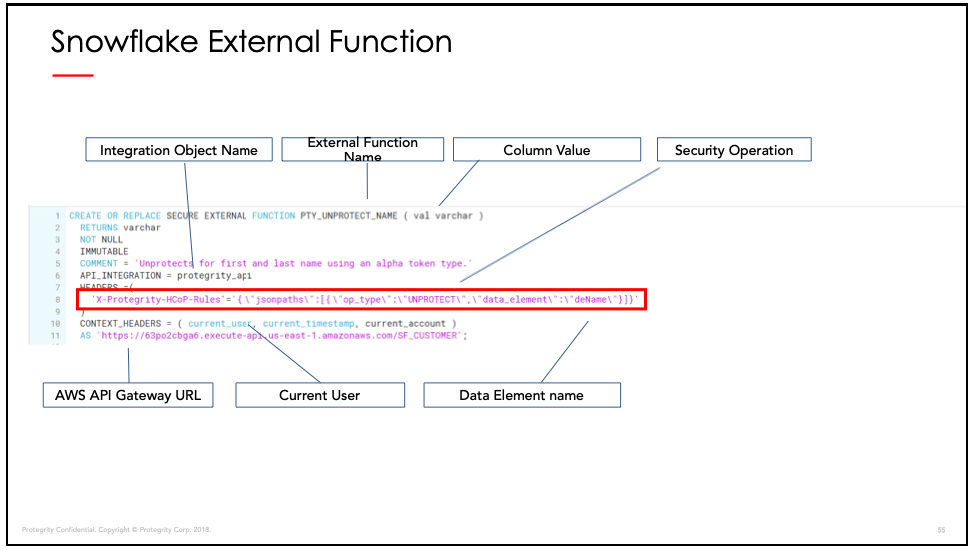 Security Operation ParametersThe following table describes optional and required security operation parameters.
1.4.3.2 - Snowflake Masking PoliciesOptimize REST requests to the Protegrity endpoint. Masking Policies in the Sample Application are used to optimize REST requests to the Protegrity endpoint and to prevent integration of External Functions into queries.
1.4.4 - PerformancePerformance benchmarks and considerations. 1.4.4.1 - Performance ConsiderationsPerformance benchmarks and considerations. Performance ConsiderationsThe following factors may cause variation in real performance versus benchmarks:
1.4.4.2 - Sample BenchmarksSample benchmarks for different cluster sizes. Sample BenchmarksThe following benchmarks were performed against different cluster sizes. These are median times of approximately five runs each. The query unprotected six columns per row (first_name, last_name, email, postal_code, ssn, iban):
1.4.4.3 - ConcurrencyGuidance on concurrency. ConcurrencySnowflake provides guidance on the maximum concurrent requests to the Protegrity API. However, reaching this maximum request depends on additional factors, such as, cluster use and available resources. In addition, depending on the query plan, individual batches may be processed serially across different UDFs. The formula for theoretical maximum Snowflake concurrency is N * C * M * E * P:
The following table shows this calculation for a single query.
Note* theoretical maximum concurrent requests based on engineering guidance from Snowflake.1.4.4.4 - Concurrency TuningConcurrency tuning considerations. Lambda TuningAWS maintains quotas for Lambda concurrent execution. Two of these quotas impact concurrency and compete with other Lambdas in the same account and region:
The concurrent executions quota cap is the maximum number of Lambda instances that can serve requests for an account and region. The default AWS quota may be inadequate based on peak concurrency based on the table in the previous section. This quota can be increased with an AWS support ticket. The Burst concurrency quota limits the rate at which Lambda will scale to accommodate demand. This quota is also per account and region. The burst quota cannot be adjusted. AWS will quickly scale until the burst limit is reached. After the burst limit is reached, functions will scale at a reduced rate per minute (e.g. 500). If no Lambda instances can serve a request, the request will fail with a The burst limit is a fixed value and varies significantly by AWS region. The highest burst (3,000) is currently available in the following regions: US West (Oregon), US East (N.Virginia), and Europe (Ireland). Other regions can burst between 500 and 1,000. It is recommended to select a Snowflake AWS region with the highest burst limits. API Gateway TuningAWS maintains a Throttle quota for the API Gateway. By default, API Gateway limits concurrent requests to 10,000 requests per second and throttles subsequent traffic with a 429 Too Many Requests error response. This quota applies across all APIs in an account and region. The API Gateway default quota may need to be increased based on the Concurrency table in Lambda Tuning. Keep in mind that hitting quota limits effectively throttles any other API services in the region. The API Gateway also limits burst. Burst is the maximum number of concurrent requests that API Gateway can fulfill at any instant without returning 429 Too Many Requests error responses. This limit can be increased by AWS, but is not normally an adjustable. Enable CloudWatch metrics within the API Gateway to monitor max concurrency and investigate throttling errors. See the Concurrency Troubleshooting section on interpreting CloudWatch metrics. Quotas adjustments are applied for region and account. Throttling is also enabled by default in the API Gateway stage used by the Protegrity Lambda function. The stage configuration throttling must be adjusted if the quota is modified. Stage throttling is shown in the following image.
For example, a test query was executed against a 274 million record table on a 2X-Large Snowflake cluster using a query with 10 UDF columns. Using the reference table in the Concurrency table, the cluster would theoretically generate over 20,000 requests/sec to execute the given query. Using API Gateway’s default settings, the requests exceeding 10,000 requests/sec will be throttled. Therefore, this query may fail intermittently due to a high number of throttling errors. After requesting a quota increase, AWS modified the account’s API Gateway throttling quota from 10,000 to 24,000, this same query succeeded without throttles. In addition, 8 concurrent queries also succeeded. Eight concurrent queries did not generate 8x the concurrent load due to the cluster’s own resource limitations. This indicates the cluster peaked. Concurrency TroubleshootingHitting up against quota limits may indicate that quota adjustments are required. Exceeding quota limits may cause a Snowflake query to fail or reduce performance. In the worst case, significant throttling can impact the performance of all your API Gateway or Lambda services in the region. Snowflake is tolerant of a certain ratio of failed requests and automatically retries. If a high percentage of requests fail, then the query may abort and the last error code will display in the console. For example, 429 Too Many Requests. CloudWatch Metrics can be manually enabled on the API Gateway to reveal if quotas are being reached. Metrics aggregate errors into two buckets that are 4xx and 5xx. CloudWatch logs can be used to access the actual error code. The following table describes how to interpret the CloudWatch metrics.
NoteThe API Gateway Lambda proxy maps 429 errors from the Lambda service to 500 errors.The following screenshot shows an example of searching CloudWatch Logs using Log Insights:
Cold-Start PerformanceCold-start vs warm execution refers to the state of the Lambda when a request is received. A cold-start undergoes additional initialization, such as, loading the security policy. Warm execution applies to all subsequent requests served by the Lambda. The following table shows an example how these states impact latency and performance.
Note
1.4.4.5 - Log Forwarder Performance TuningGuidance on concurrency. Log Forwarder PerformanceLog forwarder architecture is optimized to minimize the amount of connections and reduce the overall network bandwidth required to send audit logs to ESA. This is achieved with batching and aggregation taking place on two levels. The first level is in protect function instances, where audit logs from consecutive requests to an instance are batched and aggregated. The second level of batching takes place in Amazon Kinesis Stream where log records from different protect function instances are additionally batched and sent to log forwarder function where they are aggregated. This section shows how to configure the deployment to accommodate different patterns of anticipated audit log stream. It also shows how to monitor deployment resources to detect problems before audit records are lost.
1.4.4.6 -API Gateway TuningAWS maintains a Throttle quota for the API Gateway. By default, API Gateway limits concurrent requests to 10,000 requests per second and throttles subsequent traffic with a 429 Too Many Requests error response. This quota applies across all APIs in an account and region. The API Gateway default quota may need to be increased based on the Concurrency table in Lambda Tuning. Keep in mind that hitting quota limits effectively throttles any other API services in the region. The API Gateway also limits burst. Burst is the maximum number of concurrent requests that API Gateway can fulfill at any instant without returning 429 Too Many Requests error responses. This limit can be increased by AWS, but is not normally an adjustable. Enable CloudWatch metrics within the API Gateway to monitor max concurrency and investigate throttling errors. See the Concurrency Troubleshooting section on interpreting CloudWatch metrics. Quotas adjustments are applied for region and account. Throttling is also enabled by default in the API Gateway stage used by the Protegrity Lambda function. The stage configuration throttling must be adjusted if the quota is modified. Stage throttling is shown in the following image.
For example, a test query was executed against a 274 million record table on a 2X-Large Snowflake cluster using a query with 10 UDF columns. Using the reference table in the Concurrency table, the cluster would theoretically generate over 20,000 requests/sec to execute the given query. Using API Gateway’s default settings, the requests exceeding 10,000 requests/sec will be throttled. Therefore, this query may fail intermittently due to a high number of throttling errors. After requesting a quota increase, AWS modified the account’s API Gateway throttling quota from 10,000 to 24,000, this same query succeeded without throttles. In addition, 8 concurrent queries also succeeded. Eight concurrent queries did not generate 8x the concurrent load due to the cluster’s own resource limitations. This indicates the cluster peaked. 1.4.4.7 -Cold-Start PerformanceCold-start vs warm execution refers to the state of the Lambda when a request is received. A cold-start undergoes additional initialization, such as, loading the security policy. Warm execution applies to all subsequent requests served by the Lambda. The following table shows an example how these states impact latency and performance.
Note
1.4.4.8 -Concurrency TroubleshootingHitting up against quota limits may indicate that quota adjustments are required. Exceeding quota limits may cause a Snowflake query to fail or reduce performance. In the worst case, significant throttling can impact the performance of all your API Gateway or Lambda services in the region. Snowflake is tolerant of a certain ratio of failed requests and automatically retries. If a high percentage of requests fail, then the query may abort and the last error code will display in the console. For example, 429 Too Many Requests. CloudWatch Metrics can be manually enabled on the API Gateway to reveal if quotas are being reached. Metrics aggregate errors into two buckets that are 4xx and 5xx. CloudWatch logs can be used to access the actual error code. The following table describes how to interpret the CloudWatch metrics.
NoteThe API Gateway Lambda proxy maps 429 errors from the Lambda service to 500 errors.The following screenshot shows an example of searching CloudWatch Logs using Log Insights:
1.4.4.9 -Lambda TuningAWS maintains quotas for Lambda concurrent execution. Two of these quotas impact concurrency and compete with other Lambdas in the same account and region:
The concurrent executions quota cap is the maximum number of Lambda instances that can serve requests for an account and region. The default AWS quota may be inadequate based on peak concurrency based on the table in the previous section. This quota can be increased with an AWS support ticket. The Burst concurrency quota limits the rate at which Lambda will scale to accommodate demand. This quota is also per account and region. The burst quota cannot be adjusted. AWS will quickly scale until the burst limit is reached. After the burst limit is reached, functions will scale at a reduced rate per minute (e.g. 500). If no Lambda instances can serve a request, the request will fail with a The burst limit is a fixed value and varies significantly by AWS region. The highest burst (3,000) is currently available in the following regions: US West (Oregon), US East (N.Virginia), and Europe (Ireland). Other regions can burst between 500 and 1,000. It is recommended to select a Snowflake AWS region with the highest burst limits. 1.4.5 - Audit LoggingAudit log description/formatting Audit LoggingAudit records and application logs stream to Amazon CloudWatch Logs or optionally be sent to ESA. Cloud Protect uses a JSON format for audit records that is described in the following sections. You can analyze and alert on audit records using Protegrity ESA or Amazon CloudWatch. Third-party solutions may be used if they are supported by Amazon Cloudwatch or AWS Lambda logging extensions. For more information about forwarding your audit records to ESA, contact Protegrity. For more information about Amazon CloudWatch, refer to the Amazon CloudWatch User Guide. For more information about audit records, refer to the Protegrity Analytics Guide. Audit record fieldsThe audit record format has been altered in version 3.1 of the protector to provide more information.
Example Audit RecordsThe following are sample audit messages: Protect Success: User permission denied: Data element not found: 1.4.6 - No Access BehaviorUnauthorized unprotect requests behaviour. No Access BehaviorThe security policy maintains a No Access Operation, configured in an ESA, which determines the response for unauthorized unprotect requests.
The following table describes the result returned in the response for the various no access unprotect permissions.
NoteAn unauthorized protect will throw an exception.1.4.7 - Upgrading To The Latest VersionInstructions for upgrading the protector. Download the Latest VersionYou can download the latest version of the deployment package from https://my.protegrity.com. Navigate to Data Protection > Cloud Protect to download the latest version. After downloading the deployment package from the Protegrity Portal, unzip the package to extract the artifact files. In the AWS Console, navigate to the S3 bucket that was previously created to upload deployment artifacts (see: Create S3 bucket for Installing Artifacts). NoteOnly extract the deployment package and not the files in it.Upload the following artifacts to the S3 bucket: - -
If the release version matches your existing deployment, you don’t need to upload it again. Save the following artifacts on your local system so that you have them available during the next steps: - -
Perform the following steps to upgrade the Agent Lambda and Protect Lambda separately. ImportantIf new versions are available for both Agent and Protect Lambdas, Agent Lambda must be upgraded first.Disable Protegrity Agent Function CloudWatch Event RuleCloud Watch Event Rule is used to periodically run Protegrity Agent Function to synchronize policy from ESA. This functionality is optional when deploying Protegrity Serverless Solution. If the Event Rule is enabled, it must be disabled temporarily for the time of the upgrade process. Follow the steps below to determine if your deployment uses Event Rule and disable it.
Upgrading Policy Agent LambdaNoteIf the release version of the artifact zip file has not changed since the previous installation, you can skip the Agent Lambda upgrade.
NoteMake sure you are viewing the latest Lambda Function, not the published version.
Upgrading Log Forwarder LambdaNoteIf you are upgrading protector to one of these versions: [3.2.2, 3.2.3], skip this section and follow instruction to install new Log Forwarder Audit Log Forwarder Installation.
Upgrading Protect LambdaNoteIf the release version of the artifact zip file has not changed since the previous installation, you can skip the Protect Lambda upgrade.Diagram below illustrates upgrade steps.
Re-enable Protegrity Agent Function CloudWatch Event RuleIf the Event Rule was disabled at the beginning of the upgrade process, you must re-enabled it. Follow the steps below to re-enable Policy Agent Event rule.
1.4.8 - Known LimitationsKnown product limitations. Known LimitationsKnown product limitations:
1.4.9 - AppendicesAdditional references for the protector. 1.4.9.1 - Sample Snowflake External FunctionA collection of sample Snowflake functions. Sample Snowflake External Function
Cutover Dates of the Proleptic Gregorian Calendar: no issues (no conversions performed by Snowflake)
**Recommended approach for protecting whole numbers fields in Snowflake
When in doubt, use DECIMAL for any numeric range. 1.4.9.2 - Installing the Policy Agent and Protector in Different AWS AccountsExample steps to install Agent in a different AWS account than the Protector The Policy Agent Lambda function and Protect Lambda functions can be installed in separate AWS accounts. However, additional configuration is required to authorize the Policy Agent to provision the security policy to a remote Protect Lambda function. NoteThe Policy Agent will deploy an encrypted security policy file to an S3 bucket in the Protect function’s AWS Account.Create Agent Lambda IAM policy
Create Policy Agent cross-account IAM Role
Allow the Policy Agent Cross-Account Role to be Assumed by the Policy Agent IAM Role
Add Assume Role to the Policy Agent Execution IAM Role
Update the Policy Agent Lambda Configuration
1.4.9.3 - Integrating Cloud Protect with PPC (Protegrity Provisioned Cluster)Concepts for integrating with PPC (Protegrity Provisioned Cluster) This guide describes how to configure the Protegrity Policy Agent and Log Forwarder to connect to a Protegrity Provisioned Cluster (PPC), highlighting the differences from connecting to ESA. Key Differences: PPC vs ESA
Prerequisites
Policy Agent Setup with PPCImportantWhen connecting to PPC, the Policy Agent requires use of a datastore key fingerprint. For connecting to ESA 10.2 with Cloud Protect Policy Agent, the fingerprint is optional but recommended. See Policy Agent Installation for general setup steps.Follow these instructions as a guide for understanding specific inputs for Policy Agent integrating with PPC:
Log Forwarder Setup with PPCNoteWhen using PPC, certificate authentication and CA validation are not supported for the Log Forwarder. Configuration steps related to certificates in Log Forwarder Installation do not apply to PPC. If you attempt to use certificates provided by PPC, the Log Forwarder will not function correctly.
1.4.9.4 - Policy Agent - Custom VPC Endpoint Hostname ConfigurationCustom vpc endpoint hostname configuration The Policy Agent uses default endpoint hostnames to communicate with other AWS services (for example, secretsmanager.amazonaws.com). This configuration will only work in VPCs where Amazon-provided DNS is available (default VPC configuration with private DNS option enabled for the endpoint). If your VPC uses custom DNS, follow the instructions below to configure the Policy Agent Lambda to use custom endpoint hostnames. NoteThis configuration is only available with the Cloud Protect version 1.5.0 or higher. For more information about the upgrade instructions, refer to Upgrading to the Latest Version.Identify DNS HostnamesTo identify DNS hostnames:
Update the Policy Agent Lambda configurationTo update policy agent lambda configuration:
1.4.9.5 - Protection MethodsCloud API supported protection methods Protection MethodsFor more information about the protection methods supported by Protegrity, refer to the Protection Methods Reference.
1.4.9.6 - Configuring Regular Expression to Extract Policy UsernameExtract the policy username from the AWS identity. Configuring Regular Expression to Extract Policy UsernameCloud Protect Lambda Function exposes USERNAME_REGEX configuration to allow extraction of policy username from user in the request.
1.4.9.7 - Associating ESA Data Store With Cloud Protect AgentConfigure ESA data store for Policy Agent. Associating ESA Data Store With Cloud Protect AgentESA controls which policy is deployed to protector using concept of data store. A data store may contain a list of IP addresses identifying servers allowed to pull the policy associated with that specific data store. Data store may also be defined as default data store, which allows any server to pull the policy, provided it does not belong to any other data stores. Node registration occurs when the policy server (in this case the policy agent) makes a policy request to ESA, where the agent’s IP address is identified by ESA. NoteFor more information about ESA data store refer to Policy Management Guide which is part of Protegrity ESA documentation.Policy agent lambda source IP address used for node registration on ESA depends on ESA hubcontroller configuration ASSIGN_DATASTORE_USING_NODE_IP and the PTY_ADDIPADDRESSHEADER configuration exposed by the agent lambda. The Lambda service uses multiple network interfaces, internal network interface with ephemeral IP range of 169.254.x.x and external network interface with IP range of the VPC subnet the Lambda is associated with. By default, when agent lambda is contacting ESA to register node for policy download, ESA uses agent Lambda VPC IP address. This default behavior is caused by the default ESA hubcontroller configuration ASSIGN_DATASTORE_USING_NODE_IP=false and agent default configuration PTY_ADDIPADDRESSHEADER=yes. In some cases, when there is a proxy server between the ESA and agent lambda, the desirable ESA configuration is ASSIGN_DATASTORE_USING_NODE_IP=true. and PTY_ADDIPADDRESSHEADER=no which will cause the ESA to use proxy server IP address. The table below shows how the hubcontroller and agent settings will affect node IP registration on ESA.
1.5 - Amazon S3Cloud Storage Protector - Amazon. This document describes high-level architecture of the Cloud Storage Protector on AWS, the installation procedures and provides guidance on performance. This document should be used in conjunction with the Cloud API on AWS Protegrity documentation. This guide may also be used with the Protegrity Enterprise Security Administrator Guide, which explains the mechanism for managing the data security policy. 1.5.1 - OverviewSolution overview and features. Solution OverviewS3 Protector automatically protects files that are uploaded to an Amazon S3 source bucket and writes the processed result to an output bucket. Amazon S3 event notifications trigger the protector, and Cloud Protect API applies the configured Protegrity protection rules to the selected columns in each file. For most deployments, users only need to decide where files arrive, where protected files should be written, and which The solution requires Protegrity Cloud Protect API on AWS. Cloud Protect API provides the endpoint used by S3 Protector to perform Protegrity operations as part of cloud-based data pipelines. Protected files can be used as source for a data lake or downstream database ingestion. For example:
Like other Protegrity products, S3 Protector uses the data security policy maintained on Enterprise Security Appliance (ESA). The ESA policy user supplied during setup acts as the service account for the deployment. For more information about policy user configuration, refer to the Enterprise Security Administrator Guide. Analytics on Protected DataProtegrity’s format and length preserving tokenization scheme make it possible to perform analytics directly on protected data. Tokens are join-preserving so protected data can be joined across datasets. Often statistical analytics and machine learning training can be performed without the need to re-identify protected data. However, a user or service account with authorized security policy privileges may re-identify subsets of data using the Cloud Storage Protector - Amazon S3 service. FeaturesProtegrity S3 Protector provides the following features:
For more information about the available protection options, such as data types, Tokenization or Encryption types, or length-preserving and non-preserving tokens, refer to Protection Methods Reference. 1.5.2 - ArchitectureDeployment architecture and connectivity Deployment ArchitectureThe Protegrity S3 solution should be deployed in the customer’s Cloud account within the same AWS region as the Protegrity Cloud Protect API. The Cloud Protect API is required. Two S3 Buckets are required for processing data with S3 Protector:
The following diagram shows the high-level architecture of the S3 Protector.
The ruleset for processing a type of input dataset is defined by a metadata file called
Input and output data file specifications provide flexibility for common file structures. Column instructions define the protect
operation and data element to apply for each column. The The Protegrity S3 protector invokes the Cloud Protect API to execute the policy on the data. The processed data is saved to the specified target S3 bucket. The target bucket can be the basis of a data lake or a staging area to load databases. For example, Snowflake Snowpipe can be used to automatically ingest the processed (ie. Protected) data into Snowflake. Amazon Redshift provides a similar mechanism for bulk loading data from Amazon S3. For more information about installing and managing the Cloud API component, refer to the Cloud API on AWS Protegrity documentation. AWS Lambda TimeoutS3 Protector runs in AWS Lambda. Each Lambda invocation has a maximum execution time called a timeout.
When you install this product with the supplied CloudFormation template, the timeout is set to 15 minutes, the maximum timeout allowed by AWS.
If S3 Protector runs out of time while processing a file, it will fail with When S3 Protector runs out of time, an output upload may remain incomplete. Incomplete uploads do not appear in the S3 console, however you are still charged for them. Review AWS documentation on how to manage incomplete multipart uploads, for example: There is no way to automatically re-start this product from where it has timed out while processing a file. To reduce the likelihood of a timeout error, consider the following:
Parquet TimestampParquet files define file schema with a data type for each column. S3 Protector uses Pandas library to process data in the source file. Pandas library represents timestamps as 64-bit integers representing microseconds since the UNIX epoch. The supported date range for this representation is between ‘1677-09-21 00:12:43.145224’ and ‘2262-04-11 23:47:16.854775’. To correctly handle timestamps outside of this range, S3 Protector will treat every timestamp column in a source file as a string column. The schema of protected file will differ from the source file, where every protected timestamp column will be converted to a string column. 1.5.3 - InstallationInstructions for installing Cloud Storage Protector Service. 1.5.3.1 - PrerequisitesRequirements before installing the protector. AWS ServicesThe following table describes the AWS services that may be a part of your Protegrity installation.
Prerequisites
Required Skills and Abilities
What’s Next1.5.3.2 - Pre-ConfigurationConfiguration steps before installing the protector. Provide AWS sub-accountIdentify or create an AWS account where the Protegrity solution will be installed. The installation instructions assume the same AWS account and region are used for Cloud Protect API deployment. AWS Account ID: ___________________ AWS Region: ___________________ Create S3 bucket for Installing ArtifactsThis S3 bucket will be used for the artifacts required by the CloudFormation installation steps. This S3 bucket must be created in the region that is defined in Provide AWS sub-account. To create S3 bucket for installing artifacts:
Cloud Protect API functionProtegrity Cloud Protect API on AWS is required for the S3 Protector installation. The binaries of the Cloud Protect API on AWS are distributed with the S3 Protector installation package. See the Cloud Protect API on AWS documentation on how to create a new installation if one is not already available in your account/region. With Cloud Protect API on AWS installed, follow the below instructions to obtain the ARN of the protector lambda function. Follow these steps to obtain Cloud API Lambda ARN.
Cloud Protect API function ARN: ____________________ S3 Buckets For Input And Output DataTwo S3 buckets are required. One bucket is used for incoming files. The second bucket is used for files processed by the S3 Protector. The buckets must be different. The S3 buckets should be created in the region that is defined in Provide AWS sub-account. NoteBefore continuing it is critical to understand Amazon S3 security concepts and best practices. You can refer to AWS S3 Best Practices for the list of recommend S3 security configuration, however it is strongly recommended to check the AWS official documentation for more details.Identify existing bucket names or follow the steps below to create new buckets.
Input S3 Bucket Name: ____________________ Output S3 Bucket Name: ____________________ What’s Next1.5.3.3 - S3 Protector Service InstallationInstall the S3 protector service. PreparationEnsure that all the steps in Pre-Configuration are performed.
Create S3 Protector Lambda IAM Execution PolicyThe below steps create an IAM policy for use by the Protegrity Lambda function. The policy grants permissions to:
Steps
NoteThe sample policy above includes permissions for processing large files in chunks and reading mapping file location from S3 object tags. If you do not process large files or do not provide mapping file location using S3 object tags, you can tighten theSourceS3Access
statement by removing s3:PutObject and s3:GetObjectTagging permissions.
Create S3 Protector Lambda IAM RoleThe following steps create the role to utilize the policy defined in the previous section. Steps
Install through CloudFormationThe following steps describe deployment of the S3 Protector Lambda Function using CloudFormation.
CloudFormation Parameters
Test S3 Protector Function ConfigurationPerform the following steps to verify that S3 Protector Function can read files from input S3 bucket, call Cloud API protector and write data to output S3 bucket. NoteSteps described in this section require read/write permissions for S3 data buckets. Data bucket names were recorded in prerequisites section.Before you begin:
data.csv:
Execute S3 Protector Function in AWS console:With the input data file and mapping file uploaded, follow the steps below to trigger the S3 Protect Function.
Verify execution results:
If the expected output is not present, please consult the Troubleshooting section for common errors and solutions.
Restore production configuration:After S3 Protector Function configuration has been verified, make sure that the following configuration was restored for production environment:
Configure S3 Lambda TriggersFollow the steps below to configure Amazon S3 event notification on the input bucket. This will allow Amazon S3 to send an event to S3 Protector Lambda function when an object is created or updated. NoteThe steps below require an AWS Administrator permissions to modify the resource-based Lambda policy. When new S3 trigger is added from the Lambda console, the console modifies the resource-based policy to allow Amazon S3 to invoke the function if the bucket name and account ID match.NoteWhen uploading multiple files or folders to S3, AWS S3 Lambda Trigger will generate one event per file. As expected, this will result in multiple S3 Protector instances running concurrently, one S3 Protector instance per file.Steps to Add S3 Lambda trigger:
ImportantDo add a trigger for.json files. Do not add a trigger for .part files.
S3 Protector uses .json and .part files internally to enable parallel processing of large files in chunks.Example UsageThis section describes typical usage of S3 Protector. Prepare data for testing:Sample datasets and mapping.json files are provided in appendix sections:
Create a new folder in the input S3 bucket:A new folder must be created in the S3 input bucket for each distinct file schema. Each folder can have a mapping.json file corresponding to the dataset type expected. It is recommended that input folders use S3 encryption:
Upload the mapping.json and dataset to the folder:The appropriate mapping.json file must be uploaded to the folder prior to uploading the dataset.
Verify output:Verify the output file was created:
Troubleshooting / Logs:Logs are written to CloudWatch. This could provide helpful information if the results are not as expected:
TroubleshootingBy default, S3 Protector is set to log minimal information. It is beneficial to increase S3 Protector log level to either ‘config’ or ‘all’ while troubleshooting any error conditions. Use the CloudFormation installation steps to increase ‘MinLogLevel’ function configuration. S3 Protector Error States
Restarting S3 ProtectorIf S3 Protector fails, it is possible to start S3 Protector for existing source file without re-uploading the file again by using AWS Lambda console. With the input data file and mapping file uploaded, follow the steps below to trigger the S3 Protect Function. Steps
1.5.3.4 -Prerequisites
1.5.3.5 -AWS ServicesThe following table describes the AWS services that may be a part of your Protegrity installation.
1.5.3.6 -Required Skills and Abilities
1.5.4 - Mapping File ConfigurationKey concepts for defining the mapping.json file 1.5.4.1 - Mapping FileThe mapping.json is used for configuring how S3 Protector transforms the input data. OverviewS3 Protector uses a
Using S3 Object Tags for Mapping File ResolutionAdd a tag to the source S3 object to point to a specific mapping file. The tag key is always
Configuration StructureThe mapping.json file must be formatted in valid JSON with the key-values configuration pairs described below: Data Columns TransformationEvery source file column must appear in either ‘columns’ or ‘ignored-columns’.
Input Data ConfigurationThe “input” optional configuration contains the following key-values pairs: formatSpecifies the format of the input data files. If format is not provided in the mapping json, the format will be inferred from the file extension. specProvides additional configuration for input file processing. This allows processing of non-default file formats. For example, pipe delimited files, header-less files, and various JSON record structures. ImportantSupplying custom arguments might result in an unexpected S3 Protector behavior. Protegrity is not responsible for any damages caused due to the use of custom Pandas configuration. Use this option at your own risk.The properties within the input spec block correspond with the Python Pandas reader functions arguments. For more information about supported format arguments refer to the Pandas documentation. Below you can find a list of links to Pandas official online documentation for each format supported by S3 Protector:
Output Data ConfigurationThe “output” optional configuration contains the following key-values pairs: formatSpecifies the format of the output data files. The format in the mapping json is only used when S3 Protector Function deployment parameter OutputFileFormat is set to use_mapping_spec. See the CloudFormation installation section for the full list of the output format configuration. specProvides additional configuration for the output file processing. ImportantSupplying custom arguments might result in an unexpected S3 Protector behavior. Protegrity is not responsible for any damages caused due to the use of custom Pandas configuration. Use this option at your own risk.The properties within the output spec block correspond with the Python Pandas DataFrame output function arguments. For more information about supported format arguments refer to the Pandas documentation. Below you can find a list of links to Pandas official online documentation for each format supported by S3 Protector:
1.5.4.2 - Column Mapping RulesIn order to ensure highest level of security, the S3 Protector requires users to define processing rules for all data columns. Every column that appears in a source file must be mentioned in the ‘mapping.json’ file. A column may appear in either ‘columns’ section or ‘ignored-columns’ section, but not both. Common Error ConditionsThe table below summaries common error conditions that may occur when creating a ‘mapping.json’ file:
NoteThe column names in the mapping file are case sensitive.1.5.5 - Large File ProcessingKnown product limitations. OverviewS3 Protector processes files uploaded to Amazon S3 by invoking an AWS Lambda function for
each Two complementary mechanisms handle large files:
Dispatch and row-level streaming are complementary: a dispatched chunk is still streamed row-by-row inside each Processor Lambda, keeping per-invocation memory bounded. How Dispatch Works: Step by Step1 — DispatcherWhen a regular data file (
2 — Processor (one per chunk)Each manifest landing in S3 fires a separate
3 — Merger (inline, triggered by the last Processor)After all chunks complete, the Merger:
Staging Directory LayoutAll transient dispatch artifacts are stored under a per-job staging directory in the
source bucket. The directory is named by appending Example — for a source file Manifest files ( | ||||||||||||||||||||||||||||||||||||||||||||||||||||||||||||||||||||||||||||||||||||||||||||||||||||||||||||||||||||||||||||||||||||||||||||||||||||||||||||||||||||||||||||||||||||||||||||||||||||||||||||||||||||||||||||||||||||||||||||||||||||||||||||||||||||||||||||||||||||||||||||||||||||||||||||||||||||||||||||||||||||||||||||||||||||||||||||||||||||||||||||||||||||||||||||||||||||||||||||||||||||||||||||||||||||||||||||||||||||||||||||||||||||||||||||||||||||||||||||||||||||||||||||||||||||||||||||||||||||||||||||||||||||||||||||||||||||||||||||||||||||||||||||||||||||||||||||||||||||||||||||||||||||||||||||||||||||||||||||||||||||||||||||||||||||||||||||||||||||||||||||||||||||||||||||||||||||||||||||||||||||||||||||||||||||||||||||||||||||||||||||||||||||||||||||||||||||||||||||||||||||||||||||||||||||||||||||||||||||||||||||||||||||||||||||||||||||||||||||||||||||||||||||||||||||||||||||||||||||||||||||||||||||||||||||||||||||||||||||||||||||||||||||||||||||||||||||||||||||||
| Variable | Default | Range | Description |
|---|---|---|---|
LARGE_FILE_DISPATCH_THRESHOLD_BYTES | 262144000 (250 MB) | 100 MB – 100 GB | Size (in bytes), files of this size or larger are split across multiple Processor Lambdas. Omit or leave empty to disable dispatch entirely. Performance: lower values trigger dispatch sooner, increasing parallelism for medium-sized files at the cost of dispatch overhead. |
LARGE_FILE_CHUNK_SIZE_BYTES | 104857600 (100 MB) | 10 MB – 10 GB | Size (in bytes) of each byte-range chunk assigned to one Processor Lambda. Performance: smaller chunks → more parallel Lambdas → faster wall-clock time, but higher Lambda concurrency consumption. Larger chunks → fewer Lambdas → less concurrency pressure, but each invocation takes longer. The maximum supported number of chunks per job is 9999. |
Supported formats for dispatch: CSV, Parquet, JSON (both JSON Lines and JSON array).
XLSX dispatch is not supported.
| Variable | Default | Range | Description |
|---|---|---|---|
FILE_CHUNK_SIZE | 100000 | 100 – 100 000 000 | Number of rows read from the source file at a time during streaming I/O. Performance: larger values reduce S3 read round-trips at the cost of higher peak RAM usage per invocation. Reduce if the Lambda runs out of memory on wide rows; increase to reduce latency on narrow rows. Applies to CSV, Parquet, and JSON Lines. Does not apply to JSON array files — those load the entire assigned byte range into RAM as one DataFrame. |
MAX_BATCH_SIZE | 25000 | 100 – 100 000 000 | Maximum number of values sent to the Cloud API Lambda in a single invocation payload. Performance: the AWS Lambda synchronous invocation payload limit is 6 MB. Increasing this reduces the number of Cloud API calls (lower latency), but risks hitting the 6 MB limit for wide columns. Keep MAX_BATCH_SIZE ≤ FILE_CHUNK_SIZE. |
| Variable | Default | Range | Description |
|---|---|---|---|
MAX_PARALLEL_PROTECT_CALLS | 1000 | 0 – 10 000 | Maximum number of concurrent asyncio tasks that call the Cloud API Lambda in parallel within a single Processor Lambda invocation. Performance: higher values increase throughput by overlapping network I/O to the Cloud API, at the cost of more open connections and memory per task. |
Suitable when files are up to ~1 GB and stay within the 15-minute Lambda timeout.
FILE_CHUNK_SIZE = 150000
MAX_BATCH_SIZE = 25000
MAX_PARALLEL_PROTECT_CALLS = 1000
OUTPUT_FILE_FORMAT = preserve_input_format
OUTPUT_FILE_COMPRESSION_TYPE = gzip
MIN_LOG_LEVEL = info
Memory footprint per invocation: approximately FILE_CHUNK_SIZE × avg_row_bytes × 2
(current chunk + output buffer).
Suitable for files from 256 MB to several GB.
LARGE_FILE_DISPATCH_THRESHOLD_BYTES = 1048576000 # 1 GB — enable dispatch above this
LARGE_FILE_CHUNK_SIZE_BYTES = 157286400 # 150 MB per Processor Lambda
FILE_CHUNK_SIZE = 150000
MAX_BATCH_SIZE = 25000
MAX_PARALLEL_PROTECT_CALLS = 1000
OUTPUT_FILE_FORMAT = preserve_input_format
OUTPUT_FILE_COMPRESSION_TYPE = gzip
MIN_LOG_LEVEL = info
Each Processor Lambda handles one ~150 MB byte range. A 1.5 GB file produces ~10 parallel invocations that each finish in a fraction of the total serial time.
| Symptom | Likely cause | Fix |
|---|---|---|
| Lambda times out on large files | File too large for serial processing | Enable dispatch for this file (LARGE_FILE_DISPATCH_THRESHOLD_BYTES) |
| Lambda runs out of memory | FILE_CHUNK_SIZE too large, or cross-format conversion | Reduce FILE_CHUNK_SIZE; use the same input and output format |
| Output file not produced after all chunks succeed | Processor Lambda(s) failed before writing .part files | Check CloudWatch Logs, delete the .dispatch/ staging directory and restart file processing |
.part files accumulate and are never deleted | Merge failed | Check CloudWatch Logs, delete the .dispatch/ staging directory and restart file processing |
RuntimeError: Dispatch directory already exists | Previous dispatch run did not complete | Check CloudWatch Logs, delete the .dispatch/ staging directory and restart file processing |
| Cloud API payload errors | MAX_BATCH_SIZE too large | Reduce MAX_BATCH_SIZE until request fits under 6 MB |
Use the following CloudWatch Logs Insights query to surface errors across all Lambda invocations for a job:
fields @timestamp, @message
| filter @message like /(?i)error/ or @message like /Status: timeout/
| sort @timestamp desc
| limit 1000
Before retrying, delete the entire .dispatch/ staging directory so the Dispatcher does not abort on startup.
Then trigger S3 Protector by either re-uploading the source file or invoking the Lambda directly with a synthetic S3 test event.
Replace my-source-bucket and data/large.csv with the values for your job:
{
"Records": [
{
"s3": {
"bucket": {
"name": "my-source-bucket",
"arn": "arn:aws:s3:::my-source-bucket"
},
"object": {
"key": "data/large.csv"
}
}
}
]
}
The following factors may affect S3 Protector performance:
Number of protected columns in a file: Affects the number of requests to Cloud API. The more protected columns, the longer it will take to process the file. Review Performance section in Cloud API on AWS documentation on how to monitor and configure Cloud API for best performance.
Maximum batch size: MAX_BATCH_SIZE determines the maximum number of rows to process in a single Cloud API invocation. This value is applied to all columns. The higher the batch size, the higher the Cloud API throughput. This value controls the size of a single request to Cloud API. The request size is limited by AWS Lambda infrastructure to 6 MB. Review AWS Lambda quotas and limitations for latest information.
Maximum parallel protect calls: MAX_PARALLEL_PROTECT_CALLS controls how many protect requests can be sent at the same time across the file being processed. The default is 1000. Lower values can reduce pressure on Cloud API; higher values can improve throughput if Cloud API has enough capacity.
File streaming read size: FILE_CHUNK_SIZE controls how many rows S3 Protector reads into memory at a time from source file. Lower values reduce peak memory usage. Higher values may improve throughput. This does not apply to JSON arrays. Applies to all other file types including JSON lines.
Large-file threshold: LARGE_FILE_DISPATCH_THRESHOLD_BYTES Files larger than this threshold are processed in parallel by multiple S3 Protector instances. Does not apply to XLS files.
Large-file chunk size: LARGE_FILE_CHUNK_SIZE_BYTES controls the target size of each chunk when large files are processed in parallel. For JSON array files, each chunk must fit into a single Lambda’s memory; this constraint does not apply to JSON lines files.
Function timeout: Default S3 Protector execution time is set to 15 minutes, the maximum value imposed by AWS Lambda infrastructure. If S3 Protector runs out of time when processing a file, ensure LARGE_FILE_DISPATCH_THRESHOLD_BYTES is smaller than the files size and LARGE_FILE_CHUNK_SIZE_BYTES is small enough to fit file processing into 15 minute timeout.
Cloud API performance: S3 Protector uses Cloud API to apply protect operations to data in the file. Performance of Cloud API directly affects the performance of S3 Protector. Review Performance section in Cloud API on AWS documentation.
The following table shows throughput and latency for three different files when large file processing is not enabled. Each file has 21 columns, 6 of which were protected by S3 Protector with tokenization data elements. The remaining 15 columns were configured to pass through without applying protection.
Two of the default S3 Protector settings were updated for this benchmark:
| Rows x Columns | Protected Columns | Number of Protect Operations | File Size (MB) | Total Duration (s) | Throughput (MB/s) | Throughput (Operations/s) |
|---|---|---|---|---|---|---|
| 100k x 21 | 6 | 600,000 | 22 | 5 | 4.34 | 118k/s |
| 1m x 21 | 6 | 6,000,000 | 220 | 50 | 4.36 | 119k/s |
| 10m x 21 | 6 | 60,000,000 | 2,200 | 510 | 4.31 | 118k/s |
The following results show wall-clock duration and throughput when large-file dispatch is enabled and each file is split across multiple parallel S3 Protector instances.
Test configuration:
LARGE_FILE_CHUNK_SIZE_BYTES: 109 MB per chunkFILE_CHUNK_SIZE: 150,000 rowsMAX_BATCH_SIZE: 75,000| Format | File Size | Parallel Chunks | Total Duration | Throughput (MB/s) |
|---|---|---|---|---|
| CSV | 5 GB | 46 | 1m 7s | ~77 |
| Parquet | 5 GB | 28 | 1m 43s | ~50 |
| JSON array | 5 GB | 46 | 59s | ~86 |
| JSON lines | 5 GB | 46 | 52s | ~99 |
| CSV | 20 GB | 186 | 1m 52s | ~183 |
| Parquet | 20 GB | 294 | 1m 51s | ~185 |
| JSON array | 20 GB | 189 | 2m 9s | ~159 |
| JSON lines | 20 GB | 183 | 1m 32s | ~223 |
| CSV | 100 GB | 930 | 6m 36s | ~259 |
| Parquet | 100 GB | 600 | 5m 5s | ~336 |
| JSON array | 100 GB | 916 | 8m 52s | ~227 |
Throughput scales with file size because larger files produce more parallel Processor Lambda invocations, increasing overall concurrency.
Known product limitations:
.json files, supported tabular layouts are flat JSON arrays and JSON Lines. Deeply nested JSON structures are not supported.The diagram below illustrates upgrade steps:
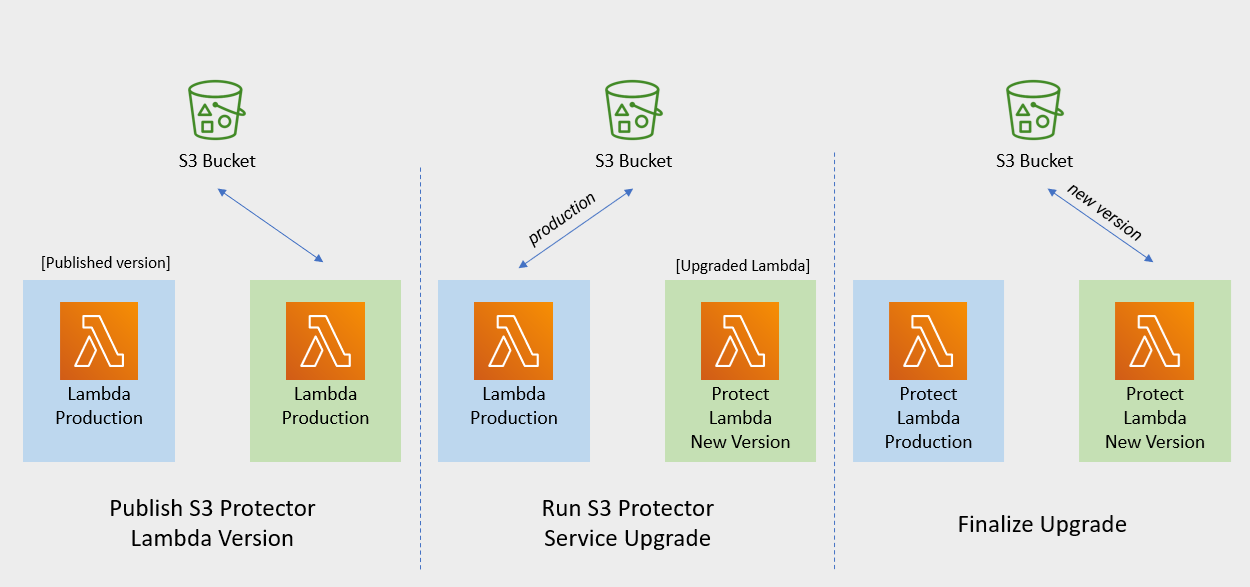
Publishing a version of the S3 Protector Lambda allows updating it without interruptions to the existing traffic.
Go to AWS Lambda console and select existing Protegrity S3 Protector Lambda.
Go to Lambda Configuration → Environment variables.
Record environment variables values. You will use them later to configure upgraded Lambda Function. You can use the aws cli command below to save the function variables into the local json file:
aws lambda get-function-configuration --function-name \
arn:aws:lambda:<aws_region>:<aws_account>:function:<function_name> \
--query Environment > <function_name>_env_config.json
Click Actions in top right portion of the screen. Select Publish new version. Click Publish.
Record the Lambda version number. It will be displayed at the top of the screen. You can also retrieve it from the Lambda function view, under Versions tab.
S3 Protector Lambda version number: ___________________
In this step, the Protect service including Lambda $LATEST version will be updated using Cloud Formation template. The Lambda version created in previous step will be used to serve existing traffic during the upgrade process.
Go to AWS Cloud Formation and select existing Protegrity deployment stack.
Select Update Stack > Make a direct update.
Select Replace existing template > Upload a template file.
Upload pty_s3_protector_cf.json file and select Next.
Update LambdaFunctionProductionVersion parameter with S3 Protector Lambda version number recorded in step 3.
Click Next until Review window and then select Update stack.
Wait for the Cloud Formation to complete.
Go back to Lambda console and select S3 Protector Lambda.
Go to Configuration → Environment variables. Replace placeholder values with values recorded in previous step.
Alternatively, you can run the following aws cli command to update function configuration using json file saved in the previous steps:
aws lambda update-function-configuration --function-name \
arn:aws:lambda:<aws_region>:<aws_account>:function:<function_name> \
--environment file://./<function_name>_env_config.json
Navigate to Aliases tab. Verify that Production alias points to the lambda version you specified in the cloud formation template.
The upgraded S3 Protector Lambda is configured with a sample policy. Run Agent Lambda Function before continuing with next steps.
In this step, the S3 Protector Lambda will be configured to serve traffic using $LATEST version upgraded in the previous step.
Go back to Protegrity AWS Cloud Formation deployment stack.
Select Update Stack > Make a direct update.
Select Use existing template and then choose Next
Update LambdaFunctionProductionVersion parameter with the following value: $LATEST.
Click Next until Review window and then select Update stack.
Go back to Lambda console and select S3 Protector Lambda.
From the Lambda console, verify that Latest alias points to $LATEST version.
Test your function to make sure it works as expected.
If you need to rollback to older version of S3 Protector Lambda, you can re-run the cloud formation with LambdaFunctionProductionVersion parameter set to the previous version of S3 Protector Lambda.
Patricia,Young,Patricia.Young@liu.info,8/25/1975,343494236548351
Ronald,Hess,Ronald.Hess@cobb.org,3/22/1977,5289549212515680
Anna,Rose,Anna.Rose@robinson.net,8/3/1983,4387393325002340
Maureen,Morgan,Maureen.Morgan@whitehead.com,10/23/1975,6011769162504860
Ryan,Lee,Ryan.Lee@summers-richards.com,4/6/1975,373509629162404
{
"input": {
"format": "csv",
"spec": {
"names": ["first_name","last_name","email","credit_card","birthdate"]
}
},
"columns":{
"first_name":{
"operation":"protect",
"data_element":"deName"
},
"last_name":{
"operation":"protect",
"data_element":"deName"
},
"email":{
"operation":"protect",
"data_element":"deEmail"
},
"credit_card": {
"operation":"protect",
"data_element":"deCCN"
},
"birthdate": {
"operation":"protect",
"data_element":"deDOB"
}
}
}
POLICY_NUM|ACTION_TAKEN_DATE|ACTION_TAKEN_TIME|PERSON_DOB|ADDR_LINE_1|ADDR_LINE_2|ADDR_CITY|ADDR_STATE|ADDR_ZIP|PERSON_NAME|PERSON_SSN
sbBksoknql8O|7/8/2011|08.00.07|9/23/1952|123 Maple Street|Apt 2B|Springfield|IL|62704|Abraham Duppstadt|755-30-1679
SdiWx5Egtxrd|7/22/2011|14.53.29|3/5/1957|456 Elm Avenue|Suite 300|Boulder|CO|80302|Christena Macklem|366-99-6352
QGOlnMvcJ50a|7/25/2011|07.14.10|7/20/1962|789 Pine Road|Unit 5|Madison|WI|53703|Ulrike Rehling|011-87-2771
MW5wPE5paWgN|7/29/2011|14.00.29|9/23/1961|321 Oak Lane|Building A|Austin|TX|78701|Summer Mauceri|806-32-5716
QGOlnMvcJ50a|7/29/2011|14.00.29|5/29/1986|654 Cedar Boulevard|Floor 4|Portland|OR|97209|Ora Scharpman|273-48-6482
{
"input": {
"format": "csv",
"spec": {
"sep": "|",
"encoding": "utf-8"
}
},
"output": {
"format": "csv",
"spec": {
"encoding": "utf-8",
"compression": "gzip"
}
},
"columns":{
"PERSON_NAME":{
"operation":"protect",
"data_element":"deName"
},
"PERSON_SSN":{
"operation":"protect",
"data_element":"deSSN"
},
"ADDR_LINE_1":{
"operation":"protect",
"data_element":"deAddress"
},
"ADDR_LINE_2":{
"operation":"protect",
"data_element":"deAddress"
},
"ADDR_CITY":{
"operation":"protect",
"data_element":"deCity"
},
"POLICY_NUM":{
"operation":"protect",
"data_element":"deIBAN"
}
}
}
[
{
"Region": "Region 1",
"Order Date": "01/12/2012",
"Registration": "2016-01-01 01:01:01.001",
"Order ID": 10,
"Unit Price": 1.01
},
{
"Region": "Region 2",
"Order Date": "27/07/2012",
"Registration": "2016-02-03 17:04:03.002",
"Order ID": 20,
"Unit Price": 456.01
},
{
"Region": "Region 3",
"Order Date": "27/07/2012",
"Registration": "2016-02-03 01:09:31.003",
"Order ID": 30,
"Unit Price": 7.99
},
{
"Region": "Region 4",
"Order Date": "27/07/2012",
"Registration": "2016-02-03 00:36:21.004",
"Order ID": 40,
"Unit Price": 89.99
}
]
{
"columns": {
"Region": {
"operation": "protect",
"data_element": "deAddress"
},
"Order Date": {
"operation": "protect",
"data_element": "deDate2"
},
"Registration": {
"operation": "protect",
"data_element": "deDOB"
},
"Order ID": {
"operation": "protect",
"data_element": "deNumeric"
},
"Unit Price": {
"operation": "protect",
"data_element": "deDecimal"
}
}
}
Enabling Block Public Access helps protect your resources by preventing public access from being granted through the resource policies or access control lists (ACLs) that are directly attached to S3 resources.
In addition to enabling Block Public Access, carefully inspect the following policies to confirm that they don’t grant public access:
IAM Access Analyzer helps you identify the resources in your organization and accounts, such as Amazon S3 buckets or IAM roles, shared with an external entity. This lets you identify unintended access to your resources and data, which is a security risk.
IAM Access Analyzer for S3 is available at no extra cost on the Amazon S3 console. IAM Access Analyzer for S3 is powered by AWS Identity and Access Management (IAM) IAM Access Analyzer. To use IAM Access Analyzer for S3 in the Amazon S3 console, you must visit the IAM console and enable IAM Access Analyzer on a per-Region basis.
All Amazon S3 buckets have encryption configured by default, and all new objects that are uploaded to an S3 bucket are automatically encrypted at rest. Server-side encryption with Amazon S3 managed keys (SSE-S3) is the default encryption configuration for every bucket in Amazon S3.
Amazon S3 also provides these server-side encryption options:
The following diagram shows a reference architecture for synchronizing the security policy from ESA.
The Protegrity Policy Agent requires network access to an Enterprise Security Administrator (ESA). Most organizations install the ESA on-premise. Therefore, it is recommended that the Policy Agent is installed into a private subnet with a Cloud VPC using a NAT Gateway to enable this communication through a corporate firewall.
The ESA is a soft appliance that must be pre-installed on a separate server. It is used to create and manage security policies.
For more information about installing the ESA, and creating and managing policies, refer to the Policy Management Guide.
| Feature | ESA 10.2 | PPC (this guide) |
|---|---|---|
| Datastore Key Fingerprint | Optional/Recommended | Required |
| CA Certificate on Agent | Optional/Recommended | Optional/Recommended |
| CA Certificate on Log Forwarder | Optional/Recommended | Not supported |
| Client Certificate Authentication from Log Forwarder | Optional/Recommended | Not supported |
| IP Address | ESA IP address | PPC address |
curl, kubectl installed.Follow these instructions as a guide for understanding specific inputs for Policy Agent integrating with PPC:
Obtain the Datastore Key Fingerprint
To retrieve the fingerprint for your Policy Agent:
Retrieve public key from the Cloud Provider Key Management service for the policy encryption key created in pre-configuration:
Escape the new line characters in the downloaded public key for use in the next step - for example:
awk 'NF {printf "%s\\n",$0}' "<public_key_file>" > "new-line-escaped-public-key.pem"
cat new-line-escaped-public-key.pem
Export key fingerprint using the PPC API as indicated in the curl example below:
curl -k -H "Authorization: Bearer ${TOKEN}" -X POST https://${HOST}/pty/v2/pim/datastores/1/export/keys -H "Content-Type: application/json" --data '{
"algorithm": "RSA-OAEP-256",
"description": "example-key-from-key-management",
"pem": "<value of new-line-escaped-public-key>"
}'
Sample Output:
{"uid":"1","algorithm":"RSA-OAEP-256","fingerprint":"4c:46:d8:05:35:2e:eb:39:4d:39:8e:6f:28:c3:ab:d3:bc:9e:7a:cb:95:cb:b1:8e:b5:90:21:0f:d3:2c:0b:27","description":"example-key-from-kms"}
Record the value for fingerprint and configure the Policy Agent:
Set the environment variable PTY_DATASTORE_KEY in the Policy Agent Lambda function to the fingerprint value.
Set the environment variable PTY_DATASTORE_KEY in the Policy Agent Function App to the fingerprint value.
Set the variable in Policy Agent main.tf pty_datastore_key to the fingerprint value and apply the changes.
Retrieve the PPC CA Certificate
To obtain the CA certificate from PPC:
kubectl -n api-gateway get secret ingress-certificate-secret -o jsonpath='{.data.ca\.crt}' | base64 -d > CA.pem
Use the ProtegrityCA.pem that was returned as described in Policy Agent Installation.
Configure the PPC Address
Use the PPC address in place of the ESA IP address wherever required in your configuration.
PTY_ESA_CA_SERVER_CERT is not provided.This task defines a policy used by the Protegrity Lambda function to write CloudWatch logs and access the KMS encryption key to decrypt the policy.
Perform the following steps to create the Lambda execution role and required policies:
From the AWS IAM console, select Policies > Create Policy.
Select the JSON tab and copy the following sample policy.
{
"Version": "2012-10-17",
"Statement": [
{
"Sid": "CloudWatchWriteLogs",
"Effect": "Allow",
"Action": [
"logs:CreateLogGroup",
"logs:CreateLogStream",
"logs:PutLogEvents"
],
"Resource": "*"
},
{
"Sid": "KmsDecrypt",
"Effect": "Allow",
"Action": [
"kms:Decrypt"
],
"Resource": [
"arn:aws:kms:*:*:key/*"
]
}
]
}
For the KMS policy, replace the Resource with the ARN for the KMS key created in a previous step.
Select Next, type in a policy name, for example, ProtegrityProtectLambdaPolicy and Create Policy. Record the policy name:
ProtectLambdaPolicyName:__________________
The following steps create the role to utilize the policy defined in Create Protect Lambda IAM Execution Policy.
To create protect lambda IAM execution role:
From the AWS IAM console, select Roles > Create Role.
Select AWS Service > Lambda > Next.
In the list, search and select the policy created in Create Protect Lambda IAM Execution Policy.
Click Next
Type the role name, for example, ProtegrityProtectRole
Click Create role
Record the role ARN.
Role ARN (LambdaExecutionRoleArn): ___________________
Go to AWS Lambda console and select existing Protegrity Agent Lambda.
Click Actions in top right portion of the screen. Select Publish new version. Click Publish. The version of Agent Lambda you just created will serve as restore point in the case you needed to rollback the upgrade.
Go to Lambda Configuration > Environment variables.
Record environment variables values. You will use them later to configure upgraded Lambda Function. You can use the aws cli command below to save the function variables into the local json file:
aws lambda get-function-configuration --function-name \
arn:aws:lambda:<aws_region>:<aws_account>:function:<function_name> \
--query Environment > <function_name>_env_config.json
Go to AWS Cloud Formation and select existing Protegrity Agent deployment stack.
Select Update. Check Replace current template > Upload a template file.
Upload pty_agent_cf.json file and select Next.
Click Next until Review window and then select Update stack.
Wait for the Cloud Formation to complete.
Navigate back to Agent Lambda Function.
Go to Configuration > Environment variables. Replace placeholder values with values recorded in previous step. Alternatively, you can run the following aws cli command to update function configuration using json file saved in the previous steps:
aws lambda update-function-configuration --function-name \
arn:aws:lambda:<aws_region>:<aws_account>:function:<function_name> \
--environment file://./<function_name>_env_config.json
If your current agent installation version is lower than 3.0.12, make sure you set the following function configuration variables:
If you are upgrading from versions prior to v3.0, backup and remove existing policy from the bucket defined by AWS_POLICY_S3_BUCKET property, so that the policy can be re-downloaded and re-encrypted with new ‘key commitment’ feature.
If you are upgrading from version prior to 1.6.1 please follow the steps below, otherwise the upgrade process is completed.
From AWS Console, navigate to IAM > Policies
Search for the Agent Lambda IAM Policy created in Create Agent Lambda IAM policy
Click on the policy, then select Edit Policy. Select JSON tab.
Add the following statement to the list of policy statements.
{
"Sid": "LambdaGetConfiguration",
"Effect": "Allow",
"Action": [
"lambda:GetFunctionConfiguration"
],
"Resource": [
"arn:aws:lambda:*:*:function:*"
]
}
Click Review Policy, then Save Changes. Wait for the changes to save.
Publish Log Forwarder Lambda Version
Publishing a version of the Log Forwarder Lambda allows to roll-back to pre-existing version if upgrade fails
Go to AWS Lambda console and select existing Protegrity Log Forwarder Lambda.
Click Actions in top right portion of the screen. Select Publish new version. Click Publish.
Record the Lambda version number. It will be displayed at the top of the screen. You can also retrieve it from the Lambda function view, under Versions tab.
Log Forwarder Lambda version number for roll-backs: ___________________
Disable Kinesis Trigger
Disabling Kinesis trigger ensures there are no unprocessed or re-processed events while function is upgraded.
Upgrade Forwarder Lambda Version
Upgrade Log Forwarder function with new code
Enable Kinesis Trigger
Monitor and roll-back
Monitor Log Forwarder function for errors in its CloudWatch logs and in Montior tab. To roll back function to the previous version if any errors occur follow these steps:
Go to AWS Lambda console and select existing Protegrity Log Forwarder Lambda.
Select Configuration tab > Triggers
Expand Details section of Kinesis trigger and record UUID value
Execute the following AWS CLI command to move Kinesis trigger to previous version of Log Forwarder Lambda that was created earlier and recorded as Log Forwarder Lambda version number for roll-backs. Substitute kinesis-mapping-uuid, log-forwarder-function-name, version-for-roll-backs with your values:
aws lambda update-event-source-mapping --uuid <kinesis-mapping-uuid> --function-name <log-forwarder-function-name>:<version-for-roll-backs>
Find Kinesis trigger attached to previous version of Log Forwarder Lambda by navigating Versions tab > Version number link in the Versions column Kinesis trigger is now moved to previous version of Log Forwarder Lambda function.
Diagram below illustrates upgrade steps.
Publish Protect Lambda Version
Publishing a version of the Protect Lambda allows updating it without interruptions to the existing traffic.
Go to AWS Lambda console and select existing Protegrity Protect Lambda.
Go to Lambda Configuration > Environment variables.
Record environment variables values. You will use them later to configure upgraded Lambda Function. You can use the aws cli command below to save the function variables into the local json file:
aws lambda get-function-configuration --function-name \
arn:aws:lambda:<aws_region>:<aws_account>:function:<function_name> \
--query Environment > <function_name>_env_config.json
Click Actions in top right portion of the screen. Select Publish new version. Click Publish.
Record the Lambda version number. It will be displayed at the top of the screen. You can also retrieve it from the Lambda function view, under Versions tab.
Protect Lambda version number: ___________________
If you are upgrading a Cloud Protect Redshift version 1.x to 2.x/3x, you must recreate your Redshift external function definitions with Protect Lambda Function version appended to the Lambda Function name. See example below.
CREATE OR REPLACE EXTERNAL FUNCTION PTY_PROTECT_TEST ( val varchar )
RETURNS varchar
VOLATILE lambda
'Protegrity_Protect_test:<protect_lambda_version_number>' iam_role
'arn:aws:iam::123456789212:role/example_role';
Run protect service upgrade
In this step, the Protect service including Lambda $LATEST version will be updated using Cloud Formation template. The Lambda version created in previous step will be used to serve existing traffic during the upgrade process.
Go to AWS Cloud Formation and select existing Protegrity deployment stack.
Select Update. Check Replace current template > Upload a template file.
Upload pty_protect_cf.json file and select Next.
Update ProtectFunctionProductionVersion parameter with Protect Lambda version number recorded in step 3.
Click Next until Review window and then select Update stack.
Wait for the Cloud Formation to complete.
Go back to Lambda console and select Protect Lambda.
Go to Configuration > Environment variables. Replace placeholder values with values recorded in previous step. Alternatively, you can run the following aws cli command to update function configuration using json file saved in the previous steps:
aws lambda update-function-configuration --function-name \
arn:aws:lambda:<aws_region>:<aws_account>:function:<function_name> \
--environment file://./<function_name>_env_config.json
If your current protect installation version is lower than 3.0.14, you can optionally set the following variable:
Navigate to Aliases tab. Verify that Production alias points to the lambda version you specified in the cloud formation template.
The upgraded Protect Lambda is configured with a sample policy. Run Agent Lambda Function before continuing with next steps.
Finalize upgrade
In this step, the Protect Lambda will be configured to serve traffic using $LATEST version upgraded in the previous step.
Go back to Protegrity AWS Cloud Formation deployment stack.
Select Update. Check Use Current template.
Update ProtectFunctionProductionVersion parameter with the following value: $LATEST.
Click Next until Review window and then select Update stack.
Go back to Lambda console and select Protect Lambda.
From the Lambda console, verify that Latest alias points to $LATEST version.
Test your function to make sure it works as expected.
If you are upgrading a Cloud Protect Redshift version 1.x to 2.x/3x, you must recreate your Redshift external function definitions with Protect Lambda Function version appended to the Lambda Function name. See example below.
CREATE OR REPLACE EXTERNAL FUNCTION PTY_PROTECT_TEST ( val varchar )
RETURNS varchar
VOLATILE lambda
'Protegrity_Protect_test:Production' iam_role
'arn:aws:iam::123456789212:role/example_role';
If you need to rollback to older version of Protect Lambda, you can re-run the cloud formation with ProtectFunctionProductionVersion parameter set to the previous version of Protect Lambda.
If the Event Rule was disabled at the beginning of the upgrade process, you must re-enabled it. Follow the steps below to re-enable Policy Agent Event rule.
Go to the Protegrity Agent Cloud Formation Stack.
Select Resources tab from the top portion of the screen.
Click on the Physical ID link in the ScheduledRule row. The link opens Policy Agent Event Rule configuration.
Select Enable from the top-right portion of the screen. This will enable the rule. You will re-enable it after the upgrade process is complete.
Cloud Watch Event Rule is used to periodically run Protegrity Agent Function to synchronize policy from ESA. This functionality is optional when deploying Protegrity Serverless Solution. If the Event Rule is enabled, it must be disabled temporarily for the time of the upgrade process.
Follow the steps below to determine if your deployment uses Event Rule and disable it.
Go to AWS Cloud Formation and select existing Protegrity deployment stack.
Select Resources tab from the top portion of the screen.
Check if there is a resource with ScheduledRule LogicalID. If there is no such resource you can skip to Upgrading Policy Agent Lambda section. If the scheduled rule is there, continue with the next steps in this section.
Click on the Physical ID link in the ScheduledRule row. The link opens Policy Agent Event Rule configuration.
Select Disable from the top-right portion of the screen. This will disable the rule. You will re-enable it after the upgrade process is complete.
You can download the latest version of the deployment package from https://my.protegrity.com. Navigate to Data Protection > Cloud Protect to download the latest version.
After downloading the deployment package from the Protegrity Portal, unzip the package to extract the artifact files. In the AWS Console, navigate to the S3 bucket that was previously created to upload deployment artifacts (see: Create S3 bucket for Installing Artifacts).
Upload the following artifacts to the S3 bucket:
- -If the release version matches your existing deployment, you don’t need to upload it again. Save the following artifacts on your local system so that you have them available during the next steps:
- -Perform the following steps to upgrade the Agent Lambda and Protect Lambda separately.
This section describes the high-level architecture of Protegrity Cloud API, installation procedures, and performance guidance. This section focuses on Protegrity specific aspects and should be consumed in conjunction with the corresponding Azure documentation.
This guide may also be used with the Protegrity Enterprise Security Administrator Guide, which explains the mechanism for managing the data security policy.
Cloud API Protector on Azure is a cloud-native, serverless product for fine-grained data protection. This enables the invocation of Protegrity data protection cryptographic methods in cloud-native serverless technology. The benefits of serverless include rapid auto-scaling, performance, low administrative overhead, and reduced infrastructure costs compared to a server-based solution.
This product provides a data protection API end-point for clients. The product is designed to scale elastically and yield reliable query performance under extremely high concurrent loads. During idle use, the serverless product will scale completely down, providing significant savings in Cloud compute fees.
Protegrity utilizes a data security policy maintained by an Enterprise Security Administrator (ESA), similar to other Protegrity products. Using a simple REST API interface, authorized users can perform both de-identification (protect) and re-identification (unprotect) operations on data. A user’s individual capabilities are subject to privileges and policies defined by the Enterprise Security Administrator.
Protegrity’s format and length preserving tokenization scheme make it possible to perform analytics directly on protected data. Tokens are join-preserving so protected data can be joined across datasets. Often statistical analytics and machine learning training can be performed without the need to re-identify protected data. However, a user or service account with authorized security policy privileges may re-identify subsets of data using the Cloud API Protector on Azure service.
Cloud API Protector on Azure incorporates Protegrity’s patent-pending vaultless tokenization capabilities into cloud-native serverless technology. Combined with an ESA security policy, the protector provides the following features:
For more information about the available protection options, such as, data types, Tokenization or Encryption types, or length preserving and non-preserving tokens, refer to Protection Methods Reference.
Protegrity’s Cloud API on Azure should be deployed in the Customer’s Cloud account. The product incorporates Protegrity’s vaultless tokenization engine within an Azure Function App. The encrypted data security policy from an ESA is deployed periodically as a static resource through an Azure Blob Storage container. The policy is decrypted in memory at runtime within the Function App. This architecture allows Protegrity Serverless to be highly available and scale very quickly without direct dependency on any other Protegrity services.
The product exposes a remote data protection service. Each REST request includes a micro-batch of data to process and parameters such as operation and data element. The function applies the data security policy including user authorization and returns a corresponding response. Security operations on sensitive data performed by protector can be audited. The product can be configured to send audit logs to ESA via optional component called Log Forwarder.
The security policy is synchronized via another serverless component called the Protegrity Policy Agent. The agent operates on a configurable schedule, fetches policy from ESA, performs envelope encryption using Azure Key Vault, and deploys the policy into the Azure Blob Storage container which is accessed by Protector Function App. This solution can be configured to automatically provision the static policy or the final step can be performed on-demand by an administrator.
The following diagram shows the high-level architecture described above.
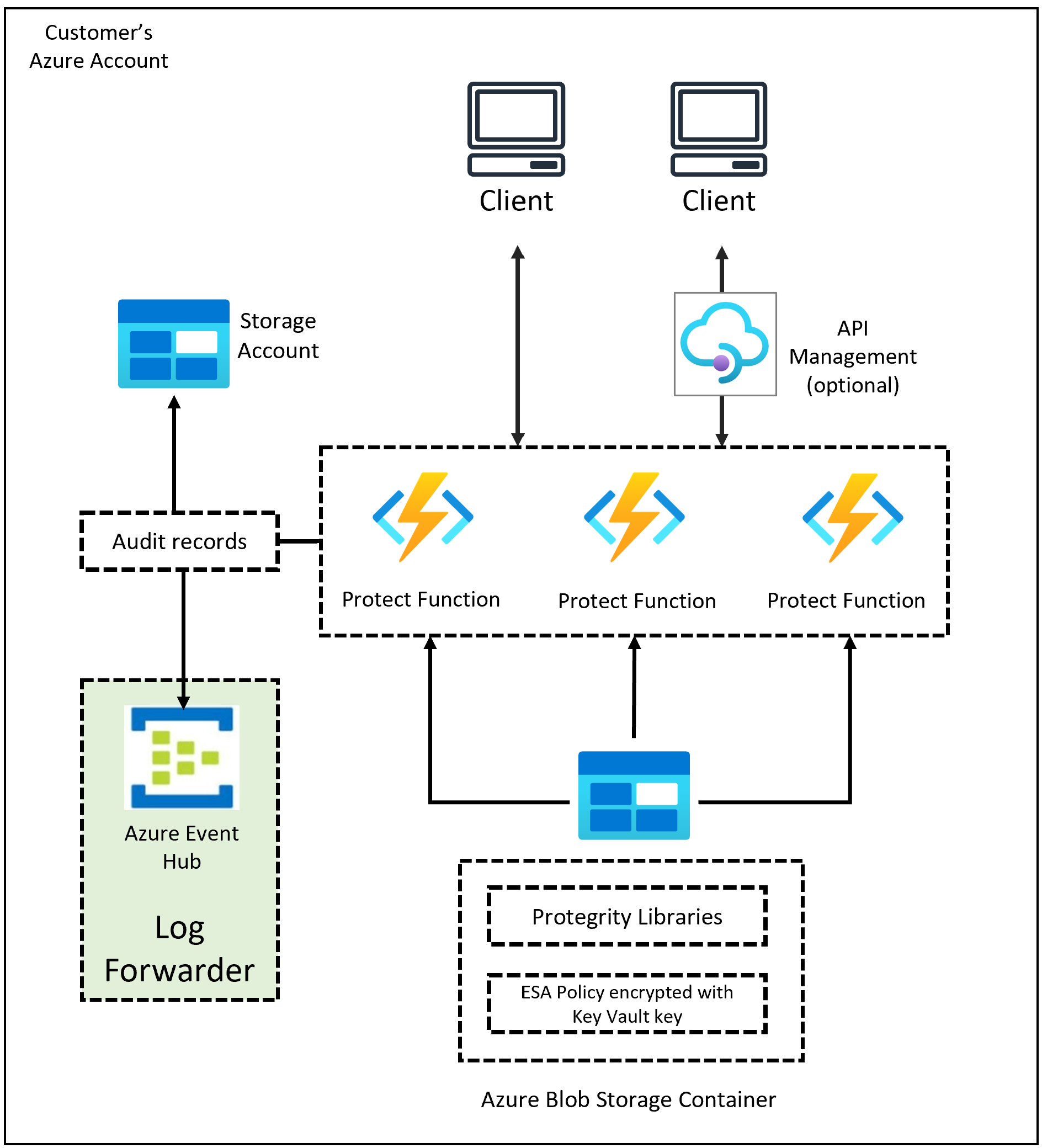
The following diagram shows a reference architecture for synchronizing the security policy from ESA.
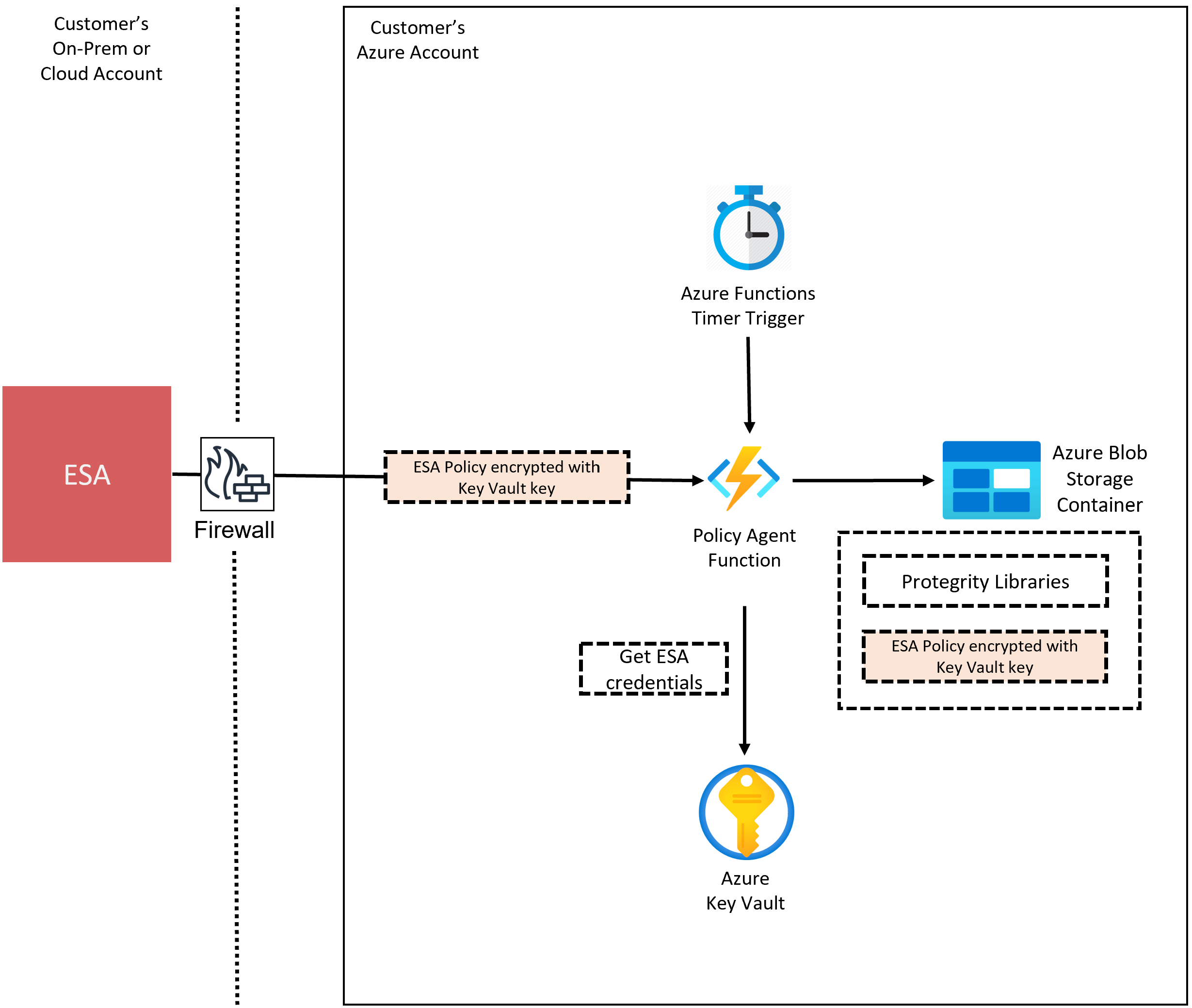
The ESA is a soft appliance that must be pre-installed on a separate server. It is used to create and manage security policies.
For more information about installing the ESA, and creating and managing policies, refer to the Policy Management Section
Audit logs are by default sent to Azure Blob Storage and Application Insights. The Cloud Protect product can also be configured to send audit logs to ESA. Such configuration requires deploying audit Log Forwarder component which is available as part of Cloud Protect deployment bundle. The diagram below shows additional resources deployed with Log Forwarder component.
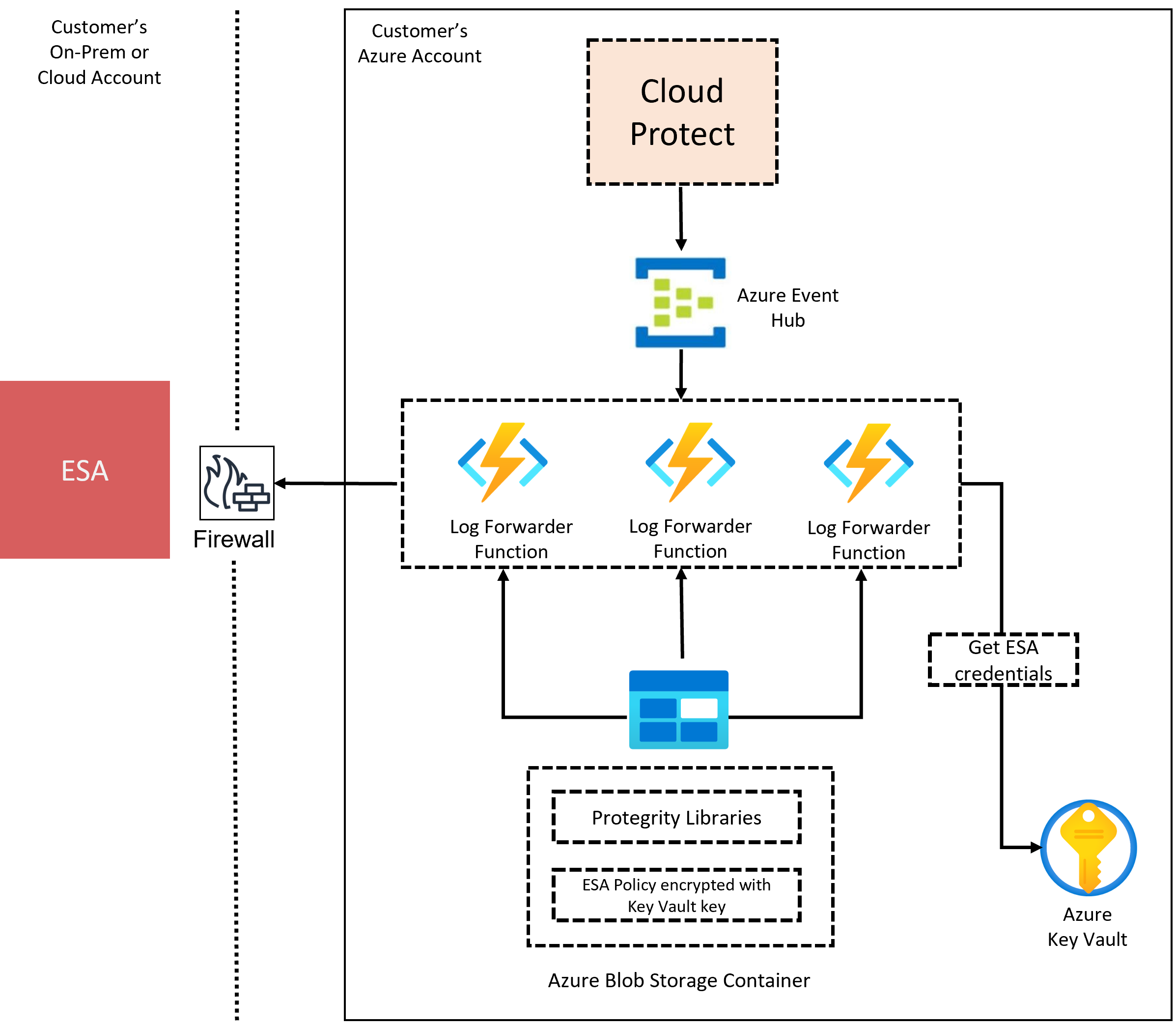
The audit log forwarding solution includes Azure Event Hubs data-streaming service and an Azure Function App deployment called Log Forwarder. Protect function delivers audit logs to Azure Event Hub instance, Event Hub instance batches audit logs and delivers them to Log Forwarder function. Log Forwarder function then delivers audit logs to ESA. Audit log aggregation occurs on both Protect and Log Forwarder functions. Aggregation rules are described in the Understanding the log aggregation section. If Log Forwarder cannot deliver audit logs to ESA due to temporary ESA connection loss, it will send undelivered audit logs to a dead-letter queue Event Hub. Audit logs in dead-letter queue Event Hub can be re-delivered to ESA using another instance of Log Forwarder, which can be configured to run either manually or on schedule.
The security of audit logs is ensured by using HTTPS connection on each link of the communication between protector function and ESA. Integrity and authenticity of audit logs is additionally checked on Log Forwarder function which verifies individual logs signature. The signature verification is done upon arrival from Azure Event Hub before applying aggregation. If signature cannot be verified, the log is forwarded as is to ESA where additional signature verification can be configured. Log Forwarder function uses client certificate to authenticate calls to ESA.
To learn more about individual audit log entry structure and purpose of audit logs, refer to Audit Logging section. Installation instruction can be found in the Audit Log Forwarder Installation.
Forwarding of audit logs requires network access from the cloud to the ESA.
The Cloud API utilizes access controls provided by the Azure Function service. The following mechanisms are available for controlling and restricting access to the Cloud API data protection endpoint:
For more information on Azure Function security concepts, refer to Azure documentation:
The Rest API supports built-in authentication and authorization provided by Azure Function app. More information is available in the following Azure documentation:
App Service Authentication/Authorization Overview
Once the request is authenticated and authorized by the Azure Function App, the Protegrity Cloud API performs the requested security operation based on the policy data element from the payload and the authenticated user.
The following table describes the Azure services that may be part of your Protegrity installation.
All permissions in the table must be granted with the Resource group scope.
Service | Description |
|---|---|
Microsoft Entra ID Application | Allows authentication with Azure Function app |
Azure Managed Identity | Allows functions assume user-defined managed identity |
Function App | Provides serverless compute for Protegrity protection operations and ESA integration to fetch policy updates or deliver audit logs. |
API Management Service | Provides the end-point and access control |
Azure Key Vault | Provides cryptographic keys for envelope encryption/decryption of the policy. Stores secrets required during deployment, e.g., ESA credentials |
Blob storage | Intermediate storage location for the encrypted ESA policy package |
Application Insights | Application and audit logs, performance monitoring, and alerts |
Azure Event Hubs | Required if audit logs are to be sent to ESA. Set up and configuration of a new Event Hub is covered in section Audit Log Forwarder Installation. |
The Protector and Log Forwarder functions require a security policy from a compatible ESA version.
The table below shows compatibility between different Protector and ESA versions.
| Protector Version | ESA Version | |||
|---|---|---|---|---|
| 8.x | 9.0 | 9.1 & 9.2 | 10.0 | |
| 2.x | No | Yes | * | No |
| 3.0.x & 3.1.x | No | No | Yes | No |
| 3.2.x | No | No | Yes | * |
| 4.0.x | No | No | No | Yes |
Legend | |
|---|---|
Yes | Protector was designed to work with this ESA version |
No | Protector will not work with this ESA version |
* | Backward compatible policy download supported:
|
Requirement | Detail |
|---|---|
Protegrity distribution and installation scripts | These artifacts are provided by Protegrity |
Protegrity ESA 10.0+ | The Cloud VNet must be able to obtain network access to the ESA |
Azure Account (Azure Global or US Government Subscription) | Recommend creating a new resource group for Protegrity. |
Role / Skillset | Description |
|---|---|
Azure Account Administrator | Ability to run Azure Resource Manager (or perform steps manually), create/configure Entra ID Application Registrations |
Protegrity Administrator | The ESA credentials required to extract the policy for the Policy Agent |
Snowflake Administrator | Account Admin access required to setup Snowflake integration |
Network Administrator | Needed to open firewall to access ESA and evaluate Azure network setup |
During the installation you will need to record output of certain steps that will be used in downstream installation procedures. We recommend copying the following cheat sheet into a notepad and fill in the information as you progress with the installation.
Azure Subscription ID (AzureSubscriptionID): ____________________
Azure Resource Group ID (ApiResourceGroup): ___________________
Azure Region (ApiRegion): ___________________
Key Vault Name (PolicyKeyValue): ___________________
Storage Account Name (StorageAccountName): ___________________
Storage Account Blob Service Url (StorageAccountBlobServiceUrl): ___________________
Protect Function Blob URL (ProtectFuncURL): ___________________
Forward Function Blob URL (ForwardFuncURL): ___________________
Agent Function Blob URL (AgentFuncURL): ___________________
Protect Function Policy Blob URL (ProtectFuncPolicyBlobUrl): ____________________
Agent Policy Blob Container Name (AgentPolicyBlobContainer): ___________________
Entra ID Application Name (EntraIDApplicationName): ___________________
Entra ID Application ID (EntraIDApplicationID): ___________________
Protect Function User-Assigned Identity (ProtectFuncUserAssignedIdentity): ___________________
Protect Function Name (ProtectFuncName): __________________
Protect Function System-Assigned Identity (ProtectFuncSystemAssignedIdentity): __________________
Protect Function App Key (FuncAppKey): ___________________
Sample Policy Blob Url (SamplePolicyBlobUrl): ___________________
ESA Credentials function URL (EsaCredentialsFnUrl): ___________________
ESA Credentials function key (EsaCredentialsFnKey): ___________________
ESA Credentials function key secret name (EsaCredentialsFnKeySecretName): ___________________
ESA Credentials function Application ID URI (EsaCredentialsFnAppIdUri): ___________________
Forward Function User-Assigned Identity (ForwardFuncUserAssignedIdentity): ___________________
Forward Function Name (ForwardFuncName): __________________
Azure Tenant ID (AzureTenantID): ____________________
ESA IP Address (EsaIpAddress): ___________________
ESA CA Server Certificate (EsaCaCert): ___________________
ESA Username Secret Name (UserSecretName): ___________________
ESA Password Secret Name (PasswordSecretName): ___________________
ESA Client Certificate (EsaClientCert): ___________________
ESA Client Certificate Key Secret Name (EsaClientCertKeySecretName): ___________________
Policy Encryption Key ID (PolicyEncryptionKey): _________________
Agent Function User-Assigned Identity (AgentFuncUserAssignedIdentity): __________________
Agent Function Name (AgentFuncName): __________________
Event Hub Name (EventHubName): __________________
Event Hub Namespace (EventHubNamespace): __________________
Identify or create a new Azure Resource Group where the Protegrity solution will be installed. It is recommended that a new Resource group is created. This can provide greater security controls and help avoid conflicts with other applications that might impact regional account limits. An individual with the Cloud Administrator role will be required for some of the subsequent installation steps.
Azure Subscription ID (AzureSubscriptionID): ____________________
Azure Resource Group ID (ApiResourceGroupID): ___________________
Azure Region (ApiRegion): ___________________
Key Vault is required to store secrets and encrypt policy deployment package. Identify existing Key Vault or create new.
To create Key Vault:
From the Azure Console select Create a resource.
Navigate to Key Vault > Create.
Select a Resource group.
Enter a Key vault name.
Select a Region. For the best performance, use the same region for all resources.
Set the Pricing tier to Standard.
Under Access configuration, select Azure role-based access control as the Permission model.
Under Networking, ensure that Enable public access is selected.
Under Review + create, click Create.
Assign the Key Vault Crypto User role to the Policy Agent and Protector identities:
Record Key Vault Name:
Key Vault Name (PolicyKeyValue): ___________________
Create a storage account to host Protegrity deployment packages provided in installation artifact bundle. Note that turning on the firewall or restricting access to selected virtual networks or IP address ranges will require additional configuration and is beyond the scope of this document.
To create Function App storage:
From the Azure Console select Create a resource.
Navigate to Storage account > Create.
Select the Resource group where the Protegrity solution will be deployed.
Enter a Storage account name.
Select the Region where the Protegrity solution will be deployed.
Set the Preferred storage type to Azure Blob Storage or Azure Data Lake Storage
Set the Primary workload to Cloud native
Setting for Performance should be set to Standard.
Setting for Redundancy should be set to Geo-redundant storage (GRS).
Continue to Advanced setup and verify Enable hierarchical namespace is unchecked
Policy is not availableAdjust the Networking and Data protection configurations according to your security requirements or use the default values.
Under Review + create, click Create.
Record the storage account name
Storage Account Name (StorageAccountName): ____________________
Record the storage blob service URL. Navigate to created Storage Account, select Settings, Endpoints, record the value of Blob Service
Storage Account Blob Service Url (StorageAccountBlobServiceUrl): ____________________
Create a deployment container using the Azure Blob Service.
Go Storage Account created in the previous step.
Under Data storage section, select Containers and click + Container .
Type in container name and click Create .
Upload the following installation artifacts to the container:
Record Protect function blob URL:
Protect Function Blob URL (ProtectFuncURL): ____________________
Record Forward function blob URL. Both Protect and Forward functions use the same protegrity-protect-azure-<version>.zip distribution:
Forward Function Blob URL (ForwardFuncURL): ____________________
Record Agent function blob URL:
Agent Function Blob URL (AgentFuncURL): ____________________
Create a blob container for encrypted Protegrity security policy using Azure Blob Service. Agent will store encrypted policy in this container. Both Protect and Log Forwarder functions will load policy from this container.
Go Storage Account created in the previous step.
Under Data storage section, select Containers and click + Container .
Type in container name and click Create .
Right-click the container name, and select Container properties to obtain URL.
Append the name of the policy file to the container URL, e.g, https://<your-storage-account>.blob.core.windows.net/<your-policy-container>/<your-policy-file-name>.zip. Record the blob url.
Protect Function Policy Blob URL (ProtectFuncPolicyBlobUrl): ____________________
The Agent function uploads an encrypted policy zip package to a blob container which is used as a staging storage. Create the policy staging container
To prepare the policy blob container:
Under Storage account created in previous step, select Data storage > Containers and click + Container .
Type in a container name and click Create .
Agent Policy Blob Container Name (AgentPolicyBlobContainer): ___________________
Ensure that all the steps in Pre-Configuration are performed.
Login to the Azure account console where Protegrity will be installed.
Ensure the Azure Resource Manager templates provided by Protegrity are available on your local computer.
A Microsoft Entra ID App provides the mechanism for Client to authenticate with the Function App instance. Creating an Entra ID app requires appropriate permissions to the Azure Subscription and is typically performed by the Azure Account Administrator.
To register an Entra ID App:
In the Azure portal navigate to Microsoft Entra ID.
Click + Add and select App registration.
Enter a Name and select Accounts in any organizational directory.
Leave the Redirect URI empty and select Register.
After registration is complete record the application name and application id displayed in the overview window.
Entra ID Application Name (EntraIDApplicationName): ___________________
Entra ID Application ID (EntraIDApplicationID): ___________________
User-assigned Azure managed identities are optional. If a user-assigned identity is not provided, a system-assigned managed identity will be enabled the function. User-assigned managed identities offer less frequent updates to Azure resources and allow for configuration of permissions ahead of function creation.
In the search box, enter Managed Identities. Under Services, select Managed Identities
Select Create
For Subscription provide recorded value of AzureSubscriptionID
For Resource Group provide recorded value of ApiResourceGroup
For Region provide recorded value of ApiRegion
For Name provide a name of the new identity
Assign following roles to this identity:
Record Protect function user-assigned identity
Protect Function User-Assigned Identity (ProtectFuncUserAssignedIdentity): ____________________
Resources created with the ARM template include API Management service, Function App, App Service Plan and Application Insights service.
To install protect function via Azure Resource Manager:
From Azure Console, select Create a resource, search for template then select Template deployment (deploy using custom templates) > Create.
Select Build your own template in the editor.
Click Load File and upload pty_protect_arm_v2.json, then click Save.
Select a Resource group.
Enter a Name for the resources. All resources will be prefixed with Protegrity-Protect except for log container which will be prefixed with ptylogs. For more information on naming rules see: Azure resource name rules.
For Location input specify Azure region name or leave default to deploy in the same region as resource group.
For Storage Account Blob Service Url Optionally use the value recorded in Create Storage Account. If value is not given, it will be automatically derived from Protect Function Blob Url.
For Protect Function Blob Url use the value from Upload Files.
For Function App Managed Identity Optionally use the value from Protect Function User-Assigned Managed Identity. If value is not given, a system-assigned managed identity will be enabled.
For Function Sku either EP1 or EP3 are recommended. Note that this will affect the running cost.
For Create Api Management Service select Do not create. API Management Service is required only for integration with Snowflake. This service is not required otherwise.
For Api Management Service Sku Applicable only when API Management Service is created. Skip this if API Management Service is not created. Either Consumption (if available) or Premium are recommended. Note that this will affect the running cost.
For Username Regex you can optionally specify regex to extract policy username from the request. See Configuring Regular Expression to Extract Policy Username for more details.
For Entra ID Application ID enter the value recorded in Register an Entra ID App.
For Forward Logs To ESA select whether audit logs are to be sent to ESA or not. If you are not planning on sending audit logs to ESA you can skip Event Hub Nameand Event Hub Namespace properties below. For details on creating and configuring Event Hubs see Audit Log Forwarder Installation
For Event Hub Name provide the name of Event Hub which will be used to send audit logs to ESA.
For Event Hub Namespace provide the name of Event Hub Namespace which is hosting Event Hub selected in previous step.
Under Review + create, click Create. Wait for all resources to deploy. If the deployment fails for any resources of type Microsoft.Web/sites/host/functionKeys then click Redeploy and try deploying again.
After deployment is complete, go to Outputs and record protectFunctionName, azureTenantId and apiGatewayUrl.
Protect Function Name (ProtectFuncName): __________________
Azure Tenant ID (AzureTenantID): __________________
API Gateway URL (ApiGatewayURL): __________________
System-assigned Azure managed identity is enabled if user-assigned managed identity is not used. User-assigned managed identities offer less frequent updates to Azure resources and allow for configuration of permissions ahead of function creation.
If you have not created a user-assigned managed identity at Protect Function User-Assigned Managed Identity, setup following role assignments for system-assigned managed identity:
Navigate to the function
Select Settings, Identity.
Confirm Status of system-assigned identity is already On on System Assigned tab
Click on Azure role assignments button.
Assign following roles to this identity:
From Azure console, navigate to Function App and select protect function deployed in previous section.
Select Overview and click Restart button. Wait until function restart completes.
The Key vault must be updated to allow the Function App to decrypt the policy files. Azure assigns a unique identifier to each Function App instance that can be used to grant permissions to that instance. Assign the appropriate Key Vault roles to the Protect function identity:
Obtain Function App identifier
Navigate to the Function App service in the Azure portal.
Select the newly created Protect Function App instance.
Select the Identity option under Settings.
Ensure that setting System assigned is set to Status On.
Record the Object ID:
Protect Function Object ID: ___________________
Assign Key Vault roles to the Protect function
The Protegrity installation bundle contains a sample policy which can be used to test the protect service installation without an ESA. Upload the sample policy artifact to the policy Blob storage container:
Go to Azure console and select Storage Account Name (StorageAccountName) recorded in step Create Storage Account.
Under Data storage select Blob Containers and select container created in Protect Function Policy Blob Container
Click Upload and select protegrity-sample-policy-<version>.zip file from your local computer.
Click Upload and wait for the file to complete uploading.
Record the sample policy blob url:
Sample Policy Blob Url (SamplePolicyBlobUrl): ___________________
Before continuing with next steps, you may verify the protect service is installed correctly. This step is optional and can be skipped.
From Azure console, navigate to Function App and select protect function app.
Select Overview and record URL value as <Protect Function URL>.
Navigate to Settings > Environment variables and click OPENID_ENABLED.
Change value to false and click Apply.
Select or create variable AZURE_POLICY_BLOB_URL.
Set value of AZURE_POLICY_BLOB_URL to value recorded for SamplePolicyBlobUrl and click Apply.
Select Apply and Confirm to finalize setting changes.
Go to Functions > App keys and record the value of default key under Host Keys (All functions) as <Protect Function app key>.
Run the following CURL command to test Function deployment.
curl -X POST "<Protect Function URL>/api/v1/unprotect" -k \
-H 'x-functions-key: <Protect Function app key>' \
-H 'Content-Type: application/json' \
-d '{
"data": ["UtfVk UHgcD!"],
"user": "MARIA",
"data_element": "alpha"
}'
Replace <Protect Function URL> and <Protect Function app key> with the values recorded in step 2 And 5.
Run curl command. Verify the following output.
{"data":["hello world!"], "success": true, "encoding": "utf8"}
Go back to Function app. Select Settings > Environment variables and click OPENID_ENABLED,
Change value to true and click Apply. Select Apply and Confirm to finalize.
To review live requests, navigate to Application Insights service and select item with the same name as the protect function. Under Investigate, select Live Metrics. Wait for the dashboard to load, then go to Sample Telemetry pane on the right and look for the requests in question.
To review the full history of requests from Application Insights under Monitoring select Logs:
You can also run the query directly in the query editor. For instance to select the 10 latest exceptions run the following query.
exceptions
| where timestamp > ago(24h)
| order by timestamp
| limit 10
Protect Function app can be customized using environment variables. From Azure console, navigate to Function App service and select protect function app. Navigate to Settings > Environment variables. Add or Edit environment variables based on the following information.
| Parameter | Description | Notes |
|---|---|---|
| OPENID_ENABLED | When set to true, every request is required to have an Authorization header with the bearer token set to a valid OAuth access token. | The following configuration attributes will also be required: OPENID_AUDIENCES, OPENID_ISSUERS, OPENID_METADATA_URL. |
| OPENID_AUDIENCES | The JWT token must have the “aud” claim and it must match one of the values in this attribute. Can be either one value or comma separated list. | applicable when OPENID_ENABLED= “true”. |
| OPENID_ISSUERS | The JWT token must have the “iss” claim and it must match one of the values in this attribute. Can be either one value or comma separated list. | applicable when OPENID_ENABLED= “true”. |
| OPENID_METADATA_URL | A URL that points to an OpenID Connect identity provider configuration document, which is also known as OpenID well-known configuration endpoint. | applicable when OPENID_ENABLED= “true”. |
| authorization | When equals “jwt”, Authorization Header JWT will be required in the Rest API Protect payload. | |
| Supported Values: [“jwt”, “”] | When equals to “jwt”, any request without Valid JWT in the Authorization header, will result in an error from API Gateway: 502 Bad Gateway. | |
| allow_assume_user | If set to 0, The user from the payload will not be used, and the policy user is the JWT user. | |
| Supported Values: [0, 1] | applicable when authorization = “jwt”. | |
| Default Value: 0 | ||
| jwt_user_claim | The JWT payload claim with username. Common claims: name, preferred_username, cognito:username | Applicable when authorization = “jwt” |
| Default Value: cognito:username | ||
| service_user | If service_user is set the protect request will use it for the policy user. | service_user should be used when the Cloud API should always run as one service_user no matter what user is in the request. service_user will always take priority over any other user in the payload or in the JWT header. |
| AZURE_POLICY_BLOB_URL | This points to Protegrity security policy blob. It is updated by the Agent to point to latest security policy. | |
| USERNAME_REGEX | If USERNAME_REGEX is set, the effective policy user will be extracted from the user in the request. | NoteSee Configuring Regular Expression to Extract Policy Username to learn how to extract username from the request |
| EVENTHUB_NAME | Event Hub name where audit logs are to be sent to. Logs are not forwarded to ESA when this parameter is empty. | NoteSet up and configuration of a new Event Hub is covered in section Audit Log Forwarder Installation |
| EventHub__fullyQualifiedNamespace | Event Hub fully qualified namespace. Logs are not forwarded to ESA when this parameter is empty. | NoteSet up and configuration of a new Event Hub is covered in section Audit Log Forwarder Installation |
| PTY_CORE_FLUSHINTERVAL | Time interval in seconds used to accumulate audit logs before sending to Event Hub. Default value: 10. | Audit logs are always aggregated into one minute buckets. A value greater than 60 will influence only audit log batching while sending logs to Event Hub. A value less than 60 will influence both aggregation and audit log batching. |
| PTY_LOG_LEVEL | Function min log level. Default: Severe | One of case-insensitive strings: off, severe, warning, info, config, all. |
| PTY_WRITE_LOG_ON_SINGLE_LINE | Whether to write log level and message on one line or separate lines. Default: true | Starting from version 3.1.0, log level and message are printed on single line. Use this environment variable to switch to multi-line logging for backward compatibility with pre-3.1.0 release. |
| EVENT_LEVEL | Level of logs produced by Azure services. Default: Error | One of case-insensitive strings: LogAlways, Critical, Error, Warning, Informational, Verbose. Set to at least ‘Informational’ during initial configuration, set to at most ‘Error’ in production environments. |
| Parameter | Notes |
|---|---|
| AZURE_CLIENT_ID | Sets the Managed Identity Client ID for Function App runtime. System-Assigned Identity is used when variable is not set. |
| APPLICATIONINSIGHTS_AUTHENTICATION_STRING | Define identity for Application Insights access. Managed Identity Client ID is provided to this setting with Function App Managed Identity ARM template parameter. See the corresponding Azure AD Authentication documentation: Azure AD authentication |
| APPLICATIONINSIGHTS_CONNECTION_STRING | Connection String for Application Insights instance. See the corresponding Azure Connection String documentation: Connection strings |
| FUNCTIONS_EXTENSION_VERSION | Azure Functions extension version |
| FUNCTIONS_WORKER_RUNTIME | Runtime of the function |
| WEBSITE_RUN_FROM_PACKAGE | URL to the zip file in blob storage with function runtime source |
| WEBSITE_RUN_FROM_PACKAGE_BLOB_MI_RESOURCE_ID | Managed Identity used to load function runtime source |
| AzureWebJobsStorage__blobServiceUri | URL of the storage account which hosts the blob identified in WEBSITE_RUN_FROM_PACKAGE |
| AZURE_TENANT_ID | Tenant identifier in Azure Active Directory |
| AzureWebJobs.AuditLogForwarder.Disabled | Defines whether audit log forwarder function is disabled or not |
| AzureWebJobs.Protect.Disabled | Defines whether Protect function is disabled or not |
| AzureWebJobs.v1-openapi.Disabled | Defines whether v1-openapi function is disabled or not |
| AzureWebJobs.v1-protect.Disabled | Defines whether v1-protect function is disabled or not |
| AzureWebJobs.v1-unprotect.Disabled | Defines whether v1-unprotect function is disabled or not |
Policy Agent Function installation is done via Azure Resource Manager template provided by Protegrity. Before running the template, some resources must be created manually.
Policy Agent function requires ESA server running and accessible from Agent Function App on TCP port 8443. Make sure inbound connections on TCP:8443 are allowed for the network where ESA is hosted. You can find the list of Agent Function Outbound IP addresses after you deploy the function in Agent Function Outbound IP address
Note down ESA IP to be accessed form Agent Function:
ESA IP Address (EsaIpAddress): ___________________
By default, ESA is configured with self-signed certificates, which can only be validated using self-signed CA certificate supplied in policy agent Cloud Function Environment variables configuration.
In case ESA is configured with publicly signed certificates, this section can be skipped since the agent function will use public CA to validate ESA certificates.
To obtain self-signed CA certificate from ESA:
Log in to ESA Web UI.
Select Settings > Network > Manage Certificates.
Hover over Server Certificate and click on download icon to download the CA certificate.
After certificate is downloaded, open the PEM file in text editor and replace all new lines with escaped new line: \n.
To escape new lines from command line, use one of the following commands depending on your operating system:
Linux Bash:
awk 'NF {printf "%s\\n",$0;}' ProtegrityCA.pem > output.txt
Windows PowerShell:
(Get-Content '.\ProtegrityCA.pem') -join '\n' | Set-Content 'output.txt'
Record the certificate content with new lines escaped.
ESA CA Server Certificate (EsaCaCert): ___________________
This value will be used to set PTY_ESA_CA_SERVER_CERT variable in the Policy Agent Function Configuration section Configure Function
For more information about ESA certificate management refer to Certificate Management Guide in ESA documentation.
Create a policy encryption key.
To create policy encryption key:
From Azure console, navigate to Key Vaults and select Key Vault created in Key Vault.
Under Objects, select Keys.
Click Generate/Import.
Specify the following:
a. Key name for the Name field.
b. RSA for Key type.
c. 2048 for RSA key size.
d. Set Enabled toggle to Yes.
Select Create.
Click on the key name after creation is complete, then click on the key identifier row under CURRENT VERSION.
Copy the full URL value of Key Identifier. Record it for later use:
Policy Encryption Key ID (PolicyEncryptionKey): _________________
User-assigned Azure managed identities are optional. If a user-assigned identity is not provided, a system-assigned managed identity will be enabled the function. User-assigned managed identities offer less frequent updates to Azure resources and allow for configuration of permissions ahead of function creation.
In the search box, enter Managed Identities. Under Services, select Managed Identities
Select Create
For Subscription provide recorded value of AzureSubscriptionID
For Resource Group provide recorded value of ApiResourceGroup
For Region provide recorded value of ApiRegion
For Name provide a name of the new identity
Assign following roles to this identity:
Record Agent function user-assigned identity
Agent Function User-Assigned Identity (AgentFuncUserAssignedIdentity): ____________________
Resources created with ARM template include Function App, Premium V3 App Service Plan (optional) and Application Insights service. Run Azure Resource Manager deployment.
To install Agent via ARM template:
From Azure Console, select Create a resource, search for template and then select Template deployment > Create.
Select Build your own template in editor.
Select Load File and upload pty_agent_arm_v2.json. Click Save.
Select Resource Group.
Specify Name for the resources (All resources will be prefixed with Protegrity-Agent).
For Location input specify Azure region name or leave default to deploy in the same region as resource group
For Agent Function Blob Url use the value from Upload Files
For Function App Managed Identity Optionally use the value from Agent Function User-Assigned Managed Identity. If value is not given, a system-assigned managed identity will be enabled.
If you set Use Existing App Service Plan to True, you must specify existing Linux App Service Plan name in the next parameter.
For Storage Account Blob Service Url Optionally use the value recorded in Create Storage Account. If value is not given, it will be automatically derived from Agent Function Blob Url.
Select Review + create then Create. Wait for all resources to deploy
After deployment is complete, go to Outputs and record agentFunctionName:
Agent Function Name: __________________
System-assigned Azure managed identity is enabled if user-assigned managed identity is not used. User-assigned managed identities offer less frequent updates to Azure resources and allow for configuration of permissions ahead of function creation.
If you have not created a user-assigned managed identity at Agent Function User-Assigned Managed Identity, setup following role assignments for system-assigned managed identity:
Navigate to the function
Select Settings, Identity.
Confirm Status of system-assigned identity is already On on System Assigned tab
Click on Azure role assignments button.
Assign following roles to this identity:
Policy Agent Function requires ESA credentials to be provided as one of the two options:
Policy Agent Function uses Key Vault as secure store for sensitive information like ESA username and password.
Create ESA credentials secrets:
Navigate to Key Vault.
Under Objects, select Secrets > Generate/import.
Select Manual, then type in valid json as shown in the example for Secret value.
{"username": "<policy_export_user>", "password": "<password>"}
Select Create.
Navigate to the secret details in Key Vault by selecting the newly created secret.
Inspect the current secret version properties by selecting the current version.
Copy the Secret Identifier value. For example https://<myvault>.vault.azure.net/secrets/<mysecret>/abcdefgxyz8edef595adaehij0d99123.
Record the Secret Identifier for later use.
Policy Agent Function requests ESA username and password from a custom Azure Function App, further referred to as ESA Credentials function. This method may be used to get the username and password from external vaults.
There are four options for configuring Policy Agent authorization with ESA Credentials function: Option 1, Option 2, Option 3 and Option 4. Only one option is expected to be configured at a time.
Create Azure HTTP triggered ESA Credentials function using any supported runtime.
a. There is no input needed.
b. The function must accept an HTTP POST request.
c. The function must return the following response schema
```
response:
type: json object
properties:
username: string
password: string
```
For example,
```
{"username": "admin", "password": "Password1234"}
```
Configure Policy Agent to use ESA Credentials function app.
a. Navigate to HTTP triggered function to open ‘Code + Test’ page.
b. Under ‘Code + Test’ tab on ‘Code + Test’ page select ‘Resource JSON’.
c. In ‘Resource JSON’ blade record the value of ‘invoke_url_template’ property.
**'invoke_url_template'** property is located towards the bottom of resource json.
URL must be in the form of 'https://[function-app-name].azurewebsites.[net|us]/api/[http-trigger-name]'.
**ESA Credentials function URL (EsaCredentialsFnUrl):__________**
d. Navigate to Policy Agent function app.
e. Expand Settings menu item.
f. Select Environment Variables menu item.
g. Click Add button.
h. For Name use PTY_ESA_CREDENTIALS_FUNCTION.
i. For Value use ESA Credentials function URL (EsaCredentialsFnUrl) recorded in previous steps.
j. Hit Apply in Add/Edit application setting blade.
k. Hit Apply in App Settings tab.
Configure Authorization Option 1: Function Key Option 2: Key Vault Option 3: System-assigned Identity Option 4: User-assigned Identity
Configure HTTP trigger of ESA Credentials function with authentication level FUNCTION.
Navigate to ESA Credentials function app.
Expand Functions menu item.
Select App Keys.
Record default key value.
ESA Credentials function key (EsaCredentialsFnKey):_______________
Navigate to Policy Agent function app.
Expand Settings menu item.
Select Environment Variables menu item.
Click Add button.
For Name use PTY_ESA_CREDENTIALS_FUNCTION_KEY.
For Value use ESA Credentials function key (EsaCredentialsFnKey) recorded in previous steps.
Hit Apply in Add/Edit application setting blade.
Hit Apply in App Settings tab.
Configure HTTP trigger of ESA Credentials function with authentication level FUNCTION.
Navigate to ESA Credentials function app.
Expand Functions menu item.
Select App Keys.
Record default key value.
ESA Credentials function key (EsaCredentialsFnKey):_______________
Navigate to Key Vault.
Under Objects, select Secrets > Generate/import.
Select Manual, type in secret name and use ESA Credentials function key value recorded in previous steps (EsaCredentialsFnKey) for Secret value.
Select Create.
Record Key Vault secret name.
ESA Credentials function key secret name (EsaCredentialsFnKeySecretName):_______________
Navigate to Policy Agent function app.
Expand Settings menu item.
Select Environment Variables menu item.
Click Add button.
For Name use PTY_ESA_CREDENTIALS_FUNCTION_KEY_SECRET.
For Value use ESA Credentials function key secret name (EsaCredentialsFnKeySecretName) recorded in previous steps.
Hit Apply in Add/Edit application setting blade.
Hit Apply in App Settings tab.
Navigate to Policy Agent function app
Expand Settings menu item
Select Identity
Select System assigned tab
Status should already be On
Other Status indicates Policy Agent was installed without system-assigned identity. Before proceeding any further you need to either install Policy Agent with system-assigned identity or follow Option 4 which describes configuration steps for Policy Agent installed with user-assigned managed identity.
Copy Object (principal) ID
Navigate to ESA Credentials function app
Expand Settings menu item
Select Authentication
Select Add identity provider
Select Microsoft in identity provider dropdown
For App registration type provide details of your choice
For Issuer URL accept the default value
For Client application requirement select Allow requests from any application
Access will be limited to only the Policy Agent identity in the next step
For Identity requirement select Allow requests from specific identities
For Allowed identities add Object (principal) ID copied in previous step
For Restrict access select Require authentication
For Unauthenticated requests select HTTP 401 Unauthorized: recommended for APIs
Check Token store
Select Add
Click OK to apply constraint
Click Save
Navigate to Application of Microsoft identity provider
A link to identity providers application is available under Authentication menu item of ESA Credentials function
Expand Manage menu item
Select Expose an API
Copy Application ID URI or select Add if it does not exist and Save to accept the default value
Record Application ID URI of identity provider
ESA Credentials function Application ID URI (EsaCredentialsFnAppIdUri):_______________
Navigate to Policy Agent function app.
Expand Settings menu item.
Select Environment Variables menu item.
Click Add button.
For Name use PTY_ESA_CREDENTIALS_FUNCTION_SCOPE.
For Value use ESA Credentials function Application ID URI (EsaCredentialsFnAppIdUri) recorded in previous steps appended with /.default
Hit Apply in Add/Edit application setting blade.
Hit Apply in App Settings tab.
Navigate to Policy Agent function app
Expand Settings menu item
Select Identity
Select User assigned tab
User-assigned identity should already be provided. Missing user-assigned identity indicates Policy Agent was installed without user-assigned identity. Before proceeding any further you need to either install Policy Agent with user-assigned identity or follow Option 3 which describes configuration steps for Policy Agent installed with system-assigned managed identity.
Copy Client ID
Copy Object (principal) ID
Navigate to ESA Credentials function app
Expand Settings menu item
Select Authentication
Select Add identity provider
Select Microsoft in identity provider dropdown
For App registration type provide details of your choice
For Issuer URL accept the default value
For Client application requirement select Allow requests from specific client applications
For Allowed client applications add Client ID copied in previous step
Click OK to apply constraint
For Identity requirement select Allow requests from specific identities
For Allowed identities add Object (principal) ID copied in previous step
Click OK to apply constraint
Click Save
Navigate to Application of Microsoft identity provider
A link to identity providers application is available under Authentication menu item of ESA Credentials function
Expand Manage menu item
Select Expose an API
Copy Application ID URI or select Add if it does not exist and Save to accept the default value
Record Application ID URI of identity provider
ESA Credentials function Application ID URI (EsaCredentialsFnAppIdUri):_______________
Navigate to Policy Agent function app.
Expand Settings menu item.
Select Environment Variables menu item.
Click Add button.
For Name use PTY_ESA_CREDENTIALS_FUNCTION_SCOPE.
For Value use ESA Credentials function Application ID URI (EsaCredentialsFnAppIdUri) recorded in previous steps appended with /.default
Hit Apply in Add/Edit application setting blade.
Hit Apply in App Settings tab.
Agent Function requires access to Key Vault created in Key Vault to encrypt policy and to access configuration secrets.
Agent Function App IP addresses may be useful for configuring ESA policy store and allowing traffic between Agent and ESA.
To obtain the list of Outbound IP addresses:
Agent Function must be configured with parameters recorded in steps above.
To configure Function:
Open Function App service from the Azure console. Select the Function App created for policy agent in previous steps.
Navigate to Settings > Environment variables .
On the App Settings pane, click on Show values to reveal all configuration values
To modify multiple parameters, click the pencil icon Advanced edit at the top. Alternatively you may click on the environment variable name to edit single values.
Modify parameters according to the table below. If configuration has a default value you don’t have to change it
Parameter | Notes |
|---|---|
AZURE_KEY_VAULT_NAME | |
AZURE_POLICY_BLOB_URL | URL of the Azure Blob file which is used to store Protegrity security policies for protector consumption. See ProtectFuncPolicyBlobUrl in Protect Function Policy Blob |
AZURE_RETAIN_POLICY_BLOB | The amount of policy backups to retain. Default: 10. Allowed values: -1, >1. Value of -1 will disable cleanup of backup policies. |
PROTEGRITY_PROTECT_FUNCTION | Protegrity function to be updated when new policy is deployed. Provide a comma separated list of protect function app names for updating multiple protectors: |
PTY_ESA_IP | |
AZURE_ESA_CREDENTIALS_SECRET_ID | |
AZURE_ENCRYPTION_KEY_ID | |
PEP_CONFIG_CASE_SENSITIVE | Default: No Allowed values: yes/no Specifies whether policy usernames should be case sensitive |
PTY_ADDIPADDRESSHEADER | When enabled, agent will send its source IP address in the request header. This configuration works in conjunction with ESA hubcontroller configuration ASSIGN_DATASTORE_USING_NODE_IP (default=false). See Associating ESA Data Store With Cloud Protect Agent for more information. Default: yes Allowed values: yes no |
PEP_CONFIG_EMPTY_STRING | Default: empty Allowed values: null empty Determines outcome of empty value operation. For example, (un)protect(’’) -> null (un)protect(’’) -> |
DISABLE_DEPLOY | Default: 0 |
POLICY_PULL_TIMEOUT | Default: 20s |
ESA_CONNECTION_TIMEOUT | Default: 5s |
LOG_LEVEL | Default: INFO. Allowed values: DEBUG, INFO, WARNING, ERROR |
AZURE_SUBSCRIPTION_ID | Default: Same as ARM Resource group |
AZURE_RESOURCE_GROUP_NAME | Default: Same as ARM Resource group |
POLICY_DOWNLOAD_CRON_EXPRESSION | Describes how often Agent Function will run Default: 0 0 * * * * (Every hour) |
PTY_ESA_CA_SERVER_CERT | ESA self-signed CA certificate used by policy Agent function to ensure ESA is the trusted server. Recorded in step Certificates on ESA In case ESA is configured with publicly signed certificates, the PTY_ESA_CA_SERVER_CERT configuration will be ignored. |
PTY_ESA_CREDENTIALS_FUNCTION | Instead of supplying AZURE_ESA_CREDENTIALS_SECRET_ID environment variable, ESA credentials can be provided by a custom Azure Function App. Provide a value recorded for EsaCredentialsFnUrl |
PTY_ESA_CREDENTIALS_FUNCTION_KEY | When ESA credentials are provided by a custom Azure Function App, Policy Agent can request credentials using function app key. Provide a value recorded for EsaCredentialsFnKey |
PTY_ESA_CREDENTIALS_FUNCTION_KEY_SECRET | When ESA credentials are provided by a custom Azure Function App, Policy Agent can request credentials using function app key stored in Azure Key Vault. Provide a value recorded for EsaCredentialsFnKeySecretName |
PTY_ESA_CREDENTIALS_FUNCTION_SCOPE | When ESA credentials are provided by a custom Azure Function App, Policy Agent can request credentials using its own identity. Provide a value here recorded for EsaCredentialsFnAppIdUri appended with /.default to create authentication scope. Review Microsoft identity platform default scope |
PTY_SYNC_DATASTORE | NoteThis configuration is not applicable for ESA versions lower than 10.2. |
PTY_DATASTORE_KEY | NoteThis configuration is not applicable for ESA versions lower than 10.2.The export key is the public part of an asymmetric key pair created in a Create Policy Encryption Key. A user with Security Officer permissions adds the public key to the data store in ESA via Policy Management > Data Stores > Export Keys. The fingerprint can then be copied using the Copy Fingerprint icon next to the key. Refer to Exporting Keys to Datastore for details. NoteFor PPC deployments, see PPC Appendix: Policy Agent Certificate and Key Guidance for details on obtaining and using the datastore key fingerprint. |
Parameter | Notes |
|---|---|
AZURE_CLIENT_ID | Sets the Managed Identity Client ID for Function App runtime. System-Assigned Identity is used when variable is not set. |
APPLICATIONINSIGHTS_AUTHENTICATION_STRING | Define identity for Application Insights access. Managed Identity Client ID is provided to this setting with Function App Managed Identity ARM template parameter. See the corresponding Azure AD Authentication documentation: Azure AD authentication |
APPLICATIONINSIGHTS_CONNECTION_STRING | Connection String for Application Insights instance. See the corresponding Azure Connection String documentation: Connection strings |
FUNCTIONS_EXTENSION_VERSION | Azure Functions extension version |
FUNCTIONS_WORKER_RUNTIME | Runtime of the function |
WEBSITE_RUN_FROM_PACKAGE | URL to the zip file in blob storage with function runtime source |
WEBSITE_RUN_FROM_PACKAGE_BLOB_MI_RESOURCE_ID | Managed Identity used to load function runtime source |
AzureWebJobsStorage__blobServiceUri | URL of the storage account which hosts the blob identified in WEBSITE_RUN_FROM_PACKAGE |
After configuration is complete you can test the function.
To test Agent function installation:
Navigate to Overview.
Select the function agent from the Functions tab.
Click Code + Test > Test/Run and then Run to execute the function.
You should see a 202 Accepted response.
Expand Logs output at the bottom of the page. Click Maximize to enlarge log output.
Below is an example log output from successful agent run.
INFO:AZURE_SUBSCRIPTION_ID: [xxxxxxxx-xxxx-xxxx-xxxx-xxxxxxxxxxxx]
INFO:AZURE_KEY_VAULT_NAME: [vault-name]
INFO:AZURE_ENCRYPTION_KEY_ID: [https://vault-name.vault.azure.net/keys/key-name/xxxxxxxxxxxxxxxxxxxxxxxxxxxxxxxx]
INFO:AZURE_RESOURCE_GROUP_NAME: [resource-group-name]
INFO:AZURE_POLICY_BLOB_URL: [https://resource-group-name.blob.core.windows.net/policy/protegrity-policy-name.zip]
INFO:AZURE_RETAIN_POLICY_BLOB: [3]
INFO:PROTEGRITY_PROTECT_FUNCTION: [Protegrity-Protect-xxxx]
INFO:DISABLE_DEPLOY: [0]
INFO:PTY_ESA_IP: [xxx.xxx.xxx.xxx]
INFO:PTY_SYNC_DATASTORE: []
INFO:POLICY_PULL_TIMEOUT: [40]
INFO:LOG_LEVEL: [info]
INFO:PTY_CORE_EMPTYSTRING: [empty]
INFO:PTY_CORE_CASESENSITIVE: [no]
INFO:PTY_ADDIPADDRESSHEADER: [yes]
INFO:Starting policy agent [4.0.3] ...
INFO:ESA_CONNECTION_TIMEOUT: [60]
INFO:Using ESA CA certificate from PTY_ESA_CA_SERVER_CERT environment variable.
INFO:ResilientPackageClient initialized.
INFO:Retrieving ESA rps version
INFO:Resilient package correlation_id=[xxxxxxxxxxxxxxxxxxxxxxxxx] datastore=[]
INFO:RPS Version: 1.9.2, Build: 1.9.2+1.g4bfba.1.9
INFO:Checking ESA rps export availability
INFO:Resilient package correlation_id=[xxxxxxxxxxxxxxxxxxxxxxxxx] datastore=[QA_DATA_STORE]
INFO:Export available, Last-Modified: [Thu, 01 Jan 2026 00:00:00 GMT]
INFO:Getting current policy metadata [https://resource-group-name.blob.core.windows.net/policy/protegrity-policy-name.zip] ...
INFO:Last modified: [Thu, 01 Jan 2026 00:00:00 GMT], Last deployed: [Thu, 01 Jan 2026 00:00:00 GMT]
WARNING:Current policy deployment has no checksum_mapping metadata:
INFO:No changes in the policy since last download. Skipping policy deployment.
INFO:Checking container for the last deployed policy [https://resource-group-name.blob.core.windows.net/policy]...
INFO:[Protegrity-Protect-xxxx] current policy blob url: [https://resource-group-name.blob.core.windows.net/policy/2026-02-01_18-00-00/protegrity-policy-name.zip]
INFO:Policy blob in sync for function [Protegrity-Protect-xxxx]
INFO:[0] blobs are outside of the retention period [3]
If the log output in this window pauses or is difficult to read, you may navigate back to the Agent Function App overview and select Monitoring > Logs from the menu on the left. Run the query traces in the query editor to view logs.
To review the most recent invocation traces, navigate to the function app instance. Select Monitoring > Logs from the menu on the left. Run the query traces in the query editor to retrieve the full history of executions with detailed traces.
The following sections provide installation steps for the Log Forwarder component in Azure. The Log Forwarder deployment allows for the audit logs generated by Protect Service to be delivered to ESA for auditing and governance purposes. Log Forwarder component is optional and is not required for the Protect Service to work properly. See Audit Log Forwarder Architecture for more information. Some of the installation steps are not required for the operation of the software but recommended for establishing a secure environment. Contact Protegrity for further guidance on configuration alternatives in the cloud.
ESA server is required as the recipient of audit logs. Verify the information below to ensure ESA is accessible and configured properly.
ESA server running and accessible on TCP port 9200 (Audit Store) or 24284 (td-agent).
Audit Store service is configured and running on ESA. Applies when audit logs are output to Audit Store directly or through td-agent. For information related to ESA Audit Store configuration, refer to Audit Store Guide.
(Optional) td-agent is configured for external input. For more information related to td-agent configuration, refer to ESA guide Sending logs to an external security information and event management (SIEM).
By default, ESA is configured with self-signed certificates, which can only be validated using self-signed CA certificate supplied in Log Forwarder configuration.
In case ESA is configured with publicly signed certificates, this section can be skipped since the Log Forwarder will use public CA to validate ESA certificates.
To obtain self-signed CA certificate from ESA:
Download ESA CA certificate from the /etc/ksa/certificates/plug directory of the ESA
After certificate is downloaded, open the PEM file in text editor and replace all new lines with escaped new line: \n.
To escape new lines from command line, use one of the following commands depending on your operating system:
Linux Bash:
awk 'NF {printf "%s\\n",$0;}' CA.pem > output.txt
Windows PowerShell:
(Get-Content '.\CA.pem') -join '\n' | Set-Content 'output.txt'
Record the certificate content with new lines escaped.
ESA CA Server Certificate (EsaCaCert): ___________________
This value will be used to set PTY_ESA_CA_SERVER_CERT Log Forwarder variable in section Install Log Forwarder via ARM template
For more information about ESA certificate management refer to Certificate Management Guide in ESA documentation.
Audit Log Forwarder must authenticate with ESA using certificate-based authentication with client certificate and certificate key. Download the following certificates from the /etc/ksa/certificates/plug directory of the ESA:
Both certificate and certificate key must be converted to single-line values using code similar to the following examples.
Client certificate (client.pem):
$folder = 'C:\Temp'
cd $folder
(Get-Content "$folder\client.pem") -join '\n' | Set-Content "$folder\one-liner-client.pem"
cat "$folder\one-liner-client.pem"
folder="/tmp"
cd "$folder"
awk 'NF {printf "%s\\n",$0}' "client.pem" > "one-liner-client.pem"
cat "one-liner-client.pem"
Client certificate key (client.key):
$folder = 'C:\Temp'
cd $folder
(Get-Content "$folder\client.key") -join '\n' | Set-Content "$folder\one-liner-client.key"
cat "$folder\one-liner-client.key"
folder="/tmp"
cd "$folder"
awk 'NF {printf "%s\\n",$0}' "client.key" > "one-liner-client.key"
cat "one-liner-client.key"
There are two options to configure Log Forwarder for certificate authentication:
Log Forwarder uses Key Vault as a secure store for certificate key file.
Create secret in Key Vault for certificate key file:
Navigate to Key Vault.
Under Objects, select Secrets > Generate/import.
Select Manual, type in secret name and specify single-line certificate key file value for Secret value.
Select Create.
Record secret name:
ESA Client Cert Key Secret Name (EsaClientCertKeySecretName): ___________________
User-assigned Azure managed identities are optional. If a user-assigned identity is not provided, a system-assigned managed identity will be enabled the function. User-assigned managed identities offer less frequent updates to Azure resources and allow for configuration of permissions ahead of function creation.
In the search box, enter Managed Identities. Under Services, select Managed Identities
Select Create
For Subscription provide recorded value of AzureSubscriptionID
For Resource Group provide recorded value of ApiResourceGroup
For Region provide recorded value of ApiRegion
For Name provide a name of the new identity
Assign following roles to this identity:
Record Forward function user-assigned identity
Forward Function User-Assigned Identity (ForwardFuncUserAssignedIdentity): ____________________
Resources created with ARM template include Function App, App Service Plan and Application Insights service. Optionally, a new Event Hub namespace and Event Hub instance can be created.
To install Log Forwarder via ARM template:
From Azure Console, select Create a resource, search for template and then select Template deployment > Create.
Select Build your own template in editor.
Select Load File and upload pty_forward_arm_v2.json. Click Save.
Select Resource Group.
Specify Name for the resources (All resources will be prefixed with Protegrity-Forward).
For Location input specify Azure region name or leave default to deploy in the same region as resource group
For Storage Account Blob Service Url Optionally use the value recorded in Create Storage Account. If value is not given, it will be automatically derived from Forward Function Blob Url.
For Forward Function Blob Url use the value from Upload Files.
For Function Sku either EP1 or EP3 are recommended. Note that this will affect the running cost.
For Function Sku Count Minimum number of workers to keep active.
For WorkSpace Sku Azure Monitor log analytics pricing plan. See Azure Monitor Pricing tiers documentation for details: Azure Monitor Pricing
For Log Retention In Days The workSpace data retention in days. Allowed values are per pricing plan. See Azure Monitor Pricing tiers documentation for details: Azure Monitor Pricing
For Forward Logs to ESA select whether to collect audit logs from a new or an existing Event Hub. A new Event Hub namespace and new Event Hub instance will be created for ‘From new Event Hub’ option.
For Audit Log Output select whether to send logs directly to Audit Store or td-agent on ESA
For Event Hub Namespace enter Event Hub namespace name. Depending on previous option, a new namespace with this name will be created or an existing namespace with this name will be used.
For New Event Hub Namespace Sku Name select Event Hub namespace SKU name. Applicable only when ‘From new Event Hub’ is selected.
For New Event Hub Namespace Sku Tier select Event Hub namespace SKU Tier used for new Event Hub namespace. Applicable only when ‘From new Event Hub’ is selected.
For New Event Hub Namespace Sku Capacity enter a value of Event Hub throughput units for Basic or Standard tiers, where value should be 0 to 20 throughput units. The Event Hubs premium units for Premium tier, where value should be 0 to 10 premium units. Applicable only when ‘From new Event Hub’ is selected.
For Event Hub Name enter Event Hub instance name. A new Event Hub instance with this name will be created or an existing Event Hub instance with this name will be used.
For Event Hub Name DLQ enter Event Hub name for the dead-letter queue, where messages will be delivered to in case connection to ESA is lost. A new Event Hub instance with this name will be created or an existing Event Hub with this name will be used.
For New Event Hub Partition Count enter number of partitions to create in a new Event Hub. Allowed values are from 1 to 32 partitions. Applicable only when ‘From new Event Hub’ is selected.
For New Event Hub Audit Log Retention In Days enter number of days audit logs will be available in Event Hub. Applies to both primary Event Hub and dead-letter queue Event Hub. Applicable only when ‘From new Event Hub’ is selected.
For Log Destination Esa Ip enter ESA IP address.
For Esa Client Cert enter single-line ESA client certificate. See section Certificate Authentication for details.
For Esa Client Cert Key Secret Name enter secret name which stores ESA client certificate single-line private key. See section Certificate Authentication for details.
For Key Vault Uri enter URI of the Key Vault that stores ESA username/password secrets.
For Esa Tls Disable Cert Verify Set to ‘0’ to enable ESA certificate validation. Set to ‘1’ to disable ESA certificate verification. Disable only for initial setup and development purposes, do not disable in production environments.
If ESA is configured with self-signed certificate, set Pty Esa Ca Server Cert. Use the ESA CA Server Certificate escaped content recorded in Certificates on ESA.
Note that for development and troubleshooting purposes, ESA certificate validation can be disabled by either redeploying this function with this ARM template where Esa Tls Disable Cert Verify option is set to ‘1’ or by directly setting PTY_ESA_DISABLE_TLS_CERT_VERIFY environment variable to ‘1’.
For Esa Connect Timeout set time in seconds to wait for the ESA connection response. Minimum value: 1. Default: 5.
For Esa Virtual Host provide ESA virtual hostname. This configuration is optional. It can be used when proxy server is present and supports TLS SNI extension.
For Min Log Level select minimum log level. Accepted values: off, severe, warning, info, config, all
Select Review + create then Create. Wait for all resources to deploy
After deployment is complete:
Go to Outputs and record:
Forward Function Name (ForwardFuncName):__________________
Record:
Event Hub Name (EventHubName):__________________
Event Hub Namespace (EventHubNamespace):__________________
System-assigned Azure managed identity is enabled if user-assigned managed identity is not used. User-assigned managed identities offer less frequent updates to Azure resources and allow for configuration of permissions ahead of function creation.
If you have not created a user-assigned managed identity at Function User-Assigned Managed Identity, setup following role assignments for system-assigned managed identity:
Navigate to the function
Select Settings, Identity.
Confirm Status of system-assigned identity is already On on System Assigned tab
Click on Azure role assignments button.
Assign following roles to this identity:
From Azure console, navigate to Function App and select audit log forwarder function deployed in previous section.
Select Overview and click Restart button. Wait until function restart completes.
The Key vault must be updated to allow the Function App to decrypt the policy files. The Forwarder is using policy to confirm the authenticity of audit logs it receives from Event Hub and to digitally sign the aggregated logs that it sends to ESA. Assign the appropriate Key Vault roles to the function identity:
Follow the steps to validate Log Forwarder installation. Successful Log Forwarder installation will aggregate logs, connect to ESA and send audit log events.
Testing in this section validates the connectivity between Log Forwarder and ESA. The sample policy included with the initial installation and test event below are not based on your ESA policy. Any logs forwarded to ESA which are not signed with a policy generated by your ESA will not be added to the audit store.
Install Log Forwarder and configure according to previous sections. Log Forwarder configuration MinLogLevel must be at least info level.
In the following command, replace ‘forwarder-function-name’ with your function name
In the following command, replace ‘forwarder-function-key’ with your function key
Run the command in PowerShell:
$forwarderFunctionName='forwarder-function-name'
$forwarderFunctionKey='forwarder-function-key'
Invoke-WebRequest -UseBasicParsing -Uri "https://$forwarderFunctionName.azurewebsites.net/admin/functions/auditlogforwarder" `
-Method POST `
-Headers @{
"x-functions-key" = $forwarderFunctionKey
} `
-ContentType "application/json" `
-Body "{`"input`":`"{\`"additional_info\`":{\`"description\`":\`"Data unprotect operation was successful.\`",\`"request_id\`":\`"f0ffbbf8-ab5b-42b7-90f4-51db7443af77\`"},\`"cnt\`": 1,\`"correlationid\`": \`"clfwrqgme0021nj329mijk52w\`",\`"logtype\`": \`"Protection\`",\`"level\`": \`"SUCCESS\`",\`"origin\`": { \`"hostname\`": \`"169.254.197.189\`", \`"ip\`": \`"169.254.197.189\`", \`"time_utc\`": 1722941687},\`"protection\`": {\`"dataelement\`": \`"alpha\`", \`"operation\`": \`"Unprotect\`",\`"audit_code\`": 8,\`"policy_user\`": \`"test_user\`",\`"datastore\`": \`"SAMPLE_POLICY\`"},\`"process\`": { \`"name\`": \`"N/A\`", \`"id\`": \`"15\`",\`"thread_id\`": \`"2243954624\`",\`"user\`": \`"sbx_user1051\`", \`"platform\`": \`"Linux_x32\`"},\`"client\`": {\`"username\`":\`"sbx_user1051\`",\`"ip\`":\`"169.254.197.189\`"},\`"protector\`": {\`"family\`": \`"IAP Lambda\`",\`"version\`": \`"3.1.0\`",\`"vendor\`": \`"Cloud Protect\`",\`"pcc_version\`": \`"3.5.0.1\`", \`"core_version\`": \`"2.0.1\`"},\`"signature\`": { \`"key_id\`":\`"5f143892-bbe4-4794-b1f4-ed28ca2a077e\`", \`"checksum\`": \`"90BC9BF39354869BD4BC5381820D201797DF4AF53B5A7F5F3AE01EC607C41A6E\`"}}`"}"
https://$forwarderFunctionName.azurewebsites.us/admin/functions/auditlogforwarderRun following query to see your function logs, allow for a few minutes for Azure to deliver the logs
traces
| project timestamp, message
| where timestamp > ago(5m)
Test is successful if the logs contain the following entry:
opensearch.0: All logs successfully send to destination
If the log entry is not present, please consult the Troubleshooting section for common errors and solutions.
In this section, Event Hub details will be provided to the Protect Service installation.
Navigate to the Protect function environment variables.
Set EVENTHUB_NAME to the output value recorded in Install Log Forwarder via ARM template.
Set EventHub__fullyQualifiedNamespace to the output value recorded in Install Log Forwarder via ARM template.
Apply and Confirm to apply the changes.
Log Forwarder requires a Protegrity policy which is in sync with the Protector Service. This section will describe the steps to update the Policy Agent to include updating the Log Forwarder.
Navigate to the Policy Agent function created in Install Agent via ARM template
Select Settings > Environment variables > PROTEGRITY_PROTECT_FUNCTION
Edit the value for environment variable PROTEGRITY_PROTECT_FUNCTION to include the Log Forwarder function’s name in the comma separated list of function names.
Select Apply > Apply > Confirm to save the changes
Test Policy Agent installation as described in Test Agent Function Installation
Test Installation
Make a protect operation using a data element or user which will result in audit log generation
Navigate to the Logs for the Protect Service function
Execute ’traces’ query
Expect to see a log similar to the below:
Completed publishing events for Event Hub: audit-logs (Partition Id/Key: '0'), Operation Id: 'e17bacd6-91e6-4fb5-8281-2929788bef09'. Service Retry Count: 0; Duration: '0.02' seconds
Navigate to the Logs for the Log Forwarder function
Execute ’traces’ query
Expect to see a log similar to the below:
opensearch.0: All logs successfully send to destination
Configure additional logging for functions:
Error | Detail |
|---|---|
|
|
| Log Forwarder failed to verify ESA certificate
|
| Log Forwarder has no permissions to use Key Vault
|
| Log Forwarder failed to connect to ESA
|
| Invalid Key Vault Uri format
|
| Protect Service function failed to send messages to Event Hub
|
| Requirement | Detail |
|---|---|
| Protegrity distribution and installation scripts | These artifacts are provided by Protegrity |
| Protegrity ESA 10.0+ | The Cloud VNet must be able to obtain network access to the ESA |
| Azure Account (Azure Global or US Government Subscription) | Recommend creating a new resource group for Protegrity. |
Role / Skillset | Description |
|---|---|
Azure Account Administrator | Ability to run Azure Resource Manager (or perform steps manually), create/configure Entra ID Application Registrations |
Protegrity Administrator | The ESA credentials required to extract the policy for the Policy Agent |
Network Administrator | Needed to open firewall to access ESA and evaluate Azure network setup |
During the installation you will need to record output of certain steps that will be used in downstream installation procedures. We recommend copying the following cheat sheet into a notepad and fill in the information as you progress with the installation.
Azure Subscription ID (AzureSubscriptionID): ____________________
Azure Resource Group ID (ApiResourceGroup): ___________________
Azure Region (ApiRegion): ___________________
Key Vault Name (PolicyKeyValue): ___________________
Storage Account Name (StorageAccountName): ___________________
Storage Account Blob Service Url (StorageAccountBlobServiceUrl): ___________________
Protect Function Blob URL (ProtectFuncURL): ___________________
Forward Function Blob URL (ForwardFuncURL): ___________________
Agent Function Blob URL (AgentFuncURL): ___________________
Protect Function Policy Blob URL (ProtectFuncPolicyBlobUrl): ____________________
Agent Policy Blob Container Name (AgentPolicyBlobContainer): ___________________
Entra ID Application Name (EntraIDApplicationName): ___________________
Entra ID Application ID (EntraIDApplicationID): ___________________
Protect Function User-Assigned Identity (ProtectFuncUserAssignedIdentity): ___________________
Protect Function Name (ProtectFuncName): __________________
Protect Function System-Assigned Identity (ProtectFuncSystemAssignedIdentity): __________________
Protect Function App Key (FuncAppKey): ___________________
Sample Policy Blob Url (SamplePolicyBlobUrl): ___________________
ESA Credentials function URL (EsaCredentialsFnUrl): ___________________
ESA Credentials function key (EsaCredentialsFnKey): ___________________
ESA Credentials function key secret name (EsaCredentialsFnKeySecretName): ___________________
ESA Credentials function Application ID URI (EsaCredentialsFnAppIdUri): ___________________
Forward Function User-Assigned Identity (ForwardFuncUserAssignedIdentity): ___________________
Forward Function Name (ForwardFuncName): __________________
Azure Tenant ID (AzureTenantID): ____________________
ESA IP Address (EsaIpAddress): ___________________
ESA CA Server Certificate (EsaCaCert): ___________________
ESA Username Secret Name (UserSecretName): ___________________
ESA Password Secret Name (PasswordSecretName): ___________________
ESA Client Certificate (EsaClientCert): ___________________
ESA Client Certificate Key Secret Name (EsaClientCertKeySecretName): ___________________
Policy Encryption Key ID (PolicyEncryptionKey): _________________
Agent Function User-Assigned Identity (AgentFuncUserAssignedIdentity): __________________
Agent Function Name (AgentFuncName): __________________
Event Hub Name (EventHubName): __________________
Event Hub Namespace (EventHubNamespace): __________________
The following sections describe key concepts for understanding the REST API.
Base URL:
https://{ProtectFuncName}.azurewebsites.net/api
Substitute the Protect function name recorded during the Protect function installation.
For Cloud API on Azure Government Cloud use the following URL:
https://{ProtectFuncName}.azurewebsites.us/api
Once the Cloud API on Azure is installed, you can export the OpenAPI documentation file from:
https://{ProtectFuncName}.azurewebsites.net/api/v1/openapi
Authentication and functions key are required to get the URL.
For Cloud API on Azure Government Cloud use the following URL:
https://{ProtectFuncName}.azurewebsites.us/api/v1/openapi
For testing the REST API, we recommend using a client tool, such as Postman.
The following encoding formats are supported in the REST API.
For every encoding, the resultant protected data is returned in the same encoding. For example, if request is hex-encoded, the response is also hex-encoded.
For more information about the encoding formats, refer to the Protection Methods Reference.
Encoding | Supported by data elements | Notes |
|---|---|---|
utf8 | All except binary data elements. | Default encoding if encoding is not specified. |
hex | All | Default encoding for binary data elements. |
base64 | All |
|
base64_mime | All |
|
base64_pem | All |
|
base64_url | All |
|
AWS Lambda service limits maximum size of payload to 6 MB. Client applications of Protegrity Cloud API must ensure their payload size is within this limit. This applies to all types of requests described below.
Performs a policy operation such as protect, unprotect, or reprotect.
URI
/v1/protect or /v1/unprotect or /v1/reprotect
Method
POST
Parameters
data: Input data to the policy operation.
data_element: Data element to use for the policy operation.
encoding: Optional, encoding of the data. One of: base64, base64_mime, base64_pem, base64_url, hex, or utf8. Defaults to hex for binary data elements, otherwise defaults to utf8.
external_iv: Optional, external initialization vector.
old_data_element: (reprotect) Data element for unprotecting the input.
old_external_iv: (reprotect) Optional, external initialization vector for the input.
query_id: Optional, identifier for the request.
user: User performing the operation.
Result
Returns the output of the policy operation.
{
"encoding": "utf8",
"query_id": "1",
"user": "user1",
"data_element": "Alphanum",
"data":[<data1>,<data2>]
}
{
"encoding": "utf8",
"query_id": "1",
"user": "user1",
"data_element": "Alphanum",
"external_iv": "abc123",
"data":[<data1>,<data2>]
}
{
"encoding": "utf8",
"query_id": "1",
"user": "user1",
"data_element": "deName",
"old_data_element": "Alphanum",
"data":[<data1>,<data2>]
}
Performs policy operations using different data elements for each data set.
URI
/v1/protect or /v1/unprotect or /v1/reprotect
Method
POST
Parameters
encoding: Optional, encoding of the data. One of: base64, base64_mime, base64_pem, base64_url, hex, or utf8. Defaults to hex for binary data elements, otherwise defaults to utf8.
query_id: Optional, prefix for the request identifier.
user: User performing the operation.
arguments[].data: Input data to the policy operation.
arguments[].data_element: Data element to use for the policy operation.
arguments[].external_iv: Optional, external initialization vector.
arguments[].id: Optional, request identifier.
arguments[].old_data_element: (reprotect) Data element for unprotecting the input.
arguments[].old_external_iv: (reprotect) Optional, external initialization vector for the input.
{
"encoding": "utf8",
"query_id": "query1234",
"user": <policy_user>,
"arguments": [
{
"id": "1",
"external_iv": "<external iv>",
"data_element": "<data element name>",
"data":["<data1>","<data2>"]
},
{
"data_element": <data element name>,
"data":["<data1>","<data2>"]
}
]
}
External IV
The External IV feature provides an additional level of security by allowing different tokenized results across protectors for the same input data and token element, depending on the External IV set on each protector. External IVs must adhere to certain guardrails and not all data elements support External IV. To read more about the Tokenization model with External IV, refer to the External Initialization Vector (IV) chapter in the Protection Methods Reference.
responsePayloadV1:
type: object
properties:
success:
type: bool
error_msg:
type: string
description: When success is false, error_msg is included
results:
type: array
items:
type: string
Example success:
{
"encoding": "utf8",
"results":["str1","str2"],
"success": true
}
If the request was successful, the success flag will always be true.
Example failure:
{
"error_msg": "token expired",
"success": false
}
If the request fails, the success flag will always be false.
Multi Data Elements Support Payload
responsePayloadV2:
type: object
properties:
success:
type: boolean
results:
type: array
items:
type: object
properties:
success:
type: bool
error_msg:
type: string
description: When success is false, error_msg is included
id:
type: string
description: When id is sent in the request payload, id is included in the response
results:
type: array
items:
type: string
Example success:
{
"encoding": "utf8",
"results":[
{
"encoding": "utf8",
"results":["str1","str2"],
"success": true
},
{
"encoding": "utf8",
"results":["str1","str2"],
"success": true
}
],
"success": true
}
If the all the subrequests were successful, the success flag will be true.
Example failure:
{
"results": [
{
"error_msg":
"Protect failed. Data element not found. Refer to audit log for details",
"success": false
},
{
"encoding": "utf8",
"results":["str1","str2"],
"success": true
}
],
"success": false
}
It is possible to have a mix of successful and unsuccessful results. In this case, the global success flag will be false.
Protegrity has multiple products with REST API capabilities, such as Protection Server (out of support), DSG, and the latest product - IAP REST. Each one has its use case. To help you move to cloud-native implementation, Cloud Product REST API supports legacy payload.
Performs a policy operation such as protect, unprotect, or reprotect.
Method
POST
Parameters
dataelementname: (protect/unprotect) Data element to use for the policy operation.
externaliv: (protect/unprotect) Optional, external initialization vector.
newdataelementname: (reprotect) Data element to use for the output.
newexternaliv: (reprotect) Optional, external initialization vector for the output.
olddataelementname: (reprotect) Data element to use for the input.
oldexternaliv: (reprotect) Optional, external initialization vector for the input.
policyusername: User performing the operation.
bulk.id: Optional, identifier for the request.
bulk.data[].content: Input data to the policy operation.
Result
Returns the output of the policy operation.
{
"protect": {
"policyusername": "user1",
"dataelementname": "Alphanum",
"bulk": {
"id": "1",
"data": [
{
"content": <Data encoded in base64>
}
]
}
}
}
{
"protect": {
"policyusername": "user1",
"dataelementname": "Alphanum",
"externaliv": "abc123",
"bulk": {
"id": "1",
"data": [
{
"content": <Data encoded in base64>
}
]
}
}
}
{
"unprotect": {
"policyusername": "user1",
"dataelementname": "Alphanum",
"bulk": {
"id": "1",
"data": [
{
"content": <Data encoded in base64>
}
]
}
}
}
{
"reprotect": {
"policyusername": "user1",
"newdataelementname": "deName",
"olddataelementname": "Alphanum",
"bulk": {
"id": "1",
"data": [
{
"content": <Data encoded in base64>
}
]
}
}
}
Example:
{"protect":{"bulk":{"returntype":"success","data":[{"returntype":"success","message":"Data
protection was successful.","content":"RGZBUFR4ODAzejFwNjQ5TWg0TEFpcFNqbA=="},{"returntype":"success",
"message":"Data protection was successful.","content":"aHNnVVB5QWFDYw=="}]}}}
By default, the Azure function app function support HTTPS.
To setup SSL Certificates in the Protect Function App please go to the following Azure documentation link:
Azure Function apps offer different hosting plans that directly impact the performance, scalability, and cost of Cloud Protect deployments. Understanding these plans and their characteristics is essential for optimizing your data protection operations.
Azure Functions provides several hosting options, each with different characteristics:
The Consumption plan provides automatic scaling and charges only for compute resources used during function execution. While cost-effective for sporadic workloads, this plan has limitations:
The Premium plan is the recommended option for Cloud Protect on Azure. It provides enhanced performance and enterprise-grade features:
The Elastic Premium plan extends the Premium plan with additional elasticity and performance optimization:
Cloud Protect on Azure recommends using either Premium or Elastic Premium plans for production deployments. These plans provide:
When deploying Cloud Protect on Azure Functions, consider the following factors:
Select appropriate instance sizes based on your workload:
Configure scaling parameters to match your protection requirements:
While Premium and Elastic Premium plans have higher baseline costs compared to Consumption, they provide:
For Cloud Protect deployments handling sensitive data with compliance requirements, the Premium/Elastic Premium investment ensures reliable, performant data protection operations.
Log forwarder architecture is optimized to minimize the amount of connections and reduce the overall network bandwidth required to send audit logs to ESA. This is achieved with batching and aggregation taking place on two levels.
The first level is in protect function instances, where audit logs from consecutive requests to an instance are batched and aggregated. The second level of batching takes place in Azure Event Hub instance where log records from different protect function instances are additionally batched and sent to log forwarder function where they are aggregated.
These sections show how to configure the deployment to accommodate different patterns of anticipated audit log stream. It also shows how to monitor deployment resources to detect problems so that audit records are not lost.
PTY_CORE_FLUSHINTERVAL: Defines for how long audit logs are aggregated before they are sent to Azure Event Hub. Default value is ten seconds. Audit logs are always aggregated into one minute buckets, therefore a value greater than sixty seconds will affect mostly the batching interval.
MAX_WAIT_TIME: Defines for how long aggregated audit logs are batched before they are sent to Azure Event Hub. Default value is ten seconds.
Increasing MAX_WAIT_TIME may result in:
Increased latency or lag of audit logs arriving to Event Hub and therefore ESA
Increased throughput rates due to fewer network requests overall
Increased aggregation rates for values up to one minute Lowering MAX_WAIT_TIME may result in:
Reduced latency or lag for audit logs to arrive to Event Hub and therefore ESA
Reduced throughput rates due to higher number of network requests overall
Reduced aggregation rates for values up to one minute It is not recommended to set MAX_WAIT_TIME lower in production workloads as it may overload the Event Hubs service. Lowering MAX_WAIT_TIME may be beneficial for speeding up log delivery to ESA in dev/test environments.
Azure Event Hub Metrics: Any positive value in ‘Throttled Requests’ metric indicates that audit logs rate from protect function is too high. The recommended actions may include:
Azure Event Hub Metrics for DLQ Event Hub: Any positive value in ‘Incoming Messages’ metric indicates that not all audit logs are being delivered to ESA. Review whether connection to ESA is set up in Audit Log Forwarder Installation
Protect Function Logs: If protect function is unable to send logs to Event Hub, it will log the following message:
Failed to forward {n} events to Event Hub
Count number of protect operations: Query logs in Log Analytics workspace of Protect Service or Log Forwarder functions:
traces
| where timestamp >= ago(20h)
| where message has 'additional_info'
| parse message with * "cnt\":" Count: long * ",\"correlation" *
| summarize count_sum = sum(Count)
View number of function instances on a graph: Query logs in Log Analytics workspace of Protect Service or Log Forwarder functions:
requests
| summarize InstanceCount = dcount(cloud_RoleInstance) by bin(timestamp, 1s)
| where timestamp >= ago(2h)
| order by timestamp desc
| render timechart
Audit records and application logs stream to Azure Storage Account. Cloud Protect uses a JSON format for audit records that is described in the following sections.
You can analyze and alert on audit records using Protegrity ESA or Azure Application Insights. For more information about forwarding your audit records to ESA, contact Protegrity. Azure Application Insights contains only a sample of the audit records. The complete audit records are written to Azure Storage Account. For more information about Azure Application Insights,, refer to the Azure Application Insights overview.
For more information about audit records, refer to the Protegrity Analytics Guide.
The audit record format has been altered in version 3.1 of the protector to provide more information.
| Field | Description |
|---|---|
| additional_info.deployment_id | The deployment_id contains the name of the Protect Function. It is automatically set based on the cloud-specific environment variables assigned to the Protect Function. This allows identifying the Cloud Protect deployment responsible for generating audit log. |
| additional_info.cluster | (Optional) Redshift cluster ARN |
| additional_info.description | A human-readable message describing the operation |
| additional_info.query_id | (Optional) Identifies the query that triggered the operation |
| additional_info.request_id | (Optional) AWS Lambda request identifier |
| cnt | Number of operations, may be aggregated |
| correlationid | (Deprecated) Use additional_info instead |
| level | Log severity, one of: SUCCESS, WARNING, ERROR, EXCEPTION |
| logtype | Always “Protection” |
| origin.ip | The private IP address of the compute resource that operates the Protect Function and is responsible for generating the log entry.NoteThe IP address is private, meaning it is used for internal network communication and is not accessible directly from the public internet.When Log Forwarding is enabled the IP address may be aggregated into minimal CIDR blocks. |
| origin.hostname | Hostname of the system that generated the log entry |
| origin.time_utc | UTC timestamp when the log entry was generated |
| protection.audit_code | Audit code of the protect operation; see the log return codes table in the Protegrity Troubleshooting Guide |
| protection.dataelement | Data element used for the policy operation |
| protection.datastore | Name of the data store corresponding to the deployed policy |
| protection.mask_setting | (Optional) Mask setting from policy management |
| protection.operation | Operation type, one of: Protect, Unprotect, Reprotect |
| protection.policy_user | User that performed the operation |
| protector.core_version | Internal core component version |
| protector.family | Always “cp” for Cloud Protect |
| protector.lambda_version | Protector Lambda application version. |
| protector.pcc_version | Internal pcc component version |
| protector.vendor | Identifies the cloud vendor and the database vendor |
| protector.version | Protector version number |
| signature.checksum | Hash value of the signature key ID used to sign the log message when the log is generated |
| signature.key_id | Key used to sign the log message when the log is generated |
The following are sample audit messages:
Protect Success:
{
"additional_info": {
"deployment_id": "Protegrity-Protect-function-deployment-id",
"description": "Data protect operation was successful.",
"query_id": "sf-query-id:01978dbc-0582-d7e4-0000-002a3603a20d",
"request_id": "8476a536-e9f4-11e8-9739-2dfe598c3fcd"
},
"cnt": 4000,
"correlationid": "sf-query-id:01978dbc-0582-d7e4-0000-002a3603a20d",
"logtype": "Protection",
"level": "SUCESS",
"origin": {
"hostname": "localhost",
"ip": "127.0.0.1",
"time_utc": 1635363966
},
"protection": {
"dataelement": "deAddress",
"operation": "Protect",
"audit_code": 6,
"datastore": "SAMPLE_POLICY",
"policy_user": "test_user"
},
process":{
"name":"protect",
"id":"13",
"module":"coreprovider",
"thread_id":"573580544",
"user":"sbx_user1051",
"platform":"\"Linux_x64\"",
"version":"UNKNOWN"
},
"client": {
"ip":"169.254.62.117"
},
"protector": {
"family": "cp",
"version": "4.0.0.102",
"vendor": "aws.snowflake",
"datastore":"SAMPLE_POLICY",
"pcc_version": "4.0.0.9",
"core_version": "2.1.4+0.g93016.2.1",
"lambda_version":"4.0.1"
},
"signature": {
"key_id": "95f5a194-b0a4-4351-a",
"checksum": "B324AF7C56944D91C47847A77C0367C594C0B948E7E75654B889571BD4F60A71"
}
}
User permission denied:
{
"additional_info": {
"deployment_id": "Protegrity-Protect-function-deployment-id",
"description": "The user does not have the appropriate permissions to perform the requested operation.",
"query_id": "sf-query-id:01978dbc-0582-d7e4-0000-002a3603a20d",
"request_id": "8476a536-e9f4-11e8-9739-2dfe598c3fcd"
},
"cnt": 4000,
"correlationid": "sf-query-id:01978dbc-0582-d7e4-0000-002a3603a20d",
"logtype": "Protection",
"level": "ERROR",
"origin": {
"hostname": "localhost",
"ip": "127.0.0.1",
"time_utc": 1635363966
},
"protection": {
"dataelement": "deAddress",
"operation": "Protect",
"audit_code": 3,
"datastore": "SAMPLE_POLICY",
"policy_user": "test_user"
},
process":{
"name":"protect",
"id":"13",
"module":"coreprovider",
"thread_id":"573580544",
"user":"sbx_user1051",
"platform":"\"Linux_x64\"",
"version":"UNKNOWN"
},
"client": {
"ip":"169.254.62.117"
},
"protector": {
"family": "cp",
"version": "4.0.0.102",
"vendor": "aws.snowflake",
"datastore":"SAMPLE_POLICY",
"pcc_version": "4.0.0.9",
"core_version": "2.1.4+0.g93016.2.1",
"lambda_version":"4.0.1"
},
"signature": {
"key_id": "95f5a194-b0a4-4351-a",
"checksum": "A216797C56944D91C47847A77C0367C594C0B948E7E75654B889571BD4F60A71"
}
}
Data element not found:
{
"additional_info": {
"deployment_id": "Protegrity-Protect-function-deployment-id",
"description": "The data element could not be found in the policy.",
"query_id": "sf-query-id:01978dbc-0582-d7e4-0000-002a3603a20d",
"request_id": "8476a536-e9f4-11e8-9739-2dfe598c3fcd"
},
"cnt": 4000,
"correlationid": "sf-query-id:01978dbc-0582-d7e4-0000-002a3603a20d",
"logtype": "Protection",
"level": "ERROR",
"origin": {
"hostname": "localhost",
"ip": "127.0.0.1",
"time_utc": 1635363966
},
"protection": {
"dataelement": "deAddress",
"operation": "Protect",
"audit_code": 2,
"datastore": "SAMPLE_POLICY",
"policy_user": "test_user"
},
process":{
"name":"protect",
"id":"13",
"module":"coreprovider",
"thread_id":"573580544",
"user":"sbx_user1051",
"platform":"\"Linux_x64\"",
"version":"UNKNOWN"
},
"client": {
"ip":"169.254.62.117"
},
"protector": {
"family": "cp",
"version": "4.0.0.102",
"vendor": "aws.snowflake",
"datastore":"SAMPLE_POLICY",
"pcc_version": "4.0.0.9",
"core_version": "2.1.4+0.g93016.2.1",
"lambda_version":"4.0.1"
},
"signature": {
"key_id": "95f5a194-b0a4-4351-a",
"checksum": "AF09217C56944D91C47847A77C0367C594C0B948E7E75654B889571BD4F60A71"
}
}
The security policy maintains a No Access Operation, configured in an ESA, which determines the response for unauthorized unprotect requests.
The following table describes the result returned in the response for the various no access unprotect permissions.
| No Access Operation | Data Returned |
|---|---|
| Null | null |
| Protected | (protected value) |
| Exception | Query will fail with an exception |
You can download the latest version of the deployment package from https://my.protegrity.com. Navigate to Data Protection > Cloud Protect to download the latest version.
After downloading the deployment package from the Protegrity Portal, go to Azure console. Navigate to the storage account that was previously created to upload deployment artifacts (see: Agent Policy Blob Container).
Upload the following artifacts to the Azure storage container:
After upload is complete, note the blob url for each file. Blob URL may be found in the blob properties.
Record Blob URL values below
New Protect Function Blob URL: ___________________
New Log Forwarder Function Blob URL: ___________________
New Agent Function Blob URL: ___________________
Perform the following steps to upgrade the Policy Agent, Protect, and Log Forwarder Functions separately.
App Function Timer Trigger is used to periodically run Protegrity Agent Function to synchronize policy from ESA. The trigger must be disabled temporarily for the time of the upgrade process.
Follow the steps below to disable the Agent Function Timer Trigger.
From Azure Console, go to Function App service and select Protegrity Agent Function.
Navigate to Overview.
The functions list should contain agent function with Trigger type Timer and status Enabled.
Click on the three dots in the same row as the agent function. Then select Disable.
If Policy Agent version is less than version 4, a new installation must be created. Carefully observe the below points:
From Azure console, navigate to Function App service and select agent function app. Navigate to Settings > Environment variables.
Click on WEBSITE_RUN_FROM_PACKAGE configuration entry.
Save existing URL. You may need it to rollback upgrade.
WEBSITE_RUN_FROM_PACKAGE: _______________
Replace URL with New Agent Function Blob URL.
Click Apply then select Apply and Confirm to finalize.
Using menu on the left, navigate to Overview. Stop the function using Stop button at the top. Then start it again.
In the next section the Agent function will be tested to make sure it works as expected.
(Optional) If you need to rollback to older version of Agent Function, replace WEBSITE_RUN_FROM_PACKAGE with URL recorded in previous steps.
Policy agent generates a backup of pulled policy when triggered. The policy will then be deployed to Protect and Log Forwarder functions. Deployment of policies to functions should be disabled during the upgrade process.
Follow the steps below to disable policy deployment:
From Azure Console, navigate to Policy Agent Function App
Navigate to Settings > Environment variables.
set DISABLE_DEPLOY to 1 if it is not already set.
Stop/Start the Agent function. It may take a few minutes for the function to start.
Follow the steps below to run the upgraded policy agent to refresh latest backup policy. Record the latest backup policy URL for later upgrade steps.
From Azure Console, navigate to the Policy Agent Function App
Navigate to the agent Test/Run feature as described in Test Agent Function Installation.
Run the policy agent. Verify the agent executed successfully by carefully inspecting the logs.
Use the following Azure Blob url from your Policy Agent Function Settings > Environment variables
AZURE_POLICY_BLOB_URL
upgraded_agent_policy_blob_url: _______________________
Diagram below illustrates upgrade steps.
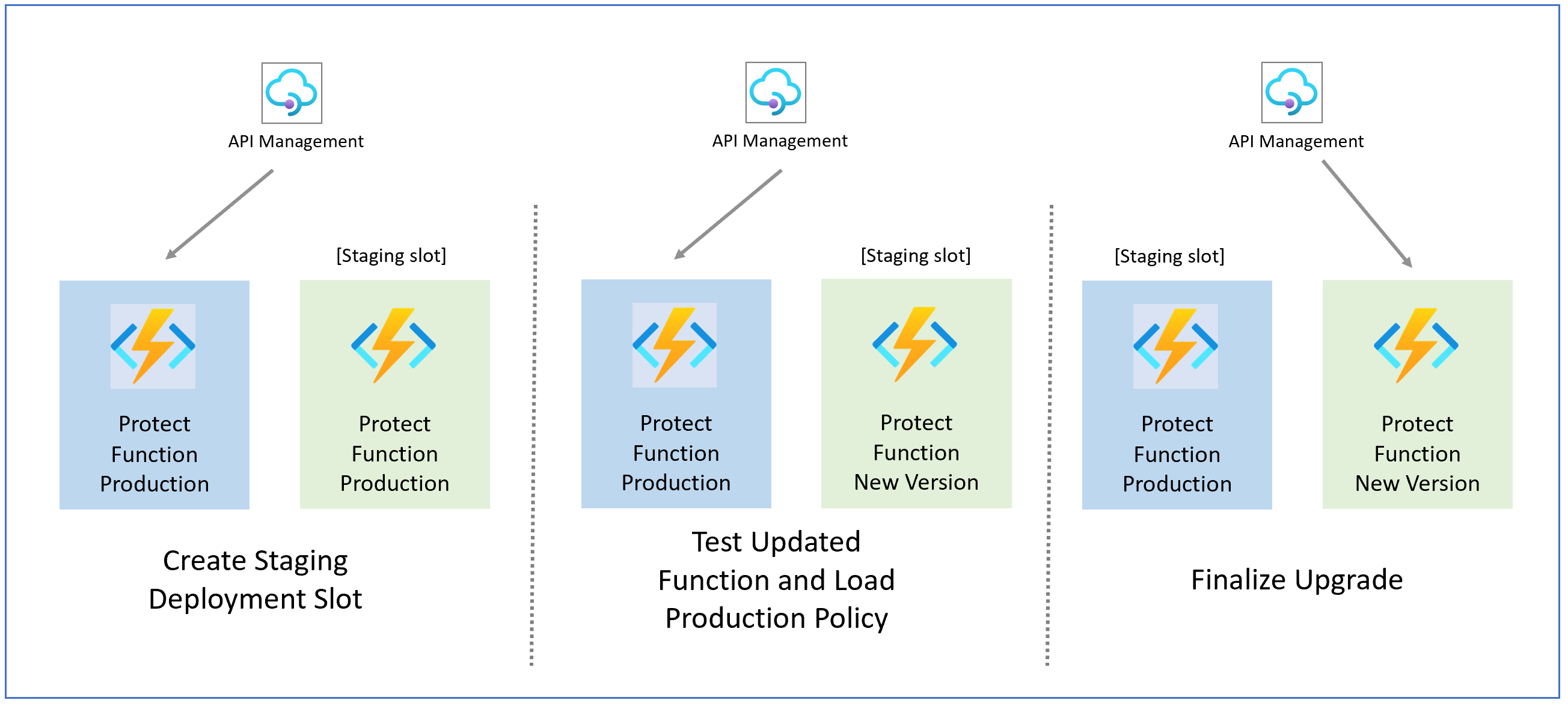
Create Staging Deployment Slot Creating new deployment slot allows updating the function without interruptions to the existing traffic.
Load Production Policy and Test New Protect Function In Staging
Finalize Protector upgrade Upgraded Protect Function can now be swapped in to production deployment slot to serve production traffic.
Creating new deployment slot allows updating the function without interruptions to the existing traffic.
From Azure console, navigate to Function App service and select the Protect Function App to upgrade. Navigate to Deployments > Deployment Slots.
Click Add slot. Specify slot name.
Click Add. Wait for the slot to be created.
After the slot is added, select Close to close the dialog box.
There should be a new slot available in the list of deployment slots. You will use this deployment slot as staging for the upgraded function. After upgrade is done and tested, you will swap staging slot with production slot.
Click on the new deployment slot. This will open the newly created replica of Cloud Protect Function.
Copy the function URL from the overview window.
Staging Protect Function URL: ________________
Navigate to Identity section under Settings.
If your installation utilizes System Assigned Identity:
Select System Assigned tab and switch Status On. Click Save.
This will generate the Object ID for the newly deployed function in the deployment slot.
Add Role Assignments to the identity as described in section Function System-Assigned Managed Identity
Use the Object ID to update Key Vault policy to allow function in the deployment slot to use policy encryption key. See Protect Function Key Vault Access Policies for instructions how to update Key Vault policy.
If your installation utilizes User Assigned Identity:
Select User Assigned tab
Select Add. Choose the identity in use on the production function, then complete by selecting Add again.
Navigate to App Keys section from the menu on the left. Record default key value under Host Keys section.
Staging Protect Function Default Host Key: ________________
Navigate to the staging Function App Settings > Environment variables
Click on WEBSITE_RUN_FROM_PACKAGE configuration entry.
Replace value with New Protect Function Blob URL.
Set EVENTHUB_NAME to the output value recorded in Install Log Forwarder via ARM template for the newly deployed log forwarder.
Set EventHub__fullyQualifiedNamespace to the output value recorded in Install Log Forwarder via ARM template.
Click Apply, then Apply to finalize.
Navigate to the new staging Protect function Settings > Environment variables
Set AZURE_POLICY_BLOB_URL environment variable to the upgraded_agent_policy_blob_url value recorded in previous steps.
Start/Stop the protect function.
Test New Protect Function in staging. You can use curl command below, replacing Staging Protect Function URL and Staging Protect Function Default Host Key with values recorded in previous section.
curl -X POST "<Staging Protect Function URL>/api/Protect" -k \
-H 'sf-custom-X-Protegrity-HCoP-Rules: {"jsonpaths":[{"op_type":"unprotect","data_element":"alpha"}]}' \
-H 'sf-context-current-user: test' \
-H 'sf-external-function-current-query-id: test-id' \
-H 'x-functions-key: <Staging Protect Function Default Host Key>' \
-H 'Content-Type: application/json' \
-d '{
"data": [
["0", "UtfVk UHgcD!"]
]
}'
curl -X POST "<Protect Function URL>/api/v1/protect" -k \
-H 'x-functions-key: <Protect Function app key>' \
-H 'Content-Type: application/json' \
-d '{
"data": ["test"],
"user": "test",
"data_element": "test"
}'
Upgraded Protect Function can now be swapped in to production deployment slot to serve production traffic.
Go to your main Protect Function.
Select deployment slots.
Select Swap.
Select staging Protect Function slot as source and production Function as target.
Click swap and wait until the functions are swapped.
If you need to rollback swap the application slots again.
Disabling the Event Hub trigger will prevent audit log delivery during the upgrade process. This reduces the chance for any duplicate or lost audit logs. Later steps will indicate when this trigger may be re-enabled.
Follow the steps below to disable the Event Hub trigger:
From Azure Console, go to Function App service and select Protegrity Log Forwarder Function.
Navigate to Overview.
The functions list should contain AuditLogForwarder function with Trigger type Event Hub and Status Enabled.
Click on the three dots in the same row as the AuditLogForwarder function. Then select Disable.
Creating new deployment slot allows updating the function such that it may easily be rolled back. Log Forwarder Function will be disabled during the upgrade process. Logs generated during this time will be processed once Log Forwarder is re-enabled
From Azure console, navigate to Function App service and select the Log Forwarder Function App to upgrade. Navigate to Deployments > Deployment Slots.
Click Add slot. Specify slot name.
Click Add. Wait for the slot to be created.
After the slot is added, select Close to close the dialog box.
There should be a new slot available in the list of deployment slots. You will use this deployment slot as staging for the upgraded function. After upgrade is done, you will swap staging slot with production slot.
Click on the new deployment slot. This will open the newly created replica of Log Forwarder Function.
Navigate to the staging Function App environment variable settings Settings > Environment variables
Click on WEBSITE_RUN_FROM_PACKAGE configuration entry.
Replace value with New Log Forwarder Function Blob URL. Click Apply.
Click on AZURE_POLICY_BLOB_URL configuration entry.
Replace value with upgraded_agent_policy_blob_url. Click Apply.
Click Apply and Confirm to push the configuration changes.
Upgraded Log Forwarder Function will be swapped into production deployment slot to serve production traffic and re-enabled,
Go to your main Log Forwarder Function.
Select deployment slots.
Select Swap.
Select staging Log Forwarder Function slot as source and current Function as target.
Click Start Swap and wait until the functions are swapped.
If you need to rollback, swap the application slots again.
Go to your main Log Forwarder Function.
Navigate to environment variable settings Settings > Environment variables
Click on AzureWebJobs.AuditLogForwarder.Disabled configuration entry.
Replace value with false. Click Apply then Apply and Confirm to finalize.
Skip this step if changes were not made to the DISABLE_DEPLOY setting in previous upgrade steps
Navigate to Agent function Settings > Environment variables
Set DISABLE_DEPLOY to 0.
apply changes and restart the Agent Function App
If the Agent Function Timer Trigger was disabled at the beginning of the upgrade process, you must re-enabled it. Follow the steps below to enable Policy Agent Timer Trigger.
Navigate back to Protegrity Agent Function.
Select Overview.
Click on the three dots in the same row as the agent function in the list of functions. Then select Enable.
This guide describes how to configure the Protegrity Policy Agent and Log Forwarder to connect to a Protegrity Provisioned Cluster (PPC), highlighting the differences from connecting to ESA.
| Feature | ESA 10.2 | PPC (this guide) |
|---|---|---|
| Datastore Key Fingerprint | Optional/Recommended | Required |
| CA Certificate on Agent | Optional/Recommended | Optional/Recommended |
| CA Certificate on Log Forwarder | Optional/Recommended | Not supported |
| Client Certificate Authentication from Log Forwarder | Optional/Recommended | Not supported |
| IP Address | ESA IP address | PPC address |
curl, kubectl installed.Follow these instructions as a guide for understanding specific inputs for Policy Agent integrating with PPC:
Obtain the Datastore Key Fingerprint
To retrieve the fingerprint for your Policy Agent:
Retrieve public key from the Cloud Provider Key Management service for the policy encryption key created in pre-configuration:
Escape the new line characters in the downloaded public key for use in the next step - for example:
awk 'NF {printf "%s\\n",$0}' "<public_key_file>" > "new-line-escaped-public-key.pem"
cat new-line-escaped-public-key.pem
Export key fingerprint using the PPC API as indicated in the curl example below:
curl -k -H "Authorization: Bearer ${TOKEN}" -X POST https://${HOST}/pty/v2/pim/datastores/1/export/keys -H "Content-Type: application/json" --data '{
"algorithm": "RSA-OAEP-256",
"description": "example-key-from-key-management",
"pem": "<value of new-line-escaped-public-key>"
}'
Sample Output:
{"uid":"1","algorithm":"RSA-OAEP-256","fingerprint":"4c:46:d8:05:35:2e:eb:39:4d:39:8e:6f:28:c3:ab:d3:bc:9e:7a:cb:95:cb:b1:8e:b5:90:21:0f:d3:2c:0b:27","description":"example-key-from-kms"}
Record the value for fingerprint and configure the Policy Agent:
Set the environment variable PTY_DATASTORE_KEY in the Policy Agent Lambda function to the fingerprint value.
Set the environment variable PTY_DATASTORE_KEY in the Policy Agent Function App to the fingerprint value.
Set the variable in Policy Agent main.tf pty_datastore_key to the fingerprint value and apply the changes.
Retrieve the PPC CA Certificate
To obtain the CA certificate from PPC:
kubectl -n api-gateway get secret ingress-certificate-secret -o jsonpath='{.data.ca\.crt}' | base64 -d > CA.pem
Use the ProtegrityCA.pem that was returned as described in Policy Agent Installation.
Configure the PPC Address
Use the PPC address in place of the ESA IP address wherever required in your configuration.
PTY_ESA_CA_SERVER_CERT is not provided.Cloud Protect Function exposes USERNAME_REGEX configuration to allow extraction of policy username from user in the request.
USERNAME_REGEX Function Environment configuration
The USERNAME_REGEX environment variable can be set to contain regular expression with one capturing group. This group is used to extract the username. Examples below show different regular expression values and the resulting policy user.
USERNAME_REGEX | User in the request | Effective Policy User |
|---|---|---|
Not Set | ||
juliet.snow/ad_postfix | juliet.snow/ad_postfix | |
| juliet.snow | |
juliet.snow/ad_postfix | juliet.snow |
Protect Function App can use Microsoft identity platform endpoint for identity-as-a-service, available in Azure Active Directory, to implement OpenID Connect and OAuth 2.0 authorization. This section describes how to get JWT using OAuth 2.0 client credentials grant flow in Azure Active Directory and authorize the Client ID in Protegrity Policy.
Suggested reading: https://docs.microsoft.com/en-us/azure/active-directory/develop/v2-oauth2-client-creds-grant-flow
High-level design:
Configure the Protect Function App:
From the Azure console, navigate to Function App service and select protect function app.
Navigate to Settings > Environment variables and click OPENID_ENABLED. Make sure it is set to true.
Click on OPENID_AUDIENCES, make sure it is set to the App ID recorded in EntraIDApplicationID.
Click or Add the authorization environment variable. Make sure it is set to jwt.
Click or Add on jwt_user_claim environment variable, make sure it is set to [“azp”, “appid”]. For more information on claims on AAD access token, refer:
https://docs.microsoft.com/en-us/azure/active-directory/develop/access-tokens
To register a Service Account:
In the Azure portal navigate to Azure Active Directory.
Under Manage, select App registrations > New registration.
Enter a Name and select Accounts in any organizational directory.
Redirect URI is set to http://localhost.
Select Register.
After registration is complete record Application ID and Directory (tenant) ID displayed in the overview window:
Service Account App ID: ___________________
Directory (tenant) ID: ___________________
In the Azure portal, in App registrations, select your application.
Select Certificates & secrets > New client secret.
Add a description for your client secret.
Select a duration.
Click Add.
Record the secret’s value for use in your client application code. This secret value is never displayed again after you leave this page.
Service Account App Secret: ___________________
For more information on app registration, see Azure documentation Quickstart Registering App
Admin Consent the Service Account:
https://login.microsoftonline.com/{tenant}/adminconsent?
client_id={Service Account App ID}
&state=12345
&redirect_uri=http://localhost
Replace the tenant and the Service Account App ID with the values recorded in the previous step. At this point, Azure AD enforces that only a tenant administrator can sign into complete the request. The administrator will be asked to approve all the direct application permissions that were requested for the app in the app registration portal.
Get the access token
curl -X POST -H "Content-Type: application/x-www-form-urlencoded" -d 'client_id={Service Account App ID}&scope={EntraIDApplicationID }%2F.default&client_secret={Service Account App Secret}&grant_type=client_credentials' 'https://login.microsoftonline.com/{tenant}/oauth2/v2.0/token'
Replace Service Account App ID, EntraIDApplicationID, Service Account App Secret, and tenant with values recorded in previous steps.
Example for successful response:
{
"token_type": "Bearer",
"expires_in": 3599,
"access_token": "eyJ0eXAiOiJKV1QiLCJhbGciOiJSUzI1NiIsIng1dCI6Ik1uQ19WWmNBVGZNNXBP..."
}
\
Record the access_token from the response. access_token: ___________________
Use the token
curl -X POST "https://<Protect hostname>/api/v1/protect" -k \
-H 'x-functions-key: <Protect Function app key>' \
-H 'Authorization: Bearer <access_token>' \
-H 'Content-Type: application/json' \
-d '{
"data": ["hello world!"],
"data_element": "alpha"
}'
Replace the {Protect hostname}, {Protect Function app key} and {access_token} with the.
Troubleshooting:
For more information about the protection methods supported by Protegrity, refer to the Protection Methods Reference.
Tokenization Type | Supported Input Data Types | Notes |
|---|---|---|
Numeric Credit Card Alpha Upper-case Alpha Alpha-Numeric Upper Alpha-Numeric Lower ASCII Printable Decimal Unicode Unicode Base64 Unicode Gen2 | STRING NULL | |
Integer | NUMBER NULL | |
Date Datetime | STRING NULL | For information about supported formats, refer to the Protection Methods Reference. |
Binary | STRING NULL | Must be |
Protection Method | Supported Input Data Types | Notes |
|---|---|---|
No Encryption | STRING NUMBER NULL |
Encryption Algorithm | Supported Input Data Types | Notes |
|---|---|---|
3DES AES-128 AES-256 CUSP 3DES CUSP AES-128 CUSP AES-256 | STRING | Must be |
Permissions below are required to install Protegrity service using ARM template.
All permissions in the table must be granted with the Resource group scope.
Permissions | Description | Built-In Azure Role |
|---|---|---|
| Read access to monitoring data and settings | Monitoring Reader |
| Write and manage access to monitoring data and settings | Monitoring Contributor |
| Write and manage access to web apps | Website Contributor |
| Manage and assign managed identities NoteThese permissions are only required when user assigned identity is used. | Managed Identity Operator |
| Manage and validate deployments | Deployment Contributor |
Log Forwarder service ARM deployment requires additional permissions below:
Permissions | Description | Built-In Azure Role |
|---|---|---|
| Allow for the creation, update, and deletion of Event Hub namespaces, event hubs within those namespaces, and their network rule sets, enabling full management of Event Hub resources. Note: These permissions are only required when deploying new event Hub. | Event Hubs Contributor |
| Read monitoring data and metrics, including Event Hub namespace data. | Monitoring Reader |
The additional permissions listed below are required when API management is part of the deployment.
Permissions | Description | Built-In Azure Role |
|---|---|---|
| Create or update API Management service instances, APIs, diagnostics, API operations, operation policies, backends, loggers, tenant policies, and API diagnostics. | API Management Service Contributor |
| Read metadata for API Management service instances and get the status of long-running operations. | API Management Service Reader |
ESA controls which policy is deployed to protector using concept of data store. A data store may contain a list of IP addresses identifying servers allowed to pull the policy associated with that specific data store. Data store may also be defined as default data store, which allows any server to pull the policy, provided it does not belong to any other data stores. Node registration occurs when the policy server (in this case the policy agent) makes a policy request to ESA, where the agent’s IP address is identified by ESA.
Policy agent function source IP address used for node registration on ESA depends on ESA hubcontroller configuration ASSIGN_DATASTORE_USING_NODE_IP and the PTY_ADDIPADDRESSHEADER configuration exposed by the agent function.
The function service uses multiple network interfaces, internal network interface with ephemeral IP range of 169.254.x.x and external network interface with IP range described in Function app outbound IP addresses section under function configuration. By default, when agent function is contacting ESA to register node for policy download, ESA uses agent function outbound IP address. This default behavior is caused by the default ESA hubcontroller configuration ASSIGN_DATASTORE_USING_NODE_IP=false and agent default configuration PTY_ADDIPADDRESSHEADER=yes.
In some cases, when there is a proxy server between the ESA and agent function, the desirable ESA configuration is ASSIGN_DATASTORE_USING_NODE_IP=true. and PTY_ADDIPADDRESSHEADER=no which will cause the ESA to use proxy server IP address.
The table below shows how the hubcontroller and agent settings will affect node IP registration on ESA.
| Agent source IP | Agent Function Outbound IP | Proxy IP | ESA config - ASSIGN_DATASTORE_USING_NODE_IP | Agent function config - PTY_ADDIPADDRESSHEADER | Agent node registration IP |
|---|---|---|---|---|---|
| 169.254.144.81 | 20.75.43.207 | No Proxy | true | yes | 169.254.144.81 |
| true | no | 20.75.43.207 | |||
| false | yes | 20.75.43.207 | |||
| false | no | 20.75.43.207 | |||
| 169.254.144.81 | 20.75.43.207 | 34.230.42.110 | true | yes | 169.254.144.81 |
| true | no | 34.230.42.110 | |||
| false | yes | 34.230.42.110 | |||
| false | no | 34.230.42.110 |
This section describes the high-level architecture of the product for integration with Snowflake, the installation procedures, and provides guidance on performance. This section focuses on Protegrity-specific aspects and should be consumed with the corresponding Snowflake documentation.
This guide may also be used with the Protegrity Enterprise Security Administrator Guide, which explains the mechanism for managing the data security policy.
Snowflake Protector on Azure is a cloud native, serverless product for fine-grained data protection with Snowflake™, a managed Cloud data warehouse. This enables invocation of the Protegrity data protection cryptographic methods from the Snowflake SQL execution context. The benefits of serverless include rapid auto-scaling, performance, low administrative overhead, and reduced infrastructure costs compared to a server-based solution.
This product provides data protection services invoked by External User Defined Functions (UDFs) within Snowflake. The UDFs act as a client transmitting micro-batches of data to the serverless Protegrity Lambda function. User queries may generate hundreds or thousands of parallel requests to perform security operations. Protegrity’s serverless function is designed to scale and yield reliable query performance under such load.
Snowflake Protector on Azure utilizes a data security policy maintained by an Enterprise Security Administrator (ESA), similar to other Protegrity products. Using regular SQL database queries or tools, such as, Tableau™, authorized users can perform de-identification (protect) and re-identification (unprotect) operations on data within the managed Cloud data warehouse. A user’s individual capabilities are subject to privileges and policies defined by the Enterprise Security Administrator.
The following data ingestion patterns are available with your managed Cloud data warehouse:
Snowflake Protector on Azure incorporates Protegrity’s patent-pending vaultless tokenization capabilities into cloud-native serverless technology. Combined with an ESA security policy, the protector provides the following features:
For more information about the available protection options, such as, data types, Tokenization or Encryption types, or length preserving and non-preserving tokens, refer to Protection Methods Reference.
Protegrity Protector for Snowflake should be deployed in Customer’s Cloud account within the same Azure region as the Snowflake cluster. The product incorporates Protegrity’s vaultless tokenization engine within an Azure Function App. The encrypted data security policy from an ESA is deployed periodically as a static resources through an Azure blob storage. The policy is decrypted in memory at runtime within the Function App. This architecture allows Protegrity Serverless to be highly available and scale very quickly without direct dependency on any other Protegrity services.
Protegrity’s Protector for Snowflake exposes a remote data protection service invoked from external User Defined Functions (UDF), a native feature of particular Cloud databases. UDFs can be invoked via direct SQL queries, database views, or features such as Snowflake table masking. The external UDF makes parallel API calls to Protegrity Serverless for protect and unprotect data operations. Each network REST request includes a micro-batch of data to process and a secure context header generated by the database with the username and a Protegrity context header with the data element type, and operation to perform. It applies the ESA security policy including user authorization and returns a corresponding response. Security operations on sensitive data performed by protector can be audited. The product can be configured to send audit logs to ESA for reporting and alerting purposes via optional component called Log Forwarder explained in details in the next section of this guide.
The security policy is synchronized via another serverless component called the Protegrity Policy Agent . The agent operates on a configurable schedule, fetches policy from ESA, performs additional envelope encryption using Azure Key Vault, and deploys the policy into the Azure blob storage container which is accessed by Protector Function App. This solution can be configured to automatically provision the static policy or the final step can be performed on-demand by an administrator.
The following diagram shows the high-level architecture described above.
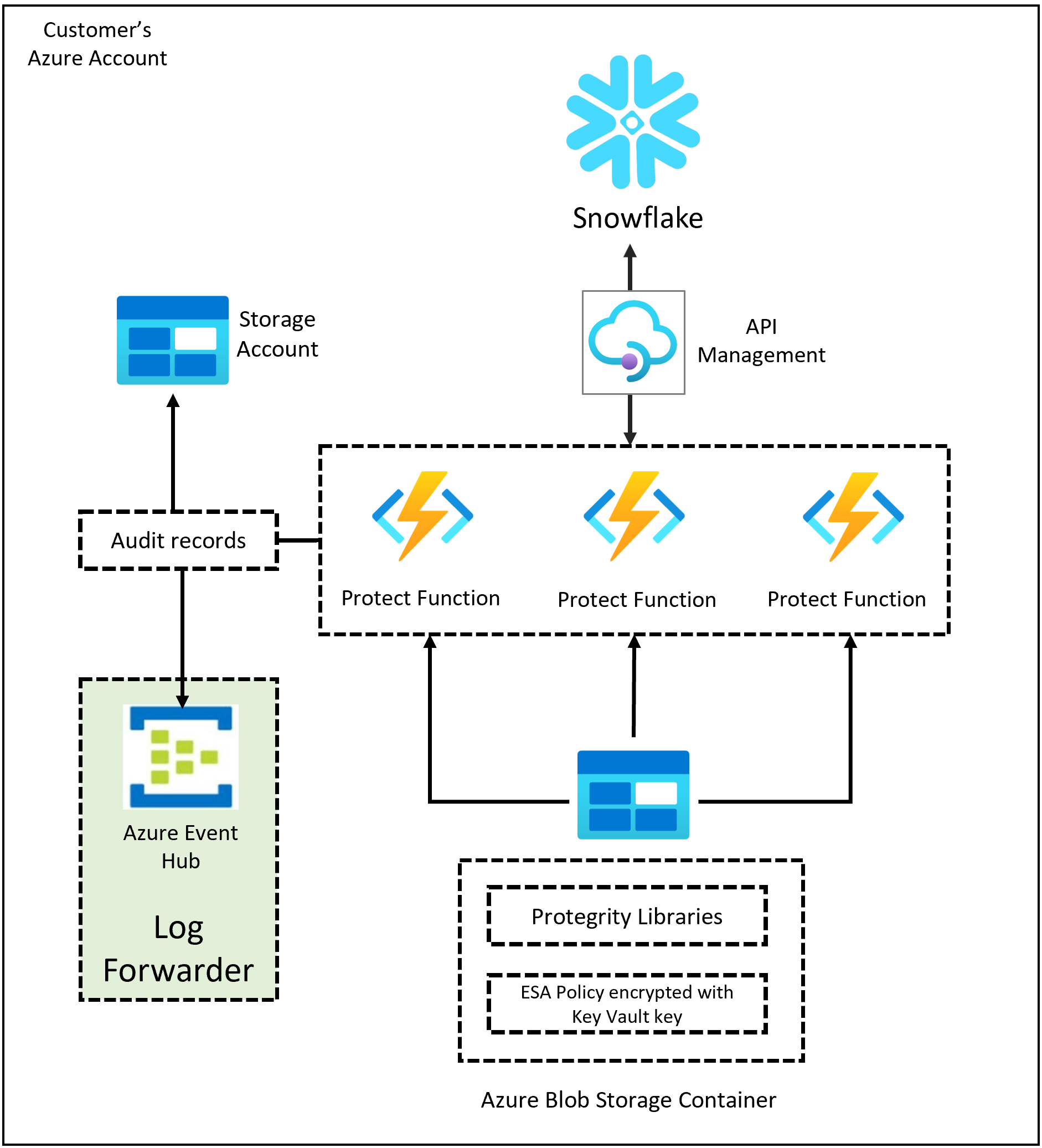
The following diagram shows a reference architecture for synchronizing the security policy from the ESA to the product.
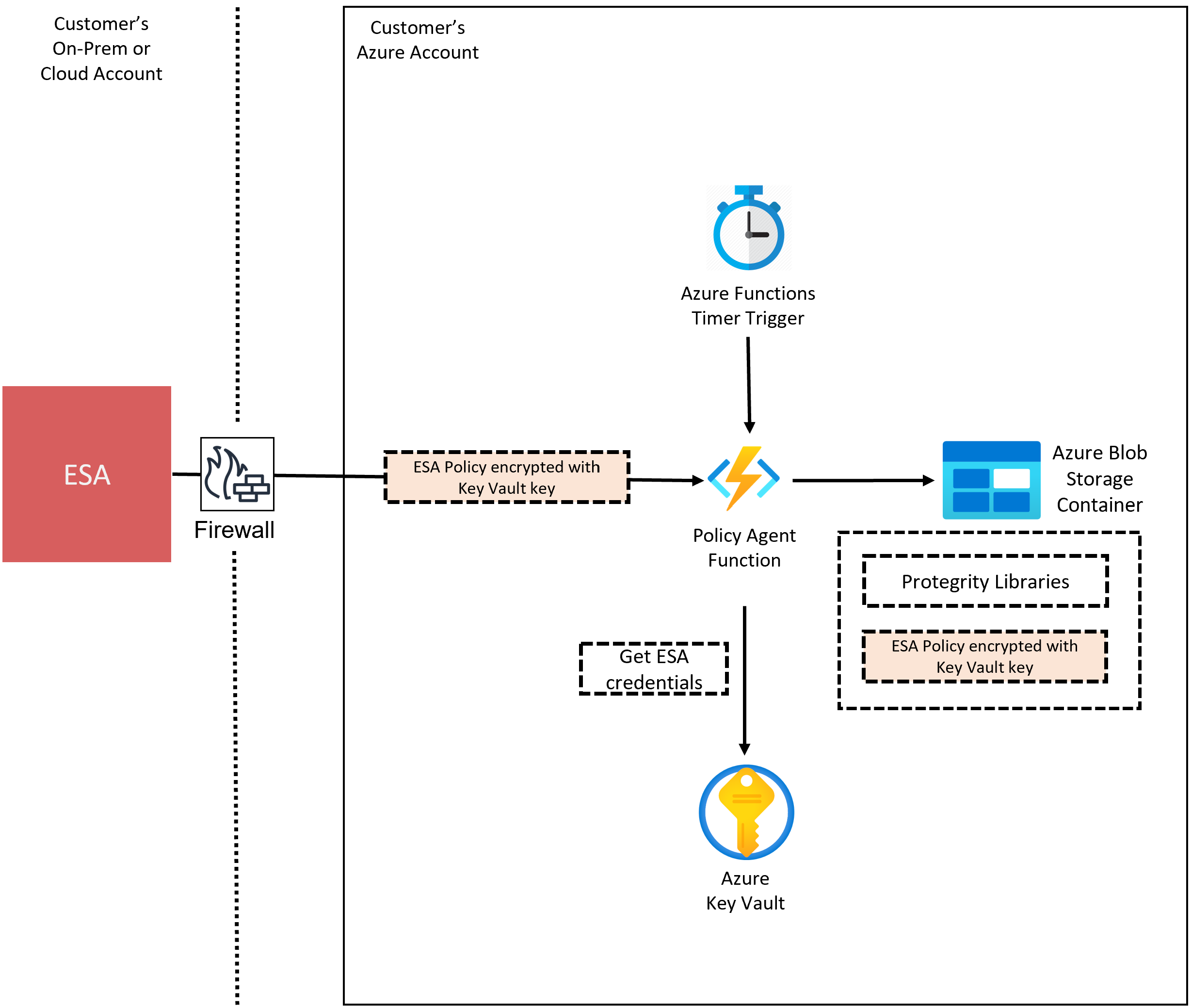
The ESA is a soft appliance that must be pre-installed on a separate server. It is used to create and manage security policies.
For more information about installing the ESA, and creating and managing policies, refer the Policy Management Section.
Audit logs are by default sent to Azure Blob Storage and Application Insights. The Cloud Protect product can also be configured to send audit logs to ESA. Such configuration requires deploying audit Log Forwarder component which is available as part of Cloud Protect deployment bundle. The diagram below shows additional resources deployed with Log Forwarder component.
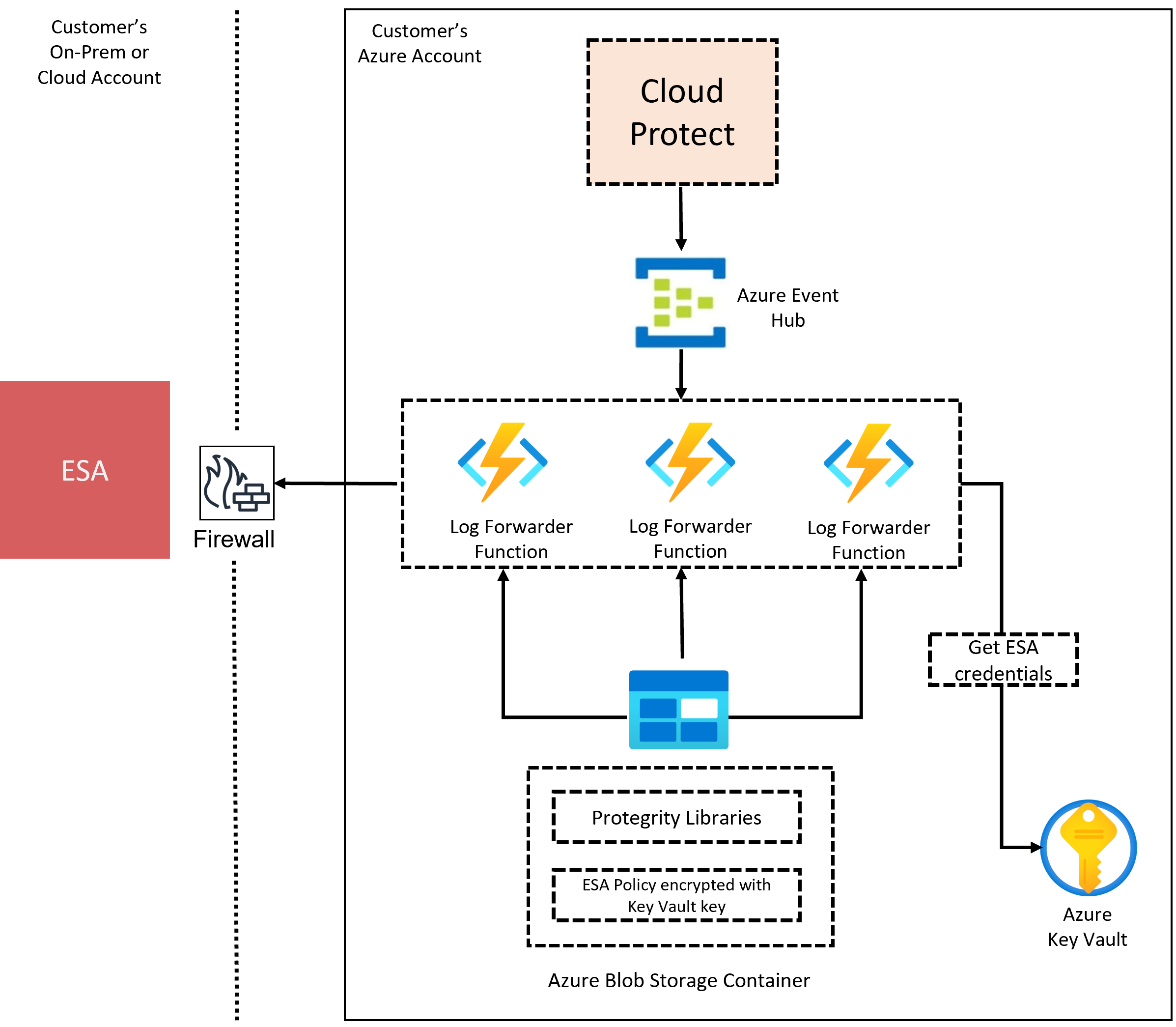
The audit log forwarding solution includes Azure Event Hubs data-streaming service and an Azure Function App deployment called Log Forwarder. Protect function delivers audit logs to Azure Event Hub instance, Event Hub instance batches audit logs and delivers them to Log Forwarder function. Log Forwarder function then delivers audit logs to ESA. Audit log aggregation occurs on both Protect and Log Forwarder functions. Aggregation rules are described in the Understanding the log aggregation section. If Log Forwarder cannot deliver audit logs to ESA due to temporary ESA connection loss, it will send undelivered audit logs to a dead-letter queue Event Hub. Audit logs in dead-letter queue Event Hub can be re-delivered to ESA using another instance of Log Forwarder, which can be configured to run either manually or on schedule.
The security of audit logs is ensured by using HTTPS connection on each link of the communication between protector function and ESA. Integrity and authenticity of audit logs is additionally checked on Log Forwarder function which verifies individual logs signature. The signature verification is done upon arrival from Azure Event Hub before applying aggregation. If signature cannot be verified, the log is forwarded as is to ESA where additional signature verification can be configured. Log Forwarder function uses client certificate to authenticate calls to ESA.
To learn more about individual audit log entry structure and purpose of audit logs, refer to Audit Logging section. Installation instruction can be found in the Audit Log Forwarder Installation.
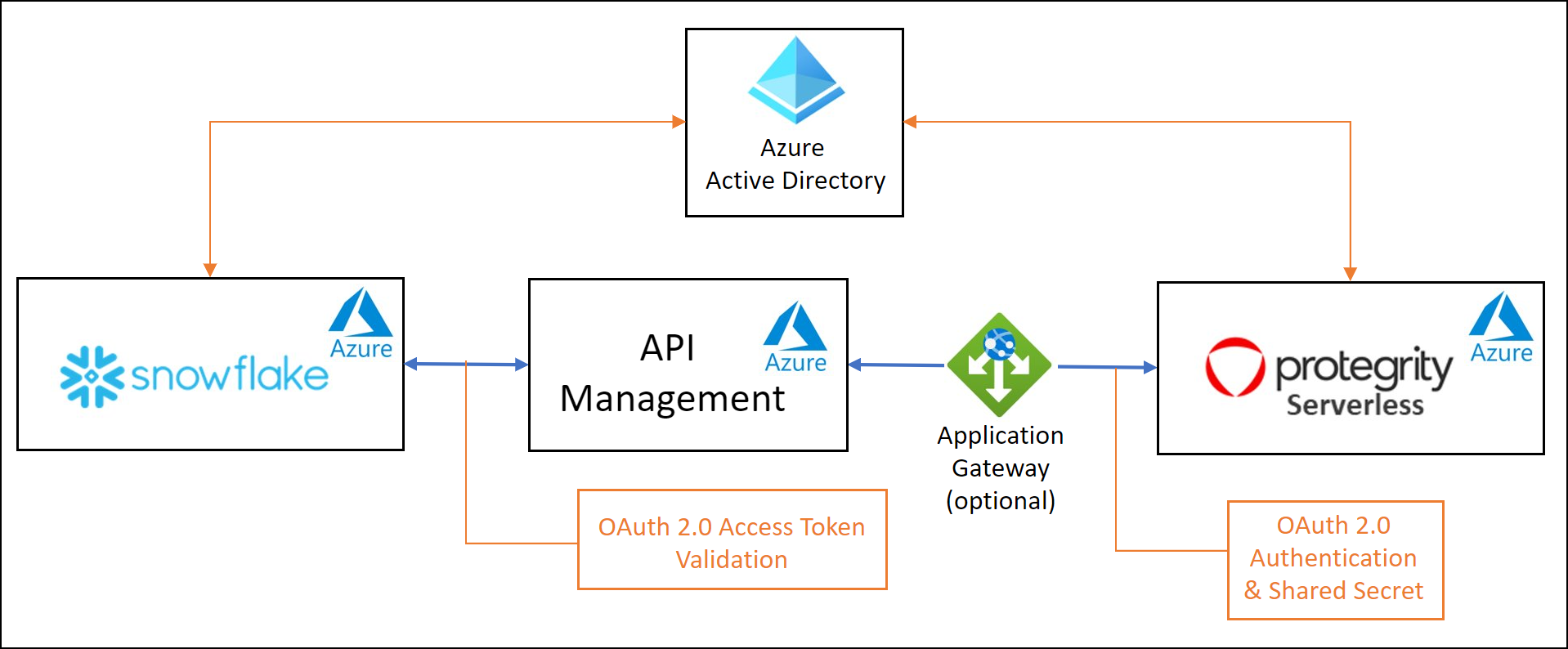
The Snowflake API Integration Object provides a connection between your Snowflake Azure account and your Azure account where the Protegrity product is hosted. Creating this connection requires setting up the API Management and appropriate access policies. These steps are provided in the installation.
The following table describes the Azure services that may be part of your Protegrity installation.
All permissions in the table must be granted with the Resource group scope.
Service | Description |
|---|---|
Microsoft Entra ID Application | Allows authentication with Azure Function app |
Azure Managed Identity | Allows functions assume user-defined managed identity |
Function App | Provides serverless compute for Protegrity protection operations and ESA integration to fetch policy updates or deliver audit logs. |
API Management Service | Provides the end-point and access control |
Azure Key Vault | Provides cryptographic keys for envelope encryption/decryption of the policy. Stores secrets required during deployment, e.g., ESA credentials |
Blob storage | Intermediate storage location for the encrypted ESA policy package |
Application Insights | Application and audit logs, performance monitoring, and alerts |
Azure Event Hubs | Required if audit logs are to be sent to ESA. Set up and configuration of a new Event Hub is covered in section Audit Log Forwarder Installation. |
The Protector and Log Forwarder functions require a security policy from a compatible ESA version.
The table below shows compatibility between different Protector and ESA versions.
| Protector Version | ESA Version | |||
|---|---|---|---|---|
| 8.x | 9.0 | 9.1 & 9.2 | 10.0 | |
| 2.x | No | Yes | * | No |
| 3.0.x & 3.1.x | No | No | Yes | No |
| 3.2.x | No | No | Yes | * |
| 4.0.x | No | No | No | Yes |
Legend | |
|---|---|
Yes | Protector was designed to work with this ESA version |
No | Protector will not work with this ESA version |
* | Backward compatible policy download supported:
|
| Requirement | Detail |
|---|---|
| Protegrity distribution and installation scripts | These artifacts are provided by Protegrity |
| Protegrity ESA 10.0+ | The Cloud VNet must be able to obtain network access to the ESA |
| Azure Account (Azure Global or US Government Subscription) | Recommend creating a new resource group for Protegrity. |
Role / Skillset | Description |
|---|---|
Azure Account Administrator | Ability to run Azure Resource Manager (or perform steps manually), create/configure Entra ID Application Registrations |
Protegrity Administrator | The ESA credentials required to extract the policy for the Policy Agent |
Network Administrator | Needed to open firewall to access ESA and evaluate Azure network setup |
During the installation you will need to record output of certain steps that will be used in downstream installation procedures. We recommend copying the following cheat sheet into a notepad and fill in the information as you progress with the installation.
Azure Subscription ID (AzureSubscriptionID): ____________________
Azure Resource Group ID (ApiResourceGroup): ___________________
Azure Region (ApiRegion): ___________________
Key Vault Name (PolicyKeyValue): ___________________
Storage Account Name (StorageAccountName): ___________________
Storage Account Blob Service Url (StorageAccountBlobServiceUrl): ___________________
Protect Function Blob URL (ProtectFuncURL): ___________________
Forward Function Blob URL (ForwardFuncURL): ___________________
Agent Function Blob URL (AgentFuncURL): ___________________
Protect Function Policy Blob URL (ProtectFuncPolicyBlobUrl): ____________________
Agent Policy Blob Container Name (AgentPolicyBlobContainer): ___________________
Entra ID Application Name (EntraIDApplicationName): ___________________
Entra ID Application ID (EntraIDApplicationID): ___________________
Protect Function User-Assigned Identity (ProtectFuncUserAssignedIdentity): ___________________
Protect Function Name (ProtectFuncName): __________________
Protect Function System-Assigned Identity (ProtectFuncSystemAssignedIdentity): __________________
Protect Function App Key (FuncAppKey): ___________________
Sample Policy Blob Url (SamplePolicyBlobUrl): ___________________
ESA Credentials function URL (EsaCredentialsFnUrl): ___________________
ESA Credentials function key (EsaCredentialsFnKey): ___________________
ESA Credentials function key secret name (EsaCredentialsFnKeySecretName): ___________________
ESA Credentials function Application ID URI (EsaCredentialsFnAppIdUri): ___________________
Forward Function User-Assigned Identity (ForwardFuncUserAssignedIdentity): ___________________
Forward Function Name (ForwardFuncName): __________________
Azure Tenant ID (AzureTenantID): ____________________
ESA IP Address (EsaIpAddress): ___________________
ESA CA Server Certificate (EsaCaCert): ___________________
ESA Username Secret Name (UserSecretName): ___________________
ESA Password Secret Name (PasswordSecretName): ___________________
ESA Client Certificate (EsaClientCert): ___________________
ESA Client Certificate Key Secret Name (EsaClientCertKeySecretName): ___________________
Policy Encryption Key ID (PolicyEncryptionKey): _________________
Agent Function User-Assigned Identity (AgentFuncUserAssignedIdentity): __________________
Agent Function Name (AgentFuncName): __________________
Event Hub Name (EventHubName): __________________
Event Hub Namespace (EventHubNamespace): __________________
Identify or create a new Azure Resource Group where the Protegrity solution will be installed. It is recommended that a new Resource group is created. This can provide greater security controls and help avoid conflicts with other applications that might impact regional account limits. An individual with the Cloud Administrator role will be required for some of the subsequent installation steps.
Azure Subscription ID (AzureSubscriptionID): ____________________
Azure Resource Group ID (AzureResourceGroupID): ___________________
Query the Azure region where Snowflake is running. This is the region where the product must be installed.
To determine the region:
Login to Snowflake
In the SQL console, run the following query.
select current_region();
Record the Azure region (e.g. AZURE_EASTUS2).
Snowflake Azure Region (AzureRegion): ___________________
Key Vault is required to store secrets and encrypt policy deployment package. Identify existing Key Vault or create new.
To create Key Vault:
From the Azure Console select Create a resource.
Navigate to Key Vault > Create.
Select a Resource group.
Enter a Key vault name.
Select a Region. For the best performance, use the same region for all resources.
Set the Pricing tier to Standard.
Under Access configuration, select Azure role-based access control as the Permission model.
Under Networking, ensure that Enable public access is selected.
Under Review + create, click Create.
Assign the Key Vault Crypto User role to the Policy Agent and Protector identities:
Record Key Vault Name:
Key Vault Name (PolicyKeyValue): ___________________
Create a storage account to host Protegrity deployment packages provided in installation artifact bundle. Note that turning on the firewall or restricting access to selected virtual networks or IP address ranges will require additional configuration and is beyond the scope of this document.
To create Function App storage:
From the Azure Console select Create a resource.
Navigate to Storage account > Create.
Select the Resource group where the Protegrity solution will be deployed.
Enter a Storage account name.
Select the Region where the Protegrity solution will be deployed.
Set the Preferred storage type to Azure Blob Storage or Azure Data Lake Storage
Set the Primary workload to Cloud native
Setting for Performance should be set to Standard.
Setting for Redundancy should be set to Geo-redundant storage (GRS).
Continue to Advanced setup and verify Enable hierarchical namespace is unchecked
Policy is not availableAdjust the Networking and Data protection configurations according to your security requirements or use the default values.
Under Review + create, click Create.
Record the storage account name
Storage Account Name (StorageAccountName): ____________________
Record the storage blob service URL. Navigate to created Storage Account, select Settings, Endpoints, record the value of Blob Service
Storage Account Blob Service Url (StorageAccountBlobServiceUrl): ____________________
Create a deployment container using the Azure Blob Service.
Go Storage Account created in the previous step.
Under Data storage section, select Containers and click + Container .
Type in container name and click Create .
Upload the following installation artifacts to the container:
Record Protect function blob URL:
Protect Function Blob URL (ProtectFuncURL): ____________________
Record Forward function blob URL. Both Protect and Forward functions use the same protegrity-protect-azure-<version>.zip distribution:
Forward Function Blob URL (ForwardFuncURL): ____________________
Record Agent function blob URL:
Agent Function Blob URL (AgentFuncURL): ____________________
Create a blob container for encrypted Protegrity security policy using Azure Blob Service. Agent will store encrypted policy in this container. Both Protect and Log Forwarder functions will load policy from this container.
Go Storage Account created in the previous step.
Under Data storage section, select Containers and click + Container .
Type in container name and click Create .
Right-click the container name, and select Container properties to obtain URL.
Append the name of the policy file to the container URL, e.g, https://<your-storage-account>.blob.core.windows.net/<your-policy-container>/<your-policy-file-name>.zip. Record the blob url.
Protect Function Policy Blob URL (ProtectFuncPolicyBlobUrl): ____________________
The Agent function uploads an encrypted policy zip package to a blob container which is used as a staging storage. Create the policy staging container
To prepare the policy blob container:
Under Storage account created in previous step, select Data storage > Containers and click + Container .
Type in a container name and click Create .
Agent Policy Blob Container Name (AgentPolicyBlobContainer): ___________________
Ensure that all the steps in Pre-Configuration are performed.
Login to the Azure account console where Protegrity will be installed.
Ensure the Azure Resource Manager templates provided by Protegrity are available on your local computer.
A Microsoft Entra ID App provides the mechanism for Client to authenticate with the Function App instance. Creating an Entra ID app requires appropriate permissions to the Azure Subscription and is typically performed by the Azure Account Administrator.
To register an Entra ID App:
In the Azure portal navigate to Microsoft Entra ID.
Click + Add and select App registration.
Enter a Name and select Accounts in any organizational directory.
Leave the Redirect URI empty and select Register.
After registration is complete record the application name and application id displayed in the overview window.
Entra ID Application Name (EntraIDApplicationName): ___________________
Entra ID Application ID (EntraIDApplicationID): ___________________
User-assigned Azure managed identities are optional. If a user-assigned identity is not provided, a system-assigned managed identity will be enabled the function. User-assigned managed identities offer less frequent updates to Azure resources and allow for configuration of permissions ahead of function creation.
In the search box, enter Managed Identities. Under Services, select Managed Identities
Select Create
For Subscription provide recorded value of AzureSubscriptionID
For Resource Group provide recorded value of ApiResourceGroup
For Region provide recorded value of ApiRegion
For Name provide a name of the new identity
Assign following roles to this identity:
Record Protect function user-assigned identity
Protect Function User-Assigned Identity (ProtectFuncUserAssignedIdentity): ____________________
Resources created with the ARM template include API Management service, Function App, App Service Plan and Application Insights service.
To install protect function via Azure Resource Manager:
From Azure Console, select Create a resource, search for template then select Template deployment (deploy using custom templates) > Create.
Select Build your own template in the editor.
Click Load File and upload pty_protect_arm_v2.json, then click Save.
Select a Resource group.
Enter a Name for the resources. All resources will be prefixed with Protegrity-Protect except for log container which will be prefixed with ptylogs. For more information on naming rules see: Azure resource name rules.
For Location input specify Azure region name or leave default to deploy in the same region as resource group.
For Storage Account Blob Service Url Optionally use the value recorded in Create Storage Account. If value is not given, it will be automatically derived from Protect Function Blob Url.
For Protect Function Blob Url use the value from Upload Files.
For Function App Managed Identity Optionally use the value from Protect Function User-Assigned Managed Identity. If value is not given, a system-assigned managed identity will be enabled.
For Function Sku either EP1 or EP3 are recommended. Note that this will affect the running cost.
For Create Api Management Service select Do not create. API Management Service is required only for integration with Snowflake. This service is not required otherwise.
For Api Management Service Sku Applicable only when API Management Service is created. Skip this if API Management Service is not created. Either Consumption (if available) or Premium are recommended. Note that this will affect the running cost.
For Username Regex you can optionally specify regex to extract policy username from the request. See Configuring Regular Expression to Extract Policy Username for more details.
For Entra ID Application ID enter the value recorded in Register an Entra ID App.
For Forward Logs To ESA select whether audit logs are to be sent to ESA or not. If you are not planning on sending audit logs to ESA you can skip Event Hub Nameand Event Hub Namespace properties below. For details on creating and configuring Event Hubs see Audit Log Forwarder Installation
For Event Hub Name provide the name of Event Hub which will be used to send audit logs to ESA.
For Event Hub Namespace provide the name of Event Hub Namespace which is hosting Event Hub selected in previous step.
Under Review + create, click Create. Wait for all resources to deploy. If the deployment fails for any resources of type Microsoft.Web/sites/host/functionKeys then click Redeploy and try deploying again.
After deployment is complete, go to Outputs and record protectFunctionName, azureTenantId and apiGatewayUrl.
Protect Function Name (ProtectFuncName): __________________
Azure Tenant ID (AzureTenantID): __________________
API Gateway URL (ApiGatewayURL): __________________
System-assigned Azure managed identity is enabled if user-assigned managed identity is not used. User-assigned managed identities offer less frequent updates to Azure resources and allow for configuration of permissions ahead of function creation.
If you have not created a user-assigned managed identity at Protect Function User-Assigned Managed Identity, setup following role assignments for system-assigned managed identity:
Navigate to the function
Select Settings, Identity.
Confirm Status of system-assigned identity is already On on System Assigned tab
Click on Azure role assignments button.
Assign following roles to this identity:
From Azure console, navigate to Function App and select protect function deployed in previous section.
Select Overview and click Restart button. Wait until function restart completes.
The Key vault must be updated to allow the Function App to decrypt the policy files. Azure assigns a unique identifier to each Function App instance that can be used to grant permissions to that instance. Assign the appropriate Key Vault roles to the Protect function identity:
Obtain Function App identifier
Navigate to the Function App service in the Azure portal.
Select the newly created Protect Function App instance.
Select the Identity option under Settings.
Ensure that setting System assigned is set to Status On.
Record the Object ID:
Protect Function Object ID: ___________________
Assign Key Vault roles to the Protect function
The Protegrity installation bundle contains a sample policy which can be used to test the protect service installation without an ESA. Upload the sample policy artifact to the policy Blob storage container:
Go to Azure console and select Storage Account Name (StorageAccountName) recorded in step Create Storage Account.
Under Data storage select Blob Containers and select container created in Protect Function Policy Blob Container
Click Upload and select protegrity-sample-policy-<version>.zip file from your local computer.
Click Upload and wait for the file to complete uploading.
Record the sample policy blob url:
Sample Policy Blob Url (SamplePolicyBlobUrl): ___________________
Before continuing with next steps, you may verify the protect service is installed correctly. This step is optional and can be skipped.
From Azure console, navigate to Function App and select protect function app.
Select Overview and record URL value as <Protect Function URL>.
Navigate to Settings > Environment variables and click OPENID_ENABLED.
Change value to false and click Apply.
Select or create variable AZURE_POLICY_BLOB_URL.
Set value of AZURE_POLICY_BLOB_URL to value recorded for SamplePolicyBlobUrl and click Apply.
Select Apply and Confirm to finalize setting changes.
Go to Functions > App keys and record the value of default key under Host Keys (All function) as <Protect Function app key>.
Run the following CURL command to test Function deployment.
curl -X POST "<Protect Function URL>/api/Protect" -k \
-H 'sf-custom-X-Protegrity-HCoP-Rules: {"jsonpaths":[{"op_type":"unprotect","data_element":"alpha"}]}' \
-H 'sf-context-current-user: test' \
-H 'sf-external-function-current-query-id: test-id' \
-H 'x-functions-key: <Protect Function app key>' \
-H 'Content-Type: application/json' \
-d '{
"data": [
["0", "UtfVk UHgcD!"]
]
}
'
Note: When you copy-paste the curl command, make sure each header is in a separate line.
Replace <Protect Function URL> and <Protect Function app key> with the values recorded in step 2 And 5.
Run curl command. Verify the following output.
{"data":["hello world!"], "success": true, "encoding": "utf8"}
Go back to Function app. Select Settings > Environment variables and click OPENID_ENABLED,
Change value to true and click Apply. Select Apply and Confirm to finalize.
This step is only applicable when API Management is using any tier except for consumption. The Function App instance can be configured to restrict access to IP addresses used by the API Management instance.
Obtain Function App identifier
Navigate to the API Management services service in the Azure portal.
Select the newly created API Management instance.
Copy the Virtual IP (VIP) addresses.
Virtual IP (VIP) addresses: ___________________
Navigate to the Function App service in the Azure portal.
Select the newly created Function App instance.
Under Settings > Networking.
Select Enabled with no access restrictions link under the section Inbound traffic configuration.
Click Add under Site access and rules section.
Change Name to API.
Ensure the Action is set to Allow.
Set Priority to 1.
Ensure the Type is IPv4.
Paste in the copied value and reformat as an IPv4 CIDR. For example “public: 169.254.169.254” becomes “169.254.169.254/32"
Click Add Rule.
If there are multiple IP addresses, repeat steps 8 through 14.
To review live requests, navigate to Application Insights service and select item with the same name as the protect function. Under Investigate, select Live Metrics. Wait for the dashboard to load, then go to Sample Telemetry pane on the right and look for the requests in question.
To review the full history of requests from Application Insights under Monitoring select Logs:
You can also run the query directly in the query editor. For instance to select the 10 latest exceptions run the following query.
exceptions
| where timestamp > ago(24h)
| order by timestamp
| limit 10
Protect Function app can be customized using environment variables. From Azure console, navigate to Function App service and select protect function app. Navigate to Settings > Environment variables. Add or Edit environment variables based on the following information.
| Parameter | Description | Notes |
|---|---|---|
| OPENID_ENABLED | When set to true, every request is required to have an Authorization header with the bearer token set to a valid OAuth access token. | The following configuration attributes will also be required: OPENID_AUDIENCES, OPENID_ISSUERS, OPENID_METADATA_URL. |
| OPENID_AUDIENCES | The JWT token must have the “aud” claim and it must match one of the values in this attribute. Can be either one value or comma separated list. | applicable when OPENID_ENABLED= “true”. |
| OPENID_ISSUERS | The JWT token must have the “iss” claim and it must match one of the values in this attribute. Can be either one value or comma separated list. | applicable when OPENID_ENABLED= “true”. |
| OPENID_METADATA_URL | A URL that points to an OpenID Connect identity provider configuration document, which is also known as OpenID well-known configuration endpoint. | applicable when OPENID_ENABLED= “true”. |
| authorization | When equals “jwt”, Authorization Header JWT will be required in the Rest API Protect payload. | |
| Supported Values: [“jwt”, “”] | When equals to “jwt”, any request without Valid JWT in the Authorization header, will result in an error from API Gateway: 502 Bad Gateway. | |
| allow_assume_user | If set to 0, The user from the payload will not be used, and the policy user is the JWT user. | |
| Supported Values: [0, 1] | applicable when authorization = “jwt”. | |
| Default Value: 0 | ||
| jwt_user_claim | The JWT payload claim with username. Common claims: name, preferred_username, cognito:username | Applicable when authorization = “jwt” |
| Default Value: cognito:username | ||
| service_user | If service_user is set the protect request will use it for the policy user. | service_user should be used when the Cloud API should always run as one service_user no matter what user is in the request. service_user will always take priority over any other user in the payload or in the JWT header. |
| AZURE_POLICY_BLOB_URL | This points to Protegrity security policy blob. It is updated by the Agent to point to latest security policy. | |
| USERNAME_REGEX | If USERNAME_REGEX is set, the effective policy user will be extracted from the user in the request. | NoteSee Configuring Regular Expression to Extract Policy Username to learn how to extract username from the request |
| EVENTHUB_NAME | Event Hub name where audit logs are to be sent to. Logs are not forwarded to ESA when this parameter is empty. | NoteSet up and configuration of a new Event Hub is covered in section Audit Log Forwarder Installation |
| EventHub__fullyQualifiedNamespace | Event Hub fully qualified namespace. Logs are not forwarded to ESA when this parameter is empty. | NoteSet up and configuration of a new Event Hub is covered in section Audit Log Forwarder Installation |
| PTY_CORE_FLUSHINTERVAL | Time interval in seconds used to accumulate audit logs before sending to Event Hub. Default value: 10. | Audit logs are always aggregated into one minute buckets. A value greater than 60 will influence only audit log batching while sending logs to Event Hub. A value less than 60 will influence both aggregation and audit log batching. |
| PTY_LOG_LEVEL | Function min log level. Default: Severe | One of case-insensitive strings: off, severe, warning, info, config, all. |
| PTY_WRITE_LOG_ON_SINGLE_LINE | Whether to write log level and message on one line or separate lines. Default: true | Starting from version 3.1.0, log level and message are printed on single line. Use this environment variable to switch to multi-line logging for backward compatibility with pre-3.1.0 release. |
| EVENT_LEVEL | Level of logs produced by Azure services. Default: Error | One of case-insensitive strings: LogAlways, Critical, Error, Warning, Informational, Verbose. Set to at least ‘Informational’ during initial configuration, set to at most ‘Error’ in production environments. |
| Parameter | Notes |
|---|---|
| AZURE_CLIENT_ID | Sets the Managed Identity Client ID for Function App runtime. System-Assigned Identity is used when variable is not set. |
| APPLICATIONINSIGHTS_AUTHENTICATION_STRING | Define identity for Application Insights access. Managed Identity Client ID is provided to this setting with Function App Managed Identity ARM template parameter. See the corresponding Azure AD Authentication documentation: Azure AD authentication |
| APPLICATIONINSIGHTS_CONNECTION_STRING | Connection String for Application Insights instance. See the corresponding Azure Connection String documentation: Connection strings |
| FUNCTIONS_EXTENSION_VERSION | Azure Functions extension version |
| FUNCTIONS_WORKER_RUNTIME | Runtime of the function |
| WEBSITE_RUN_FROM_PACKAGE | URL to the zip file in blob storage with function runtime source |
| WEBSITE_RUN_FROM_PACKAGE_BLOB_MI_RESOURCE_ID | Managed Identity used to load function runtime source |
| AzureWebJobsStorage__blobServiceUri | URL of the storage account which hosts the blob identified in WEBSITE_RUN_FROM_PACKAGE |
| AZURE_TENANT_ID | Tenant identifier in Azure Active Directory |
| AzureWebJobs.AuditLogForwarder.Disabled | Defines whether audit log forwarder function is disabled or not |
| AzureWebJobs.Protect.Disabled | Defines whether Protect function is disabled or not |
| AzureWebJobs.v1-openapi.Disabled | Defines whether v1-openapi function is disabled or not |
| AzureWebJobs.v1-protect.Disabled | Defines whether v1-protect function is disabled or not |
| AzureWebJobs.v1-unprotect.Disabled | Defines whether v1-unprotect function is disabled or not |
The following sections will configure Snowflake to access the API Gateway.
Ensure that the current user can assume the Account Administrator role. This role must be created.
Create Snowflake integration object to allow invoking Protegrity Function App from Snowflake.
From the Snowflake console worksheet, select the role ACCOUNTADMIN.
Paste the DDL test below.
Replace <Azure Tenant ID> and <API Gateway URL> with Azure Tenant ID and API Gateway URL from Install Protect Function via Azure Resource Manager.
Replace <Entra ID Application ID> with Entra ID Application ID from Register an Entra ID App.
Run DDL
create or replace api integration protegrity_api
api_provider = azure_api_management
azure_tenant_id = '<Azure Tenant ID>'
azure_ad_application_id = '<Entra ID Application ID>'
enabled = true
api_allowed_prefixes = ('<API Gateway URL>');
Snowflake will create an application that must be linked to Azure Active Directory giving it permission to access the API Management and Function App instances. Information about this integration should be retrieved from the Snowflake instance.
To link Snowflake to AD:
Run the following query in the console.
DESCRIBE API INTEGRATION protegrity_api;
Record the following output values from the resulting query:
An Azure Account Administrator is required for the remaining steps to grant the Snowflake application access to the Azure Active Directory.
Open the Azure Consent URL in a web browser.
If redirected to the Snowflake website, then skip to step 9.
If prompted to login then enter the credentials of an Azure user or administrator.
Click Accept to grant Snowflake access to the Azure account.
Additional instructions may be shown if the current user is not authorized to add the Snowflake application.
Navigate to the Enterprise applications service within the Azure portal.
Select the application that matches the Azure Multi-Tenant App Name.
Record the Application ID below.
Azure Multi-Tenant App ID: ___________________
To update API policies:
Navigate to API Management services in the Azure portal.
Select the instance created previously.
Select the APIs option under APIs.
Select All APIs.
Click the </> icon next to Policies under Inbound processing.
Add the <required-claims> using the example below replacing <Azure Tenant ID>, <Entra ID Application ID>, and <Azure Multi-Tenant App ID> with values recorded in earlier steps.
<policies>
<inbound>
<validate-jwt header-name="Authorization" failed-validation-httpcode="401">
<openid-config url="https://login.microsoftonline.com/<Azure Tenant ID>/.well-known/openid-configuration" />
<required-claims>
<claim name="aud" match="all">
<value><Entra ID Application ID></value>
</claim>
<claim name="appid" match="all">
<value><Azure Multi-Tenant App ID></value>
</claim>
</required-claims>
</validate-jwt>
</inbound>
<backend>
<forward-request timeout="30" fail-on-error-status-code="true" />
</backend>
<outbound></outbound>
<on-error>
</on-error>
</policies>
Click Save.
API management allows specifying function key in the request to function app backend.
To update API function key:
From Azure console, navigate to Function App and select protect function app.
Go to Functions > App keys and record the value of default key under Host Keys (All functions) as <Protect Function app key>.
From the API management view, select the Backends option under APIs.
Select backend1.
Select the Authorization credentials option under Settings.
Under Headers locate the x-functions-key header.
For x-functions-key Value use the <Protect Function app key> recorded in step above.
Click Save.
The Function App configuration can be updated to verify that the request is coming from Snowflake.
To update Function App configuration:
Navigate to the Function App service in the Azure Portal and select the Protegrity-Protect-<name> item (there may be more than one).
Navigate to Settings > Environment variables.
Click Add.
Enter OPENID_APPID in the Name field.
Enter the value for Azure Multi-Tenant App ID in the Value field.
Click Apply then Apply and Confirm to finalize.
Repeat the above steps if there are multiple Function Apps.
Verify connectivity from Snowflake to Protect Function app.
Access the Snowflake SQL console.
Copy and paste the following snippet into a worksheet.
CREATE OR REPLACE SECURE EXTERNAL FUNCTION PTY_UNPROTECT_SAMPLE_POLICY(VAL VARCHAR)
RETURNS VARCHAR(16777216)
IMMUTABLE
API_INTEGRATION = PROTEGRITY_API
HEADERS = (
'X-Protegrity-HCoP-Rules'=
'{"jsonpaths":[{"op_type":"unprotect","data_element":"alpha"}]}'
)
CONTEXT_HEADERS = (CURRENT_USER,CURRENT_TIMESTAMP,CURRENT_ACCOUNT)
COMMENT='Unprotects text using an alpha token type.'
AS '<API Gateway URL>/api/Protect';
Replace the placeholder value indicated substituting your API Gateway URL captured in Install Protect Function via Azure Resource Manager
Run the following protect in the console:
select pty_unprotect_sample_policy('UtfVk UHgcD!');
To review live requests, navigate to Application Insights service and select item with the same name as the protect function. Under Investigate, select Live Metrics. Wait for the dashboard to load, then go to Sample Telemetry pane on the right and look for the requests in question.
To review the full history of requests from Application Insights under Monitoring select Logs:
You can also run the query directly in the query editor. For instance to select the 10 latest exceptions run the following query.
exceptions
| where timestamp > ago(24h)
| order by timestamp
| limit 10
For more helpful platform-specific symptoms, refer to the Snowflake documentation: Platform Specific Symptoms
Policy Agent Function installation is done via Azure Resource Manager template provided by Protegrity. Before running the template, some resources must be created manually.
Policy Agent function requires ESA server running and accessible from Agent Function App on TCP port 8443. Make sure inbound connections on TCP:8443 are allowed for the network where ESA is hosted. You can find the list of Agent Function Outbound IP addresses after you deploy the function in Agent Function Outbound IP address
Note down ESA IP to be accessed form Agent Function:
ESA IP Address (EsaIpAddress): ___________________
By default, ESA is configured with self-signed certificates, which can only be validated using self-signed CA certificate supplied in policy agent Cloud Function Environment variables configuration.
In case ESA is configured with publicly signed certificates, this section can be skipped since the agent function will use public CA to validate ESA certificates.
To obtain self-signed CA certificate from ESA:
Log in to ESA Web UI.
Select Settings > Network > Manage Certificates.
Hover over Server Certificate and click on download icon to download the CA certificate.
After certificate is downloaded, open the PEM file in text editor and replace all new lines with escaped new line: \n.
To escape new lines from command line, use one of the following commands depending on your operating system:
Linux Bash:
awk 'NF {printf "%s\\n",$0;}' ProtegrityCA.pem > output.txt
Windows PowerShell:
(Get-Content '.\ProtegrityCA.pem') -join '\n' | Set-Content 'output.txt'
Record the certificate content with new lines escaped.
ESA CA Server Certificate (EsaCaCert): ___________________
This value will be used to set PTY_ESA_CA_SERVER_CERT variable in the Policy Agent Function Configuration section Configure Function
For more information about ESA certificate management refer to Certificate Management Guide in ESA documentation.
Create a policy encryption key.
To create policy encryption key:
From Azure console, navigate to Key Vaults and select Key Vault created in Key Vault.
Under Objects, select Keys.
Click Generate/Import.
Specify the following:
a. Key name for the Name field.
b. RSA for Key type.
c. 2048 for RSA key size.
d. Set Enabled toggle to Yes.
Select Create.
Click on the key name after creation is complete, then click on the key identifier row under CURRENT VERSION.
Copy the full URL value of Key Identifier. Record it for later use:
Policy Encryption Key ID (PolicyEncryptionKey): _________________
User-assigned Azure managed identities are optional. If a user-assigned identity is not provided, a system-assigned managed identity will be enabled the function. User-assigned managed identities offer less frequent updates to Azure resources and allow for configuration of permissions ahead of function creation.
In the search box, enter Managed Identities. Under Services, select Managed Identities
Select Create
For Subscription provide recorded value of AzureSubscriptionID
For Resource Group provide recorded value of ApiResourceGroup
For Region provide recorded value of ApiRegion
For Name provide a name of the new identity
Assign following roles to this identity:
Record Agent function user-assigned identity
Agent Function User-Assigned Identity (AgentFuncUserAssignedIdentity): ____________________
Resources created with ARM template include Function App, Premium V3 App Service Plan (optional) and Application Insights service. Run Azure Resource Manager deployment.
To install Agent via ARM template:
From Azure Console, select Create a resource, search for template and then select Template deployment > Create.
Select Build your own template in editor.
Select Load File and upload pty_agent_arm_v2.json. Click Save.
Select Resource Group.
Specify Name for the resources (All resources will be prefixed with Protegrity-Agent).
For Location input specify Azure region name or leave default to deploy in the same region as resource group
For Agent Function Blob Url use the value from Upload Files
For Function App Managed Identity Optionally use the value from Agent Function User-Assigned Managed Identity. If value is not given, a system-assigned managed identity will be enabled.
If you set Use Existing App Service Plan to True, you must specify existing Linux App Service Plan name in the next parameter.
For Storage Account Blob Service Url Optionally use the value recorded in Create Storage Account. If value is not given, it will be automatically derived from Agent Function Blob Url.
Select Review + create then Create. Wait for all resources to deploy
After deployment is complete, go to Outputs and record agentFunctionName:
Agent Function Name: __________________
System-assigned Azure managed identity is enabled if user-assigned managed identity is not used. User-assigned managed identities offer less frequent updates to Azure resources and allow for configuration of permissions ahead of function creation.
If you have not created a user-assigned managed identity at Agent Function User-Assigned Managed Identity, setup following role assignments for system-assigned managed identity:
Navigate to the function
Select Settings, Identity.
Confirm Status of system-assigned identity is already On on System Assigned tab
Click on Azure role assignments button.
Assign following roles to this identity:
Policy Agent Function requires ESA credentials to be provided as one of the two options:
Policy Agent Function uses Key Vault as secure store for sensitive information like ESA username and password.
Create ESA credentials secrets:
Navigate to Key Vault.
Under Objects, select Secrets > Generate/import.
Select Manual, then type in valid json as shown in the example for Secret value.
{"username": "<policy_export_user>", "password": "<password>"}
Select Create.
Navigate to the secret details in Key Vault by selecting the newly created secret.
Inspect the current secret version properties by selecting the current version.
Copy the Secret Identifier value. For example https://<myvault>.vault.azure.net/secrets/<mysecret>/abcdefgxyz8edef595adaehij0d99123.
Record the Secret Identifier for later use.
Policy Agent Function requests ESA username and password from a custom Azure Function App, further referred to as ESA Credentials function. This method may be used to get the username and password from external vaults.
There are four options for configuring Policy Agent authorization with ESA Credentials function: Option 1, Option 2, Option 3 and Option 4. Only one option is expected to be configured at a time.
Create Azure HTTP triggered ESA Credentials function using any supported runtime.
a. There is no input needed.
b. The function must accept an HTTP POST request.
c. The function must return the following response schema
```
response:
type: json object
properties:
username: string
password: string
```
For example,
```
{"username": "admin", "password": "Password1234"}
```
Configure Policy Agent to use ESA Credentials function app.
a. Navigate to HTTP triggered function to open ‘Code + Test’ page.
b. Under ‘Code + Test’ tab on ‘Code + Test’ page select ‘Resource JSON’.
c. In ‘Resource JSON’ blade record the value of ‘invoke_url_template’ property.
**'invoke_url_template'** property is located towards the bottom of resource json.
URL must be in the form of 'https://[function-app-name].azurewebsites.[net|us]/api/[http-trigger-name]'.
**ESA Credentials function URL (EsaCredentialsFnUrl):__________**
d. Navigate to Policy Agent function app.
e. Expand Settings menu item.
f. Select Environment Variables menu item.
g. Click Add button.
h. For Name use PTY_ESA_CREDENTIALS_FUNCTION.
i. For Value use ESA Credentials function URL (EsaCredentialsFnUrl) recorded in previous steps.
j. Hit Apply in Add/Edit application setting blade.
k. Hit Apply in App Settings tab.
Configure Authorization Option 1: Function Key Option 2: Key Vault Option 3: System-assigned Identity Option 4: User-assigned Identity
Configure HTTP trigger of ESA Credentials function with authentication level FUNCTION.
Navigate to ESA Credentials function app.
Expand Functions menu item.
Select App Keys.
Record default key value.
ESA Credentials function key (EsaCredentialsFnKey):_______________
Navigate to Policy Agent function app.
Expand Settings menu item.
Select Environment Variables menu item.
Click Add button.
For Name use PTY_ESA_CREDENTIALS_FUNCTION_KEY.
For Value use ESA Credentials function key (EsaCredentialsFnKey) recorded in previous steps.
Hit Apply in Add/Edit application setting blade.
Hit Apply in App Settings tab.
Configure HTTP trigger of ESA Credentials function with authentication level FUNCTION.
Navigate to ESA Credentials function app.
Expand Functions menu item.
Select App Keys.
Record default key value.
ESA Credentials function key (EsaCredentialsFnKey):_______________
Navigate to Key Vault.
Under Objects, select Secrets > Generate/import.
Select Manual, type in secret name and use ESA Credentials function key value recorded in previous steps (EsaCredentialsFnKey) for Secret value.
Select Create.
Record Key Vault secret name.
ESA Credentials function key secret name (EsaCredentialsFnKeySecretName):_______________
Navigate to Policy Agent function app.
Expand Settings menu item.
Select Environment Variables menu item.
Click Add button.
For Name use PTY_ESA_CREDENTIALS_FUNCTION_KEY_SECRET.
For Value use ESA Credentials function key secret name (EsaCredentialsFnKeySecretName) recorded in previous steps.
Hit Apply in Add/Edit application setting blade.
Hit Apply in App Settings tab.
Navigate to Policy Agent function app
Expand Settings menu item
Select Identity
Select System assigned tab
Status should already be On
Other Status indicates Policy Agent was installed without system-assigned identity. Before proceeding any further you need to either install Policy Agent with system-assigned identity or follow Option 4 which describes configuration steps for Policy Agent installed with user-assigned managed identity.
Copy Object (principal) ID
Navigate to ESA Credentials function app
Expand Settings menu item
Select Authentication
Select Add identity provider
Select Microsoft in identity provider dropdown
For App registration type provide details of your choice
For Issuer URL accept the default value
For Client application requirement select Allow requests from any application
Access will be limited to only the Policy Agent identity in the next step
For Identity requirement select Allow requests from specific identities
For Allowed identities add Object (principal) ID copied in previous step
For Restrict access select Require authentication
For Unauthenticated requests select HTTP 401 Unauthorized: recommended for APIs
Check Token store
Select Add
Click OK to apply constraint
Click Save
Navigate to Application of Microsoft identity provider
A link to identity providers application is available under Authentication menu item of ESA Credentials function
Expand Manage menu item
Select Expose an API
Copy Application ID URI or select Add if it does not exist and Save to accept the default value
Record Application ID URI of identity provider
ESA Credentials function Application ID URI (EsaCredentialsFnAppIdUri):_______________
Navigate to Policy Agent function app.
Expand Settings menu item.
Select Environment Variables menu item.
Click Add button.
For Name use PTY_ESA_CREDENTIALS_FUNCTION_SCOPE.
For Value use ESA Credentials function Application ID URI (EsaCredentialsFnAppIdUri) recorded in previous steps appended with /.default
Hit Apply in Add/Edit application setting blade.
Hit Apply in App Settings tab.
Navigate to Policy Agent function app
Expand Settings menu item
Select Identity
Select User assigned tab
User-assigned identity should already be provided. Missing user-assigned identity indicates Policy Agent was installed without user-assigned identity. Before proceeding any further you need to either install Policy Agent with user-assigned identity or follow Option 3 which describes configuration steps for Policy Agent installed with system-assigned managed identity.
Copy Client ID
Copy Object (principal) ID
Navigate to ESA Credentials function app
Expand Settings menu item
Select Authentication
Select Add identity provider
Select Microsoft in identity provider dropdown
For App registration type provide details of your choice
For Issuer URL accept the default value
For Client application requirement select Allow requests from specific client applications
For Allowed client applications add Client ID copied in previous step
Click OK to apply constraint
For Identity requirement select Allow requests from specific identities
For Allowed identities add Object (principal) ID copied in previous step
Click OK to apply constraint
Click Save
Navigate to Application of Microsoft identity provider
A link to identity providers application is available under Authentication menu item of ESA Credentials function
Expand Manage menu item
Select Expose an API
Copy Application ID URI or select Add if it does not exist and Save to accept the default value
Record Application ID URI of identity provider
ESA Credentials function Application ID URI (EsaCredentialsFnAppIdUri):_______________
Navigate to Policy Agent function app.
Expand Settings menu item.
Select Environment Variables menu item.
Click Add button.
For Name use PTY_ESA_CREDENTIALS_FUNCTION_SCOPE.
For Value use ESA Credentials function Application ID URI (EsaCredentialsFnAppIdUri) recorded in previous steps appended with /.default
Hit Apply in Add/Edit application setting blade.
Hit Apply in App Settings tab.
Agent Function requires access to Key Vault created in Key Vault to encrypt policy and to access configuration secrets.
Agent Function App IP addresses may be useful for configuring ESA policy store and allowing traffic between Agent and ESA.
To obtain the list of Outbound IP addresses:
Agent Function must be configured with parameters recorded in steps above.
To configure Function:
Open Function App service from the Azure console. Select the Function App created for policy agent in previous steps.
Navigate to Settings > Environment variables .
On the App Settings pane, click on Show values to reveal all configuration values
To modify multiple parameters, click the pencil icon Advanced edit at the top. Alternatively you may click on the environment variable name to edit single values.
Modify parameters according to the table below. If configuration has a default value you don’t have to change it
Parameter | Notes |
|---|---|
AZURE_KEY_VAULT_NAME | |
AZURE_POLICY_BLOB_URL | URL of the Azure Blob file which is used to store Protegrity security policies for protector consumption. See ProtectFuncPolicyBlobUrl in Protect Function Policy Blob |
AZURE_RETAIN_POLICY_BLOB | The amount of policy backups to retain. Default: 10. Allowed values: -1, >1. Value of -1 will disable cleanup of backup policies. |
PROTEGRITY_PROTECT_FUNCTION | Protegrity function to be updated when new policy is deployed. Provide a comma separated list of protect function app names for updating multiple protectors: |
PTY_ESA_IP | |
AZURE_ESA_CREDENTIALS_SECRET_ID | |
AZURE_ENCRYPTION_KEY_ID | |
PEP_CONFIG_CASE_SENSITIVE | Default: No Allowed values: yes/no Specifies whether policy usernames should be case sensitive |
PTY_ADDIPADDRESSHEADER | When enabled, agent will send its source IP address in the request header. This configuration works in conjunction with ESA hubcontroller configuration ASSIGN_DATASTORE_USING_NODE_IP (default=false). See Associating ESA Data Store With Cloud Protect Agent for more information. Default: yes Allowed values: yes no |
PEP_CONFIG_EMPTY_STRING | Default: empty Allowed values: null empty Determines outcome of empty value operation. For example, (un)protect(’’) -> null (un)protect(’’) -> |
DISABLE_DEPLOY | Default: 0 |
POLICY_PULL_TIMEOUT | Default: 20s |
ESA_CONNECTION_TIMEOUT | Default: 5s |
LOG_LEVEL | Default: INFO. Allowed values: DEBUG, INFO, WARNING, ERROR |
AZURE_SUBSCRIPTION_ID | Default: Same as ARM Resource group |
AZURE_RESOURCE_GROUP_NAME | Default: Same as ARM Resource group |
POLICY_DOWNLOAD_CRON_EXPRESSION | Describes how often Agent Function will run Default: 0 0 * * * * (Every hour) |
PTY_ESA_CA_SERVER_CERT | ESA self-signed CA certificate used by policy Agent function to ensure ESA is the trusted server. Recorded in step Certificates on ESA In case ESA is configured with publicly signed certificates, the PTY_ESA_CA_SERVER_CERT configuration will be ignored. |
PTY_ESA_CREDENTIALS_FUNCTION | Instead of supplying AZURE_ESA_CREDENTIALS_SECRET_ID environment variable, ESA credentials can be provided by a custom Azure Function App. Provide a value recorded for EsaCredentialsFnUrl |
PTY_ESA_CREDENTIALS_FUNCTION_KEY | When ESA credentials are provided by a custom Azure Function App, Policy Agent can request credentials using function app key. Provide a value recorded for EsaCredentialsFnKey |
PTY_ESA_CREDENTIALS_FUNCTION_KEY_SECRET | When ESA credentials are provided by a custom Azure Function App, Policy Agent can request credentials using function app key stored in Azure Key Vault. Provide a value recorded for EsaCredentialsFnKeySecretName |
PTY_ESA_CREDENTIALS_FUNCTION_SCOPE | When ESA credentials are provided by a custom Azure Function App, Policy Agent can request credentials using its own identity. Provide a value here recorded for EsaCredentialsFnAppIdUri appended with /.default to create authentication scope. Review Microsoft identity platform default scope |
PTY_SYNC_DATASTORE | NoteThis configuration is not applicable for ESA versions lower than 10.2. |
PTY_DATASTORE_KEY | NoteThis configuration is not applicable for ESA versions lower than 10.2.The export key is the public part of an asymmetric key pair created in a Create Policy Encryption Key. A user with Security Officer permissions adds the public key to the data store in ESA via Policy Management > Data Stores > Export Keys. The fingerprint can then be copied using the Copy Fingerprint icon next to the key. Refer to Exporting Keys to Datastore for details. NoteFor PPC deployments, see PPC Appendix: Policy Agent Certificate and Key Guidance for details on obtaining and using the datastore key fingerprint. |
Parameter | Notes |
|---|---|
AZURE_CLIENT_ID | Sets the Managed Identity Client ID for Function App runtime. System-Assigned Identity is used when variable is not set. |
APPLICATIONINSIGHTS_AUTHENTICATION_STRING | Define identity for Application Insights access. Managed Identity Client ID is provided to this setting with Function App Managed Identity ARM template parameter. See the corresponding Azure AD Authentication documentation: Azure AD authentication |
APPLICATIONINSIGHTS_CONNECTION_STRING | Connection String for Application Insights instance. See the corresponding Azure Connection String documentation: Connection strings |
FUNCTIONS_EXTENSION_VERSION | Azure Functions extension version |
FUNCTIONS_WORKER_RUNTIME | Runtime of the function |
WEBSITE_RUN_FROM_PACKAGE | URL to the zip file in blob storage with function runtime source |
WEBSITE_RUN_FROM_PACKAGE_BLOB_MI_RESOURCE_ID | Managed Identity used to load function runtime source |
AzureWebJobsStorage__blobServiceUri | URL of the storage account which hosts the blob identified in WEBSITE_RUN_FROM_PACKAGE |
After configuration is complete you can test the function.
To test Agent function installation:
Navigate to Overview.
Select the function agent from the Functions tab.
Click Code + Test > Test/Run and then Run to execute the function.
You should see a 202 Accepted response.
Expand Logs output at the bottom of the page. Click Maximize to enlarge log output.
Below is an example log output from successful agent run.
INFO:AZURE_SUBSCRIPTION_ID: [xxxxxxxx-xxxx-xxxx-xxxx-xxxxxxxxxxxx]
INFO:AZURE_KEY_VAULT_NAME: [vault-name]
INFO:AZURE_ENCRYPTION_KEY_ID: [https://vault-name.vault.azure.net/keys/key-name/xxxxxxxxxxxxxxxxxxxxxxxxxxxxxxxx]
INFO:AZURE_RESOURCE_GROUP_NAME: [resource-group-name]
INFO:AZURE_POLICY_BLOB_URL: [https://resource-group-name.blob.core.windows.net/policy/protegrity-policy-name.zip]
INFO:AZURE_RETAIN_POLICY_BLOB: [3]
INFO:PROTEGRITY_PROTECT_FUNCTION: [Protegrity-Protect-xxxx]
INFO:DISABLE_DEPLOY: [0]
INFO:PTY_ESA_IP: [xxx.xxx.xxx.xxx]
INFO:PTY_SYNC_DATASTORE: []
INFO:POLICY_PULL_TIMEOUT: [40]
INFO:LOG_LEVEL: [info]
INFO:PTY_CORE_EMPTYSTRING: [empty]
INFO:PTY_CORE_CASESENSITIVE: [no]
INFO:PTY_ADDIPADDRESSHEADER: [yes]
INFO:Starting policy agent [4.0.3] ...
INFO:ESA_CONNECTION_TIMEOUT: [60]
INFO:Using ESA CA certificate from PTY_ESA_CA_SERVER_CERT environment variable.
INFO:ResilientPackageClient initialized.
INFO:Retrieving ESA rps version
INFO:Resilient package correlation_id=[xxxxxxxxxxxxxxxxxxxxxxxxx] datastore=[]
INFO:RPS Version: 1.9.2, Build: 1.9.2+1.g4bfba.1.9
INFO:Checking ESA rps export availability
INFO:Resilient package correlation_id=[xxxxxxxxxxxxxxxxxxxxxxxxx] datastore=[QA_DATA_STORE]
INFO:Export available, Last-Modified: [Thu, 01 Jan 2026 00:00:00 GMT]
INFO:Getting current policy metadata [https://resource-group-name.blob.core.windows.net/policy/protegrity-policy-name.zip] ...
INFO:Last modified: [Thu, 01 Jan 2026 00:00:00 GMT], Last deployed: [Thu, 01 Jan 2026 00:00:00 GMT]
WARNING:Current policy deployment has no checksum_mapping metadata:
INFO:No changes in the policy since last download. Skipping policy deployment.
INFO:Checking container for the last deployed policy [https://resource-group-name.blob.core.windows.net/policy]...
INFO:[Protegrity-Protect-xxxx] current policy blob url: [https://resource-group-name.blob.core.windows.net/policy/2026-02-01_18-00-00/protegrity-policy-name.zip]
INFO:Policy blob in sync for function [Protegrity-Protect-xxxx]
INFO:[0] blobs are outside of the retention period [3]
If the log output in this window pauses or is difficult to read, you may navigate back to the Agent Function App overview and select Monitoring > Logs from the menu on the left. Run the query traces in the query editor to view logs.
To review the most recent invocation traces, navigate to the function app instance. Select Monitoring > Logs from the menu on the left. Run the query traces in the query editor to retrieve the full history of executions with detailed traces.
The following sections provide installation steps for the Log Forwarder component in Azure. The Log Forwarder deployment allows for the audit logs generated by Protect Service to be delivered to ESA for auditing and governance purposes. Log Forwarder component is optional and is not required for the Protect Service to work properly. See Audit Log Forwarder Architecture for more information. Some of the installation steps are not required for the operation of the software but recommended for establishing a secure environment. Contact Protegrity for further guidance on configuration alternatives in the cloud.
ESA server is required as the recipient of audit logs. Verify the information below to ensure ESA is accessible and configured properly.
ESA server running and accessible on TCP port 9200 (Audit Store) or 24284 (td-agent).
Audit Store service is configured and running on ESA. Applies when audit logs are output to Audit Store directly or through td-agent. For information related to ESA Audit Store configuration, refer to Audit Store Guide.
(Optional) td-agent is configured for external input. For more information related to td-agent configuration, refer to ESA guide Sending logs to an external security information and event management (SIEM).
By default, ESA is configured with self-signed certificates, which can only be validated using self-signed CA certificate supplied in Log Forwarder configuration.
In case ESA is configured with publicly signed certificates, this section can be skipped since the Log Forwarder will use public CA to validate ESA certificates.
To obtain self-signed CA certificate from ESA:
Download ESA CA certificate from the /etc/ksa/certificates/plug directory of the ESA
After certificate is downloaded, open the PEM file in text editor and replace all new lines with escaped new line: \n.
To escape new lines from command line, use one of the following commands depending on your operating system:
Linux Bash:
awk 'NF {printf "%s\\n",$0;}' CA.pem > output.txt
Windows PowerShell:
(Get-Content '.\CA.pem') -join '\n' | Set-Content 'output.txt'
Record the certificate content with new lines escaped.
ESA CA Server Certificate (EsaCaCert): ___________________
This value will be used to set PTY_ESA_CA_SERVER_CERT Log Forwarder variable in section Install Log Forwarder via ARM template
For more information about ESA certificate management refer to Certificate Management Guide in ESA documentation.
Audit Log Forwarder must authenticate with ESA using certificate-based authentication with client certificate and certificate key. Download the following certificates from the /etc/ksa/certificates/plug directory of the ESA:
Both certificate and certificate key must be converted to single-line values using code similar to the following examples.
Client certificate (client.pem):
$folder = 'C:\Temp'
cd $folder
(Get-Content "$folder\client.pem") -join '\n' | Set-Content "$folder\one-liner-client.pem"
cat "$folder\one-liner-client.pem"
folder="/tmp"
cd "$folder"
awk 'NF {printf "%s\\n",$0}' "client.pem" > "one-liner-client.pem"
cat "one-liner-client.pem"
Client certificate key (client.key):
$folder = 'C:\Temp'
cd $folder
(Get-Content "$folder\client.key") -join '\n' | Set-Content "$folder\one-liner-client.key"
cat "$folder\one-liner-client.key"
folder="/tmp"
cd "$folder"
awk 'NF {printf "%s\\n",$0}' "client.key" > "one-liner-client.key"
cat "one-liner-client.key"
There are two options to configure Log Forwarder for certificate authentication:
Log Forwarder uses Key Vault as a secure store for certificate key file.
Create secret in Key Vault for certificate key file:
Navigate to Key Vault.
Under Objects, select Secrets > Generate/import.
Select Manual, type in secret name and specify single-line certificate key file value for Secret value.
Select Create.
Record secret name:
ESA Client Cert Key Secret Name (EsaClientCertKeySecretName): ___________________
User-assigned Azure managed identities are optional. If a user-assigned identity is not provided, a system-assigned managed identity will be enabled the function. User-assigned managed identities offer less frequent updates to Azure resources and allow for configuration of permissions ahead of function creation.
In the search box, enter Managed Identities. Under Services, select Managed Identities
Select Create
For Subscription provide recorded value of AzureSubscriptionID
For Resource Group provide recorded value of ApiResourceGroup
For Region provide recorded value of ApiRegion
For Name provide a name of the new identity
Assign following roles to this identity:
Record Forward function user-assigned identity
Forward Function User-Assigned Identity (ForwardFuncUserAssignedIdentity): ____________________
Resources created with ARM template include Function App, App Service Plan and Application Insights service. Optionally, a new Event Hub namespace and Event Hub instance can be created.
To install Log Forwarder via ARM template:
From Azure Console, select Create a resource, search for template and then select Template deployment > Create.
Select Build your own template in editor.
Select Load File and upload pty_forward_arm_v2.json. Click Save.
Select Resource Group.
Specify Name for the resources (All resources will be prefixed with Protegrity-Forward).
For Location input specify Azure region name or leave default to deploy in the same region as resource group
For Storage Account Blob Service Url Optionally use the value recorded in Create Storage Account. If value is not given, it will be automatically derived from Forward Function Blob Url.
For Forward Function Blob Url use the value from Upload Files.
For Function Sku either EP1 or EP3 are recommended. Note that this will affect the running cost.
For Function Sku Count Minimum number of workers to keep active.
For WorkSpace Sku Azure Monitor log analytics pricing plan. See Azure Monitor Pricing tiers documentation for details: Azure Monitor Pricing
For Log Retention In Days The workSpace data retention in days. Allowed values are per pricing plan. See Azure Monitor Pricing tiers documentation for details: Azure Monitor Pricing
For Forward Logs to ESA select whether to collect audit logs from a new or an existing Event Hub. A new Event Hub namespace and new Event Hub instance will be created for ‘From new Event Hub’ option.
For Audit Log Output select whether to send logs directly to Audit Store or td-agent on ESA
For Event Hub Namespace enter Event Hub namespace name. Depending on previous option, a new namespace with this name will be created or an existing namespace with this name will be used.
For New Event Hub Namespace Sku Name select Event Hub namespace SKU name. Applicable only when ‘From new Event Hub’ is selected.
For New Event Hub Namespace Sku Tier select Event Hub namespace SKU Tier used for new Event Hub namespace. Applicable only when ‘From new Event Hub’ is selected.
For New Event Hub Namespace Sku Capacity enter a value of Event Hub throughput units for Basic or Standard tiers, where value should be 0 to 20 throughput units. The Event Hubs premium units for Premium tier, where value should be 0 to 10 premium units. Applicable only when ‘From new Event Hub’ is selected.
For Event Hub Name enter Event Hub instance name. A new Event Hub instance with this name will be created or an existing Event Hub instance with this name will be used.
For Event Hub Name DLQ enter Event Hub name for the dead-letter queue, where messages will be delivered to in case connection to ESA is lost. A new Event Hub instance with this name will be created or an existing Event Hub with this name will be used.
For New Event Hub Partition Count enter number of partitions to create in a new Event Hub. Allowed values are from 1 to 32 partitions. Applicable only when ‘From new Event Hub’ is selected.
For New Event Hub Audit Log Retention In Days enter number of days audit logs will be available in Event Hub. Applies to both primary Event Hub and dead-letter queue Event Hub. Applicable only when ‘From new Event Hub’ is selected.
For Log Destination Esa Ip enter ESA IP address.
For Esa Client Cert enter single-line ESA client certificate. See section Certificate Authentication for details.
For Esa Client Cert Key Secret Name enter secret name which stores ESA client certificate single-line private key. See section Certificate Authentication for details.
For Key Vault Uri enter URI of the Key Vault that stores ESA username/password secrets.
For Esa Tls Disable Cert Verify Set to ‘0’ to enable ESA certificate validation. Set to ‘1’ to disable ESA certificate verification. Disable only for initial setup and development purposes, do not disable in production environments.
If ESA is configured with self-signed certificate, set Pty Esa Ca Server Cert. Use the ESA CA Server Certificate escaped content recorded in Certificates on ESA.
Note that for development and troubleshooting purposes, ESA certificate validation can be disabled by either redeploying this function with this ARM template where Esa Tls Disable Cert Verify option is set to ‘1’ or by directly setting PTY_ESA_DISABLE_TLS_CERT_VERIFY environment variable to ‘1’.
For Esa Connect Timeout set time in seconds to wait for the ESA connection response. Minimum value: 1. Default: 5.
For Esa Virtual Host provide ESA virtual hostname. This configuration is optional. It can be used when proxy server is present and supports TLS SNI extension.
For Min Log Level select minimum log level. Accepted values: off, severe, warning, info, config, all
Select Review + create then Create. Wait for all resources to deploy
After deployment is complete:
Go to Outputs and record:
Forward Function Name (ForwardFuncName):__________________
Record:
Event Hub Name (EventHubName):__________________
Event Hub Namespace (EventHubNamespace):__________________
System-assigned Azure managed identity is enabled if user-assigned managed identity is not used. User-assigned managed identities offer less frequent updates to Azure resources and allow for configuration of permissions ahead of function creation.
If you have not created a user-assigned managed identity at Function User-Assigned Managed Identity, setup following role assignments for system-assigned managed identity:
Navigate to the function
Select Settings, Identity.
Confirm Status of system-assigned identity is already On on System Assigned tab
Click on Azure role assignments button.
Assign following roles to this identity:
From Azure console, navigate to Function App and select audit log forwarder function deployed in previous section.
Select Overview and click Restart button. Wait until function restart completes.
The Key vault must be updated to allow the Function App to decrypt the policy files. The Forwarder is using policy to confirm the authenticity of audit logs it receives from Event Hub and to digitally sign the aggregated logs that it sends to ESA. Assign the appropriate Key Vault roles to the function identity:
Follow the steps to validate Log Forwarder installation. Successful Log Forwarder installation will aggregate logs, connect to ESA and send audit log events.
Testing in this section validates the connectivity between Log Forwarder and ESA. The sample policy included with the initial installation and test event below are not based on your ESA policy. Any logs forwarded to ESA which are not signed with a policy generated by your ESA will not be added to the audit store.
Install Log Forwarder and configure according to previous sections. Log Forwarder configuration MinLogLevel must be at least info level.
In the following command, replace ‘forwarder-function-name’ with your function name
In the following command, replace ‘forwarder-function-key’ with your function key
Run the command in PowerShell:
$forwarderFunctionName='forwarder-function-name'
$forwarderFunctionKey='forwarder-function-key'
Invoke-WebRequest -UseBasicParsing -Uri "https://$forwarderFunctionName.azurewebsites.net/admin/functions/auditlogforwarder" `
-Method POST `
-Headers @{
"x-functions-key" = $forwarderFunctionKey
} `
-ContentType "application/json" `
-Body "{`"input`":`"{\`"additional_info\`":{\`"description\`":\`"Data unprotect operation was successful.\`",\`"request_id\`":\`"f0ffbbf8-ab5b-42b7-90f4-51db7443af77\`"},\`"cnt\`": 1,\`"correlationid\`": \`"clfwrqgme0021nj329mijk52w\`",\`"logtype\`": \`"Protection\`",\`"level\`": \`"SUCCESS\`",\`"origin\`": { \`"hostname\`": \`"169.254.197.189\`", \`"ip\`": \`"169.254.197.189\`", \`"time_utc\`": 1722941687},\`"protection\`": {\`"dataelement\`": \`"alpha\`", \`"operation\`": \`"Unprotect\`",\`"audit_code\`": 8,\`"policy_user\`": \`"test_user\`",\`"datastore\`": \`"SAMPLE_POLICY\`"},\`"process\`": { \`"name\`": \`"N/A\`", \`"id\`": \`"15\`",\`"thread_id\`": \`"2243954624\`",\`"user\`": \`"sbx_user1051\`", \`"platform\`": \`"Linux_x32\`"},\`"client\`": {\`"username\`":\`"sbx_user1051\`",\`"ip\`":\`"169.254.197.189\`"},\`"protector\`": {\`"family\`": \`"IAP Lambda\`",\`"version\`": \`"3.1.0\`",\`"vendor\`": \`"Cloud Protect\`",\`"pcc_version\`": \`"3.5.0.1\`", \`"core_version\`": \`"2.0.1\`"},\`"signature\`": { \`"key_id\`":\`"5f143892-bbe4-4794-b1f4-ed28ca2a077e\`", \`"checksum\`": \`"90BC9BF39354869BD4BC5381820D201797DF4AF53B5A7F5F3AE01EC607C41A6E\`"}}`"}"
https://$forwarderFunctionName.azurewebsites.us/admin/functions/auditlogforwarderRun following query to see your function logs, allow for a few minutes for Azure to deliver the logs
traces
| project timestamp, message
| where timestamp > ago(5m)
Test is successful if the logs contain the following entry:
opensearch.0: All logs successfully send to destination
If the log entry is not present, please consult the Troubleshooting section for common errors and solutions.
In this section, Event Hub details will be provided to the Protect Service installation.
Navigate to the Protect function environment variables.
Set EVENTHUB_NAME to the output value recorded in Install Log Forwarder via ARM template.
Set EventHub__fullyQualifiedNamespace to the output value recorded in Install Log Forwarder via ARM template.
Apply and Confirm to apply the changes.
Log Forwarder requires a Protegrity policy which is in sync with the Protector Service. This section will describe the steps to update the Policy Agent to include updating the Log Forwarder.
Navigate to the Policy Agent function created in Install Agent via ARM template
Select Settings > Environment variables > PROTEGRITY_PROTECT_FUNCTION
Edit the value for environment variable PROTEGRITY_PROTECT_FUNCTION to include the Log Forwarder function’s name in the comma separated list of function names.
Select Apply > Apply > Confirm to save the changes
Test Policy Agent installation as described in Test Agent Function Installation
Test Installation
Make a protect operation using a data element or user which will result in audit log generation
Navigate to the Logs for the Protect Service function
Execute ’traces’ query
Expect to see a log similar to the below:
Completed publishing events for Event Hub: audit-logs (Partition Id/Key: '0'), Operation Id: 'e17bacd6-91e6-4fb5-8281-2929788bef09'. Service Retry Count: 0; Duration: '0.02' seconds
Navigate to the Logs for the Log Forwarder function
Execute ’traces’ query
Expect to see a log similar to the below:
opensearch.0: All logs successfully send to destination
Configure additional logging for functions:
Error | Detail |
|---|---|
|
|
| Log Forwarder failed to verify ESA certificate
|
| Log Forwarder has no permissions to use Key Vault
|
| Log Forwarder failed to connect to ESA
|
| Invalid Key Vault Uri format
|
| Protect Service function failed to send messages to Event Hub
|
Requirement | Detail |
|---|---|
Protegrity distribution and installation scripts | These artifacts are provided by Protegrity |
Protegrity ESA 10.0+ | The Cloud VNet must be able to obtain network access to the ESA |
Azure Account (Azure Global or US Government Subscription) | Recommend creating a new resource group for Protegrity. |
Role / Skillset | Description |
|---|---|
Azure Account Administrator | Ability to run Azure Resource Manager (or perform steps manually), create/configure Entra ID Application Registrations |
Protegrity Administrator | The ESA credentials required to extract the policy for the Policy Agent |
Snowflake Administrator | Account Admin access required to setup Snowflake integration |
Network Administrator | Needed to open firewall to access ESA and evaluate Azure network setup |
During the installation you will need to record output of certain steps that will be used in downstream installation procedures. We recommend copying the following cheat sheet into a notepad and fill in the information as you progress with the installation.
Azure Subscription ID (AzureSubscriptionID): ____________________
Azure Resource Group ID (ApiResourceGroup): ___________________
Azure Region (ApiRegion): ___________________
Key Vault Name (PolicyKeyValue): ___________________
Storage Account Name (StorageAccountName): ___________________
Storage Account Blob Service Url (StorageAccountBlobServiceUrl): ___________________
Protect Function Blob URL (ProtectFuncURL): ___________________
Forward Function Blob URL (ForwardFuncURL): ___________________
Agent Function Blob URL (AgentFuncURL): ___________________
Protect Function Policy Blob URL (ProtectFuncPolicyBlobUrl): ____________________
Agent Policy Blob Container Name (AgentPolicyBlobContainer): ___________________
Entra ID Application Name (EntraIDApplicationName): ___________________
Entra ID Application ID (EntraIDApplicationID): ___________________
Protect Function User-Assigned Identity (ProtectFuncUserAssignedIdentity): ___________________
Protect Function Name (ProtectFuncName): __________________
Protect Function System-Assigned Identity (ProtectFuncSystemAssignedIdentity): __________________
Protect Function App Key (FuncAppKey): ___________________
Sample Policy Blob Url (SamplePolicyBlobUrl): ___________________
ESA Credentials function URL (EsaCredentialsFnUrl): ___________________
ESA Credentials function key (EsaCredentialsFnKey): ___________________
ESA Credentials function key secret name (EsaCredentialsFnKeySecretName): ___________________
ESA Credentials function Application ID URI (EsaCredentialsFnAppIdUri): ___________________
Forward Function User-Assigned Identity (ForwardFuncUserAssignedIdentity): ___________________
Forward Function Name (ForwardFuncName): __________________
Azure Tenant ID (AzureTenantID): ____________________
ESA IP Address (EsaIpAddress): ___________________
ESA CA Server Certificate (EsaCaCert): ___________________
ESA Username Secret Name (UserSecretName): ___________________
ESA Password Secret Name (PasswordSecretName): ___________________
ESA Client Certificate (EsaClientCert): ___________________
ESA Client Certificate Key Secret Name (EsaClientCertKeySecretName): ___________________
Policy Encryption Key ID (PolicyEncryptionKey): _________________
Agent Function User-Assigned Identity (AgentFuncUserAssignedIdentity): __________________
Agent Function Name (AgentFuncName): __________________
Event Hub Name (EventHubName): __________________
Event Hub Namespace (EventHubNamespace): __________________
Snowflake provides an External Function capability used to call out to a process external to Snowflake through a REST request over TLS encryption. In the Protegrity Cloud Protect for Snowflake solution, this external service is the Protegrity Endpoint for data re-identification operations.
The following table describes optional and required security operation parameters.
Parameter | Type | Example | Description |
|---|---|---|---|
op_type | String | “op_type”:“UNPROTECT” “op_type”:“PROTECT” | Required operation name, can be either UNPROTECT or PROTECT |
data_element | String | “data_element”:“TOK_ALPHA” | Required data element name defined in Protegrity Security Policy |
external_iv | String | “external_iv”:“abc-123” | Optional external intialization vector, which allows for different tokenized results for the same input data and data element of the same security policy. Refer to the External Initialization Vector (IV) in the Protection Methods Reference for more details. |
External Function Sample Definition with External IV: | |||
| |||
Masking Policies in the Sample Application are used to optimize REST requests to the Protegrity endpoint and to prevent integration of External Functions into queries.
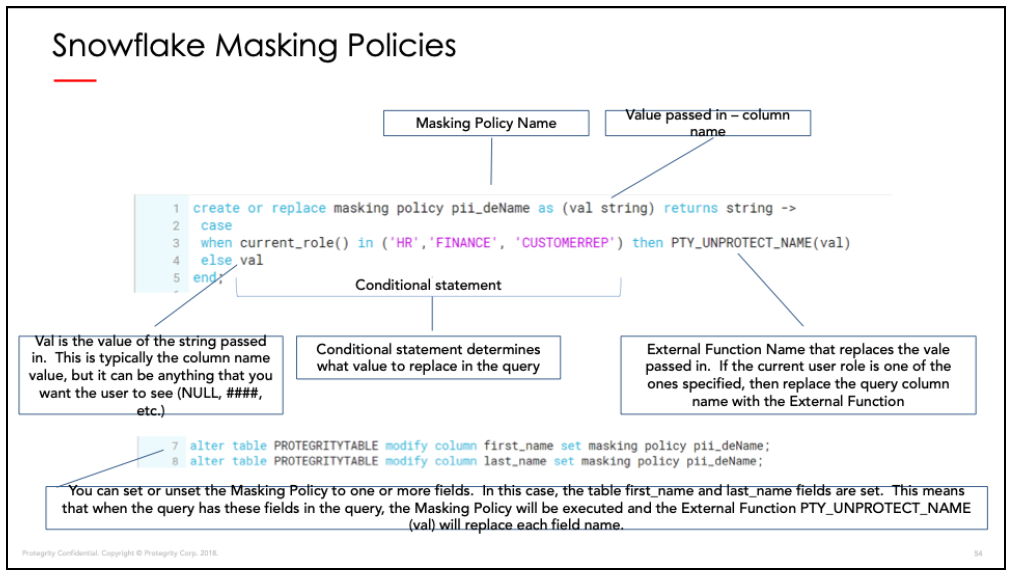
Azure Function apps offer different hosting plans that directly impact the performance, scalability, and cost of Cloud Protect deployments. Understanding these plans and their characteristics is essential for optimizing your data protection operations.
Azure Functions provides several hosting options, each with different characteristics:
The Consumption plan provides automatic scaling and charges only for compute resources used during function execution. While cost-effective for sporadic workloads, this plan has limitations:
The Premium plan is the recommended option for Cloud Protect on Azure. It provides enhanced performance and enterprise-grade features:
The Elastic Premium plan extends the Premium plan with additional elasticity and performance optimization:
Cloud Protect on Azure recommends using either Premium or Elastic Premium plans for production deployments. These plans provide:
When deploying Cloud Protect on Azure Functions, consider the following factors:
Select appropriate instance sizes based on your workload:
Configure scaling parameters to match your protection requirements:
While Premium and Elastic Premium plans have higher baseline costs compared to Consumption, they provide:
For Cloud Protect deployments handling sensitive data with compliance requirements, the Premium/Elastic Premium investment ensures reliable, performant data protection operations.
Log forwarder architecture is optimized to minimize the amount of connections and reduce the overall network bandwidth required to send audit logs to ESA. This is achieved with batching and aggregation taking place on two levels.
The first level is in protect function instances, where audit logs from consecutive requests to an instance are batched and aggregated. The second level of batching takes place in Azure Event Hub instance where log records from different protect function instances are additionally batched and sent to log forwarder function where they are aggregated.
These sections show how to configure the deployment to accommodate different patterns of anticipated audit log stream. It also shows how to monitor deployment resources to detect problems so that audit records are not lost.
PTY_CORE_FLUSHINTERVAL: Defines for how long audit logs are aggregated before they are sent to Azure Event Hub. Default value is ten seconds. Audit logs are always aggregated into one minute buckets, therefore a value greater than sixty seconds will affect mostly the batching interval.
MAX_WAIT_TIME: Defines for how long aggregated audit logs are batched before they are sent to Azure Event Hub. Default value is ten seconds.
Increasing MAX_WAIT_TIME may result in:
Increased latency or lag of audit logs arriving to Event Hub and therefore ESA
Increased throughput rates due to fewer network requests overall
Increased aggregation rates for values up to one minute Lowering MAX_WAIT_TIME may result in:
Reduced latency or lag for audit logs to arrive to Event Hub and therefore ESA
Reduced throughput rates due to higher number of network requests overall
Reduced aggregation rates for values up to one minute It is not recommended to set MAX_WAIT_TIME lower in production workloads as it may overload the Event Hubs service. Lowering MAX_WAIT_TIME may be beneficial for speeding up log delivery to ESA in dev/test environments.
Azure Event Hub Metrics: Any positive value in ‘Throttled Requests’ metric indicates that audit logs rate from protect function is too high. The recommended actions may include:
Azure Event Hub Metrics for DLQ Event Hub: Any positive value in ‘Incoming Messages’ metric indicates that not all audit logs are being delivered to ESA. Review whether connection to ESA is set up in Audit Log Forwarder Installation
Protect Function Logs: If protect function is unable to send logs to Event Hub, it will log the following message:
Failed to forward {n} events to Event Hub
Count number of protect operations: Query logs in Log Analytics workspace of Protect Service or Log Forwarder functions:
traces
| where timestamp >= ago(20h)
| where message has 'additional_info'
| parse message with * "cnt\":" Count: long * ",\"correlation" *
| summarize count_sum = sum(Count)
View number of function instances on a graph: Query logs in Log Analytics workspace of Protect Service or Log Forwarder functions:
requests
| summarize InstanceCount = dcount(cloud_RoleInstance) by bin(timestamp, 1s)
| where timestamp >= ago(2h)
| order by timestamp desc
| render timechart
Audit records and application logs stream to Azure Storage Account. Cloud Protect uses a JSON format for audit records that is described in the following sections.
You can analyze and alert on audit records using Protegrity ESA or Azure Application Insights. For more information about forwarding your audit records to ESA, contact Protegrity. Azure Application Insights contains only a sample of the audit records. The complete audit records are written to Azure Storage Account. For more information about Azure Application Insights,, refer to the Azure Application Insights overview.
For more information about audit records, refer to the Protegrity Analytics Guide.
The audit record format has been altered in version 3.1 of the protector to provide more information.
| Field | Description |
|---|---|
| additional_info.deployment_id | The deployment_id contains the name of the Protect Function. It is automatically set based on the cloud-specific environment variables assigned to the Protect Function. This allows identifying the Cloud Protect deployment responsible for generating audit log. |
| additional_info.cluster | (Optional) Redshift cluster ARN |
| additional_info.description | A human-readable message describing the operation |
| additional_info.query_id | (Optional) Identifies the query that triggered the operation |
| additional_info.request_id | (Optional) AWS Lambda request identifier |
| cnt | Number of operations, may be aggregated |
| correlationid | (Deprecated) Use additional_info instead |
| level | Log severity, one of: SUCCESS, WARNING, ERROR, EXCEPTION |
| logtype | Always “Protection” |
| origin.ip | The private IP address of the compute resource that operates the Protect Function and is responsible for generating the log entry.NoteThe IP address is private, meaning it is used for internal network communication and is not accessible directly from the public internet.When Log Forwarding is enabled the IP address may be aggregated into minimal CIDR blocks. |
| origin.hostname | Hostname of the system that generated the log entry |
| origin.time_utc | UTC timestamp when the log entry was generated |
| protection.audit_code | Audit code of the protect operation; see the log return codes table in the Protegrity Troubleshooting Guide |
| protection.dataelement | Data element used for the policy operation |
| protection.datastore | Name of the data store corresponding to the deployed policy |
| protection.mask_setting | (Optional) Mask setting from policy management |
| protection.operation | Operation type, one of: Protect, Unprotect, Reprotect |
| protection.policy_user | User that performed the operation |
| protector.core_version | Internal core component version |
| protector.family | Always “cp” for Cloud Protect |
| protector.lambda_version | Protector Lambda application version. |
| protector.pcc_version | Internal pcc component version |
| protector.vendor | Identifies the cloud vendor and the database vendor |
| protector.version | Protector version number |
| signature.checksum | Hash value of the signature key ID used to sign the log message when the log is generated |
| signature.key_id | Key used to sign the log message when the log is generated |
The following are sample audit messages:
Protect Success:
{
"additional_info": {
"deployment_id": "Protegrity-Protect-function-deployment-id",
"description": "Data protect operation was successful.",
"query_id": "sf-query-id:01978dbc-0582-d7e4-0000-002a3603a20d",
"request_id": "8476a536-e9f4-11e8-9739-2dfe598c3fcd"
},
"cnt": 4000,
"correlationid": "sf-query-id:01978dbc-0582-d7e4-0000-002a3603a20d",
"logtype": "Protection",
"level": "SUCESS",
"origin": {
"hostname": "localhost",
"ip": "127.0.0.1",
"time_utc": 1635363966
},
"protection": {
"dataelement": "deAddress",
"operation": "Protect",
"audit_code": 6,
"datastore": "SAMPLE_POLICY",
"policy_user": "test_user"
},
process":{
"name":"protect",
"id":"13",
"module":"coreprovider",
"thread_id":"573580544",
"user":"sbx_user1051",
"platform":"\"Linux_x64\"",
"version":"UNKNOWN"
},
"client": {
"ip":"169.254.62.117"
},
"protector": {
"family": "cp",
"version": "4.0.0.102",
"vendor": "aws.snowflake",
"datastore":"SAMPLE_POLICY",
"pcc_version": "4.0.0.9",
"core_version": "2.1.4+0.g93016.2.1",
"lambda_version":"4.0.1"
},
"signature": {
"key_id": "95f5a194-b0a4-4351-a",
"checksum": "B324AF7C56944D91C47847A77C0367C594C0B948E7E75654B889571BD4F60A71"
}
}
User permission denied:
{
"additional_info": {
"deployment_id": "Protegrity-Protect-function-deployment-id",
"description": "The user does not have the appropriate permissions to perform the requested operation.",
"query_id": "sf-query-id:01978dbc-0582-d7e4-0000-002a3603a20d",
"request_id": "8476a536-e9f4-11e8-9739-2dfe598c3fcd"
},
"cnt": 4000,
"correlationid": "sf-query-id:01978dbc-0582-d7e4-0000-002a3603a20d",
"logtype": "Protection",
"level": "ERROR",
"origin": {
"hostname": "localhost",
"ip": "127.0.0.1",
"time_utc": 1635363966
},
"protection": {
"dataelement": "deAddress",
"operation": "Protect",
"audit_code": 3,
"datastore": "SAMPLE_POLICY",
"policy_user": "test_user"
},
process":{
"name":"protect",
"id":"13",
"module":"coreprovider",
"thread_id":"573580544",
"user":"sbx_user1051",
"platform":"\"Linux_x64\"",
"version":"UNKNOWN"
},
"client": {
"ip":"169.254.62.117"
},
"protector": {
"family": "cp",
"version": "4.0.0.102",
"vendor": "aws.snowflake",
"datastore":"SAMPLE_POLICY",
"pcc_version": "4.0.0.9",
"core_version": "2.1.4+0.g93016.2.1",
"lambda_version":"4.0.1"
},
"signature": {
"key_id": "95f5a194-b0a4-4351-a",
"checksum": "A216797C56944D91C47847A77C0367C594C0B948E7E75654B889571BD4F60A71"
}
}
Data element not found:
{
"additional_info": {
"deployment_id": "Protegrity-Protect-function-deployment-id",
"description": "The data element could not be found in the policy.",
"query_id": "sf-query-id:01978dbc-0582-d7e4-0000-002a3603a20d",
"request_id": "8476a536-e9f4-11e8-9739-2dfe598c3fcd"
},
"cnt": 4000,
"correlationid": "sf-query-id:01978dbc-0582-d7e4-0000-002a3603a20d",
"logtype": "Protection",
"level": "ERROR",
"origin": {
"hostname": "localhost",
"ip": "127.0.0.1",
"time_utc": 1635363966
},
"protection": {
"dataelement": "deAddress",
"operation": "Protect",
"audit_code": 2,
"datastore": "SAMPLE_POLICY",
"policy_user": "test_user"
},
process":{
"name":"protect",
"id":"13",
"module":"coreprovider",
"thread_id":"573580544",
"user":"sbx_user1051",
"platform":"\"Linux_x64\"",
"version":"UNKNOWN"
},
"client": {
"ip":"169.254.62.117"
},
"protector": {
"family": "cp",
"version": "4.0.0.102",
"vendor": "aws.snowflake",
"datastore":"SAMPLE_POLICY",
"pcc_version": "4.0.0.9",
"core_version": "2.1.4+0.g93016.2.1",
"lambda_version":"4.0.1"
},
"signature": {
"key_id": "95f5a194-b0a4-4351-a",
"checksum": "AF09217C56944D91C47847A77C0367C594C0B948E7E75654B889571BD4F60A71"
}
}
The security policy maintains a No Access Operation, configured in an ESA, which determines the response for unauthorized unprotect requests.
The following table describes the result returned in the response for the various no access unprotect permissions.
| No Access Operation | Data Returned |
|---|---|
| Null | null |
| Protected | (protected value) |
| Exception | Query will fail with an exception |
You can download the latest version of the deployment package from https://my.protegrity.com. Navigate to Data Protection > Cloud Protect to download the latest version.
After downloading the deployment package from the Protegrity Portal, go to Azure console. Navigate to the storage account that was previously created to upload deployment artifacts (see: Agent Policy Blob Container).
Upload the following artifacts to the Azure storage container:
After upload is complete, note the blob url for each file. Blob URL may be found in the blob properties.
Record Blob URL values below
New Protect Function Blob URL: ___________________
New Log Forwarder Function Blob URL: ___________________
New Agent Function Blob URL: ___________________
Perform the following steps to upgrade the Policy Agent, Protect, and Log Forwarder Functions separately.
App Function Timer Trigger is used to periodically run Protegrity Agent Function to synchronize policy from ESA. The trigger must be disabled temporarily for the time of the upgrade process.
Follow the steps below to disable the Agent Function Timer Trigger.
From Azure Console, go to Function App service and select Protegrity Agent Function.
Navigate to Overview.
The functions list should contain agent function with Trigger type Timer and status Enabled.
Click on the three dots in the same row as the agent function. Then select Disable.
If Policy Agent version is less than version 4, a new installation must be created. Carefully observe the below points:
From Azure console, navigate to Function App service and select agent function app. Navigate to Settings > Environment variables.
Click on WEBSITE_RUN_FROM_PACKAGE configuration entry.
Save existing URL. You may need it to rollback upgrade.
WEBSITE_RUN_FROM_PACKAGE: _______________
Replace URL with New Agent Function Blob URL.
Click Apply then select Apply and Confirm to finalize.
Using menu on the left, navigate to Overview. Stop the function using Stop button at the top. Then start it again.
In the next section the Agent function will be tested to make sure it works as expected.
(Optional) If you need to rollback to older version of Agent Function, replace WEBSITE_RUN_FROM_PACKAGE with URL recorded in previous steps.
Policy agent generates a backup of pulled policy when triggered. The policy will then be deployed to Protect and Log Forwarder functions. Deployment of policies to functions should be disabled during the upgrade process.
Follow the steps below to disable policy deployment:
From Azure Console, navigate to Policy Agent Function App
Navigate to Settings > Environment variables.
set DISABLE_DEPLOY to 1 if it is not already set.
Stop/Start the Agent function. It may take a few minutes for the function to start.
Follow the steps below to run the upgraded policy agent to refresh latest backup policy. Record the latest backup policy URL for later upgrade steps.
From Azure Console, navigate to the Policy Agent Function App
Navigate to the agent Test/Run feature as described in Test Agent Function Installation.
Run the policy agent. Verify the agent executed successfully by carefully inspecting the logs.
Use the following Azure Blob url from your Policy Agent Function Settings > Environment variables
AZURE_POLICY_BLOB_URL
upgraded_agent_policy_blob_url: _______________________
Diagram below illustrates upgrade steps.
Create Staging Deployment Slot Creating new deployment slot allows updating the function without interruptions to the existing traffic.
Load Production Policy and Test New Protect Function In Staging
Finalize Protector upgrade Upgraded Protect Function can now be swapped in to production deployment slot to serve production traffic.
Creating new deployment slot allows updating the function without interruptions to the existing traffic.
From Azure console, navigate to Function App service and select the Protect Function App to upgrade. Navigate to Deployments > Deployment Slots.
Click Add slot. Specify slot name.
Click Add. Wait for the slot to be created.
After the slot is added, select Close to close the dialog box.
There should be a new slot available in the list of deployment slots. You will use this deployment slot as staging for the upgraded function. After upgrade is done and tested, you will swap staging slot with production slot.
Click on the new deployment slot. This will open the newly created replica of Cloud Protect Function.
Copy the function URL from the overview window.
Staging Protect Function URL: ________________
Navigate to Identity section under Settings.
If your installation utilizes System Assigned Identity:
Select System Assigned tab and switch Status On. Click Save.
This will generate the Object ID for the newly deployed function in the deployment slot.
Add Role Assignments to the identity as described in section Function System-Assigned Managed Identity
Use the Object ID to update Key Vault policy to allow function in the deployment slot to use policy encryption key. See Protect Function Key Vault Access Policies for instructions how to update Key Vault policy.
If your installation utilizes User Assigned Identity:
Select User Assigned tab
Select Add. Choose the identity in use on the production function, then complete by selecting Add again.
Navigate to App Keys section from the menu on the left. Record default key value under Host Keys section.
Staging Protect Function Default Host Key: ________________
Navigate to the staging Function App Settings > Environment variables
Click on WEBSITE_RUN_FROM_PACKAGE configuration entry.
Replace value with New Protect Function Blob URL.
Set EVENTHUB_NAME to the output value recorded in Install Log Forwarder via ARM template for the newly deployed log forwarder.
Set EventHub__fullyQualifiedNamespace to the output value recorded in Install Log Forwarder via ARM template.
Click Apply, then Apply to finalize.
Navigate to the new staging Protect function Settings > Environment variables
Set AZURE_POLICY_BLOB_URL environment variable to the upgraded_agent_policy_blob_url value recorded in previous steps.
Start/Stop the protect function.
Test New Protect Function in staging. You can use curl command below, replacing Staging Protect Function URL and Staging Protect Function Default Host Key with values recorded in previous section.
curl -X POST "<Staging Protect Function URL>/api/Protect" -k \
-H 'sf-custom-X-Protegrity-HCoP-Rules: {"jsonpaths":[{"op_type":"unprotect","data_element":"alpha"}]}' \
-H 'sf-context-current-user: test' \
-H 'sf-external-function-current-query-id: test-id' \
-H 'x-functions-key: <Staging Protect Function Default Host Key>' \
-H 'Content-Type: application/json' \
-d '{
"data": [
["0", "UtfVk UHgcD!"]
]
}'
curl -X POST "<Protect Function URL>/api/v1/protect" -k \
-H 'x-functions-key: <Protect Function app key>' \
-H 'Content-Type: application/json' \
-d '{
"data": ["test"],
"user": "test",
"data_element": "test"
}'
Upgraded Protect Function can now be swapped in to production deployment slot to serve production traffic.
Go to your main Protect Function.
Select deployment slots.
Select Swap.
Select staging Protect Function slot as source and production Function as target.
Click swap and wait until the functions are swapped.
If you need to rollback swap the application slots again.
Disabling the Event Hub trigger will prevent audit log delivery during the upgrade process. This reduces the chance for any duplicate or lost audit logs. Later steps will indicate when this trigger may be re-enabled.
Follow the steps below to disable the Event Hub trigger:
From Azure Console, go to Function App service and select Protegrity Log Forwarder Function.
Navigate to Overview.
The functions list should contain AuditLogForwarder function with Trigger type Event Hub and Status Enabled.
Click on the three dots in the same row as the AuditLogForwarder function. Then select Disable.
Creating new deployment slot allows updating the function such that it may easily be rolled back. Log Forwarder Function will be disabled during the upgrade process. Logs generated during this time will be processed once Log Forwarder is re-enabled
From Azure console, navigate to Function App service and select the Log Forwarder Function App to upgrade. Navigate to Deployments > Deployment Slots.
Click Add slot. Specify slot name.
Click Add. Wait for the slot to be created.
After the slot is added, select Close to close the dialog box.
There should be a new slot available in the list of deployment slots. You will use this deployment slot as staging for the upgraded function. After upgrade is done, you will swap staging slot with production slot.
Click on the new deployment slot. This will open the newly created replica of Log Forwarder Function.
Navigate to the staging Function App environment variable settings Settings > Environment variables
Click on WEBSITE_RUN_FROM_PACKAGE configuration entry.
Replace value with New Log Forwarder Function Blob URL. Click Apply.
Click on AZURE_POLICY_BLOB_URL configuration entry.
Replace value with upgraded_agent_policy_blob_url. Click Apply.
Click Apply and Confirm to push the configuration changes.
Upgraded Log Forwarder Function will be swapped into production deployment slot to serve production traffic and re-enabled,
Go to your main Log Forwarder Function.
Select deployment slots.
Select Swap.
Select staging Log Forwarder Function slot as source and current Function as target.
Click Start Swap and wait until the functions are swapped.
If you need to rollback, swap the application slots again.
Go to your main Log Forwarder Function.
Navigate to environment variable settings Settings > Environment variables
Click on AzureWebJobs.AuditLogForwarder.Disabled configuration entry.
Replace value with false. Click Apply then Apply and Confirm to finalize.
Skip this step if changes were not made to the DISABLE_DEPLOY setting in previous upgrade steps
Navigate to Agent function Settings > Environment variables
Set DISABLE_DEPLOY to 0.
apply changes and restart the Agent Function App
If the Agent Function Timer Trigger was disabled at the beginning of the upgrade process, you must re-enabled it. Follow the steps below to enable Policy Agent Timer Trigger.
Navigate back to Protegrity Agent Function.
Select Overview.
Click on the three dots in the same row as the agent function in the list of functions. Then select Enable.
This guide describes how to configure the Protegrity Policy Agent and Log Forwarder to connect to a Protegrity Provisioned Cluster (PPC), highlighting the differences from connecting to ESA.
| Feature | ESA 10.2 | PPC (this guide) |
|---|---|---|
| Datastore Key Fingerprint | Optional/Recommended | Required |
| CA Certificate on Agent | Optional/Recommended | Optional/Recommended |
| CA Certificate on Log Forwarder | Optional/Recommended | Not supported |
| Client Certificate Authentication from Log Forwarder | Optional/Recommended | Not supported |
| IP Address | ESA IP address | PPC address |
curl, kubectl installed.Follow these instructions as a guide for understanding specific inputs for Policy Agent integrating with PPC:
Obtain the Datastore Key Fingerprint
To retrieve the fingerprint for your Policy Agent:
Retrieve public key from the Cloud Provider Key Management service for the policy encryption key created in pre-configuration:
Escape the new line characters in the downloaded public key for use in the next step - for example:
awk 'NF {printf "%s\\n",$0}' "<public_key_file>" > "new-line-escaped-public-key.pem"
cat new-line-escaped-public-key.pem
Export key fingerprint using the PPC API as indicated in the curl example below:
curl -k -H "Authorization: Bearer ${TOKEN}" -X POST https://${HOST}/pty/v2/pim/datastores/1/export/keys -H "Content-Type: application/json" --data '{
"algorithm": "RSA-OAEP-256",
"description": "example-key-from-key-management",
"pem": "<value of new-line-escaped-public-key>"
}'
Sample Output:
{"uid":"1","algorithm":"RSA-OAEP-256","fingerprint":"4c:46:d8:05:35:2e:eb:39:4d:39:8e:6f:28:c3:ab:d3:bc:9e:7a:cb:95:cb:b1:8e:b5:90:21:0f:d3:2c:0b:27","description":"example-key-from-kms"}
Record the value for fingerprint and configure the Policy Agent:
Set the environment variable PTY_DATASTORE_KEY in the Policy Agent Lambda function to the fingerprint value.
Set the environment variable PTY_DATASTORE_KEY in the Policy Agent Function App to the fingerprint value.
Set the variable in Policy Agent main.tf pty_datastore_key to the fingerprint value and apply the changes.
Retrieve the PPC CA Certificate
To obtain the CA certificate from PPC:
kubectl -n api-gateway get secret ingress-certificate-secret -o jsonpath='{.data.ca\.crt}' | base64 -d > CA.pem
Use the ProtegrityCA.pem that was returned as described in Policy Agent Installation.
Configure the PPC Address
Use the PPC address in place of the ESA IP address wherever required in your configuration.
PTY_ESA_CA_SERVER_CERT is not provided.Cloud Protect Function exposes USERNAME_REGEX configuration to allow extraction of policy username from user in the request.
USERNAME_REGEX Function Environment configuration
The USERNAME_REGEX environment variable can be set to contain regular expression with one capturing group. This group is used to extract the username. Examples below show different regular expression values and the resulting policy user.
USERNAME_REGEX | User in the request | Effective Policy User |
|---|---|---|
Not Set | ||
juliet.snow/ad_postfix | juliet.snow/ad_postfix | |
| juliet.snow | |
juliet.snow/ad_postfix | juliet.snow |
Method: Tokenization | ||
Type: ALPHA | ||
| ||
Snowflake Data Types | Snowflake Max Size | Protegrity Max Size |
VARCHAR | 16M (16,777,216 bytes) | 4K (4,096 bytes) |
CHAR | ||
STRING | ||
TEXT | ||
| ||
External Function Sample Definitions: | ||
| ||
| ||
| ||
Sample EF Calls: | ||
| ||
| ||
| ||
Snowflake Masking Policy example: | ||
| ||
| ||
Method: Tokenization | ||
Type: NUMERIC | ||
| ||
Snowflake Data Types | Snowflake Max Size | Protegrity Max Size |
NUMBER |
|
|
DECIMAL | ||
INTEGER | ||
DOUBLE | ||
| ||
External Function Sample Definitions: | ||
| ||
| ||
| ||
Sample EF Calls: | ||
| ||
| ||
| ||
Snowflake Masking Policy example: | ||
| ||
| ||
Method: Tokenization | ||
Type: DATE YYYY-MM-DD | ||
| ||
Snowflake Data Types | Snowflake Max Size | Protegrity Max Size |
DATE (any supported format) | 10 bytes | 10 bytes |
| ||
External Function Sample Definitions: | ||
| ||
| ||
Sample EF Calls: | ||
| ||
| ||
| ||
| ||
| ||
| ||
| ||
| ||
Snowflake Masking Policy example: | ||
| ||
| ||
Cutover Dates of the Proleptic Gregorian Calendar: no issues (no conversions performed by Snowflake)
Method: Tokenization | ||
Type: DATETIME | ||
| ||
Snowflake Data Types | Snowflake Max Size | Protegrity Max Size |
DATE | 10 bytes | 29 bytes |
DATETIME | 29 bytes | |
TIMESTAMPNTZ* | ||
TIMESTAMP_NTZ* | ||
TIMESTAMP WITHOUT TIME ZONE* | ||
| ||
External Function Sample Definitions: | ||
| ||
| ||
Sample EF Calls: | ||
| ||
| ||
| ||
| ||
| ||
| ||
| ||
| ||
| ||
Snowflake Masking Policy example: | ||
| ||
| ||
Method: Tokenization | ||
Type: DECIMAL | ||
| ||
Snowflake Data Types | Snowflake Max Size | Protegrity Max Size |
NUMBER(N,M) | 38 digits | 36 digits |
NUMERIC(N,M)* | ||
DECIMAL(N,M)* | ||
| ||
External Function Sample Definitions: | ||
| ||
| ||
Sample EF Calls: | ||
| ||
| ||
| ||
Snowflake Masking Policy example: | ||
| ||
| ||
Method: Tokenization | ||
Type: INTEGER | ||
| ||
Snowflake Data Types | Snowflake Max Size | Protegrity Max Size |
NUMBER | 38 digits | 2 bytes 4 bytes 8 bytes |
NUMERIC* | ||
INT* | ||
INTEGER* | ||
BIGINT* | ||
SMALLINT* | ||
TINYINT* | ||
BYTEINT* | ||
| ||
External Function Sample Definitions: | ||
| ||
| ||
Sample EF Calls: | ||
| ||
| ||
| ||
Snowflake Masking Policy example: | ||
| ||
| ||
**Recommended approach for protecting whole numbers fields in Snowflake
| When values are | …then use the following Data Element: |
|---|---|
| Between -32768 and 32767 | INTEGER (2 bytes) |
| Between -2147483648 and 2147483647 | INTEGER (4 bytes) |
| Between -9223372036854775808 and 9223372036854775807 | INTEGER (8 bytes) |
| < -9223372036854775808 or > 9223372036854775807 | DECIMAL |
When in doubt, use DECIMAL for any numeric range.
Permissions below are required to install Protegrity service using ARM template.
All permissions in the table must be granted with the Resource group scope.
Permissions | Description | Built-In Azure Role |
|---|---|---|
| Read access to monitoring data and settings | Monitoring Reader |
| Write and manage access to monitoring data and settings | Monitoring Contributor |
| Write and manage access to web apps | Website Contributor |
| Manage and assign managed identities NoteThese permissions are only required when user assigned identity is used. | Managed Identity Operator |
| Manage and validate deployments | Deployment Contributor |
Log Forwarder service ARM deployment requires additional permissions below:
Permissions | Description | Built-In Azure Role |
|---|---|---|
| Allow for the creation, update, and deletion of Event Hub namespaces, event hubs within those namespaces, and their network rule sets, enabling full management of Event Hub resources. Note: These permissions are only required when deploying new event Hub. | Event Hubs Contributor |
| Read monitoring data and metrics, including Event Hub namespace data. | Monitoring Reader |
The additional permissions listed below are required when API management is part of the deployment.
Permissions | Description | Built-In Azure Role |
|---|---|---|
| Create or update API Management service instances, APIs, diagnostics, API operations, operation policies, backends, loggers, tenant policies, and API diagnostics. | API Management Service Contributor |
| Read metadata for API Management service instances and get the status of long-running operations. | API Management Service Reader |
ESA controls which policy is deployed to protector using concept of data store. A data store may contain a list of IP addresses identifying servers allowed to pull the policy associated with that specific data store. Data store may also be defined as default data store, which allows any server to pull the policy, provided it does not belong to any other data stores. Node registration occurs when the policy server (in this case the policy agent) makes a policy request to ESA, where the agent’s IP address is identified by ESA.
Policy agent function source IP address used for node registration on ESA depends on ESA hubcontroller configuration ASSIGN_DATASTORE_USING_NODE_IP and the PTY_ADDIPADDRESSHEADER configuration exposed by the agent function.
The function service uses multiple network interfaces, internal network interface with ephemeral IP range of 169.254.x.x and external network interface with IP range described in Function app outbound IP addresses section under function configuration. By default, when agent function is contacting ESA to register node for policy download, ESA uses agent function outbound IP address. This default behavior is caused by the default ESA hubcontroller configuration ASSIGN_DATASTORE_USING_NODE_IP=false and agent default configuration PTY_ADDIPADDRESSHEADER=yes.
In some cases, when there is a proxy server between the ESA and agent function, the desirable ESA configuration is ASSIGN_DATASTORE_USING_NODE_IP=true. and PTY_ADDIPADDRESSHEADER=no which will cause the ESA to use proxy server IP address.
The table below shows how the hubcontroller and agent settings will affect node IP registration on ESA.
| Agent source IP | Agent Function Outbound IP | Proxy IP | ESA config - ASSIGN_DATASTORE_USING_NODE_IP | Agent function config - PTY_ADDIPADDRESSHEADER | Agent node registration IP |
|---|---|---|---|---|---|
| 169.254.144.81 | 20.75.43.207 | No Proxy | true | yes | 169.254.144.81 |
| true | no | 20.75.43.207 | |||
| false | yes | 20.75.43.207 | |||
| false | no | 20.75.43.207 | |||
| 169.254.144.81 | 20.75.43.207 | 34.230.42.110 | true | yes | 169.254.144.81 |
| true | no | 34.230.42.110 | |||
| false | yes | 34.230.42.110 | |||
| false | no | 34.230.42.110 |
Agent Function App IP addresses may be useful for configuring ESA policy store and allowing traffic between Agent and ESA.
To obtain the list of Outbound IP addresses:
Agent Function must be configured with parameters recorded in steps above.
To configure Function:
Open Function App service from the Azure console. Select the Function App created for policy agent in previous steps.
Navigate to Settings > Environment variables .
On the App Settings pane, click on Show values to reveal all configuration values
To modify multiple parameters, click the pencil icon Advanced edit at the top. Alternatively you may click on the environment variable name to edit single values.
Modify parameters according to the table below. If configuration has a default value you don’t have to change it
Parameter | Notes |
|---|---|
AZURE_KEY_VAULT_NAME | |
AZURE_POLICY_BLOB_URL | URL of the Azure Blob file which is used to store Protegrity security policies for protector consumption. See ProtectFuncPolicyBlobUrl in Protect Function Policy Blob |
AZURE_RETAIN_POLICY_BLOB | The amount of policy backups to retain. Default: 10. Allowed values: -1, >1. Value of -1 will disable cleanup of backup policies. |
PROTEGRITY_PROTECT_FUNCTION | Protegrity function to be updated when new policy is deployed. Provide a comma separated list of protect function app names for updating multiple protectors: |
PTY_ESA_IP | |
AZURE_ESA_CREDENTIALS_SECRET_ID | |
AZURE_ENCRYPTION_KEY_ID | |
PEP_CONFIG_CASE_SENSITIVE | Default: No Allowed values: yes/no Specifies whether policy usernames should be case sensitive |
PTY_ADDIPADDRESSHEADER | When enabled, agent will send its source IP address in the request header. This configuration works in conjunction with ESA hubcontroller configuration ASSIGN_DATASTORE_USING_NODE_IP (default=false). See Associating ESA Data Store With Cloud Protect Agent for more information. Default: yes Allowed values: yes no |
PEP_CONFIG_EMPTY_STRING | Default: empty Allowed values: null empty Determines outcome of empty value operation. For example, (un)protect(’’) -> null (un)protect(’’) -> |
DISABLE_DEPLOY | Default: 0 |
POLICY_PULL_TIMEOUT | Default: 20s |
ESA_CONNECTION_TIMEOUT | Default: 5s |
LOG_LEVEL | Default: INFO. Allowed values: DEBUG, INFO, WARNING, ERROR |
AZURE_SUBSCRIPTION_ID | Default: Same as ARM Resource group |
AZURE_RESOURCE_GROUP_NAME | Default: Same as ARM Resource group |
POLICY_DOWNLOAD_CRON_EXPRESSION | Describes how often Agent Function will run Default: 0 0 * * * * (Every hour) |
PTY_ESA_CA_SERVER_CERT | ESA self-signed CA certificate used by policy Agent function to ensure ESA is the trusted server. Recorded in step Certificates on ESA In case ESA is configured with publicly signed certificates, the PTY_ESA_CA_SERVER_CERT configuration will be ignored. |
PTY_ESA_CREDENTIALS_FUNCTION | Instead of supplying AZURE_ESA_CREDENTIALS_SECRET_ID environment variable, ESA credentials can be provided by a custom Azure Function App. Provide a value recorded for EsaCredentialsFnUrl |
PTY_ESA_CREDENTIALS_FUNCTION_KEY | When ESA credentials are provided by a custom Azure Function App, Policy Agent can request credentials using function app key. Provide a value recorded for EsaCredentialsFnKey |
PTY_ESA_CREDENTIALS_FUNCTION_KEY_SECRET | When ESA credentials are provided by a custom Azure Function App, Policy Agent can request credentials using function app key stored in Azure Key Vault. Provide a value recorded for EsaCredentialsFnKeySecretName |
PTY_ESA_CREDENTIALS_FUNCTION_SCOPE | When ESA credentials are provided by a custom Azure Function App, Policy Agent can request credentials using its own identity. Provide a value here recorded for EsaCredentialsFnAppIdUri appended with /.default to create authentication scope. Review Microsoft identity platform default scope |
PTY_SYNC_DATASTORE | NoteThis configuration is not applicable for ESA versions lower than 10.2. |
PTY_DATASTORE_KEY | NoteThis configuration is not applicable for ESA versions lower than 10.2.The export key is the public part of an asymmetric key pair created in a Create Policy Encryption Key. A user with Security Officer permissions adds the public key to the data store in ESA via Policy Management > Data Stores > Export Keys. The fingerprint can then be copied using the Copy Fingerprint icon next to the key. Refer to Exporting Keys to Datastore for details. NoteFor PPC deployments, see PPC Appendix: Policy Agent Certificate and Key Guidance for details on obtaining and using the datastore key fingerprint. |
Parameter | Notes |
|---|---|
AZURE_CLIENT_ID | Sets the Managed Identity Client ID for Function App runtime. System-Assigned Identity is used when variable is not set. |
APPLICATIONINSIGHTS_AUTHENTICATION_STRING | Define identity for Application Insights access. Managed Identity Client ID is provided to this setting with Function App Managed Identity ARM template parameter. See the corresponding Azure AD Authentication documentation: Azure AD authentication |
APPLICATIONINSIGHTS_CONNECTION_STRING | Connection String for Application Insights instance. See the corresponding Azure Connection String documentation: Connection strings |
FUNCTIONS_EXTENSION_VERSION | Azure Functions extension version |
FUNCTIONS_WORKER_RUNTIME | Runtime of the function |
WEBSITE_RUN_FROM_PACKAGE | URL to the zip file in blob storage with function runtime source |
WEBSITE_RUN_FROM_PACKAGE_BLOB_MI_RESOURCE_ID | Managed Identity used to load function runtime source |
AzureWebJobsStorage__blobServiceUri | URL of the storage account which hosts the blob identified in WEBSITE_RUN_FROM_PACKAGE |
Create a policy encryption key.
To create policy encryption key:
From Azure console, navigate to Key Vaults and select Key Vault created in Key Vault.
Under Objects, select Keys.
Click Generate/Import.
Specify the following:
a. Key name for the Name field.
b. RSA for Key type.
c. 2048 for RSA key size.
d. Set Enabled toggle to Yes.
Select Create.
Click on the key name after creation is complete, then click on the key identifier row under CURRENT VERSION.
Copy the full URL value of Key Identifier. Record it for later use:
Policy Encryption Key ID (PolicyEncryptionKey): _________________
By default, ESA is configured with self-signed certificates, which can only be validated using self-signed CA certificate supplied in policy agent Cloud Function Environment variables configuration.
In case ESA is configured with publicly signed certificates, this section can be skipped since the agent function will use public CA to validate ESA certificates.
To obtain self-signed CA certificate from ESA:
Log in to ESA Web UI.
Select Settings > Network > Manage Certificates.
Hover over Server Certificate and click on download icon to download the CA certificate.
After certificate is downloaded, open the PEM file in text editor and replace all new lines with escaped new line: \n.
To escape new lines from command line, use one of the following commands depending on your operating system:
Linux Bash:
awk 'NF {printf "%s\\n",$0;}' ProtegrityCA.pem > output.txt
Windows PowerShell:
(Get-Content '.\ProtegrityCA.pem') -join '\n' | Set-Content 'output.txt'
Record the certificate content with new lines escaped.
ESA CA Server Certificate (EsaCaCert): ___________________
This value will be used to set PTY_ESA_CA_SERVER_CERT variable in the Policy Agent Function Configuration section Configure Function
For more information about ESA certificate management refer to Certificate Management Guide in ESA documentation.
Policy Agent Function requires ESA credentials to be provided as one of the two options:
Policy Agent Function uses Key Vault as secure store for sensitive information like ESA username and password.
Create ESA credentials secrets:
Navigate to Key Vault.
Under Objects, select Secrets > Generate/import.
Select Manual, then type in valid json as shown in the example for Secret value.
{"username": "<policy_export_user>", "password": "<password>"}
Select Create.
Navigate to the secret details in Key Vault by selecting the newly created secret.
Inspect the current secret version properties by selecting the current version.
Copy the Secret Identifier value. For example https://<myvault>.vault.azure.net/secrets/<mysecret>/abcdefgxyz8edef595adaehij0d99123.
Record the Secret Identifier for later use.
Policy Agent Function requests ESA username and password from a custom Azure Function App, further referred to as ESA Credentials function. This method may be used to get the username and password from external vaults.
There are four options for configuring Policy Agent authorization with ESA Credentials function: Option 1, Option 2, Option 3 and Option 4. Only one option is expected to be configured at a time.
Create Azure HTTP triggered ESA Credentials function using any supported runtime.
a. There is no input needed.
b. The function must accept an HTTP POST request.
c. The function must return the following response schema
```
response:
type: json object
properties:
username: string
password: string
```
For example,
```
{"username": "admin", "password": "Password1234"}
```
Configure Policy Agent to use ESA Credentials function app.
a. Navigate to HTTP triggered function to open ‘Code + Test’ page.
b. Under ‘Code + Test’ tab on ‘Code + Test’ page select ‘Resource JSON’.
c. In ‘Resource JSON’ blade record the value of ‘invoke_url_template’ property.
**'invoke_url_template'** property is located towards the bottom of resource json.
URL must be in the form of 'https://[function-app-name].azurewebsites.[net|us]/api/[http-trigger-name]'.
**ESA Credentials function URL (EsaCredentialsFnUrl):__________**
d. Navigate to Policy Agent function app.
e. Expand Settings menu item.
f. Select Environment Variables menu item.
g. Click Add button.
h. For Name use PTY_ESA_CREDENTIALS_FUNCTION.
i. For Value use ESA Credentials function URL (EsaCredentialsFnUrl) recorded in previous steps.
j. Hit Apply in Add/Edit application setting blade.
k. Hit Apply in App Settings tab.
Configure Authorization Option 1: Function Key Option 2: Key Vault Option 3: System-assigned Identity Option 4: User-assigned Identity
Configure HTTP trigger of ESA Credentials function with authentication level FUNCTION.
Navigate to ESA Credentials function app.
Expand Functions menu item.
Select App Keys.
Record default key value.
ESA Credentials function key (EsaCredentialsFnKey):_______________
Navigate to Policy Agent function app.
Expand Settings menu item.
Select Environment Variables menu item.
Click Add button.
For Name use PTY_ESA_CREDENTIALS_FUNCTION_KEY.
For Value use ESA Credentials function key (EsaCredentialsFnKey) recorded in previous steps.
Hit Apply in Add/Edit application setting blade.
Hit Apply in App Settings tab.
Configure HTTP trigger of ESA Credentials function with authentication level FUNCTION.
Navigate to ESA Credentials function app.
Expand Functions menu item.
Select App Keys.
Record default key value.
ESA Credentials function key (EsaCredentialsFnKey):_______________
Navigate to Key Vault.
Under Objects, select Secrets > Generate/import.
Select Manual, type in secret name and use ESA Credentials function key value recorded in previous steps (EsaCredentialsFnKey) for Secret value.
Select Create.
Record Key Vault secret name.
ESA Credentials function key secret name (EsaCredentialsFnKeySecretName):_______________
Navigate to Policy Agent function app.
Expand Settings menu item.
Select Environment Variables menu item.
Click Add button.
For Name use PTY_ESA_CREDENTIALS_FUNCTION_KEY_SECRET.
For Value use ESA Credentials function key secret name (EsaCredentialsFnKeySecretName) recorded in previous steps.
Hit Apply in Add/Edit application setting blade.
Hit Apply in App Settings tab.
Navigate to Policy Agent function app
Expand Settings menu item
Select Identity
Select System assigned tab
Status should already be On
Other Status indicates Policy Agent was installed without system-assigned identity. Before proceeding any further you need to either install Policy Agent with system-assigned identity or follow Option 4 which describes configuration steps for Policy Agent installed with user-assigned managed identity.
Copy Object (principal) ID
Navigate to ESA Credentials function app
Expand Settings menu item
Select Authentication
Select Add identity provider
Select Microsoft in identity provider dropdown
For App registration type provide details of your choice
For Issuer URL accept the default value
For Client application requirement select Allow requests from any application
Access will be limited to only the Policy Agent identity in the next step
For Identity requirement select Allow requests from specific identities
For Allowed identities add Object (principal) ID copied in previous step
For Restrict access select Require authentication
For Unauthenticated requests select HTTP 401 Unauthorized: recommended for APIs
Check Token store
Select Add
Click OK to apply constraint
Click Save
Navigate to Application of Microsoft identity provider
A link to identity providers application is available under Authentication menu item of ESA Credentials function
Expand Manage menu item
Select Expose an API
Copy Application ID URI or select Add if it does not exist and Save to accept the default value
Record Application ID URI of identity provider
ESA Credentials function Application ID URI (EsaCredentialsFnAppIdUri):_______________
Navigate to Policy Agent function app.
Expand Settings menu item.
Select Environment Variables menu item.
Click Add button.
For Name use PTY_ESA_CREDENTIALS_FUNCTION_SCOPE.
For Value use ESA Credentials function Application ID URI (EsaCredentialsFnAppIdUri) recorded in previous steps appended with /.default
Hit Apply in Add/Edit application setting blade.
Hit Apply in App Settings tab.
Navigate to Policy Agent function app
Expand Settings menu item
Select Identity
Select User assigned tab
User-assigned identity should already be provided. Missing user-assigned identity indicates Policy Agent was installed without user-assigned identity. Before proceeding any further you need to either install Policy Agent with user-assigned identity or follow Option 3 which describes configuration steps for Policy Agent installed with system-assigned managed identity.
Copy Client ID
Copy Object (principal) ID
Navigate to ESA Credentials function app
Expand Settings menu item
Select Authentication
Select Add identity provider
Select Microsoft in identity provider dropdown
For App registration type provide details of your choice
For Issuer URL accept the default value
For Client application requirement select Allow requests from specific client applications
For Allowed client applications add Client ID copied in previous step
Click OK to apply constraint
For Identity requirement select Allow requests from specific identities
For Allowed identities add Object (principal) ID copied in previous step
Click OK to apply constraint
Click Save
Navigate to Application of Microsoft identity provider
A link to identity providers application is available under Authentication menu item of ESA Credentials function
Expand Manage menu item
Select Expose an API
Copy Application ID URI or select Add if it does not exist and Save to accept the default value
Record Application ID URI of identity provider
ESA Credentials function Application ID URI (EsaCredentialsFnAppIdUri):_______________
Navigate to Policy Agent function app.
Expand Settings menu item.
Select Environment Variables menu item.
Click Add button.
For Name use PTY_ESA_CREDENTIALS_FUNCTION_SCOPE.
For Value use ESA Credentials function Application ID URI (EsaCredentialsFnAppIdUri) recorded in previous steps appended with /.default
Hit Apply in Add/Edit application setting blade.
Hit Apply in App Settings tab.
Policy Agent Function requests ESA username and password from a custom Azure Function App, further referred to as ESA Credentials function. This method may be used to get the username and password from external vaults.
There are four options for configuring Policy Agent authorization with ESA Credentials function: Option 1, Option 2, Option 3 and Option 4. Only one option is expected to be configured at a time.
Create Azure HTTP triggered ESA Credentials function using any supported runtime.
a. There is no input needed.
b. The function must accept an HTTP POST request.
c. The function must return the following response schema
```
response:
type: json object
properties:
username: string
password: string
```
For example,
```
{"username": "admin", "password": "Password1234"}
```
Configure Policy Agent to use ESA Credentials function app.
a. Navigate to HTTP triggered function to open ‘Code + Test’ page.
b. Under ‘Code + Test’ tab on ‘Code + Test’ page select ‘Resource JSON’.
c. In ‘Resource JSON’ blade record the value of ‘invoke_url_template’ property.
**'invoke_url_template'** property is located towards the bottom of resource json.
URL must be in the form of 'https://[function-app-name].azurewebsites.[net|us]/api/[http-trigger-name]'.
**ESA Credentials function URL (EsaCredentialsFnUrl):__________**
d. Navigate to Policy Agent function app.
e. Expand Settings menu item.
f. Select Environment Variables menu item.
g. Click Add button.
h. For Name use PTY_ESA_CREDENTIALS_FUNCTION.
i. For Value use ESA Credentials function URL (EsaCredentialsFnUrl) recorded in previous steps.
j. Hit Apply in Add/Edit application setting blade.
k. Hit Apply in App Settings tab.
Configure Authorization Option 1: Function Key Option 2: Key Vault Option 3: System-assigned Identity Option 4: User-assigned Identity
Configure HTTP trigger of ESA Credentials function with authentication level FUNCTION.
Navigate to ESA Credentials function app.
Expand Functions menu item.
Select App Keys.
Record default key value.
ESA Credentials function key (EsaCredentialsFnKey):_______________
Navigate to Policy Agent function app.
Expand Settings menu item.
Select Environment Variables menu item.
Click Add button.
For Name use PTY_ESA_CREDENTIALS_FUNCTION_KEY.
For Value use ESA Credentials function key (EsaCredentialsFnKey) recorded in previous steps.
Hit Apply in Add/Edit application setting blade.
Hit Apply in App Settings tab.
Configure HTTP trigger of ESA Credentials function with authentication level FUNCTION.
Navigate to ESA Credentials function app.
Expand Functions menu item.
Select App Keys.
Record default key value.
ESA Credentials function key (EsaCredentialsFnKey):_______________
Navigate to Key Vault.
Under Objects, select Secrets > Generate/import.
Select Manual, type in secret name and use ESA Credentials function key value recorded in previous steps (EsaCredentialsFnKey) for Secret value.
Select Create.
Record Key Vault secret name.
ESA Credentials function key secret name (EsaCredentialsFnKeySecretName):_______________
Navigate to Policy Agent function app.
Expand Settings menu item.
Select Environment Variables menu item.
Click Add button.
For Name use PTY_ESA_CREDENTIALS_FUNCTION_KEY_SECRET.
For Value use ESA Credentials function key secret name (EsaCredentialsFnKeySecretName) recorded in previous steps.
Hit Apply in Add/Edit application setting blade.
Hit Apply in App Settings tab.
Navigate to Policy Agent function app
Expand Settings menu item
Select Identity
Select System assigned tab
Status should already be On
Other Status indicates Policy Agent was installed without system-assigned identity. Before proceeding any further you need to either install Policy Agent with system-assigned identity or follow Option 4 which describes configuration steps for Policy Agent installed with user-assigned managed identity.
Copy Object (principal) ID
Navigate to ESA Credentials function app
Expand Settings menu item
Select Authentication
Select Add identity provider
Select Microsoft in identity provider dropdown
For App registration type provide details of your choice
For Issuer URL accept the default value
For Client application requirement select Allow requests from any application
Access will be limited to only the Policy Agent identity in the next step
For Identity requirement select Allow requests from specific identities
For Allowed identities add Object (principal) ID copied in previous step
For Restrict access select Require authentication
For Unauthenticated requests select HTTP 401 Unauthorized: recommended for APIs
Check Token store
Select Add
Click OK to apply constraint
Click Save
Navigate to Application of Microsoft identity provider
A link to identity providers application is available under Authentication menu item of ESA Credentials function
Expand Manage menu item
Select Expose an API
Copy Application ID URI or select Add if it does not exist and Save to accept the default value
Record Application ID URI of identity provider
ESA Credentials function Application ID URI (EsaCredentialsFnAppIdUri):_______________
Navigate to Policy Agent function app.
Expand Settings menu item.
Select Environment Variables menu item.
Click Add button.
For Name use PTY_ESA_CREDENTIALS_FUNCTION_SCOPE.
For Value use ESA Credentials function Application ID URI (EsaCredentialsFnAppIdUri) recorded in previous steps appended with /.default
Hit Apply in Add/Edit application setting blade.
Hit Apply in App Settings tab.
Navigate to Policy Agent function app
Expand Settings menu item
Select Identity
Select User assigned tab
User-assigned identity should already be provided. Missing user-assigned identity indicates Policy Agent was installed without user-assigned identity. Before proceeding any further you need to either install Policy Agent with user-assigned identity or follow Option 3 which describes configuration steps for Policy Agent installed with system-assigned managed identity.
Copy Client ID
Copy Object (principal) ID
Navigate to ESA Credentials function app
Expand Settings menu item
Select Authentication
Select Add identity provider
Select Microsoft in identity provider dropdown
For App registration type provide details of your choice
For Issuer URL accept the default value
For Client application requirement select Allow requests from specific client applications
For Allowed client applications add Client ID copied in previous step
Click OK to apply constraint
For Identity requirement select Allow requests from specific identities
For Allowed identities add Object (principal) ID copied in previous step
Click OK to apply constraint
Click Save
Navigate to Application of Microsoft identity provider
A link to identity providers application is available under Authentication menu item of ESA Credentials function
Expand Manage menu item
Select Expose an API
Copy Application ID URI or select Add if it does not exist and Save to accept the default value
Record Application ID URI of identity provider
ESA Credentials function Application ID URI (EsaCredentialsFnAppIdUri):_______________
Navigate to Policy Agent function app.
Expand Settings menu item.
Select Environment Variables menu item.
Click Add button.
For Name use PTY_ESA_CREDENTIALS_FUNCTION_SCOPE.
For Value use ESA Credentials function Application ID URI (EsaCredentialsFnAppIdUri) recorded in previous steps appended with /.default
Hit Apply in Add/Edit application setting blade.
Hit Apply in App Settings tab.
Policy Agent Function uses Key Vault as secure store for sensitive information like ESA username and password.
Create ESA credentials secrets:
Navigate to Key Vault.
Under Objects, select Secrets > Generate/import.
Select Manual, then type in valid json as shown in the example for Secret value.
{"username": "<policy_export_user>", "password": "<password>"}
Select Create.
Navigate to the secret details in Key Vault by selecting the newly created secret.
Inspect the current secret version properties by selecting the current version.
Copy the Secret Identifier value. For example https://<myvault>.vault.azure.net/secrets/<mysecret>/abcdefgxyz8edef595adaehij0d99123.
Record the Secret Identifier for later use.
Policy Agent function requires ESA server running and accessible from Agent Function App on TCP port 8443. Make sure inbound connections on TCP:8443 are allowed for the network where ESA is hosted. You can find the list of Agent Function Outbound IP addresses after you deploy the function in Agent Function Outbound IP address
Note down ESA IP to be accessed form Agent Function:
ESA IP Address (EsaIpAddress): ___________________
Resources created with ARM template include Function App, Premium V3 App Service Plan (optional) and Application Insights service. Run Azure Resource Manager deployment.
To install Agent via ARM template:
From Azure Console, select Create a resource, search for template and then select Template deployment > Create.
Select Build your own template in editor.
Select Load File and upload pty_agent_arm_v2.json. Click Save.
Select Resource Group.
Specify Name for the resources (All resources will be prefixed with Protegrity-Agent).
For Location input specify Azure region name or leave default to deploy in the same region as resource group
For Agent Function Blob Url use the value from Upload Files
For Function App Managed Identity Optionally use the value from Agent Function User-Assigned Managed Identity. If value is not given, a system-assigned managed identity will be enabled.
If you set Use Existing App Service Plan to True, you must specify existing Linux App Service Plan name in the next parameter.
For Storage Account Blob Service Url Optionally use the value recorded in Create Storage Account. If value is not given, it will be automatically derived from Agent Function Blob Url.
Select Review + create then Create. Wait for all resources to deploy
After deployment is complete, go to Outputs and record agentFunctionName:
Agent Function Name: __________________
Agent Function requires access to Key Vault created in Key Vault to encrypt policy and to access configuration secrets.
System-assigned Azure managed identity is enabled if user-assigned managed identity is not used. User-assigned managed identities offer less frequent updates to Azure resources and allow for configuration of permissions ahead of function creation.
If you have not created a user-assigned managed identity at Agent Function User-Assigned Managed Identity, setup following role assignments for system-assigned managed identity:
Navigate to the function
Select Settings, Identity.
Confirm Status of system-assigned identity is already On on System Assigned tab
Click on Azure role assignments button.
Assign following roles to this identity:
After configuration is complete you can test the function.
To test Agent function installation:
Navigate to Overview.
Select the function agent from the Functions tab.
Click Code + Test > Test/Run and then Run to execute the function.
You should see a 202 Accepted response.
Expand Logs output at the bottom of the page. Click Maximize to enlarge log output.
Below is an example log output from successful agent run.
INFO:AZURE_SUBSCRIPTION_ID: [xxxxxxxx-xxxx-xxxx-xxxx-xxxxxxxxxxxx]
INFO:AZURE_KEY_VAULT_NAME: [vault-name]
INFO:AZURE_ENCRYPTION_KEY_ID: [https://vault-name.vault.azure.net/keys/key-name/xxxxxxxxxxxxxxxxxxxxxxxxxxxxxxxx]
INFO:AZURE_RESOURCE_GROUP_NAME: [resource-group-name]
INFO:AZURE_POLICY_BLOB_URL: [https://resource-group-name.blob.core.windows.net/policy/protegrity-policy-name.zip]
INFO:AZURE_RETAIN_POLICY_BLOB: [3]
INFO:PROTEGRITY_PROTECT_FUNCTION: [Protegrity-Protect-xxxx]
INFO:DISABLE_DEPLOY: [0]
INFO:PTY_ESA_IP: [xxx.xxx.xxx.xxx]
INFO:PTY_SYNC_DATASTORE: []
INFO:POLICY_PULL_TIMEOUT: [40]
INFO:LOG_LEVEL: [info]
INFO:PTY_CORE_EMPTYSTRING: [empty]
INFO:PTY_CORE_CASESENSITIVE: [no]
INFO:PTY_ADDIPADDRESSHEADER: [yes]
INFO:Starting policy agent [4.0.3] ...
INFO:ESA_CONNECTION_TIMEOUT: [60]
INFO:Using ESA CA certificate from PTY_ESA_CA_SERVER_CERT environment variable.
INFO:ResilientPackageClient initialized.
INFO:Retrieving ESA rps version
INFO:Resilient package correlation_id=[xxxxxxxxxxxxxxxxxxxxxxxxx] datastore=[]
INFO:RPS Version: 1.9.2, Build: 1.9.2+1.g4bfba.1.9
INFO:Checking ESA rps export availability
INFO:Resilient package correlation_id=[xxxxxxxxxxxxxxxxxxxxxxxxx] datastore=[QA_DATA_STORE]
INFO:Export available, Last-Modified: [Thu, 01 Jan 2026 00:00:00 GMT]
INFO:Getting current policy metadata [https://resource-group-name.blob.core.windows.net/policy/protegrity-policy-name.zip] ...
INFO:Last modified: [Thu, 01 Jan 2026 00:00:00 GMT], Last deployed: [Thu, 01 Jan 2026 00:00:00 GMT]
WARNING:Current policy deployment has no checksum_mapping metadata:
INFO:No changes in the policy since last download. Skipping policy deployment.
INFO:Checking container for the last deployed policy [https://resource-group-name.blob.core.windows.net/policy]...
INFO:[Protegrity-Protect-xxxx] current policy blob url: [https://resource-group-name.blob.core.windows.net/policy/2026-02-01_18-00-00/protegrity-policy-name.zip]
INFO:Policy blob in sync for function [Protegrity-Protect-xxxx]
INFO:[0] blobs are outside of the retention period [3]
If the log output in this window pauses or is difficult to read, you may navigate back to the Agent Function App overview and select Monitoring > Logs from the menu on the left. Run the query traces in the query editor to view logs.
To review the most recent invocation traces, navigate to the function app instance. Select Monitoring > Logs from the menu on the left. Run the query traces in the query editor to retrieve the full history of executions with detailed traces.
User-assigned Azure managed identities are optional. If a user-assigned identity is not provided, a system-assigned managed identity will be enabled the function. User-assigned managed identities offer less frequent updates to Azure resources and allow for configuration of permissions ahead of function creation.
In the search box, enter Managed Identities. Under Services, select Managed Identities
Select Create
For Subscription provide recorded value of AzureSubscriptionID
For Resource Group provide recorded value of ApiResourceGroup
For Region provide recorded value of ApiRegion
For Name provide a name of the new identity
Assign following roles to this identity:
Record Agent function user-assigned identity
Agent Function User-Assigned Identity (AgentFuncUserAssignedIdentity): ____________________
ESA controls which policy is deployed to protector using concept of data store. A data store may contain a list of IP addresses identifying servers allowed to pull the policy associated with that specific data store. Data store may also be defined as default data store, which allows any server to pull the policy, provided it does not belong to any other data stores. Node registration occurs when the policy server (in this case the policy agent) makes a policy request to ESA, where the agent’s IP address is identified by ESA.
Policy agent function source IP address used for node registration on ESA depends on ESA hubcontroller configuration ASSIGN_DATASTORE_USING_NODE_IP and the PTY_ADDIPADDRESSHEADER configuration exposed by the agent function.
The function service uses multiple network interfaces, internal network interface with ephemeral IP range of 169.254.x.x and external network interface with IP range described in Function app outbound IP addresses section under function configuration. By default, when agent function is contacting ESA to register node for policy download, ESA uses agent function outbound IP address. This default behavior is caused by the default ESA hubcontroller configuration ASSIGN_DATASTORE_USING_NODE_IP=false and agent default configuration PTY_ADDIPADDRESSHEADER=yes.
In some cases, when there is a proxy server between the ESA and agent function, the desirable ESA configuration is ASSIGN_DATASTORE_USING_NODE_IP=true. and PTY_ADDIPADDRESSHEADER=no which will cause the ESA to use proxy server IP address.
The table below shows how the hubcontroller and agent settings will affect node IP registration on ESA.
| Agent source IP | Agent Function Outbound IP | Proxy IP | ESA config - ASSIGN_DATASTORE_USING_NODE_IP | Agent function config - PTY_ADDIPADDRESSHEADER | Agent node registration IP |
|---|---|---|---|---|---|
| 169.254.144.81 | 20.75.43.207 | No Proxy | true | yes | 169.254.144.81 |
| true | no | 20.75.43.207 | |||
| false | yes | 20.75.43.207 | |||
| false | no | 20.75.43.207 | |||
| 169.254.144.81 | 20.75.43.207 | 34.230.42.110 | true | yes | 169.254.144.81 |
| true | no | 34.230.42.110 | |||
| false | yes | 34.230.42.110 | |||
| false | no | 34.230.42.110 |
Permissions below are required to install Protegrity service using ARM template.
All permissions in the table must be granted with the Resource group scope.
Permissions | Description | Built-In Azure Role |
|---|---|---|
| Read access to monitoring data and settings | Monitoring Reader |
| Write and manage access to monitoring data and settings | Monitoring Contributor |
| Write and manage access to web apps | Website Contributor |
| Manage and assign managed identities NoteThese permissions are only required when user assigned identity is used. | Managed Identity Operator |
| Manage and validate deployments | Deployment Contributor |
Log Forwarder service ARM deployment requires additional permissions below:
Permissions | Description | Built-In Azure Role |
|---|---|---|
| Allow for the creation, update, and deletion of Event Hub namespaces, event hubs within those namespaces, and their network rule sets, enabling full management of Event Hub resources. Note: These permissions are only required when deploying new event Hub. | Event Hubs Contributor |
| Read monitoring data and metrics, including Event Hub namespace data. | Monitoring Reader |
The additional permissions listed below are required when API management is part of the deployment.
Permissions | Description | Built-In Azure Role |
|---|---|---|
| Create or update API Management service instances, APIs, diagnostics, API operations, operation policies, backends, loggers, tenant policies, and API diagnostics. | API Management Service Contributor |
| Read metadata for API Management service instances and get the status of long-running operations. | API Management Service Reader |
Cloud Protect Function exposes USERNAME_REGEX configuration to allow extraction of policy username from user in the request.
USERNAME_REGEX Function Environment configuration
The USERNAME_REGEX environment variable can be set to contain regular expression with one capturing group. This group is used to extract the username. Examples below show different regular expression values and the resulting policy user.
USERNAME_REGEX | User in the request | Effective Policy User |
|---|---|---|
Not Set | ||
juliet.snow/ad_postfix | juliet.snow/ad_postfix | |
| juliet.snow | |
juliet.snow/ad_postfix | juliet.snow |
Audit logs are by default sent to Azure Blob Storage and Application Insights. The Cloud Protect product can also be configured to send audit logs to ESA. Such configuration requires deploying audit Log Forwarder component which is available as part of Cloud Protect deployment bundle. The diagram below shows additional resources deployed with Log Forwarder component.
The audit log forwarding solution includes Azure Event Hubs data-streaming service and an Azure Function App deployment called Log Forwarder. Protect function delivers audit logs to Azure Event Hub instance, Event Hub instance batches audit logs and delivers them to Log Forwarder function. Log Forwarder function then delivers audit logs to ESA. Audit log aggregation occurs on both Protect and Log Forwarder functions. Aggregation rules are described in the Understanding the log aggregation section. If Log Forwarder cannot deliver audit logs to ESA due to temporary ESA connection loss, it will send undelivered audit logs to a dead-letter queue Event Hub. Audit logs in dead-letter queue Event Hub can be re-delivered to ESA using another instance of Log Forwarder, which can be configured to run either manually or on schedule.
The security of audit logs is ensured by using HTTPS connection on each link of the communication between protector function and ESA. Integrity and authenticity of audit logs is additionally checked on Log Forwarder function which verifies individual logs signature. The signature verification is done upon arrival from Azure Event Hub before applying aggregation. If signature cannot be verified, the log is forwarded as is to ESA where additional signature verification can be configured. Log Forwarder function uses client certificate to authenticate calls to ESA.
To learn more about individual audit log entry structure and purpose of audit logs, refer to Audit Logging section. Installation instruction can be found in the Audit Log Forwarder Installation.
The following sections provide installation steps for the Log Forwarder component in Azure. The Log Forwarder deployment allows for the audit logs generated by Protect Service to be delivered to ESA for auditing and governance purposes. Log Forwarder component is optional and is not required for the Protect Service to work properly. See Audit Log Forwarder Architecture for more information. Some of the installation steps are not required for the operation of the software but recommended for establishing a secure environment. Contact Protegrity for further guidance on configuration alternatives in the cloud.
ESA server is required as the recipient of audit logs. Verify the information below to ensure ESA is accessible and configured properly.
ESA server running and accessible on TCP port 9200 (Audit Store) or 24284 (td-agent).
Audit Store service is configured and running on ESA. Applies when audit logs are output to Audit Store directly or through td-agent. For information related to ESA Audit Store configuration, refer to Audit Store Guide.
(Optional) td-agent is configured for external input. For more information related to td-agent configuration, refer to ESA guide Sending logs to an external security information and event management (SIEM).
By default, ESA is configured with self-signed certificates, which can only be validated using self-signed CA certificate supplied in Log Forwarder configuration.
In case ESA is configured with publicly signed certificates, this section can be skipped since the Log Forwarder will use public CA to validate ESA certificates.
To obtain self-signed CA certificate from ESA:
Download ESA CA certificate from the /etc/ksa/certificates/plug directory of the ESA
After certificate is downloaded, open the PEM file in text editor and replace all new lines with escaped new line: \n.
To escape new lines from command line, use one of the following commands depending on your operating system:
Linux Bash:
awk 'NF {printf "%s\\n",$0;}' CA.pem > output.txt
Windows PowerShell:
(Get-Content '.\CA.pem') -join '\n' | Set-Content 'output.txt'
Record the certificate content with new lines escaped.
ESA CA Server Certificate (EsaCaCert): ___________________
This value will be used to set PTY_ESA_CA_SERVER_CERT Log Forwarder variable in section Install Log Forwarder via ARM template
For more information about ESA certificate management refer to Certificate Management Guide in ESA documentation.
Audit Log Forwarder must authenticate with ESA using certificate-based authentication with client certificate and certificate key. Download the following certificates from the /etc/ksa/certificates/plug directory of the ESA:
Both certificate and certificate key must be converted to single-line values using code similar to the following examples.
Client certificate (client.pem):
$folder = 'C:\Temp'
cd $folder
(Get-Content "$folder\client.pem") -join '\n' | Set-Content "$folder\one-liner-client.pem"
cat "$folder\one-liner-client.pem"
folder="/tmp"
cd "$folder"
awk 'NF {printf "%s\\n",$0}' "client.pem" > "one-liner-client.pem"
cat "one-liner-client.pem"
Client certificate key (client.key):
$folder = 'C:\Temp'
cd $folder
(Get-Content "$folder\client.key") -join '\n' | Set-Content "$folder\one-liner-client.key"
cat "$folder\one-liner-client.key"
folder="/tmp"
cd "$folder"
awk 'NF {printf "%s\\n",$0}' "client.key" > "one-liner-client.key"
cat "one-liner-client.key"
There are two options to configure Log Forwarder for certificate authentication:
Log Forwarder uses Key Vault as a secure store for certificate key file.
Create secret in Key Vault for certificate key file:
Navigate to Key Vault.
Under Objects, select Secrets > Generate/import.
Select Manual, type in secret name and specify single-line certificate key file value for Secret value.
Select Create.
Record secret name:
ESA Client Cert Key Secret Name (EsaClientCertKeySecretName): ___________________
User-assigned Azure managed identities are optional. If a user-assigned identity is not provided, a system-assigned managed identity will be enabled the function. User-assigned managed identities offer less frequent updates to Azure resources and allow for configuration of permissions ahead of function creation.
In the search box, enter Managed Identities. Under Services, select Managed Identities
Select Create
For Subscription provide recorded value of AzureSubscriptionID
For Resource Group provide recorded value of ApiResourceGroup
For Region provide recorded value of ApiRegion
For Name provide a name of the new identity
Assign following roles to this identity:
Record Forward function user-assigned identity
Forward Function User-Assigned Identity (ForwardFuncUserAssignedIdentity): ____________________
Resources created with ARM template include Function App, App Service Plan and Application Insights service. Optionally, a new Event Hub namespace and Event Hub instance can be created.
To install Log Forwarder via ARM template:
From Azure Console, select Create a resource, search for template and then select Template deployment > Create.
Select Build your own template in editor.
Select Load File and upload pty_forward_arm_v2.json. Click Save.
Select Resource Group.
Specify Name for the resources (All resources will be prefixed with Protegrity-Forward).
For Location input specify Azure region name or leave default to deploy in the same region as resource group
For Storage Account Blob Service Url Optionally use the value recorded in Create Storage Account. If value is not given, it will be automatically derived from Forward Function Blob Url.
For Forward Function Blob Url use the value from Upload Files.
For Function Sku either EP1 or EP3 are recommended. Note that this will affect the running cost.
For Function Sku Count Minimum number of workers to keep active.
For WorkSpace Sku Azure Monitor log analytics pricing plan. See Azure Monitor Pricing tiers documentation for details: Azure Monitor Pricing
For Log Retention In Days The workSpace data retention in days. Allowed values are per pricing plan. See Azure Monitor Pricing tiers documentation for details: Azure Monitor Pricing
For Forward Logs to ESA select whether to collect audit logs from a new or an existing Event Hub. A new Event Hub namespace and new Event Hub instance will be created for ‘From new Event Hub’ option.
For Audit Log Output select whether to send logs directly to Audit Store or td-agent on ESA
For Event Hub Namespace enter Event Hub namespace name. Depending on previous option, a new namespace with this name will be created or an existing namespace with this name will be used.
For New Event Hub Namespace Sku Name select Event Hub namespace SKU name. Applicable only when ‘From new Event Hub’ is selected.
For New Event Hub Namespace Sku Tier select Event Hub namespace SKU Tier used for new Event Hub namespace. Applicable only when ‘From new Event Hub’ is selected.
For New Event Hub Namespace Sku Capacity enter a value of Event Hub throughput units for Basic or Standard tiers, where value should be 0 to 20 throughput units. The Event Hubs premium units for Premium tier, where value should be 0 to 10 premium units. Applicable only when ‘From new Event Hub’ is selected.
For Event Hub Name enter Event Hub instance name. A new Event Hub instance with this name will be created or an existing Event Hub instance with this name will be used.
For Event Hub Name DLQ enter Event Hub name for the dead-letter queue, where messages will be delivered to in case connection to ESA is lost. A new Event Hub instance with this name will be created or an existing Event Hub with this name will be used.
For New Event Hub Partition Count enter number of partitions to create in a new Event Hub. Allowed values are from 1 to 32 partitions. Applicable only when ‘From new Event Hub’ is selected.
For New Event Hub Audit Log Retention In Days enter number of days audit logs will be available in Event Hub. Applies to both primary Event Hub and dead-letter queue Event Hub. Applicable only when ‘From new Event Hub’ is selected.
For Log Destination Esa Ip enter ESA IP address.
For Esa Client Cert enter single-line ESA client certificate. See section Certificate Authentication for details.
For Esa Client Cert Key Secret Name enter secret name which stores ESA client certificate single-line private key. See section Certificate Authentication for details.
For Key Vault Uri enter URI of the Key Vault that stores ESA username/password secrets.
For Esa Tls Disable Cert Verify Set to ‘0’ to enable ESA certificate validation. Set to ‘1’ to disable ESA certificate verification. Disable only for initial setup and development purposes, do not disable in production environments.
If ESA is configured with self-signed certificate, set Pty Esa Ca Server Cert. Use the ESA CA Server Certificate escaped content recorded in Certificates on ESA.
Note that for development and troubleshooting purposes, ESA certificate validation can be disabled by either redeploying this function with this ARM template where Esa Tls Disable Cert Verify option is set to ‘1’ or by directly setting PTY_ESA_DISABLE_TLS_CERT_VERIFY environment variable to ‘1’.
For Esa Connect Timeout set time in seconds to wait for the ESA connection response. Minimum value: 1. Default: 5.
For Esa Virtual Host provide ESA virtual hostname. This configuration is optional. It can be used when proxy server is present and supports TLS SNI extension.
For Min Log Level select minimum log level. Accepted values: off, severe, warning, info, config, all
Select Review + create then Create. Wait for all resources to deploy
After deployment is complete:
Go to Outputs and record:
Forward Function Name (ForwardFuncName):__________________
Record:
Event Hub Name (EventHubName):__________________
Event Hub Namespace (EventHubNamespace):__________________
System-assigned Azure managed identity is enabled if user-assigned managed identity is not used. User-assigned managed identities offer less frequent updates to Azure resources and allow for configuration of permissions ahead of function creation.
If you have not created a user-assigned managed identity at Function User-Assigned Managed Identity, setup following role assignments for system-assigned managed identity:
Navigate to the function
Select Settings, Identity.
Confirm Status of system-assigned identity is already On on System Assigned tab
Click on Azure role assignments button.
Assign following roles to this identity:
From Azure console, navigate to Function App and select audit log forwarder function deployed in previous section.
Select Overview and click Restart button. Wait until function restart completes.
The Key vault must be updated to allow the Function App to decrypt the policy files. The Forwarder is using policy to confirm the authenticity of audit logs it receives from Event Hub and to digitally sign the aggregated logs that it sends to ESA. Assign the appropriate Key Vault roles to the function identity:
Follow the steps to validate Log Forwarder installation. Successful Log Forwarder installation will aggregate logs, connect to ESA and send audit log events.
Testing in this section validates the connectivity between Log Forwarder and ESA. The sample policy included with the initial installation and test event below are not based on your ESA policy. Any logs forwarded to ESA which are not signed with a policy generated by your ESA will not be added to the audit store.
Install Log Forwarder and configure according to previous sections. Log Forwarder configuration MinLogLevel must be at least info level.
In the following command, replace ‘forwarder-function-name’ with your function name
In the following command, replace ‘forwarder-function-key’ with your function key
Run the command in PowerShell:
$forwarderFunctionName='forwarder-function-name'
$forwarderFunctionKey='forwarder-function-key'
Invoke-WebRequest -UseBasicParsing -Uri "https://$forwarderFunctionName.azurewebsites.net/admin/functions/auditlogforwarder" `
-Method POST `
-Headers @{
"x-functions-key" = $forwarderFunctionKey
} `
-ContentType "application/json" `
-Body "{`"input`":`"{\`"additional_info\`":{\`"description\`":\`"Data unprotect operation was successful.\`",\`"request_id\`":\`"f0ffbbf8-ab5b-42b7-90f4-51db7443af77\`"},\`"cnt\`": 1,\`"correlationid\`": \`"clfwrqgme0021nj329mijk52w\`",\`"logtype\`": \`"Protection\`",\`"level\`": \`"SUCCESS\`",\`"origin\`": { \`"hostname\`": \`"169.254.197.189\`", \`"ip\`": \`"169.254.197.189\`", \`"time_utc\`": 1722941687},\`"protection\`": {\`"dataelement\`": \`"alpha\`", \`"operation\`": \`"Unprotect\`",\`"audit_code\`": 8,\`"policy_user\`": \`"test_user\`",\`"datastore\`": \`"SAMPLE_POLICY\`"},\`"process\`": { \`"name\`": \`"N/A\`", \`"id\`": \`"15\`",\`"thread_id\`": \`"2243954624\`",\`"user\`": \`"sbx_user1051\`", \`"platform\`": \`"Linux_x32\`"},\`"client\`": {\`"username\`":\`"sbx_user1051\`",\`"ip\`":\`"169.254.197.189\`"},\`"protector\`": {\`"family\`": \`"IAP Lambda\`",\`"version\`": \`"3.1.0\`",\`"vendor\`": \`"Cloud Protect\`",\`"pcc_version\`": \`"3.5.0.1\`", \`"core_version\`": \`"2.0.1\`"},\`"signature\`": { \`"key_id\`":\`"5f143892-bbe4-4794-b1f4-ed28ca2a077e\`", \`"checksum\`": \`"90BC9BF39354869BD4BC5381820D201797DF4AF53B5A7F5F3AE01EC607C41A6E\`"}}`"}"
https://$forwarderFunctionName.azurewebsites.us/admin/functions/auditlogforwarderRun following query to see your function logs, allow for a few minutes for Azure to deliver the logs
traces
| project timestamp, message
| where timestamp > ago(5m)
Test is successful if the logs contain the following entry:
opensearch.0: All logs successfully send to destination
If the log entry is not present, please consult the Troubleshooting section for common errors and solutions.
In this section, Event Hub details will be provided to the Protect Service installation.
Navigate to the Protect function environment variables.
Set EVENTHUB_NAME to the output value recorded in Install Log Forwarder via ARM template.
Set EventHub__fullyQualifiedNamespace to the output value recorded in Install Log Forwarder via ARM template.
Apply and Confirm to apply the changes.
Log Forwarder requires a Protegrity policy which is in sync with the Protector Service. This section will describe the steps to update the Policy Agent to include updating the Log Forwarder.
Navigate to the Policy Agent function created in Install Agent via ARM template
Select Settings > Environment variables > PROTEGRITY_PROTECT_FUNCTION
Edit the value for environment variable PROTEGRITY_PROTECT_FUNCTION to include the Log Forwarder function’s name in the comma separated list of function names.
Select Apply > Apply > Confirm to save the changes
Test Policy Agent installation as described in Test Agent Function Installation
Test Installation
Make a protect operation using a data element or user which will result in audit log generation
Navigate to the Logs for the Protect Service function
Execute ’traces’ query
Expect to see a log similar to the below:
Completed publishing events for Event Hub: audit-logs (Partition Id/Key: '0'), Operation Id: 'e17bacd6-91e6-4fb5-8281-2929788bef09'. Service Retry Count: 0; Duration: '0.02' seconds
Navigate to the Logs for the Log Forwarder function
Execute ’traces’ query
Expect to see a log similar to the below:
opensearch.0: All logs successfully send to destination
Configure additional logging for functions:
Error | Detail |
|---|---|
|
|
| Log Forwarder failed to verify ESA certificate
|
| Log Forwarder has no permissions to use Key Vault
|
| Log Forwarder failed to connect to ESA
|
| Invalid Key Vault Uri format
|
| Protect Service function failed to send messages to Event Hub
|
By default, ESA is configured with self-signed certificates, which can only be validated using self-signed CA certificate supplied in Log Forwarder configuration.
In case ESA is configured with publicly signed certificates, this section can be skipped since the Log Forwarder will use public CA to validate ESA certificates.
To obtain self-signed CA certificate from ESA:
Download ESA CA certificate from the /etc/ksa/certificates/plug directory of the ESA
After certificate is downloaded, open the PEM file in text editor and replace all new lines with escaped new line: \n.
To escape new lines from command line, use one of the following commands depending on your operating system:
Linux Bash:
awk 'NF {printf "%s\\n",$0;}' CA.pem > output.txt
Windows PowerShell:
(Get-Content '.\CA.pem') -join '\n' | Set-Content 'output.txt'
Record the certificate content with new lines escaped.
ESA CA Server Certificate (EsaCaCert): ___________________
This value will be used to set PTY_ESA_CA_SERVER_CERT Log Forwarder variable in section Install Log Forwarder via ARM template
For more information about ESA certificate management refer to Certificate Management Guide in ESA documentation.
Log Forwarder uses Key Vault as a secure store for certificate key file.
Create secret in Key Vault for certificate key file:
Navigate to Key Vault.
Under Objects, select Secrets > Generate/import.
Select Manual, type in secret name and specify single-line certificate key file value for Secret value.
Select Create.
Record secret name:
ESA Client Cert Key Secret Name (EsaClientCertKeySecretName): ___________________
Audit Log Forwarder must authenticate with ESA using certificate-based authentication with client certificate and certificate key. Download the following certificates from the /etc/ksa/certificates/plug directory of the ESA:
Both certificate and certificate key must be converted to single-line values using code similar to the following examples.
Client certificate (client.pem):
$folder = 'C:\Temp'
cd $folder
(Get-Content "$folder\client.pem") -join '\n' | Set-Content "$folder\one-liner-client.pem"
cat "$folder\one-liner-client.pem"
folder="/tmp"
cd "$folder"
awk 'NF {printf "%s\\n",$0}' "client.pem" > "one-liner-client.pem"
cat "one-liner-client.pem"
Client certificate key (client.key):
$folder = 'C:\Temp'
cd $folder
(Get-Content "$folder\client.key") -join '\n' | Set-Content "$folder\one-liner-client.key"
cat "$folder\one-liner-client.key"
folder="/tmp"
cd "$folder"
awk 'NF {printf "%s\\n",$0}' "client.key" > "one-liner-client.key"
cat "one-liner-client.key"
There are two options to configure Log Forwarder for certificate authentication:
Resources created with ARM template include Function App, App Service Plan and Application Insights service. Optionally, a new Event Hub namespace and Event Hub instance can be created.
To install Log Forwarder via ARM template:
From Azure Console, select Create a resource, search for template and then select Template deployment > Create.
Select Build your own template in editor.
Select Load File and upload pty_forward_arm_v2.json. Click Save.
Select Resource Group.
Specify Name for the resources (All resources will be prefixed with Protegrity-Forward).
For Location input specify Azure region name or leave default to deploy in the same region as resource group
For Storage Account Blob Service Url Optionally use the value recorded in Create Storage Account. If value is not given, it will be automatically derived from Forward Function Blob Url.
For Forward Function Blob Url use the value from Upload Files.
For Function Sku either EP1 or EP3 are recommended. Note that this will affect the running cost.
For Function Sku Count Minimum number of workers to keep active.
For WorkSpace Sku Azure Monitor log analytics pricing plan. See Azure Monitor Pricing tiers documentation for details: Azure Monitor Pricing
For Log Retention In Days The workSpace data retention in days. Allowed values are per pricing plan. See Azure Monitor Pricing tiers documentation for details: Azure Monitor Pricing
For Forward Logs to ESA select whether to collect audit logs from a new or an existing Event Hub. A new Event Hub namespace and new Event Hub instance will be created for ‘From new Event Hub’ option.
For Audit Log Output select whether to send logs directly to Audit Store or td-agent on ESA
For Event Hub Namespace enter Event Hub namespace name. Depending on previous option, a new namespace with this name will be created or an existing namespace with this name will be used.
For New Event Hub Namespace Sku Name select Event Hub namespace SKU name. Applicable only when ‘From new Event Hub’ is selected.
For New Event Hub Namespace Sku Tier select Event Hub namespace SKU Tier used for new Event Hub namespace. Applicable only when ‘From new Event Hub’ is selected.
For New Event Hub Namespace Sku Capacity enter a value of Event Hub throughput units for Basic or Standard tiers, where value should be 0 to 20 throughput units. The Event Hubs premium units for Premium tier, where value should be 0 to 10 premium units. Applicable only when ‘From new Event Hub’ is selected.
For Event Hub Name enter Event Hub instance name. A new Event Hub instance with this name will be created or an existing Event Hub instance with this name will be used.
For Event Hub Name DLQ enter Event Hub name for the dead-letter queue, where messages will be delivered to in case connection to ESA is lost. A new Event Hub instance with this name will be created or an existing Event Hub with this name will be used.
For New Event Hub Partition Count enter number of partitions to create in a new Event Hub. Allowed values are from 1 to 32 partitions. Applicable only when ‘From new Event Hub’ is selected.
For New Event Hub Audit Log Retention In Days enter number of days audit logs will be available in Event Hub. Applies to both primary Event Hub and dead-letter queue Event Hub. Applicable only when ‘From new Event Hub’ is selected.
For Log Destination Esa Ip enter ESA IP address.
For Esa Client Cert enter single-line ESA client certificate. See section Certificate Authentication for details.
For Esa Client Cert Key Secret Name enter secret name which stores ESA client certificate single-line private key. See section Certificate Authentication for details.
For Key Vault Uri enter URI of the Key Vault that stores ESA username/password secrets.
For Esa Tls Disable Cert Verify Set to ‘0’ to enable ESA certificate validation. Set to ‘1’ to disable ESA certificate verification. Disable only for initial setup and development purposes, do not disable in production environments.
If ESA is configured with self-signed certificate, set Pty Esa Ca Server Cert. Use the ESA CA Server Certificate escaped content recorded in Certificates on ESA.
Note that for development and troubleshooting purposes, ESA certificate validation can be disabled by either redeploying this function with this ARM template where Esa Tls Disable Cert Verify option is set to ‘1’ or by directly setting PTY_ESA_DISABLE_TLS_CERT_VERIFY environment variable to ‘1’.
For Esa Connect Timeout set time in seconds to wait for the ESA connection response. Minimum value: 1. Default: 5.
For Esa Virtual Host provide ESA virtual hostname. This configuration is optional. It can be used when proxy server is present and supports TLS SNI extension.
For Min Log Level select minimum log level. Accepted values: off, severe, warning, info, config, all
Select Review + create then Create. Wait for all resources to deploy
After deployment is complete:
Go to Outputs and record:
Forward Function Name (ForwardFuncName):__________________
Record:
Event Hub Name (EventHubName):__________________
Event Hub Namespace (EventHubNamespace):__________________
The Key vault must be updated to allow the Function App to decrypt the policy files. The Forwarder is using policy to confirm the authenticity of audit logs it receives from Event Hub and to digitally sign the aggregated logs that it sends to ESA. Assign the appropriate Key Vault roles to the function identity:
System-assigned Azure managed identity is enabled if user-assigned managed identity is not used. User-assigned managed identities offer less frequent updates to Azure resources and allow for configuration of permissions ahead of function creation.
If you have not created a user-assigned managed identity at Function User-Assigned Managed Identity, setup following role assignments for system-assigned managed identity:
Navigate to the function
Select Settings, Identity.
Confirm Status of system-assigned identity is already On on System Assigned tab
Click on Azure role assignments button.
Assign following roles to this identity:
From Azure console, navigate to Function App and select audit log forwarder function deployed in previous section.
Select Overview and click Restart button. Wait until function restart completes.
Test Installation
Make a protect operation using a data element or user which will result in audit log generation
Navigate to the Logs for the Protect Service function
Execute ’traces’ query
Expect to see a log similar to the below:
Completed publishing events for Event Hub: audit-logs (Partition Id/Key: '0'), Operation Id: 'e17bacd6-91e6-4fb5-8281-2929788bef09'. Service Retry Count: 0; Duration: '0.02' seconds
Navigate to the Logs for the Log Forwarder function
Execute ’traces’ query
Expect to see a log similar to the below:
opensearch.0: All logs successfully send to destination
Follow the steps to validate Log Forwarder installation. Successful Log Forwarder installation will aggregate logs, connect to ESA and send audit log events.
Testing in this section validates the connectivity between Log Forwarder and ESA. The sample policy included with the initial installation and test event below are not based on your ESA policy. Any logs forwarded to ESA which are not signed with a policy generated by your ESA will not be added to the audit store.
Install Log Forwarder and configure according to previous sections. Log Forwarder configuration MinLogLevel must be at least info level.
In the following command, replace ‘forwarder-function-name’ with your function name
In the following command, replace ‘forwarder-function-key’ with your function key
Run the command in PowerShell:
$forwarderFunctionName='forwarder-function-name'
$forwarderFunctionKey='forwarder-function-key'
Invoke-WebRequest -UseBasicParsing -Uri "https://$forwarderFunctionName.azurewebsites.net/admin/functions/auditlogforwarder" `
-Method POST `
-Headers @{
"x-functions-key" = $forwarderFunctionKey
} `
-ContentType "application/json" `
-Body "{`"input`":`"{\`"additional_info\`":{\`"description\`":\`"Data unprotect operation was successful.\`",\`"request_id\`":\`"f0ffbbf8-ab5b-42b7-90f4-51db7443af77\`"},\`"cnt\`": 1,\`"correlationid\`": \`"clfwrqgme0021nj329mijk52w\`",\`"logtype\`": \`"Protection\`",\`"level\`": \`"SUCCESS\`",\`"origin\`": { \`"hostname\`": \`"169.254.197.189\`", \`"ip\`": \`"169.254.197.189\`", \`"time_utc\`": 1722941687},\`"protection\`": {\`"dataelement\`": \`"alpha\`", \`"operation\`": \`"Unprotect\`",\`"audit_code\`": 8,\`"policy_user\`": \`"test_user\`",\`"datastore\`": \`"SAMPLE_POLICY\`"},\`"process\`": { \`"name\`": \`"N/A\`", \`"id\`": \`"15\`",\`"thread_id\`": \`"2243954624\`",\`"user\`": \`"sbx_user1051\`", \`"platform\`": \`"Linux_x32\`"},\`"client\`": {\`"username\`":\`"sbx_user1051\`",\`"ip\`":\`"169.254.197.189\`"},\`"protector\`": {\`"family\`": \`"IAP Lambda\`",\`"version\`": \`"3.1.0\`",\`"vendor\`": \`"Cloud Protect\`",\`"pcc_version\`": \`"3.5.0.1\`", \`"core_version\`": \`"2.0.1\`"},\`"signature\`": { \`"key_id\`":\`"5f143892-bbe4-4794-b1f4-ed28ca2a077e\`", \`"checksum\`": \`"90BC9BF39354869BD4BC5381820D201797DF4AF53B5A7F5F3AE01EC607C41A6E\`"}}`"}"
https://$forwarderFunctionName.azurewebsites.us/admin/functions/auditlogforwarderRun following query to see your function logs, allow for a few minutes for Azure to deliver the logs
traces
| project timestamp, message
| where timestamp > ago(5m)
Test is successful if the logs contain the following entry:
opensearch.0: All logs successfully send to destination
If the log entry is not present, please consult the Troubleshooting section for common errors and solutions.
Configure additional logging for functions:
Error | Detail |
|---|---|
|
|
| Log Forwarder failed to verify ESA certificate
|
| Log Forwarder has no permissions to use Key Vault
|
| Log Forwarder failed to connect to ESA
|
| Invalid Key Vault Uri format
|
| Protect Service function failed to send messages to Event Hub
|
Log Forwarder requires a Protegrity policy which is in sync with the Protector Service. This section will describe the steps to update the Policy Agent to include updating the Log Forwarder.
Navigate to the Policy Agent function created in Install Agent via ARM template
Select Settings > Environment variables > PROTEGRITY_PROTECT_FUNCTION
Edit the value for environment variable PROTEGRITY_PROTECT_FUNCTION to include the Log Forwarder function’s name in the comma separated list of function names.
Select Apply > Apply > Confirm to save the changes
Test Policy Agent installation as described in Test Agent Function Installation
In this section, Event Hub details will be provided to the Protect Service installation.
Navigate to the Protect function environment variables.
Set EVENTHUB_NAME to the output value recorded in Install Log Forwarder via ARM template.
Set EventHub__fullyQualifiedNamespace to the output value recorded in Install Log Forwarder via ARM template.
Apply and Confirm to apply the changes.
User-assigned Azure managed identities are optional. If a user-assigned identity is not provided, a system-assigned managed identity will be enabled the function. User-assigned managed identities offer less frequent updates to Azure resources and allow for configuration of permissions ahead of function creation.
In the search box, enter Managed Identities. Under Services, select Managed Identities
Select Create
For Subscription provide recorded value of AzureSubscriptionID
For Resource Group provide recorded value of ApiResourceGroup
For Region provide recorded value of ApiRegion
For Name provide a name of the new identity
Assign following roles to this identity:
Record Forward function user-assigned identity
Forward Function User-Assigned Identity (ForwardFuncUserAssignedIdentity): ____________________
Azure Event Hub Metrics: Any positive value in ‘Throttled Requests’ metric indicates that audit logs rate from protect function is too high. The recommended actions may include:
Azure Event Hub Metrics for DLQ Event Hub: Any positive value in ‘Incoming Messages’ metric indicates that not all audit logs are being delivered to ESA. Review whether connection to ESA is set up in Audit Log Forwarder Installation
Protect Function Logs: If protect function is unable to send logs to Event Hub, it will log the following message:
Failed to forward {n} events to Event Hub
Count number of protect operations: Query logs in Log Analytics workspace of Protect Service or Log Forwarder functions:
traces
| where timestamp >= ago(20h)
| where message has 'additional_info'
| parse message with * "cnt\":" Count: long * ",\"correlation" *
| summarize count_sum = sum(Count)
View number of function instances on a graph: Query logs in Log Analytics workspace of Protect Service or Log Forwarder functions:
requests
| summarize InstanceCount = dcount(cloud_RoleInstance) by bin(timestamp, 1s)
| where timestamp >= ago(2h)
| order by timestamp desc
| render timechart
Log forwarder architecture is optimized to minimize the amount of connections and reduce the overall network bandwidth required to send audit logs to ESA. This is achieved with batching and aggregation taking place on two levels.
The first level is in protect function instances, where audit logs from consecutive requests to an instance are batched and aggregated. The second level of batching takes place in Azure Event Hub instance where log records from different protect function instances are additionally batched and sent to log forwarder function where they are aggregated.
These sections show how to configure the deployment to accommodate different patterns of anticipated audit log stream. It also shows how to monitor deployment resources to detect problems so that audit records are not lost.
PTY_CORE_FLUSHINTERVAL: Defines for how long audit logs are aggregated before they are sent to Azure Event Hub. Default value is ten seconds. Audit logs are always aggregated into one minute buckets, therefore a value greater than sixty seconds will affect mostly the batching interval.
MAX_WAIT_TIME: Defines for how long aggregated audit logs are batched before they are sent to Azure Event Hub. Default value is ten seconds.
Increasing MAX_WAIT_TIME may result in:
Increased latency or lag of audit logs arriving to Event Hub and therefore ESA
Increased throughput rates due to fewer network requests overall
Increased aggregation rates for values up to one minute Lowering MAX_WAIT_TIME may result in:
Reduced latency or lag for audit logs to arrive to Event Hub and therefore ESA
Reduced throughput rates due to higher number of network requests overall
Reduced aggregation rates for values up to one minute It is not recommended to set MAX_WAIT_TIME lower in production workloads as it may overload the Event Hubs service. Lowering MAX_WAIT_TIME may be beneficial for speeding up log delivery to ESA in dev/test environments.
| Feature | ESA 10.2 | PPC (this guide) |
|---|---|---|
| Datastore Key Fingerprint | Optional/Recommended | Required |
| CA Certificate on Agent | Optional/Recommended | Optional/Recommended |
| CA Certificate on Log Forwarder | Optional/Recommended | Not supported |
| Client Certificate Authentication from Log Forwarder | Optional/Recommended | Not supported |
| IP Address | ESA IP address | PPC address |
curl, kubectl installed.Follow these instructions as a guide for understanding specific inputs for Policy Agent integrating with PPC:
Obtain the Datastore Key Fingerprint
To retrieve the fingerprint for your Policy Agent:
Retrieve public key from the Cloud Provider Key Management service for the policy encryption key created in pre-configuration:
Escape the new line characters in the downloaded public key for use in the next step - for example:
awk 'NF {printf "%s\\n",$0}' "<public_key_file>" > "new-line-escaped-public-key.pem"
cat new-line-escaped-public-key.pem
Export key fingerprint using the PPC API as indicated in the curl example below:
curl -k -H "Authorization: Bearer ${TOKEN}" -X POST https://${HOST}/pty/v2/pim/datastores/1/export/keys -H "Content-Type: application/json" --data '{
"algorithm": "RSA-OAEP-256",
"description": "example-key-from-key-management",
"pem": "<value of new-line-escaped-public-key>"
}'
Sample Output:
{"uid":"1","algorithm":"RSA-OAEP-256","fingerprint":"4c:46:d8:05:35:2e:eb:39:4d:39:8e:6f:28:c3:ab:d3:bc:9e:7a:cb:95:cb:b1:8e:b5:90:21:0f:d3:2c:0b:27","description":"example-key-from-kms"}
Record the value for fingerprint and configure the Policy Agent:
Set the environment variable PTY_DATASTORE_KEY in the Policy Agent Lambda function to the fingerprint value.
Set the environment variable PTY_DATASTORE_KEY in the Policy Agent Function App to the fingerprint value.
Set the variable in Policy Agent main.tf pty_datastore_key to the fingerprint value and apply the changes.
Retrieve the PPC CA Certificate
To obtain the CA certificate from PPC:
kubectl -n api-gateway get secret ingress-certificate-secret -o jsonpath='{.data.ca\.crt}' | base64 -d > CA.pem
Use the ProtegrityCA.pem that was returned as described in Policy Agent Installation.
Configure the PPC Address
Use the PPC address in place of the ESA IP address wherever required in your configuration.
PTY_ESA_CA_SERVER_CERT is not provided.Key Vault is required to store secrets and encrypt policy deployment package. Identify existing Key Vault or create new.
To create Key Vault:
From the Azure Console select Create a resource.
Navigate to Key Vault > Create.
Select a Resource group.
Enter a Key vault name.
Select a Region. For the best performance, use the same region for all resources.
Set the Pricing tier to Standard.
Under Access configuration, select Azure role-based access control as the Permission model.
Under Networking, ensure that Enable public access is selected.
Under Review + create, click Create.
Assign the Key Vault Crypto User role to the Policy Agent and Protector identities:
Record Key Vault Name:
Key Vault Name (PolicyKeyValue): ___________________
Identify or create a new Azure Resource Group where the Protegrity solution will be installed. It is recommended that a new Resource group is created. This can provide greater security controls and help avoid conflicts with other applications that might impact regional account limits. An individual with the Cloud Administrator role will be required for some of the subsequent installation steps.
Azure Subscription ID (AzureSubscriptionID): ____________________
Azure Resource Group ID (ApiResourceGroupID): ___________________
Azure Region (ApiRegion): ___________________
Identify or create a new Azure Resource Group where the Protegrity solution will be installed. It is recommended that a new Resource group is created. This can provide greater security controls and help avoid conflicts with other applications that might impact regional account limits. An individual with the Cloud Administrator role will be required for some of the subsequent installation steps.
Azure Subscription ID (AzureSubscriptionID): ____________________
Azure Resource Group ID (AzureResourceGroupID): ___________________
Create a storage account to host Protegrity deployment packages provided in installation artifact bundle. Note that turning on the firewall or restricting access to selected virtual networks or IP address ranges will require additional configuration and is beyond the scope of this document.
To create Function App storage:
From the Azure Console select Create a resource.
Navigate to Storage account > Create.
Select the Resource group where the Protegrity solution will be deployed.
Enter a Storage account name.
Select the Region where the Protegrity solution will be deployed.
Set the Preferred storage type to Azure Blob Storage or Azure Data Lake Storage
Set the Primary workload to Cloud native
Setting for Performance should be set to Standard.
Setting for Redundancy should be set to Geo-redundant storage (GRS).
Continue to Advanced setup and verify Enable hierarchical namespace is unchecked
Policy is not availableAdjust the Networking and Data protection configurations according to your security requirements or use the default values.
Under Review + create, click Create.
Record the storage account name
Storage Account Name (StorageAccountName): ____________________
Record the storage blob service URL. Navigate to created Storage Account, select Settings, Endpoints, record the value of Blob Service
Storage Account Blob Service Url (StorageAccountBlobServiceUrl): ____________________
Create a deployment container using the Azure Blob Service.
Go Storage Account created in the previous step.
Under Data storage section, select Containers and click + Container .
Type in container name and click Create .
Upload the following installation artifacts to the container:
Record Protect function blob URL:
Protect Function Blob URL (ProtectFuncURL): ____________________
Record Forward function blob URL. Both Protect and Forward functions use the same protegrity-protect-azure-<version>.zip distribution:
Forward Function Blob URL (ForwardFuncURL): ____________________
Record Agent function blob URL:
Agent Function Blob URL (AgentFuncURL): ____________________
Create a blob container for encrypted Protegrity security policy using Azure Blob Service. Agent will store encrypted policy in this container. Both Protect and Log Forwarder functions will load policy from this container.
Go Storage Account created in the previous step.
Under Data storage section, select Containers and click + Container .
Type in container name and click Create .
Right-click the container name, and select Container properties to obtain URL.
Append the name of the policy file to the container URL, e.g, https://<your-storage-account>.blob.core.windows.net/<your-policy-container>/<your-policy-file-name>.zip. Record the blob url.
Protect Function Policy Blob URL (ProtectFuncPolicyBlobUrl): ____________________
The Agent function uploads an encrypted policy zip package to a blob container which is used as a staging storage. Create the policy staging container
To prepare the policy blob container:
Under Storage account created in previous step, select Data storage > Containers and click + Container .
Type in a container name and click Create .
Agent Policy Blob Container Name (AgentPolicyBlobContainer): ___________________
The Agent function uploads an encrypted policy zip package to a blob container which is used as a staging storage. Create the policy staging container
To prepare the policy blob container:
Under Storage account created in previous step, select Data storage > Containers and click + Container .
Type in a container name and click Create .
Agent Policy Blob Container Name (AgentPolicyBlobContainer): ___________________
Create a blob container for encrypted Protegrity security policy using Azure Blob Service. Agent will store encrypted policy in this container. Both Protect and Log Forwarder functions will load policy from this container.
Go Storage Account created in the previous step.
Under Data storage section, select Containers and click + Container .
Type in container name and click Create .
Right-click the container name, and select Container properties to obtain URL.
Append the name of the policy file to the container URL, e.g, https://<your-storage-account>.blob.core.windows.net/<your-policy-container>/<your-policy-file-name>.zip. Record the blob url.
Protect Function Policy Blob URL (ProtectFuncPolicyBlobUrl): ____________________
Create a storage account to host Protegrity deployment packages provided in installation artifact bundle. Note that turning on the firewall or restricting access to selected virtual networks or IP address ranges will require additional configuration and is beyond the scope of this document.
To create Function App storage:
From the Azure Console select Create a resource.
Navigate to Storage account > Create.
Select the Resource group where the Protegrity solution will be deployed.
Enter a Storage account name.
Select the Region where the Protegrity solution will be deployed.
Set the Preferred storage type to Azure Blob Storage or Azure Data Lake Storage
Set the Primary workload to Cloud native
Setting for Performance should be set to Standard.
Setting for Redundancy should be set to Geo-redundant storage (GRS).
Continue to Advanced setup and verify Enable hierarchical namespace is unchecked
Policy is not availableAdjust the Networking and Data protection configurations according to your security requirements or use the default values.
Under Review + create, click Create.
Record the storage account name
Storage Account Name (StorageAccountName): ____________________
Record the storage blob service URL. Navigate to created Storage Account, select Settings, Endpoints, record the value of Blob Service
Storage Account Blob Service Url (StorageAccountBlobServiceUrl): ____________________
Create a deployment container using the Azure Blob Service.
Go Storage Account created in the previous step.
Under Data storage section, select Containers and click + Container .
Type in container name and click Create .
Upload the following installation artifacts to the container:
Record Protect function blob URL:
Protect Function Blob URL (ProtectFuncURL): ____________________
Record Forward function blob URL. Both Protect and Forward functions use the same protegrity-protect-azure-<version>.zip distribution:
Forward Function Blob URL (ForwardFuncURL): ____________________
Record Agent function blob URL:
Agent Function Blob URL (AgentFuncURL): ____________________
The following table describes the Azure services that may be part of your Protegrity installation.
All permissions in the table must be granted with the Resource group scope.
Service | Description |
|---|---|
Microsoft Entra ID Application | Allows authentication with Azure Function app |
Azure Managed Identity | Allows functions assume user-defined managed identity |
Function App | Provides serverless compute for Protegrity protection operations and ESA integration to fetch policy updates or deliver audit logs. |
API Management Service | Provides the end-point and access control |
Azure Key Vault | Provides cryptographic keys for envelope encryption/decryption of the policy. Stores secrets required during deployment, e.g., ESA credentials |
Blob storage | Intermediate storage location for the encrypted ESA policy package |
Application Insights | Application and audit logs, performance monitoring, and alerts |
Azure Event Hubs | Required if audit logs are to be sent to ESA. Set up and configuration of a new Event Hub is covered in section Audit Log Forwarder Installation. |
Ensure that all the steps in Pre-Configuration are performed.
Login to the Azure account console where Protegrity will be installed.
Ensure the Azure Resource Manager templates provided by Protegrity are available on your local computer.
A Microsoft Entra ID App provides the mechanism for Client to authenticate with the Function App instance. Creating an Entra ID app requires appropriate permissions to the Azure Subscription and is typically performed by the Azure Account Administrator.
To register an Entra ID App:
In the Azure portal navigate to Microsoft Entra ID.
Click + Add and select App registration.
Enter a Name and select Accounts in any organizational directory.
Leave the Redirect URI empty and select Register.
After registration is complete record the application name and application id displayed in the overview window.
Entra ID Application Name (EntraIDApplicationName): ___________________
Entra ID Application ID (EntraIDApplicationID): ___________________
System-assigned Azure managed identity is enabled if user-assigned managed identity is not used. User-assigned managed identities offer less frequent updates to Azure resources and allow for configuration of permissions ahead of function creation.
If you have not created a user-assigned managed identity at Protect Function User-Assigned Managed Identity, setup following role assignments for system-assigned managed identity:
Navigate to the function
Select Settings, Identity.
Confirm Status of system-assigned identity is already On on System Assigned tab
Click on Azure role assignments button.
Assign following roles to this identity:
From Azure console, navigate to Function App and select protect function deployed in previous section.
Select Overview and click Restart button. Wait until function restart completes.
To review live requests, navigate to Application Insights service and select item with the same name as the protect function. Under Investigate, select Live Metrics. Wait for the dashboard to load, then go to Sample Telemetry pane on the right and look for the requests in question.
To review the full history of requests from Application Insights under Monitoring select Logs:
You can also run the query directly in the query editor. For instance to select the 10 latest exceptions run the following query.
exceptions
| where timestamp > ago(24h)
| order by timestamp
| limit 10
The Key vault must be updated to allow the Function App to decrypt the policy files. Azure assigns a unique identifier to each Function App instance that can be used to grant permissions to that instance. Assign the appropriate Key Vault roles to the Protect function identity:
Obtain Function App identifier
Navigate to the Function App service in the Azure portal.
Select the newly created Protect Function App instance.
Select the Identity option under Settings.
Ensure that setting System assigned is set to Status On.
Record the Object ID:
Protect Function Object ID: ___________________
Assign Key Vault roles to the Protect function
The Protegrity installation bundle contains a sample policy which can be used to test the protect service installation without an ESA. Upload the sample policy artifact to the policy Blob storage container:
Go to Azure console and select Storage Account Name (StorageAccountName) recorded in step Create Storage Account.
Under Data storage select Blob Containers and select container created in Protect Function Policy Blob Container
Click Upload and select protegrity-sample-policy-<version>.zip file from your local computer.
Click Upload and wait for the file to complete uploading.
Record the sample policy blob url:
Sample Policy Blob Url (SamplePolicyBlobUrl): ___________________
User-assigned Azure managed identities are optional. If a user-assigned identity is not provided, a system-assigned managed identity will be enabled the function. User-assigned managed identities offer less frequent updates to Azure resources and allow for configuration of permissions ahead of function creation.
In the search box, enter Managed Identities. Under Services, select Managed Identities
Select Create
For Subscription provide recorded value of AzureSubscriptionID
For Resource Group provide recorded value of ApiResourceGroup
For Region provide recorded value of ApiRegion
For Name provide a name of the new identity
Assign following roles to this identity:
Record Protect function user-assigned identity
Protect Function User-Assigned Identity (ProtectFuncUserAssignedIdentity): ____________________
Policy agent generates a backup of pulled policy when triggered. The policy will then be deployed to Protect and Log Forwarder functions. Deployment of policies to functions should be disabled during the upgrade process.
Follow the steps below to disable policy deployment:
From Azure Console, navigate to Policy Agent Function App
Navigate to Settings > Environment variables.
set DISABLE_DEPLOY to 1 if it is not already set.
Stop/Start the Agent function. It may take a few minutes for the function to start.
App Function Timer Trigger is used to periodically run Protegrity Agent Function to synchronize policy from ESA. The trigger must be disabled temporarily for the time of the upgrade process.
Follow the steps below to disable the Agent Function Timer Trigger.
From Azure Console, go to Function App service and select Protegrity Agent Function.
Navigate to Overview.
The functions list should contain agent function with Trigger type Timer and status Enabled.
Click on the three dots in the same row as the agent function. Then select Disable.
You can download the latest version of the deployment package from https://my.protegrity.com. Navigate to Data Protection > Cloud Protect to download the latest version.
After downloading the deployment package from the Protegrity Portal, go to Azure console. Navigate to the storage account that was previously created to upload deployment artifacts (see: Agent Policy Blob Container).
Upload the following artifacts to the Azure storage container:
After upload is complete, note the blob url for each file. Blob URL may be found in the blob properties.
Record Blob URL values below
New Protect Function Blob URL: ___________________
New Log Forwarder Function Blob URL: ___________________
New Agent Function Blob URL: ___________________
Perform the following steps to upgrade the Policy Agent, Protect, and Log Forwarder Functions separately.
Skip this step if changes were not made to the DISABLE_DEPLOY setting in previous upgrade steps
Navigate to Agent function Settings > Environment variables
Set DISABLE_DEPLOY to 0.
apply changes and restart the Agent Function App
If the Agent Function Timer Trigger was disabled at the beginning of the upgrade process, you must re-enabled it. Follow the steps below to enable Policy Agent Timer Trigger.
Navigate back to Protegrity Agent Function.
Select Overview.
Click on the three dots in the same row as the agent function in the list of functions. Then select Enable.
Follow the steps below to run the upgraded policy agent to refresh latest backup policy. Record the latest backup policy URL for later upgrade steps.
From Azure Console, navigate to the Policy Agent Function App
Navigate to the agent Test/Run feature as described in Test Agent Function Installation.
Run the policy agent. Verify the agent executed successfully by carefully inspecting the logs.
Use the following Azure Blob url from your Policy Agent Function Settings > Environment variables
AZURE_POLICY_BLOB_URL
upgraded_agent_policy_blob_url: _______________________
If Policy Agent version is less than version 4, a new installation must be created. Carefully observe the below points:
From Azure console, navigate to Function App service and select agent function app. Navigate to Settings > Environment variables.
Click on WEBSITE_RUN_FROM_PACKAGE configuration entry.
Save existing URL. You may need it to rollback upgrade.
WEBSITE_RUN_FROM_PACKAGE: _______________
Replace URL with New Agent Function Blob URL.
Click Apply then select Apply and Confirm to finalize.
Using menu on the left, navigate to Overview. Stop the function using Stop button at the top. Then start it again.
In the next section the Agent function will be tested to make sure it works as expected.
(Optional) If you need to rollback to older version of Agent Function, replace WEBSITE_RUN_FROM_PACKAGE with URL recorded in previous steps.
If the Agent Function Timer Trigger was disabled at the beginning of the upgrade process, you must re-enabled it. Follow the steps below to enable Policy Agent Timer Trigger.
Navigate back to Protegrity Agent Function.
Select Overview.
Click on the three dots in the same row as the agent function in the list of functions. Then select Enable.
Skip this step if changes were not made to the DISABLE_DEPLOY setting in previous upgrade steps
Navigate to Agent function Settings > Environment variables
Set DISABLE_DEPLOY to 0.
apply changes and restart the Agent Function App
Upgraded Log Forwarder Function will be swapped into production deployment slot to serve production traffic and re-enabled,
Go to your main Log Forwarder Function.
Navigate to environment variable settings Settings > Environment variables
Click on AzureWebJobs.AuditLogForwarder.Disabled configuration entry.
Replace value with false. Click Apply then Apply and Confirm to finalize.
Go to your main Log Forwarder Function.
Select deployment slots.
Select Swap.
Select staging Log Forwarder Function slot as source and current Function as target.
Click Start Swap and wait until the functions are swapped.
If you need to rollback, swap the application slots again.
Disabling the Event Hub trigger will prevent audit log delivery during the upgrade process. This reduces the chance for any duplicate or lost audit logs. Later steps will indicate when this trigger may be re-enabled.
Follow the steps below to disable the Event Hub trigger:
From Azure Console, go to Function App service and select Protegrity Log Forwarder Function.
Navigate to Overview.
The functions list should contain AuditLogForwarder function with Trigger type Event Hub and Status Enabled.
Click on the three dots in the same row as the AuditLogForwarder function. Then select Disable.
Creating new deployment slot allows updating the function such that it may easily be rolled back. Log Forwarder Function will be disabled during the upgrade process. Logs generated during this time will be processed once Log Forwarder is re-enabled
From Azure console, navigate to Function App service and select the Log Forwarder Function App to upgrade. Navigate to Deployments > Deployment Slots.
Click Add slot. Specify slot name.
Click Add. Wait for the slot to be created.
After the slot is added, select Close to close the dialog box.
There should be a new slot available in the list of deployment slots. You will use this deployment slot as staging for the upgraded function. After upgrade is done, you will swap staging slot with production slot.
Click on the new deployment slot. This will open the newly created replica of Log Forwarder Function.
Navigate to the staging Function App environment variable settings Settings > Environment variables
Click on WEBSITE_RUN_FROM_PACKAGE configuration entry.
Replace value with New Log Forwarder Function Blob URL. Click Apply.
Click on AZURE_POLICY_BLOB_URL configuration entry.
Replace value with upgraded_agent_policy_blob_url. Click Apply.
Click Apply and Confirm to push the configuration changes.
Diagram below illustrates upgrade steps.
Create Staging Deployment Slot Creating new deployment slot allows updating the function without interruptions to the existing traffic.
Load Production Policy and Test New Protect Function In Staging
Finalize Protector upgrade Upgraded Protect Function can now be swapped in to production deployment slot to serve production traffic.
Creating new deployment slot allows updating the function without interruptions to the existing traffic.
From Azure console, navigate to Function App service and select the Protect Function App to upgrade. Navigate to Deployments > Deployment Slots.
Click Add slot. Specify slot name.
Click Add. Wait for the slot to be created.
After the slot is added, select Close to close the dialog box.
There should be a new slot available in the list of deployment slots. You will use this deployment slot as staging for the upgraded function. After upgrade is done and tested, you will swap staging slot with production slot.
Click on the new deployment slot. This will open the newly created replica of Cloud Protect Function.
Copy the function URL from the overview window.
Staging Protect Function URL: ________________
Navigate to Identity section under Settings.
If your installation utilizes System Assigned Identity:
Select System Assigned tab and switch Status On. Click Save.
This will generate the Object ID for the newly deployed function in the deployment slot.
Add Role Assignments to the identity as described in section Function System-Assigned Managed Identity
Use the Object ID to update Key Vault policy to allow function in the deployment slot to use policy encryption key. See Protect Function Key Vault Access Policies for instructions how to update Key Vault policy.
If your installation utilizes User Assigned Identity:
Select User Assigned tab
Select Add. Choose the identity in use on the production function, then complete by selecting Add again.
Navigate to App Keys section from the menu on the left. Record default key value under Host Keys section.
Staging Protect Function Default Host Key: ________________
Navigate to the staging Function App Settings > Environment variables
Click on WEBSITE_RUN_FROM_PACKAGE configuration entry.
Replace value with New Protect Function Blob URL.
Set EVENTHUB_NAME to the output value recorded in Install Log Forwarder via ARM template for the newly deployed log forwarder.
Set EventHub__fullyQualifiedNamespace to the output value recorded in Install Log Forwarder via ARM template.
Click Apply, then Apply to finalize.
Navigate to the new staging Protect function Settings > Environment variables
Set AZURE_POLICY_BLOB_URL environment variable to the upgraded_agent_policy_blob_url value recorded in previous steps.
Start/Stop the protect function.
Test New Protect Function in staging. You can use curl command below, replacing Staging Protect Function URL and Staging Protect Function Default Host Key with values recorded in previous section.
curl -X POST "<Staging Protect Function URL>/api/Protect" -k \
-H 'sf-custom-X-Protegrity-HCoP-Rules: {"jsonpaths":[{"op_type":"unprotect","data_element":"alpha"}]}' \
-H 'sf-context-current-user: test' \
-H 'sf-external-function-current-query-id: test-id' \
-H 'x-functions-key: <Staging Protect Function Default Host Key>' \
-H 'Content-Type: application/json' \
-d '{
"data": [
["0", "UtfVk UHgcD!"]
]
}'
curl -X POST "<Protect Function URL>/api/v1/protect" -k \
-H 'x-functions-key: <Protect Function app key>' \
-H 'Content-Type: application/json' \
-d '{
"data": ["test"],
"user": "test",
"data_element": "test"
}'
Upgraded Protect Function can now be swapped in to production deployment slot to serve production traffic.
Go to your main Protect Function.
Select deployment slots.
Select Swap.
Select staging Protect Function slot as source and production Function as target.
Click swap and wait until the functions are swapped.
If you need to rollback swap the application slots again.
This section describes the high-level architecture of Protegrity Cloud API, installation procedures, and performance guidance. This section focuses on Protegrity specific aspects and should be consumed in conjunction with the corresponding GCP documentation.
This guide may also be used with the Protegrity Enterprise Security Administrator Guide, which explains the mechanism for managing the data security policy.
Cloud API Protector on GCP is a cloud-native, serverless product for fine-grained data protection. This enables the invocation of Protegrity data protection cryptographic methods in cloud-native serverless technology. The benefits of serverless include rapid auto-scaling, performance, low administrative overhead, and reduced infrastructure costs compared to a server-based solution.
This product provides a data protection API end-point for clients. The product is designed to scale elastically and yield reliable query performance under extremely high concurrent loads. During idle use, the serverless product will scale completely down, providing significant savings in Cloud compute fees.
Protegrity utilizes a data security policy maintained by an Enterprise Security Administrator (ESA), similar to other Protegrity products. Using a simple REST API interface, authorized users can perform both de-identification (protect) and re-identification (unprotect) operations on data. A user’s individual capabilities are subject to privileges and policies defined by the Enterprise Security Administrator.
Protegrity’s format and length preserving tokenization scheme make it possible to perform analytics directly on protected data. Tokens are join-preserving so protected data can be joined across datasets. Often statistical analytics and machine learning training can be performed without the need to re-identify protected data. However, a user or service account with authorized security policy privileges may re-identify subsets of data using the Cloud API Protector on GCP service.
Cloud API Protector on GCP incorporates Protegrity’s patent-pending vaultless tokenization capabilities into cloud-native serverless technology. Combined with an ESA security policy, the protector provides the following features:
For more information about the available protection options, such as, data types, Tokenization or Encryption types, or length preserving and non-preserving tokens, refer to Protection Methods Reference.
The Protegrity product should be deployed in the customer’s Cloud account. The product incorporates Protegrity’s vaultless tokenization engine within Google Cloud Functions. The encrypted data security policy from an ESA is deployed periodically as a static resource together with Cloud Function binaries. The policy is decrypted in memory at runtime within the Cloud Function. This architecture allows Protegrity to be highly available and scale very quickly without direct dependency on any other Protegrity services.
The product exposes a remote data protection service. Each network REST request includes a micro-batch of data to process and parameters such as operation and data element. The product applies the ESA security policy including user authorization and returns a corresponding response. Security operations on sensitive data performed by protector can be audited. The product can be configured to send audit logs to ESA via optional component called Log Forwarder.
The security policy is synchronized through another serverless component called the Protegrity Policy Agent. The agent operates on a configurable schedule, fetches the policy from the ESA, performs envelope encryption using Google Key Management Service, and deploys new version of Cloud Function with updated policy. This solution can be configured to automatically provision the static policy or the final step can be performed on-demand by an administrator. There is no downtime for users during this process. Instances provisioned with the function’s previous policy version may continue running (and processing traffic) for several minutes after a deployment has finished.
The following diagram illustrates the high-level architecture.
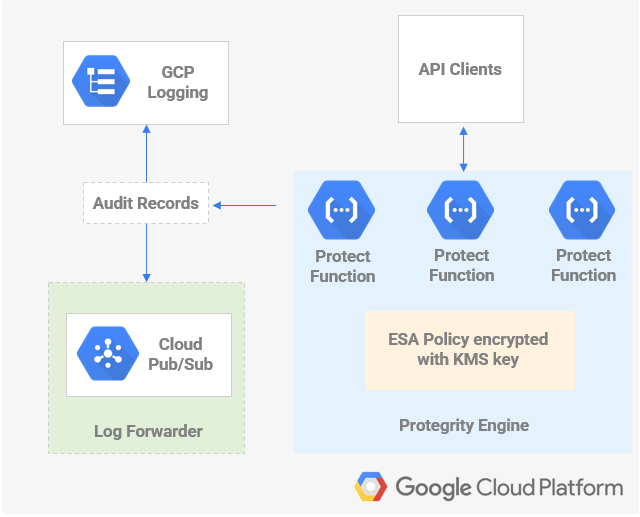
The following diagram illustrates a reference architecture for synchronizing the security policy from the ESA to the product.
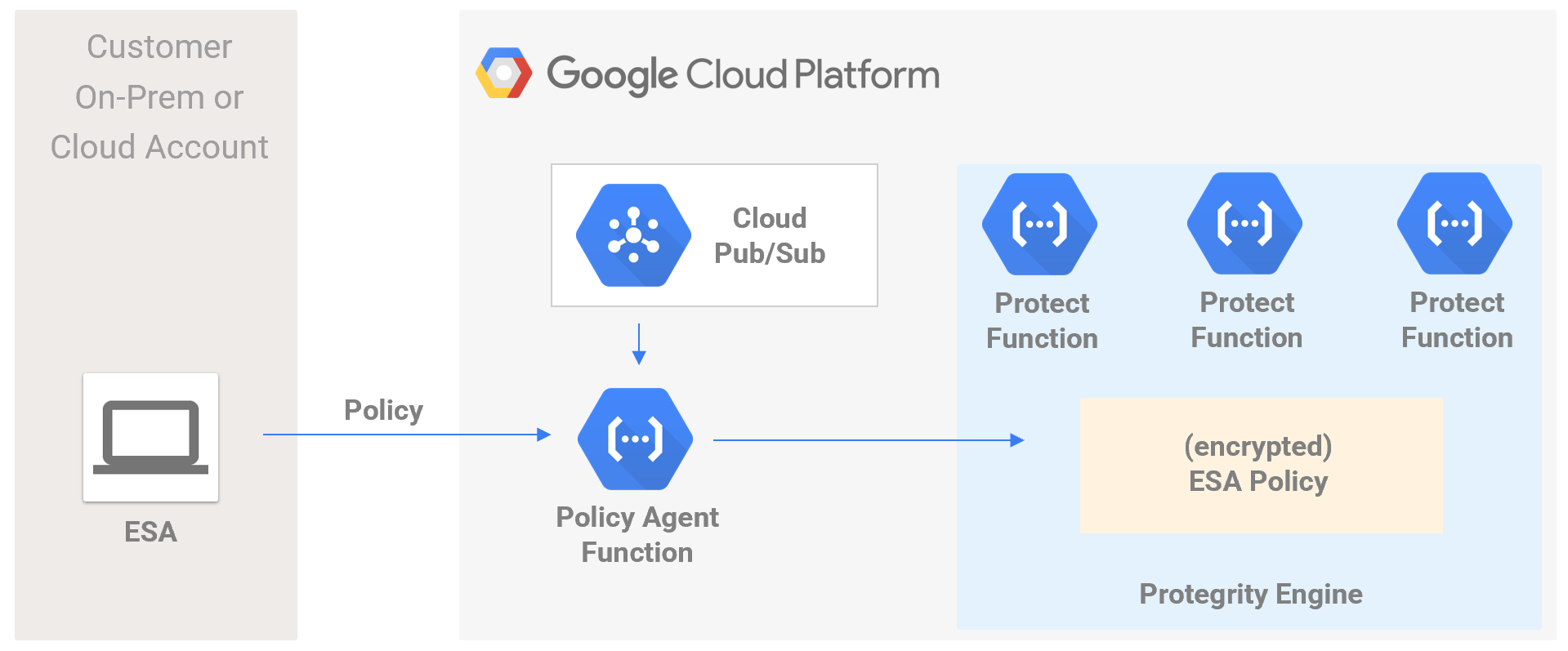
The Protegrity Policy Agent requires network access from GCP to your ESA. Most organizations install the ESA on-premise. Thus, it is recommended to install the Policy Agent in a private subnet with a Cloud VPC using a NAT Gateway to enable this communication through a corporate firewall.
The ESA is a soft appliance that must be installed on a separate server. It is used to create and manage security policies.
For more information about installing the ESA, and creating and managing policies, refer to the Policy Management Guide.
Audit logs are by default sent to Cloud Logging. The Protegrity Product can also be configured to send audit logs to ESA. Such configuration requires deploying Log Forwarder component which is available as part of Protegrity Product deployment bundle. The diagram below shows additional resources deployed with Log Forwarder component.
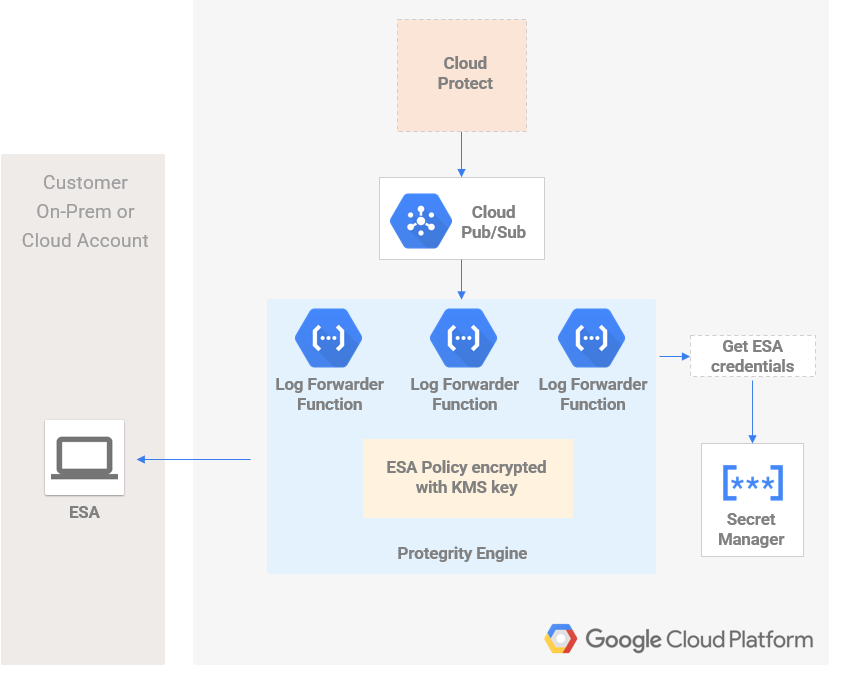
The log forwarder component includes Pub/Sub service topic and the audit log forwarder function. Pub/Sub service is used to asynchronously send audit records to forwarder function, where similar audit logs are aggregated before sending to ESA. Aggregation rules are described in the Protegrity Log Forwarding guide. When the protector function is configured to send audit logs to log forwarder, audit logs are aggregated on the protector function before sending to Pub/Sub topic. Protector function exposes configuration to control the time it spends aggregating audit logs which is described in the protector function installation section.
The security of audit logs is ensured by using HTTPS connection on each link of the communication between protector function and ESA. Integrity and authenticity of audit logs is additionally checked on log forwarder which verifies individual logs signature. The signature verification is done upon arrival from Pub/Sub topic before applying aggregation. If signature cannot be verified, the log is forwarded as is to ESA where additional signature verification can be configured. Log forwarder function uses basic auth and optional certificate verification to authenticate calls to ESA. Basic auth credentials are stored securely in Secret Manager Service.
To learn more about individual audit log entry structure and purpose of audit logs, refer to Audit Logging section in this document. Installation instruction can be found in the Audit Log Forwarder installation.
The audit log forwarding requires network access from the cloud to the ESA. Most organizations install the ESA on-premise. Therefore, it is recommended that the Log Forwarder Function is installed into a private subnet with a Cloud VPC using a NAT Gateway to enable this communication through a corporate firewall.
The Cloud API utilizes access controls provided by the Google Cloud Functions service. The following mechanisms are available for controlling and restricting access to the Cloud API data protection endpoint:
For more information on Google Cloud Functions security concepts, refer to Securing Cloud Functions
The Rest API supports built-in authentication and authorization provided by Google Cloud Functions. More information is available in the following Google Cloud Functions documentation.
https://cloud.google.com/functions/docs/securing/authenticating
Once the request is authenticated and authorized by the Cloud Function, the Protegrity Cloud API performs the requested security operation based on the policy data element from the payload and the authenticated user.
The following table describes the Google Cloud services that may a part of your Protegrity installation.
| Service | Description |
|---|---|
| Cloud Run Functions | Provides serverless compute for Protegrity protection operations and the ESA integration to fetch policy updates. |
| API Gateway | Provides the end-point and access control (Required for Snowflake only). |
| Key Management Service | Provides cryptographic keys for envelope encryption/decryption of the policy. |
| Secret Manager Service | Stores secrets required during deployment, e.g., ESA credentials. |
| Cloud Storage Service | Storage location for the encrypted ESA policy package. |
| Identity and Access Management | Enforces access policies for deployed resources. |
| Cloud Logging Service | Application and audit logs, performance monitoring, and alerts. |
| Cloud VPC | Required for securing network access to On-Prem or cloud-based ESA. |
| Pub/Sub | Provides a messaging service when forwarding audit logs to ESA is enabled. |
The Protector and Log Forwarder functions require a security policy from a compatible ESA version.
The table below shows compatibility between different Protector and ESA versions.
| Protector Version | ESA Version | |||
|---|---|---|---|---|
| 8.x | 9.0 | 9.1 & 9.2 | 10.0 | |
| 2.x | No | Yes | * | No |
| 3.0.x & 3.1.x | No | No | Yes | No |
| 3.2.x | No | No | Yes | * |
| 4.0.x | No | No | No | Yes |
Legend | |
|---|---|
Yes | Protector was designed to work with this ESA version |
No | Protector will not work with this ESA version |
* | Backward compatible policy download supported:
|
| Requirement | Detail |
|---|---|
| Protegrity distribution and installation scripts | These artifacts are provided by Protegrity |
| Protegrity ESA 10.0+ | The Cloud VNet must be able to obtain network access to the ESA |
| Google Cloud Account | Recommend creating a new project for Protegrity Serverless |
| Terraform CLI v0.14 or higher | Terraform is used to deploy resources to Google Cloud Account |
| Requirements | Description |
|---|---|
| GCP Cloud Administrator | Run Terraform (or perform steps manually), create/configure a VPC and IAM permissions. |
| Protegrity Administrator | The ESA credentials required to extract the policy for the Policy Agent |
| Network Administrator | Open firewall to access ESA and evaluate Google Cloud network setup |
Identify or create a new Google Cloud Project where the Protegrity solution will be installed. It is recommended to create a new project. This provides greater security controls and avoids conflicts with other applications that might impact regional account limits. An individual with the Owner role will be required for some of the subsequent installations.
Google Project ID: ___________________
Google Project Number: ___________________
Google Cloud Region: ___________________
The Google Cloud Key Management Service (KMS) provides Protegrity Serverless solution the ability to encrypt and decrypt the Protegrity Security Policy.
To create KMS Key Ring and Asymmetric Encryption Master Key:
Log in to Google Account and select project where Protegrity service will be installed.
Navigate to Security > Key Management.
Select Create key ring.
Specify key ring name. For example, protegrity-policy-keyring.
select Key ring location which corresponds to the region where Protegrity solution will be installed.
Select Create.
Select CREATE KEY to create encryption key.
Specify key name. For example, protegrity-policy-key.
under Purpose selection, select Asymmetric Decrypt .
Select Key Algorithm. For example, 3072-bit RSA with OAEP Padding and SHA256 digest.
Select Create.
Once the key is created, a screen opens on the key. If the screen does not appear, click on the key name.
Then click on the elipses under Actions that is next to the key version.
Select Copy Resource Name and record the value below, e.g., projects/{project-id}/locations/region/keyRings/{key-ring}/cryptoKeys/{key-name}/cryptoKeyVersions/1
Policy Encryption Key Version Resource Name: ___________________
Cloud Storage buckets are required for the Gen 2 Cloud Function sources, the Terraform backend, and the deployment of the Protegrity installation artifacts. It is recommended that you create 3 separate buckets to separate files used for different purposes. If you cannot create 3 separate buckets, you may reuse a bucket for multiple purposes.
Create the buckets:
Run the cloud command below to enable the Google Storage Transfer API.
gcloud services enable storagetransfer.googleapis.com
Create the Gen 2 Cloud Function sources bucket. This bucket is not required if you will be deploying to Gen 1 Cloud Functions. The bucket name much match the example below. Replace the <gcp-project-number> and <region> placeholders.
gcf-v2-sources-<gcp-project-number>-<region>
Use the following gcloud command to obtain project number
gcloud projects describe <gcp-project-id> --format='value(projectNumber)'
Create the deployment bucket or reuse an existing bucket. This bucket is used during the installation process to store the Protegrity installation artifacts.
Deployment Bucket Name:___________________
Create the Terraform backend bucket or reuse an existing bucket. This bucket is used by Terraform to store information about your Cloud Protect installation, and will be used if you upgrade to a later version of Cloud Protect in the future.
Terraform Backend Bucket Name:___________________
Cloud Functions use the service accounts created in this deployment. You can create Service accounts manually or use the Protegrity Terraform installation script to create one. Each service account requires specific permissions, which must be granted through IAM roles. Run the following steps to create service accounts and configure the required IAM access. If you use Terraform scripts, skip these steps.
To create Agent Function IAM Role:
Log in to Google Account and select project where Protegrity service will be installed.
Navigate to IAM & Admin > Roles, Select CREATE ROLE.
Specify role name and description.
Select ADD PERMISSIONS.
Select the following permissions:
Click Add and then Create.
Alternatively, you can run the following command from the Cloud Shell Terminal.
gcloud iam roles create role-id \
--project=project-id \
--title=role-title \
--description=role-description \
--permissions=cloudkms.cryptoKeyVersions.useToEncrypt,\
cloudkms.cryptoKeyVersions.viewPublicKey,\
secretmanager.versions.access,\
storage.objects.get,\
storage.objects.create,\
storage.objects.delete,\
storage.objects.list,\
storage.objects.update,\
storage.buckets.get,\
cloudfunctions.functions.get,\
cloudfunctions.functions.update,\
cloudfunctions.functions.sourceCodeGet,\
cloudfunctions.functions.sourceCodeSet,\
iam.serviceAccounts.actAs \
--stage=GA
role-id
is the name of the role, such as ptyProtectRole.
project-id
is the name of the project, such as my-project-id.
role-description
is a short description of the role, such as “My custom role description”.
Sample output:
Created role [role-id].
description: role-description
etag: *****************
includedPermissions:
- cloudfunctions.functions.get
- cloudfunctions.functions.sourceCodeGet
- cloudfunctions.functions.sourceCodeSet
- cloudfunctions.functions.update
- cloudkms.cryptoKeyVersions.useToEncrypt
- cloudkms.cryptoKeyVersions.viewPublicKey
- iam.serviceAccounts.actAs
- secretmanager.versions.access
- storage.buckets.get
- storage.objects.create
- storage.objects.delete
- storage.objects.get
- storage.objects.list
- storage.objects.update
name: projects/{project-id}/roles/{role-id}
stage: GA
title: role-title
To create Agent Service Account:
Log in to Google Account and select project where Protegrity service will be installed.
Navigate to IAM & Admin > Service Accounts.
Select CREATE SERVICE ACCOUNT.
Specify service account name and description.
Select Create and Continue.
In the next step, click Select Role.
Select Custom and select the role created above .
Click Done.
Once the service account is created, the screen should open on the service account. If the screen does not appear, refresh the page with the service account list and select the service account created.
Record the full email. For example, service-account-name@project-id.iam.gserviceaccount.com
Agent Function Service Account Email: ___________________
To create Protect Function IAM role:
Log in to Google Account and select project where Protegrity service will be installed.
Navigate to IAM & Admin > Roles, Select CREATE ROLE.
Specify role name and description.
Select ADD PERMISSIONS.
Select the cloudkms.cryptoKeyVersions.useToDecrypt permission.
Click Add and then Create.
To create Protect Service Account:
Log in to Google Account and select the project where Protegrity service will be installed.
Navigate to IAM & Admin > Service Accounts.
Select CREATE SERVICE ACCOUNT.
Specify service account name and description.
Select Create and Continue.
In the next step, click Select Role. Then select Custom and select the role created above .
Click Done.
Once the service account is created, the screen should open on the service account. If the screen does not appear, refresh the page with the service account list and select the service account created.
Record the full email. For example, service-account-name@project-id.iam.gserviceaccount.com.
Protect Function Service Account Email: ___________________
Ensure that all the steps in pre-configuration are performed.
Log in to the Google Cloud account where Protegrity will be installed.
Select the project.
Ensure that you have access to shell command on your computer or Cloud Shell with Terraform CLI v0.14 or higher installed.
Ensure that the Terraform scripts provided by Protegrity are available on your local computer.
Resources created with Terraform scripts include Protect Cloud Functions Service and other required resources depending on Terraform parameters. If you don’t specify the deployment bucket Terraform parameter, a new storage bucket will also be created. You can optionally choose to create a new service account with custom IAM role.
To install using Terraform:
From the command shell move to directory where you downloaded Protegrity installation bundle.
Unzip the bundle. Verify that the following files are available:
Unzip the protegrity-cloud-protect-gcp-{version}.zip file. Verify that the following files are available:
Open the main.tf file and update Terraform backend information at the top of the file:
terraform {
backend "gcs" {
bucket = ""
prefix = "protegrity/terraform/pty-protect-gcp/state"
}
}
In the same main.tf file, specify the following Terraform variables: All the values were recorded in Google Cloud Project.
Parameter | Description |
|---|---|
project_id | The project id recorded in the pre-configuration step |
region | The Region recorded in the pre-configuration step. |
deployment_id | Specify short name to identify deployment. This id will be added to all resources deployed with Terraform. |
deployment_bucket | Use Deployment Bucket Name recorded in pre-configuration or leave empty to create new bucket. |
create_service_account | Leave this as false if you created service account in pre-configuration. Otherwise set to true. |
protect_function_service_account_email | Use Protect Function Service account recorded in pre-configuration or leave empty. |
username_regex | If username_regex is set, the effective policy user will be extracted from the user in the request. NoteSee Configuring Regular Expression to Extract Policy Username to learn how to extract username from the request |
max_instance_count | GCP Cloud Functions advanced configuration |
available_memory_mb | GCP Cloud Functions advanced configuration |
timeout_seconds | GCP Cloud Functions advanced configuration |
gen2_available_cpu | 2nd Gen Cloud Function advanced configuration |
gen2_container_concurrency | 2nd Gen Cloud Function advanced configuration |
upgrade_step | Set this variable when upgrading to the latest version. |
deploy_api_gateway | Deploys GCP API Gateway proxy for Protect Cloud Function service. |
api_gateway_jwt_issuer | Applicable when deploy_api_gateway = true. Allows setting issuer of JSON Web Token credential used to authenticate calls to API Gateway. Accepts email or URI. |
api_gateway_jwks_uri | Applicable when deploy_api_gateway = true. Allows setting URI of the authentication provider’s public key set to validate the signature of the JSON Web Token. |
labels | You can set this map to include labels for deployed resources. Pay attention to GCP label requirements. For more information, refer to the following link https://cloud.google.com/compute/docs/labeling-resources. For example, only use lowercase and maximum length of 63 characters. |
openid_enabled | When set to true, every request is required to have an Authorization header with the bearer token set to a valid OAuth access token. The following configuration attributes will also be required: OPENID_AUDIENCES, OPENID_ISSUERS, OPENID_METADATA_URL. |
openid_audiences | Applicable when OPENID_ENABLED= “true”. The JWT token must have the “aud” claim and it must match one of the values in this attribute. Can be either one value or comma separated list. |
openid_issuers | Applicable when OPENID_ENABLED= “true”. The JWT token must have the “iss” claim and it must match one of the values in this attribute. Can be either one value or comma separated list. |
openid_metadata_url | Applicable when OPENID_ENABLED= “true”. A URL that points to an OpenID Connect identity provider configuration document, which is also known as OpenID well-known configuration endpoint. |
openid_appid | Applicable when OPENID_ENABLED= “true”. Validates the provided open_appid is listed in the appid claim. If value is empty, appid claim is ignored. Supported Values: ["<appid>", “”] |
authorization | When equals “jwt”, Authorization Header JWT will be required in the Rest API Protect payload. Supported Values: [“jwt”, “”]. When set to “jwt”, any request without Valid JWT in the Authorization header will result in an error from API Gateway: 502 Bad Gateway. *Applies for all configurations of jwt_verify and openid_enabled. |
allow_assume_user | Applicable when authorization = “jwt”. If set to 0, The user from the payload will not be used, and the policy user is the JWT user. Supported Values: [0, 1]. Default Value: 0. *Applies for all configurations of jwt_verify and openid_enabled. |
jwt_user_claim | Applicable when authorization = “jwt”. The JWT payload claim with username. Common claims: name, preferred_username, cognito:username. Default Value: cognito:username. *Applies for all configurations of jwt_verify and openid_enabled. |
service_user | If service_user is set the protect request will use it for the policy user. service_user should be used when the Cloud API should always run as one service_user no matter what user is in the request. service_user will always take priority over any other user in the payload or in the JWT header. *Applies for all configurations of jwt_verify and openid_enabled. |
pty_gcp_jwt_header | When set to true, both Google Cloud access control and Protegrity openid will be supported in two separate headers. This is useful when having access control with GCP IAM (In Authorization header) and the OPENID verification and policy user from JWT in the X-PTY-Authorization header. |
jwt_verify | When set to 1, jwt_secret_base64 is required. Only applicable when authorization is jwt. Supported JWT Algorithm RS256, RS384, RS512. (HS256, HS384, HS512 are supported but not recommended for use). Only applicable when authorization = “jwt” Supported Values: [1, “”] *Applies for all configurations of openid_enabled. |
jwt_secret_base64 | Required when jwt_verify = 1 and Authorization = JWT. The secret must be provided in base64 encoding. It is recommended to only use public key (asymmetric algorithm). applicable when authorization = “jwt” and jwt_verify=1 Supported Values: [<base64 encoded secret key>, “”] |
min_log_level | Minimum log level for log forwarder function. One of off|severe|warning|info|config|all. Defaults to ‘severe’ |
pty_log_output | Audit log output. Accepted values: “”(empty string), “pub_sub”. NoteWhen set to “pub_sub” audit logs will be aggregated and sent to Pub/Sub topic. See Log Forwarder installation section for more details. |
audit_log_flush_interval | Time interval in seconds used to accumulate audit logs before sending to Pub/Sub topic. Default value: 30 |
pty_pub_sub_topic | Pub/Sub topic where audit logs will be sent. |
```
terraform init
```
Terraform will download necessary providers.
Run the following command to verify configuration and print out deployment plan.
terraform plan
Run the following command to deploy resources to your account.
terraform apply
Once deployment is complete Terraform will print output variables.
Record the following values:
Terraform module provided by Protegrity allows deploying Google API Gateway proxy for the Cloud Protect Service.
To deploy API Gateway:
In the main.tf file set the following Terraform variables.
deploy_api_gateway = true
api_gateway_jwt_issuer = "<service-account>@<google-cloud-project-id>.iam.gserviceaccount.com"
api_gateway_jwks_uri = "https://www.googleapis.com/robot/v1/metadata/x509/<service-account>@<google-cloud-project-id>.iam.gserviceaccount.com"
Below is the brief description of each Terraform variable. You can find more information in the Terraform README file.
Run terraform plan.
Run terraform apply.
Wait for the Terraform apply command to complete.
Once Terraform apply completes, it prints out deployment resources information. Record the following information from the Terraform output.
api_gateway_managed_service: ___________________
api_gateway_protect_service_url: ___________________
Follow instructions in the link below to generate JWT token which you can use to authorize request to Protegrity API Gateway endpoint. Use the same service account you configured in section above for api_gateway_jwks_uri.
https://cloud.google.com/iam/docs/create-short-lived-credentials-direct#create-jwt
Record identity token returned in step above:
gcloud_auth_token: ___________________
Run the following CURL command to test API Gateway deployment.
curl -X POST "{api_gateway_protect_service_url}/api/v1/unprotect" \
-H 'Authorization:Bearer {gcloud_auth_token}' \
-d '{
"user": "test",
"data_element":"alpha",
"data": ["UtfVk UHgcD!"]
}'
Verify the following output:
{"encoding":"utf8","results":["hello world!"],"success":true}
Before continuing with next steps, you can verify whether Cloud Functions are installed correctly. This step is optional and can be skipped.
Below you can find example CURL command to test your function.
Before you can execute it, you need to obtain temporary authentication token. Run the gcloud auth login and then gcloud auth print-identity-token commands. The logged in gcloud user must have the cloudfunctions.functions.invoke permission. Record the output of print identity token command.
gcloud_auth_token: _________________
Replace {protect_function_url}; with value recorded in previous step.
Replace {gcloud_auth_token} with value recorded in above step.
Run the following CURL command to test Function deployment.
curl -X POST "{protect_function_url}/pty/v1/unprotect" \
-H 'Authorization:Bearer {gcloud_auth_token}' \
-d '{
"user": "test",
"data_element":"alpha",
"data": ["UtfVk UHgcD!"]
}'
Verify the following output:
{"encoding":"utf8","results":["hello world!"],"success":true}
Policy Agent Function installation is done via Terraform scripts provided by Protegrity. Before running the template, some resources must be created manually.
Policy Agent function requires ESA server running and accessible from Agent Cloud Function on TCP port 8443. Make sure inbound connections on TCP:8443 are allowed for the network where ESA is hosted.
Note down ESA IP address:
ESA IP Address (EsaIpAddress): ___________________
By default, ESA is configured with self-signed certificates, which can only be validated using self-signed CA certificate supplied in Cloud Function Environment variables configuration.
In case ESA is configured with publicly signed certificates, this section can be skipped since the Cloud Function will use public CA to validate ESA certificates.
To obtain self-signed CA certificate from ESA:
Log in to ESA Web UI.
Select Settings > Network > Manage Certificates.
Hover over Server Certificate and click on download icon to download the CA certificate.
After certificate is downloaded, open the PEM file in text editor and replace all new lines with escaped new line: \n.
To escape new lines from command line, use one of the following commands depending on your operating system:
Linux Bash:
awk 'NF {printf "%s\\n",$0;}' ProtegrityCA.pem > output.txt
Windows PowerShell:
(Get-Content '.\ProtegrityCA.pem') -join '\n' | Set-Content 'output.txt'
Record the certificate content with new lines escaped.
ESA CA Server Certificate (EsaCaCert): ___________________
This value will be used to set pty_esa_ca_server_cert Terraform variable in installation section.
For more information about ESA certificate management refer to Certificate Management Guide in ESA documentation.
Google Cloud VPC is used to route traffic from Policy Agent Cloud Function to ESA. If your ESA is in a Google Cloud VPC, it is recommended to create a serverless VPC access and record its name:
google_vpc_access_connector_name: ___________________
If ESA is not on Google Cloud VPC, you can either create one or choose to let Terraform script to create one. The Terraform script will create the following elements:
NAT gateway
To connect to ESA outside the Google Cloud Network
External IP address
Can add it to the allowlist by the firewall in the network environment where ESA is hosted.
Serverless VPC access
Allows connectivity from the Cloud function to the VPC.
Policy Agent Function requires ESA credentials to be provided as one of the two options:
Secret Manager is the recommended option for storing ESA credentials.
Create ESA credentials secrets:
Log in to Google Account and select project where Protegrity service will be installed.
Go to Security > Secret Manager.
Select CREATE SECRET.
Specify the Secret Value:
{
"username": "{esa_username}",
"password": "{esa_password}"
}
Select Create Secret.
Once the secret is created, you should see the secret screen opened. If not click on the secret name to see a screen with secret versions.
Click on Actions, next to the secret version you just created.
Select Copy Resource ID and record the full secret version path, For example, projects/{project-id}/secrets/{secret name}/versions/2.
Secret resource id: ___________________
If you have the skills to write code, you may provide a custom Cloud Function that returns the ESA credentials to the Policy Agent. One use case is when reading the ESA credentials from a third-party password vault.
Create the Cloud Function:
Create a new 2nd gen Cloud Function using any runtime.
The Policy Agent does not provide an input payload.
The Cloud Function must return a response according to the following schema:
response:
type: object
  properties:
    username: string
    password: string
For example,
example output: {"username": "admin", "password": "Password1234"}
Sample GCP Function in Python:
def handler(request):
return {"username": "admin", "password": "password1234"}
Grant the Cloud Run Invoker role to the Policy Agent function service account.
Grant the cloudfunctions.functions.get permission to the Policy Agent function service account role.
Record the Function name:
ESA CREDENTIALS FUNCTION NAME: _______________
Agent Terraform scripts provided by Protegrity create a Cloud Function in your Google account. If you don’t specify the deployment bucket Terraform parameter, a new storage bucket will also be created. You can also create the following optional resources by specifying the corresponding parameters:
To install Policy Agent Function through Terraform:
From command shell, move to the directory where you downloaded Protegrity installation bundle.
Unzip the bundle, then unzip the protegrity-agent-gcp-{version}.zip. Verify that the following files are available:
Open the main.tf file and update Terraform backend information at the top of the file:
terraform {
backend "gcs" {
bucket = ""
prefix = "protegrity/terraform/pty-protect-gcp/state"
}
}
Set the bucket property to Terraform Backend Bucket Name recorded in Google Cloud Storage
Set the prefix property with value unique to your deployment.
In the same main.tf file, specify the following Terraform variables.
| Parameter | Description |
|---|---|
| project_id | The Project ID recorded in the pre-configuration step |
| region | The Region recorded in the pre-configuration step, for example, us-central1. |
| deployment_id | Specify short name to identify deployment. This id will be added to all resources deployed with Terraform. |
| deployment_bucket | Use Deployment Bucket Name recorded in pre-configuration or leave empty to create new bucket. |
| deployment_bucket_location | Geographical location of deployment bucket, e.g., US, EU, ASIA. |
| deployment_file_directory_path | Path to directory where deployment zip file is located. By default the deployment file should be in the same directory as this main.tf file. |
| policy_download_cron_expression | Cron expression determining how often policy agent function will run to synchronize security policy from ESA. |
| create_service_account | Leave this as false if you created service account in pre-configuration. Otherwise set to true. |
| agent_function_service_account_email | Use Agent Function Service account recorded in pre-configuration or leave empty. |
| create_vpc | Set this to true, if you would like to create VPC with NAT, external IP and vpc access connector, otherwise leave empty. This will be ignored if google_vpc_access_connector_name is specified. |
| google_vpc_access_connector_name | Specify the existing VPC access connector name you identified in earlier step, otherwise leave empty. This setting will disable create_vpc = true. |
| google_vpc_access_connector_full_resource_name | Alternative configuration for VPC access connector. If this parameter is set the google_vpc_access_connector_name will be ignored. Use this parameter, if vpc connector is in different region/project that the one specified for the deployment. |
| labels | You can set this map to include labels for deployed resources. Pay attention to gcp label requirements. More information in: https://cloud.google.com/compute/docs/labeling-resources. For example, only use lowercase and maximum length of 63 characters. |
All the values were recorded in Pre-Configuration and this section’s previous steps.
Provide Policy update Terraform variables. In the same main.tf file, you can specify configuration related to policy update. Any of these variables can be updated at any given time by running the terraform again or directly in the GCP Console. Most of the values were recorded in previous installation steps.
Parameter | Description | Notes |
|---|---|---|
pty_esa_ip | ESA IP address or hostname | |
pty_esa_ca_server_cert | ESA self-signed CA certificate used by policy Agent Function to ensure ESA is the trusted server. | Recorded in step Certificates on ESA In case ESA is configured with publicly signed certificates, the pty_esa_ca_server_cert configuration will be ignored. |
gcp_esa_credentials_secret_resource_id | ESA username and password (encrypted value by Google Cloud Secrets Manager). For example, projects/{project-id}/secrets/{secret name}/versions/{version} | |
pty_esa_credentials_function | ESA credentials GCP function resource name. For example, projects/{project-name}/locations/{region}/functions/{esa-credentials-function-name}. | Recorded in step Option 2: Custom Cloud Function ESA CREDENTIALS FUNCTION NAME. Presence of gcp_esa_credentials_secret_resource_id will cause this value to be ignored. The Policy Agent Function must have network access and IAM permissions to call the ESA Credentials function you have created in Option 2: Custom Cloud Function. |
gcp_kms_key_resource_name | The Key full resource name. For Example, projects/{project-id}/locations/region/keyRings/ {key-ring}/cryptoKeys/{key-name}/cryptoKeyVersions/1 | |
gcp_protect_function_resource_name | List of comma separated Protect function resource names. For Example, projects/{project-id}/ locations/{region}/functions/{function-name1},projects/{project-id}/ locations/{region}/functions/{function-name2} | Use protect_function_resource_name recorded in Protect Service Installation section. |
gcp_policy_retention_storage_bucket | Deployment Bucket Name where the encrypted policy will be written. | You can use deployment bucket recorded in Google Cloud Storage section, or you can specify other existing bucket. |
gcp_policy_version_object_key | Filename of the encrypted policy stored in the Deployment Bucket Name | Default: policy.zip |
retain_policy_versions | Number of policy versions to retain as backup. (e.g. 2 will retain the latest 2 policies and remove older ones). -1 retains all. | Default: 10 |
disable_deploy | This flag can be either 1 or 0. If set to 1, then the agent will not update protector function with the newest policy. Else, the policy will be saved in the cloud storage bucket and deployed to the protector function. WarningAgent deployment requires a deployed Protect or Log Forwarder Cloud Run function when disable_deploy is set | Default: 0 |
log_level | Application and audit logs verbiage level | Default: INFO. Allowed values: DEBUG – the most verbose INFO, WARNING, ERROR – the least verbose |
policy_pull_timeout | Time in seconds to wait for the ESA to send the full policy | Default: 20 |
pty_core_casesensitive | Specifies whether policy usernames should be case sensitive | Default: no. Allowed values: yes, no |
pty_core_emptystring | Override default behavior. Empty string response values are returned as null values. For instance, (un)protect(’’) -> null (un)protect(’’) -> '' | Default: empty. Allowed values: null, empty |
esa_connection_timeout | Time in seconds to wait for the ESA response | Default: 5s |
pty_addipaddressheader | When enabled, agent will send its source IP address in the request header. This configuration works in conjunction with ESA hubcontroller configuration ASSIGN_DATASTORE_USING_NODE_IP (default=false). See Associating ESA Data Store With Cloud Protect Agent for more information. | Default: yes. Allowed values: yes, no |
pty_datastore_key | ESA policy datastore public key fingerprint (64 char long) e.g. 123bff642f621123d845f006c6bfff27737b21299e8a2ef6380aa642e76e89e5. | NoteThis configuration is not applicable for ESA versions lower than 10.2.The export key is the public part of an asymmetric key pair created in a Create KMS Key. A user with Security Officer permissions adds the public key to the data store in ESA via Policy Management > Data Stores > Export Keys. The fingerprint can then be copied using the Copy Fingerprint icon next to the key. Refer to Exporting Keys to Datastore for details. NoteFor PPC deployments, see PPC Appendix: Policy Agent Certificate and Key Guidance for details on obtaining and using the datastore key fingerprint. |
pty_sync_datastore | Optional name of the policy datastore to sync with ESA. Refer to ESA documentation for more information on policy datastore sync. | Default: "" |
From local command line or Cloud Shell, change directory to location of the main.tf, for example:
protegrity-agent-gcp-{version}/pty-agent-gcp/
Run terraform init.
Terraform will download necessary providers.
Run terraform plan to verify configuration and print out deployment plan.
Run terraform apply to deploy resources to your account. Once deployment is complete, Terraform will print output variables.
Below is the sample output from successful deployment.
Apply complete! Resources: 1 added, 0 changed, 0 destroyed.
Outputs:
agent_function_service_account_email = "pty-agent-test@test.iam.gserviceaccount.com"
deployment_bucket_name = "test-bucket"
nat_ip = 0
policy_agent_function_deployment_object = "pty-agent-test-1.0.1.zip"
policy_agent_function_name = "pty-agent-test"
After configuration is complete, you can test the function.
To test and run the Policy Agent Function:
From the Google Cloud console, go to Cloud Run Functions or Cloud Run.
Click on the function you just deployed: pty_agent_{deployment_id}.
Click Test button at the top right section of the screen.
Scroll down to CLI test command.
Copy and run the curl command to trigger the agent. Alternatively, use the option Test in Cloud Shell.
Wait for the function to complete.
Navigate to the LOGS tab to view agent execution logs.
Alternatively, you may review the logs by navigating to Logging from your Google Console. In the Log Explorer select the All resources dropdown, then Cloud Run Revision > pty-agent-{deployment-id} and apply.
Function execution took 23892 ms, finished with status: 'ok'
iap.policy_deployer:INFO:Deleting object [policy_v07-26-2021_21-00-00.zip]
iap.policy_deployer:INFO:Deleting object [policy_v07-26-2021_19-03-23.zip]
iap.policy_deployer:INFO:Removing old function versions in [test-artifacts]. Will retain [1] versions.
iap.policy_deployer:INFO:Updating function [projects/cloud-engineering-315519/locations/us-central1/functions/pty-protect-test] with new deployment artifact [test-artifacts/policy_v07-26-2021_21-00-01.zip] ...
iap.imp_creator:INFO:Uploading encrypted policy data to: [test-artifacts/policy_v07-26-2021_19-03-23.zip]
iap.imp_creator:INFO:Preparing deployment package ...
iap_agent_gcp.cloud_functions_util:INFO:Downloading function deployment package ...
iap.imp_creator:INFO:Encrypting policy package ...
iap.policy_agent:INFO:Preparing new policy deployment ...
iap.policy_agent:WARNING:Current policy deployment has no checksum_mapping metadata:
iap.imp_creator:INFO:Checking current policy version ...
iap.policy_agent:INFO:Current deployment package version: [policy_v07-26-2021_18-51-43.zip].
iap.policy_agent:INFO:Getting current policy metadata ...
iap.imp_creator:INFO:Policy downloaded successfully ...
iap.imp_creator:INFO:PepServer started ...
iap.imp_creator:INFO:Starting PepServer ...
iap.imp_creator:INFO:PepServer configured successfully
iap.imp_creator:INFO:Downloading certificates from ESA ...
iap.imp_creator:INFO:Configuring PepServer ...
iap.policy_agent:INFO:Starting policy agent ...
iap.policy_agent:INFO:Using Secret Manager [GCP_ESA_CREDENTIALS_SECRET_RESOURCE_ID] to retreive ESA credentials.
iap.policy_agent:INFO:PTY_CORE_CASESENSITIVE [no]
iap.policy_agent:INFO:PTY_CORE_EMPTYSTRING [empty]
iap.policy_agent:INFO:RETAIN_POLICY_VERSIONS [1]
iap.policy_agent:INFO:GCP_PROTECT_FUNCTION_RESOURCE_NAME [projects/test/locations/us-central1/functions/pty-protect-test]
iap.policy_agent:INFO:GCP_POLICY_VERSION_OBJECT_KEY [policy.zip]
iap.policy_agent:INFO:GCP_POLICY_RETENTION_STORAGE_BUCKET [test-artifacts]
iap.policy_agent:INFO:GCP_KMS_KEY_RESOURCE_NAME [projects/test/locations/us-central1/keyRings/test-key-ring/cryptoKeys/test-protect-asymmetric/cryptoKeyVersions/1]
iap.policy_agent:INFO:GCP_ESA_CREDENTIALS_SECRET_RESOURCE_ID [projects/1234/secrets/ESA_ADMIN_CREDENTIALS/versions/2]
iap.policy_agent:INFO:PTY_ESA_IP [54.236.107.39]
iap.policy_agent:INFO:POLICY_PULL_TIMEOUT [20]
iap.policy_agent:INFO:DISABLE_DEPLOY [0]
Function execution started
Configure additional logging:
Set log_level Terraform variable on the Agent function to DEBUG.
In the GCP Logs Explorer, you can run the query below, replacing placeholders with your deployment id and project name.
resource.type="cloud_run_revision"
resource.labels.service_name=~"pty-agent-<deploymentd-id>"
severity=ERROR OR textPayload=~"\[error\]"
-logName="projects/<gcp-project-id>/logs/run.googleapis.com%2Frequests"
Expand each log entry for more details. Check for jsonPayload > exception to see more detailed error.
Error message | Details |
|---|---|
| This error may indicate the following configuration issues:
|
| This error may indicate the following configuration issues:
|
| Indicates the Agent Cloud Run function’s identity does not have permissions to sourceCodeGet for Protect/Log Forwarder function(s) provided to the gcp_protect_function_resource_name configuration. |
Audit Log Forwarder installation is done via Terraform scripts provided by Protegrity in the installation bundle.
ESA server is required as the recipient of audit logs. Verify the information below to ensure ESA is accessible and configured properly.
ESA server running and accessible on TCP port 9200.
Audit Store service is configured and running on ESA. For information related to ESA Audit Store configuration, refer to Audit Store Guide.
By default, ESA is configured with self-signed certificates, which can only be validated using self-signed CA certificate supplied in Log Forwarder configuration.
In case ESA is configured with publicly signed certificates, this section can be skipped since the Log Forwarder will use public CA to validate ESA certificates.
To obtain self-signed CA certificate from ESA:
Download ESA CA certificate from the /etc/ksa/certificates/plug directory of the ESA
After certificate is downloaded, open the PEM file in text editor and replace all new lines with escaped new line: \n.
To escape new lines from command line, use one of the following commands depending on your operating system:
Linux Bash:
awk 'NF {printf "%s\\n",$0;}' CA.pem > output.txt
Windows PowerShell:
(Get-Content '.\CA.pem') -join '\n' | Set-Content 'output.txt'
Record the certificate content with new lines escaped.
ESA CA Server Certificate (EsaCaCert): ___________________
This value will be used to set pty_esa_ca_server_cert Terraform variable in installation section. Install Log Forwarder via Terraform
For more information about ESA certificate management refer to Certificate Management Guide in ESA documentation.
Similar to Policy Agent Function, log forwarder function requires Google Cloud VPC to route traffic from the function to ESA. Review the VPC configuration steps for agent in section Identify or Create a new VPC. Same VPC connector as the policy agent can be used. Note down VPC connector name:
google_vpc_access_connector_name: ___________________
Audit Log Forwarder must authenticate with ESA using certificate-based authentication with client certificate and certificate key. Download the following certificates from the /etc/ksa/certificates/plug directory of the ESA:
| File Name | Description |
|---|---|
| client.key | Client certificate key |
| client.pem | Client certificate (PEM) |
Both certificate and certificate key must be converted to single-line values using code similar to the following examples.
Client certificate (client.pem):
$folder = 'C:\Temp'
cd $folder
(Get-Content "$folder\client.pem") -join '\n' | Set-Content "$folder\one-liner-client.pem"
cat "$folder\one-liner-client.pem"
folder="/tmp"
cd "$folder"
awk 'NF {printf "%s\\n",$0}' "client.pem" > "one-liner-client.pem"
cat "one-liner-client.pem"
Client certificate key (client.key):
$folder = 'C:\Temp'
cd $folder
(Get-Content "$folder\client.key") -join '\n' | Set-Content "$folder\one-liner-client.key"
cat "$folder\one-liner-client.key"
folder="/tmp"
cd "$folder"
awk 'NF {printf "%s\\n",$0}' "client.key" > "one-liner-client.key"
cat "one-liner-client.key"
While installing using Terraform template:
Audit Log Forwarder Function uses GCP Secret Manager to store ESA Audit Store credentials used during authentication.
For information on how to configure basic and certificate authentication for Audit Store on ESA refer to Audit Store Guide.
Log in to Google Account and select project where Protegrity service will be installed.
Go to Security > Secret Manager.
Select CREATE SECRET.
Specify the Secret Value:
{
"username": "admin",
"password": "{esa_password}"
}
Select Create Secret.
Once the secret is created, you should see the secret screen opened. If not click on the secret name to see a screen with secret versions.
Click on Actions, next to the secret version you just created.
Select Copy Resource ID and record the full secret version path, for example, projects/{project-id}/secrets/{secret name}/versions/2.
ESA Log Forwarder Credentials Secret Name: _________________
Create another secret with single-line contents of ESA client certificate key file
See Certificate Authentication for details on client certificate key
Record the full secret version path, for example, projects/{project-id}/secrets/{secret name}/versions/1.
ESA Log Forwarder Client Certificate Key Secret Name: _________________
To create Log Forwarder Service Account:
Log in to Google Account and select the project where Protegrity service will be installed.
Navigate to IAM & Admin > Service Accounts.
Select CREATE SERVICE ACCOUNT.
Specify service account name and description.
Select Create and Continue.
In the next step, click Select Role. Then select the following roles:
Click Done.
Once the service account is created, the screen should open on the service account. If the screen does not appear, refresh the page with the service account list and select the service account created.
Record the full email. For example, service-account-name@project-id.iam.gserviceaccount.com.
Log Forwarder Function Service Account Email: ___________________
Pub/Sub service requires Cloud Run Invoker permissions in order to be able to send messages to the Forwarder function.
Log in to Google Account and select the project where Protegrity forwarder will be installed.
Navigate to IAM & Admin > Service Accounts.
Select CREATE SERVICE ACCOUNT.
Specify service account name and description.
Select Create and Continue.
In the next step, click Select Role. Then select Cloud Run Invoker.
Click Done.
Once the service account is created, the screen should open on the service account. If the screen does not appear, refresh the page with the service account list and select the service account created.
Record the full email. For example, service-account-name@project-id.iam.gserviceaccount.com.
Pub/Sub Log Forwarder Service Account Email: ___________________
Ensure that all the steps in Google Cloud Project are performed.
Log in to the Google Cloud account where Protegrity will be installed.
Select the project.
Ensure that you have access to shell command on your computer or Cloud Shell with Terraform CLI v0.14 or higher installed.
Ensure that the Terraform scripts provided by Protegrity are available on your local computer.
Resources created with Terraform scripts include Audit Log Forwarder Cloud Functions Service and Pub/Sub topic. If you don’t specify the deployment bucket Terraform parameter, a new storage bucket will also be created. You can optionally choose to create a new service account with custom IAM role.
To install using Terraform:
From the command shell move to directory where you downloaded Protegrity installation bundle.
Unzip the bundle, then unzip the protegrity-gcp-bigquery-{version}.zip. Navigate to pty-log-forwarder-gcp/. Verify that the following files are available:
Open the main.tf file and update Terraform backend information at the top of the file:
terraform {
backend "gcs" {
bucket = ""
# The bucket/prefix combination must be unique for different deployments
# to avoid conflicting Terraform states and accidental resources destruction.
# prefix = "protegrity-gcp-bigquery/forwarder/<deployment_id>/tf-state"
}
}
Set the bucket property to Terraform Backend Bucket Name recorded in Google Cloud Storage
Set the prefix property with value unique to your deployment.
In the same main.tf file, specify the following Terraform variables: All the values were recorded in Google Cloud Project.
| Parameter | Description |
|---|---|
| project_id | The project id recorded in the pre-configuration step |
| region | The Region recorded in the pre-configuration step. |
| deployment_id | Specify short name to identify deployment. This id will be added to all resources deployed with Terraform. |
| deployment_bucket | Use Deployment Bucket Name recorded in pre-configuration or leave empty to create new bucket. |
| create_service_account | Leave this as false if you created service account in pre-configuration. Otherwise set to true. |
| forwarder_function_service_account_email | Use Forwarder Function Service account recorded in pre-configuration or leave empty. |
| pub_sub_log_forwarder_service_account_email | Service account of the audit log Pub/Sub trigger. The service account must be assigned Cloud Run Invoker (roles/run.invoker) role. |
| create_vpc | If create_vpc flag is set, new vpc will be created together with vpc connector, NAT and external IP Use this flag if you have VPC admin permissions in your Google Account. If you set it to false, you can specify the existing VPC in the google_vpc_access_connector_name parameter. |
| google_vpc_access_connector_name | Use existing VPC connector to associate with Log Forwarder Function. You can specify either the VPC connector name or the full resource name if vpc connector is in different region/project that the one specified for the deployment. You can alternatively set the use google_vpc_access_connector_full_resource_name. Both parameters are optional. Full resource name takes precedence over connector name. |
| log_destination_esa_ip | Ip address of the ESA where Protector logs will be sent to. |
| pty_esa_ca_server_cert | ESA self-signed CA certificate used by log forwarder function to ensure ESA is the trusted server. See documentation for more details. |
| esa_credentials_secret_resource_id | GCP Secret Manager secret id where ESA Fluent Bit logger credentials are stored. |
| pty_esa_client_cert | Single-line ESA client certificate content. See Certificate Authentication for details on client certificate |
| pty_esa_client_cert_key_secret_id | GCP Secret Manager secret id where single-line ESA client certificate key content is stored. See Configure ESA Secrets In GCP Secret Manager for details on client certificate key secret |
| min_log_level | Minimum log level for log forwarder function. Must be one of the following: [off,severe,warning,info,config,all]. |
| esa_tls_disable_cert_verify | Disable certificate verification when connecting to ESA. This is only for dev purposes, should not be used in production environment. |
| esa_connect_timeout | Esa connection timeout in seconds. |
| esa_virtual_host | ESA Virtual Host. |
| audit_log_flush_interval | Time interval in seconds used to accumulate audit logs before sending to ESA. Default value: 10 Min value: 1 Max value: 900 |
| dlq_topic_message_retention_duration | Indicates the minimum duration to retain a message in dead letter queue topic in case log destination server is not available. Value must be decimal number, followed by the letter s (seconds). Cannot be more than 31 days or less than 10 minutes. Default value is 1 day |
| audit_log_dead_letter_topic | This parameter is expected to be used in a separate deployment to replay dead letter queue messages. |
| max_instance_count | GCP Cloud Functions advanced configuration |
| available_memory_mb | GCP Cloud Functions advanced configuration |
| timeout_seconds | GCP Cloud Functions advanced configuration |
| gen2_available_cpu | 2nd Gen Cloud Function advanced configuration |
| gen2_container_concurrency | 2nd Gen Cloud Function advanced configuration |
| upgrade_step | Set this variable when upgrading to the latest version. |
| labels | You can set this map to include labels for deployed resources. Pay attention to GCP label requirements. For more information, refer to the following link https://cloud.google.com/compute/docs/labeling-resources. For example, only use lowercase and maximum length of 63 characters. |
From local command line or Cloud Shell, change directory to location of the main.tf, for example:
pty-log-forwarder-gcp-{version}/pty-log-forwarder-gcp/
Run the following command.
terraform init
Terraform will download necessary providers.
Run the following command to verify configuration and print out deployment plan.
terraform plan
Run the following command to deploy resources to your account.
terraform apply
Once deployment is complete Terraform will print output variables.
Record the following values:
Both Protect and Log Forwarder functions must run for a short period of time after all requests are handled. In order for the GCP Cloud Run service to allow that, the Instance-based billing feature must be enabled for both function deployments.
To enable Instance-based billing:
Log in to Google Account and select the project where Protegrity Cloud Run Function was installed.
Navigate to Cloud Run.
Click on the Cloud Function name.
In Cloud Run revision view, select Edit & deploy new revision.
Scroll down to Billing.
Select Instance-based.
Click DEPLOY.
Repeat the steps for Log Forwarder function.
Before continuing with next steps, you can verify whether Log Forwarder Function is installed correctly. This step is optional and can be skipped.
Below you can find example CURL command to test your function.
Before you can execute it, test if you can obtain temporary authentication token. Run the gcloud auth login and then gcloud auth print-identity-token commands. The logged in gcloud user must have the Cloud Run Invoker permissions. Continue to the next step if the command succeeds and prints the token.
Replace {forwarder_function_url}; with value recorded in previous step.
Run the following CURL command to test Function deployment.
curl {forwarder_function_url} \
-H "Authorization: Bearer $(gcloud auth print-identity-token)" \
-H "Content-Type: application/json" \
-H "ce-id: 123451234512345" \
-H "ce-specversion: 1.0" \
-H "ce-time: 2020-01-02T12:34:56.789Z" \
-H "ce-type: google.cloud.pubsub.topic.v1.messagePublished" \
-H "ce-source: //pubsub.googleapis.com/projects/MY-PROJECT/topics/MY-TOPIC" \
-d '{
"message": {
"data": "'"$(echo '{"additional_info":{"description":"Data unprotect operation was successful.","query_id":"sf-query-id:k6-test-df51a612-4739-4cfb-9fe4-6ec548b70d23"},"client":{},"cnt":4000,"correlationid":"sf-query-id:k6-test-df51a612-4739-4cfb-9fe4-6ec548b70d23","level":"SUCCESS","logtype":"Protection","origin":{"hostname":"localhost","time_utc":1725558586},"process":{"id":1},"protection":{"audit_code":8,"dataelement":"alpha","datastore":"SAMPLE_POLICY","mask_setting":"","operation":"Unprotect","policy_user":"master_user"},"protector":{"core_version":"1.2.2+42.g01eb3.HEAD","family":"cp","pcc_version":"3.4.0.20","vendor":"gcp.snowflake","version":"3.1.0.158"},"signature":{"checksum":"7CE5FFCE9DBE570AAA72D1BB20CD083532EF8FAD3E96E38629EB92E837272D8E","key_id":"676c5178-756d-4363-9"}}' | base64 -w 0)"'",
"attributes": {},
"messageId": "",
"publishTime": "2014-10-02T15:01:23Z",
"orderingKey": ""
}
}'
In GCP Logs Explorer console verify that the following output appears in the logs:
Request finished HTTP/1.1 POST http://pty-forwarder-31-smoke-jf-pfadh7riaq-uc.a.run.app/ - 200 0 - 75.6570ms
[/jenkins/workspace/iaplambda_release_3.1/src/iap/logging/log-aggregator.cpp:66] Failed to aggregate log entry at index 0Protect function requires permissions to publish audit log messages to Pub/Sub.
Log in to Google Account and select the project where Protegrity service will be installed.
Navigate to IAM & Admin.
Search for protector function service account email recorded in protect service installation step.
Select Edit principal pencil icon.
Select ADD ANOTHER ROLE.
Select Pub/Sub Publisher.
Click Save.
Protect function must be configured to output audit logs to Pub/Sub topic.
To configure Protect function audit log output:
Go to Protect function Terraform deployment.
Navigate to pty-protect-gcp/main.tf.
Set Terraform variable pty_log_output=“pub_sub”.
Set Terraform variable pty_pub_sub_topic to log forwarder Pub/Sub topic.
Run terraform apply.
Configure additional logging:
Set min_log_level Terraform variable on both Protect function and Log Forwarder function to config.
In the GCP Logs Explorer, you can run the query below, replacing placeholders with your deployment id and project name.
resource.type="cloud_run_revision"
resource.labels.service_name=~"pty-(protect|forwarder)-<deploymentd-id>"
severity=ERROR OR textPayload=~"\[error\]"
-logName="projects/<gcp-project-id>/logs/run.googleapis.com%2Frequests"
Expand each log entry for more details. Check for jsonPayload > exception to see more detailed error.
Error message | Details |
|---|---|
|
|
|
|
|
|
| Requirement | Detail |
|---|---|
| Protegrity distribution and installation scripts | These artifacts are provided by Protegrity |
| Protegrity ESA 10.0+ | The Cloud VNet must be able to obtain network access to the ESA |
| Google Cloud Account | Recommend creating a new project for Protegrity Serverless |
| Terraform CLI v0.14 or higher | Terraform is used to deploy resources to Google Cloud Account |
| Requirements | Description |
|---|---|
| GCP Cloud Administrator | Run Terraform (or perform steps manually), create/configure a VPC and IAM permissions. |
| Protegrity Administrator | The ESA credentials required to extract the policy for the Policy Agent |
| Network Administrator | Open firewall to access ESA and evaluate Google Cloud network setup |
The following sections describe key concepts for understanding the REST API.
Base URL: https://{YOUR_REGION}-{YOUR_PROJECT_ID}.cloudfunctions.net/{FUNCTION_NAME}
Substitute:
Protegrity Policy roles defines the unique data access privileges for every member. The protector function protects the data with the username sent in either the JWT-formatted authorization header, the request body or service user in the environment variables.
The protector function behavior can be set in the cloud function environment variables as described in Install Protect Function via Terraform Scripts
| Authorization/allow_assume_user | 0 | 1 |
|---|---|---|
| Empty | User from the request body. / (Throw an error). | User from the request body. |
| JWT | User from JWT payload | User from request body. If not found user from JWT payload. |
Cloud Protect function can authenticate JWTs with an OpenID endpoint or a stored certificate/secret.
The protector must be able to reach specified OpenID endpoint to obtain the public key when OpenID settings are enabled. The retrieved key is used to verify the signature. Several additional claims are verified against the configuration provided to the protect function when OpenID is enabled: issuer, audience, appid (optional).
Availability of an OpenID endpoint from the protector may not be feasible or a non-OpenID issuer may be in use. In those cases, a stored certificate/secret may be used to validate the jwt signature by enabling jwt_verify and including a base64 encoded certificate/secret in jwt_secret_base64 configuration. Additional claims are not verified.
Stored secret verification example using jwt_verify and jwt_secret_base64 configurations:
Parameter | Value | Notes |
|---|---|---|
authorization | JWT | |
jwt_verify | 1 |
|
jwt_secret_base64 | Secret in base64 encoding. For example, the value of the public key is as follows. This public key will be stored as follows. | The secret must be in base64. We recommend using RSA public certificates, it is not recommended to keep Hash (symmetric) secrets in the clear. |
Verification example using openid_* configuration parameters:
| Parameter | Value | Notes |
|---|---|---|
| openid_enabled | true | |
| openid_audiences | Audience as it would appear in the aud claim, for example “https://management.azure.com/" | Can be either one value or comma separated list. |
| openid_issuers | Issuer as it would appear in the iss claim, for example “https://sts.windows.net/bca3157d-b8d9-4ca8-a724-1c7e2b96e1ef" | Can be either one value or comma separated list. |
| openid_appid | Appid as it would appear in the appid claim, for example “9ada3e7d-4ec4-48da-9d69-5379b7984fe1” | Optional. If value is “”, appid claim is ignored. When openid_appid is provided, it must match the appid claim of the token. |
Allowing unauthenticated HTTP function invocation on Google Cloud protector function.
The Protect function will validate the JWT in the Authorization header.
Authenticating for invocation on Google Cloud protector function. All requests to the protector function will need to send the Google JWT in the Authorization header.
When PTY_GCP_JWT_HEADER is not set or it is false the Protect function will validate the JWT in the Authorization header.
When PTY_GCP_JWT_HEADER = true the Protect function will validate the JWT in the X-PTY-Authorization header.
Once the Cloud API on GCP is installed, you can export the OpenAPI documentation file from:
{base url}/pty/v1/openapi
Authentication and Authorization configurations are enforced on the openapi endpoint URL.
To get the base url, login to Google Cloud console. Navigate to the Protect Cloud Function details and to the TRIGGER tab.
For testing the REST API, we recommend using a client tool, such as Postman.
AWS Lambda service limits maximum size of payload to 6 MB. Client applications of Protegrity Cloud API must ensure their payload size is within this limit. This applies to all types of requests described below.
Performs a policy operation such as protect, unprotect, or reprotect.
URI
/v1/protect or /v1/unprotect or /v1/reprotect
Method
POST
Parameters
data: Input data to the policy operation.
data_element: Data element to use for the policy operation.
encoding: Optional, encoding of the data. One of: base64, base64_mime, base64_pem, base64_url, hex, or utf8. Defaults to hex for binary data elements, otherwise defaults to utf8.
external_iv: Optional, external initialization vector.
old_data_element: (reprotect) Data element for unprotecting the input.
old_external_iv: (reprotect) Optional, external initialization vector for the input.
query_id: Optional, identifier for the request.
user: User performing the operation.
Result
Returns the output of the policy operation.
{
"encoding": "utf8",
"query_id": "1",
"user": "user1",
"data_element": "Alphanum",
"data":[<data1>,<data2>]
}
{
"encoding": "utf8",
"query_id": "1",
"user": "user1",
"data_element": "Alphanum",
"external_iv": "abc123",
"data":[<data1>,<data2>]
}
{
"encoding": "utf8",
"query_id": "1",
"user": "user1",
"data_element": "deName",
"old_data_element": "Alphanum",
"data":[<data1>,<data2>]
}
Performs policy operations using different data elements for each data set.
URI
/v1/protect or /v1/unprotect or /v1/reprotect
Method
POST
Parameters
encoding: Optional, encoding of the data. One of: base64, base64_mime, base64_pem, base64_url, hex, or utf8. Defaults to hex for binary data elements, otherwise defaults to utf8.
query_id: Optional, prefix for the request identifier.
user: User performing the operation.
arguments[].data: Input data to the policy operation.
arguments[].data_element: Data element to use for the policy operation.
arguments[].external_iv: Optional, external initialization vector.
arguments[].id: Optional, request identifier.
arguments[].old_data_element: (reprotect) Data element for unprotecting the input.
arguments[].old_external_iv: (reprotect) Optional, external initialization vector for the input.
{
"encoding": "utf8",
"query_id": "query1234",
"user": <policy_user>,
"arguments": [
{
"id": "1",
"external_iv": "<external iv>",
"data_element": "<data element name>",
"data":["<data1>","<data2>"]
},
{
"data_element": <data element name>,
"data":["<data1>","<data2>"]
}
]
}
External IV
The External IV feature provides an additional level of security by allowing different tokenized results across protectors for the same input data and token element, depending on the External IV set on each protector. External IVs must adhere to certain guardrails and not all data elements support External IV. To read more about the Tokenization model with External IV, refer to the External Initialization Vector (IV) chapter in the Protection Methods Reference.
responsePayloadV1:
type: object
properties:
success:
type: bool
error_msg:
type: string
description: When success is false, error_msg is included
results:
type: array
items:
type: string
Example success:
{
"encoding": "utf8",
"results":["str1","str2"],
"success": true
}
If the request was successful, the success flag will always be true.
Example failure:
{
"error_msg": "token expired",
"success": false
}
If the request fails, the success flag will always be false.
Multi Data Elements Support Payload
responsePayloadV2:
type: object
properties:
success:
type: boolean
results:
type: array
items:
type: object
properties:
success:
type: bool
error_msg:
type: string
description: When success is false, error_msg is included
id:
type: string
description: When id is sent in the request payload, id is included in the response
results:
type: array
items:
type: string
Example success:
{
"encoding": "utf8",
"results":[
{
"encoding": "utf8",
"results":["str1","str2"],
"success": true
},
{
"encoding": "utf8",
"results":["str1","str2"],
"success": true
}
],
"success": true
}
If the all the subrequests were successful, the success flag will be true.
Example failure:
{
"results": [
{
"error_msg":
"Protect failed. Data element not found. Refer to audit log for details",
"success": false
},
{
"encoding": "utf8",
"results":["str1","str2"],
"success": true
}
],
"success": false
}
It is possible to have a mix of successful and unsuccessful results. In this case, the global success flag will be false.
Protegrity has multiple products with REST API capabilities, such as Protection Server (out of support), DSG, and the latest product - IAP REST. Each one has its use case. To help you move to cloud-native implementation, Cloud Product REST API supports legacy payload.
Performs a policy operation such as protect, unprotect, or reprotect.
Method
POST
Parameters
dataelementname: (protect/unprotect) Data element to use for the policy operation.
externaliv: (protect/unprotect) Optional, external initialization vector.
newdataelementname: (reprotect) Data element to use for the output.
newexternaliv: (reprotect) Optional, external initialization vector for the output.
olddataelementname: (reprotect) Data element to use for the input.
oldexternaliv: (reprotect) Optional, external initialization vector for the input.
policyusername: User performing the operation.
bulk.id: Optional, identifier for the request.
bulk.data[].content: Input data to the policy operation.
Result
Returns the output of the policy operation.
{
"protect": {
"policyusername": "user1",
"dataelementname": "Alphanum",
"bulk": {
"id": "1",
"data": [
{
"content": <Data encoded in base64>
}
]
}
}
}
{
"protect": {
"policyusername": "user1",
"dataelementname": "Alphanum",
"externaliv": "abc123",
"bulk": {
"id": "1",
"data": [
{
"content": <Data encoded in base64>
}
]
}
}
}
{
"unprotect": {
"policyusername": "user1",
"dataelementname": "Alphanum",
"bulk": {
"id": "1",
"data": [
{
"content": <Data encoded in base64>
}
]
}
}
}
{
"reprotect": {
"policyusername": "user1",
"newdataelementname": "deName",
"olddataelementname": "Alphanum",
"bulk": {
"id": "1",
"data": [
{
"content": <Data encoded in base64>
}
]
}
}
}
Example:
{"protect":{"bulk":{"returntype":"success","data":[{"returntype":"success","message":"Data
protection was successful.","content":"RGZBUFR4ODAzejFwNjQ5TWg0TEFpcFNqbA=="},{"returntype":"success",
"message":"Data protection was successful.","content":"aHNnVVB5QWFDYw=="}]}}}
The following table explains the different HTTP Status Codes with their corresponding response.
Status Codes | Response | Description |
|---|---|---|
200 | | Success protected data is in results and success attribute is true |
400 | | There was an issue in the request, success is false, check error_msg attribute. For more information check the logs |
500 | | Configuration error in the Google Cloud function configuration variables. |
By default, the Google Cloud Functions support HTTPS.
Google Cloud Function HTTPS endpoint have TLS 1.0, TLS 1.1, TLS 1.2 and TLS1.3 enabled.
For more information on HTTPS setting on Google Cloud HTTP Functions, refer to Security levels
Verification example using openid_* configuration parameters:
| Parameter | Value | Notes |
|---|---|---|
| openid_enabled | true | |
| openid_audiences | Audience as it would appear in the aud claim, for example “https://management.azure.com/" | Can be either one value or comma separated list. |
| openid_issuers | Issuer as it would appear in the iss claim, for example “https://sts.windows.net/bca3157d-b8d9-4ca8-a724-1c7e2b96e1ef" | Can be either one value or comma separated list. |
| openid_appid | Appid as it would appear in the appid claim, for example “9ada3e7d-4ec4-48da-9d69-5379b7984fe1” | Optional. If value is “”, appid claim is ignored. When openid_appid is provided, it must match the appid claim of the token. |
Performs a policy operation such as protect, unprotect, or reprotect.
URI
/v1/protect or /v1/unprotect or /v1/reprotect
Method
POST
Parameters
data: Input data to the policy operation.
data_element: Data element to use for the policy operation.
encoding: Optional, encoding of the data. One of: base64, hex, or utf8. Defaults to hex for binary data elements, otherwise defaults to utf8.
external_iv: Optional, external initialization vector.
old_data_element: (reprotect) Data element for unprotecting the input.
old_external_iv: (reprotect) Optional, external initialization vector for the input.
query_id: Optional, identifier for the request.
user: User performing the operation.
Result
Returns the output of the policy operation.
{
"encoding": "utf8",
"query_id": "1",
"user": "user1",
"data_element": "Alphanum",
"data":[<data1>,<data2>]
}
{
"encoding": "utf8",
"query_id": "1",
"user": "user1",
"data_element": "Alphanum",
"external_iv": "abc123",
"data":[<data1>,<data2>]
}
{
"encoding": "utf8",
"query_id": "1",
"user": "user1",
"data_element": "deName",
"old_data_element": "Alphanum",
"data":[<data1>,<data2>]
}
Performs policy operations using different data elements for each data set.
URI
/v1/protect or /v1/unprotect or /v1/reprotect
Method
POST
Parameters
encoding: Optional, encoding of the data. One of: base64, hex, or utf8. Defaults to hex for binary data elements, otherwise defaults to utf8.
query_id: Optional, prefix for the request identifier.
user: User performing the operation.
arguments[].data: Input data to the policy operation.
arguments[].data_element: Data element to use for the policy operation.
arguments[].external_iv: Optional, external initialization vector.
arguments[].id: Optional, request identifier.
arguments[].old_data_element: (reprotect) Data element for unprotecting the input.
arguments[].old_external_iv: (reprotect) Optional, external initialization vector for the input.
Note: When multiple data elements are sent in the payload, the Cloud API generates an audit log per argument. The Cloud API appends the argument id, if it exists, to the query_id. For example: query_id.id:{id}. If an argument id is not provided then the index in the argument array is appended to the query_id. For example: query_id.index:{index}.
{
"encoding": "utf8",
"query_id": "query1234",
"user": <policy_user>,
"arguments": [
{
"id": "1",
"external_iv": "<external iv>",
"data_element": "<data element name>",
"data":["<data1>","<data2>"]
},
{
"data_element": <data element name>,
"data":["<data1>","<data2>"]
}
]
}
External IV
The External IV feature provides an additional level of security by allowing different tokenized results across protectors for the same input data and token element, depending on the External IV set on each protector. To read more about the Tokenization model with External IV, refer to the External Initialization Vector (IV) in the Protection Methods Reference guide.
Performs a policy operation such as protect, unprotect, or reprotect.
Method
POST
Parameters
dataelementname: (protect/unprotect) Data element to use for the policy operation.
externaliv: (protect/unprotect) Optional, external initialization vector.
newdataelementname: (reprotect) Data element to use for the output.
newexternaliv: (reprotect) Optional, external initialization vector for the output.
olddataelementname: (reprotect) Data element to use for the input.
oldexternaliv: (reprotect) Optional, external initialization vector for the input.
policyusername: User performing the operation.
bulk.id: Optional, identifier for the request.
bulk.data[].content: Input data to the policy operation.
Result
Returns the output of the policy operation.
{
"protect": {
"policyusername": "user1",
"dataelementname": "Alphanum",
"bulk": {
"id": "1",
"data": [
{
"content": <Data encoded in base64>
}
]
}
}
}
{
"protect": {
"policyusername": "user1",
"dataelementname": "Alphanum",
"externaliv": "abc123",
"bulk": {
"id": "1",
"data": [
{
"content": <Data encoded in base64>
}
]
}
}
}
{
"unprotect": {
"policyusername": "user1",
"dataelementname": "Alphanum",
"bulk": {
"id": "1",
"data": [
{
"content": <Data encoded in base64>
}
]
}
}
}
{
"reprotect": {
"policyusername": "user1",
"newdataelementname": "deName",
"olddataelementname": "Alphanum",
"bulk": {
"id": "1",
"data": [
{
"content": <Data encoded in base64>
}
]
}
}
}
responsePayloadV1:
type: object
properties:
success:
type: bool
error_msg:
type: string
description: When success is false, error_msg is included
results:
type: array
items:
type: string
Example success:
{
"encoding": "utf8",
"results":["str1","str2"],
"success": true
}
If the request was successful, the success flag will always be true.
Example failure:
{
"error_msg": "token expired",
"success": false
}
If the request fails, the success flag will always be false.
Multi Data Elements Support Payload
responsePayloadV2:
type: object
properties:
success:
type: boolean
results:
type: array
items:
type: object
properties:
success:
type: bool
error_msg:
type: string
description: When success is false, error_msg is included
id:
type: string
description: When id is sent in the request payload, id is included in the response
results:
type: array
items:
type: string
Example success:
{
"encoding": "utf8",
"results":[
{
"encoding": "utf8",
"results":["str1","str2"],
"success": true
},
{
"encoding": "utf8",
"results":["str1","str2"],
"success": true
}
],
"success": true
}
If the all the subrequests were successful, the success flag will be true.
Example failure:
{
"results": [
{
"error_msg":
"Protect failed. Data element not found. Refer to audit log for details",
"success": false
},
{
"encoding": "utf8",
"results":["str1","str2"],
"success": true
}
],
"success": false
}
It is possible to have a mix of successful and unsuccessful results. In this case, the global success flag will be false.
Example:
{"protect":{"bulk":{"returntype":"success","data":[{"returntype":"success","message":"Data
protection was successful.","content":"RGZBUFR4ODAzejFwNjQ5TWg0TEFpcFNqbA=="},{"returntype":"success",
"message":"Data protection was successful.","content":"aHNnVVB5QWFDYw=="}]}}}
Stored secret verification example using jwt_verify and jwt_secret_base64 configurations:
Parameter | Value | Notes |
|---|---|---|
authorization | JWT | |
jwt_verify | 1 |
|
jwt_secret_base64 | Secret in base64 encoding. For example, the value of the public key is as follows. This public key will be stored as follows. | The secret must be in base64. We recommend using RSA public certificates, it is not recommended to keep Hash (symmetric) secrets in the clear. |
The following factors may affect performance benchmarks:
Log forwarder architecture is optimized to minimize the amount of connections and reduce the overall network bandwidth required to send audit logs to ESA. This is achieved with batching and aggregation taking place on two levels. The first level is in protector function instances, where audit logs from consecutive requests to an instance are batched and aggregated. The second level of batching and aggregation takes place in the log forwarder function before audit logs are forwarded to ESA. This section shows how to configure the deployment to accommodate different patterns of anticipated audit log stream. It also shows how to monitor deployment resources to detect problems before audit records are lost.
Protector Function Terraform configuration:
Log Forwarder Function Terraform configuration
Monitoring Log Forwarder Resources
Protector Function Logs: If protector function is unable to send logs to Pub/Sub, it will log the following message:
Failed to send x/y audit logs to GCP Pub/Sub.
See the description of ‘audit_log_flush_interval’ in the protector function configuration section above to learn about potential mitigation.
Pub/Sub DLQ Topic Metrics: Any positive value in count aggregator on ’topic/message_sizes’ metric indicates that not all audit logs are being delivered to ESA. Review whether connection to ESA is set up in Install Log Forwarder Function via Terraform Scripts
Log Forwarder Function Logs: If log forwarder function is unable to send logs to ESA, it will log the following message:
[/jenkins/workspace/iaplambda_release_3.1/src/iap/logging/fluent-bit-external-sink.cpp:225] opensearch.0: Dropped records: x/y.
See the description of ‘audit_log_flush_interval’ in the log forwarder configuration section above to learn about potential mitigation.
Audit records and application logs stream to Google Cloud Logging. Cloud Protect uses a JSON format for audit records that is described in the following sections.
You can analyze and alert on audit records using Protegrity ESA or Google Cloud Logging. For more information about forwarding your audit records to ESA, contact Protegrity. For more information about Google Cloud Logging, refer to the Google Cloud Logging overview.
For more information about audit records, refer to the Protegrity Analytics Guide.
The audit record format has been altered in version 3.1 of the protector to provide more information.
| Field | Description |
|---|---|
| additional_info.deployment_id | The deployment_id contains the name of the Protect Function. It is automatically set based on the cloud-specific environment variables assigned to the Protect Function. This allows identifying the Cloud Protect deployment responsible for generating audit log. |
| additional_info.cluster | (Optional) Redshift cluster ARN |
| additional_info.description | A human-readable message describing the operation |
| additional_info.query_id | (Optional) Identifies the query that triggered the operation |
| additional_info.request_id | (Optional) AWS Lambda request identifier |
| cnt | Number of operations, may be aggregated |
| correlationid | (Deprecated) Use additional_info instead |
| level | Log severity, one of: SUCCESS, WARNING, ERROR, EXCEPTION |
| logtype | Always “Protection” |
| origin.ip | The private IP address of the compute resource that operates the Protect Function and is responsible for generating the log entry.NoteThe IP address is private, meaning it is used for internal network communication and is not accessible directly from the public internet.When Log Forwarding is enabled the IP address may be aggregated into minimal CIDR blocks. |
| origin.hostname | Hostname of the system that generated the log entry |
| origin.time_utc | UTC timestamp when the log entry was generated |
| protection.audit_code | Audit code of the protect operation; see the log return codes table in the Protegrity Troubleshooting Guide |
| protection.dataelement | Data element used for the policy operation |
| protection.datastore | Name of the data store corresponding to the deployed policy |
| protection.mask_setting | (Optional) Mask setting from policy management |
| protection.operation | Operation type, one of: Protect, Unprotect, Reprotect |
| protection.policy_user | User that performed the operation |
| protector.core_version | Internal core component version |
| protector.family | Always “cp” for Cloud Protect |
| protector.lambda_version | Protector Lambda application version. |
| protector.pcc_version | Internal pcc component version |
| protector.vendor | Identifies the cloud vendor and the database vendor |
| protector.version | Protector version number |
| signature.checksum | Hash value of the signature key ID used to sign the log message when the log is generated |
| signature.key_id | Key used to sign the log message when the log is generated |
The following are sample audit messages:
Protect Success:
{
"additional_info": {
"description": "Data protect operation was successful.",
"query_id": "sf-query-id:01978dbc-0582-d7e4-0000-002a3603a20d",
"request_id": "8476a536-e9f4-11e8-9739-2dfe598c3fcd"
},
"cnt": 4000,
"correlationid": "sf-query-id:01978dbc-0582-d7e4-0000-002a3603a20d",
"logtype": "Protection",
"level": "SUCESS",
"origin": {
"hostname": "localhost",
"time_utc": 1635363966
},
"protection": {
"dataelement": "deAddress",
"operation": "Protect",
"audit_code": 6,
"datastore": "SAMPLE_POLICY",
"policy_user": "test_user"
},
"client": {},
"protector": {
"family": "cp",
"lambda_version": "3.2.10",
"version": "3.2.0",
"vendor": "aws.snowflake",
"pcc_version": "3.4.0.14",
"core_version": "1.2.1+55.g590fe.HEAD"
},
"signature": {
"key_id": "95f5a194-b0a4-4351-a",
"checksum": "B324AF7C56944D91C47847A77C0367C594C0B948E7E75654B889571BD4F60A71"
}
}
User permission denied:
{
"additional_info": {
"description": "The user does not have the appropriate permissions to perform the requested operation."
},
"cnt": 4000,
"correlationid": "sf-query-id:01978dbc-0582-d7e4-0000-002a3603a20d",
"logtype": "Protection",
"level": "ERROR",
"origin": {
"hostname": "localhost",
"time_utc": 1635363966
},
"protection": {
"dataelement": "deAddress",
"operation": "Protect",
"audit_code": 3,
"policy_user": "test_user"
},
"process": {
"id": "1",
"thread_id": "849348352"
},
"client": {},
"protector": {
"family": "IAP Lambda",
"lambda_version": "3.2.10",
"version": "3.2.0",
"vendor": "Cloud Protect",
"pcc_version": "3.3.0.5",
"core_version": "1.1.0"
},
"signature": {
"key_id": "95f5a194-b0a4-4351-a",
"checksum": "A216797C56944D91C47847A77C0367C594C0B948E7E75654B889571BD4F60A71"
}
}
Data element not found:
{
"additional_info": {
"description": "The data element could not be found in the policy in shared memory."
},
"cnt": 4000,
"correlationid": "sf-query-id:01978dbc-0582-d7e4-0000-002a3603a20d",
"logtype": "Protection",
"level": "ERROR",
"origin": {
"hostname": "localhost",
"time_utc": 1635363966
},
"protection": {
"dataelement": "deAddress",
"operation": "Protect",
"audit_code": 2,
"policy_user": "test_user"
},
"process": {
"id": "1",
"thread_id": "849348352"
},
"client": {},
"protector": {
"family": "IAP Lambda",
"lambda_version": "3.2.10",
"version": "3.2.0",
"vendor": "Cloud Protect",
"pcc_version": "3.3.0.5",
"core_version": "1.1.0"
},
"signature": {
"key_id": "95f5a194-b0a4-4351-a",
"checksum": "AF09217C56944D91C47847A77C0367C594C0B948E7E75654B889571BD4F60A71"
}
}
The following are sample audit messages:
Protect Success:
{
"additional_info": {
"description": "Data protect operation was successful.",
"query_id": "sf-query-id:01978dbc-0582-d7e4-0000-002a3603a20d",
"request_id": "8476a536-e9f4-11e8-9739-2dfe598c3fcd"
},
"cnt": 4000,
"correlationid": "sf-query-id:01978dbc-0582-d7e4-0000-002a3603a20d",
"logtype": "Protection",
"level": "SUCESS",
"origin": {
"hostname": "localhost",
"time_utc": 1635363966
},
"protection": {
"dataelement": "deAddress",
"operation": "Protect",
"audit_code": 6,
"datastore": "SAMPLE_POLICY",
"policy_user": "test_user"
},
"client": {},
"protector": {
"family": "cp",
"version": "3.1.0",
"vendor": "aws.snowflake",
"pcc_version": "3.4.0.14",
"core_version": "1.2.1+55.g590fe.HEAD"
},
"signature": {
"key_id": "95f5a194-b0a4-4351-a",
"checksum": "B324AF7C56944D91C47847A77C0367C594C0B948E7E75654B889571BD4F60A71"
}
}
Reprotect Success:
{
"additional_info": {
"description": "Data reprotect operation was successful.",
"query_id": "sf-query-id:01978dbc-0582-d7e4-0000-002a3603a20d",
"request_id": "8476a536-e9f4-11e8-9739-2dfe598c3fcd"
},
"cnt": 4000,
"correlationid": "sf-query-id:01978dbc-0582-d7e4-0000-002a3603a20d",
"logtype": "Protection",
"level": "SUCCESS",
"origin": {
"hostname": "localhost",
"time_utc": 1635363966
},
"protection": {
"old_dataelement": "deAddress1",
"dataelement": "deAddress2",
"operation": "Reprotect",
"audit_code": 50,
"datastore": "SAMPLE_POLICY",
"policy_user": "test_user"
},
"client": {},
"protector": {
"family": "cp",
"version": "3.1.0",
"vendor": "aws.snowflake",
"pcc_version": "3.4.0.14",
"core_version": "1.2.1+55.g590fe.HEAD"
},
"signature": {
"key_id": "95f5a194-b0a4-4351-a",
"checksum": "B324AF7C56944D91C47847A77C0367C594C0B948E7E75654B889571BD4F60A71"
}
}
User permission denied:
{
"additional_info": {
"description": "The user does not have the appropriate permissions to perform the requested operation.",
"query_id": "sf-query-id:01978dbc-0582-d7e4-0000-002a3603a20d",
"request_id": "8476a536-e9f4-11e8-9739-2dfe598c3fcd"
},
"cnt": 4000,
"correlationid": "sf-query-id:01978dbc-0582-d7e4-0000-002a3603a20d",
"logtype": "Protection",
"level": "ERROR",
"origin": {
"hostname": "localhost",
"time_utc": 1635363966
},
"protection": {
"dataelement": "deAddress",
"operation": "Protect",
"audit_code": 3,
"datastore": "SAMPLE_POLICY",
"policy_user": "test_user"
},
"client": {},
"protector": {
"family": "cp",
"version": "3.1.0",
"vendor": "aws.snowflake",
"pcc_version": "3.4.0.14",
"core_version": "1.2.1+55.g590fe.HEAD"
},
"signature": {
"key_id": "95f5a194-b0a4-4351-a",
"checksum": "A216797C56944D91C47847A77C0367C594C0B948E7E75654B889571BD4F60A71"
}
}
Data element not found:
{
"additional_info": {
"description": "The data element could not be found in the policy in shared memory.",
"query_id": "sf-query-id:01978dbc-0582-d7e4-0000-002a3603a20d",
"request_id": "8476a536-e9f4-11e8-9739-2dfe598c3fcd"
},
"cnt": 4000,
"correlationid": "sf-query-id:01978dbc-0582-d7e4-0000-002a3603a20d",
"logtype": "Protection",
"level": "ERROR",
"origin": {
"hostname": "localhost",
"time_utc": 1635363966
},
"protection": {
"dataelement": "deAddress",
"operation": "Protect",
"audit_code": 2,
"datastore": "SAMPLE_POLICY",
"policy_user": "test_user"
},
"client": {},
"protector": {
"family": "cp",
"version": "3.1.0",
"vendor": "aws.snowflake",
"pcc_version": "3.4.0.14",
"core_version": "1.2.1+55.g590fe.HEAD"
},
"signature": {
"key_id": "95f5a194-b0a4-4351-a",
"checksum": "AF09217C56944D91C47847A77C0367C594C0B948E7E75654B889571BD4F60A71"
}
}
The security policy maintains a No Access Operation, configured in an ESA, which determines the response for unauthorized unprotect requests.
The following table describes the result returned in the response for the various no access unprotect permissions.
| No Access Operation | Data Returned |
|---|---|
| Null | null |
| Protected | (protected value) |
| Exception | Query will fail with an exception |
Only protect and unprotect operations are supported. The re-protect operation is not supported.
The Semi-structured (JSON) data type is not supported in the product.
Cloud Function (Gen2) labels must not be updated from the Cloud Run Services console. When updating labels for a GCP Cloud Function (Gen2) through the Cloud Run Services console, GCP creates a new Cloud Run revision with the updated labels, but the underlying Cloud Function retains the old labels. Because the policy agent reads labels from the Cloud Function definition (not the Cloud Run revision), it will not detect the label change and will not trigger a policy update.
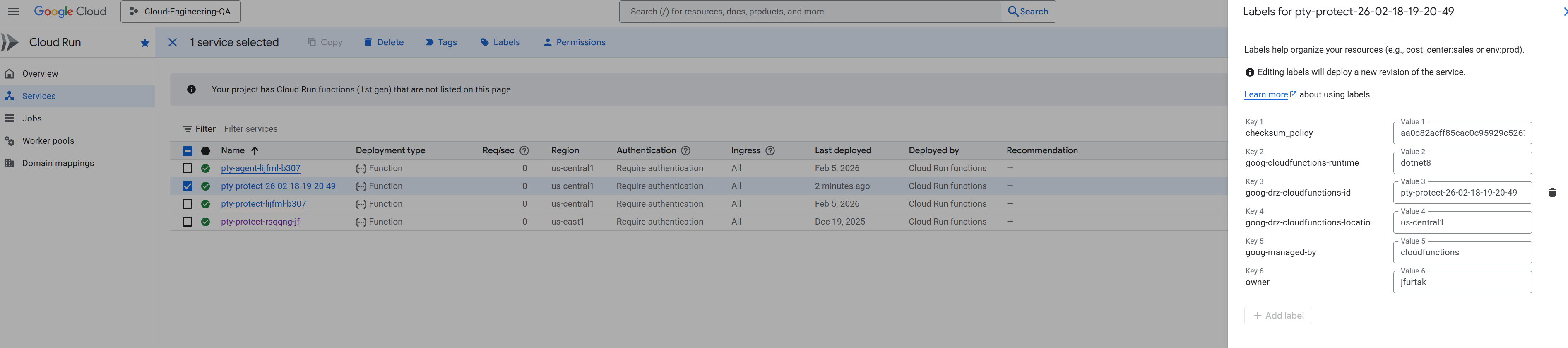
To avoid this issue, always update labels using one of the following methods:
labels variable in your Terraform configuration and run terraform apply.gcloud functions deploy with the updated --update-labels flag.If labels were already updated incorrectly through the Cloud Run Services console, redeploy the function using one of the methods above to synchronize the labels and trigger a policy update.
| Feature | ESA 10.2 | PPC (this guide) |
|---|---|---|
| Datastore Key Fingerprint | Optional/Recommended | Required |
| CA Certificate on Agent | Optional/Recommended | Optional/Recommended |
| CA Certificate on Log Forwarder | Optional/Recommended | Not supported |
| Client Certificate Authentication from Log Forwarder | Optional/Recommended | Not supported |
| IP Address | ESA IP address | PPC address |
curl, kubectl installed.Follow these instructions as a guide for understanding specific inputs for Policy Agent integrating with PPC:
Obtain the Datastore Key Fingerprint
To retrieve the fingerprint for your Policy Agent:
Retrieve public key from the Cloud Provider Key Management service for the policy encryption key created in pre-configuration:
Escape the new line characters in the downloaded public key for use in the next step - for example:
awk 'NF {printf "%s\\n",$0}' "<public_key_file>" > "new-line-escaped-public-key.pem"
cat new-line-escaped-public-key.pem
Export key fingerprint using the PPC API as indicated in the curl example below:
curl -k -H "Authorization: Bearer ${TOKEN}" -X POST https://${HOST}/pty/v2/pim/datastores/1/export/keys -H "Content-Type: application/json" --data '{
"algorithm": "RSA-OAEP-256",
"description": "example-key-from-key-management",
"pem": "<value of new-line-escaped-public-key>"
}'
Sample Output:
{"uid":"1","algorithm":"RSA-OAEP-256","fingerprint":"4c:46:d8:05:35:2e:eb:39:4d:39:8e:6f:28:c3:ab:d3:bc:9e:7a:cb:95:cb:b1:8e:b5:90:21:0f:d3:2c:0b:27","description":"example-key-from-kms"}
Record the value for fingerprint and configure the Policy Agent:
Set the environment variable PTY_DATASTORE_KEY in the Policy Agent Lambda function to the fingerprint value.
Set the environment variable PTY_DATASTORE_KEY in the Policy Agent Function App to the fingerprint value.
Set the variable in Policy Agent main.tf pty_datastore_key to the fingerprint value and apply the changes.
Retrieve the PPC CA Certificate
To obtain the CA certificate from PPC:
kubectl -n api-gateway get secret ingress-certificate-secret -o jsonpath='{.data.ca\.crt}' | base64 -d > CA.pem
Use the ProtegrityCA.pem that was returned as described in Policy Agent Installation.
Configure the PPC Address
Use the PPC address in place of the ESA IP address wherever required in your configuration.
PTY_ESA_CA_SERVER_CERT is not provided.For more information about the protection methods supported by Protegrity, refer to the Protection Methods Reference.
Tokenization Type | Supported Input Data Types | Notes |
|---|---|---|
Numeric Credit Card Alpha Upper-case Alpha Alpha-Numeric Upper Alpha-Numeric Lower ASCII Printable Decimal Unicode Unicode Base64 Unicode Gen2 | STRING NULL | |
Integer | NUMBER NULL | |
Date Datetime | STRING NULL | For information about supported formats, refer to the Protection Methods Reference. |
Binary | STRING NULL | Must be |
Protection Method | Supported Input Data Types | Notes |
|---|---|---|
No Encryption | STRING NUMBER NULL |
Encryption Algorithm | Supported Input Data Types | Notes |
|---|---|---|
3DES AES-128 AES-256 CUSP 3DES CUSP AES-128 CUSP AES-256 | STRING | Must be |
Cloud Protect Cloud Function exposes USERNAME_REGEX configuration to allow extraction of policy username from user in the request.
USERNAME_REGEX Cloud Function Environment configuration
The USERNAME_REGEX environment variable can be set to contain regular expression with one capturing group. This group is used to extract the username. Examples below show different regular expression values and the resulting policy user.
USERNAME_REGEX | User in the request | Effective Policy User |
|---|---|---|
Not Set | ||
| service-account-user | |
user |
ESA controls which policy is deployed to protector using concept of data store. A data store may contain a list of IP addresses identifying servers allowed to pull the policy associated with that specific data store. Data store may also be defined as default data store, which allows any server to pull the policy, provided it does not belong to any other data stores. Node registration occurs when the policy server (in this case the policy agent) makes a policy request to ESA, where the agent’s IP address is identified by ESA.
Policy agent function source IP address used for node registration on ESA depends on ESA hubcontroller configuration ASSIGN_DATASTORE_USING_NODE_IP and the PTY_ADDIPADDRESSHEADER configuration exposed by the agent function.
The function service uses multiple network interfaces, internal network interface with ephemeral IP range of 169.254.x.x and external network interface with IP range described in Function app outbound IP addresses section under function configuration. By default, when agent function is contacting ESA to register node for policy download, ESA uses agent function outbound IP address. This default behavior is caused by the default ESA hubcontroller configuration ASSIGN_DATASTORE_USING_NODE_IP=false and agent default configuration PTY_ADDIPADDRESSHEADER=yes.
In some cases, when there is a proxy server between the ESA and agent function, the desirable ESA configuration is ASSIGN_DATASTORE_USING_NODE_IP=true. and PTY_ADDIPADDRESSHEADER=no which will cause the ESA to use proxy server IP address.
The table below shows how the hubcontroller and agent settings will affect node IP registration on ESA.
| Agent source IP | Agent Function Outbound IP | Proxy IP | ESA config - ASSIGN_DATASTORE_USING_NODE_IP | Agent function config - PTY_ADDIPADDRESSHEADER | Agent node registration IP |
|---|---|---|---|---|---|
| 169.254.144.81 | 20.75.43.207 | No Proxy | true | yes | 169.254.144.81 |
| true | no | 20.75.43.207 | |||
| false | yes | ||||
| false | no | ||||
| 169.254.144.81 | 20.75.43.207 | 34.230.42.110 | true | yes | 169.254.144.81 |
| true | no | 34.230.42.110 | |||
| false | yes | ||||
| false | no |
Protegrity Cloud Protect Log Forwarder installation provides a solution to recover undelivered audit logs. Reasons for undeliverable logs may include:
Log Forwarder is triggered by pub/sub events generated by Protect Functions. If Log Forwarder is unable to reach ESA to deliver the logs, they are pushed to a dead letter pub/sub topic. Dead letter pub/sub topic is created when installing the Log Forwarder with the service installation script. See Install Log Forwarder Function via Terraform Scripts for dead letter topic configuration options and naming conventions.
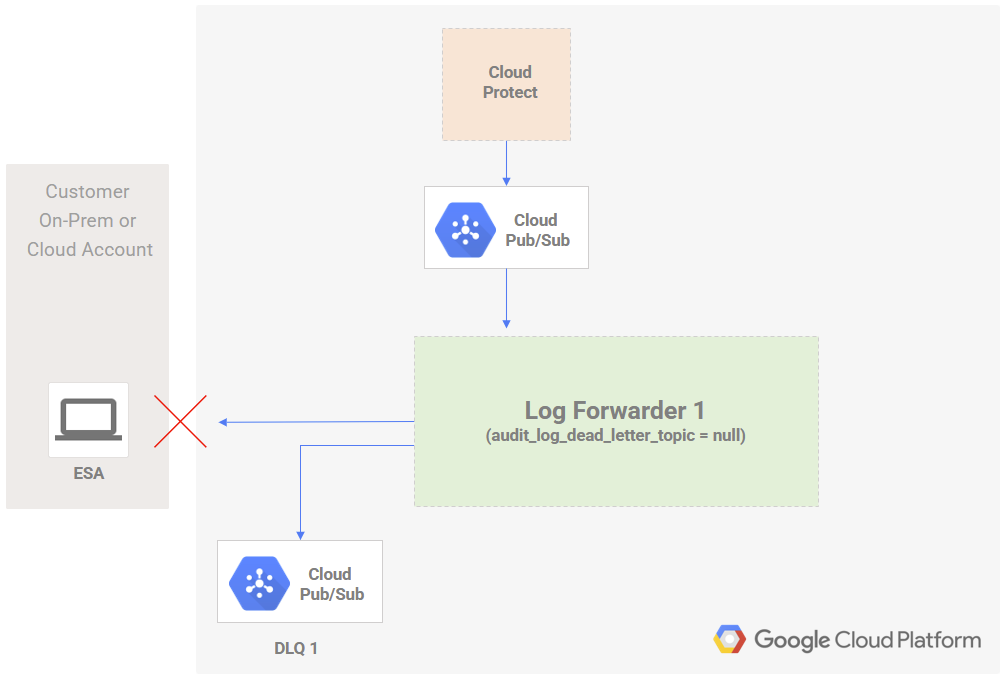
Logs pushed to the dead letter pub/sub topic will be purged and no longer recoverable when specified dlq_topic_message_retention_duration has been reached. Monitoring the dead letter topic is recommended to ensure timely recovery of audit messages before they are permanently lost. Consult the GCP monitoring alerts documentation for setting up alerts based on pub/sub topic metrics.
Protegrity recommends creation of an additional Log Forwarder installation in the case where logs are not delivered to ESA, as described in Log Forwarder Dead Letter Pub/Sub Architecture.
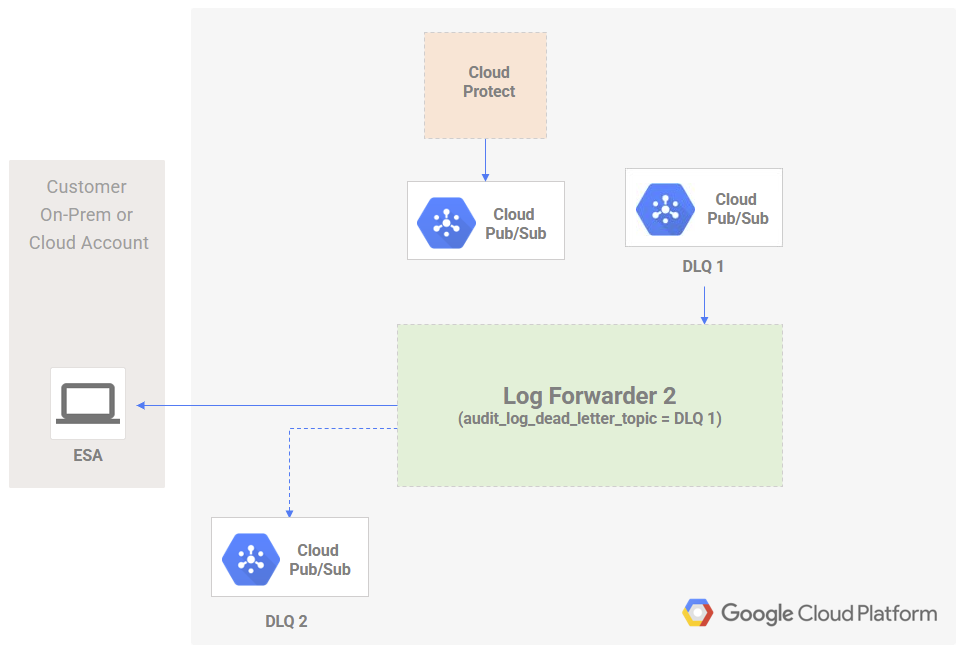
Steps to recover audit logs using new Log Forwarder installation:
Create a second Log Forwarder installation (Log Forwarder 2 in the above diagram) for processing undelivered logs. Value for audit_log_dead_letter_topic in the terraform script should be set to null during installation.
Configure and test newly installed Log Forwarder to verify ESA connectivity. See Install Log Forwarder Function via Terraform Scripts for installation instructions.
Identify the dead letter pub/sub topic (DLQ 1 in the above diagram) resource name by running command
terraform output
for the Log Forwarder which failed to deliver logs (Log Forwarder as described in Log Forwarder Dead Letter Pub/Sub Architecture). Note the value for audit_log_dlq_topic.
Set audit_log_dead_letter_topic in the new Log Forwarder (Log Forwarder 2 in the above diagram) terraform installation script to the value of audit_log_dlq_topic identified in previous step. Apply the changes with terraform apply.
Monitor the new Log Forwarder function logs for any failures.
When the recommended method of for recovery described in Recovering Logs in Dead Letter Topic (Recommended) is not an option, you may use the existing Log Forwarder to reprocess undelivered logs.
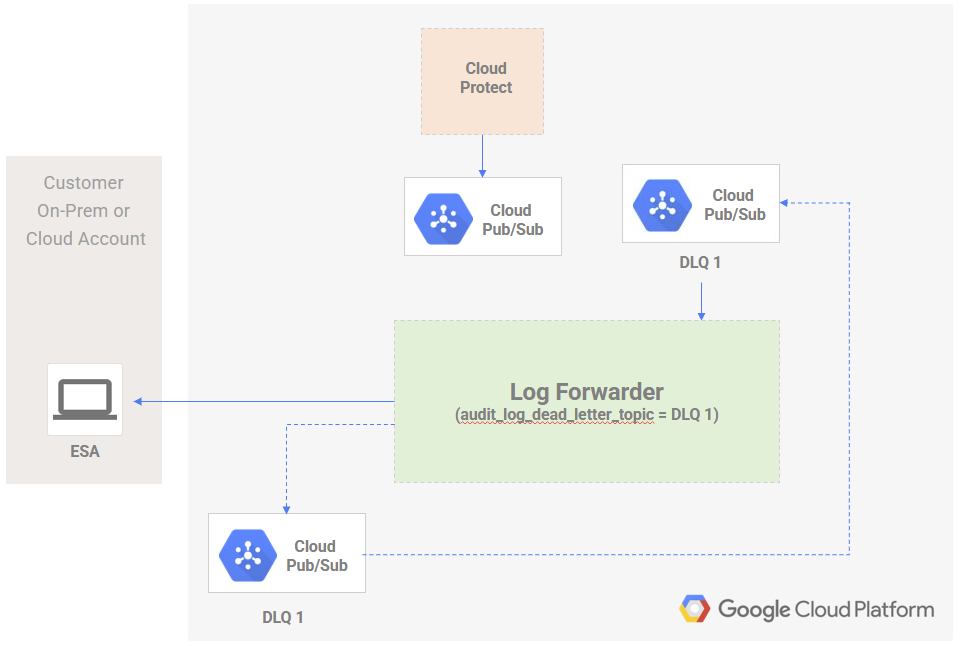
Steps to recover audit logs using existing Log Forwarder installation:
Fix any configuration errors causing the Log Forwarder to fail. Verify audit logs are being transmitted successfully to ESA.
Identify the dead letter pub/sub topic (DLQ 1 in the above diagram) resource name by running command
terraform output
for the Log Forwarder. Note the value for audit_log_dlq_topic.
Set audit_log_dead_letter_topic in the terraform installation script to the value of audit_log_dlq_topic identified in previous step. Apply the changes with
terraform apply
When audit logs have been transmitted to ESA, revert setting audit_log_dead_letter_topic to null Apply the changes with
terraform apply
This section describes the high-level architecture of the Protegrity BigQuery Protector on Google Cloud Platform (GCP), and the installation procedures. This section focuses on Protegrity specific aspects and should be consumed in conjunction with corresponding Google Cloud documentation.
This guide may also be used with the Protegrity Enterprise Security Administrator Guide, which explains the mechanism for managing the data security policy.
The GCP (Google Cloud Platform) BigQuery Protector is a cloud-native, serverless product for fine-grained data protection. This enables the invocation of Protegrity data protection cryptographic methods in cloud-native serverless technology. The benefits of serverless include rapid auto-scaling, performance, low administrative overhead, and reduced infrastructure costs compared to a server-based solution.
This product provides integration with Google BigQuery Remote Function. The product is designed to scale elastically and yield reliable query performance under extremely high concurrent loads. During idle use, the serverless product will scale completely down, providing significant savings in Cloud compute fees.
Protegrity utilizes a data security policy maintained by an Enterprise Security Administrator (ESA), similar to other Protegrity products. Using a simple REST API interface, authorized users can perform both de-identification (protect) and re-identification (unprotect) operations on data. A user’s individual capabilities are subject to privileges and policies defined by the Enterprise Security Administrator.
Protegrity’s format and length preserving tokenization scheme make it possible to perform analytics directly on protected data. Tokens are join-preserving so protected data can be joined across datasets. Often statistical analytics and machine learning training can be performed without the need to re-identify protected data. However, a user or service account with authorized security policy privileges may re-identify subsets of data using the BigQuery Protector on GCP service.
BigQuery Protector on GCP incorporates Protegrity’s patent-pending vaultless tokenization capabilities into cloud-native serverless technology. Combined with an ESA security policy, the protector provides the following features:
For more information about the available protection options, such as, data types, Tokenization or Encryption types, or length preserving and non-preserving tokens, refer to Protection Methods Reference.
The Protegrity product should be deployed in the customer’s Cloud account within the same Google Cloud region as the BigQuery dataset. The product incorporates Protegrity’s vaultless tokenization engine within Google Cloud Functions. The encrypted data security policy from an ESA is deployed periodically as a static resource together with Cloud Function binaries. The policy is decrypted in memory at runtime within the Cloud Function. This architecture allows Protegrity to be highly available and scale very quickly without direct dependency on any other Protegrity services.
The product exposes a remote data protection service invoked from external User Defined Functions (UDFs), a native feature of specific Cloud databases. The UDFs can be invoked through direct SQL queries or database views. The external UDF makes parallel API calls to the serverless Protegrity Cloud function to perform protect and unprotect data operations. Each network REST request includes a micro-batch of data to process and a secure context header generated by the database with the username and a Protegrity context header with the data element type, and operation to perform. The product applies the ESA security policy including user authorization and returns a corresponding response. Security operations on sensitive data performed by protector can be audited. The product can be configured to send audit logs to ESA via optional component called Log Forwarder.
The security policy is synchronized through another serverless component called the Protegrity Policy Agent. The agent operates on a configurable schedule, fetches the policy from the ESA, performs envelope encryption using Google Key Management Service, and deploys new version of Cloud Function with updated policy. This solution can be configured to automatically provision the static policy or the final step can be performed on-demand by an administrator. There is no downtime for users during this process. Instances provisioned with the function’s previous policy version may continue running (and processing traffic) for several minutes after a deployment has finished.
The following diagram illustrates the high-level architecture.
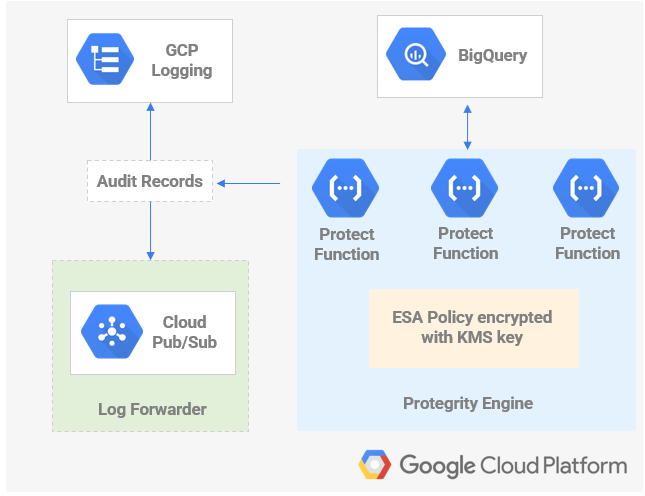
The following diagram illustrates a reference architecture for synchronizing the security policy from the ESA to the product.
The Protegrity Policy Agent requires network access from GCP to your ESA. Most organizations install the ESA on-premise. Thus, it is recommended to install the Policy Agent in a private subnet with a Cloud VPC using a NAT Gateway to enable this communication through a corporate firewall.
The ESA is a soft appliance that must be installed on a separate server. It is used to create and manage security policies.
For more information about installing the ESA, and creating and managing policies, refer the Policy Management Section.
Audit logs are by default sent to Cloud Logging. The Protegrity Product can also be configured to send audit logs to ESA. Such configuration requires deploying Log Forwarder component which is available as part of Protegrity Product deployment bundle. The diagram below shows additional resources deployed with Log Forwarder component.
The log forwarder component includes Pub/Sub service topic and the audit log forwarder function. Pub/Sub service is used to asynchronously send audit records to forwarder function, where similar audit logs are aggregated before sending to ESA. Aggregation rules are described in the Protegrity Log Forwarding guide. When the protector function is configured to send audit logs to log forwarder, audit logs are aggregated on the protector function before sending to Pub/Sub topic. Protector function exposes configuration to control the time it spends aggregating audit logs which is described in the protector function installation section.
The security of audit logs is ensured by using HTTPS connection on each link of the communication between protector function and ESA. Integrity and authenticity of audit logs is additionally checked on log forwarder which verifies individual logs signature. The signature verification is done upon arrival from Pub/Sub topic before applying aggregation. If signature cannot be verified, the log is forwarded as is to ESA where additional signature verification can be configured. Log forwarder function uses basic auth and optional certificate verification to authenticate calls to ESA. Basic auth credentials are stored securely in Secret Manager Service.
To learn more about individual audit log entry structure and purpose of audit logs, refer to Audit Logging section in this document. Installation instruction can be found in the Audit Log Forwarder Installation.
The audit log forwarding requires network access from the cloud to the ESA. Most organizations install the ESA on-premise. Therefore, it is recommended that the Log Forwarder Function is installed into a private subnet with a Cloud VPC using a NAT Gateway to enable this communication through a corporate firewall.
BigQuery invokes Protegrity Cloud Function deployed as an HTTP trigger. Requests are authenticated/authorized using GCP role-based access control. BigQuery uses cloud resource connection to create unique system service account. The service account is used to authenticate/authorize requests to Protect Cloud Function. The following figure illustrates the integration architecture between BigQuery and the Protegrity Cloud Function.
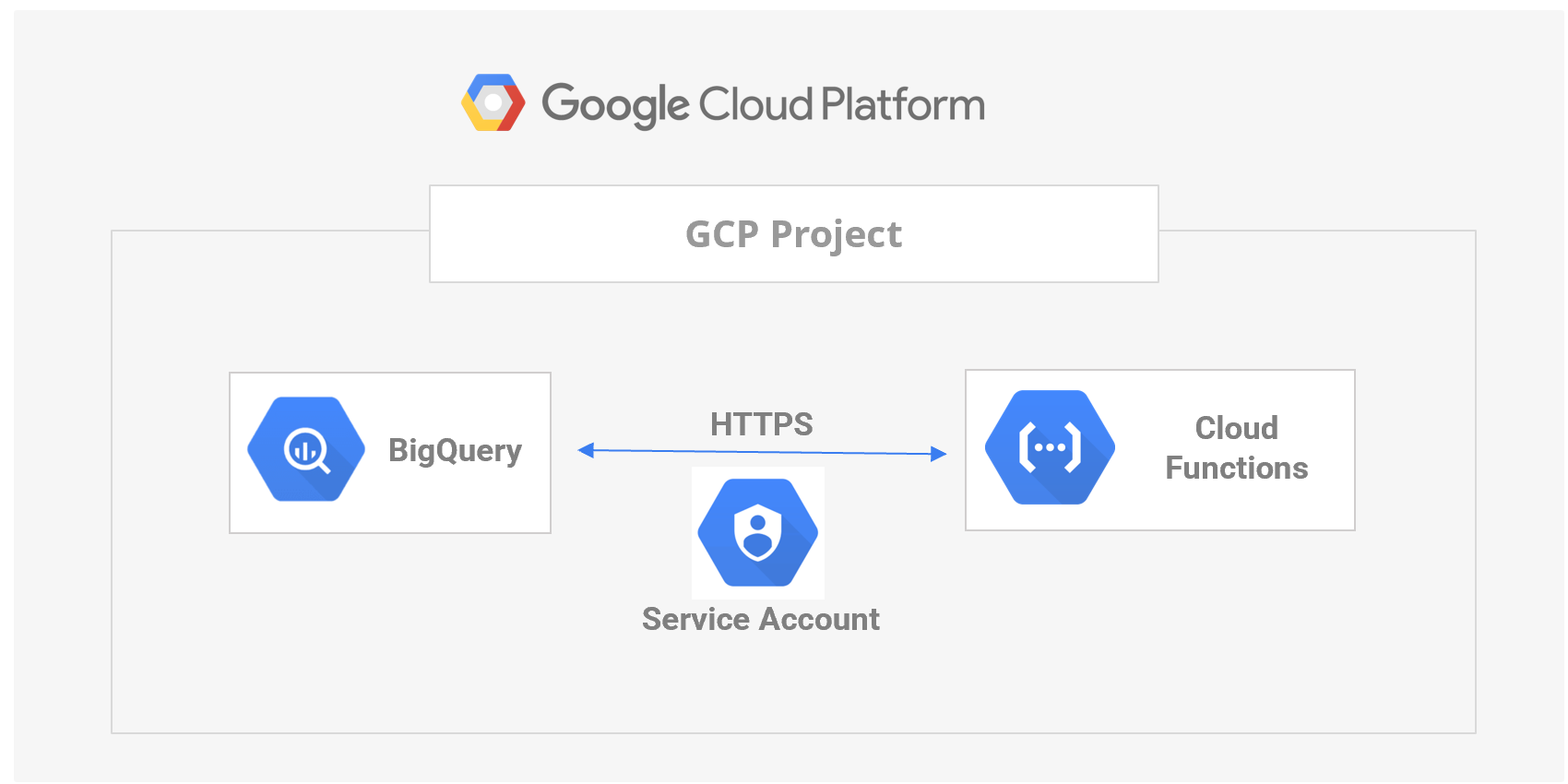
The BigQuery Connection API enables users to set up a connection from BigQuery to an external data source. Creating connection requires completing an initial one-time setup to create a connection resource in BigQuery. These steps are provided in the installation.
The following table describes the Google Cloud services that may a part of your Protegrity installation.
| Service | Description |
|---|---|
| Cloud Run Functions | Provides serverless compute for Protegrity protection operations and the ESA integration to fetch policy updates. |
| Key Management Service | Provides cryptographic keys for envelope encryption/decryption of the policy. |
| Secret Manager Service | Stores secrets required during deployment, e.g., ESA credentials. |
| Cloud Storage Service | Storage location for the encrypted ESA policy package. |
| Identity and Access Management | Enforces access policies for deployed resources. |
| Cloud Logging Service | Application and audit logs, performance monitoring, and alerts. |
| Cloud VPC | Required for securing network access to On-Prem or cloud-based ESA. |
| Pub/Sub | Provides a messaging service when forwarding audit logs to ESA is enabled. |
| BIgQuery Connection API | Allows creating connection from BigQuery to Protect Cloud Function. |
The Protector and Log Forwarder functions require a security policy from a compatible ESA version.
The table below shows compatibility between different Protector and ESA versions.
| Protector Version | ESA Version | |||
|---|---|---|---|---|
| 8.x | 9.0 | 9.1 & 9.2 | 10.0 | |
| 2.x | No | Yes | * | No |
| 3.0.x & 3.1.x | No | No | Yes | No |
| 3.2.x | No | No | Yes | * |
| 4.0.x | No | No | No | Yes |
Legend | |
|---|---|
Yes | Protector was designed to work with this ESA version |
No | Protector will not work with this ESA version |
* | Backward compatible policy download supported:
|
| Requirement | Detail |
|---|---|
| Protegrity distribution and installation scripts | These artifacts are provided by Protegrity |
| Protegrity ESA 10.0+ | The Cloud VNet must be able to obtain network access to the ESA |
| Google Cloud Account | Recommend creating a new project for Protegrity Serverless |
| Terraform CLI v0.14 or higher | Terraform is used to deploy resources to Google Cloud Account |
| Requirements | Description |
|---|---|
| GCP Cloud Administrator | Run Terraform (or perform steps manually), create/configure a VPC and IAM permissions. |
| Protegrity Administrator | The ESA credentials required to extract the policy for the Policy Agent |
| Network Administrator | Open firewall to access ESA and evaluate Google Cloud network setup |
Identify or create a new Google Cloud Project where the Protegrity solution will be installed. It is recommended to create a new project. This provides greater security controls and avoids conflicts with other applications that might impact regional account limits. An individual with the Owner role will be required for some of the subsequent installations.
Google Project ID: ___________________
Google Project Number: ___________________
Google Cloud Region: ___________________
The Google Cloud Key Management Service (KMS) provides Protegrity Serverless solution the ability to encrypt and decrypt the Protegrity Security Policy.
To create KMS Key Ring and Asymmetric Encryption Master Key:
Log in to Google Account and select project where Protegrity service will be installed.
Navigate to Security > Key Management.
Select Create key ring.
Specify key ring name. For example, protegrity-policy-keyring.
select Key ring location which corresponds to the region where Protegrity solution will be installed.
Select Create.
Select CREATE KEY to create encryption key.
Specify key name. For example, protegrity-policy-key.
under Purpose selection, select Asymmetric Decrypt .
Select Key Algorithm. For example, 3072-bit RSA with OAEP Padding and SHA256 digest.
Select Create.
Once the key is created, a screen opens on the key. If the screen does not appear, click on the key name.
Then click on the elipses under Actions that is next to the key version.
Select Copy Resource Name and record the value below, e.g., projects/{project-id}/locations/region/keyRings/{key-ring}/cryptoKeys/{key-name}/cryptoKeyVersions/1
Policy Encryption Key Version Resource Name: ___________________
Cloud Storage buckets are required for the Gen 2 Cloud Function sources, the Terraform backend, and the deployment of the Protegrity installation artifacts. It is recommended that you create 3 separate buckets to separate files used for different purposes. If you cannot create 3 separate buckets, you may reuse a bucket for multiple purposes.
Create the buckets:
Run the cloud command below to enable the Google Storage Transfer API.
gcloud services enable storagetransfer.googleapis.com
Create the Gen 2 Cloud Function sources bucket. This bucket is not required if you will be deploying to Gen 1 Cloud Functions. The bucket name much match the example below. Replace the <gcp-project-number> and <region> placeholders.
gcf-v2-sources-<gcp-project-number>-<region>
Use the following gcloud command to obtain project number
gcloud projects describe <gcp-project-id> --format='value(projectNumber)'
Create the deployment bucket or reuse an existing bucket. This bucket is used during the installation process to store the Protegrity installation artifacts.
Deployment Bucket Name:___________________
Create the Terraform backend bucket or reuse an existing bucket. This bucket is used by Terraform to store information about your Cloud Protect installation, and will be used if you upgrade to a later version of Cloud Protect in the future.
Terraform Backend Bucket Name:___________________
Cloud Functions use the service accounts created in this deployment. You can create Service accounts manually or use the Protegrity Terraform installation script to create one. Each service account requires specific permissions, which must be granted through IAM roles. Run the following steps to create service accounts and configure the required IAM access. If you use Terraform scripts, skip these steps.
To create Agent Function IAM Role:
Log in to Google Account and select project where Protegrity service will be installed.
Navigate to IAM & Admin > Roles, Select CREATE ROLE.
Specify role name and description.
Select ADD PERMISSIONS.
Select the following permissions:
Click Add and then Create.
Alternatively, you can run the following command from the Cloud Shell Terminal.
gcloud iam roles create role-id \
--project=project-id \
--title=role-title \
--description=role-description \
--permissions=cloudkms.cryptoKeyVersions.useToEncrypt,\
cloudkms.cryptoKeyVersions.viewPublicKey,\
secretmanager.versions.access,\
storage.objects.get,\
storage.objects.create,\
storage.objects.delete,\
storage.objects.list,\
storage.objects.update,\
storage.buckets.get,\
cloudfunctions.functions.get,\
cloudfunctions.functions.update,\
cloudfunctions.functions.sourceCodeGet,\
cloudfunctions.functions.sourceCodeSet,\
iam.serviceAccounts.actAs \
--stage=GA
role-id
is the name of the role, such as ptyProtectRole.
project-id
is the name of the project, such as my-project-id.
role-description
is a short description of the role, such as “My custom role description”.
Sample output:
Created role [role-id].
description: role-description
etag: *****************
includedPermissions:
- cloudfunctions.functions.get
- cloudfunctions.functions.sourceCodeGet
- cloudfunctions.functions.sourceCodeSet
- cloudfunctions.functions.update
- cloudkms.cryptoKeyVersions.useToEncrypt
- cloudkms.cryptoKeyVersions.viewPublicKey
- iam.serviceAccounts.actAs
- secretmanager.versions.access
- storage.buckets.get
- storage.objects.create
- storage.objects.delete
- storage.objects.get
- storage.objects.list
- storage.objects.update
name: projects/{project-id}/roles/{role-id}
stage: GA
title: role-title
To create Agent Service Account:
Log in to Google Account and select project where Protegrity service will be installed.
Navigate to IAM & Admin > Service Accounts.
Select CREATE SERVICE ACCOUNT.
Specify service account name and description.
Select Create and Continue.
In the next step, click Select Role.
Select Custom and select the role created above .
Click Done.
Once the service account is created, the screen should open on the service account. If the screen does not appear, refresh the page with the service account list and select the service account created.
Record the full email. For example, service-account-name@project-id.iam.gserviceaccount.com
Agent Function Service Account Email: ___________________
To create Protect Function IAM role:
Log in to Google Account and select project where Protegrity service will be installed.
Navigate to IAM & Admin > Roles, Select CREATE ROLE.
Specify role name and description.
Select ADD PERMISSIONS.
Select the cloudkms.cryptoKeyVersions.useToDecrypt permission.
Click Add and then Create.
To create Protect Service Account:
Log in to Google Account and select the project where Protegrity service will be installed.
Navigate to IAM & Admin > Service Accounts.
Select CREATE SERVICE ACCOUNT.
Specify service account name and description.
Select Create and Continue.
In the next step, click Select Role. Then select Custom and select the role created above .
Click Done.
Once the service account is created, the screen should open on the service account. If the screen does not appear, refresh the page with the service account list and select the service account created.
Record the full email. For example, service-account-name@project-id.iam.gserviceaccount.com.
Protect Function Service Account Email: ___________________
Ensure that all the steps in pre-configuration are performed.
Log in to the Google Cloud account where Protegrity will be installed.
Select the project.
Ensure that you have access to shell command on your computer or Cloud Shell with Terraform CLI v0.14 or higher installed.
Ensure that the Terraform scripts provided by Protegrity are available on your local computer.
Resources created with Terraform scripts include Protect Cloud Functions Service and other required resources depending on Terraform parameters. If you don’t specify the deployment bucket Terraform parameter, a new storage bucket will also be created. You can optionally choose to create a new service account with custom IAM role.
To install using Terraform:
From the command shell move to directory where you downloaded Protegrity installation bundle.
Unzip the bundle. Verify that the following files are available:
Unzip the protegrity-cloud-protect-gcp-{version}.zip file. Verify that the following files are available:
Open the main.tf file and update Terraform backend information at the top of the file:
terraform {
backend "gcs" {
bucket = ""
prefix = "protegrity/terraform/pty-protect-gcp/state"
}
}
In the same main.tf file, specify the following Terraform variables: All the values were recorded in Google Cloud Project.
| Parameter | Description |
|---|---|
| project_id | The project id recorded in the pre-configuration step |
| region | The Region recorded in the pre-configuration step. |
| deployment_id | Specify short name to identify deployment. This id will be added to all resources deployed with Terraform. |
| deployment_bucket | Use Deployment Bucket Name recorded in pre-configuration or leave empty to create new bucket. |
| deployment_bucket_location | Geographical location of deployment bucket, e.g., US, EU, ASIA. |
| deployment_file_directory_path | Path to directory where deployment zip file is located. By default the deployment file should be in the same directory as this main.tf file. |
| create_service_account | Leave this as false if you created service account in pre-configuration. Otherwise set to true. |
| protect_function_service_account_email | Use Protect Function Service account recorded in pre-configuration or leave empty. |
| min_log_level | Minimum log level for log forwarder function. One of off|severe|warning|info|config|all. Defaults to ‘severe’ |
| pty_log_output | Audit log output. Accepted values: “"(empty string), “pub_sub”.NoteWhen set to “pub_sub” audit logs will be aggregated and sent to Pub/Sub topic. See Log Forwarder installation section for more details. |
| audit_log_flush_interval | Time interval in seconds used to accumulate audit logs before sending to Pub/Sub topic. Default value: 30, Min value: 1, Max value: 900 |
| pty_pub_sub_topic | Pub/Sub topic where audit logs will be sent. |
| username_regex | If username_regex is set, the effective policy user will be extracted from the user in the request.NoteSee gcp_username_regex_appendix to learn how to extract username from the request. |
| max_instance_count | GCP Cloud Functions advanced configuration |
| available_memory_mb | GCP Cloud Functions advanced configuration |
| timeout_seconds | GCP Cloud Functions advanced configuration |
| gen2_available_cpu | 2nd Gen Cloud Function advanced configuration |
| gen2_container_concurrency | 2nd Gen Cloud Function advanced configuration |
| upgrade_step | Set this variable when upgrading to the latest version. |
| labels | You can set this map to include labels for deployed resources. Pay attention to GCP label requirements. For more information, refer to Labeling Resources. For example, only use lowercase and maximum length of 63 characters. |
From local command line or Cloud Shell, change directory to location of the main.tf, for example:
protegrity-gcp-bigquery-{version}/pty-protect-gcp/
Run the following command.
terraform init
Terraform will download necessary providers.
Run the following command to verify configuration and print out deployment plan.
terraform plan
Run the following command to deploy resources to your account.
terraform apply
Once deployment is complete Terraform will print output variables.
Record the following values:
Before continuing with next steps, you can verify whether Cloud Functions are installed correctly. This step is optional and can be skipped.
Below you can find example Linux curl command to test your function.
Before you can execute it, you need to obtain temporary authentication token. Run the gcloud auth login and then gcloud auth print-identity-token commands. The logged in gcloud user must have the Cloud Run Invoker Role (roles/run.invoker) role. Record the output of print identity token command.
gcloud_auth_token: _________________
Replace {protect_function_url} with value recorded in previous step.
Replace {gcloud_auth_token} with value recorded in above step.
Run the following CURL command to test Function deployment.
curl -X POST "{protect_function_url}" \
-H 'Authorization:Bearer {gcloud_auth_token}' \
-d '{
"caller": "bigquery.googleapis.com/projects/my-project-id/jobs/123456",
"requestId": "124ab1c",
"sessionUser": "test-user@test-company.com",
"userDefinedContext": {
"data_element": "alpha",
"op_type": "unprotect"
},
"calls": [
[
"UtfVk UHgcD!"
]
]
}'
Verify the following output:
{"replies":["hello world!"]}
Policy Agent Function installation is done via Terraform scripts provided by Protegrity. Before running the template, some resources must be created manually.
Policy Agent function requires ESA server running and accessible from Agent Cloud Function on TCP port 8443. Make sure inbound connections on TCP:8443 are allowed for the network where ESA is hosted.
Note down ESA IP address:
ESA IP Address (EsaIpAddress): ___________________
By default, ESA is configured with self-signed certificates, which can only be validated using self-signed CA certificate supplied in Cloud Function Environment variables configuration.
In case ESA is configured with publicly signed certificates, this section can be skipped since the Cloud Function will use public CA to validate ESA certificates.
To obtain self-signed CA certificate from ESA:
Log in to ESA Web UI.
Select Settings > Network > Manage Certificates.
Hover over Server Certificate and click on download icon to download the CA certificate.
After certificate is downloaded, open the PEM file in text editor and replace all new lines with escaped new line: \n.
To escape new lines from command line, use one of the following commands depending on your operating system:
Linux Bash:
awk 'NF {printf "%s\\n",$0;}' ProtegrityCA.pem > output.txt
Windows PowerShell:
(Get-Content '.\ProtegrityCA.pem') -join '\n' | Set-Content 'output.txt'
Record the certificate content with new lines escaped.
ESA CA Server Certificate (EsaCaCert): ___________________
This value will be used to set pty_esa_ca_server_cert Terraform variable in installation section.
For more information about ESA certificate management refer to Certificate Management Guide in ESA documentation.
Google Cloud VPC is used to route traffic from Policy Agent Cloud Function to ESA. If your ESA is in a Google Cloud VPC, it is recommended to create a serverless VPC access and record its name:
google_vpc_access_connector_name: ___________________
If ESA is not on Google Cloud VPC, you can either create one or choose to let Terraform script to create one. The Terraform script will create the following elements:
NAT gateway
To connect to ESA outside the Google Cloud Network
External IP address
Can add it to the allowlist by the firewall in the network environment where ESA is hosted.
Serverless VPC access
Allows connectivity from the Cloud function to the VPC.
Policy Agent Function requires ESA credentials to be provided as one of the two options:
Secret Manager is the recommended option for storing ESA credentials.
Create ESA credentials secrets:
Log in to Google Account and select project where Protegrity service will be installed.
Go to Security > Secret Manager.
Select CREATE SECRET.
Specify the Secret Value:
{
"username": "{esa_username}",
"password": "{esa_password}"
}
Select Create Secret.
Once the secret is created, you should see the secret screen opened. If not click on the secret name to see a screen with secret versions.
Click on Actions, next to the secret version you just created.
Select Copy Resource ID and record the full secret version path, For example, projects/{project-id}/secrets/{secret name}/versions/2.
Secret resource id: ___________________
If you have the skills to write code, you may provide a custom Cloud Function that returns the ESA credentials to the Policy Agent. One use case is when reading the ESA credentials from a third-party password vault.
Create the Cloud Function:
Create a new 2nd gen Cloud Function using any runtime.
The Policy Agent does not provide an input payload.
The Cloud Function must return a response according to the following schema:
response:
type: object
properties:
username: string
password: string
For example,
example output: {"username": "admin", "password": "Password1234"}
Sample GCP Function in Python:
def handler(request):
return {"username": "admin", "password": "password1234"}
Grant the Cloud Run Invoker role to the Policy Agent function service account.
Grant the cloudfunctions.functions.get permission to the Policy Agent function service account role.
Record the Function name:
ESA CREDENTIALS FUNCTION NAME: _______________
Agent Terraform scripts provided by Protegrity create a Cloud Function in your Google account. If you don’t specify the deployment bucket Terraform parameter, a new storage bucket will also be created. You can also create the following optional resources by specifying the corresponding parameters:
To install Policy Agent Function through Terraform:
From command shell, move to the directory where you downloaded Protegrity installation bundle.
Unzip the bundle, then unzip the protegrity-agent-gcp-{version}.zip. Verify that the following files are available:
Open the main.tf file and update Terraform backend information at the top of the file:
terraform {
backend "gcs" {
bucket = ""
prefix = "protegrity/terraform/pty-protect-gcp/state"
}
}
Set the bucket property to Terraform Backend Bucket Name recorded in Google Cloud Storage
Set the prefix property with value unique to your deployment.
In the same main.tf file, specify the following Terraform variables.
| Parameter | Description |
|---|---|
| project_id | The Project ID recorded in the pre-configuration step |
| region | The Region recorded in the pre-configuration step, for example, us-central1. |
| deployment_id | Specify short name to identify deployment. This id will be added to all resources deployed with Terraform. |
| deployment_bucket | Use Deployment Bucket Name recorded in pre-configuration or leave empty to create new bucket. |
| deployment_bucket_location | Geographical location of deployment bucket, e.g., US, EU, ASIA. |
| deployment_file_directory_path | Path to directory where deployment zip file is located. By default the deployment file should be in the same directory as this main.tf file. |
| policy_download_cron_expression | Cron expression determining how often policy agent function will run to synchronize security policy from ESA. |
| create_service_account | Leave this as false if you created service account in pre-configuration. Otherwise set to true. |
| agent_function_service_account_email | Use Agent Function Service account recorded in pre-configuration or leave empty. |
| create_vpc | Set this to true, if you would like to create VPC with NAT, external IP and vpc access connector, otherwise leave empty. This will be ignored if google_vpc_access_connector_name is specified. |
| google_vpc_access_connector_name | Specify the existing VPC access connector name you identified in earlier step, otherwise leave empty. This setting will disable create_vpc = true. |
| google_vpc_access_connector_full_resource_name | Alternative configuration for VPC access connector. If this parameter is set the google_vpc_access_connector_name will be ignored. Use this parameter, if vpc connector is in different region/project that the one specified for the deployment. |
| labels | You can set this map to include labels for deployed resources. Pay attention to gcp label requirements. More information in: https://cloud.google.com/compute/docs/labeling-resources. For example, only use lowercase and maximum length of 63 characters. |
All the values were recorded in Pre-Configuration and this section’s previous steps.
Provide Policy update Terraform variables. In the same main.tf file, you can specify configuration related to policy update. Any of these variables can be updated at any given time by running the terraform again or directly in the GCP Console. Most of the values were recorded in previous installation steps.
Parameter | Description | Notes |
|---|---|---|
pty_esa_ip | ESA IP address or hostname | |
pty_esa_ca_server_cert | ESA self-signed CA certificate used by policy Agent Function to ensure ESA is the trusted server. | Recorded in step Certificates on ESA In case ESA is configured with publicly signed certificates, the pty_esa_ca_server_cert configuration will be ignored. |
gcp_esa_credentials_secret_resource_id | ESA username and password (encrypted value by Google Cloud Secrets Manager). For example, projects/{project-id}/secrets/{secret name}/versions/{version} | |
pty_esa_credentials_function | ESA credentials GCP function resource name. For example, projects/{project-name}/locations/{region}/functions/{esa-credentials-function-name}. | Recorded in step Option 2: Custom Cloud Function ESA CREDENTIALS FUNCTION NAME. Presence of gcp_esa_credentials_secret_resource_id will cause this value to be ignored. The Policy Agent Function must have network access and IAM permissions to call the ESA Credentials function you have created in Option 2: Custom Cloud Function. |
gcp_kms_key_resource_name | The Key full resource name. For Example, projects/{project-id}/locations/region/keyRings/ {key-ring}/cryptoKeys/{key-name}/cryptoKeyVersions/1 | |
gcp_protect_function_resource_name | List of comma separated Protect function resource names. For Example, projects/{project-id}/ locations/{region}/functions/{function-name1},projects/{project-id}/ locations/{region}/functions/{function-name2} | Use protect_function_resource_name recorded in Protect Service Installation section. |
gcp_policy_retention_storage_bucket | Deployment Bucket Name where the encrypted policy will be written. | You can use deployment bucket recorded in Google Cloud Storage section, or you can specify other existing bucket. |
gcp_policy_version_object_key | Filename of the encrypted policy stored in the Deployment Bucket Name | Default: policy.zip |
retain_policy_versions | Number of policy versions to retain as backup. (e.g. 2 will retain the latest 2 policies and remove older ones). -1 retains all. | Default: 10 |
disable_deploy | This flag can be either 1 or 0. If set to 1, then the agent will not update protector function with the newest policy. Else, the policy will be saved in the cloud storage bucket and deployed to the protector function. WarningAgent deployment requires a deployed Protect or Log Forwarder Cloud Run function when disable_deploy is set | Default: 0 |
log_level | Application and audit logs verbiage level | Default: INFO. Allowed values: DEBUG – the most verbose INFO, WARNING, ERROR – the least verbose |
policy_pull_timeout | Time in seconds to wait for the ESA to send the full policy | Default: 20 |
pty_core_casesensitive | Specifies whether policy usernames should be case sensitive | Default: no. Allowed values: yes, no |
pty_core_emptystring | Override default behavior. Empty string response values are returned as null values. For instance, (un)protect(’’) -> null (un)protect(’’) -> '' | Default: empty. Allowed values: null, empty |
esa_connection_timeout | Time in seconds to wait for the ESA response | Default: 5s |
pty_addipaddressheader | When enabled, agent will send its source IP address in the request header. This configuration works in conjunction with ESA hubcontroller configuration ASSIGN_DATASTORE_USING_NODE_IP (default=false). See Associating ESA Data Store With Cloud Protect Agent for more information. | Default: yes. Allowed values: yes, no |
pty_datastore_key | ESA policy datastore public key fingerprint (64 char long) e.g. 123bff642f621123d845f006c6bfff27737b21299e8a2ef6380aa642e76e89e5. | NoteThis configuration is not applicable for ESA versions lower than 10.2.The export key is the public part of an asymmetric key pair created in a Create KMS Key. A user with Security Officer permissions adds the public key to the data store in ESA via Policy Management > Data Stores > Export Keys. The fingerprint can then be copied using the Copy Fingerprint icon next to the key. Refer to Exporting Keys to Datastore for details. NoteFor PPC deployments, see PPC Appendix: Policy Agent Certificate and Key Guidance for details on obtaining and using the datastore key fingerprint. |
pty_sync_datastore | Optional name of the policy datastore to sync with ESA. Refer to ESA documentation for more information on policy datastore sync. | Default: "" |
From local command line or Cloud Shell, change directory to location of the main.tf, for example:
protegrity-agent-gcp-{version}/pty-agent-gcp/
Run terraform init.
Terraform will download necessary providers.
Run terraform plan to verify configuration and print out deployment plan.
Run terraform apply to deploy resources to your account. Once deployment is complete, Terraform will print output variables.
Below is the sample output from successful deployment.
Apply complete! Resources: 1 added, 0 changed, 0 destroyed.
Outputs:
agent_function_service_account_email = "pty-agent-test@test.iam.gserviceaccount.com"
deployment_bucket_name = "test-bucket"
nat_ip = 0
policy_agent_function_deployment_object = "pty-agent-test-1.0.1.zip"
policy_agent_function_name = "pty-agent-test"
After configuration is complete, you can test the function.
To test and run the Policy Agent Function:
From the Google Cloud console, go to Cloud Run Functions or Cloud Run.
Click on the function you just deployed: pty_agent_{deployment_id}.
Click Test button at the top right section of the screen.
Scroll down to CLI test command.
Copy and run the curl command to trigger the agent. Alternatively, use the option Test in Cloud Shell.
Wait for the function to complete.
Navigate to the LOGS tab to view agent execution logs.
Alternatively, you may review the logs by navigating to Logging from your Google Console. In the Log Explorer select the All resources dropdown, then Cloud Run Revision > pty-agent-{deployment-id} and apply.
Function execution took 23892 ms, finished with status: 'ok'
iap.policy_deployer:INFO:Deleting object [policy_v07-26-2021_21-00-00.zip]
iap.policy_deployer:INFO:Deleting object [policy_v07-26-2021_19-03-23.zip]
iap.policy_deployer:INFO:Removing old function versions in [test-artifacts]. Will retain [1] versions.
iap.policy_deployer:INFO:Updating function [projects/cloud-engineering-315519/locations/us-central1/functions/pty-protect-test] with new deployment artifact [test-artifacts/policy_v07-26-2021_21-00-01.zip] ...
iap.imp_creator:INFO:Uploading encrypted policy data to: [test-artifacts/policy_v07-26-2021_19-03-23.zip]
iap.imp_creator:INFO:Preparing deployment package ...
iap_agent_gcp.cloud_functions_util:INFO:Downloading function deployment package ...
iap.imp_creator:INFO:Encrypting policy package ...
iap.policy_agent:INFO:Preparing new policy deployment ...
iap.policy_agent:WARNING:Current policy deployment has no checksum_mapping metadata:
iap.imp_creator:INFO:Checking current policy version ...
iap.policy_agent:INFO:Current deployment package version: [policy_v07-26-2021_18-51-43.zip].
iap.policy_agent:INFO:Getting current policy metadata ...
iap.imp_creator:INFO:Policy downloaded successfully ...
iap.imp_creator:INFO:PepServer started ...
iap.imp_creator:INFO:Starting PepServer ...
iap.imp_creator:INFO:PepServer configured successfully
iap.imp_creator:INFO:Downloading certificates from ESA ...
iap.imp_creator:INFO:Configuring PepServer ...
iap.policy_agent:INFO:Starting policy agent ...
iap.policy_agent:INFO:Using Secret Manager [GCP_ESA_CREDENTIALS_SECRET_RESOURCE_ID] to retreive ESA credentials.
iap.policy_agent:INFO:PTY_CORE_CASESENSITIVE [no]
iap.policy_agent:INFO:PTY_CORE_EMPTYSTRING [empty]
iap.policy_agent:INFO:RETAIN_POLICY_VERSIONS [1]
iap.policy_agent:INFO:GCP_PROTECT_FUNCTION_RESOURCE_NAME [projects/test/locations/us-central1/functions/pty-protect-test]
iap.policy_agent:INFO:GCP_POLICY_VERSION_OBJECT_KEY [policy.zip]
iap.policy_agent:INFO:GCP_POLICY_RETENTION_STORAGE_BUCKET [test-artifacts]
iap.policy_agent:INFO:GCP_KMS_KEY_RESOURCE_NAME [projects/test/locations/us-central1/keyRings/test-key-ring/cryptoKeys/test-protect-asymmetric/cryptoKeyVersions/1]
iap.policy_agent:INFO:GCP_ESA_CREDENTIALS_SECRET_RESOURCE_ID [projects/1234/secrets/ESA_ADMIN_CREDENTIALS/versions/2]
iap.policy_agent:INFO:PTY_ESA_IP [54.236.107.39]
iap.policy_agent:INFO:POLICY_PULL_TIMEOUT [20]
iap.policy_agent:INFO:DISABLE_DEPLOY [0]
Function execution started
Configure additional logging:
Set log_level Terraform variable on the Agent function to DEBUG.
In the GCP Logs Explorer, you can run the query below, replacing placeholders with your deployment id and project name.
resource.type="cloud_run_revision"
resource.labels.service_name=~"pty-agent-<deploymentd-id>"
severity=ERROR OR textPayload=~"\[error\]"
-logName="projects/<gcp-project-id>/logs/run.googleapis.com%2Frequests"
Expand each log entry for more details. Check for jsonPayload > exception to see more detailed error.
Error message | Details |
|---|---|
| This error may indicate the following configuration issues:
|
| This error may indicate the following configuration issues:
|
| Indicates the Agent Cloud Run function’s identity does not have permissions to sourceCodeGet for Protect/Log Forwarder function(s) provided to the gcp_protect_function_resource_name configuration. |
Audit Log Forwarder installation is done via Terraform scripts provided by Protegrity in the installation bundle.
ESA server is required as the recipient of audit logs. Verify the information below to ensure ESA is accessible and configured properly.
ESA server running and accessible on TCP port 9200.
Audit Store service is configured and running on ESA. For information related to ESA Audit Store configuration, refer to Audit Store Guide.
By default, ESA is configured with self-signed certificates, which can only be validated using self-signed CA certificate supplied in Log Forwarder configuration.
In case ESA is configured with publicly signed certificates, this section can be skipped since the Log Forwarder will use public CA to validate ESA certificates.
To obtain self-signed CA certificate from ESA:
Download ESA CA certificate from the /etc/ksa/certificates/plug directory of the ESA
After certificate is downloaded, open the PEM file in text editor and replace all new lines with escaped new line: \n.
To escape new lines from command line, use one of the following commands depending on your operating system:
Linux Bash:
awk 'NF {printf "%s\\n",$0;}' CA.pem > output.txt
Windows PowerShell:
(Get-Content '.\CA.pem') -join '\n' | Set-Content 'output.txt'
Record the certificate content with new lines escaped.
ESA CA Server Certificate (EsaCaCert): ___________________
This value will be used to set pty_esa_ca_server_cert Terraform variable in installation section. Install Log Forwarder via Terraform
For more information about ESA certificate management refer to Certificate Management Guide in ESA documentation.
Similar to Policy Agent Function, log forwarder function requires Google Cloud VPC to route traffic from the function to ESA. Review the VPC configuration steps for agent in section Identify or Create a new VPC. Same VPC connector as the policy agent can be used. Note down VPC connector name:
google_vpc_access_connector_name: ___________________
Audit Log Forwarder must authenticate with ESA using certificate-based authentication with client certificate and certificate key. Download the following certificates from the /etc/ksa/certificates/plug directory of the ESA:
| File Name | Description |
|---|---|
| client.key | Client certificate key |
| client.pem | Client certificate (PEM) |
Both certificate and certificate key must be converted to single-line values using code similar to the following examples.
Client certificate (client.pem):
$folder = 'C:\Temp'
cd $folder
(Get-Content "$folder\client.pem") -join '\n' | Set-Content "$folder\one-liner-client.pem"
cat "$folder\one-liner-client.pem"
folder="/tmp"
cd "$folder"
awk 'NF {printf "%s\\n",$0}' "client.pem" > "one-liner-client.pem"
cat "one-liner-client.pem"
Client certificate key (client.key):
$folder = 'C:\Temp'
cd $folder
(Get-Content "$folder\client.key") -join '\n' | Set-Content "$folder\one-liner-client.key"
cat "$folder\one-liner-client.key"
folder="/tmp"
cd "$folder"
awk 'NF {printf "%s\\n",$0}' "client.key" > "one-liner-client.key"
cat "one-liner-client.key"
While installing using Terraform template:
Audit Log Forwarder Function uses GCP Secret Manager to store ESA Audit Store credentials used during authentication.
For information on how to configure basic and certificate authentication for Audit Store on ESA refer to Audit Store Guide.
Log in to Google Account and select project where Protegrity service will be installed.
Go to Security > Secret Manager.
Select CREATE SECRET.
Specify the Secret Value:
{
"username": "admin",
"password": "{esa_password}"
}
Select Create Secret.
Once the secret is created, you should see the secret screen opened. If not click on the secret name to see a screen with secret versions.
Click on Actions, next to the secret version you just created.
Select Copy Resource ID and record the full secret version path, for example, projects/{project-id}/secrets/{secret name}/versions/2.
ESA Log Forwarder Credentials Secret Name: _________________
Create another secret with single-line contents of ESA client certificate key file
See Certificate Authentication for details on client certificate key
Record the full secret version path, for example, projects/{project-id}/secrets/{secret name}/versions/1.
ESA Log Forwarder Client Certificate Key Secret Name: _________________
To create Log Forwarder Service Account:
Log in to Google Account and select the project where Protegrity service will be installed.
Navigate to IAM & Admin > Service Accounts.
Select CREATE SERVICE ACCOUNT.
Specify service account name and description.
Select Create and Continue.
In the next step, click Select Role. Then select the following roles:
Click Done.
Once the service account is created, the screen should open on the service account. If the screen does not appear, refresh the page with the service account list and select the service account created.
Record the full email. For example, service-account-name@project-id.iam.gserviceaccount.com.
Log Forwarder Function Service Account Email: ___________________
Pub/Sub service requires Cloud Run Invoker permissions in order to be able to send messages to the Forwarder function.
Log in to Google Account and select the project where Protegrity forwarder will be installed.
Navigate to IAM & Admin > Service Accounts.
Select CREATE SERVICE ACCOUNT.
Specify service account name and description.
Select Create and Continue.
In the next step, click Select Role. Then select Cloud Run Invoker.
Click Done.
Once the service account is created, the screen should open on the service account. If the screen does not appear, refresh the page with the service account list and select the service account created.
Record the full email. For example, service-account-name@project-id.iam.gserviceaccount.com.
Pub/Sub Log Forwarder Service Account Email: ___________________
Ensure that all the steps in Google Cloud Project are performed.
Log in to the Google Cloud account where Protegrity will be installed.
Select the project.
Ensure that you have access to shell command on your computer or Cloud Shell with Terraform CLI v0.14 or higher installed.
Ensure that the Terraform scripts provided by Protegrity are available on your local computer.
Resources created with Terraform scripts include Audit Log Forwarder Cloud Functions Service and Pub/Sub topic. If you don’t specify the deployment bucket Terraform parameter, a new storage bucket will also be created. You can optionally choose to create a new service account with custom IAM role.
To install using Terraform:
From the command shell move to directory where you downloaded Protegrity installation bundle.
Unzip the bundle, then unzip the protegrity-gcp-bigquery-{version}.zip. Navigate to pty-log-forwarder-gcp/. Verify that the following files are available:
Open the main.tf file and update Terraform backend information at the top of the file:
terraform {
backend "gcs" {
bucket = ""
# The bucket/prefix combination must be unique for different deployments
# to avoid conflicting Terraform states and accidental resources destruction.
# prefix = "protegrity-gcp-bigquery/forwarder/<deployment_id>/tf-state"
}
}
Set the bucket property to Terraform Backend Bucket Name recorded in Google Cloud Storage
Set the prefix property with value unique to your deployment.
In the same main.tf file, specify the following Terraform variables: All the values were recorded in Google Cloud Project.
| Parameter | Description |
|---|---|
| project_id | The project id recorded in the pre-configuration step |
| region | The Region recorded in the pre-configuration step. |
| deployment_id | Specify short name to identify deployment. This id will be added to all resources deployed with Terraform. |
| deployment_bucket | Use Deployment Bucket Name recorded in pre-configuration or leave empty to create new bucket. |
| create_service_account | Leave this as false if you created service account in pre-configuration. Otherwise set to true. |
| forwarder_function_service_account_email | Use Forwarder Function Service account recorded in pre-configuration or leave empty. |
| pub_sub_log_forwarder_service_account_email | Service account of the audit log Pub/Sub trigger. The service account must be assigned Cloud Run Invoker (roles/run.invoker) role. |
| create_vpc | If create_vpc flag is set, new vpc will be created together with vpc connector, NAT and external IP Use this flag if you have VPC admin permissions in your Google Account. If you set it to false, you can specify the existing VPC in the google_vpc_access_connector_name parameter. |
| google_vpc_access_connector_name | Use existing VPC connector to associate with Log Forwarder Function. You can specify either the VPC connector name or the full resource name if vpc connector is in different region/project that the one specified for the deployment. You can alternatively set the use google_vpc_access_connector_full_resource_name. Both parameters are optional. Full resource name takes precedence over connector name. |
| log_destination_esa_ip | Ip address of the ESA where Protector logs will be sent to. |
| pty_esa_ca_server_cert | ESA self-signed CA certificate used by log forwarder function to ensure ESA is the trusted server. See documentation for more details. |
| esa_credentials_secret_resource_id | GCP Secret Manager secret id where ESA Fluent Bit logger credentials are stored. |
| pty_esa_client_cert | Single-line ESA client certificate content. See Certificate Authentication for details on client certificate |
| pty_esa_client_cert_key_secret_id | GCP Secret Manager secret id where single-line ESA client certificate key content is stored. See Configure ESA Secrets In GCP Secret Manager for details on client certificate key secret |
| min_log_level | Minimum log level for log forwarder function. Must be one of the following: [off,severe,warning,info,config,all]. |
| esa_tls_disable_cert_verify | Disable certificate verification when connecting to ESA. This is only for dev purposes, should not be used in production environment. |
| esa_connect_timeout | Esa connection timeout in seconds. |
| esa_virtual_host | ESA Virtual Host. |
| audit_log_flush_interval | Time interval in seconds used to accumulate audit logs before sending to ESA. Default value: 10 Min value: 1 Max value: 900 |
| dlq_topic_message_retention_duration | Indicates the minimum duration to retain a message in dead letter queue topic in case log destination server is not available. Value must be decimal number, followed by the letter s (seconds). Cannot be more than 31 days or less than 10 minutes. Default value is 1 day |
| audit_log_dead_letter_topic | This parameter is expected to be used in a separate deployment to replay dead letter queue messages. |
| max_instance_count | GCP Cloud Functions advanced configuration |
| available_memory_mb | GCP Cloud Functions advanced configuration |
| timeout_seconds | GCP Cloud Functions advanced configuration |
| gen2_available_cpu | 2nd Gen Cloud Function advanced configuration |
| gen2_container_concurrency | 2nd Gen Cloud Function advanced configuration |
| upgrade_step | Set this variable when upgrading to the latest version. |
| labels | You can set this map to include labels for deployed resources. Pay attention to GCP label requirements. For more information, refer to the following link https://cloud.google.com/compute/docs/labeling-resources. For example, only use lowercase and maximum length of 63 characters. |
From local command line or Cloud Shell, change directory to location of the main.tf, for example:
pty-log-forwarder-gcp-{version}/pty-log-forwarder-gcp/
Run the following command.
terraform init
Terraform will download necessary providers.
Run the following command to verify configuration and print out deployment plan.
terraform plan
Run the following command to deploy resources to your account.
terraform apply
Once deployment is complete Terraform will print output variables.
Record the following values:
Both Protect and Log Forwarder functions must run for a short period of time after all requests are handled. In order for the GCP Cloud Run service to allow that, the Instance-based billing feature must be enabled for both function deployments.
To enable Instance-based billing:
Log in to Google Account and select the project where Protegrity Cloud Run Function was installed.
Navigate to Cloud Run.
Click on the Cloud Function name.
In Cloud Run revision view, select Edit & deploy new revision.
Scroll down to Billing.
Select Instance-based.
Click DEPLOY.
Repeat the steps for Log Forwarder function.
Before continuing with next steps, you can verify whether Log Forwarder Function is installed correctly. This step is optional and can be skipped.
Below you can find example CURL command to test your function.
Before you can execute it, test if you can obtain temporary authentication token. Run the gcloud auth login and then gcloud auth print-identity-token commands. The logged in gcloud user must have the Cloud Run Invoker permissions. Continue to the next step if the command succeeds and prints the token.
Replace {forwarder_function_url}; with value recorded in previous step.
Run the following CURL command to test Function deployment.
curl {forwarder_function_url} \
-H "Authorization: Bearer $(gcloud auth print-identity-token)" \
-H "Content-Type: application/json" \
-H "ce-id: 123451234512345" \
-H "ce-specversion: 1.0" \
-H "ce-time: 2020-01-02T12:34:56.789Z" \
-H "ce-type: google.cloud.pubsub.topic.v1.messagePublished" \
-H "ce-source: //pubsub.googleapis.com/projects/MY-PROJECT/topics/MY-TOPIC" \
-d '{
"message": {
"data": "'"$(echo '{"additional_info":{"description":"Data unprotect operation was successful.","query_id":"sf-query-id:k6-test-df51a612-4739-4cfb-9fe4-6ec548b70d23"},"client":{},"cnt":4000,"correlationid":"sf-query-id:k6-test-df51a612-4739-4cfb-9fe4-6ec548b70d23","level":"SUCCESS","logtype":"Protection","origin":{"hostname":"localhost","time_utc":1725558586},"process":{"id":1},"protection":{"audit_code":8,"dataelement":"alpha","datastore":"SAMPLE_POLICY","mask_setting":"","operation":"Unprotect","policy_user":"master_user"},"protector":{"core_version":"1.2.2+42.g01eb3.HEAD","family":"cp","pcc_version":"3.4.0.20","vendor":"gcp.snowflake","version":"3.1.0.158"},"signature":{"checksum":"7CE5FFCE9DBE570AAA72D1BB20CD083532EF8FAD3E96E38629EB92E837272D8E","key_id":"676c5178-756d-4363-9"}}' | base64 -w 0)"'",
"attributes": {},
"messageId": "",
"publishTime": "2014-10-02T15:01:23Z",
"orderingKey": ""
}
}'
In GCP Logs Explorer console verify that the following output appears in the logs:
Request finished HTTP/1.1 POST http://pty-forwarder-31-smoke-jf-pfadh7riaq-uc.a.run.app/ - 200 0 - 75.6570ms
[/jenkins/workspace/iaplambda_release_3.1/src/iap/logging/log-aggregator.cpp:66] Failed to aggregate log entry at index 0Protect function requires permissions to publish audit log messages to Pub/Sub.
Log in to Google Account and select the project where Protegrity service will be installed.
Navigate to IAM & Admin.
Search for protector function service account email recorded in protect service installation step.
Select Edit principal pencil icon.
Select ADD ANOTHER ROLE.
Select Pub/Sub Publisher.
Click Save.
Protect function must be configured to output audit logs to Pub/Sub topic.
To configure Protect function audit log output:
Go to Protect function Terraform deployment.
Navigate to pty-protect-gcp/main.tf.
Set Terraform variable pty_log_output=“pub_sub”.
Set Terraform variable pty_pub_sub_topic to log forwarder Pub/Sub topic.
Run terraform apply.
Configure additional logging:
Set min_log_level Terraform variable on both Protect function and Log Forwarder function to config.
In the GCP Logs Explorer, you can run the query below, replacing placeholders with your deployment id and project name.
resource.type="cloud_run_revision"
resource.labels.service_name=~"pty-(protect|forwarder)-<deploymentd-id>"
severity=ERROR OR textPayload=~"\[error\]"
-logName="projects/<gcp-project-id>/logs/run.googleapis.com%2Frequests"
Expand each log entry for more details. Check for jsonPayload > exception to see more detailed error.
Error message | Details |
|---|---|
|
|
|
|
|
|
| Requirement | Detail |
|---|---|
| Protegrity distribution and installation scripts | These artifacts are provided by Protegrity |
| Protegrity ESA 10.0+ | The Cloud VNet must be able to obtain network access to the ESA |
| Google Cloud Account | Recommend creating a new project for Protegrity Serverless |
| Terraform CLI v0.14 or higher | Terraform is used to deploy resources to Google Cloud Account |
| Requirements | Description |
|---|---|
| GCP Cloud Administrator | Run Terraform (or perform steps manually), create/configure a VPC and IAM permissions. |
| Protegrity Administrator | The ESA credentials required to extract the policy for the Policy Agent |
| Network Administrator | Open firewall to access ESA and evaluate Google Cloud network setup |
Configuring BigQuery connection requires permissions included in the following predefined IAM roles:
Additionally the following permissions on the data set are required to configure remote function:
Open Cloud Shell Terminal in your GCP Project.
Run the following command, replacing <my-project-id>, <location> and <my-connection> with your project id, location of your BigQuery dataset and the id of the connection you are about to create.
bq mk --connection --display_name='Protegrity Cloud Protect' --connection_type=CLOUD_RESOURCE
--project_id=<my-project-id> --location=<location> <my-connection>
Record the connection id. You will use it in the next steps.
Cloud Resource Connection ID: ___________________
Run the command below to display information about BigQuery connection you created in the previous step.
bq show --location=<location> --connection <my-connection>
Record the serviceAccountId value. This service account was generated for the connection your created in the previous step. It will be used to authenticate BigQuery requests to Cloud Function.
Cloud Resource Connection Service Account: ___________________
Run the following command to associate cloud function/run invoker role to the BigQuery connection created earlier. Replace <cloud-resource-connection-service-account> with service account recorded in the previous step. If protector is deployed in Cloud Functions Gen 2, role should be set to roles/run.invoker. For Cloud Functions Gen 1 use roles/cloudfunctions.invoker.
gcloud projects add-iam-policy-binding <my-project-id> --member='serviceAccount:<cloud-resource-connection-service-account>' --role='<role>'
Perform the following steps to verify whether BigQuery is working correctly with the Protegrity product.
Access the GCP BigQuery console.
Copy and paste the following snippet into a BiqQuery SQL editor.
CREATE OR REPLACE FUNCTION <dataset>.PTY_UNPROTECT_SAMPLE_POLICY(val STRING) RETURNS
STRING
REMOTE WITH CONNECTION `<region>.<cloud-resource-connection-id>`
OPTIONS (
endpoint ='https://<region>-<project-id>.cloudfunctions.net/<protect-function-name>',
user_defined_context = [("data_element", "alpha"),("op_type", "unprotect")]
);
Replace the placeholder values with your dataset, project-id, region and cloud-resource-connection-id recorded in previous section.
Run the following protect in the console:
SELECT PTY.PTY_UNPROTECT_SAMPLE_POLICY('UtfVk UHgcD!');
Verify that the string hello world! is returned.
Use Cloud Logging to To troubleshoot errors.
From your Google Console, navigate to Logging > Logs Explorer
Use the Log Fields panel to filter results by resource type, name, severity, and other criteria. For instance to see the last Cloud Protect Function logs, make the following selections:
RESOURCE TYPE = Cloud Function
FUNCTION NAME = pty-protect-{deployment-id}
You can also use the Log Filter Query and run the following query:
resource.type="cloud_function"
resource.labels.function_name="pty-protect-"
You can change the time range in the top right corner. If Protegrity policy is configured to generate audit logs, you can use the following query to only view the audit logs:
resource.type="cloud_function"
resource.labels.function_name="pty-protect-"
jsonPayload.message=~"\"type\":\"audit\""
The following factors may affect performance benchmarks:
The following benchmarks were performed using BigQuery on-demand pricing model. These are median times of ten runs each. The query unprotected six columns per row (first_name, last_name, email, street, city, birthday):
| Rows x Cols | # Ops | Query duration |
|---|---|---|
| 100K x 6 cols | 600K | 8.5 |
| 1M x 6 cols | 6M | 18 |
| 10M x 6 cols | 60M | 29 |
| 100M x 6 cols | 600M | 57 |
Log forwarder architecture is optimized to minimize the amount of connections and reduce the overall network bandwidth required to send audit logs to ESA. This is achieved with batching and aggregation taking place on two levels. The first level is in protector function instances, where audit logs from consecutive requests to an instance are batched and aggregated. The second level of batching and aggregation takes place in the log forwarder function before audit logs are forwarded to ESA. This section shows how to configure the deployment to accommodate different patterns of anticipated audit log stream. It also shows how to monitor deployment resources to detect problems before audit records are lost.
Protector Function Terraform configuration:
Log Forwarder Function Terraform configuration
Monitoring Log Forwarder Resources
Protector Function Logs: If protector function is unable to send logs to Pub/Sub, it will log the following message:
Failed to send x/y audit logs to GCP Pub/Sub.
See the description of ‘audit_log_flush_interval’ in the protector function configuration section above to learn about potential mitigation.
Pub/Sub DLQ Topic Metrics: Any positive value in count aggregator on ’topic/message_sizes’ metric indicates that not all audit logs are being delivered to ESA. Review whether connection to ESA is set up in Install Log Forwarder Function via Terraform Scripts
Log Forwarder Function Logs: If log forwarder function is unable to send logs to ESA, it will log the following message:
[/jenkins/workspace/iaplambda_release_3.1/src/iap/logging/fluent-bit-external-sink.cpp:225] opensearch.0: Dropped records: x/y.
See the description of ‘audit_log_flush_interval’ in the log forwarder configuration section above to learn about potential mitigation.
Audit records and application logs stream to Google Cloud Logging. Cloud Protect uses a JSON format for audit records that is described in the following sections.
You can analyze and alert on audit records using Protegrity ESA or Google Cloud Logging. For more information about forwarding your audit records to ESA, contact Protegrity. For more information about Google Cloud Logging, refer to the Google Cloud Logging overview.
For more information about audit records, refer to the Protegrity Analytics Guide.
The audit record format has been altered in version 3.1 of the protector to provide more information.
| Field | Description |
|---|---|
| additional_info.deployment_id | The deployment_id contains the name of the Protect Function. It is automatically set based on the cloud-specific environment variables assigned to the Protect Function. This allows identifying the Cloud Protect deployment responsible for generating audit log. |
| additional_info.cluster | (Optional) Redshift cluster ARN |
| additional_info.description | A human-readable message describing the operation |
| additional_info.query_id | (Optional) Identifies the query that triggered the operation |
| additional_info.request_id | (Optional) AWS Lambda request identifier |
| cnt | Number of operations, may be aggregated |
| correlationid | (Deprecated) Use additional_info instead |
| level | Log severity, one of: SUCCESS, WARNING, ERROR, EXCEPTION |
| logtype | Always “Protection” |
| origin.ip | The private IP address of the compute resource that operates the Protect Function and is responsible for generating the log entry.NoteThe IP address is private, meaning it is used for internal network communication and is not accessible directly from the public internet.When Log Forwarding is enabled the IP address may be aggregated into minimal CIDR blocks. |
| origin.hostname | Hostname of the system that generated the log entry |
| origin.time_utc | UTC timestamp when the log entry was generated |
| protection.audit_code | Audit code of the protect operation; see the log return codes table in the Protegrity Troubleshooting Guide |
| protection.dataelement | Data element used for the policy operation |
| protection.datastore | Name of the data store corresponding to the deployed policy |
| protection.mask_setting | (Optional) Mask setting from policy management |
| protection.operation | Operation type, one of: Protect, Unprotect, Reprotect |
| protection.policy_user | User that performed the operation |
| protector.core_version | Internal core component version |
| protector.family | Always “cp” for Cloud Protect |
| protector.lambda_version | Protector Lambda application version. |
| protector.pcc_version | Internal pcc component version |
| protector.vendor | Identifies the cloud vendor and the database vendor |
| protector.version | Protector version number |
| signature.checksum | Hash value of the signature key ID used to sign the log message when the log is generated |
| signature.key_id | Key used to sign the log message when the log is generated |
The following are sample audit messages:
Protect Success:
{
"additional_info": {
"description": "Data protect operation was successful.",
"query_id": "sf-query-id:01978dbc-0582-d7e4-0000-002a3603a20d",
"request_id": "8476a536-e9f4-11e8-9739-2dfe598c3fcd"
},
"cnt": 4000,
"correlationid": "sf-query-id:01978dbc-0582-d7e4-0000-002a3603a20d",
"logtype": "Protection",
"level": "SUCESS",
"origin": {
"hostname": "localhost",
"time_utc": 1635363966
},
"protection": {
"dataelement": "deAddress",
"operation": "Protect",
"audit_code": 6,
"datastore": "SAMPLE_POLICY",
"policy_user": "test_user"
},
"client": {},
"protector": {
"family": "cp",
"lambda_version": "3.2.10",
"version": "3.2.0",
"vendor": "aws.snowflake",
"pcc_version": "3.4.0.14",
"core_version": "1.2.1+55.g590fe.HEAD"
},
"signature": {
"key_id": "95f5a194-b0a4-4351-a",
"checksum": "B324AF7C56944D91C47847A77C0367C594C0B948E7E75654B889571BD4F60A71"
}
}
User permission denied:
{
"additional_info": {
"description": "The user does not have the appropriate permissions to perform the requested operation."
},
"cnt": 4000,
"correlationid": "sf-query-id:01978dbc-0582-d7e4-0000-002a3603a20d",
"logtype": "Protection",
"level": "ERROR",
"origin": {
"hostname": "localhost",
"time_utc": 1635363966
},
"protection": {
"dataelement": "deAddress",
"operation": "Protect",
"audit_code": 3,
"policy_user": "test_user"
},
"process": {
"id": "1",
"thread_id": "849348352"
},
"client": {},
"protector": {
"family": "IAP Lambda",
"lambda_version": "3.2.10",
"version": "3.2.0",
"vendor": "Cloud Protect",
"pcc_version": "3.3.0.5",
"core_version": "1.1.0"
},
"signature": {
"key_id": "95f5a194-b0a4-4351-a",
"checksum": "A216797C56944D91C47847A77C0367C594C0B948E7E75654B889571BD4F60A71"
}
}
Data element not found:
{
"additional_info": {
"description": "The data element could not be found in the policy in shared memory."
},
"cnt": 4000,
"correlationid": "sf-query-id:01978dbc-0582-d7e4-0000-002a3603a20d",
"logtype": "Protection",
"level": "ERROR",
"origin": {
"hostname": "localhost",
"time_utc": 1635363966
},
"protection": {
"dataelement": "deAddress",
"operation": "Protect",
"audit_code": 2,
"policy_user": "test_user"
},
"process": {
"id": "1",
"thread_id": "849348352"
},
"client": {},
"protector": {
"family": "IAP Lambda",
"lambda_version": "3.2.10",
"version": "3.2.0",
"vendor": "Cloud Protect",
"pcc_version": "3.3.0.5",
"core_version": "1.1.0"
},
"signature": {
"key_id": "95f5a194-b0a4-4351-a",
"checksum": "AF09217C56944D91C47847A77C0367C594C0B948E7E75654B889571BD4F60A71"
}
}
The following are sample audit messages:
Protect Success:
{
"additional_info": {
"description": "Data protect operation was successful.",
"query_id": "sf-query-id:01978dbc-0582-d7e4-0000-002a3603a20d",
"request_id": "8476a536-e9f4-11e8-9739-2dfe598c3fcd"
},
"cnt": 4000,
"correlationid": "sf-query-id:01978dbc-0582-d7e4-0000-002a3603a20d",
"logtype": "Protection",
"level": "SUCESS",
"origin": {
"hostname": "localhost",
"time_utc": 1635363966
},
"protection": {
"dataelement": "deAddress",
"operation": "Protect",
"audit_code": 6,
"datastore": "SAMPLE_POLICY",
"policy_user": "test_user"
},
"client": {},
"protector": {
"family": "cp",
"version": "3.1.0",
"vendor": "aws.snowflake",
"pcc_version": "3.4.0.14",
"core_version": "1.2.1+55.g590fe.HEAD"
},
"signature": {
"key_id": "95f5a194-b0a4-4351-a",
"checksum": "B324AF7C56944D91C47847A77C0367C594C0B948E7E75654B889571BD4F60A71"
}
}
Reprotect Success:
{
"additional_info": {
"description": "Data reprotect operation was successful.",
"query_id": "sf-query-id:01978dbc-0582-d7e4-0000-002a3603a20d",
"request_id": "8476a536-e9f4-11e8-9739-2dfe598c3fcd"
},
"cnt": 4000,
"correlationid": "sf-query-id:01978dbc-0582-d7e4-0000-002a3603a20d",
"logtype": "Protection",
"level": "SUCCESS",
"origin": {
"hostname": "localhost",
"time_utc": 1635363966
},
"protection": {
"old_dataelement": "deAddress1",
"dataelement": "deAddress2",
"operation": "Reprotect",
"audit_code": 50,
"datastore": "SAMPLE_POLICY",
"policy_user": "test_user"
},
"client": {},
"protector": {
"family": "cp",
"version": "3.1.0",
"vendor": "aws.snowflake",
"pcc_version": "3.4.0.14",
"core_version": "1.2.1+55.g590fe.HEAD"
},
"signature": {
"key_id": "95f5a194-b0a4-4351-a",
"checksum": "B324AF7C56944D91C47847A77C0367C594C0B948E7E75654B889571BD4F60A71"
}
}
User permission denied:
{
"additional_info": {
"description": "The user does not have the appropriate permissions to perform the requested operation.",
"query_id": "sf-query-id:01978dbc-0582-d7e4-0000-002a3603a20d",
"request_id": "8476a536-e9f4-11e8-9739-2dfe598c3fcd"
},
"cnt": 4000,
"correlationid": "sf-query-id:01978dbc-0582-d7e4-0000-002a3603a20d",
"logtype": "Protection",
"level": "ERROR",
"origin": {
"hostname": "localhost",
"time_utc": 1635363966
},
"protection": {
"dataelement": "deAddress",
"operation": "Protect",
"audit_code": 3,
"datastore": "SAMPLE_POLICY",
"policy_user": "test_user"
},
"client": {},
"protector": {
"family": "cp",
"version": "3.1.0",
"vendor": "aws.snowflake",
"pcc_version": "3.4.0.14",
"core_version": "1.2.1+55.g590fe.HEAD"
},
"signature": {
"key_id": "95f5a194-b0a4-4351-a",
"checksum": "A216797C56944D91C47847A77C0367C594C0B948E7E75654B889571BD4F60A71"
}
}
Data element not found:
{
"additional_info": {
"description": "The data element could not be found in the policy in shared memory.",
"query_id": "sf-query-id:01978dbc-0582-d7e4-0000-002a3603a20d",
"request_id": "8476a536-e9f4-11e8-9739-2dfe598c3fcd"
},
"cnt": 4000,
"correlationid": "sf-query-id:01978dbc-0582-d7e4-0000-002a3603a20d",
"logtype": "Protection",
"level": "ERROR",
"origin": {
"hostname": "localhost",
"time_utc": 1635363966
},
"protection": {
"dataelement": "deAddress",
"operation": "Protect",
"audit_code": 2,
"datastore": "SAMPLE_POLICY",
"policy_user": "test_user"
},
"client": {},
"protector": {
"family": "cp",
"version": "3.1.0",
"vendor": "aws.snowflake",
"pcc_version": "3.4.0.14",
"core_version": "1.2.1+55.g590fe.HEAD"
},
"signature": {
"key_id": "95f5a194-b0a4-4351-a",
"checksum": "AF09217C56944D91C47847A77C0367C594C0B948E7E75654B889571BD4F60A71"
}
}
The security policy maintains a No Access Operation, configured in an ESA, which determines the response for unauthorized unprotect requests.
The following table describes the result returned in the response for the various no access unprotect permissions.
| No Access Operation | Data Returned |
|---|---|
| Null | null |
| Protected | (protected value) |
| Exception | Query will fail with an exception |
Only protect and unprotect operations are supported. The re-protect operation is not supported.
The Semi-structured (JSON) data type is not supported in the product.
Cloud Function (Gen2) labels must not be updated from the Cloud Run Services console. When updating labels for a GCP Cloud Function (Gen2) through the Cloud Run Services console, GCP creates a new Cloud Run revision with the updated labels, but the underlying Cloud Function retains the old labels. Because the policy agent reads labels from the Cloud Function definition (not the Cloud Run revision), it will not detect the label change and will not trigger a policy update.
To avoid this issue, always update labels using one of the following methods:
labels variable in your Terraform configuration and run terraform apply.gcloud functions deploy with the updated --update-labels flag.If labels were already updated incorrectly through the Cloud Run Services console, redeploy the function using one of the methods above to synchronize the labels and trigger a policy update.
| Feature | ESA 10.2 | PPC (this guide) |
|---|---|---|
| Datastore Key Fingerprint | Optional/Recommended | Required |
| CA Certificate on Agent | Optional/Recommended | Optional/Recommended |
| CA Certificate on Log Forwarder | Optional/Recommended | Not supported |
| Client Certificate Authentication from Log Forwarder | Optional/Recommended | Not supported |
| IP Address | ESA IP address | PPC address |
curl, kubectl installed.Follow these instructions as a guide for understanding specific inputs for Policy Agent integrating with PPC:
Obtain the Datastore Key Fingerprint
To retrieve the fingerprint for your Policy Agent:
Retrieve public key from the Cloud Provider Key Management service for the policy encryption key created in pre-configuration:
Escape the new line characters in the downloaded public key for use in the next step - for example:
awk 'NF {printf "%s\\n",$0}' "<public_key_file>" > "new-line-escaped-public-key.pem"
cat new-line-escaped-public-key.pem
Export key fingerprint using the PPC API as indicated in the curl example below:
curl -k -H "Authorization: Bearer ${TOKEN}" -X POST https://${HOST}/pty/v2/pim/datastores/1/export/keys -H "Content-Type: application/json" --data '{
"algorithm": "RSA-OAEP-256",
"description": "example-key-from-key-management",
"pem": "<value of new-line-escaped-public-key>"
}'
Sample Output:
{"uid":"1","algorithm":"RSA-OAEP-256","fingerprint":"4c:46:d8:05:35:2e:eb:39:4d:39:8e:6f:28:c3:ab:d3:bc:9e:7a:cb:95:cb:b1:8e:b5:90:21:0f:d3:2c:0b:27","description":"example-key-from-kms"}
Record the value for fingerprint and configure the Policy Agent:
Set the environment variable PTY_DATASTORE_KEY in the Policy Agent Lambda function to the fingerprint value.
Set the environment variable PTY_DATASTORE_KEY in the Policy Agent Function App to the fingerprint value.
Set the variable in Policy Agent main.tf pty_datastore_key to the fingerprint value and apply the changes.
Retrieve the PPC CA Certificate
To obtain the CA certificate from PPC:
kubectl -n api-gateway get secret ingress-certificate-secret -o jsonpath='{.data.ca\.crt}' | base64 -d > CA.pem
Use the ProtegrityCA.pem that was returned as described in Policy Agent Installation.
Configure the PPC Address
Use the PPC address in place of the ESA IP address wherever required in your configuration.
PTY_ESA_CA_SERVER_CERT is not provided.Method: Tokenization | |
Type: ALPHA | |
BigQuery Data Types | Protegrity Max Size |
STRING | 16M (16,777,216 bytes) |
External Function Sample Definitions: | |
| |
| |
Sample EF Calls: | |
| |
| |
Method: Tokenization | |
Type: NUMERIC | |
BigQuery Data Types | Protegrity Max Size |
NUMERIC |
|
DECIMAL | |
INTEGER | |
FLOAT64 | |
External Function Sample Definitions: | |
| |
| |
Sample EF Calls: | |
| |
| |
Method: Tokenization | |
Type: DATE YYYY-MM-DD | |
BigQuery Data Types | Protegrity Max Size |
DATE (any supported format) | 10 bytes |
External Function Sample Definitions: | |
| |
| |
Sample EF Calls: | |
| |
| |
| |
| |
| |
| |
Method: Tokenization | |
Type: DATETIME | |
BigQuery Data Types | Protegrity Max Size |
DATE | 10 bytes |
DATETIME | 29 bytes |
External Function Sample Definitions: | |
| |
| |
Sample EF Calls: | |
| |
| |
| |
| |
| |
| |
Method: Tokenization | |
Type: DECIMAL | |
BigQuery Data Types | Protegrity Max Size |
DECIMAL | 38 digits |
External Function Sample Definitions: | |
| |
| |
Sample EF Calls: | |
| |
| |
Method: Tokenization | |
Type: INTEGER | |
BigQuery Data Types | Protegrity Max Size |
NUMERIC | |
INTEGER | |
External Function Sample Definitions: | |
| |
| |
Sample EF Calls: | |
| |
| |
| When values are | …then use the following Data Element: |
|---|---|
| Between -32768 and 32767 | INTEGER (2 bytes) |
| Between -2147483648 and 2147483647 | INTEGER (4 bytes) |
| Between -9223372036854775808 and 9223372036854775807 | INTEGER (8 bytes) |
| < -9223372036854775808 or > 9223372036854775807 | DECIMAL |
When in doubt, use DECIMAL for any numeric range.
Cloud Protect Cloud Function exposes USERNAME_REGEX configuration to allow extraction of policy username from user in the request.
USERNAME_REGEX Cloud Function Environment configuration
The USERNAME_REGEX environment variable can be set to contain regular expression with one capturing group. This group is used to extract the username. Examples below show different regular expression values and the resulting policy user.
USERNAME_REGEX | User in the request | Effective Policy User |
|---|---|---|
Not Set | ||
| service-account-user | |
user |
ESA controls which policy is deployed to protector using concept of data store. A data store may contain a list of IP addresses identifying servers allowed to pull the policy associated with that specific data store. Data store may also be defined as default data store, which allows any server to pull the policy, provided it does not belong to any other data stores. Node registration occurs when the policy server (in this case the policy agent) makes a policy request to ESA, where the agent’s IP address is identified by ESA.
Policy agent function source IP address used for node registration on ESA depends on ESA hubcontroller configuration ASSIGN_DATASTORE_USING_NODE_IP and the PTY_ADDIPADDRESSHEADER configuration exposed by the agent function.
The function service uses multiple network interfaces, internal network interface with ephemeral IP range of 169.254.x.x and external network interface with IP range described in Function app outbound IP addresses section under function configuration. By default, when agent function is contacting ESA to register node for policy download, ESA uses agent function outbound IP address. This default behavior is caused by the default ESA hubcontroller configuration ASSIGN_DATASTORE_USING_NODE_IP=false and agent default configuration PTY_ADDIPADDRESSHEADER=yes.
In some cases, when there is a proxy server between the ESA and agent function, the desirable ESA configuration is ASSIGN_DATASTORE_USING_NODE_IP=true. and PTY_ADDIPADDRESSHEADER=no which will cause the ESA to use proxy server IP address.
The table below shows how the hubcontroller and agent settings will affect node IP registration on ESA.
| Agent source IP | Agent Function Outbound IP | Proxy IP | ESA config - ASSIGN_DATASTORE_USING_NODE_IP | Agent function config - PTY_ADDIPADDRESSHEADER | Agent node registration IP |
|---|---|---|---|---|---|
| 169.254.144.81 | 20.75.43.207 | No Proxy | true | yes | 169.254.144.81 |
| true | no | 20.75.43.207 | |||
| false | yes | ||||
| false | no | ||||
| 169.254.144.81 | 20.75.43.207 | 34.230.42.110 | true | yes | 169.254.144.81 |
| true | no | 34.230.42.110 | |||
| false | yes | ||||
| false | no |
Protegrity Cloud Protect Log Forwarder installation provides a solution to recover undelivered audit logs. Reasons for undeliverable logs may include:
Log Forwarder is triggered by pub/sub events generated by Protect Functions. If Log Forwarder is unable to reach ESA to deliver the logs, they are pushed to a dead letter pub/sub topic. Dead letter pub/sub topic is created when installing the Log Forwarder with the service installation script. See Install Log Forwarder Function via Terraform Scripts for dead letter topic configuration options and naming conventions.
Logs pushed to the dead letter pub/sub topic will be purged and no longer recoverable when specified dlq_topic_message_retention_duration has been reached. Monitoring the dead letter topic is recommended to ensure timely recovery of audit messages before they are permanently lost. Consult the GCP monitoring alerts documentation for setting up alerts based on pub/sub topic metrics.
Protegrity recommends creation of an additional Log Forwarder installation in the case where logs are not delivered to ESA, as described in Log Forwarder Dead Letter Pub/Sub Architecture.
Steps to recover audit logs using new Log Forwarder installation:
Create a second Log Forwarder installation (Log Forwarder 2 in the above diagram) for processing undelivered logs. Value for audit_log_dead_letter_topic in the terraform script should be set to null during installation.
Configure and test newly installed Log Forwarder to verify ESA connectivity. See Install Log Forwarder Function via Terraform Scripts for installation instructions.
Identify the dead letter pub/sub topic (DLQ 1 in the above diagram) resource name by running command
terraform output
for the Log Forwarder which failed to deliver logs (Log Forwarder as described in Log Forwarder Dead Letter Pub/Sub Architecture). Note the value for audit_log_dlq_topic.
Set audit_log_dead_letter_topic in the new Log Forwarder (Log Forwarder 2 in the above diagram) terraform installation script to the value of audit_log_dlq_topic identified in previous step. Apply the changes with terraform apply.
Monitor the new Log Forwarder function logs for any failures.
When the recommended method of for recovery described in Recovering Logs in Dead Letter Topic (Recommended) is not an option, you may use the existing Log Forwarder to reprocess undelivered logs.
Steps to recover audit logs using existing Log Forwarder installation:
Fix any configuration errors causing the Log Forwarder to fail. Verify audit logs are being transmitted successfully to ESA.
Identify the dead letter pub/sub topic (DLQ 1 in the above diagram) resource name by running command
terraform output
for the Log Forwarder. Note the value for audit_log_dlq_topic.
Set audit_log_dead_letter_topic in the terraform installation script to the value of audit_log_dlq_topic identified in previous step. Apply the changes with
terraform apply
When audit logs have been transmitted to ESA, revert setting audit_log_dead_letter_topic to null Apply the changes with
terraform apply
When the recommended method of for recovery described in Recovering Logs in Dead Letter Topic (Recommended) is not an option, you may use the existing Log Forwarder to reprocess undelivered logs.

Steps to recover audit logs using existing Log Forwarder installation:
Fix any configuration errors causing the Log Forwarder to fail. Verify audit logs are being transmitted successfully to ESA.
Identify the dead letter pub/sub topic (DLQ 1 in the above diagram) resource name by running command
terraform output
for the Log Forwarder. Note the value for audit_log_dlq_topic.
Set audit_log_dead_letter_topic in the terraform installation script to the value of audit_log_dlq_topic identified in previous step. Apply the changes with
terraform apply
When audit logs have been transmitted to ESA, revert setting audit_log_dead_letter_topic to null Apply the changes with
terraform apply
Log Forwarder is triggered by pub/sub events generated by Protect Functions. If Log Forwarder is unable to reach ESA to deliver the logs, they are pushed to a dead letter pub/sub topic. Dead letter pub/sub topic is created when installing the Log Forwarder with the service installation script. See Install Log Forwarder Function via Terraform Scripts for dead letter topic configuration options and naming conventions.
Logs pushed to the dead letter pub/sub topic will be purged and no longer recoverable when specified dlq_topic_message_retention_duration has been reached. Monitoring the dead letter topic is recommended to ensure timely recovery of audit messages before they are permanently lost. Consult the GCP monitoring alerts documentation for setting up alerts based on pub/sub topic metrics.
Protegrity recommends creation of an additional Log Forwarder installation in the case where logs are not delivered to ESA, as described in Log Forwarder Dead Letter Pub/Sub Architecture.
Steps to recover audit logs using new Log Forwarder installation:
Create a second Log Forwarder installation (Log Forwarder 2 in the above diagram) for processing undelivered logs. Value for audit_log_dead_letter_topic in the terraform script should be set to null during installation.
Configure and test newly installed Log Forwarder to verify ESA connectivity. See Install Log Forwarder Function via Terraform Scripts for installation instructions.
Identify the dead letter pub/sub topic (DLQ 1 in the above diagram) resource name by running command
terraform output
for the Log Forwarder which failed to deliver logs (Log Forwarder as described in Log Forwarder Dead Letter Pub/Sub Architecture). Note the value for audit_log_dlq_topic.
Set audit_log_dead_letter_topic in the new Log Forwarder (Log Forwarder 2 in the above diagram) terraform installation script to the value of audit_log_dlq_topic identified in previous step. Apply the changes with terraform apply.
Monitor the new Log Forwarder function logs for any failures.
The GCP (Google Cloud Platform) BigQuery Protector is a cloud-native, serverless product for fine-grained data protection. This enables the invocation of Protegrity data protection cryptographic methods in cloud-native serverless technology. The benefits of serverless include rapid auto-scaling, performance, low administrative overhead, and reduced infrastructure costs compared to a server-based solution.
This product provides integration with Google BigQuery Remote Function. The product is designed to scale elastically and yield reliable query performance under extremely high concurrent loads. During idle use, the serverless product will scale completely down, providing significant savings in Cloud compute fees.
Protegrity utilizes a data security policy maintained by an Enterprise Security Administrator (ESA), similar to other Protegrity products. Using a simple REST API interface, authorized users can perform both de-identification (protect) and re-identification (unprotect) operations on data. A user’s individual capabilities are subject to privileges and policies defined by the Enterprise Security Administrator.
This section describes the high-level architecture of the Protegrity Snowflake Protector on Google Cloud Platform (GCP), and the installation procedures. This section focuses on Protegrity specific aspects and should be consumed in conjunction with corresponding Snowflake and Google Cloud documentation.
This guide may also be used with the Protegrity Enterprise Security Administrator Guide, which explains the mechanism for managing the data security policy.
Snowflake Protector on Google Cloud is a cloud native, serverless product for fine-grained data protection with Snowflake™, a managed Cloud data warehouse. This enables invocation of the Protegrity data protection cryptographic methods from the Snowflake SQL execution context. The benefits of serverless include rapid auto-scaling, performance, low administrative overhead, and reduced infrastructure costs compared to a server-based solution.
This product provides data protection services invoked by External User Defined Functions (UDFs) within Snowflake. The UDFs act as a client transmitting micro-batches of data to the serverless Protegrity Cloud function. User queries may generate hundreds or thousands of parallel requests to perform security operations. Protegrity’s serverless function is designed to scale and yield reliable query performance under such load.
Snowflake Protector on Google Cloud utilizes a data security policy maintained by an Enterprise Security Administrator (ESA), similar to other Protegrity products. Using regular SQL database queries or tools, such as, Tableau™, authorized users can perform de-identification (protect) and re-identification (unprotect) operations on data within the managed Cloud data warehouse. A user’s individual capabilities are subject to privileges and policies defined by the Enterprise Security Administrator.
The following data ingestion patterns are available with your managed Cloud data warehouse:
Protegrity’s format and length preserving tokenization scheme make it possible to perform analytics directly on protected data. Tokens are join-preserving so protected data can be joined across datasets. Often statistical analytics and machine learning training can be performed without the need to re-identify protected data. However, a user or service account with authorized security policy privileges may re-identify subsets of data using the Snowflake Protector on GCP service.
Snowflake Protector on GCP incorporates Protegrity’s patent-pending vaultless tokenization capabilities into cloud-native serverless technology. Combined with an ESA security policy, the protector provides the following features:
For more information about the available protection options, such as, data types, Tokenization or Encryption types, or length preserving and non-preserving tokens, refer to Protection Methods Reference.
The Protegrity product should be deployed in the customer’s Cloud account within the same Google Cloud region as the Snowflake cluster. The product incorporates Protegrity’s vaultless tokenization engine within Google Cloud Functions. The encrypted data security policy from an ESA is deployed periodically as a static resource together with Cloud Function binaries. The policy is decrypted in memory at runtime within the Cloud Function. This architecture allows Protegrity to be highly available and scale very quickly without direct dependency on any other Protegrity services.
The product exposes a remote data protection service invoked from external User Defined Functions (UDFs), a native feature of specific Cloud databases. The UDFs can be invoked through direct SQL queries or database views. The external UDF makes parallel API calls to the serverless Protegrity Cloud function via the GCP API Gateway to perform protect and unprotect data operations. Each network REST request includes a micro-batch of data to process and a secure context header generated by the database with the username and a Protegrity context header with the data element type, and operation to perform. The product applies the ESA security policy including user authorization and returns a corresponding response. Security operations on sensitive data performed by protector can be audited. The product can be configured to send audit logs to ESA via optional component called Log Forwarder.
The security policy is synchronized through another serverless component called the Protegrity Policy Agent. The agent operates on a configurable schedule, fetches the policy from the ESA, performs envelope encryption using Google Key Management Service, and deploys new version of Cloud Function with updated policy. This solution can be configured to automatically provision the static policy or the final step can be performed on-demand by an administrator. There is no downtime for users during this process. Instances provisioned with the function’s previous policy version may continue running (and processing traffic) for several minutes after a deployment has finished.
The following diagram shows the high-level architecture described above.
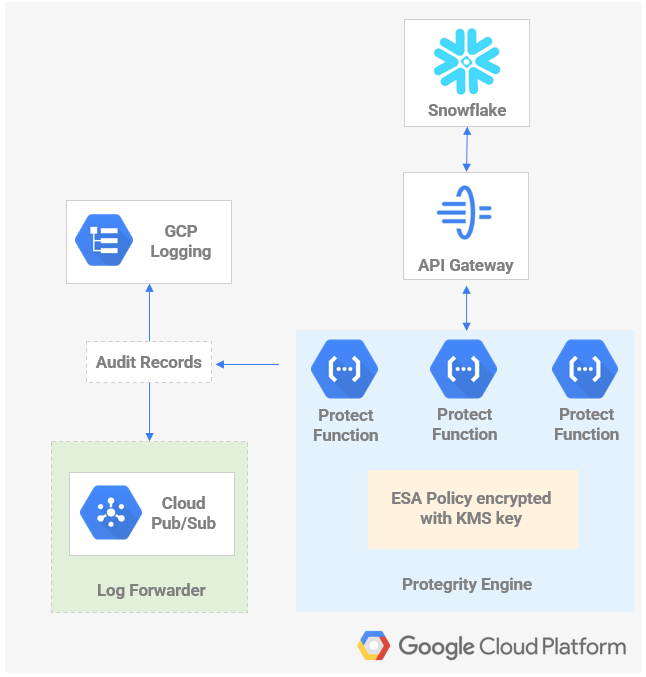
The following diagram shows a reference architecture for synchronizing the security policy from the ESA to the product.
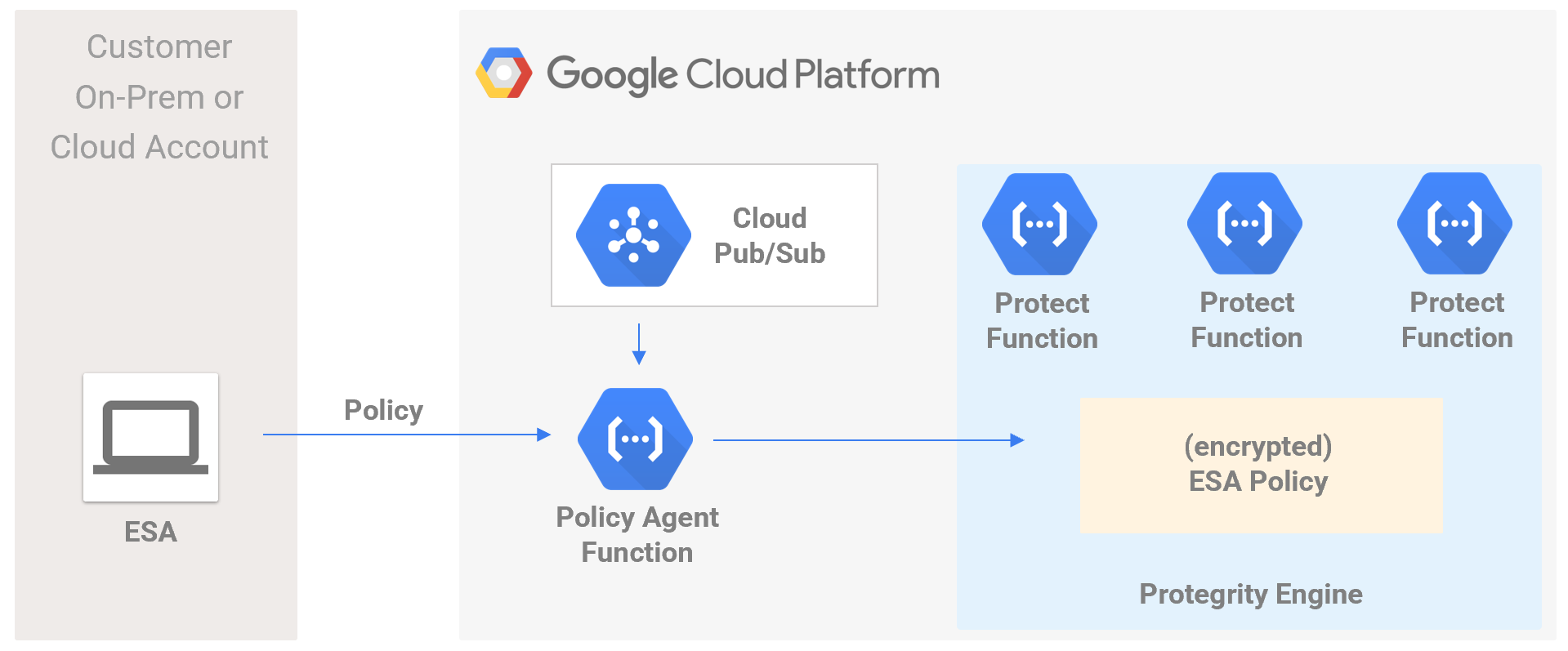
The Protegrity Policy Agent requires network access from the Cloud to your ESA. Most organizations install the ESA on-premise. Therefore, it is recommended that the Policy Agent is installed into a private subnet with a Cloud VPC using a NAT Gateway to enable this communication through a corporate firewall.
The ESA is a soft appliance that must be pre-installed on a separate server. It is used to create and manage security policies.
For more information about installing the ESA, and creating and managing policies, refer to the Policy Management Section.
Audit logs are by default sent to Cloud Logging. The Protegrity Product can also be configured to send audit logs to ESA. Such configuration requires deploying Log Forwarder component which is available as part of Protegrity Product deployment bundle. The diagram below shows additional resources deployed with Log Forwarder component.
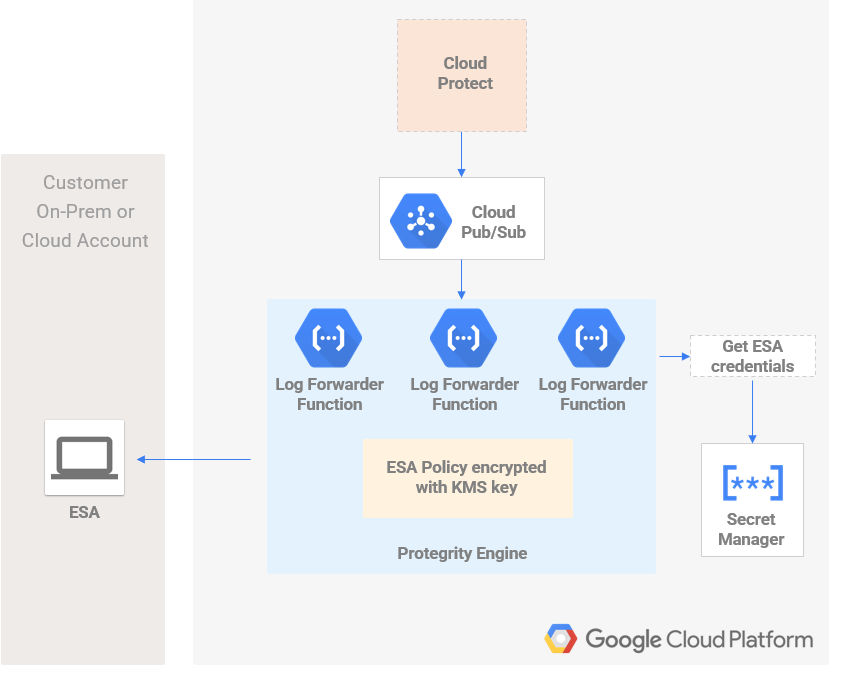
The log forwarder component includes Pub/Sub service topic and the audit log forwarder function. Pub/Sub service is used to asynchronously send audit records to forwarder function, where similar audit logs are aggregated before sending to ESA. Aggregation rules are described in the Protegrity Log Forwarding guide. When the protector function is configured to send audit logs to log forwarder, audit logs are aggregated on the protector function before sending to Pub/Sub topic. Protector function exposes configuration to control the time it spends aggregating audit logs which is described in the protector function installation section.
The security of audit logs is ensured by using HTTPS connection on each link of the communication between protector function and ESA. Integrity and authenticity of audit logs is additionally checked on log forwarder which verifies individual logs signature. The signature verification is done upon arrival from Pub/Sub topic before applying aggregation. If signature cannot be verified, the log is forwarded as is to ESA where additional signature verification can be configured. Log forwarder function uses basic auth and optional certificate verification to authenticate calls to ESA. Basic auth credentials are stored securely in Secret Manager Service.
To learn more about individual audit log entry structure and purpose of audit logs, refer to Audit Logging section in this document. Installation instruction can be found in the Audit Log Forwarder Installation.
The audit log forwarding requires network access from the cloud to the ESA. Most organizations install the ESA on-premise. Therefore, it is recommended that the Log Forwarder Function is installed into a private subnet with a Cloud VPC using a NAT Gateway to enable this communication through a corporate firewall.
Snowflake communicates to the Snowflake Protector through the Google Cloud API Gateway. The API Gateway is configured to use an OAuth 2.0 implicit grant flow. Snowflake generates a JWT token used for remote authorization with the API Gateway. Snowflake requests are directed to the customer’s Google API Gateway which is configured to verify the JWT token. The following figure illustrates the integration architecture between Snowflake and the Protegrity software.
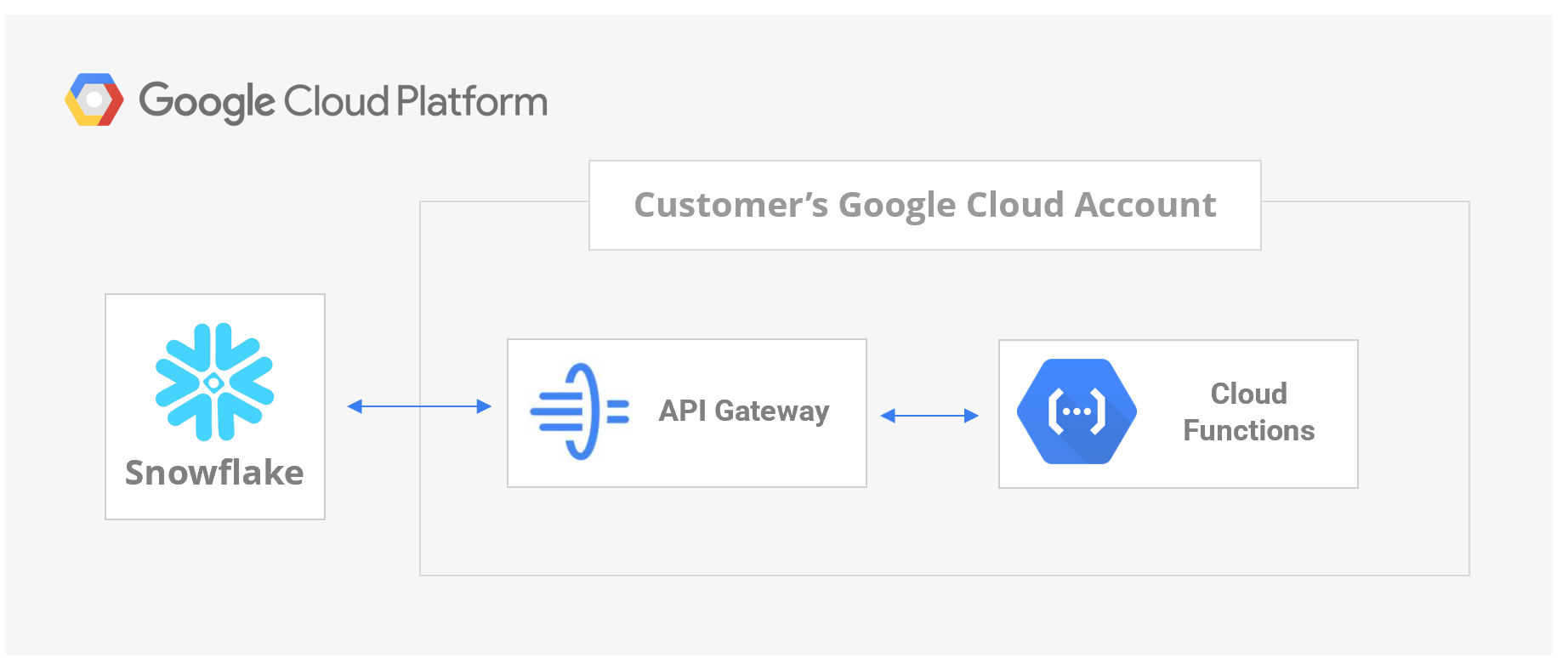
The Snowflake API Integration Object provides a connection between your Snowflake Google Cloud Account and your Google Cloud account where the Protegrity product is hosted. Creating this connection requires setting up the API Gateway and the appropriate access policies. These steps are provided in the installation.
The following table describes the Google Cloud services that may a part of your Protegrity installation.
| Service | Description |
|---|---|
| Cloud Run Functions | Provides serverless compute for Protegrity protection operations and the ESA integration to fetch policy updates. |
| API Gateway | Provides the end-point and access control (Required for Snowflake only). |
| Key Management Service | Provides cryptographic keys for envelope encryption/decryption of the policy. |
| Secret Manager Service | Stores secrets required during deployment, e.g., ESA credentials. |
| Cloud Storage Service | Storage location for the encrypted ESA policy package. |
| Identity and Access Management | Enforces access policies for deployed resources. |
| Cloud Logging Service | Application and audit logs, performance monitoring, and alerts. |
| Cloud VPC | Required for securing network access to On-Prem or cloud-based ESA. |
| Pub/Sub | Provides a messaging service when forwarding audit logs to ESA is enabled. |
The Protector and Log Forwarder functions require a security policy from a compatible ESA version.
The table below shows compatibility between different Protector and ESA versions.
| Protector Version | ESA Version | |||
|---|---|---|---|---|
| 8.x | 9.0 | 9.1 & 9.2 | 10.0 | |
| 2.x | No | Yes | * | No |
| 3.0.x & 3.1.x | No | No | Yes | No |
| 3.2.x | No | No | Yes | * |
| 4.0.x | No | No | No | Yes |
Legend | |
|---|---|
Yes | Protector was designed to work with this ESA version |
No | Protector will not work with this ESA version |
* | Backward compatible policy download supported:
|
The following requirements must be completed for the Snowflake implementation.
| Requirements | Description |
|---|---|
| Protegrity distribution and installation scripts | These artifacts are provided by Protegrity |
| Protegrity ESA 10.0+ | The Cloud VPC must be able to obtain network access to the ESA |
| Google Cloud Account | Recommend creating a new project for Protegrity Serverless |
| Snowflake cluster (Enterprise Edition recommended) | |
| Terraform CLI v0.14 or higher | Terraform is used to deploy resources to Google Cloud Account |
| Requirements | Description |
|---|---|
| Google Cloud Account Administrator | Run Terraform (or perform steps manually), create/configure a VPC and IAM permissions. |
| Protegrity Administrator | The ESA credentials required to extract the policy for the Policy Agent |
| Snowflake Administrator | Account Admin access required to setup access |
| Network Administrator | Open firewall to access ESA and evaluate Google Cloud network setup |
Identify or create a new Google Cloud Project where the Protegrity solution will be installed. It is recommended to create a new project. This provides greater security controls and avoids conflicts with other applications that might impact regional account limits. An individual with the Owner role will be required for some of the subsequent installations.
Google Project ID: ___________________
Google Project Number: ___________________
Google Cloud Region: ___________________
Query the Google Cloud region where the Snowflake cluster is running. This is the region in which Protegrity Serverless must be installed.
To determine the Google Cloud region:
Login to Snowflake
In the SQL console, run the following query.
select current_region();
Record the Google Cloud region. For example, GCP_US_CERNTAL1.
Snowflake Google Cloud Region: ___________________
The Google Cloud Key Management Service (KMS) provides Protegrity Serverless solution the ability to encrypt and decrypt the Protegrity Security Policy.
To create KMS Key Ring and Asymmetric Encryption Master Key:
Log in to Google Account and select project where Protegrity service will be installed.
Navigate to Security > Key Management.
Select Create key ring.
Specify key ring name. For example, protegrity-policy-keyring.
select Key ring location which corresponds to the region where Protegrity solution will be installed.
Select Create.
Select CREATE KEY to create encryption key.
Specify key name. For example, protegrity-policy-key.
under Purpose selection, select Asymmetric Decrypt .
Select Key Algorithm. For example, 3072-bit RSA with OAEP Padding and SHA256 digest.
Select Create.
Once the key is created, a screen opens on the key. If the screen does not appear, click on the key name.
Then click on the elipses under Actions that is next to the key version.
Select Copy Resource Name and record the value below, e.g., projects/{project-id}/locations/region/keyRings/{key-ring}/cryptoKeys/{key-name}/cryptoKeyVersions/1
Policy Encryption Key Version Resource Name: ___________________
Cloud Storage buckets are required for the Gen 2 Cloud Function sources, the Terraform backend, and the deployment of the Protegrity installation artifacts. It is recommended that you create 3 separate buckets to separate files used for different purposes. If you cannot create 3 separate buckets, you may reuse a bucket for multiple purposes.
Create the buckets:
Run the cloud command below to enable the Google Storage Transfer API.
gcloud services enable storagetransfer.googleapis.com
Create the Gen 2 Cloud Function sources bucket. This bucket is not required if you will be deploying to Gen 1 Cloud Functions. The bucket name much match the example below. Replace the <gcp-project-number> and <region> placeholders.
gcf-v2-sources-<gcp-project-number>-<region>
Use the following gcloud command to obtain project number
gcloud projects describe <gcp-project-id> --format='value(projectNumber)'
Create the deployment bucket or reuse an existing bucket. This bucket is used during the installation process to store the Protegrity installation artifacts.
Deployment Bucket Name:___________________
Create the Terraform backend bucket or reuse an existing bucket. This bucket is used by Terraform to store information about your Cloud Protect installation, and will be used if you upgrade to a later version of Cloud Protect in the future.
Terraform Backend Bucket Name:___________________
Cloud Functions use the service accounts created in this deployment. You can create Service accounts manually or use the Protegrity Terraform installation script to create one. Each service account requires specific permissions, which must be granted through IAM roles. Run the following steps to create service accounts and configure the required IAM access. If you use Terraform scripts, skip these steps.
To create Agent Function IAM Role:
Log in to Google Account and select project where Protegrity service will be installed.
Navigate to IAM & Admin > Roles, Select CREATE ROLE.
Specify role name and description.
Select ADD PERMISSIONS.
Select the following permissions:
Click Add and then Create.
Alternatively, you can run the following command from the Cloud Shell Terminal.
gcloud iam roles create role-id \
--project=project-id \
--title=role-title \
--description=role-description \
--permissions=cloudkms.cryptoKeyVersions.useToEncrypt,\
cloudkms.cryptoKeyVersions.viewPublicKey,\
secretmanager.versions.access,\
storage.objects.get,\
storage.objects.create,\
storage.objects.delete,\
storage.objects.list,\
storage.objects.update,\
storage.buckets.get,\
cloudfunctions.functions.get,\
cloudfunctions.functions.update,\
cloudfunctions.functions.sourceCodeGet,\
cloudfunctions.functions.sourceCodeSet,\
iam.serviceAccounts.actAs \
--stage=GA
role-id
is the name of the role, such as ptyProtectRole.
project-id
is the name of the project, such as my-project-id.
role-description
is a short description of the role, such as “My custom role description”.
Sample output:
Created role [role-id].
description: role-description
etag: *****************
includedPermissions:
- cloudfunctions.functions.get
- cloudfunctions.functions.sourceCodeGet
- cloudfunctions.functions.sourceCodeSet
- cloudfunctions.functions.update
- cloudkms.cryptoKeyVersions.useToEncrypt
- cloudkms.cryptoKeyVersions.viewPublicKey
- iam.serviceAccounts.actAs
- secretmanager.versions.access
- storage.buckets.get
- storage.objects.create
- storage.objects.delete
- storage.objects.get
- storage.objects.list
- storage.objects.update
name: projects/{project-id}/roles/{role-id}
stage: GA
title: role-title
To create Agent Service Account:
Log in to Google Account and select project where Protegrity service will be installed.
Navigate to IAM & Admin > Service Accounts.
Select CREATE SERVICE ACCOUNT.
Specify service account name and description.
Select Create and Continue.
In the next step, click Select Role.
Select Custom and select the role created above .
Click Done.
Once the service account is created, the screen should open on the service account. If the screen does not appear, refresh the page with the service account list and select the service account created.
Record the full email. For example, service-account-name@project-id.iam.gserviceaccount.com
Agent Function Service Account Email: ___________________
To create Protect Function IAM role:
Log in to Google Account and select project where Protegrity service will be installed.
Navigate to IAM & Admin > Roles, Select CREATE ROLE.
Specify role name and description.
Select ADD PERMISSIONS.
Select the cloudkms.cryptoKeyVersions.useToDecrypt permission.
Click Add and then Create.
To create Protect Service Account:
Log in to Google Account and select the project where Protegrity service will be installed.
Navigate to IAM & Admin > Service Accounts.
Select CREATE SERVICE ACCOUNT.
Specify service account name and description.
Select Create and Continue.
In the next step, click Select Role. Then select Custom and select the role created above .
Click Done.
Once the service account is created, the screen should open on the service account. If the screen does not appear, refresh the page with the service account list and select the service account created.
Record the full email. For example, service-account-name@project-id.iam.gserviceaccount.com.
Protect Function Service Account Email: ___________________
Ensure that all the steps in Pre-Configuration are performed.
Log in to the Google Cloud account where Protegrity will be installed.
Select the project.
Ensure that you have access to shell command on your computer or Cloud Shell with Terraform CLI v0.14 or higher installed.
Ensure that the Terraform scripts provided by Protegrity are available on your local computer.
Resources created with Terraform scripts include Protect Cloud Functions Service and other required resources depending on Terraform parameters. If you don’t specify the deployment bucket Terraform parameter, a new storage bucket will also be created. You can optionally choose to create a new service account with custom IAM role.
To install using Terraform:
From the command shell move to directory where you downloaded Protegrity installation bundle.
Unzip the main bundle. Then unzip protegrity-cloud-protect-gcp-{version}.zip. Verify that the following files are available:
Unzip the protegrity-cloud-protect-gcp-{version}.zip file. Verify that the following files are available:
Open the main.tf file and update Terraform backend information at the top of the file:
terraform {
backend "gcs" {
bucket = ""
prefix = "protegrity/terraform/pty-protect-gcp/state"
}
}
In the same main.tf file, specify the following Terraform variables: All the values were recorded in Google Cloud Project.
Parameter | Description |
|---|---|
project_id | The project id recorded in the pre-configuration step |
region | The Region recorded in the pre-configuration step. |
deployment_id | Specify short name to identify deployment. This id will be added to all resources deployed with Terraform. |
deployment_bucket | Use Deployment Bucket Name recorded in pre-configuration or leave empty to create new bucket. |
create_service_account | Leave this as false if you created service account in pre-configuration. Otherwise set to true. |
protect_function_service_account_email | Use Protect Function Service account recorded in pre-configuration or leave empty. |
api_gateway_gcp_service_account_issuer | Allows setting issuer of JSON Web Token credential used to authenticate calls to API Gateway. Set this to API_GCP_SERVICE_ACCOUNT obtained in section Describe the API Integration Object |
username_regex | If username_regex is set, the effective policy user will be extracted from the user in the request. NoteSee Configuring Regular Expression to Extract Policy Username to learn how to extract username from the request |
max_instance_count | GCP Cloud Functions advanced configuration |
available_memory_mb | GCP Cloud Functions advanced configuration |
timeout_seconds | GCP Cloud Functions advanced configuration |
gen2_available_cpu | 2nd Gen Cloud Function advanced configuration |
gen2_container_concurrency | 2nd Gen Cloud Function advanced configuration |
upgrade_step | Set this variable when upgrading to the latest version. |
labels | You can set this map to include labels for deployed resources. Pay attention to GCP label requirements. For more information, refer to the following link https://cloud.google.com/compute/docs/labeling-resources. For example, only use lowercase and maximum length of 63 characters. |
min_log_level | Minimum log level for log forwarder function. One of off|severe|warning|info|config|all. Defaults to ‘severe’ |
pty_log_output | Audit log output. Accepted values: “”(empty string), “pub_sub”. NoteWhen set to “pub_sub” audit logs will be aggregated and sent to Pub/Sub topic. See Log Forwarder installation section for more details. |
pty_pub_sub_topic | Pub/Sub topic where audit logs will be sent. |
Run the following command.
terraform init
Terraform will download necessary providers.
Run the following command to verify configuration and print out deployment plan.
terraform plan
Run the following command to deploy resources to your account.
terraform apply
Once deployment is complete Terraform will print output variables.
Record the following values:
Before continuing with next steps, you can verify whether Cloud Functions are installed correctly. This step is optional and can be skipped.
Below you can find example CURL command to test your function.
Before you can execute it, you need to obtain temporary authentication token. Run the gcloud auth login and then gcloud auth print-identity-token commands. The logged in gcloud user must have the roles/run.invoker role. Record the output of print identity token command.
gcloud_auth_token: _________________
Replace {protect_function_url}; with value recorded in previous step.
Replace {gcloud_auth_token} with value recorded in above step.
Run the following CURL command to test Function deployment.
curl -X POST "{protect_function_url}" \
-H 'Authorization:Bearer {gcloud_auth_token}' \
-H 'sf-custom-X-Protegrity-HCoP-Rules: {"jsonpaths":[{"op_type":"unprotect","data_element":"alpha"}]}' \
-H 'sf-context-current-user: test' \
-H 'sf-external-function-current-query-id: test-id' \
-H 'Content-Type: application/json' \
-d '{
"data": [
["0", "UtfVk UHgcD!"]
]
}
'
Verify the following output:
{"data":[[0,"hello world!"]]}
The following sections will configure Snowflake to access the API Gateway. The Terraform installation deployed a sample policy that can be used to smoke test the installation.
Ensure that the current user can assume the Account Administrator role. This role is required to create the Snowflake API Integration object.
From the Snowflake console worksheet, select the role ACCOUNTADMIN.
Paste the following text and replace the two parameters <api_gateway_managed_service> and <api_gateway_protect_service_url> with values recorded in the last installation step of Install Protect Function via Terraform Scripts, then run the following Data Definition Language (DDL) in the console to create API integration object:
create or replace api integration protegrity_api
api_provider = google_api_gateway
google_audience = '<api_gateway_managed_service>'
enabled = true
api_allowed_prefixes = ('<api_gateway_protect_service_url>/pty/snowflake');
We require values generated by the Snowflake integration object to configure the API Gateway Authorization.
To describe API integration objects:
Run the following query in the console.
DESCRIBE API INTEGRATION protegrity_api;
Record the API_GCP_SERVICE_ACCOUNT value from the resulting query:
This step allows the Snowflake service account to invoke Protect API Gateway endpoint.
Update Protect API Gateway Endpoint:
Return to Terraform script used to install Protegrity Protect service.
Open main.tf and update api_client_service_account_email with the API GCP Service Account recorded in previous step.
Run terraform apply.
Wait till the process is completed.
Perform the following steps to verify whether Snowflake is working correctly with the Protegrity product.
Access the Snowflake SQL console.
Copy and paste the following snippet into a worksheet.
CREATE OR REPLACE SECURE EXTERNAL FUNCTION PTY_UNPROTECT_SAMPLE_POLICY(VAL VARCHAR)
RETURNS VARCHAR(16777216)
IMMUTABLE
API_INTEGRATION = PROTEGRITY_API
HEADERS =(
'X-Protegrity-HCoP-Rules'=
'{"jsonpaths":[{"op_type":"UNPROTECT","data_element":"alpha"}]}'
)
CONTEXT_HEADERS = (CURRENT_USER,CURRENT_TIMESTAMP,CURRENT_ACCOUNT)
COMMENT='Unprotects text using an alpha token type.'
AS '<api_gateway_protect_service_url>/pty/snowflake';
Replace the placeholder value indicated substituting your API Gateway URL captured in the Terraform outputs (api_gateway_protect_service_url).
Run the following protect in the console:
select pty_unprotect_sample_policy('UtfVk UHgcD!');
Verify that the string hello world! is returned.
Use Cloud Logging to troubleshoot errors.
From your Google Console, navigate to Logging > Logs Explorer
Use the Log Fields panel to filter results by resource type, name, severity, and other criteria. For instance to see the last Cloud Protect Function logs, make the following selections:
RESOURCE TYPE = Cloud Function
FUNCTION NAME = pty-protect-{deployment-id}
You can also use the Log Filter Query and run the following query:
resource.type="cloud_function"
resource.labels.function_name="pty-protect-"
You can change the time range in the top right corner. If Protegrity policy is configured to generate audit logs, you can use the following query to only view the audit logs:
resource.type="cloud_function"
resource.labels.function_name="pty-protect-"
jsonPayload.message=~"\"type\":\"audit\""
Policy Agent Function installation is done via Terraform scripts provided by Protegrity. Before running the template, some resources must be created manually.
Policy Agent function requires ESA server running and accessible from Agent Cloud Function on TCP port 8443. Make sure inbound connections on TCP:8443 are allowed for the network where ESA is hosted.
Note down ESA IP address:
ESA IP Address (EsaIpAddress): ___________________
By default, ESA is configured with self-signed certificates, which can only be validated using self-signed CA certificate supplied in Cloud Function Environment variables configuration.
In case ESA is configured with publicly signed certificates, this section can be skipped since the Cloud Function will use public CA to validate ESA certificates.
To obtain self-signed CA certificate from ESA:
Log in to ESA Web UI.
Select Settings > Network > Manage Certificates.
Hover over Server Certificate and click on download icon to download the CA certificate.
After certificate is downloaded, open the PEM file in text editor and replace all new lines with escaped new line: \n.
To escape new lines from command line, use one of the following commands depending on your operating system:
Linux Bash:
awk 'NF {printf "%s\\n",$0;}' ProtegrityCA.pem > output.txt
Windows PowerShell:
(Get-Content '.\ProtegrityCA.pem') -join '\n' | Set-Content 'output.txt'
Record the certificate content with new lines escaped.
ESA CA Server Certificate (EsaCaCert): ___________________
This value will be used to set pty_esa_ca_server_cert Terraform variable in installation section.
For more information about ESA certificate management refer to Certificate Management Guide in ESA documentation.
Google Cloud VPC is used to route traffic from Policy Agent Cloud Function to ESA. If your ESA is in a Google Cloud VPC, it is recommended to create a serverless VPC access and record its name:
google_vpc_access_connector_name: ___________________
If ESA is not on Google Cloud VPC, you can either create one or choose to let Terraform script to create one. The Terraform script will create the following elements:
NAT gateway
To connect to ESA outside the Google Cloud Network
External IP address
Can add it to the allowlist by the firewall in the network environment where ESA is hosted.
Serverless VPC access
Allows connectivity from the Cloud function to the VPC.
Policy Agent Function requires ESA credentials to be provided as one of the two options:
Secret Manager is the recommended option for storing ESA credentials.
Create ESA credentials secrets:
Log in to Google Account and select project where Protegrity service will be installed.
Go to Security > Secret Manager.
Select CREATE SECRET.
Specify the Secret Value:
{
"username": "{esa_username}",
"password": "{esa_password}"
}
Select Create Secret.
Once the secret is created, you should see the secret screen opened. If not click on the secret name to see a screen with secret versions.
Click on Actions, next to the secret version you just created.
Select Copy Resource ID and record the full secret version path, For example, projects/{project-id}/secrets/{secret name}/versions/2.
Secret resource id: ___________________
If you have the skills to write code, you may provide a custom Cloud Function that returns the ESA credentials to the Policy Agent. One use case is when reading the ESA credentials from a third-party password vault.
Create the Cloud Function:
Create a new 2nd gen Cloud Function using any runtime.
The Policy Agent does not provide an input payload.
The Cloud Function must return a response according to the following schema:
response:
type: object
properties:
username: string
password: string
For example,
example output: {"username": "admin", "password": "Password1234"}
Sample GCP Function in Python:
def handler(request):
return {"username": "admin", "password": "password1234"}
Grant the Cloud Run Invoker role to the Policy Agent function service account.
Grant the cloudfunctions.functions.get permission to the Policy Agent function service account role.
Record the Function name:
ESA CREDENTIALS FUNCTION NAME: _______________
Agent Terraform scripts provided by Protegrity create a Cloud Function in your Google account. If you don’t specify the deployment bucket Terraform parameter, a new storage bucket will also be created. You can also create the following optional resources by specifying the corresponding parameters:
To install Policy Agent Function through Terraform:
From command shell, move to the directory where you downloaded Protegrity installation bundle.
Unzip the bundle, then unzip the protegrity-agent-gcp-{version}.zip. Verify that the following files are available:
Open the main.tf file and update Terraform backend information at the top of the file:
terraform {
backend "gcs" {
bucket = ""
prefix = "protegrity/terraform/pty-protect-gcp/state"
}
}
Set the bucket property to Terraform Backend Bucket Name recorded in Google Cloud Storage
Set the prefix property with value unique to your deployment.
In the same main.tf file, specify the following Terraform variables.
| Parameter | Description |
|---|---|
| project_id | The Project ID recorded in the pre-configuration step |
| region | The Region recorded in the pre-configuration step, for example, us-central1. |
| deployment_id | Specify short name to identify deployment. This id will be added to all resources deployed with Terraform. |
| deployment_bucket | Use Deployment Bucket Name recorded in pre-configuration or leave empty to create new bucket. |
| deployment_bucket_location | Geographical location of deployment bucket, e.g., US, EU, ASIA. |
| deployment_file_directory_path | Path to directory where deployment zip file is located. By default the deployment file should be in the same directory as this main.tf file. |
| policy_download_cron_expression | Cron expression determining how often policy agent function will run to synchronize security policy from ESA. |
| create_service_account | Leave this as false if you created service account in pre-configuration. Otherwise set to true. |
| agent_function_service_account_email | Use Agent Function Service account recorded in pre-configuration or leave empty. |
| create_vpc | Set this to true, if you would like to create VPC with NAT, external IP and vpc access connector, otherwise leave empty. This will be ignored if google_vpc_access_connector_name is specified. |
| google_vpc_access_connector_name | Specify the existing VPC access connector name you identified in earlier step, otherwise leave empty. This setting will disable create_vpc = true. |
| google_vpc_access_connector_full_resource_name | Alternative configuration for VPC access connector. If this parameter is set the google_vpc_access_connector_name will be ignored. Use this parameter, if vpc connector is in different region/project that the one specified for the deployment. |
| labels | You can set this map to include labels for deployed resources. Pay attention to gcp label requirements. More information in: https://cloud.google.com/compute/docs/labeling-resources. For example, only use lowercase and maximum length of 63 characters. |
All the values were recorded in Pre-Configuration and this section’s previous steps.
Provide Policy update Terraform variables. In the same main.tf file, you can specify configuration related to policy update. Any of these variables can be updated at any given time by running the terraform again or directly in the GCP Console. Most of the values were recorded in previous installation steps.
Parameter | Description | Notes |
|---|---|---|
pty_esa_ip | ESA IP address or hostname | |
pty_esa_ca_server_cert | ESA self-signed CA certificate used by policy Agent Function to ensure ESA is the trusted server. | Recorded in step Certificates on ESA In case ESA is configured with publicly signed certificates, the pty_esa_ca_server_cert configuration will be ignored. |
gcp_esa_credentials_secret_resource_id | ESA username and password (encrypted value by Google Cloud Secrets Manager). For example, projects/{project-id}/secrets/{secret name}/versions/{version} | |
pty_esa_credentials_function | ESA credentials GCP function resource name. For example, projects/{project-name}/locations/{region}/functions/{esa-credentials-function-name}. | Recorded in step Option 2: Custom Cloud Function ESA CREDENTIALS FUNCTION NAME. Presence of gcp_esa_credentials_secret_resource_id will cause this value to be ignored. The Policy Agent Function must have network access and IAM permissions to call the ESA Credentials function you have created in Option 2: Custom Cloud Function. |
gcp_kms_key_resource_name | The Key full resource name. For Example, projects/{project-id}/locations/region/keyRings/ {key-ring}/cryptoKeys/{key-name}/cryptoKeyVersions/1 | |
gcp_protect_function_resource_name | List of comma separated Protect function resource names. For Example, projects/{project-id}/ locations/{region}/functions/{function-name1},projects/{project-id}/ locations/{region}/functions/{function-name2} | Use protect_function_resource_name recorded in Protect Service Installation section. |
gcp_policy_retention_storage_bucket | Deployment Bucket Name where the encrypted policy will be written. | You can use deployment bucket recorded in Google Cloud Storage section, or you can specify other existing bucket. |
gcp_policy_version_object_key | Filename of the encrypted policy stored in the Deployment Bucket Name | Default: policy.zip |
retain_policy_versions | Number of policy versions to retain as backup. (e.g. 2 will retain the latest 2 policies and remove older ones). -1 retains all. | Default: 10 |
disable_deploy | This flag can be either 1 or 0. If set to 1, then the agent will not update protector function with the newest policy. Else, the policy will be saved in the cloud storage bucket and deployed to the protector function. WarningAgent deployment requires a deployed Protect or Log Forwarder Cloud Run function when disable_deploy is set | Default: 0 |
log_level | Application and audit logs verbiage level | Default: INFO. Allowed values: DEBUG – the most verbose INFO, WARNING, ERROR – the least verbose |
policy_pull_timeout | Time in seconds to wait for the ESA to send the full policy | Default: 20 |
pty_core_casesensitive | Specifies whether policy usernames should be case sensitive | Default: no. Allowed values: yes, no |
pty_core_emptystring | Override default behavior. Empty string response values are returned as null values. For instance, (un)protect(’’) -> null (un)protect(’’) -> '' | Default: empty. Allowed values: null, empty |
esa_connection_timeout | Time in seconds to wait for the ESA response | Default: 5s |
pty_addipaddressheader | When enabled, agent will send its source IP address in the request header. This configuration works in conjunction with ESA hubcontroller configuration ASSIGN_DATASTORE_USING_NODE_IP (default=false). See Associating ESA Data Store With Cloud Protect Agent for more information. | Default: yes. Allowed values: yes, no |
pty_datastore_key | ESA policy datastore public key fingerprint (64 char long) e.g. 123bff642f621123d845f006c6bfff27737b21299e8a2ef6380aa642e76e89e5. | NoteThis configuration is not applicable for ESA versions lower than 10.2.The export key is the public part of an asymmetric key pair created in a Create KMS Key. A user with Security Officer permissions adds the public key to the data store in ESA via Policy Management > Data Stores > Export Keys. The fingerprint can then be copied using the Copy Fingerprint icon next to the key. Refer to Exporting Keys to Datastore for details. NoteFor PPC deployments, see PPC Appendix: Policy Agent Certificate and Key Guidance for details on obtaining and using the datastore key fingerprint. |
pty_sync_datastore | Optional name of the policy datastore to sync with ESA. Refer to ESA documentation for more information on policy datastore sync. | Default: "" |
From local command line or Cloud Shell, change directory to location of the main.tf, for example:
protegrity-agent-gcp-{version}/pty-agent-gcp/
Run terraform init.
Terraform will download necessary providers.
Run terraform plan to verify configuration and print out deployment plan.
Run terraform apply to deploy resources to your account. Once deployment is complete, Terraform will print output variables.
Below is the sample output from successful deployment.
Apply complete! Resources: 1 added, 0 changed, 0 destroyed.
Outputs:
agent_function_service_account_email = "pty-agent-test@test.iam.gserviceaccount.com"
deployment_bucket_name = "test-bucket"
nat_ip = 0
policy_agent_function_deployment_object = "pty-agent-test-1.0.1.zip"
policy_agent_function_name = "pty-agent-test"
After configuration is complete, you can test the function.
To test and run the Policy Agent Function:
From the Google Cloud console, go to Cloud Run Functions or Cloud Run.
Click on the function you just deployed: pty_agent_{deployment_id}.
Click Test button at the top right section of the screen.
Scroll down to CLI test command.
Copy and run the curl command to trigger the agent. Alternatively, use the option Test in Cloud Shell.
Wait for the function to complete.
Navigate to the LOGS tab to view agent execution logs.
Alternatively, you may review the logs by navigating to Logging from your Google Console. In the Log Explorer select the All resources dropdown, then Cloud Run Revision > pty-agent-{deployment-id} and apply.
Function execution took 23892 ms, finished with status: 'ok'
iap.policy_deployer:INFO:Deleting object [policy_v07-26-2021_21-00-00.zip]
iap.policy_deployer:INFO:Deleting object [policy_v07-26-2021_19-03-23.zip]
iap.policy_deployer:INFO:Removing old function versions in [test-artifacts]. Will retain [1] versions.
iap.policy_deployer:INFO:Updating function [projects/cloud-engineering-315519/locations/us-central1/functions/pty-protect-test] with new deployment artifact [test-artifacts/policy_v07-26-2021_21-00-01.zip] ...
iap.imp_creator:INFO:Uploading encrypted policy data to: [test-artifacts/policy_v07-26-2021_19-03-23.zip]
iap.imp_creator:INFO:Preparing deployment package ...
iap_agent_gcp.cloud_functions_util:INFO:Downloading function deployment package ...
iap.imp_creator:INFO:Encrypting policy package ...
iap.policy_agent:INFO:Preparing new policy deployment ...
iap.policy_agent:WARNING:Current policy deployment has no checksum_mapping metadata:
iap.imp_creator:INFO:Checking current policy version ...
iap.policy_agent:INFO:Current deployment package version: [policy_v07-26-2021_18-51-43.zip].
iap.policy_agent:INFO:Getting current policy metadata ...
iap.imp_creator:INFO:Policy downloaded successfully ...
iap.imp_creator:INFO:PepServer started ...
iap.imp_creator:INFO:Starting PepServer ...
iap.imp_creator:INFO:PepServer configured successfully
iap.imp_creator:INFO:Downloading certificates from ESA ...
iap.imp_creator:INFO:Configuring PepServer ...
iap.policy_agent:INFO:Starting policy agent ...
iap.policy_agent:INFO:Using Secret Manager [GCP_ESA_CREDENTIALS_SECRET_RESOURCE_ID] to retreive ESA credentials.
iap.policy_agent:INFO:PTY_CORE_CASESENSITIVE [no]
iap.policy_agent:INFO:PTY_CORE_EMPTYSTRING [empty]
iap.policy_agent:INFO:RETAIN_POLICY_VERSIONS [1]
iap.policy_agent:INFO:GCP_PROTECT_FUNCTION_RESOURCE_NAME [projects/test/locations/us-central1/functions/pty-protect-test]
iap.policy_agent:INFO:GCP_POLICY_VERSION_OBJECT_KEY [policy.zip]
iap.policy_agent:INFO:GCP_POLICY_RETENTION_STORAGE_BUCKET [test-artifacts]
iap.policy_agent:INFO:GCP_KMS_KEY_RESOURCE_NAME [projects/test/locations/us-central1/keyRings/test-key-ring/cryptoKeys/test-protect-asymmetric/cryptoKeyVersions/1]
iap.policy_agent:INFO:GCP_ESA_CREDENTIALS_SECRET_RESOURCE_ID [projects/1234/secrets/ESA_ADMIN_CREDENTIALS/versions/2]
iap.policy_agent:INFO:PTY_ESA_IP [54.236.107.39]
iap.policy_agent:INFO:POLICY_PULL_TIMEOUT [20]
iap.policy_agent:INFO:DISABLE_DEPLOY [0]
Function execution started
Configure additional logging:
Set log_level Terraform variable on the Agent function to DEBUG.
In the GCP Logs Explorer, you can run the query below, replacing placeholders with your deployment id and project name.
resource.type="cloud_run_revision"
resource.labels.service_name=~"pty-agent-<deploymentd-id>"
severity=ERROR OR textPayload=~"\[error\]"
-logName="projects/<gcp-project-id>/logs/run.googleapis.com%2Frequests"
Expand each log entry for more details. Check for jsonPayload > exception to see more detailed error.
Error message | Details |
|---|---|
| This error may indicate the following configuration issues:
|
| This error may indicate the following configuration issues:
|
| Indicates the Agent Cloud Run function’s identity does not have permissions to sourceCodeGet for Protect/Log Forwarder function(s) provided to the gcp_protect_function_resource_name configuration. |
Audit Log Forwarder installation is done via Terraform scripts provided by Protegrity in the installation bundle.
ESA server is required as the recipient of audit logs. Verify the information below to ensure ESA is accessible and configured properly.
ESA server running and accessible on TCP port 9200.
Audit Store service is configured and running on ESA. For information related to ESA Audit Store configuration, refer to Audit Store Guide.
By default, ESA is configured with self-signed certificates, which can only be validated using self-signed CA certificate supplied in Log Forwarder configuration.
In case ESA is configured with publicly signed certificates, this section can be skipped since the Log Forwarder will use public CA to validate ESA certificates.
To obtain self-signed CA certificate from ESA:
Download ESA CA certificate from the /etc/ksa/certificates/plug directory of the ESA
After certificate is downloaded, open the PEM file in text editor and replace all new lines with escaped new line: \n.
To escape new lines from command line, use one of the following commands depending on your operating system:
Linux Bash:
awk 'NF {printf "%s\\n",$0;}' CA.pem > output.txt
Windows PowerShell:
(Get-Content '.\CA.pem') -join '\n' | Set-Content 'output.txt'
Record the certificate content with new lines escaped.
ESA CA Server Certificate (EsaCaCert): ___________________
This value will be used to set pty_esa_ca_server_cert Terraform variable in installation section. Install Log Forwarder via Terraform
For more information about ESA certificate management refer to Certificate Management Guide in ESA documentation.
Similar to Policy Agent Function, log forwarder function requires Google Cloud VPC to route traffic from the function to ESA. Review the VPC configuration steps for agent in section Identify or Create a new VPC. Same VPC connector as the policy agent can be used. Note down VPC connector name:
google_vpc_access_connector_name: ___________________
Audit Log Forwarder must authenticate with ESA using certificate-based authentication with client certificate and certificate key. Download the following certificates from the /etc/ksa/certificates/plug directory of the ESA:
| File Name | Description |
|---|---|
| client.key | Client certificate key |
| client.pem | Client certificate (PEM) |
Both certificate and certificate key must be converted to single-line values using code similar to the following examples.
Client certificate (client.pem):
$folder = 'C:\Temp'
cd $folder
(Get-Content "$folder\client.pem") -join '\n' | Set-Content "$folder\one-liner-client.pem"
cat "$folder\one-liner-client.pem"
folder="/tmp"
cd "$folder"
awk 'NF {printf "%s\\n",$0}' "client.pem" > "one-liner-client.pem"
cat "one-liner-client.pem"
Client certificate key (client.key):
$folder = 'C:\Temp'
cd $folder
(Get-Content "$folder\client.key") -join '\n' | Set-Content "$folder\one-liner-client.key"
cat "$folder\one-liner-client.key"
folder="/tmp"
cd "$folder"
awk 'NF {printf "%s\\n",$0}' "client.key" > "one-liner-client.key"
cat "one-liner-client.key"
While installing using Terraform template:
Audit Log Forwarder Function uses GCP Secret Manager to store ESA Audit Store credentials used during authentication.
For information on how to configure basic and certificate authentication for Audit Store on ESA refer to Audit Store Guide.
Log in to Google Account and select project where Protegrity service will be installed.
Go to Security > Secret Manager.
Select CREATE SECRET.
Specify the Secret Value:
{
"username": "admin",
"password": "{esa_password}"
}
Select Create Secret.
Once the secret is created, you should see the secret screen opened. If not click on the secret name to see a screen with secret versions.
Click on Actions, next to the secret version you just created.
Select Copy Resource ID and record the full secret version path, for example, projects/{project-id}/secrets/{secret name}/versions/2.
ESA Log Forwarder Credentials Secret Name: _________________
Create another secret with single-line contents of ESA client certificate key file
See Certificate Authentication for details on client certificate key
Record the full secret version path, for example, projects/{project-id}/secrets/{secret name}/versions/1.
ESA Log Forwarder Client Certificate Key Secret Name: _________________
To create Log Forwarder Service Account:
Log in to Google Account and select the project where Protegrity service will be installed.
Navigate to IAM & Admin > Service Accounts.
Select CREATE SERVICE ACCOUNT.
Specify service account name and description.
Select Create and Continue.
In the next step, click Select Role. Then select the following roles:
Click Done.
Once the service account is created, the screen should open on the service account. If the screen does not appear, refresh the page with the service account list and select the service account created.
Record the full email. For example, service-account-name@project-id.iam.gserviceaccount.com.
Log Forwarder Function Service Account Email: ___________________
Pub/Sub service requires Cloud Run Invoker permissions in order to be able to send messages to the Forwarder function.
Log in to Google Account and select the project where Protegrity forwarder will be installed.
Navigate to IAM & Admin > Service Accounts.
Select CREATE SERVICE ACCOUNT.
Specify service account name and description.
Select Create and Continue.
In the next step, click Select Role. Then select Cloud Run Invoker.
Click Done.
Once the service account is created, the screen should open on the service account. If the screen does not appear, refresh the page with the service account list and select the service account created.
Record the full email. For example, service-account-name@project-id.iam.gserviceaccount.com.
Pub/Sub Log Forwarder Service Account Email: ___________________
Ensure that all the steps in Google Cloud Project are performed.
Log in to the Google Cloud account where Protegrity will be installed.
Select the project.
Ensure that you have access to shell command on your computer or Cloud Shell with Terraform CLI v0.14 or higher installed.
Ensure that the Terraform scripts provided by Protegrity are available on your local computer.
Resources created with Terraform scripts include Audit Log Forwarder Cloud Functions Service and Pub/Sub topic. If you don’t specify the deployment bucket Terraform parameter, a new storage bucket will also be created. You can optionally choose to create a new service account with custom IAM role.
To install using Terraform:
From the command shell move to directory where you downloaded Protegrity installation bundle.
Unzip the bundle, then unzip the protegrity-gcp-bigquery-{version}.zip. Navigate to pty-log-forwarder-gcp/. Verify that the following files are available:
Open the main.tf file and update Terraform backend information at the top of the file:
terraform {
backend "gcs" {
bucket = ""
# The bucket/prefix combination must be unique for different deployments
# to avoid conflicting Terraform states and accidental resources destruction.
# prefix = "protegrity-gcp-bigquery/forwarder/<deployment_id>/tf-state"
}
}
Set the bucket property to Terraform Backend Bucket Name recorded in Google Cloud Storage
Set the prefix property with value unique to your deployment.
In the same main.tf file, specify the following Terraform variables: All the values were recorded in Google Cloud Project.
| Parameter | Description |
|---|---|
| project_id | The project id recorded in the pre-configuration step |
| region | The Region recorded in the pre-configuration step. |
| deployment_id | Specify short name to identify deployment. This id will be added to all resources deployed with Terraform. |
| deployment_bucket | Use Deployment Bucket Name recorded in pre-configuration or leave empty to create new bucket. |
| create_service_account | Leave this as false if you created service account in pre-configuration. Otherwise set to true. |
| forwarder_function_service_account_email | Use Forwarder Function Service account recorded in pre-configuration or leave empty. |
| pub_sub_log_forwarder_service_account_email | Service account of the audit log Pub/Sub trigger. The service account must be assigned Cloud Run Invoker (roles/run.invoker) role. |
| create_vpc | If create_vpc flag is set, new vpc will be created together with vpc connector, NAT and external IP Use this flag if you have VPC admin permissions in your Google Account. If you set it to false, you can specify the existing VPC in the google_vpc_access_connector_name parameter. |
| google_vpc_access_connector_name | Use existing VPC connector to associate with Log Forwarder Function. You can specify either the VPC connector name or the full resource name if vpc connector is in different region/project that the one specified for the deployment. You can alternatively set the use google_vpc_access_connector_full_resource_name. Both parameters are optional. Full resource name takes precedence over connector name. |
| log_destination_esa_ip | Ip address of the ESA where Protector logs will be sent to. |
| pty_esa_ca_server_cert | ESA self-signed CA certificate used by log forwarder function to ensure ESA is the trusted server. See documentation for more details. |
| esa_credentials_secret_resource_id | GCP Secret Manager secret id where ESA Fluent Bit logger credentials are stored. |
| pty_esa_client_cert | Single-line ESA client certificate content. See Certificate Authentication for details on client certificate |
| pty_esa_client_cert_key_secret_id | GCP Secret Manager secret id where single-line ESA client certificate key content is stored. See Configure ESA Secrets In GCP Secret Manager for details on client certificate key secret |
| min_log_level | Minimum log level for log forwarder function. Must be one of the following: [off,severe,warning,info,config,all]. |
| esa_tls_disable_cert_verify | Disable certificate verification when connecting to ESA. This is only for dev purposes, should not be used in production environment. |
| esa_connect_timeout | Esa connection timeout in seconds. |
| esa_virtual_host | ESA Virtual Host. |
| audit_log_flush_interval | Time interval in seconds used to accumulate audit logs before sending to ESA. Default value: 10 Min value: 1 Max value: 900 |
| dlq_topic_message_retention_duration | Indicates the minimum duration to retain a message in dead letter queue topic in case log destination server is not available. Value must be decimal number, followed by the letter s (seconds). Cannot be more than 31 days or less than 10 minutes. Default value is 1 day |
| audit_log_dead_letter_topic | This parameter is expected to be used in a separate deployment to replay dead letter queue messages. |
| max_instance_count | GCP Cloud Functions advanced configuration |
| available_memory_mb | GCP Cloud Functions advanced configuration |
| timeout_seconds | GCP Cloud Functions advanced configuration |
| gen2_available_cpu | 2nd Gen Cloud Function advanced configuration |
| gen2_container_concurrency | 2nd Gen Cloud Function advanced configuration |
| upgrade_step | Set this variable when upgrading to the latest version. |
| labels | You can set this map to include labels for deployed resources. Pay attention to GCP label requirements. For more information, refer to the following link https://cloud.google.com/compute/docs/labeling-resources. For example, only use lowercase and maximum length of 63 characters. |
From local command line or Cloud Shell, change directory to location of the main.tf, for example:
pty-log-forwarder-gcp-{version}/pty-log-forwarder-gcp/
Run the following command.
terraform init
Terraform will download necessary providers.
Run the following command to verify configuration and print out deployment plan.
terraform plan
Run the following command to deploy resources to your account.
terraform apply
Once deployment is complete Terraform will print output variables.
Record the following values:
Both Protect and Log Forwarder functions must run for a short period of time after all requests are handled. In order for the GCP Cloud Run service to allow that, the Instance-based billing feature must be enabled for both function deployments.
To enable Instance-based billing:
Log in to Google Account and select the project where Protegrity Cloud Run Function was installed.
Navigate to Cloud Run.
Click on the Cloud Function name.
In Cloud Run revision view, select Edit & deploy new revision.
Scroll down to Billing.
Select Instance-based.
Click DEPLOY.
Repeat the steps for Log Forwarder function.
Before continuing with next steps, you can verify whether Log Forwarder Function is installed correctly. This step is optional and can be skipped.
Below you can find example CURL command to test your function.
Before you can execute it, test if you can obtain temporary authentication token. Run the gcloud auth login and then gcloud auth print-identity-token commands. The logged in gcloud user must have the Cloud Run Invoker permissions. Continue to the next step if the command succeeds and prints the token.
Replace {forwarder_function_url}; with value recorded in previous step.
Run the following CURL command to test Function deployment.
curl {forwarder_function_url} \
-H "Authorization: Bearer $(gcloud auth print-identity-token)" \
-H "Content-Type: application/json" \
-H "ce-id: 123451234512345" \
-H "ce-specversion: 1.0" \
-H "ce-time: 2020-01-02T12:34:56.789Z" \
-H "ce-type: google.cloud.pubsub.topic.v1.messagePublished" \
-H "ce-source: //pubsub.googleapis.com/projects/MY-PROJECT/topics/MY-TOPIC" \
-d '{
"message": {
"data": "'"$(echo '{"additional_info":{"description":"Data unprotect operation was successful.","query_id":"sf-query-id:k6-test-df51a612-4739-4cfb-9fe4-6ec548b70d23"},"client":{},"cnt":4000,"correlationid":"sf-query-id:k6-test-df51a612-4739-4cfb-9fe4-6ec548b70d23","level":"SUCCESS","logtype":"Protection","origin":{"hostname":"localhost","time_utc":1725558586},"process":{"id":1},"protection":{"audit_code":8,"dataelement":"alpha","datastore":"SAMPLE_POLICY","mask_setting":"","operation":"Unprotect","policy_user":"master_user"},"protector":{"core_version":"1.2.2+42.g01eb3.HEAD","family":"cp","pcc_version":"3.4.0.20","vendor":"gcp.snowflake","version":"3.1.0.158"},"signature":{"checksum":"7CE5FFCE9DBE570AAA72D1BB20CD083532EF8FAD3E96E38629EB92E837272D8E","key_id":"676c5178-756d-4363-9"}}' | base64 -w 0)"'",
"attributes": {},
"messageId": "",
"publishTime": "2014-10-02T15:01:23Z",
"orderingKey": ""
}
}'
In GCP Logs Explorer console verify that the following output appears in the logs:
Request finished HTTP/1.1 POST http://pty-forwarder-31-smoke-jf-pfadh7riaq-uc.a.run.app/ - 200 0 - 75.6570ms
[/jenkins/workspace/iaplambda_release_3.1/src/iap/logging/log-aggregator.cpp:66] Failed to aggregate log entry at index 0Protect function requires permissions to publish audit log messages to Pub/Sub.
Log in to Google Account and select the project where Protegrity service will be installed.
Navigate to IAM & Admin.
Search for protector function service account email recorded in protect service installation step.
Select Edit principal pencil icon.
Select ADD ANOTHER ROLE.
Select Pub/Sub Publisher.
Click Save.
Protect function must be configured to output audit logs to Pub/Sub topic.
To configure Protect function audit log output:
Go to Protect function Terraform deployment.
Navigate to pty-protect-gcp/main.tf.
Set Terraform variable pty_log_output=“pub_sub”.
Set Terraform variable pty_pub_sub_topic to log forwarder Pub/Sub topic.
Run terraform apply.
Configure additional logging:
Set min_log_level Terraform variable on both Protect function and Log Forwarder function to config.
In the GCP Logs Explorer, you can run the query below, replacing placeholders with your deployment id and project name.
resource.type="cloud_run_revision"
resource.labels.service_name=~"pty-(protect|forwarder)-<deploymentd-id>"
severity=ERROR OR textPayload=~"\[error\]"
-logName="projects/<gcp-project-id>/logs/run.googleapis.com%2Frequests"
Expand each log entry for more details. Check for jsonPayload > exception to see more detailed error.
Error message | Details |
|---|---|
|
|
|
|
|
|
The following requirements must be completed for the Snowflake implementation.
| Requirements | Description |
|---|---|
| Protegrity distribution and installation scripts | These artifacts are provided by Protegrity |
| Protegrity ESA 10.0+ | The Cloud VPC must be able to obtain network access to the ESA |
| Google Cloud Account | Recommend creating a new project for Protegrity Serverless |
| Snowflake cluster (Enterprise Edition recommended) | |
| Terraform CLI v0.14 or higher | Terraform is used to deploy resources to Google Cloud Account |
| Requirements | Description |
|---|---|
| Google Cloud Account Administrator | Run Terraform (or perform steps manually), create/configure a VPC and IAM permissions. |
| Protegrity Administrator | The ESA credentials required to extract the policy for the Policy Agent |
| Snowflake Administrator | Account Admin access required to setup access |
| Network Administrator | Open firewall to access ESA and evaluate Google Cloud network setup |
Snowflake provides an External Function capability used to call out to a process external to Snowflake through a REST request over TLS encryption. In the Protegrity Cloud Protect for Snowflake solution, this external service is the Protegrity Endpoint for data re-identification operations.
The following table describes optional and required security operation parameters.
Parameter | Type | Example | Description |
|---|---|---|---|
op_type | String | “op_type”:“UNPROTECT” “op_type”:“PROTECT” | Required operation name, can be either UNPROTECT or PROTECT |
data_element | String | “data_element”:“TOK_ALPHA” | Required data element name defined in Protegrity Security Policy |
external_iv | String | “external_iv”:“abc-123” | Optional external intialization vector, which allows for different tokenized results for the same input data and data element of the same security policy. Refer to the External Initialization Vector (IV) in the Protection Methods Reference for more details. |
External Function Sample Definition with External IV: | |||
| |||
Masking Policies in the Sample Application are used to optimize REST requests to the Protegrity endpoint and to prevent integration of External Functions into queries.
The following factors may affect performance benchmarks:
The following benchmarks were performed against different cluster sizes. These are average times of approximately six runs each. The query unprotected six columns per row (first_name, last_name, email, street, city, birthday):
| Rows x Cols | # Ops | Small | Medium | Large | 2XL |
|---|---|---|---|---|---|
| 100K x 6 cols | 600K | 3.4 | 3.5 | 3.3 | 3.3 |
| 1M x 6 cols | 6M | 9.0 | 8.9 | 9.1 | 8.7 |
| 10M x 6 cols | 60M | 29.6 | 21.9 | 18.4 | 33.3 |
| 100M x 6 cols | 600M | - | - | 77.0 | 76.7 |
Snowflake provides guidance on the maximum concurrent requests to the Protegrity API. However, reaching this maximum request depends on additional factors, such as, cluster use and available resources. In addition, depending on the query plan, individual batches may be processed serially across different UDFs.
The formula for theoretical maximum Snowflake concurrency is N * C * M * E * P:
The following table shows this calculation for a single query.
| Cluster size | Predicted concurrent per query * | 1 UDF | 2 UDF | 5 UDF | 10 UDF |
|---|---|---|---|---|---|
| Medium | 4 servers x 8 CPU x 8 = 256 | 256 | 512 | 1,280 | 2,560 |
| X-Large | 16 servers x 8 CPU x 8 = 1,024 | 1,024 | 2,048 | 5,120 | 10,240 |
| 2X-Large | 32 servers x 8 CPU x 8 = 2,048 | 2,048 | 4,096 | 10,240 | 20,480 |
Log forwarder architecture is optimized to minimize the amount of connections and reduce the overall network bandwidth required to send audit logs to ESA. This is achieved with batching and aggregation taking place on two levels. The first level is in protector function instances, where audit logs from consecutive requests to an instance are batched and aggregated. The second level of batching and aggregation takes place in the log forwarder function before audit logs are forwarded to ESA. This section shows how to configure the deployment to accommodate different patterns of anticipated audit log stream. It also shows how to monitor deployment resources to detect problems before audit records are lost.
Protector Function Terraform configuration:
Log Forwarder Function Terraform configuration
Monitoring Log Forwarder Resources
Protector Function Logs: If protector function is unable to send logs to Pub/Sub, it will log the following message:
Failed to send x/y audit logs to GCP Pub/Sub.
See the description of ‘audit_log_flush_interval’ in the protector function configuration section above to learn about potential mitigation.
Pub/Sub DLQ Topic Metrics: Any positive value in count aggregator on ’topic/message_sizes’ metric indicates that not all audit logs are being delivered to ESA. Review whether connection to ESA is set up in Install Log Forwarder Function via Terraform Scripts
Log Forwarder Function Logs: If log forwarder function is unable to send logs to ESA, it will log the following message:
[/jenkins/workspace/iaplambda_release_3.1/src/iap/logging/fluent-bit-external-sink.cpp:225] opensearch.0: Dropped records: x/y.
See the description of ‘audit_log_flush_interval’ in the log forwarder configuration section above to learn about potential mitigation.
Audit records and application logs stream to Google Cloud Logging. Cloud Protect uses a JSON format for audit records that is described in the following sections.
You can analyze and alert on audit records using Protegrity ESA or Google Cloud Logging. For more information about forwarding your audit records to ESA, contact Protegrity. For more information about Google Cloud Logging, refer to the Google Cloud Logging overview.
For more information about audit records, refer to the Protegrity Analytics Guide.
The audit record format has been altered in version 3.1 of the protector to provide more information.
| Field | Description |
|---|---|
| additional_info.deployment_id | The deployment_id contains the name of the Protect Function. It is automatically set based on the cloud-specific environment variables assigned to the Protect Function. This allows identifying the Cloud Protect deployment responsible for generating audit log. |
| additional_info.cluster | (Optional) Redshift cluster ARN |
| additional_info.description | A human-readable message describing the operation |
| additional_info.query_id | (Optional) Identifies the query that triggered the operation |
| additional_info.request_id | (Optional) AWS Lambda request identifier |
| cnt | Number of operations, may be aggregated |
| correlationid | (Deprecated) Use additional_info instead |
| level | Log severity, one of: SUCCESS, WARNING, ERROR, EXCEPTION |
| logtype | Always “Protection” |
| origin.ip | The private IP address of the compute resource that operates the Protect Function and is responsible for generating the log entry.NoteThe IP address is private, meaning it is used for internal network communication and is not accessible directly from the public internet.When Log Forwarding is enabled the IP address may be aggregated into minimal CIDR blocks. |
| origin.hostname | Hostname of the system that generated the log entry |
| origin.time_utc | UTC timestamp when the log entry was generated |
| protection.audit_code | Audit code of the protect operation; see the log return codes table in the Protegrity Troubleshooting Guide |
| protection.dataelement | Data element used for the policy operation |
| protection.datastore | Name of the data store corresponding to the deployed policy |
| protection.mask_setting | (Optional) Mask setting from policy management |
| protection.operation | Operation type, one of: Protect, Unprotect, Reprotect |
| protection.policy_user | User that performed the operation |
| protector.core_version | Internal core component version |
| protector.family | Always “cp” for Cloud Protect |
| protector.lambda_version | Protector Lambda application version. |
| protector.pcc_version | Internal pcc component version |
| protector.vendor | Identifies the cloud vendor and the database vendor |
| protector.version | Protector version number |
| signature.checksum | Hash value of the signature key ID used to sign the log message when the log is generated |
| signature.key_id | Key used to sign the log message when the log is generated |
The following are sample audit messages:
Protect Success:
{
"additional_info": {
"description": "Data protect operation was successful.",
"query_id": "sf-query-id:01978dbc-0582-d7e4-0000-002a3603a20d",
"request_id": "8476a536-e9f4-11e8-9739-2dfe598c3fcd"
},
"cnt": 4000,
"correlationid": "sf-query-id:01978dbc-0582-d7e4-0000-002a3603a20d",
"logtype": "Protection",
"level": "SUCESS",
"origin": {
"hostname": "localhost",
"time_utc": 1635363966
},
"protection": {
"dataelement": "deAddress",
"operation": "Protect",
"audit_code": 6,
"datastore": "SAMPLE_POLICY",
"policy_user": "test_user"
},
"client": {},
"protector": {
"family": "cp",
"lambda_version": "3.2.10",
"version": "3.2.0",
"vendor": "aws.snowflake",
"pcc_version": "3.4.0.14",
"core_version": "1.2.1+55.g590fe.HEAD"
},
"signature": {
"key_id": "95f5a194-b0a4-4351-a",
"checksum": "B324AF7C56944D91C47847A77C0367C594C0B948E7E75654B889571BD4F60A71"
}
}
User permission denied:
{
"additional_info": {
"description": "The user does not have the appropriate permissions to perform the requested operation."
},
"cnt": 4000,
"correlationid": "sf-query-id:01978dbc-0582-d7e4-0000-002a3603a20d",
"logtype": "Protection",
"level": "ERROR",
"origin": {
"hostname": "localhost",
"time_utc": 1635363966
},
"protection": {
"dataelement": "deAddress",
"operation": "Protect",
"audit_code": 3,
"policy_user": "test_user"
},
"process": {
"id": "1",
"thread_id": "849348352"
},
"client": {},
"protector": {
"family": "IAP Lambda",
"lambda_version": "3.2.10",
"version": "3.2.0",
"vendor": "Cloud Protect",
"pcc_version": "3.3.0.5",
"core_version": "1.1.0"
},
"signature": {
"key_id": "95f5a194-b0a4-4351-a",
"checksum": "A216797C56944D91C47847A77C0367C594C0B948E7E75654B889571BD4F60A71"
}
}
Data element not found:
{
"additional_info": {
"description": "The data element could not be found in the policy in shared memory."
},
"cnt": 4000,
"correlationid": "sf-query-id:01978dbc-0582-d7e4-0000-002a3603a20d",
"logtype": "Protection",
"level": "ERROR",
"origin": {
"hostname": "localhost",
"time_utc": 1635363966
},
"protection": {
"dataelement": "deAddress",
"operation": "Protect",
"audit_code": 2,
"policy_user": "test_user"
},
"process": {
"id": "1",
"thread_id": "849348352"
},
"client": {},
"protector": {
"family": "IAP Lambda",
"lambda_version": "3.2.10",
"version": "3.2.0",
"vendor": "Cloud Protect",
"pcc_version": "3.3.0.5",
"core_version": "1.1.0"
},
"signature": {
"key_id": "95f5a194-b0a4-4351-a",
"checksum": "AF09217C56944D91C47847A77C0367C594C0B948E7E75654B889571BD4F60A71"
}
}
The following are sample audit messages:
Protect Success:
{
"additional_info": {
"description": "Data protect operation was successful.",
"query_id": "sf-query-id:01978dbc-0582-d7e4-0000-002a3603a20d",
"request_id": "8476a536-e9f4-11e8-9739-2dfe598c3fcd"
},
"cnt": 4000,
"correlationid": "sf-query-id:01978dbc-0582-d7e4-0000-002a3603a20d",
"logtype": "Protection",
"level": "SUCESS",
"origin": {
"hostname": "localhost",
"time_utc": 1635363966
},
"protection": {
"dataelement": "deAddress",
"operation": "Protect",
"audit_code": 6,
"datastore": "SAMPLE_POLICY",
"policy_user": "test_user"
},
"client": {},
"protector": {
"family": "cp",
"version": "3.1.0",
"vendor": "aws.snowflake",
"pcc_version": "3.4.0.14",
"core_version": "1.2.1+55.g590fe.HEAD"
},
"signature": {
"key_id": "95f5a194-b0a4-4351-a",
"checksum": "B324AF7C56944D91C47847A77C0367C594C0B948E7E75654B889571BD4F60A71"
}
}
Reprotect Success:
{
"additional_info": {
"description": "Data reprotect operation was successful.",
"query_id": "sf-query-id:01978dbc-0582-d7e4-0000-002a3603a20d",
"request_id": "8476a536-e9f4-11e8-9739-2dfe598c3fcd"
},
"cnt": 4000,
"correlationid": "sf-query-id:01978dbc-0582-d7e4-0000-002a3603a20d",
"logtype": "Protection",
"level": "SUCCESS",
"origin": {
"hostname": "localhost",
"time_utc": 1635363966
},
"protection": {
"old_dataelement": "deAddress1",
"dataelement": "deAddress2",
"operation": "Reprotect",
"audit_code": 50,
"datastore": "SAMPLE_POLICY",
"policy_user": "test_user"
},
"client": {},
"protector": {
"family": "cp",
"version": "3.1.0",
"vendor": "aws.snowflake",
"pcc_version": "3.4.0.14",
"core_version": "1.2.1+55.g590fe.HEAD"
},
"signature": {
"key_id": "95f5a194-b0a4-4351-a",
"checksum": "B324AF7C56944D91C47847A77C0367C594C0B948E7E75654B889571BD4F60A71"
}
}
User permission denied:
{
"additional_info": {
"description": "The user does not have the appropriate permissions to perform the requested operation.",
"query_id": "sf-query-id:01978dbc-0582-d7e4-0000-002a3603a20d",
"request_id": "8476a536-e9f4-11e8-9739-2dfe598c3fcd"
},
"cnt": 4000,
"correlationid": "sf-query-id:01978dbc-0582-d7e4-0000-002a3603a20d",
"logtype": "Protection",
"level": "ERROR",
"origin": {
"hostname": "localhost",
"time_utc": 1635363966
},
"protection": {
"dataelement": "deAddress",
"operation": "Protect",
"audit_code": 3,
"datastore": "SAMPLE_POLICY",
"policy_user": "test_user"
},
"client": {},
"protector": {
"family": "cp",
"version": "3.1.0",
"vendor": "aws.snowflake",
"pcc_version": "3.4.0.14",
"core_version": "1.2.1+55.g590fe.HEAD"
},
"signature": {
"key_id": "95f5a194-b0a4-4351-a",
"checksum": "A216797C56944D91C47847A77C0367C594C0B948E7E75654B889571BD4F60A71"
}
}
Data element not found:
{
"additional_info": {
"description": "The data element could not be found in the policy in shared memory.",
"query_id": "sf-query-id:01978dbc-0582-d7e4-0000-002a3603a20d",
"request_id": "8476a536-e9f4-11e8-9739-2dfe598c3fcd"
},
"cnt": 4000,
"correlationid": "sf-query-id:01978dbc-0582-d7e4-0000-002a3603a20d",
"logtype": "Protection",
"level": "ERROR",
"origin": {
"hostname": "localhost",
"time_utc": 1635363966
},
"protection": {
"dataelement": "deAddress",
"operation": "Protect",
"audit_code": 2,
"datastore": "SAMPLE_POLICY",
"policy_user": "test_user"
},
"client": {},
"protector": {
"family": "cp",
"version": "3.1.0",
"vendor": "aws.snowflake",
"pcc_version": "3.4.0.14",
"core_version": "1.2.1+55.g590fe.HEAD"
},
"signature": {
"key_id": "95f5a194-b0a4-4351-a",
"checksum": "AF09217C56944D91C47847A77C0367C594C0B948E7E75654B889571BD4F60A71"
}
}
The security policy maintains a No Access Operation, configured in an ESA, which determines the response for unauthorized unprotect requests.
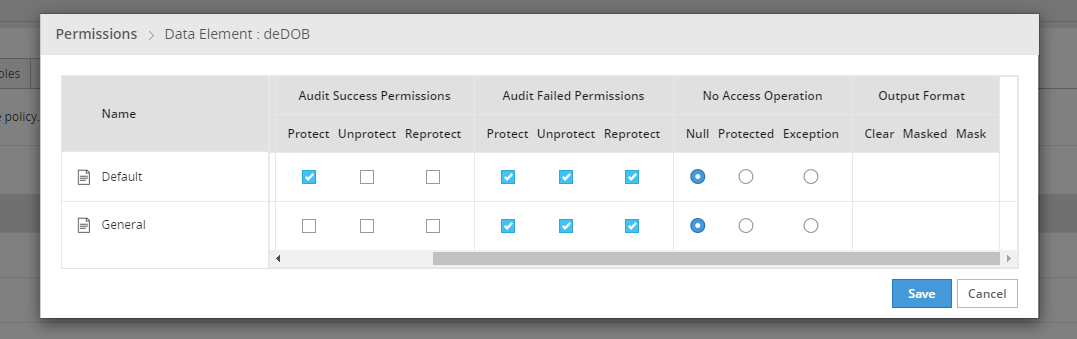
The following table describes the value returned to the UDF function for various cases:
| No Access Operation | Data Returned |
|---|---|
| Null | null |
| Protected | (protected value) |
| Exception | Query will return an exception |
Only protect and unprotect operations are supported. The re-protect operation is not supported.
The Semi-structured (JSON) data type is not supported in the product.
Cloud Function (Gen2) labels must not be updated from the Cloud Run Services console. When updating labels for a GCP Cloud Function (Gen2) through the Cloud Run Services console, GCP creates a new Cloud Run revision with the updated labels, but the underlying Cloud Function retains the old labels. Because the policy agent reads labels from the Cloud Function definition (not the Cloud Run revision), it will not detect the label change and will not trigger a policy update.
To avoid this issue, always update labels using one of the following methods:
labels variable in your Terraform configuration and run terraform apply.gcloud functions deploy with the updated --update-labels flag.If labels were already updated incorrectly through the Cloud Run Services console, redeploy the function using one of the methods above to synchronize the labels and trigger a policy update.
| Feature | ESA 10.2 | PPC (this guide) |
|---|---|---|
| Datastore Key Fingerprint | Optional/Recommended | Required |
| CA Certificate on Agent | Optional/Recommended | Optional/Recommended |
| CA Certificate on Log Forwarder | Optional/Recommended | Not supported |
| Client Certificate Authentication from Log Forwarder | Optional/Recommended | Not supported |
| IP Address | ESA IP address | PPC address |
curl, kubectl installed.Follow these instructions as a guide for understanding specific inputs for Policy Agent integrating with PPC:
Obtain the Datastore Key Fingerprint
To retrieve the fingerprint for your Policy Agent:
Retrieve public key from the Cloud Provider Key Management service for the policy encryption key created in pre-configuration:
Escape the new line characters in the downloaded public key for use in the next step - for example:
awk 'NF {printf "%s\\n",$0}' "<public_key_file>" > "new-line-escaped-public-key.pem"
cat new-line-escaped-public-key.pem
Export key fingerprint using the PPC API as indicated in the curl example below:
curl -k -H "Authorization: Bearer ${TOKEN}" -X POST https://${HOST}/pty/v2/pim/datastores/1/export/keys -H "Content-Type: application/json" --data '{
"algorithm": "RSA-OAEP-256",
"description": "example-key-from-key-management",
"pem": "<value of new-line-escaped-public-key>"
}'
Sample Output:
{"uid":"1","algorithm":"RSA-OAEP-256","fingerprint":"4c:46:d8:05:35:2e:eb:39:4d:39:8e:6f:28:c3:ab:d3:bc:9e:7a:cb:95:cb:b1:8e:b5:90:21:0f:d3:2c:0b:27","description":"example-key-from-kms"}
Record the value for fingerprint and configure the Policy Agent:
Set the environment variable PTY_DATASTORE_KEY in the Policy Agent Lambda function to the fingerprint value.
Set the environment variable PTY_DATASTORE_KEY in the Policy Agent Function App to the fingerprint value.
Set the variable in Policy Agent main.tf pty_datastore_key to the fingerprint value and apply the changes.
Retrieve the PPC CA Certificate
To obtain the CA certificate from PPC:
kubectl -n api-gateway get secret ingress-certificate-secret -o jsonpath='{.data.ca\.crt}' | base64 -d > CA.pem
Use the ProtegrityCA.pem that was returned as described in Policy Agent Installation.
Configure the PPC Address
Use the PPC address in place of the ESA IP address wherever required in your configuration.
PTY_ESA_CA_SERVER_CERT is not provided.Method: Tokenization | ||
Type: ALPHA | ||
| ||
Snowflake Data Types | Snowflake Max Size | Protegrity Max Size |
VARCHAR | 16M (16,777,216 bytes) | 4K (4,096 bytes) |
CHAR | ||
STRING | ||
TEXT | ||
| ||
External Function Sample Definitions: | ||
| ||
| ||
| ||
Sample EF Calls: | ||
| ||
| ||
| ||
Snowflake Masking Policy example: | ||
| ||
| ||
Method: Tokenization | ||
Type: NUMERIC | ||
| ||
Snowflake Data Types | Snowflake Max Size | Protegrity Max Size |
NUMBER |
|
|
DECIMAL | ||
INTEGER | ||
DOUBLE | ||
| ||
External Function Sample Definitions: | ||
| ||
| ||
| ||
Sample EF Calls: | ||
| ||
| ||
| ||
Snowflake Masking Policy example: | ||
| ||
| ||
Method: Tokenization | ||
Type: DATE YYYY-MM-DD | ||
| ||
Snowflake Data Types | Snowflake Max Size | Protegrity Max Size |
DATE (any supported format) | 10 bytes | 10 bytes |
| ||
External Function Sample Definitions: | ||
| ||
| ||
Sample EF Calls: | ||
| ||
| ||
| ||
| ||
| ||
| ||
| ||
| ||
Snowflake Masking Policy example: | ||
| ||
| ||
Cutover Dates of the Proleptic Gregorian Calendar: no issues (no conversions performed by Snowflake)
Method: Tokenization | ||
Type: DATETIME | ||
| ||
Snowflake Data Types | Snowflake Max Size | Protegrity Max Size |
DATE | 10 bytes | 29 bytes |
DATETIME | 29 bytes | |
TIMESTAMPNTZ* | ||
TIMESTAMP_NTZ* | ||
TIMESTAMP WITHOUT TIME ZONE* | ||
| ||
External Function Sample Definitions: | ||
| ||
| ||
Sample EF Calls: | ||
| ||
| ||
| ||
| ||
| ||
| ||
| ||
| ||
| ||
Snowflake Masking Policy example: | ||
| ||
| ||
Method: Tokenization | ||
Type: DECIMAL | ||
| ||
Snowflake Data Types | Snowflake Max Size | Protegrity Max Size |
NUMBER(N,M) | 38 digits | 36 digits |
NUMERIC(N,M)* | ||
DECIMAL(N,M)* | ||
| ||
External Function Sample Definitions: | ||
| ||
| ||
Sample EF Calls: | ||
| ||
| ||
| ||
Snowflake Masking Policy example: | ||
| ||
| ||
Method: Tokenization | ||
Type: INTEGER | ||
| ||
Snowflake Data Types | Snowflake Max Size | Protegrity Max Size |
NUMBER | 38 digits | 2 bytes 4 bytes 8 bytes |
NUMERIC* | ||
INT* | ||
INTEGER* | ||
BIGINT* | ||
SMALLINT* | ||
TINYINT* | ||
BYTEINT* | ||
| ||
External Function Sample Definitions: | ||
| ||
| ||
Sample EF Calls: | ||
| ||
| ||
| ||
Snowflake Masking Policy example: | ||
| ||
| ||
**Recommended approach for protecting whole numbers fields in Snowflake
| When values are | …then use the following Data Element: |
|---|---|
| Between -32768 and 32767 | INTEGER (2 bytes) |
| Between -2147483648 and 2147483647 | INTEGER (4 bytes) |
| Between -9223372036854775808 and 9223372036854775807 | INTEGER (8 bytes) |
| < -9223372036854775808 or > 9223372036854775807 | DECIMAL |
When in doubt, use DECIMAL for any numeric range.
Cloud Protect Cloud Function exposes USERNAME_REGEX configuration to allow extraction of policy username from user in the request.
USERNAME_REGEX Cloud Function Environment configuration
The USERNAME_REGEX environment variable can be set to contain regular expression with one capturing group. This group is used to extract the username. Examples below show different regular expression values and the resulting policy user.
USERNAME_REGEX | User in the request | Effective Policy User |
|---|---|---|
Not Set | ||
| service-account-user | |
user |
ESA controls which policy is deployed to protector using concept of data store. A data store may contain a list of IP addresses identifying servers allowed to pull the policy associated with that specific data store. Data store may also be defined as default data store, which allows any server to pull the policy, provided it does not belong to any other data stores. Node registration occurs when the policy server (in this case the policy agent) makes a policy request to ESA, where the agent’s IP address is identified by ESA.
Policy agent function source IP address used for node registration on ESA depends on ESA hubcontroller configuration ASSIGN_DATASTORE_USING_NODE_IP and the PTY_ADDIPADDRESSHEADER configuration exposed by the agent function.
The function service uses multiple network interfaces, internal network interface with ephemeral IP range of 169.254.x.x and external network interface with IP range described in Function app outbound IP addresses section under function configuration. By default, when agent function is contacting ESA to register node for policy download, ESA uses agent function outbound IP address. This default behavior is caused by the default ESA hubcontroller configuration ASSIGN_DATASTORE_USING_NODE_IP=false and agent default configuration PTY_ADDIPADDRESSHEADER=yes.
In some cases, when there is a proxy server between the ESA and agent function, the desirable ESA configuration is ASSIGN_DATASTORE_USING_NODE_IP=true. and PTY_ADDIPADDRESSHEADER=no which will cause the ESA to use proxy server IP address.
The table below shows how the hubcontroller and agent settings will affect node IP registration on ESA.
| Agent source IP | Agent Function Outbound IP | Proxy IP | ESA config - ASSIGN_DATASTORE_USING_NODE_IP | Agent function config - PTY_ADDIPADDRESSHEADER | Agent node registration IP |
|---|---|---|---|---|---|
| 169.254.144.81 | 20.75.43.207 | No Proxy | true | yes | 169.254.144.81 |
| true | no | 20.75.43.207 | |||
| false | yes | ||||
| false | no | ||||
| 169.254.144.81 | 20.75.43.207 | 34.230.42.110 | true | yes | 169.254.144.81 |
| true | no | 34.230.42.110 | |||
| false | yes | ||||
| false | no |
Protegrity Cloud Protect Log Forwarder installation provides a solution to recover undelivered audit logs. Reasons for undeliverable logs may include:
Log Forwarder is triggered by pub/sub events generated by Protect Functions. If Log Forwarder is unable to reach ESA to deliver the logs, they are pushed to a dead letter pub/sub topic. Dead letter pub/sub topic is created when installing the Log Forwarder with the service installation script. See Install Log Forwarder Function via Terraform Scripts for dead letter topic configuration options and naming conventions.
Logs pushed to the dead letter pub/sub topic will be purged and no longer recoverable when specified dlq_topic_message_retention_duration has been reached. Monitoring the dead letter topic is recommended to ensure timely recovery of audit messages before they are permanently lost. Consult the GCP monitoring alerts documentation for setting up alerts based on pub/sub topic metrics.
Protegrity recommends creation of an additional Log Forwarder installation in the case where logs are not delivered to ESA, as described in Log Forwarder Dead Letter Pub/Sub Architecture.
Steps to recover audit logs using new Log Forwarder installation:
Create a second Log Forwarder installation (Log Forwarder 2 in the above diagram) for processing undelivered logs. Value for audit_log_dead_letter_topic in the terraform script should be set to null during installation.
Configure and test newly installed Log Forwarder to verify ESA connectivity. See Install Log Forwarder Function via Terraform Scripts for installation instructions.
Identify the dead letter pub/sub topic (DLQ 1 in the above diagram) resource name by running command
terraform output
for the Log Forwarder which failed to deliver logs (Log Forwarder as described in Log Forwarder Dead Letter Pub/Sub Architecture). Note the value for audit_log_dlq_topic.
Set audit_log_dead_letter_topic in the new Log Forwarder (Log Forwarder 2 in the above diagram) terraform installation script to the value of audit_log_dlq_topic identified in previous step. Apply the changes with terraform apply.
Monitor the new Log Forwarder function logs for any failures.
When the recommended method of for recovery described in Recovering Logs in Dead Letter Topic (Recommended) is not an option, you may use the existing Log Forwarder to reprocess undelivered logs.
Steps to recover audit logs using existing Log Forwarder installation:
Fix any configuration errors causing the Log Forwarder to fail. Verify audit logs are being transmitted successfully to ESA.
Identify the dead letter pub/sub topic (DLQ 1 in the above diagram) resource name by running command
terraform output
for the Log Forwarder. Note the value for audit_log_dlq_topic.
Set audit_log_dead_letter_topic in the terraform installation script to the value of audit_log_dlq_topic identified in previous step. Apply the changes with
terraform apply
When audit logs have been transmitted to ESA, revert setting audit_log_dead_letter_topic to null Apply the changes with
terraform apply
Snowflake Protector on Google Cloud is a cloud native, serverless product for fine-grained data protection with Snowflake™, a managed Cloud data warehouse. This enables invocation of the Protegrity data protection cryptographic methods from the Snowflake SQL execution context. The benefits of serverless include rapid auto-scaling, performance, low administrative overhead, and reduced infrastructure costs compared to a server-based solution.
This product provides data protection services invoked by External User Defined Functions (UDFs) within Snowflake. The UDFs act as a client transmitting micro-batches of data to the serverless Protegrity Cloud function. User queries may generate hundreds or thousands of parallel requests to perform security operations. Protegrity’s serverless function is designed to scale and yield reliable query performance under such load.
Snowflake Protector on Google Cloud utilizes a data security policy maintained by an Enterprise Security Administrator (ESA), similar to other Protegrity products. Using regular SQL database queries or tools, such as, Tableau™, authorized users can perform de-identification (protect) and re-identification (unprotect) operations on data within the managed Cloud data warehouse. A user’s individual capabilities are subject to privileges and policies defined by the Enterprise Security Administrator.
The following data ingestion patterns are available with your managed Cloud data warehouse:
By default, ESA is configured with self-signed certificates, which can only be validated using self-signed CA certificate supplied in Cloud Function Environment variables configuration.
In case ESA is configured with publicly signed certificates, this section can be skipped since the Cloud Function will use public CA to validate ESA certificates.
To obtain self-signed CA certificate from ESA:
Log in to ESA Web UI.
Select Settings > Network > Manage Certificates.
Hover over Server Certificate and click on download icon to download the CA certificate.
After certificate is downloaded, open the PEM file in text editor and replace all new lines with escaped new line: \n.
To escape new lines from command line, use one of the following commands depending on your operating system:
Linux Bash:
awk 'NF {printf "%s\\n",$0;}' ProtegrityCA.pem > output.txt
Windows PowerShell:
(Get-Content '.\ProtegrityCA.pem') -join '\n' | Set-Content 'output.txt'
Record the certificate content with new lines escaped.
ESA CA Server Certificate (EsaCaCert): ___________________
This value will be used to set pty_esa_ca_server_cert Terraform variable in installation section.
For more information about ESA certificate management refer to Certificate Management Guide in ESA documentation.
Policy Agent Function requires ESA credentials to be provided as one of the two options:
Secret Manager is the recommended option for storing ESA credentials.
Create ESA credentials secrets:
Log in to Google Account and select project where Protegrity service will be installed.
Go to Security > Secret Manager.
Select CREATE SECRET.
Specify the Secret Value:
{
"username": "{esa_username}",
"password": "{esa_password}"
}
Select Create Secret.
Once the secret is created, you should see the secret screen opened. If not click on the secret name to see a screen with secret versions.
Click on Actions, next to the secret version you just created.
Select Copy Resource ID and record the full secret version path, For example, projects/{project-id}/secrets/{secret name}/versions/2.
Secret resource id: ___________________
If you have the skills to write code, you may provide a custom Cloud Function that returns the ESA credentials to the Policy Agent. One use case is when reading the ESA credentials from a third-party password vault.
Create the Cloud Function:
Create a new 2nd gen Cloud Function using any runtime.
The Policy Agent does not provide an input payload.
The Cloud Function must return a response according to the following schema:
response:
type: object
properties:
username: string
password: string
For example,
example output: {"username": "admin", "password": "Password1234"}
Sample GCP Function in Python:
def handler(request):
return {"username": "admin", "password": "password1234"}
Grant the Cloud Run Invoker role to the Policy Agent function service account.
Grant the cloudfunctions.functions.get permission to the Policy Agent function service account role.
Record the Function name:
ESA CREDENTIALS FUNCTION NAME: _______________
If you have the skills to write code, you may provide a custom Cloud Function that returns the ESA credentials to the Policy Agent. One use case is when reading the ESA credentials from a third-party password vault.
Create the Cloud Function:
Create a new 2nd gen Cloud Function using any runtime.
The Policy Agent does not provide an input payload.
The Cloud Function must return a response according to the following schema:
response:
type: object
properties:
username: string
password: string
For example,
example output: {"username": "admin", "password": "Password1234"}
Sample GCP Function in Python:
def handler(request):
return {"username": "admin", "password": "password1234"}
Grant the Cloud Run Invoker role to the Policy Agent function service account.
Grant the cloudfunctions.functions.get permission to the Policy Agent function service account role.
Record the Function name:
ESA CREDENTIALS FUNCTION NAME: _______________
Secret Manager is the recommended option for storing ESA credentials.
Create ESA credentials secrets:
Log in to Google Account and select project where Protegrity service will be installed.
Go to Security > Secret Manager.
Select CREATE SECRET.
Specify the Secret Value:
{
"username": "{esa_username}",
"password": "{esa_password}"
}
Select Create Secret.
Once the secret is created, you should see the secret screen opened. If not click on the secret name to see a screen with secret versions.
Click on Actions, next to the secret version you just created.
Select Copy Resource ID and record the full secret version path, For example, projects/{project-id}/secrets/{secret name}/versions/2.
Secret resource id: ___________________
Policy Agent function requires ESA server running and accessible from Agent Cloud Function on TCP port 8443. Make sure inbound connections on TCP:8443 are allowed for the network where ESA is hosted.
Note down ESA IP address:
ESA IP Address (EsaIpAddress): ___________________
Google Cloud VPC is used to route traffic from Policy Agent Cloud Function to ESA. If your ESA is in a Google Cloud VPC, it is recommended to create a serverless VPC access and record its name:
google_vpc_access_connector_name: ___________________
If ESA is not on Google Cloud VPC, you can either create one or choose to let Terraform script to create one. The Terraform script will create the following elements:
NAT gateway
To connect to ESA outside the Google Cloud Network
External IP address
Can add it to the allowlist by the firewall in the network environment where ESA is hosted.
Serverless VPC access
Allows connectivity from the Cloud function to the VPC.
Agent Terraform scripts provided by Protegrity create a Cloud Function in your Google account. If you don’t specify the deployment bucket Terraform parameter, a new storage bucket will also be created. You can also create the following optional resources by specifying the corresponding parameters:
To install Policy Agent Function through Terraform:
From command shell, move to the directory where you downloaded Protegrity installation bundle.
Unzip the bundle, then unzip the protegrity-agent-gcp-{version}.zip. Verify that the following files are available:
Open the main.tf file and update Terraform backend information at the top of the file:
terraform {
backend "gcs" {
bucket = ""
prefix = "protegrity/terraform/pty-protect-gcp/state"
}
}
Set the bucket property to Terraform Backend Bucket Name recorded in Google Cloud Storage
Set the prefix property with value unique to your deployment.
In the same main.tf file, specify the following Terraform variables.
| Parameter | Description |
|---|---|
| project_id | The Project ID recorded in the pre-configuration step |
| region | The Region recorded in the pre-configuration step, for example, us-central1. |
| deployment_id | Specify short name to identify deployment. This id will be added to all resources deployed with Terraform. |
| deployment_bucket | Use Deployment Bucket Name recorded in pre-configuration or leave empty to create new bucket. |
| deployment_bucket_location | Geographical location of deployment bucket, e.g., US, EU, ASIA. |
| deployment_file_directory_path | Path to directory where deployment zip file is located. By default the deployment file should be in the same directory as this main.tf file. |
| policy_download_cron_expression | Cron expression determining how often policy agent function will run to synchronize security policy from ESA. |
| create_service_account | Leave this as false if you created service account in pre-configuration. Otherwise set to true. |
| agent_function_service_account_email | Use Agent Function Service account recorded in pre-configuration or leave empty. |
| create_vpc | Set this to true, if you would like to create VPC with NAT, external IP and vpc access connector, otherwise leave empty. This will be ignored if google_vpc_access_connector_name is specified. |
| google_vpc_access_connector_name | Specify the existing VPC access connector name you identified in earlier step, otherwise leave empty. This setting will disable create_vpc = true. |
| google_vpc_access_connector_full_resource_name | Alternative configuration for VPC access connector. If this parameter is set the google_vpc_access_connector_name will be ignored. Use this parameter, if vpc connector is in different region/project that the one specified for the deployment. |
| labels | You can set this map to include labels for deployed resources. Pay attention to gcp label requirements. More information in: https://cloud.google.com/compute/docs/labeling-resources. For example, only use lowercase and maximum length of 63 characters. |
All the values were recorded in Pre-Configuration and this section’s previous steps.
Provide Policy update Terraform variables. In the same main.tf file, you can specify configuration related to policy update. Any of these variables can be updated at any given time by running the terraform again or directly in the GCP Console. Most of the values were recorded in previous installation steps.
Parameter | Description | Notes |
|---|---|---|
pty_esa_ip | ESA IP address or hostname | |
pty_esa_ca_server_cert | ESA self-signed CA certificate used by policy Agent Function to ensure ESA is the trusted server. | Recorded in step Certificates on ESA In case ESA is configured with publicly signed certificates, the pty_esa_ca_server_cert configuration will be ignored. |
gcp_esa_credentials_secret_resource_id | ESA username and password (encrypted value by Google Cloud Secrets Manager). For example, projects/{project-id}/secrets/{secret name}/versions/{version} | |
pty_esa_credentials_function | ESA credentials GCP function resource name. For example, projects/{project-name}/locations/{region}/functions/{esa-credentials-function-name}. | Recorded in step Option 2: Custom Cloud Function ESA CREDENTIALS FUNCTION NAME. Presence of gcp_esa_credentials_secret_resource_id will cause this value to be ignored. The Policy Agent Function must have network access and IAM permissions to call the ESA Credentials function you have created in Option 2: Custom Cloud Function. |
gcp_kms_key_resource_name | The Key full resource name. For Example, projects/{project-id}/locations/region/keyRings/ {key-ring}/cryptoKeys/{key-name}/cryptoKeyVersions/1 | |
gcp_protect_function_resource_name | List of comma separated Protect function resource names. For Example, projects/{project-id}/ locations/{region}/functions/{function-name1},projects/{project-id}/ locations/{region}/functions/{function-name2} | Use protect_function_resource_name recorded in Protect Service Installation section. |
gcp_policy_retention_storage_bucket | Deployment Bucket Name where the encrypted policy will be written. | You can use deployment bucket recorded in Google Cloud Storage section, or you can specify other existing bucket. |
gcp_policy_version_object_key | Filename of the encrypted policy stored in the Deployment Bucket Name | Default: policy.zip |
retain_policy_versions | Number of policy versions to retain as backup. (e.g. 2 will retain the latest 2 policies and remove older ones). -1 retains all. | Default: 10 |
disable_deploy | This flag can be either 1 or 0. If set to 1, then the agent will not update protector function with the newest policy. Else, the policy will be saved in the cloud storage bucket and deployed to the protector function. WarningAgent deployment requires a deployed Protect or Log Forwarder Cloud Run function when disable_deploy is set | Default: 0 |
log_level | Application and audit logs verbiage level | Default: INFO. Allowed values: DEBUG – the most verbose INFO, WARNING, ERROR – the least verbose |
policy_pull_timeout | Time in seconds to wait for the ESA to send the full policy | Default: 20 |
pty_core_casesensitive | Specifies whether policy usernames should be case sensitive | Default: no. Allowed values: yes, no |
pty_core_emptystring | Override default behavior. Empty string response values are returned as null values. For instance, (un)protect(’’) -> null (un)protect(’’) -> '' | Default: empty. Allowed values: null, empty |
esa_connection_timeout | Time in seconds to wait for the ESA response | Default: 5s |
pty_addipaddressheader | When enabled, agent will send its source IP address in the request header. This configuration works in conjunction with ESA hubcontroller configuration ASSIGN_DATASTORE_USING_NODE_IP (default=false). See Associating ESA Data Store With Cloud Protect Agent for more information. | Default: yes. Allowed values: yes, no |
pty_datastore_key | ESA policy datastore public key fingerprint (64 char long) e.g. 123bff642f621123d845f006c6bfff27737b21299e8a2ef6380aa642e76e89e5. | NoteThis configuration is not applicable for ESA versions lower than 10.2.The export key is the public part of an asymmetric key pair created in a Create KMS Key. A user with Security Officer permissions adds the public key to the data store in ESA via Policy Management > Data Stores > Export Keys. The fingerprint can then be copied using the Copy Fingerprint icon next to the key. Refer to Exporting Keys to Datastore for details. NoteFor PPC deployments, see PPC Appendix: Policy Agent Certificate and Key Guidance for details on obtaining and using the datastore key fingerprint. |
pty_sync_datastore | Optional name of the policy datastore to sync with ESA. Refer to ESA documentation for more information on policy datastore sync. | Default: "" |
From local command line or Cloud Shell, change directory to location of the main.tf, for example:
protegrity-agent-gcp-{version}/pty-agent-gcp/
Run terraform init.
Terraform will download necessary providers.
Run terraform plan to verify configuration and print out deployment plan.
Run terraform apply to deploy resources to your account. Once deployment is complete, Terraform will print output variables.
Below is the sample output from successful deployment.
Apply complete! Resources: 1 added, 0 changed, 0 destroyed.
Outputs:
agent_function_service_account_email = "pty-agent-test@test.iam.gserviceaccount.com"
deployment_bucket_name = "test-bucket"
nat_ip = 0
policy_agent_function_deployment_object = "pty-agent-test-1.0.1.zip"
policy_agent_function_name = "pty-agent-test"
After configuration is complete, you can test the function.
To test and run the Policy Agent Function:
From the Google Cloud console, go to Cloud Run Functions or Cloud Run.
Click on the function you just deployed: pty_agent_{deployment_id}.
Click Test button at the top right section of the screen.
Scroll down to CLI test command.
Copy and run the curl command to trigger the agent. Alternatively, use the option Test in Cloud Shell.
Wait for the function to complete.
Navigate to the LOGS tab to view agent execution logs.
Alternatively, you may review the logs by navigating to Logging from your Google Console. In the Log Explorer select the All resources dropdown, then Cloud Run Revision > pty-agent-{deployment-id} and apply.
Function execution took 23892 ms, finished with status: 'ok'
iap.policy_deployer:INFO:Deleting object [policy_v07-26-2021_21-00-00.zip]
iap.policy_deployer:INFO:Deleting object [policy_v07-26-2021_19-03-23.zip]
iap.policy_deployer:INFO:Removing old function versions in [test-artifacts]. Will retain [1] versions.
iap.policy_deployer:INFO:Updating function [projects/cloud-engineering-315519/locations/us-central1/functions/pty-protect-test] with new deployment artifact [test-artifacts/policy_v07-26-2021_21-00-01.zip] ...
iap.imp_creator:INFO:Uploading encrypted policy data to: [test-artifacts/policy_v07-26-2021_19-03-23.zip]
iap.imp_creator:INFO:Preparing deployment package ...
iap_agent_gcp.cloud_functions_util:INFO:Downloading function deployment package ...
iap.imp_creator:INFO:Encrypting policy package ...
iap.policy_agent:INFO:Preparing new policy deployment ...
iap.policy_agent:WARNING:Current policy deployment has no checksum_mapping metadata:
iap.imp_creator:INFO:Checking current policy version ...
iap.policy_agent:INFO:Current deployment package version: [policy_v07-26-2021_18-51-43.zip].
iap.policy_agent:INFO:Getting current policy metadata ...
iap.imp_creator:INFO:Policy downloaded successfully ...
iap.imp_creator:INFO:PepServer started ...
iap.imp_creator:INFO:Starting PepServer ...
iap.imp_creator:INFO:PepServer configured successfully
iap.imp_creator:INFO:Downloading certificates from ESA ...
iap.imp_creator:INFO:Configuring PepServer ...
iap.policy_agent:INFO:Starting policy agent ...
iap.policy_agent:INFO:Using Secret Manager [GCP_ESA_CREDENTIALS_SECRET_RESOURCE_ID] to retreive ESA credentials.
iap.policy_agent:INFO:PTY_CORE_CASESENSITIVE [no]
iap.policy_agent:INFO:PTY_CORE_EMPTYSTRING [empty]
iap.policy_agent:INFO:RETAIN_POLICY_VERSIONS [1]
iap.policy_agent:INFO:GCP_PROTECT_FUNCTION_RESOURCE_NAME [projects/test/locations/us-central1/functions/pty-protect-test]
iap.policy_agent:INFO:GCP_POLICY_VERSION_OBJECT_KEY [policy.zip]
iap.policy_agent:INFO:GCP_POLICY_RETENTION_STORAGE_BUCKET [test-artifacts]
iap.policy_agent:INFO:GCP_KMS_KEY_RESOURCE_NAME [projects/test/locations/us-central1/keyRings/test-key-ring/cryptoKeys/test-protect-asymmetric/cryptoKeyVersions/1]
iap.policy_agent:INFO:GCP_ESA_CREDENTIALS_SECRET_RESOURCE_ID [projects/1234/secrets/ESA_ADMIN_CREDENTIALS/versions/2]
iap.policy_agent:INFO:PTY_ESA_IP [54.236.107.39]
iap.policy_agent:INFO:POLICY_PULL_TIMEOUT [20]
iap.policy_agent:INFO:DISABLE_DEPLOY [0]
Function execution started
Configure additional logging:
Set log_level Terraform variable on the Agent function to DEBUG.
In the GCP Logs Explorer, you can run the query below, replacing placeholders with your deployment id and project name.
resource.type="cloud_run_revision"
resource.labels.service_name=~"pty-agent-<deploymentd-id>"
severity=ERROR OR textPayload=~"\[error\]"
-logName="projects/<gcp-project-id>/logs/run.googleapis.com%2Frequests"
Expand each log entry for more details. Check for jsonPayload > exception to see more detailed error.
Error message | Details |
|---|---|
| This error may indicate the following configuration issues:
|
| This error may indicate the following configuration issues:
|
| Indicates the Agent Cloud Run function’s identity does not have permissions to sourceCodeGet for Protect/Log Forwarder function(s) provided to the gcp_protect_function_resource_name configuration. |
When the recommended method of for recovery described in Recovering Logs in Dead Letter Topic (Recommended) is not an option, you may use the existing Log Forwarder to reprocess undelivered logs.
Steps to recover audit logs using existing Log Forwarder installation:
Fix any configuration errors causing the Log Forwarder to fail. Verify audit logs are being transmitted successfully to ESA.
Identify the dead letter pub/sub topic (DLQ 1 in the above diagram) resource name by running command
terraform output
for the Log Forwarder. Note the value for audit_log_dlq_topic.
Set audit_log_dead_letter_topic in the terraform installation script to the value of audit_log_dlq_topic identified in previous step. Apply the changes with
terraform apply
When audit logs have been transmitted to ESA, revert setting audit_log_dead_letter_topic to null Apply the changes with
terraform apply
Protegrity Cloud Protect Log Forwarder installation provides a solution to recover undelivered audit logs. Reasons for undeliverable logs may include:
Log Forwarder is triggered by pub/sub events generated by Protect Functions. If Log Forwarder is unable to reach ESA to deliver the logs, they are pushed to a dead letter pub/sub topic. Dead letter pub/sub topic is created when installing the Log Forwarder with the service installation script. See Install Log Forwarder Function via Terraform Scripts for dead letter topic configuration options and naming conventions.
Logs pushed to the dead letter pub/sub topic will be purged and no longer recoverable when specified dlq_topic_message_retention_duration has been reached. Monitoring the dead letter topic is recommended to ensure timely recovery of audit messages before they are permanently lost. Consult the GCP monitoring alerts documentation for setting up alerts based on pub/sub topic metrics.
Protegrity recommends creation of an additional Log Forwarder installation in the case where logs are not delivered to ESA, as described in Log Forwarder Dead Letter Pub/Sub Architecture.
Steps to recover audit logs using new Log Forwarder installation:
Create a second Log Forwarder installation (Log Forwarder 2 in the above diagram) for processing undelivered logs. Value for audit_log_dead_letter_topic in the terraform script should be set to null during installation.
Configure and test newly installed Log Forwarder to verify ESA connectivity. See Install Log Forwarder Function via Terraform Scripts for installation instructions.
Identify the dead letter pub/sub topic (DLQ 1 in the above diagram) resource name by running command
terraform output
for the Log Forwarder which failed to deliver logs (Log Forwarder as described in Log Forwarder Dead Letter Pub/Sub Architecture). Note the value for audit_log_dlq_topic.
Set audit_log_dead_letter_topic in the new Log Forwarder (Log Forwarder 2 in the above diagram) terraform installation script to the value of audit_log_dlq_topic identified in previous step. Apply the changes with terraform apply.
Monitor the new Log Forwarder function logs for any failures.
Cloud Protect Cloud Function exposes USERNAME_REGEX configuration to allow extraction of policy username from user in the request.
USERNAME_REGEX Cloud Function Environment configuration
The USERNAME_REGEX environment variable can be set to contain regular expression with one capturing group. This group is used to extract the username. Examples below show different regular expression values and the resulting policy user.
USERNAME_REGEX | User in the request | Effective Policy User |
|---|---|---|
Not Set | ||
| service-account-user | |
user |
By default, ESA is configured with self-signed certificates, which can only be validated using self-signed CA certificate supplied in Log Forwarder configuration.
In case ESA is configured with publicly signed certificates, this section can be skipped since the Log Forwarder will use public CA to validate ESA certificates.
To obtain self-signed CA certificate from ESA:
Download ESA CA certificate from the /etc/ksa/certificates/plug directory of the ESA
After certificate is downloaded, open the PEM file in text editor and replace all new lines with escaped new line: \n.
To escape new lines from command line, use one of the following commands depending on your operating system:
Linux Bash:
awk 'NF {printf "%s\\n",$0;}' CA.pem > output.txt
Windows PowerShell:
(Get-Content '.\CA.pem') -join '\n' | Set-Content 'output.txt'
Record the certificate content with new lines escaped.
ESA CA Server Certificate (EsaCaCert): ___________________
This value will be used to set pty_esa_ca_server_cert Terraform variable in installation section. Install Log Forwarder via Terraform
For more information about ESA certificate management refer to Certificate Management Guide in ESA documentation.
To create Log Forwarder Service Account:
Log in to Google Account and select the project where Protegrity service will be installed.
Navigate to IAM & Admin > Service Accounts.
Select CREATE SERVICE ACCOUNT.
Specify service account name and description.
Select Create and Continue.
In the next step, click Select Role. Then select the following roles:
Click Done.
Once the service account is created, the screen should open on the service account. If the screen does not appear, refresh the page with the service account list and select the service account created.
Record the full email. For example, service-account-name@project-id.iam.gserviceaccount.com.
Log Forwarder Function Service Account Email: ___________________
Pub/Sub service requires Cloud Run Invoker permissions in order to be able to send messages to the Forwarder function.
Log in to Google Account and select the project where Protegrity forwarder will be installed.
Navigate to IAM & Admin > Service Accounts.
Select CREATE SERVICE ACCOUNT.
Specify service account name and description.
Select Create and Continue.
In the next step, click Select Role. Then select Cloud Run Invoker.
Click Done.
Once the service account is created, the screen should open on the service account. If the screen does not appear, refresh the page with the service account list and select the service account created.
Record the full email. For example, service-account-name@project-id.iam.gserviceaccount.com.
Pub/Sub Log Forwarder Service Account Email: ___________________
ESA server is required as the recipient of audit logs. Verify the information below to ensure ESA is accessible and configured properly.
ESA server running and accessible on TCP port 9200.
Audit Store service is configured and running on ESA. For information related to ESA Audit Store configuration, refer to Audit Store Guide.
Certificate authentication uses a public certificate and a private certificate key. Consult Audit Store Guide on how to set up certificate authentication on ESA and how to download certificate and certificate key. Certificate contains no sensitive information. Certificate key contains private information and for this reason is stored in GCP Secret Manager. Both certificate and certificate key must be converted to single-line values using code similar to the following Powershell code snippet:
$files = @('client.pem', 'client.key')
$folder = 'C:\Temp'
cd $folder
foreach ($file in $files) {
(Get-Content "$folder\$file") -join '\n' | Set-Content "$folder\one-liner-$file"
cat "$folder\one-liner-$file"
}
There are two options to configure Log Forwarder for certificate authentication:
Audit Log Forwarder must authenticate with ESA using certificate-based authentication with client certificate and certificate key. Download the following certificates from the /etc/ksa/certificates/plug directory of the ESA:
| File Name | Description |
|---|---|
| client.key | Client certificate key |
| client.pem | Client certificate (PEM) |
Both certificate and certificate key must be converted to single-line values using code similar to the following examples.
Client certificate (client.pem):
$folder = 'C:\Temp'
cd $folder
(Get-Content "$folder\client.pem") -join '\n' | Set-Content "$folder\one-liner-client.pem"
cat "$folder\one-liner-client.pem"
folder="/tmp"
cd "$folder"
awk 'NF {printf "%s\\n",$0}' "client.pem" > "one-liner-client.pem"
cat "one-liner-client.pem"
Client certificate key (client.key):
$folder = 'C:\Temp'
cd $folder
(Get-Content "$folder\client.key") -join '\n' | Set-Content "$folder\one-liner-client.key"
cat "$folder\one-liner-client.key"
folder="/tmp"
cd "$folder"
awk 'NF {printf "%s\\n",$0}' "client.key" > "one-liner-client.key"
cat "one-liner-client.key"
While installing using Terraform template:
Resources created with Terraform scripts include Audit Log Forwarder Cloud Functions Service and Pub/Sub topic. If you don’t specify the deployment bucket Terraform parameter, a new storage bucket will also be created. You can optionally choose to create a new service account with custom IAM role.
To install using Terraform:
From the command shell move to directory where you downloaded Protegrity installation bundle.
Unzip the bundle, then unzip the protegrity-gcp-bigquery-{version}.zip. Navigate to pty-log-forwarder-gcp/. Verify that the following files are available:
Open the main.tf file and update Terraform backend information at the top of the file:
terraform {
backend "gcs" {
bucket = ""
# The bucket/prefix combination must be unique for different deployments
# to avoid conflicting Terraform states and accidental resources destruction.
# prefix = "protegrity-gcp-bigquery/forwarder/<deployment_id>/tf-state"
}
}
Set the bucket property to Terraform Backend Bucket Name recorded in Google Cloud Storage
Set the prefix property with value unique to your deployment.
In the same main.tf file, specify the following Terraform variables: All the values were recorded in Google Cloud Project.
| Parameter | Description |
|---|---|
| project_id | The project id recorded in the pre-configuration step |
| region | The Region recorded in the pre-configuration step. |
| deployment_id | Specify short name to identify deployment. This id will be added to all resources deployed with Terraform. |
| deployment_bucket | Use Deployment Bucket Name recorded in pre-configuration or leave empty to create new bucket. |
| create_service_account | Leave this as false if you created service account in pre-configuration. Otherwise set to true. |
| forwarder_function_service_account_email | Use Forwarder Function Service account recorded in pre-configuration or leave empty. |
| pub_sub_log_forwarder_service_account_email | Service account of the audit log Pub/Sub trigger. The service account must be assigned Cloud Run Invoker (roles/run.invoker) role. |
| create_vpc | If create_vpc flag is set, new vpc will be created together with vpc connector, NAT and external IP Use this flag if you have VPC admin permissions in your Google Account. If you set it to false, you can specify the existing VPC in the google_vpc_access_connector_name parameter. |
| google_vpc_access_connector_name | Use existing VPC connector to associate with Log Forwarder Function. You can specify either the VPC connector name or the full resource name if vpc connector is in different region/project that the one specified for the deployment. You can alternatively set the use google_vpc_access_connector_full_resource_name. Both parameters are optional. Full resource name takes precedence over connector name. |
| log_destination_esa_ip | Ip address of the ESA where Protector logs will be sent to. |
| pty_esa_ca_server_cert | ESA self-signed CA certificate used by log forwarder function to ensure ESA is the trusted server. See documentation for more details. |
| esa_credentials_secret_resource_id | GCP Secret Manager secret id where ESA Fluent Bit logger credentials are stored. |
| pty_esa_client_cert | Single-line ESA client certificate content. See Certificate Authentication for details on client certificate |
| pty_esa_client_cert_key_secret_id | GCP Secret Manager secret id where single-line ESA client certificate key content is stored. See Configure ESA Secrets In GCP Secret Manager for details on client certificate key secret |
| min_log_level | Minimum log level for log forwarder function. Must be one of the following: [off,severe,warning,info,config,all]. |
| esa_tls_disable_cert_verify | Disable certificate verification when connecting to ESA. This is only for dev purposes, should not be used in production environment. |
| esa_connect_timeout | Esa connection timeout in seconds. |
| esa_virtual_host | ESA Virtual Host. |
| audit_log_flush_interval | Time interval in seconds used to accumulate audit logs before sending to ESA. Default value: 10 Min value: 1 Max value: 900 |
| dlq_topic_message_retention_duration | Indicates the minimum duration to retain a message in dead letter queue topic in case log destination server is not available. Value must be decimal number, followed by the letter s (seconds). Cannot be more than 31 days or less than 10 minutes. Default value is 1 day |
| audit_log_dead_letter_topic | This parameter is expected to be used in a separate deployment to replay dead letter queue messages. |
| max_instance_count | GCP Cloud Functions advanced configuration |
| available_memory_mb | GCP Cloud Functions advanced configuration |
| timeout_seconds | GCP Cloud Functions advanced configuration |
| gen2_available_cpu | 2nd Gen Cloud Function advanced configuration |
| gen2_container_concurrency | 2nd Gen Cloud Function advanced configuration |
| upgrade_step | Set this variable when upgrading to the latest version. |
| labels | You can set this map to include labels for deployed resources. Pay attention to GCP label requirements. For more information, refer to the following link https://cloud.google.com/compute/docs/labeling-resources. For example, only use lowercase and maximum length of 63 characters. |
From local command line or Cloud Shell, change directory to location of the main.tf, for example:
pty-log-forwarder-gcp-{version}/pty-log-forwarder-gcp/
Run the following command.
terraform init
Terraform will download necessary providers.
Run the following command to verify configuration and print out deployment plan.
terraform plan
Run the following command to deploy resources to your account.
terraform apply
Once deployment is complete Terraform will print output variables.
Record the following values:
Identify or create a new Google Cloud Project where the Protegrity solution will be installed. It is recommended to create a new project. This provides greater security controls and avoids conflicts with other applications that might impact regional account limits. An individual with the Owner role will be required for some of the subsequent installations.
Google Project ID: ___________________
Google Project Number: ___________________
Google Cloud Region: ___________________
Ensure that all the steps in Google Cloud Project are performed.
Log in to the Google Cloud account where Protegrity will be installed.
Select the project.
Ensure that you have access to shell command on your computer or Cloud Shell with Terraform CLI v0.14 or higher installed.
Ensure that the Terraform scripts provided by Protegrity are available on your local computer.
Protect function must be configured to output audit logs to Pub/Sub topic.
To configure Protect function audit log output:
Go to Protect function Terraform deployment.
Navigate to pty-protect-gcp/main.tf.
Set Terraform variable pty_log_output=“pub_sub”.
Set Terraform variable pty_pub_sub_topic to log forwarder Pub/Sub topic.
Run terraform apply.
Audit Log Forwarder Function uses GCP Secret Manager to store ESA Audit Store credentials used during authentication.
For information on how to configure basic and certificate authentication for Audit Store on ESA refer to Audit Store Guide.
Log in to Google Account and select project where Protegrity service will be installed.
Go to Security > Secret Manager.
Select CREATE SECRET.
Specify the Secret Value:
{
"username": "admin",
"password": "{esa_password}"
}
Select Create Secret.
Once the secret is created, you should see the secret screen opened. If not click on the secret name to see a screen with secret versions.
Click on Actions, next to the secret version you just created.
Select Copy Resource ID and record the full secret version path, for example, projects/{project-id}/secrets/{secret name}/versions/2.
ESA Log Forwarder Credentials Secret Name: _________________
Create another secret with single-line contents of ESA client certificate key file
See Certificate Authentication for details on client certificate key
Record the full secret version path, for example, projects/{project-id}/secrets/{secret name}/versions/1.
ESA Log Forwarder Client Certificate Key Secret Name: _________________
Cloud Storage buckets are required for the Gen 2 Cloud Function sources, the Terraform backend, and the deployment of the Protegrity installation artifacts. It is recommended that you create 3 separate buckets to separate files used for different purposes. If you cannot create 3 separate buckets, you may reuse a bucket for multiple purposes.
Create the buckets:
Run the cloud command below to enable the Google Storage Transfer API.
gcloud services enable storagetransfer.googleapis.com
Create the Gen 2 Cloud Function sources bucket. This bucket is not required if you will be deploying to Gen 1 Cloud Functions. The bucket name much match the example below. Replace the <gcp-project-number> and <region> placeholders.
gcf-v2-sources-<gcp-project-number>-<region>
Use the following gcloud command to obtain project number
gcloud projects describe <gcp-project-id> --format='value(projectNumber)'
Create the deployment bucket or reuse an existing bucket. This bucket is used during the installation process to store the Protegrity installation artifacts.
Deployment Bucket Name:___________________
Create the Terraform backend bucket or reuse an existing bucket. This bucket is used by Terraform to store information about your Cloud Protect installation, and will be used if you upgrade to a later version of Cloud Protect in the future.
Terraform Backend Bucket Name:___________________
Note: You may delete the deployment bucket after you’ve completed the installation. A deployment bucket is required for upgrades, but it can be recreated at that time. The Terraform backend files must be retained for upgrading your Cloud Protect deployment in the future.
Before continuing with next steps, you can verify whether Log Forwarder Function is installed correctly. This step is optional and can be skipped.
Below you can find example CURL command to test your function.
Before you can execute it, test if you can obtain temporary authentication token. Run the gcloud auth login and then gcloud auth print-identity-token commands. The logged in gcloud user must have the Cloud Run Invoker permissions. Continue to the next step if the command succeeds and prints the token.
Replace {forwarder_function_url}; with value recorded in previous step.
Run the following CURL command to test Function deployment.
curl {forwarder_function_url} \
-H "Authorization: Bearer $(gcloud auth print-identity-token)" \
-H "Content-Type: application/json" \
-H "ce-id: 123451234512345" \
-H "ce-specversion: 1.0" \
-H "ce-time: 2020-01-02T12:34:56.789Z" \
-H "ce-type: google.cloud.pubsub.topic.v1.messagePublished" \
-H "ce-source: //pubsub.googleapis.com/projects/MY-PROJECT/topics/MY-TOPIC" \
-d '{
"message": {
"data": "'"$(echo '{"additional_info":{"description":"Data unprotect operation was successful.","query_id":"sf-query-id:k6-test-df51a612-4739-4cfb-9fe4-6ec548b70d23"},"client":{},"cnt":4000,"correlationid":"sf-query-id:k6-test-df51a612-4739-4cfb-9fe4-6ec548b70d23","level":"SUCCESS","logtype":"Protection","origin":{"hostname":"localhost","time_utc":1725558586},"process":{"id":1},"protection":{"audit_code":8,"dataelement":"alpha","datastore":"SAMPLE_POLICY","mask_setting":"","operation":"Unprotect","policy_user":"master_user"},"protector":{"core_version":"1.2.2+42.g01eb3.HEAD","family":"cp","pcc_version":"3.4.0.20","vendor":"gcp.snowflake","version":"3.1.0.158"},"signature":{"checksum":"7CE5FFCE9DBE570AAA72D1BB20CD083532EF8FAD3E96E38629EB92E837272D8E","key_id":"676c5178-756d-4363-9"}}' | base64 -w 0)"'",
"attributes": {},
"messageId": "",
"publishTime": "2014-10-02T15:01:23Z",
"orderingKey": ""
}
}'
In GCP Logs Explorer console verify that the following output appears in the logs:
Request finished HTTP/1.1 POST http://pty-forwarder-31-smoke-jf-pfadh7riaq-uc.a.run.app/ - 200 0 - 75.6570ms
[/jenkins/workspace/iaplambda_release_3.1/src/iap/logging/log-aggregator.cpp:66] Failed to aggregate log entry at index 0Configure additional logging:
Set min_log_level Terraform variable on both Protect function and Log Forwarder function to config.
In the GCP Logs Explorer, you can run the query below, replacing placeholders with your deployment id and project name.
resource.type="cloud_run_revision"
resource.labels.service_name=~"pty-(protect|forwarder)-<deploymentd-id>"
severity=ERROR OR textPayload=~"\[error\]"
-logName="projects/<gcp-project-id>/logs/run.googleapis.com%2Frequests"
Expand each log entry for more details. Check for jsonPayload > exception to see more detailed error.
Error message | Details |
|---|---|
|
|
|
|
|
|
Both Protect and Log Forwarder functions must run for a short period of time after all requests are handled. In order for the GCP Cloud Run service to allow that, the Instance-based billing feature must be enabled for both function deployments.
To enable Instance-based billing:
Log in to Google Account and select the project where Protegrity Cloud Run Function was installed.
Navigate to Cloud Run.
Click on the Cloud Function name.
In Cloud Run revision view, select Edit & deploy new revision.
Scroll down to Billing.
Select Instance-based.
Click DEPLOY.
Repeat the steps for Log Forwarder function.
Protect function requires permissions to publish audit log messages to Pub/Sub.
Log in to Google Account and select the project where Protegrity service will be installed.
Navigate to IAM & Admin.
Search for protector function service account email recorded in protect service installation step.
Select Edit principal pencil icon.
Select ADD ANOTHER ROLE.
Select Pub/Sub Publisher.
Click Save.
Similar to Policy Agent Function, log forwarder function requires Google Cloud VPC to route traffic from the function to ESA. Review the VPC configuration steps for agent in section Identify or Create a new VPC. Same VPC connector as the policy agent can be used. Note down VPC connector name:
google_vpc_access_connector_name: ___________________
Log forwarder architecture is optimized to minimize the amount of connections and reduce the overall network bandwidth required to send audit logs to ESA. This is achieved with batching and aggregation taking place on two levels. The first level is in protector function instances, where audit logs from consecutive requests to an instance are batched and aggregated. The second level of batching and aggregation takes place in the log forwarder function before audit logs are forwarded to ESA. This section shows how to configure the deployment to accommodate different patterns of anticipated audit log stream. It also shows how to monitor deployment resources to detect problems before audit records are lost.
Protector Function Terraform configuration:
Log Forwarder Function Terraform configuration
Monitoring Log Forwarder Resources
Protector Function Logs: If protector function is unable to send logs to Pub/Sub, it will log the following message:
Failed to send x/y audit logs to GCP Pub/Sub.
See the description of ‘audit_log_flush_interval’ in the protector function configuration section above to learn about potential mitigation.
Pub/Sub DLQ Topic Metrics: Any positive value in count aggregator on ’topic/message_sizes’ metric indicates that not all audit logs are being delivered to ESA. Review whether connection to ESA is set up in Install Log Forwarder Function via Terraform Scripts
Log Forwarder Function Logs: If log forwarder function is unable to send logs to ESA, it will log the following message:
[/jenkins/workspace/iaplambda_release_3.1/src/iap/logging/fluent-bit-external-sink.cpp:225] opensearch.0: Dropped records: x/y.
See the description of ‘audit_log_flush_interval’ in the log forwarder configuration section above to learn about potential mitigation.
The following factors may affect performance benchmarks:
| Feature | ESA 10.2 | PPC (this guide) |
|---|---|---|
| Datastore Key Fingerprint | Optional/Recommended | Required |
| CA Certificate on Agent | Optional/Recommended | Optional/Recommended |
| CA Certificate on Log Forwarder | Optional/Recommended | Not supported |
| Client Certificate Authentication from Log Forwarder | Optional/Recommended | Not supported |
| IP Address | ESA IP address | PPC address |
curl, kubectl installed.Follow these instructions as a guide for understanding specific inputs for Policy Agent integrating with PPC:
Obtain the Datastore Key Fingerprint
To retrieve the fingerprint for your Policy Agent:
Retrieve public key from the Cloud Provider Key Management service for the policy encryption key created in pre-configuration:
Escape the new line characters in the downloaded public key for use in the next step - for example:
awk 'NF {printf "%s\\n",$0}' "<public_key_file>" > "new-line-escaped-public-key.pem"
cat new-line-escaped-public-key.pem
Export key fingerprint using the PPC API as indicated in the curl example below:
curl -k -H "Authorization: Bearer ${TOKEN}" -X POST https://${HOST}/pty/v2/pim/datastores/1/export/keys -H "Content-Type: application/json" --data '{
"algorithm": "RSA-OAEP-256",
"description": "example-key-from-key-management",
"pem": "<value of new-line-escaped-public-key>"
}'
Sample Output:
{"uid":"1","algorithm":"RSA-OAEP-256","fingerprint":"4c:46:d8:05:35:2e:eb:39:4d:39:8e:6f:28:c3:ab:d3:bc:9e:7a:cb:95:cb:b1:8e:b5:90:21:0f:d3:2c:0b:27","description":"example-key-from-kms"}
Record the value for fingerprint and configure the Policy Agent:
Set the environment variable PTY_DATASTORE_KEY in the Policy Agent Lambda function to the fingerprint value.
Set the environment variable PTY_DATASTORE_KEY in the Policy Agent Function App to the fingerprint value.
Set the variable in Policy Agent main.tf pty_datastore_key to the fingerprint value and apply the changes.
Retrieve the PPC CA Certificate
To obtain the CA certificate from PPC:
kubectl -n api-gateway get secret ingress-certificate-secret -o jsonpath='{.data.ca\.crt}' | base64 -d > CA.pem
Use the ProtegrityCA.pem that was returned as described in Policy Agent Installation.
Configure the PPC Address
Use the PPC address in place of the ESA IP address wherever required in your configuration.
PTY_ESA_CA_SERVER_CERT is not provided.Cloud Functions use the service accounts created in this deployment. You can create Service accounts manually or use the Protegrity Terraform installation script to create one. Each service account requires specific permissions, which must be granted through IAM roles. Run the following steps to create service accounts and configure the required IAM access. If you use Terraform scripts, skip these steps.
To create Agent Function IAM Role:
Log in to Google Account and select project where Protegrity service will be installed.
Navigate to IAM & Admin > Roles, Select CREATE ROLE.
Specify role name and description.
Select ADD PERMISSIONS.
Select the following permissions:
Click Add and then Create.
Alternatively, you can run the following command from the Cloud Shell Terminal.
gcloud iam roles create role-id \
--project=project-id \
--title=role-title \
--description=role-description \
--permissions=cloudkms.cryptoKeyVersions.useToEncrypt,\
cloudkms.cryptoKeyVersions.viewPublicKey,\
secretmanager.versions.access,\
storage.objects.get,\
storage.objects.create,\
storage.objects.delete,\
storage.objects.list,\
storage.objects.update,\
storage.buckets.get,\
cloudfunctions.functions.get,\
cloudfunctions.functions.update,\
cloudfunctions.functions.sourceCodeGet,\
cloudfunctions.functions.sourceCodeSet,\
iam.serviceAccounts.actAs \
--stage=GA
role-id
is the name of the role, such as ptyProtectRole.
project-id
is the name of the project, such as my-project-id.
role-description
is a short description of the role, such as “My custom role description”.
Sample output:
Created role [role-id].
description: role-description
etag: *****************
includedPermissions:
- cloudfunctions.functions.get
- cloudfunctions.functions.sourceCodeGet
- cloudfunctions.functions.sourceCodeSet
- cloudfunctions.functions.update
- cloudkms.cryptoKeyVersions.useToEncrypt
- cloudkms.cryptoKeyVersions.viewPublicKey
- iam.serviceAccounts.actAs
- secretmanager.versions.access
- storage.buckets.get
- storage.objects.create
- storage.objects.delete
- storage.objects.get
- storage.objects.list
- storage.objects.update
name: projects/{project-id}/roles/{role-id}
stage: GA
title: role-title
To create Agent Service Account:
Log in to Google Account and select project where Protegrity service will be installed.
Navigate to IAM & Admin > Service Accounts.
Select CREATE SERVICE ACCOUNT.
Specify service account name and description.
Select Create and Continue.
In the next step, click Select Role.
Select Custom and select the role created above .
Click Done.
Once the service account is created, the screen should open on the service account. If the screen does not appear, refresh the page with the service account list and select the service account created.
Record the full email. For example, service-account-name@project-id.iam.gserviceaccount.com
Agent Function Service Account Email: ___________________
To create Protect Function IAM role:
Log in to Google Account and select project where Protegrity service will be installed.
Navigate to IAM & Admin > Roles, Select CREATE ROLE.
Specify role name and description.
Select ADD PERMISSIONS.
Select the cloudkms.cryptoKeyVersions.useToDecrypt permission.
Click Add and then Create.
To create Protect Service Account:
Log in to Google Account and select the project where Protegrity service will be installed.
Navigate to IAM & Admin > Service Accounts.
Select CREATE SERVICE ACCOUNT.
Specify service account name and description.
Select Create and Continue.
In the next step, click Select Role. Then select Custom and select the role created above .
Click Done.
Once the service account is created, the screen should open on the service account. If the screen does not appear, refresh the page with the service account list and select the service account created.
Record the full email. For example, service-account-name@project-id.iam.gserviceaccount.com.
Protect Function Service Account Email: ___________________
Identify or create a new Google Cloud Project where the Protegrity solution will be installed. It is recommended to create a new project. This provides greater security controls and avoids conflicts with other applications that might impact regional account limits. An individual with the Owner role will be required for some of the subsequent installations.
Google Project ID: ___________________
Google Project Number: ___________________
Google Cloud Region: ___________________
The Google Cloud Key Management Service (KMS) provides Protegrity Serverless solution the ability to encrypt and decrypt the Protegrity Security Policy.
To create KMS Key Ring and Asymmetric Encryption Master Key:
Log in to Google Account and select project where Protegrity service will be installed.
Navigate to Security > Key Management.
Select Create key ring.
Specify key ring name. For example, protegrity-policy-keyring.
select Key ring location which corresponds to the region where Protegrity solution will be installed.
Select Create.
Select CREATE KEY to create encryption key.
Specify key name. For example, protegrity-policy-key.
under Purpose selection, select Asymmetric Decrypt .
Select Key Algorithm. For example, 3072-bit RSA with OAEP Padding and SHA256 digest.
Select Create.
Once the key is created, a screen opens on the key. If the screen does not appear, click on the key name.
Then click on the elipses under Actions that is next to the key version.
Select Copy Resource Name and record the value below, e.g., projects/{project-id}/locations/region/keyRings/{key-ring}/cryptoKeys/{key-name}/cryptoKeyVersions/1
Policy Encryption Key Version Resource Name: ___________________
To create Agent Function IAM Role:
Log in to Google Account and select project where Protegrity service will be installed.
Navigate to IAM & Admin > Roles, Select CREATE ROLE.
Specify role name and description.
Select ADD PERMISSIONS.
Select the following permissions:
Click Add and then Create.
Alternatively, you can run the following command from the Cloud Shell Terminal.
gcloud iam roles create role-id \
--project=project-id \
--title=role-title \
--description=role-description \
--permissions=cloudkms.cryptoKeyVersions.useToEncrypt,\
cloudkms.cryptoKeyVersions.viewPublicKey,\
secretmanager.versions.access,\
storage.objects.get,\
storage.objects.create,\
storage.objects.delete,\
storage.objects.list,\
storage.objects.update,\
storage.buckets.get,\
cloudfunctions.functions.get,\
cloudfunctions.functions.update,\
cloudfunctions.functions.sourceCodeGet,\
cloudfunctions.functions.sourceCodeSet,\
iam.serviceAccounts.actAs \
--stage=GA
role-id
is the name of the role, such as ptyProtectRole.
project-id
is the name of the project, such as my-project-id.
role-description
is a short description of the role, such as “My custom role description”.
Sample output:
Created role [role-id].
description: role-description
etag: *****************
includedPermissions:
- cloudfunctions.functions.get
- cloudfunctions.functions.sourceCodeGet
- cloudfunctions.functions.sourceCodeSet
- cloudfunctions.functions.update
- cloudkms.cryptoKeyVersions.useToEncrypt
- cloudkms.cryptoKeyVersions.viewPublicKey
- iam.serviceAccounts.actAs
- secretmanager.versions.access
- storage.buckets.get
- storage.objects.create
- storage.objects.delete
- storage.objects.get
- storage.objects.list
- storage.objects.update
name: projects/{project-id}/roles/{role-id}
stage: GA
title: role-title
To create Agent Service Account:
Log in to Google Account and select project where Protegrity service will be installed.
Navigate to IAM & Admin > Service Accounts.
Select CREATE SERVICE ACCOUNT.
Specify service account name and description.
Select Create and Continue.
In the next step, click Select Role.
Select Custom and select the role created above .
Click Done.
Once the service account is created, the screen should open on the service account. If the screen does not appear, refresh the page with the service account list and select the service account created.
Record the full email. For example, service-account-name@project-id.iam.gserviceaccount.com
Agent Function Service Account Email: ___________________
To create Protect Function IAM role:
Log in to Google Account and select project where Protegrity service will be installed.
Navigate to IAM & Admin > Roles, Select CREATE ROLE.
Specify role name and description.
Select ADD PERMISSIONS.
Select the cloudkms.cryptoKeyVersions.useToDecrypt permission.
Click Add and then Create.
To create Protect Service Account:
Log in to Google Account and select the project where Protegrity service will be installed.
Navigate to IAM & Admin > Service Accounts.
Select CREATE SERVICE ACCOUNT.
Specify service account name and description.
Select Create and Continue.
In the next step, click Select Role. Then select Custom and select the role created above .
Click Done.
Once the service account is created, the screen should open on the service account. If the screen does not appear, refresh the page with the service account list and select the service account created.
Record the full email. For example, service-account-name@project-id.iam.gserviceaccount.com.
Protect Function Service Account Email: ___________________
Cloud Storage buckets are required for the Gen 2 Cloud Function sources, the Terraform backend, and the deployment of the Protegrity installation artifacts. It is recommended that you create 3 separate buckets to separate files used for different purposes. If you cannot create 3 separate buckets, you may reuse a bucket for multiple purposes.
Create the buckets:
Run the cloud command below to enable the Google Storage Transfer API.
gcloud services enable storagetransfer.googleapis.com
Create the Gen 2 Cloud Function sources bucket. This bucket is not required if you will be deploying to Gen 1 Cloud Functions. The bucket name much match the example below. Replace the <gcp-project-number> and <region> placeholders.
gcf-v2-sources-<gcp-project-number>-<region>
Use the following gcloud command to obtain project number
gcloud projects describe <gcp-project-id> --format='value(projectNumber)'
Create the deployment bucket or reuse an existing bucket. This bucket is used during the installation process to store the Protegrity installation artifacts.
Deployment Bucket Name:___________________
Create the Terraform backend bucket or reuse an existing bucket. This bucket is used by Terraform to store information about your Cloud Protect installation, and will be used if you upgrade to a later version of Cloud Protect in the future.
Terraform Backend Bucket Name:___________________
The following table describes the Google Cloud services that may a part of your Protegrity installation.
| Service | Description |
|---|---|
| Cloud Run Functions | Provides serverless compute for Protegrity protection operations and the ESA integration to fetch policy updates. |
| API Gateway | Provides the end-point and access control (Required for Snowflake only). |
| Key Management Service | Provides cryptographic keys for envelope encryption/decryption of the policy. |
| Secret Manager Service | Stores secrets required during deployment, e.g., ESA credentials. |
| Cloud Storage Service | Storage location for the encrypted ESA policy package. |
| Identity and Access Management | Enforces access policies for deployed resources. |
| Cloud Logging Service | Application and audit logs, performance monitoring, and alerts. |
| Cloud VPC | Required for securing network access to On-Prem or cloud-based ESA. |
| Pub/Sub | Provides a messaging service when forwarding audit logs to ESA is enabled. |
Ensure that all the steps in pre-configuration are performed.
Log in to the Google Cloud account where Protegrity will be installed.
Select the project.
Ensure that you have access to shell command on your computer or Cloud Shell with Terraform CLI v0.14 or higher installed.
Ensure that the Terraform scripts provided by Protegrity are available on your local computer.
Verify audit log transmission from old version is complete and remove installation. Before you begin
To remove the previous installation:
Navigate to the previous Log Forwarder installation
run the command:
terraform destroy
Make sure the correct installation is indicated for removal, then approve the changes
After the upgrade is tested, it can be deployed to production Protect Cloud Function. Follow the instructions below to run terraform and deploy the upgrade.
In the main.tf file set upgrade_step variable to “deploy_changes”. Apply Terraform changes.
terraform plan
terraform apply
Make sure Protect Function works correctly after the Terraform apply is completed. If testing is unsuccessful, go to the next section to see the instruction how to rollback changes.
The upgrade_step variable can be left set to “deploy_changes” for extended amount of time or until the next upgrade. This allows rolling back the upgrade at any given moment. Once the upgrade_step variable is set to “”(empty string) upgrade is final and rollback is no longer possible.
You can download the latest version of the deployment package from https://my.protegrity.com. Navigate to Data Protection > Cloud Protect to download the latest version.
Perform the following steps to upgrade the Policy Agent Function and Protect Function separately.
If the protect function was upgraded, function resource name environment variable must be updated to the original value.
Reinstate the production function resource name in policy agent configuration. See the example below (replace placeholder with values recorded above):
GCP_PROTECT_FUNCTION_RESOURCE_NAME=<protect_function_resource_name>
Run the Terraform apply command to apply the change.
If the Agent Function Scheduled Job was paused at the beginning of the upgrade process, you must resume it. Follow the steps below to resume the Policy Agent Scheduled Job.
Navigate back to Cloud Scheduler.
Select checkbox next to Protegrity Agent Function, e.g. pty-agent-<deployment-id>
Click Resume button placed on the top action panel.
Upgrade of log forwarder component requires new Log Forwarder installation.
In the newly downloaded Protegrity Log Forwarder function Terraform directory, open the main.tf configuration file.
Populate Terraform variables values, using your current Log Forwarder Terraform main.tf file as a guide.
a. prefix in the backend configuration
b. deployment_id
Initialize Terraform modules.
terraform init -upgrade
Run the following command to verify configuration and print out deployment plan.
terraform plan
Run the following command to deploy updated resources to your account.
terraform apply
Note the following values:
forwarder_function_resource_name: ___________________
audit_log_topic: ___________________
Modify Agent Cloud Function policy target with the new log forwarder function resource name. Run the Agent Function to load policy.
Open the main.tf file for Policy Agent.
Replace the current log forwarder function name in gcp_protect_function_resource_name variable (if it exists, otherwise add). Use the new Log Forwarder forwarder_function_resource_name recorded in previous steps.
Cloud API on GCP v3.2.3 Upgrading to the Latest Version If the value for gcp_policy_version_object_key has not been updated as part of any other component upgrade for the new release, replace gcp_policy_version_object_key with a new object key.
Save the main.tf file and run the Terraform apply command to apply the changes.
Run Agent Function to upload your production policy to the Log Forwarder function.
The Log Forwarder Function should now have the same policy as the Protect Function.
App Function Scheduled Job is used to periodically run Protegrity Agent Function to synchronize policy from ESA. The trigger must be paused temporarily for the time of the upgrade process.
Follow the steps below to pause the Agent Function Scheduled Job.
From GCP Console, go to Cloud Scheduler.
Select checkbox next to Protegrity Agent Function, e.g. pty-agent-<deployment-id>
Click Pause button placed on the top action panel.
Follow the instructions below to rollback upgrade changes deployed in previous section.
In the main.tf file set upgrade_step variable to “rollback_changes”. Apply Terraform changes.
terraform plan
terraform apply
In the main.tf file set upgrade_step variable to “”. Apply Terraform changes.
terraform plan
terraform apply
The first step in upgrading Cloud Protect Function is staging the new changes in a separate Cloud Function (Upgrade Protect Function). This is done automatically with Terraform script. Follow the instructions below to update and run Terraform and then test production workloads against Upgrade Protect Function to ensure no unexpected behavior when changes are deployed to production Protect Function.
In the newly downloaded Protegrity Protect Function Terraform directory, open the main.tf configuration file.
Populate Terraform variables using values recorded in prerequisites section. Use the same deployment_id and backend configuration with the same gcs bucket and prefix.
Initialize Terraform modules.
terraform init -upgrade
Update Terraform state configuration. Some of the steps will be skipped depending on your current release version.
Skip b. and c. only if the command below returns the following error: No instance found for the given address. If no errors or other errors/warnings are printed, please proceed with steps b. and c.
terraform state show module.pty-protect-gcp.google_cloudfunctions_function.protect_function
Run Terraform output to print current Terraform deployment configuration.
terraform output
Record the value of protect_function_resource_name.
protect_function_resource_name: ___________________
Run the Terraform remove and import commands to migrate Terraform state for the protector function resource. Replace <protect_function_resource_name> placeholder with the value recorded above.
terraform state rm module.pty-protect-gcp.google_cloudfunctions_function.protect_function
terraform import module.pty-protect-gcp.module.protect_function.google_cloudfunctions_function.protect_function[0] <protect_function_resource_name>
In the main.tf file set upgrade_step variable to empty string ("").
Run Terraform plan. The update plan may contain in-place updates to Protect Cloud Function resource, however it should never contain updates to Protect Cloud Function source archive. If Terraform update plan shows updates to Protect Cloud Function source archive, double check that the previous steps were executed correctly or contact Protegrity support. Do not proceed with next steps until the issue is resolved.
terraform plan
Apply Terraform changes. This will update Terraform resources. Any changes to Protect Function will be applied in-place ensuring no interruptions to production traffic.
terraform apply
Error: googleapi: Error 409: Function <protect_function_name> in region <region> in project <gcp-project-id> already exists
In the main.tf file set upgrade_step variable to “stage_changes”.
Apply Terraform changes. This will deploy a copy of the current Protect Cloud Function with a postfix -upgrade. This function contain new Protect Cloud Function source code.
terraform plan
terraform apply
Record the following values from the Terraform output.
protect_function_resource_name: ___________________
protect_function_upgrade_resource_name: ___________________
Modify Agent Cloud Function policy target with the upgrade function resource name.
Open the main.tf file for Policy Agent.
Replace gcp\protect\function\resource\name variable with the upgraded function resource name. In the finalize steps, you will revert this to the original value.
See the example below (replace placeholder with values recorded above):
gcp\protect\function\resource\name=<protect_function_upgrade_resource_name>
Replace gcp_policy_version_object_key with a new backup version object key for the upgraded function. Save the main.tf file and run the Terraform apply command to apply the changes.
Run Agent Function to upload your production policy to Upgraded Protect Function.
The Upgrade Protect Function should now have the same policy as your production Protect Function. Test your production workloads against the Upgrade Function to make sure that everything is working as expected. If the testing is completed successfully, proceed to the next section. If testing fails you can abort the upgrade by setting the upgrade_step variable to empty value (""), then run terraform apply again to destroy the upgrade function.
Cloud Protectors transmit logs to Log Forwarder function by using pub/sub topics. Any protectors utilizing Log Forwarder
Function must be updated to reference the upgraded Log Forwarder pub/sub topic.
Open the main.tf file for Protector.
Replace the current pty_pub_sub_topic value with the new Log Forwarder audit_log_topic recorded in previous steps.
Save the main.tf file and run the Terraform apply command to apply the changes.
Allow a few minutes for the change to take effect. Test the upgrade by invoking Protector such that audit logs are generated. Verify logs are flowing through the new topic by navigating to the pub/sub metrics in GCP console. Additionally validate delivery of audit logs in the ESA Audit Store.
Upgrade the Policy Agent:
In the newly downloaded Protegrity Agent Function Terraform directory, open the main.tf configuration file.
Populate Terraform variables using values from your current agent Terraform main.tf file.
deployment_id and terraform backend prefix to new values. Starting in version 3.0.1, the Policy Agent uses 2nd gen Cloud Functions. If using a credentials function, ensure that it is a 2nd gen Cloud Function.If your current Agent function version is lower than 3.0.13, make sure you set the new Terraform variables below. For more information about the new variables, refer to the Install Policy Agent Function through Terraform Scripts section.
Set new agent function Terraform variables:
pty_esa_ca_server_cert
pty_addipaddressheader
Initialize Terraform modules.
terraform init -upgrade
Run the following command to verify configuration and print out deployment plan.
terraform plan
Run the following command to deploy updated resources to your account.
terraform apply
Once deployment is complete Terraform will print updated output variables.
If the release version of the artifact zip file has not changed since the previous installation, Log Forwarder function upgrade may be skipped.
Follow the steps below to prepare for upgrade.
Identify current Protegrity Log Forwarder Function Terraform module directory.
Record release_version Terraform variable from pty-log-forwarder-gcp/variables.tf file.
Current Log Forwarder Function Release Version: ___________________
Record all Terraform variables from the main.tf file.
Navigate to directory where new version of Protegrity installation bundle was downloaded.
Unzip the main package. Then unzip protegrity-gcp-{protector}-{version}.zip. Verify that the following files are present:
Open pty-log-forwarder-gcp/variables.tf file and check release-version variable. Compare it with the Current Log Forwarder Function Release Version recorded in the previous step. If the two versions are the same, Log Forwarder Function upgrade can be skipped. If not, continue with the next steps.
Ensure that the Agent Cloud Function is running and ESA server is available for the policy synchronization. The Agent Function and ESA with production policy are required in the upgrade process.
Protect Function Terraform module contains upgrade functionality with zero downtime release and rollback capabilities.
Diagram below illustrates upgrade process.
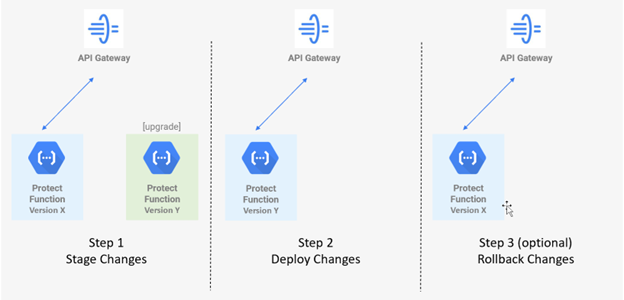
Steps in the upgrade process have the following purpose:
Protect Function Upgrade Prerequisites
Follow the steps below to prepare for upgrade.
2nd Generation Protect Function Upgrade Prerequisites
To run Cloud Protect in Gen 2 Cloud Functions, a new instance of Cloud Protect must be created using the included terraform installation scripts. Upgrading a Gen 1 Cloud Function to Gen 2 is not currently supported for Cloud Protect.
Stage Protect Function Changes The first step in upgrading Cloud Protect Function is staging the new changes in a separate Cloud Function (Upgrade Protect Function). This is done automatically with Terraform script. Follow the instructions below to update and run Terraform and then test production workloads against Upgrade Protect Function to ensure no unexpected behavior when changes are deployed to production Protect Function.
Deploy Protect Function Changes
After the upgrade is tested, it can be deployed to production Protect Cloud Function. Follow the instructions below to run terraform and deploy the upgrade.
Rollback Protect Function Changes
Follow the instructions below to rollback upgrade changes deployed in previous section.
Reset Agent environment variable for protect function resource name
Follow the steps below to prepare for upgrade.
Identify current Protegrity Protect Function Terraform module directory.
Record release-version Terraform variable from pty-protect-gcp/variables.tf file.
Current Protect Function Release Version: ___________________
Record all Terraform variables from the main.tf file.
Navigate to directory where new version of Protegrity installation bundle was downloaded.
Unzip the main package. Then unzip protegrity-gcp-{protector}-{version}.zip. Verify that the following files are present:
Open pty-protect-gcp/variables.tf file and check release-version variable. Compare it with the Current Protect Function Release Version recorded in the previous step. If the two versions are the same, Protect Function upgrade can be skipped. If not, continue with the next steps.
Ensure that the Agent Cloud Function is running and ESA server is available for the policy synchronization. The Agent Function and ESA with production policy are required in the upgrade process.
To run Cloud Protect in Gen 2 Cloud Functions, a new instance of Cloud Protect must be created using the included terraform installation scripts. Upgrading a Gen 1 Cloud Function to Gen 2 is not currently supported for Cloud Protect.
Run the cloud command below to enable Google Storage Transfer API.
gcloud services enable storagetransfer.googleapis.com
Create Cloud Functions storage bucket below. Replace <gcp-project-number> and <region> placeholders.
gcf-v2-sources-<gcp-project-number>-<region>
Use the following gcloud command to obtain project number
gcloud projects describe <gcp-project-id> --format='value(projectNumber)'
If transitioning from Google Cloud Functions Gen1 to Gen 2, accessing services will require the permissions of Cloud Run Invoker. See Cloud Functions Authentication Reference GCP
The following encoding formats are supported in the REST API.
For every encoding, the resultant protected data is returned in the same encoding. For example, if request is hex-encoded, the response is also hex-encoded.
For more information about the encoding formats, refer to the Protection Methods Reference.
Encoding | Supported by data elements | Notes |
|---|---|---|
utf8 | All except binary data elements. | Default encoding if encoding is not specified. |
hex | All | Default encoding for binary data elements. |
base64 | All |
|
base64_mime | All |
|
base64_pem | All |
|
base64_url | All |
|
Performs a policy operation such as protect, unprotect, or reprotect.
Method
POST
Parameters
dataelementname: (protect/unprotect) Data element to use for the policy operation.
externaliv: (protect/unprotect) Optional, external initialization vector.
newdataelementname: (reprotect) Data element to use for the output.
newexternaliv: (reprotect) Optional, external initialization vector for the output.
olddataelementname: (reprotect) Data element to use for the input.
oldexternaliv: (reprotect) Optional, external initialization vector for the input.
policyusername: User performing the operation.
bulk.id: Optional, identifier for the request.
bulk.data[].content: Input data to the policy operation.
Result
Returns the output of the policy operation.
{
"protect": {
"policyusername": "user1",
"dataelementname": "Alphanum",
"bulk": {
"id": "1",
"data": [
{
"content": <Data encoded in base64>
}
]
}
}
}
{
"protect": {
"policyusername": "user1",
"dataelementname": "Alphanum",
"externaliv": "abc123",
"bulk": {
"id": "1",
"data": [
{
"content": <Data encoded in base64>
}
]
}
}
}
{
"unprotect": {
"policyusername": "user1",
"dataelementname": "Alphanum",
"bulk": {
"id": "1",
"data": [
{
"content": <Data encoded in base64>
}
]
}
}
}
{
"reprotect": {
"policyusername": "user1",
"newdataelementname": "deName",
"olddataelementname": "Alphanum",
"bulk": {
"id": "1",
"data": [
{
"content": <Data encoded in base64>
}
]
}
}
}
Example:
{"protect":{"bulk":{"returntype":"success","data":[{"returntype":"success","message":"Data
protection was successful.","content":"RGZBUFR4ODAzejFwNjQ5TWg0TEFpcFNqbA=="},{"returntype":"success",
"message":"Data protection was successful.","content":"aHNnVVB5QWFDYw=="}]}}}
AWS Lambda service limits maximum size of payload to 6 MB. Client applications of Protegrity Cloud API must ensure their payload size is within this limit. This applies to all types of requests described below.
Performs a policy operation such as protect, unprotect, or reprotect.
URI
/v1/protect or /v1/unprotect or /v1/reprotect
Method
POST
Parameters
data: Input data to the policy operation.
data_element: Data element to use for the policy operation.
encoding: Optional, encoding of the data. One of: base64, base64_mime, base64_pem, base64_url, hex, or utf8. Defaults to hex for binary data elements, otherwise defaults to utf8.
external_iv: Optional, external initialization vector.
old_data_element: (reprotect) Data element for unprotecting the input.
old_external_iv: (reprotect) Optional, external initialization vector for the input.
query_id: Optional, identifier for the request.
user: User performing the operation.
Result
Returns the output of the policy operation.
{
"encoding": "utf8",
"query_id": "1",
"user": "user1",
"data_element": "Alphanum",
"data":[<data1>,<data2>]
}
{
"encoding": "utf8",
"query_id": "1",
"user": "user1",
"data_element": "Alphanum",
"external_iv": "abc123",
"data":[<data1>,<data2>]
}
{
"encoding": "utf8",
"query_id": "1",
"user": "user1",
"data_element": "deName",
"old_data_element": "Alphanum",
"data":[<data1>,<data2>]
}
Performs policy operations using different data elements for each data set.
URI
/v1/protect or /v1/unprotect or /v1/reprotect
Method
POST
Parameters
encoding: Optional, encoding of the data. One of: base64, base64_mime, base64_pem, base64_url, hex, or utf8. Defaults to hex for binary data elements, otherwise defaults to utf8.
query_id: Optional, prefix for the request identifier.
user: User performing the operation.
arguments[].data: Input data to the policy operation.
arguments[].data_element: Data element to use for the policy operation.
arguments[].external_iv: Optional, external initialization vector.
arguments[].id: Optional, request identifier.
arguments[].old_data_element: (reprotect) Data element for unprotecting the input.
arguments[].old_external_iv: (reprotect) Optional, external initialization vector for the input.
{
"encoding": "utf8",
"query_id": "query1234",
"user": <policy_user>,
"arguments": [
{
"id": "1",
"external_iv": "<external iv>",
"data_element": "<data element name>",
"data":["<data1>","<data2>"]
},
{
"data_element": <data element name>,
"data":["<data1>","<data2>"]
}
]
}
External IV
The External IV feature provides an additional level of security by allowing different tokenized results across protectors for the same input data and token element, depending on the External IV set on each protector. External IVs must adhere to certain guardrails and not all data elements support External IV. To read more about the Tokenization model with External IV, refer to the External Initialization Vector (IV) chapter in the Protection Methods Reference.
responsePayloadV1:
type: object
properties:
success:
type: bool
error_msg:
type: string
description: When success is false, error_msg is included
results:
type: array
items:
type: string
Example success:
{
"encoding": "utf8",
"results":["str1","str2"],
"success": true
}
If the request was successful, the success flag will always be true.
Example failure:
{
"error_msg": "token expired",
"success": false
}
If the request fails, the success flag will always be false.
Multi Data Elements Support Payload
responsePayloadV2:
type: object
properties:
success:
type: boolean
results:
type: array
items:
type: object
properties:
success:
type: bool
error_msg:
type: string
description: When success is false, error_msg is included
id:
type: string
description: When id is sent in the request payload, id is included in the response
results:
type: array
items:
type: string
Example success:
{
"encoding": "utf8",
"results":[
{
"encoding": "utf8",
"results":["str1","str2"],
"success": true
},
{
"encoding": "utf8",
"results":["str1","str2"],
"success": true
}
],
"success": true
}
If the all the subrequests were successful, the success flag will be true.
Example failure:
{
"results": [
{
"error_msg":
"Protect failed. Data element not found. Refer to audit log for details",
"success": false
},
{
"encoding": "utf8",
"results":["str1","str2"],
"success": true
}
],
"success": false
}
It is possible to have a mix of successful and unsuccessful results. In this case, the global success flag will be false.
ESA server is required as the recipient of audit logs. Verify the information below to ensure ESA is accessible and configured properly.
ESA server running and accessible on TCP port 9200 (Audit Store) or 24284 (td-agent).
Audit Store service is configured and running on ESA. Applies when audit logs are output to Audit Store directly or through td-agent. For information related to ESA Audit Store configuration, refer to Audit Store Guide.
(Optional) td-agent is configured for external input. For more information related to td-agent configuration, refer to ESA guide Sending logs to an external security information and event management (SIEM).
| Feature | ESA 10.2 | PPC (this guide) |
|---|---|---|
| Datastore Key Fingerprint | Optional/Recommended | Required |
| CA Certificate on Agent | Optional/Recommended | Optional/Recommended |
| CA Certificate on Log Forwarder | Optional/Recommended | Not supported |
| Client Certificate Authentication from Log Forwarder | Optional/Recommended | Not supported |
| IP Address | ESA IP address | PPC address |
PTY_ESA_CA_SERVER_CERT is not provided.This guide describes how to configure the Protegrity Policy Agent and Log Forwarder to connect to a Protegrity Provisioned Cluster (PPC), highlighting the differences from connecting to ESA.
Follow these instructions as a guide for understanding specific inputs for Policy Agent integrating with PPC:
Obtain the Datastore Key Fingerprint
To retrieve the fingerprint for your Policy Agent:
Retrieve public key from the Cloud Provider Key Management service for the policy encryption key created in pre-configuration:
Escape the new line characters in the downloaded public key for use in the next step - for example:
awk 'NF {printf "%s\\n",$0}' "<public_key_file>" > "new-line-escaped-public-key.pem"
cat new-line-escaped-public-key.pem
Export key fingerprint using the PPC API as indicated in the curl example below:
curl -k -H "Authorization: Bearer ${TOKEN}" -X POST https://${HOST}/pty/v2/pim/datastores/1/export/keys -H "Content-Type: application/json" --data '{
"algorithm": "RSA-OAEP-256",
"description": "example-key-from-key-management",
"pem": "<value of new-line-escaped-public-key>"
}'
Sample Output:
{"uid":"1","algorithm":"RSA-OAEP-256","fingerprint":"4c:46:d8:05:35:2e:eb:39:4d:39:8e:6f:28:c3:ab:d3:bc:9e:7a:cb:95:cb:b1:8e:b5:90:21:0f:d3:2c:0b:27","description":"example-key-from-kms"}
Record the value for fingerprint and configure the Policy Agent:
Set the environment variable PTY_DATASTORE_KEY in the Policy Agent Lambda function to the fingerprint value.
Set the environment variable PTY_DATASTORE_KEY in the Policy Agent Function App to the fingerprint value.
Set the variable in Policy Agent main.tf pty_datastore_key to the fingerprint value and apply the changes.
Retrieve the PPC CA Certificate
To obtain the CA certificate from PPC:
kubectl -n api-gateway get secret ingress-certificate-secret -o jsonpath='{.data.ca\.crt}' | base64 -d > CA.pem
Use the ProtegrityCA.pem that was returned as described in Policy Agent Installation.
Configure the PPC Address
Use the PPC address in place of the ESA IP address wherever required in your configuration.
curl, kubectl installed.The Protector and Log Forwarder functions require a security policy from a compatible ESA version.
The table below shows compatibility between different Protector and ESA versions.
| Protector Version | ESA Version | |||
|---|---|---|---|---|
| 8.x | 9.0 | 9.1 & 9.2 | 10.0 | |
| 2.x | No | Yes | * | No |
| 3.0.x & 3.1.x | No | No | Yes | No |
| 3.2.x | No | No | Yes | * |
| 4.0.x | No | No | No | Yes |
Legend | |
|---|---|
Yes | Protector was designed to work with this ESA version |
No | Protector will not work with this ESA version |
* | Backward compatible policy download supported:
|
The following table describes optional and required security operation parameters.
Parameter | Type | Example | Description |
|---|---|---|---|
op_type | String | “op_type”:“UNPROTECT” “op_type”:“PROTECT” | Required operation name, can be either UNPROTECT or PROTECT |
data_element | String | “data_element”:“TOK_ALPHA” | Required data element name defined in Protegrity Security Policy |
external_iv | String | “external_iv”:“abc-123” | Optional external intialization vector, which allows for different tokenized results for the same input data and data element of the same security policy. Refer to the External Initialization Vector (IV) in the Protection Methods Reference for more details. |
External Function Sample Definition with External IV: | |||
| |||