This is the multi-page printable view of this section. Click here to print.
Installation
1 - Pre-Configuration
Determine AWS Region
Query the AWS region where the Snowflake cluster is running. This is the region in which Protegrity Serverless must be installed.
To determine AWS region:
Login to Snowflake
In the SQL console, run the following query.
select current_region();Record the AWS region (e.g. us-east-1).
AWS Region: ___________________
Provide AWS sub-account
Identify or create an AWS account where the Protegrity solution will be installed. It is recommended that a new AWS sub-account be created. This can provide greater security controls and help avoid conflicts with other applications that might impact regional account limits. An individual with the Cloud Administrator role will be required for some subsequent installation steps.
AWS Account ID: ___________________
AWS Region (AwsRegion): ___________________
Create S3 bucket for Installing Artifacts
This S3 bucket will be used for the artifacts required by the CloudFormation installation steps. This S3 bucket must be created in the region that is defined in Provide AWS sub-account
Sign in to the AWS Management Console and open the Amazon S3 console.
Change region to the one determined in Provide AWS sub-account
Click Create Bucket.
Enter a unique bucket name:
For example, protegrity-install.us-west-2.example.com
Upload the installation artifacts to this bucket. Protegrity will provide the following three artifacts:
- protegrity-protect-<version>.zip
- protegrity-agent-<version>.zip
- protegrity-external-extension-<version>.zip
- protegrity-sample-policy-<version>.zip
Important
The deployment package you receive from Protegrity must be extracted to reveal the Protegrity artifacts. CloudFormation requires them in the provided .zip format. Do not extract the individual Protegrity artifacts. Upload these artifacts to the S3 bucket created.
S3 Bucket name (ArtifactS3Bucket): ___________________
Create KMS Key
The Amazon Key Management Service (KMS) provides the ability for the Protegrity Serverless solution to encrypt and decrypt the Protegrity Security Policy.
Note
It is recommended to host the KMS key in a separate AWS sub-account. This allows dual control, separating the responsibility between the key administrator and the Protegrity Serverless account administrator.To create KMS key:
In the AWS sub-account where the KMS key will reside, select the region.
Navigate to Key Management Service > Create Key.
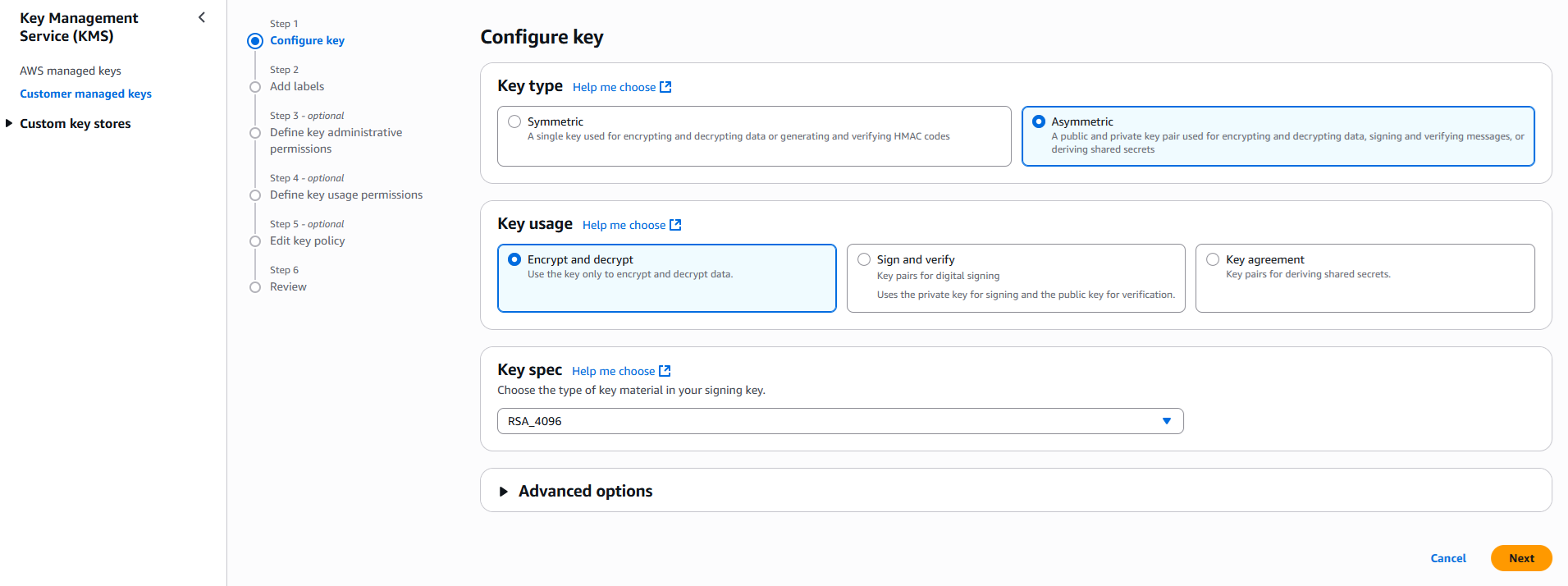
Configure the key settings:
- Key type: Asymmetric
- Key usage: Encrypt and decrypt
- Key spec: RSA_4096
- Click Next
Create alias and optional description, such as, Protegrity-Serverless and click Next.
Define key administrative permissions, the IAM user who will administrate the key.
Note
It is recommended the administrator be different than the administrator of the Protegrity Serverless accountClick Next.
Define the key usage permissions.
In Other AWS accounts, enter the AWS account id used for the Protegrity Serverless installation.
Continue on to create the key. If there is a concern this permission is overly broad, then you can return later to restrict access to the role of two Protegrity Serverless Lambda as principals. Click to open the key in the list and record the ARN.
KMS Key ARN (AWS_KMS_KEY_ID): ___________________
Download the public key from the KMS key. Navigate to the key in KMS console, select the Public key tab, and click Download. Save the PEM file. This public key will be added to the ESA data store as an export key. Refer to Exporting Keys to Datastore for instructions on adding the public key to the data store.
Note
This step is not applicable for ESA versions lower than 10.2.KMS Public Key PEM file: ___________________
Create IAM Account Role
An IAM role is used to authorize Snowflake to access the future Protect Lambda resource.
To create IAM account role:
From the AWS console, login to the AWS sub-account where Protegrity will be hosted.
Access IAM, select roles and then Create Role.
Select AWS account from the list of trusted entities types.
Select your AWS Account Id as a placeholder value. You will update this field later when configuring Snowflake access.
Select Require external ID and enter the following placeholder value.
REPLACE_ME_WITH_EXTERNAL_ID
Click Next.
Continue and click Next
Enter a Role name, for example, Snowflake.
After the role is created, click on the role. Record the following information:
- Role Name (DBRoleName): ____________________
- Role ARN: ____________________
2 - Prerequisites
AWS Services
The following table describes the AWS services that may be a part of your Protegrity installation.
Service | Description |
|---|---|
Lambda | Provides serverless compute for Protegrity protection operations and the ESA integration to fetch policy updates or deliver audit logs. |
API Gateway | Provides the endpoint and access control. |
KMS | Provides secrets for envelope policy encryption/decryption for Protegrity. |
Secrets Manager | Provides secrets management for the ESA credentials . |
S3 | Intermediate storage location for the encrypted ESA policy layer. |
Kinesis | Required if Log Forwarder is to be deployed. Amazon Kinesis is used to batch audit logs sent from protector function to ESA. |
VPC & NAT Gateway | Optional. Provides a private subnet to communicate with an on-prem ESA. |
CloudWatch | Application and audit logs, performance monitoring, and alerts. Scheduling for the policy agent. |
ESA Version Requirements
The Protector and Log Forwarder functions require a security policy from a compatible ESA version.
The table below shows compatibility between different Protector and ESA versions.
Note
For the latest up-to-date information refer to: Protegrity Compatibility Matrix| Protector Version | ESA Version | |||
|---|---|---|---|---|
| 8.x | 9.0 | 9.1 & 9.2 | 10.0 | |
| 2.x | No | Yes | * | No |
| 3.0.x & 3.1.x | No | No | Yes | No |
| 3.2.x | No | No | Yes | * |
| 4.0.x | No | No | No | Yes |
Legend | |
|---|---|
Yes | Protector was designed to work with this ESA version |
No | Protector will not work with this ESA version |
* | Backward compatible policy download supported:
|
Prerequisites
Requirement | Detail |
|---|---|
Protegrity distribution and installation scripts | These artifacts are provided by Protegrity |
Protegrity ESA 10.0+ | The Cloud VPC must be able to obtain network access to the ESA |
| AWS Account | Recommend creating a new sub-account for Protegrity Serverless |
| Snowflake cluster (Enterprise Edition) |
Required Skills and Abilities
Role / Skillset | Description |
|---|---|
AWS Account Administrator | To run CloudFormation (or perform steps manually), create/configure a VPC and IAM permissions. |
Protegrity Administrator | The ESA credentials required to extract the policy for the Policy Agent |
| Network Administrator | To open firewall to access ESA and evaluate AWS network setup |
| Snowflake Administrator | Account Admin access required to setup access |
3 - Protect Service Installation
Preparation
Ensure that all the steps in Pre-Configuration are performed.
Login to the AWS account console where - Snowflake Protector on AWS will be installed.
Ensure that the required CloudFormation templates provided by Protegrity are available on your local computer.
Create Protect Lambda IAM Execution Policy
This task defines a policy used by the Protegrity Lambda function to write CloudWatch logs and access the KMS encryption key to decrypt the policy.
Perform the following steps to create the Lambda execution role and required policies:
From the AWS IAM console, select Policies > Create Policy.
Select the JSON tab and copy the following sample policy.
{
  "Version": "2012-10-17",
  "Statement": [
    {
      "Sid": "CloudWatchWriteLogs",
      "Effect": "Allow",
      "Action": [
        "logs:CreateLogGroup",
        "logs:CreateLogStream",
        "logs:PutLogEvents"
      ],
      "Resource": "*"
    },
    {
      "Sid": "KmsDecrypt",
      "Effect": "Allow",
      "Action": [
        "kms:Decrypt"
      ],
      "Resource": [
        "arn:aws:kms:*:*:key/*"
      ]
    }
  ]
}
For the KMS policy, replace the Resource with the ARN for the KMS key created in a previous step.
Select Next, type in a policy name, for example, ProtegrityProtectLambdaPolicy and Create Policy. Record the policy name:
ProtectLambdaPolicyName:__________________
Create Protect Lambda IAM Role
The following steps create the role to utilize the policy defined in Create Protect Lambda IAM Execution Policy.
To create protect lambda IAM execution role:
From the AWS IAM console, select Roles > Create Role.
Select AWS Service > Lambda > Next.
In the list, search and select the policy created in Create Protect Lambda IAM Execution Policy.
Click Next
Type the role name, for example, ProtegrityProtectRole
Click Create role
Record the role ARN.
Role ARN (LambdaExecutionRoleArn): ___________________
Installing through CloudFormation
The following steps describe the deployment of the Lambda function.
To install through CloudFormation:
Access CloudFormation and select the target AWS Region.
Click Create Stack and choose With new resources.
Specify the template.
Select Upload a template file.
Upload the Protegrity-provided CloudFormation template called pty_protect_cf.json and click Next.
Specify the stack details. Enter a stack name.
Note
The stack name will be appended to all the services created by the template.Enter the required parameters. All the values were generated in Pre-Configuration.
Parameter Description DBRoleName Name of the account role created in the pre-configuration step ArtifactS3Bucket Name of S3 bucket created in the pre-configuration step LambdaExecutionRoleArn The ARN of Lambda role created in the prior step MinLogLevel Minimum log level for protect function. Allowed Values: off, severe, warning, info, config, all The log forwarder parameters can be provided later after log forwarder is deployed. If you are not planning to deploy log forwarder you can skip this step.
Parameter Description KinesisLogStreamArn The ARN of the AWS Kinesis stream where audit logs will be sent for aggregation AuditLogFlushInterval Time interval in seconds used to accumulate audit logs before sending to Kinesis. Default value: 30. See Log Forwarder Performance section for more details. Click Next with defaults to complete CloudFormation.
After CloudFormation is completed, select the Outputs tab in the stack.
Record the following values:
- ApiGatewayId: ________________________________
- ProtectFunctionName: __________________________
- ProtectFunctionProductionAlias: __________________________
- ProtectLayerName: _____________________________
- SnowflakeApiAllowedPrefixes: ____________________
- SnowflakeApiAwsRoleARN: _______________________
Snowflake Configuration
The following sections will configure Snowflake to access the API Gateway. The CloudFormation installation installed a sample policy that can be used to smoke test the installation.
Login to Snowflake as ACCOUNTADMIN
Ensure that the current user can assume the Account Administrator role. This role must be created.
Create the Snowflake API Integration Object
From the Snowflake console worksheet, select the role ACCOUNTADMIN.
Paste the following text and replace the two parameters <SnowflakeApiAwsRoleARN> and <SnowflakeApiAllowedPrefixes> with values recorded in the last installation step of Installing through CloudFormation, then run the following Data Definition Language (DDL) in the console to create API integration object:
create or replace api integration protegrity_api
api_provider = aws_api_gateway api_aws_role_arn = '<SnowflakeApiAwsRoleARN>'
enabled = true
api_allowed_prefixes = ('<SnowflakeApiAllowedPrefixes>');
Note
The name of the object protegrity_api can be replaced with a name of your choice, however the name you choose must be used consistently throughout the installation steps below.Describe the API Integration Object
We require values generated by the Snowflake integration object to complete configuring the API Gateway resource policy.
To describe API integration objects:
Run the following query in the console.
DESCRIBE API INTEGRATION protegrity_api;Record the following output values from the resulting query:
- API_AWS_IAM_USER_ARN: ___________________
- API_AWS_EXTERNAL_ID: ___________________
Update IAM Access Role Policy
This step allows the Snowflake IAM account to assume the role required to invoke the API Gateway resource.
To update API Integration Objects:
Return to theAWS Console > IAM > Roles and find the IAM role created earlier. For example, Snowflake.
Navigate to Trust Relationships > Edit trust policy.
Modify the Policy Document replacing the placeholder values indicated in the following snippet as API_AWS_IAM_USER_ARN and API_AWS_EXTERNAL_ID with the values recorded from the Snowflake integration object in Describe the API Integration Object.
{
  "Version": "2012-10-17",
  "Statement": [
    {
      "Effect": "Allow",
      "Principal": {
        "AWS": "<API_AWS_IAM_USER_ARN>"
      },
      "Action": "sts:AssumeRole",
      "Condition": {
        "StringEquals": {
          "sts:ExternalId": "<API_AWS_EXTERNAL_ID>"
        }
      }
    }
  ]
}
Test Connectivity
Perform the following steps to verify if Snowflake is working correctly with the Protegrity product.
Access the Snowflake SQL console.
Copy and paste the following snippet into a worksheet.
CREATE OR REPLACE SECURE EXTERNAL FUNCTION PTY_UNPROTECT_SAMPLE_POLICY(VAL VARCHAR)
    RETURNS VARCHAR(16777216)
    IMMUTABLE
    API_INTEGRATION = PROTEGRITY_API
    HEADERS = (
      'X-Protegrity-HCoP-Rules'=
      '{"jsonpaths":[{"op_type":"unprotect","data_element":"alpha"}]}'
    )
    CONTEXT_HEADERS = (CURRENT_USER,CURRENT_TIMESTAMP,CURRENT_ACCOUNT)
    COMMENT='Unprotects text using an alpha token type.'
    AS '<SnowflakeApiAllowedPrefixes>';
Replace the placeholder value indicated substituting your API Gateway URL captured in the stack outputs (SnowflakeApiAllowedPrefixes).
Run the following protect in the console:
select pty_unprotect_sample_policy('UtfVk UHgcD!');Verify that the string hello world! is returned.
Troubleshooting
Error | Action | |||||||||||||||||||||||||||||||||||||||||||||||||||||||||||||||||||||||||||||||||||||||||||||||||||||||||||||||||||||||||||||||||||||||||||||||||||||||||||||||||||||||||||||||||||||||||||||||||||||||||||||||||||||||||||||||||||||||||||||||||||||||||||||||||||||||||||||||||||||||
|---|---|---|---|---|---|---|---|---|---|---|---|---|---|---|---|---|---|---|---|---|---|---|---|---|---|---|---|---|---|---|---|---|---|---|---|---|---|---|---|---|---|---|---|---|---|---|---|---|---|---|---|---|---|---|---|---|---|---|---|---|---|---|---|---|---|---|---|---|---|---|---|---|---|---|---|---|---|---|---|---|---|---|---|---|---|---|---|---|---|---|---|---|---|---|---|---|---|---|---|---|---|---|---|---|---|---|---|---|---|---|---|---|---|---|---|---|---|---|---|---|---|---|---|---|---|---|---|---|---|---|---|---|---|---|---|---|---|---|---|---|---|---|---|---|---|---|---|---|---|---|---|---|---|---|---|---|---|---|---|---|---|---|---|---|---|---|---|---|---|---|---|---|---|---|---|---|---|---|---|---|---|---|---|---|---|---|---|---|---|---|---|---|---|---|---|---|---|---|---|---|---|---|---|---|---|---|---|---|---|---|---|---|---|---|---|---|---|---|---|---|---|---|---|---|---|---|---|---|---|---|---|---|---|---|---|---|---|---|---|---|---|---|---|---|---|---|---|---|---|---|---|---|---|---|---|---|---|---|---|---|---|---|---|---|---|---|---|---|---|---|---|---|---|---|---|---|---|---|---|---|
Snowflake: 403 unauthorized |
| |||||||||||||||||||||||||||||||||||||||||||||||||||||||||||||||||||||||||||||||||||||||||||||||||||||||||||||||||||||||||||||||||||||||||||||||||||||||||||||||||||||||||||||||||||||||||||||||||||||||||||||||||||||||||||||||||||||||||||||||||||||||||||||||||||||||||||||||||||||||
Snowflake: 5xx error | Try running the Lambda directly. Open the Lambda function and create the following test case:``` { “body”: “{ "data":[ [0," ‘UtfVk UHgcD!’"] ] }”, “headers”: { “sf-context-current-user”: “test”, “sf-custom-x-protegrity-hcop-rules”: “{"jsonpaths":[{"op_type":"unprotect","data_element":"alpha"}]}”, “sf-external-function-current-query-id”: “test-id” } } 4 - Policy Agent InstallationInstall the policy agent. The following sections will install the Policy Agent. The Policy Agent polls the ESA and deploys the policy to Protegrity Serverless as a static resource. Some of the installation steps are not required for the operation of the software but recommended for establishing a secure environment. Contact Protegrity Professional Services for further guidance on configuration alternatives in the Cloud. ImportantIf you are deploying Policy Agent with Protegrity Provisioned Cluster (PPC), refer to the PPC Appendix: Policy Agent Certificate and Key Guidance for specific instructions on obtaining and using the CA certificate and datastore key fingerprint. The steps in this section are specific to ESA and may differ for PPC. Be sure to follow the PPC documentation for the most accurate and up-to-date setup guidance.ESA ServerPolicy Agent Lambda requires ESA server running and accessible on TCP port 443. Note down ESA IP address: ESA IP Address (EsaIpAddress): ___________________ Certificates on ESANoteIf you are deploying Policy Agent with Protegrity Provisioned Cluster (PPC), see PPC Appendix: Policy Agent Certificate Guidance for specific instructions on obtaining and using the CA certificate. The steps in this section are specific to ESA and may differ for PPC.Whether your ESA is configured with default self-signed certificate or your corporate CA certificate, Policy Agent can validate authenticity of ESA connection using CA certificate. The process for both scenarios is the same:
To obtain self-signed CA certificate from ESA:
For more information about ESA certificate management refer to Certificate Management Guide in ESA documentation. Identify or Create a new VPCEstablish a VPC where the Policy Agent will be hosted. This VPC will need connectivity to the ESA. The VPC should be in the same account and region established in Pre-Configuration. VPC name: ___________________ VPC Subnet ConfigurationIdentify or create a new subnet in the VPC where tha Lambda function will be connected to. It is recommended to use a private subnet. Subnet name: ___________________ NAT Gateway For ESA Hosted Outside AWS NetworkIf ESA server is hosted outside of the AWS Cloud network, the VPC configured for Lambda function must ensure additional network configuration is available to allow connectivity with ESA. For instance if ESA has a public IP, the Lambda function VPC must have public subnet with a NAT server to allow routing traffic outside of the AWS network. A Routing Table and Network ACL may need to be configured for outbound access to the ESA as well. VPC Endpoints ConfigurationIf an internal VPC was created, then add VPC Endpoints, which will be used by the Policy Agent to access AWS services. Policy Agent needs access to the following AWS services:
Identify or Create Security GroupsPolicy Agent and cloud-based ESA appliance use AWS security groups to control traffic that is allowed to leave and reach them. Policy Agent runs on schedule and is mostly concerned with allowing traffic out of itself to ESA and AWS services it depends on. ESA runs most of the time and it must allow Policy Agent to connect to it. Policy Agent security group must allow outbound traffic using rules described in the table below. To edit security group navigate: From VPC > Security Groups > Policy Agent Security Group configuration.
Record Policy Agent security group ID: Policy Agent Security Group Id: ___________________ Policy Agent will reach out to ESA on port 443. Create following inbound security group rule for cloud-based ESA appliance to allow connections from Policy Agent:
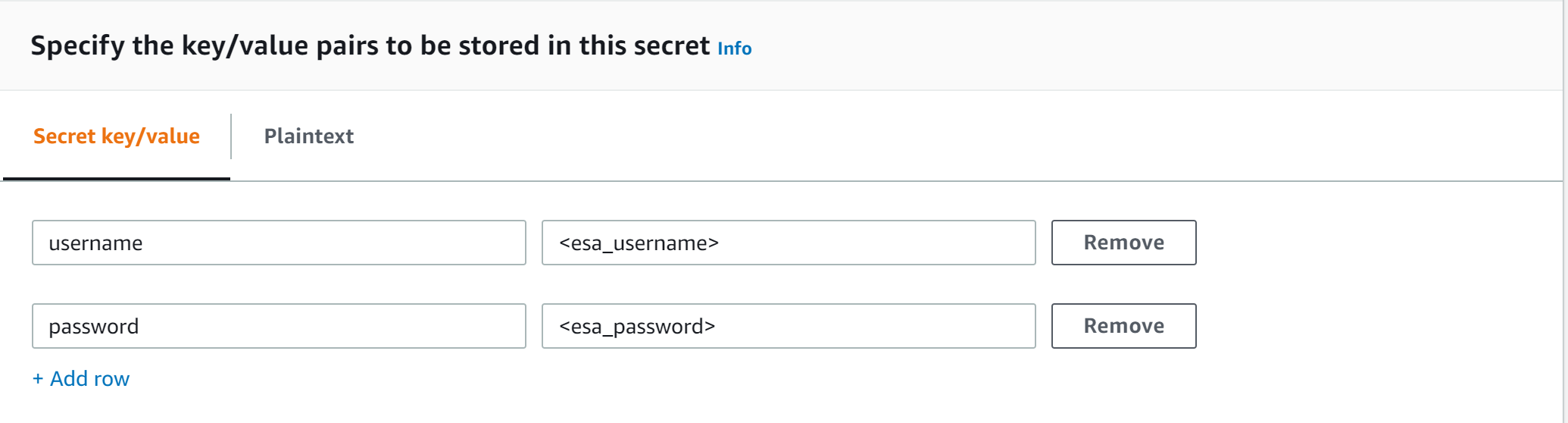
Creating ESA CredentialsPolicy Agent Lambda requires ESA credentials to be provided as one of the three options. NoteThe username and password of the ESA user requires role with Export Resilient Package and Can Create JWT Token permissions. Security Administrator is one of the predefined roles which contains the above permissions, however for separation of duties it is recommended to create custom role.Option 1: Secrets ManagerCreating secrets manager secret with ESA username and password.
Option 2: KMS Encrypted PasswordESA password is encrypted with AWS KMS symmetric key.
Option 3: Custom AWS Lambda functionWith this option ESA username and password are returned by a custom AWS Lambda function. This method may be used to get the username and password from external vaults.
Create Agent Lambda IAM PolicyFollow the steps below to create Lambda execution policies. Create Agent Lambda IAM policy
Create Agent Lambda IAM RolePerform the following steps to create Agent Lambda execution IAM role. To create agent Lambda IAM role:
Corporate Firewall ConfigurationIf an on-premise firewall is used, then the firewall must allow access from the NAT Gateway to an ESA. The firewall must allow access from the NAT Gateway IP to ESA via port 443 and 443. CloudFormation InstallationCreate the Policy Agent in the VPC using the CloudFormation script provided by Protegrity.
Policy Agent Lambda ConfigurationAfter the CloudFormation stack is deployed, the Policy Agent Lambda must be configured with parameters recorded in earlier steps. From your AWS Console, navigate to lambda and select the following Lambda. Protegrity_Agent<STACK_NAME>_ Select Configuration tab and scroll down to the Environment variables section. Select Editand replace all entries with the actual values.
Test InstallationOpen the Lambda and configure Test to execute the lambda and specify the default test event. Wait for around 20 seconds for the Lambda to complete. If policy is downloaded successfully, then a success message appears. Navigate to the AWS_POLICY_S3_BUCKET bucket and verify that the AWS_POLICY_S3_FILENAME file was created. Troubleshooting
Additional ConfigurationStrengthen the KMS IAM policy by granting access only to the required Lambda function(s). Finalize the IAM policy for the Lambda Execution Role. Ensure to replace wildcard * with the region, account, and resource name information where required. For example, Policy Agent ScheduleIf specified in CloudFormation Installation, the agent installation created a CloudWatch event rule, which checks for policy update on an hourly schedule. This schedule can be altered to the required frequency. Under CloudWatch > Events > Rules, find Protegrity_Agent_{stack_name}. Click Action > Edit Set the cron expression. A cron expression can easily be defined using CronMaker, a free online tool. Refer to http://www.cronmaker.com. 5 - Audit Log Forwarder InstallationInstall the audit log forwarder. The following sections show steps how to install Audit Log Forwarder component in the AWS Cloud. The Log Forwarder deployment allows for the audit logs generated by Protector to be delivered to ESA for auditing and governance purposes. Log Forwarder component is optional and is not required for the Protector Service to work properly. See Log Forwarding Architecture section in this document for more information. Some of the installation steps are not required for the operation of the software but recommended for establishing a secure environment. C ontact Protegrity for further guidance on configuration alternatives in the Cloud. NoteThe installation steps below assume that the Log Forwarder is going to be installed in the same AWS account as the corresponding Protect Lambda service. For instructions on how to install Log Forwarder in the AWS account separate than the Protect Lambda, please contact Protegrity.ESA Audit Store ConfigurationESA server is required as the recipient of audit logs. Verify the information below to ensure ESA is accessible and configured properly.
Certificates on ESANoteThis section is optional. If CA certificate is not provided, the Log Forwarder will skip server certificate validation and will connect to ESA without verifying that it is a trusted server. If you are deploying Log Forwarder with Protegrity Provisioned Cluster (PPC), certificate authorization and CA validation are not supported. Configuration steps related to certificates in this section do not apply to PPC. See Integrating Cloud Protect with PPC (Protegrity Provisioned Cluster): Log Forwarder Setup with PPC for details. By default, ESA is configured with self-signed certificates, which can optionally be validated using a self-signed CA certificate supplied in the Log Forwarder configuration. If no CA certificate is provided, the Log Forwarder will skip server certificate validation. NoteCertificate Validation can be bypassed for testing purposes, see section: Install through CloudFormationIf ESA is configured with publicly signed certificates, this section can be skipped since the forwarder Lambda will use the public CA to validate ESA certificates. To obtain the self-signed CA certificate from ESA:
For more information about ESA certificate management refer to Certificate Management Guide in ESA documentation. AWS VPC ConfigurationLog forwarder Lambda function requires network connectivity to ESA, similar to Policy Agent Lambda function. Therefore, it can be hosted in the same VPC as Policy Agent. Separate VPC can be used, as long as it provides network connectivity to ESA. NoteAWS Lambda service uses permissions in log forwarder function execution role to create and manage network interfaces. Lambda creates a Hyperplane ENI and reuses it for other VPC-enabled functions in your account that use the same subnet and security group combination. Each Hyperplane ENI can handle thousands of connections/ports as the Lambda function scales up. If more connections are needed AWS Lambda service creates additional Hyperplane ENIs. There’s no additional charge for using a VPC or a Hyperplane ENI. Refer to AWS official Lambda Hyperplane ENIs docs for more information.VPC Name: ___________________ VPC Subnet ConfigurationLog Forwarder can be connected to the same subnet as Policy Agent or separate one as long as it provides connectivity to ESA. Subnet Name: ___________________ NAT Gateway For ESA Hosted Outside AWS NetworkIf ESA server is hosted outside of the AWS Cloud network, the VPC configured for Lambda function must ensure additional network configuration is available to allow connectivity with ESA. For instance if ESA has a public IP, the Lambda function VPC must have public subnet with a NAT server to allow routing traffic outside of the AWS network. A Routing Table and Network ACL may need to be configured for outbound access to the ESA as well. VPC Endpoint ConfigurationLog Forwarder Lambda function requires connectivity to Secrets Manager AWS service. If the VPC identified in the steps before has no connectivity to public internet through the NAT Gateway, then the following service endpoint must be configured:
Security Group ConfigurationSecurity groups restrict communication between Log Forwarder Lambda function and the ESA appliance. The following rules must be in place for ESA and Log Forwarder Lambda function. From VPC > Security Groups > Log Forwarder Security Group configuration.
Record the name of Log Forwarder security group name. Log Forwarder Security Group Id: ___________________ The following port must be open for the ESA. If the ESA is running in the Cloud, then create the following security. NoteIf an on-premise firewall is used, then the firewall must allow access from the NAT Gateway to an ESA. The firewall must allow access the NAT Gateway IP access to ESA via port 9200.ESA Security Group configuration
Configure ESA Audit Store CredentialsNoteThis section is optional. If client certificate authentication is not set up, the Log Forwarder will connect to ESA without authentication credentials.Audit Log Forwarder can optionally authenticate with ESA using certificate-based authentication with a client certificate and certificate key. If used, both the certificate and certificate key will be stored in AWS Secrets Manager. Download the following certificates from the /etc/ksa/certificates/plug directory of the ESA:
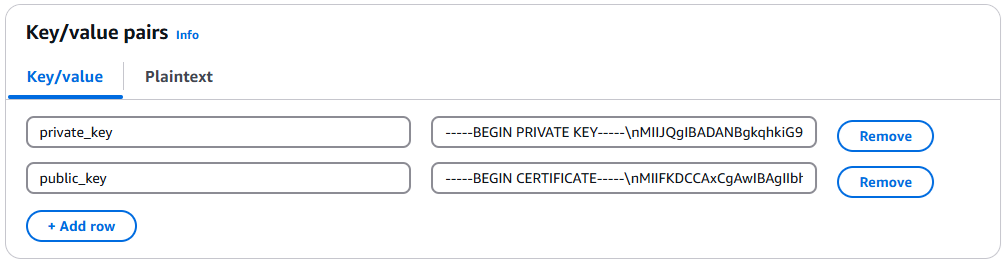
After certificates are downloaded, open each PEM file in text editor and replace all new lines with escaped new line: \n. To escape new lines from command line, use one of the commands below depending on your operating system. Linux Bash: Windows PowerShell: For more information on how to configure client certificate authentication for Audit Store on ESA refer to Audit Store Guide. To create secret with ESA client certificate/key pair in AWS Secrets Manager.
NoteIf you are deploying Log Forwarder with PPC, do not configure client certificate authentication. See PPC Appendix: Log Forwarder Certificate Guidance for details.Create Audit Log Forwarder IAM Execution PolicyThis task defines a policy used by the Protegrity Log Forwarder Lambda function to write CloudWatch logs, access the KMS encryption key to decrypt the policy and access Secrets Manager for log forwarder user credentials. Perform the following steps to create the Lambda execution role and required policies:
Create Log Forwarder IAM RolePerform the following steps to create Log Forwarder execution IAM role. To create Log Forwarder IAM role:
Installation ArtifactsAudit Log Forwarder installation artifacts are part of the same deployment package as the one used for protect and policy agent services. Follow the steps below to ensure the right artifacts are available for log forwarder installation.
Install through CloudFormationThe following steps describe the deployment of the Audit Log Forwarder AWS cloud components.
Add Kinesis Put Record permission to the Protect Function IAM Role
Test Log Forwarder InstallationTesting in this section validates the connectivity between Log Forwarder and ESA. The sample policy included with the initial installation and test event below are not based on your ESA policy. Any logs forwarded to ESA which are not signed with a policy generated by your ESA will not be added to the audit store. Install Log Forwarder and configure according to previous sections. Log Forwarder configuration MinLogLevel must be at least info level.
Update Protector With Kinesis Log StreamIn this section, Kinesis log stream ARN will be provided to the Protect Function installation. NoteIf the Protector has not been installed, you may provide the KinesisLogStreamArn during protector installation and skip the remainder of this section.
Update Policy Agent With Log Forwarder Function TargetLog Forwarder Lambda function requires a policy layer which is in sync with the Protegrity Protector. This section will describe the steps to update the policy agent to include updating Log Forwarder Lambda function. NoteIf the policy agent has not been installed, follow the steps in Policy Agent Installation. Set AWS_PROTECT_FN_NAME to include both protector and log forwarder lambda functions.
Test Full Log Forwarder InstallationInstall and configure Protegrity Agent, Protector, and Log Forwarder components.
Troubleshooting
6 -Prerequisites
7 -Required Skills and Abilities
8 -AWS ServicesThe following table describes the AWS services that may be a part of your Protegrity installation.
|